
Frozen Potatoes Market Size and Share
Market Overview
| Study Period | 2022 - 2032 |
|---|---|
| Market Size (2027) | USD 74.22 Billion |
| Market Size (2032) | USD 93.65 Billion |
| Growth Rate (2027 - 2032) | 4.76 % |
| Fastest Growing Market | Asia-Pacific |
| Largest Market | North America |
| Market Concentration | Medium |
Major Players *Disclaimer: Major Players sorted in no particular order Image © Mordor Intelligence. Reuse requires attribution under CC BY 4.0. | |
Frozen Potatoes Market Analysis by Mordor Intelligence
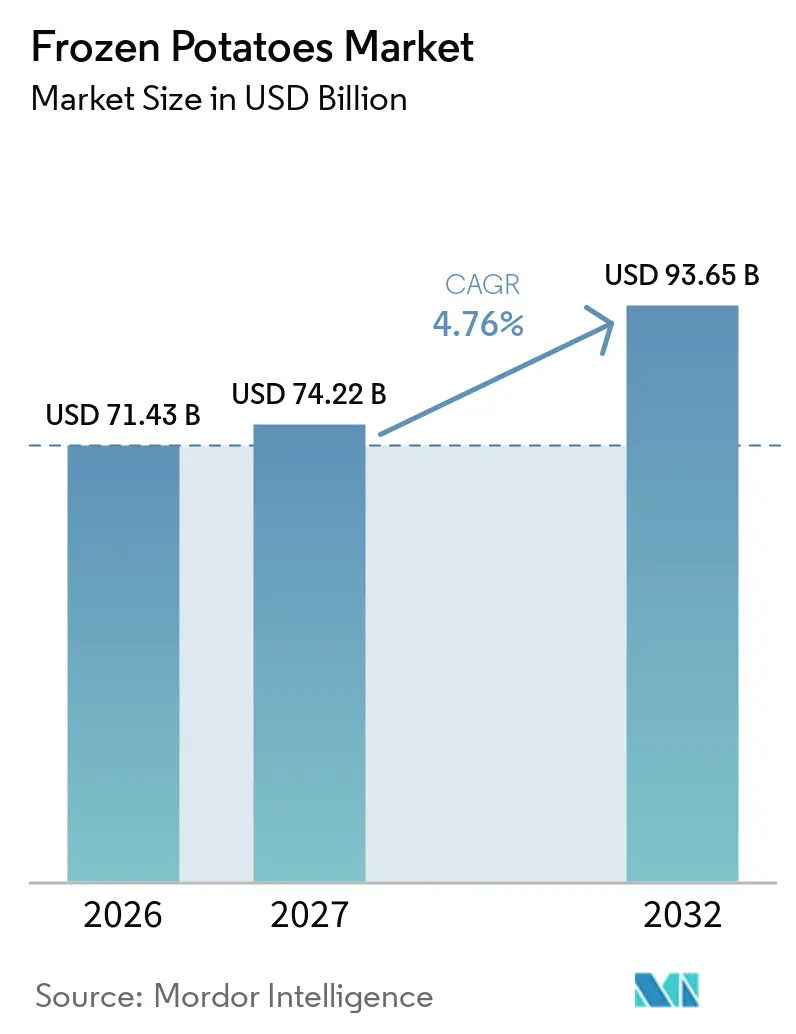
The Frozen Potatoes Market was valued at USD 71.43 billion in 2026 and is estimated to grow from USD 74.22 billion in 2027 to reach USD 93.65 billion by 2032, at a CAGR of 4.76% during the forecast period (2027–2032). The market is experiencing steady growth, supported by increasing demand for convenient food products, changing meal preparation habits, and the need for consistent quality and year-round availability. Frozen potato products offer longer shelf life, simplified storage, reduced preparation time, and reliable taste and texture, making them an attractive option for consumers and commercial buyers. Improvements in freezing, processing, and packaging technologies are helping preserve product quality while supporting operational efficiency and reducing post-harvest losses. The growing emphasis on convenience, portion consistency, and ease of preparation is driving broader adoption of frozen potato products.
Key Report Takeaways
- By product type, French fries held 46.54% of the frozen potato products market share in 2026, while hash browns are forecast to grow at a CAGR of 5.63% through 2032.
- By processing method, par-fried products accounted for 63.45% of the frozen potato products market share in 2026, while non-fried products are projected to expand at a CAGR of 5.78% through 2032.
- By distribution channel, foodservice, including HoReCa, captured 64.54% of the frozen potato products market share in 2026, while retail is expected to record the highest CAGR of 6.88% through 2032.
- By geography, North America accounted for 36.29% of the frozen potato products market share in 2026, while Asia-Pacific is projected to grow at a CAGR of 6.49% through 2032.
Note: Market numbers in this report are based on Mordor Intelligence's proprietary estimation framework, which combines nine months of actuals with Q4 projections for base year 2026.
Global Frozen Potatoes Market Trends and Insights
Drivers Impact Analysis*
| Driver | (~) % Impact on CAGR Forecast | Geographic Relevance | Impact Timeline |
|---|---|---|---|
| Demand for convenient, ready-to-cook potato products | +1.4% | Global | Short term (≤ 2 years) |
| Growing preference for restaurant-style meals at home | +0.8% | North America and Europe, spill-over to Asia-Pacific | Short term (≤ 2 years) |
| Increasing popularity of Western-style and global cuisines | +0.7% | Asia-Pacific core, spill-over to Middle-East and Africa | Medium term (2–4 years) |
| Increasing adoption of air fryers and alternative cooking methods | +0.8% | North America and Europe, rising across Asia-Pacific | Short term (≤ 2 years) |
| Development of healthier frozen potato alternatives | +0.5% | North America and Europe | Medium term (2–4 years) |
| Advancements in freezing and pre-frying technologies | +0.4% | Global, led by Europe processors | Long term (≥ 4 years) |
| Source: Mordor Intelligence | |||
Demand for Convenient, Ready-to-Cook Potato Products
Consumer preference for quick meal preparation with minimal effort is driving demand for convenient, ready-to-cook potato products. Frozen potato products, including fries, wedges, and hash browns, come in pre-prepared formats that reduce peeling, cutting, and preparation time while offering consistent portions and flexible cooking options. Their suitability for household meals, snacks, and foodservice applications supports demand among consumers and commercial operators seeking convenient food solutions. For instance, according to the Government of the United Kingdom, potato production for human consumption reached 4.52 million tons in 2025, highlighting the substantial availability of potatoes for food use and providing broader supply-side context for the potato products market[1]. This production figure covers potatoes for human consumption overall and does not specifically measure frozen potato demand.
Growing Preference for Restaurant-Style Meals at Home
The growing preference for restaurant-style meals at home is supporting the frozen potatoes market, as consumers increasingly seek dining experiences that combine restaurant-quality results with the convenience of home preparation. Changing meal habits and greater interest in recreating popular dining experiences are encouraging consumers to choose foods that deliver consistent taste, texture, and presentation without requiring advanced culinary skills. Frozen potato products benefit from their standardized preparation requirements and reliable cooking outcomes, helping households achieve predictable results with less effort. This trend is further supported by the desire to control meal portions, customize seasonings, and enjoy restaurant-inspired meals in a more flexible home setting. As consumers continue to balance convenience with the appeal of home dining experiences, frozen potato products are becoming an accessible option for everyday meals and informal social occasions.
Increasing Popularity of Western-Style and Global Cuisines
The growing popularity of Western-style and global cuisines is expanding the use of frozen potato products as international food preferences become more integrated into everyday eating habits. Exposure to global culinary trends through travel, digital media, and changing dining preferences is encouraging consumers to explore food formats associated with different regional cuisines. The incorporation of internationally inspired dishes into local menus is creating opportunities for frozen potato products to serve as adaptable accompaniments across a wide range of meal occasions. Their standardized preparation and consistent quality make them suitable for food businesses seeking to maintain uniform serving experiences while offering globally influenced menu options. This growing acceptance of international food styles is broadening the relevance of potato-based dishes across markets and supporting sustained demand for frozen potato products.
Increasing Adoption of Air Fryers and Alternative Cooking Methods
The increasing adoption of air fryers and alternative cooking methods is supporting demand for frozen potato products by offering consumers convenient ways to prepare food with greater control over oil usage, cooking time, and texture. These cooking methods allow consumers to prepare frozen products with less hands-on effort while achieving consistent results, making them suitable for everyday meals and at-home snacking. Compatibility with different household cooking appliances also broadens preparation flexibility and reduces reliance on traditional deep-frying. For instance, according to the National Frozen & Refrigerated Foods Association (NFRA) in 2025, air fryers were present in 71% of United States homes[2]. This widespread adoption supports the availability of cooking equipment suitable for preparing frozen foods and reinforces the potential for continued demand for convenient frozen potato products.
Restraints Impact Analysis*
| Restraint | (~) % Impact on CAGR Forecast | Geographic Relevance | Impact Timeline |
|---|---|---|---|
| Dependence on uninterrupted cold-chain infrastructure | -0.7% | Asia-Pacific core, Middle-East and Africa, South America | Medium term (2–4 years) |
| Fluctuations in potato quality and agricultural yields | -0.5% | Global, acute exposure in Europe and North America | Short term (≤ 2 years) |
| Regulatory requirements for food safety and labeling | -0.3% | North America and Europe | Medium term (2–4 years) |
| Risk of freezer burn and product quality deterioration | -0.2% | Global, more pronounced in emerging markets | Long term (≥ 4 years) |
| Source: Mordor Intelligence | |||
Dependence on Uninterrupted Cold-Chain Infrastructure
The frozen potatoes market is constrained by its dependence on uninterrupted cold-chain infrastructure across storage, transportation, and distribution. Maintaining consistently low temperatures is essential to preserve product quality, texture, moisture content, and food safety. Temperature fluctuations can cause partial thawing and refreezing, leading to ice crystal formation, texture deterioration, product clumping, and reduced consumer acceptance. These requirements increase operating costs through energy-intensive refrigeration, specialized storage facilities, insulated transportation, and continuous temperature monitoring. In markets with limited cold-storage capacity or unreliable electricity supply, maintaining appropriate frozen conditions is particularly challenging, restricting distribution reach and increasing the risk of product losses.
Fluctuations in Potato Quality and Agricultural Yields
Fluctuations in potato quality and agricultural yields restrain the frozen potatoes market by creating uncertainty in raw material availability, processing suitability, and procurement costs. Variations in weather conditions, water availability, soil quality, pest infestations, and crop diseases can affect potato yields, size distribution, dry matter content, and sugar concentrations. These characteristics are particularly important for frozen potato processing, as unsuitable raw materials can result in inconsistent color, texture, cooking performance, and finished-product quality. Seasonal supply variations can also complicate procurement planning, forcing processors to adjust sourcing strategies or absorb higher raw material costs when suitable potatoes become scarce. Inconsistent crop quality can increase sorting, rejection, and processing losses, reducing operational efficiency and making it difficult to maintain uniform product specifications.
*Our forecasts treat driver/restraint impacts as directional, not additive. The impact forecasts reflect baseline growth, mix effects, and variable interactions.
Segment Analysis
By Product Type: French Fries Anchor Volumes; Hash Browns Redefine Snacking and Breakfast
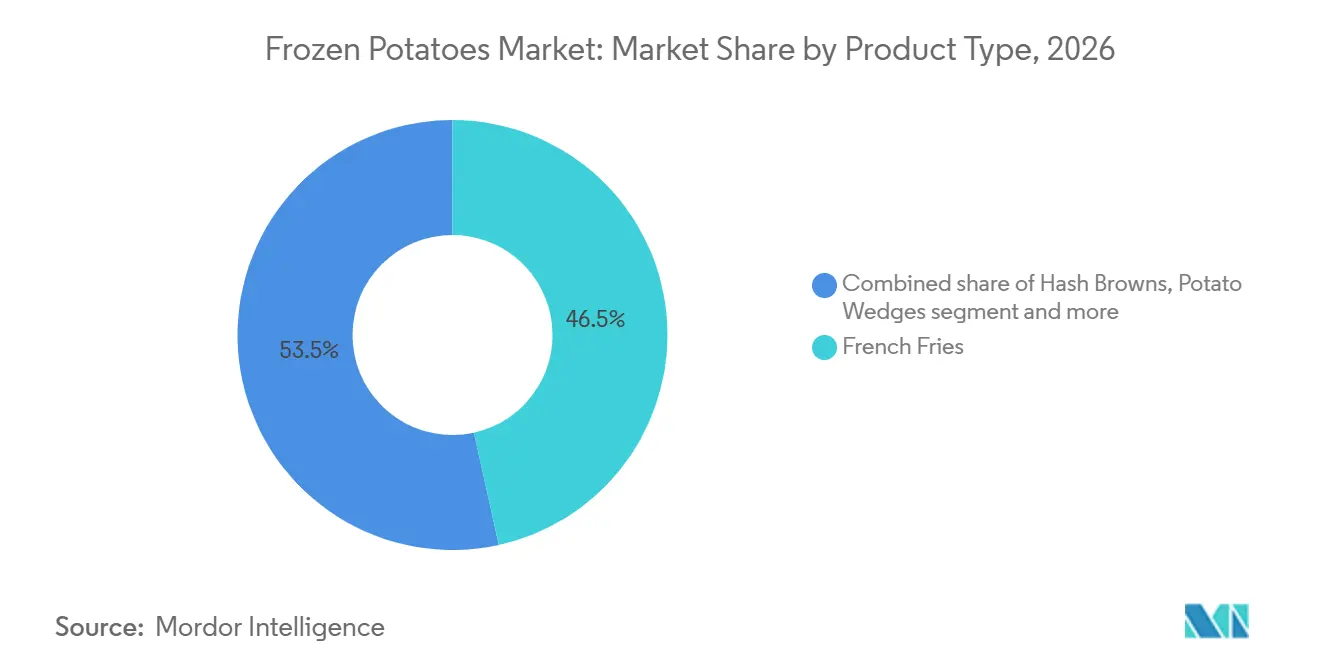
French fries accounted for 46.54% of the Frozen Potatoes Market in 2026, supported by their standardized cut sizes, predictable cooking performance, and ability to retain desirable texture after freezing and preparation. Their suitability for large-scale processing allows manufacturers to produce uniform batches with consistent color, shape, and crispness, while established frozen processing methods help preserve product quality during storage and distribution. According to the United States Department of Agriculture (USDA), approximately 150.48 million hundredweight (cwt) of potatoes were used to produce frozen French fries in the United States in 2024, highlighting the substantial raw-material volume dedicated to this product category[3]. This extensive processing base, combined with the product's consistent preparation characteristics and versatility in serving formats, reinforces French fries' dominant position in the Frozen Potatoes Market.
Hash browns represent the fastest-growing product type in the Frozen Potatoes Market, expanding at a CAGR of 5.63% over 2027–2032, driven by their uniform portion sizes, consistent texture, and ease of preparation. Their production from grated or shredded potatoes allows manufacturers to create products with distinctive textures and shapes while maintaining batch-to-batch consistency. The binding and forming processes help potato pieces retain their structure during handling and cooking, while freezing preserves the prepared format and extends storage life. Demand is further supported by product development involving different thicknesses, seasoning profiles, and formulations, enabling manufacturers to cater to varied texture preferences without substantially altering preparation methods. These characteristics strengthen the appeal of hash browns as a convenient, standardized frozen potato product and support their projected growth over the forecast period.

By Processing Method: Par-Fried Formats Dominate; Non-Fried Processing Accelerates
Par-fried frozen potatoes accounted for 63.45% of the frozen potatoes market by processing method in 2026, supported by the operational advantages of partial frying before freezing. This process establishes the initial surface structure, helping products develop a desirable color and texture during final preparation while reducing cooking time. Controlled pre-frying also enables manufacturers to manage moisture levels and achieve more consistent product characteristics across production batches. These qualities support efficient processing, predictable cooking performance, and reliable product quality throughout frozen storage, reinforcing the widespread adoption of par-fried processing.
Non-fried frozen potatoes are projected to grow at a CAGR of 5.78% over 2027–2032, driven by increasing interest in controlling oil use during food preparation. The absence of a pre-frying stage gives manufacturers greater flexibility to develop products with different nutritional profiles and ingredient specifications. This processing approach also preserves flexibility in subsequent cooking, allowing the final texture and degree of browning to be determined by the selected preparation method. Growing attention to ingredient transparency and cooking methods that require little or no added oil further supports product development in this category, strengthening its growth prospects over the forecast period.
By Distribution Channel: HoReCa Commands Scale; Retail Channels Accelerate on Innovation
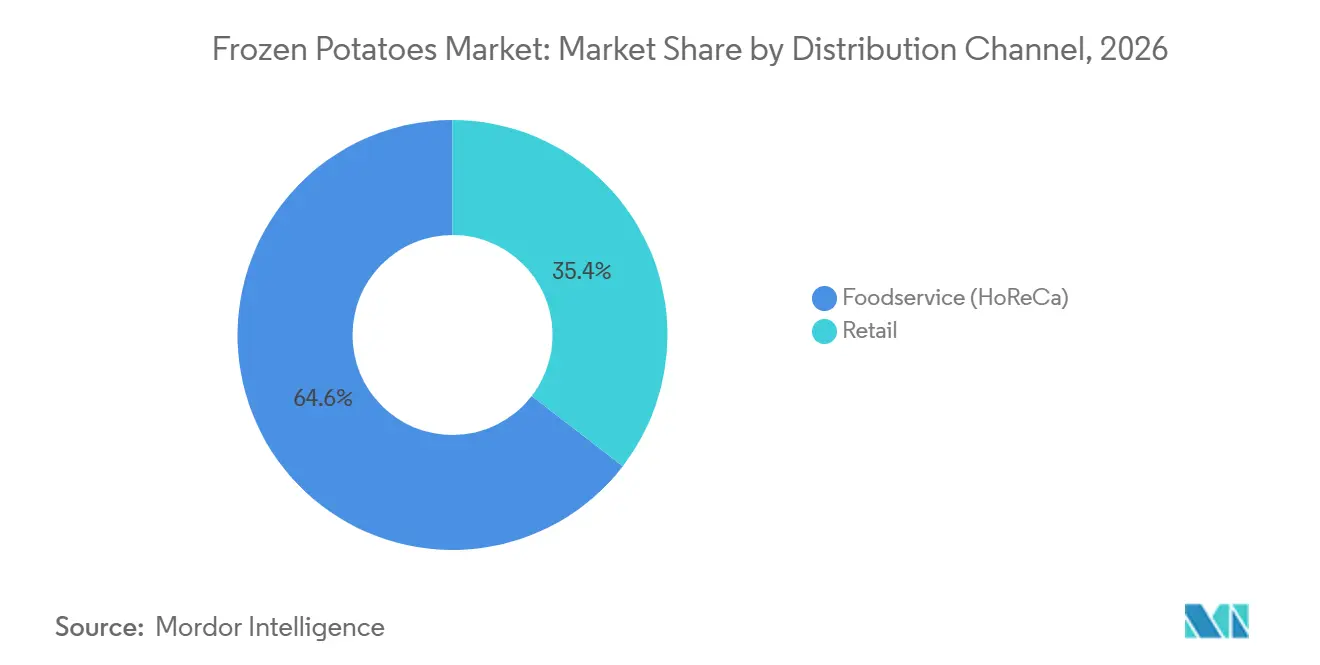
The foodservice (HoReCa) channel accounted for 64.54% of the Frozen Potatoes Market in 2026, driven by the widespread use of frozen potato products across restaurants, hotels, cafés, catering services, and quick-service restaurants. These products offer consistent quality, standardized portions, and simplified preparation, helping foodservice operators manage kitchen workloads and maintain uniform serving standards. Their longer storage life and ease of handling also support inventory planning, reduce preparation complexity, and enable operators to serve potato-based dishes efficiently during peak demand periods. The convenience of ready-to-cook formats and their adaptability to different menu styles further support foodservice demand.
Retail is projected to be the fastest-growing distribution channel in the Frozen Potatoes Market, registering a CAGR of 6.88% over 2027–2032. Growth is supported by increasing consumer preference for convenient home-preparation options that require minimal cooking time and effort. Frozen potato products allow households to prepare familiar snacks, side dishes, and meal accompaniments while maintaining flexibility in portion sizes and cooking methods. Wider availability through supermarkets, grocery stores, and online retail platforms is improving product accessibility, while expanding assortments of cuts, shapes, coatings, and seasoned varieties are encouraging consumers to explore more options for at-home consumption.
Geography Analysis
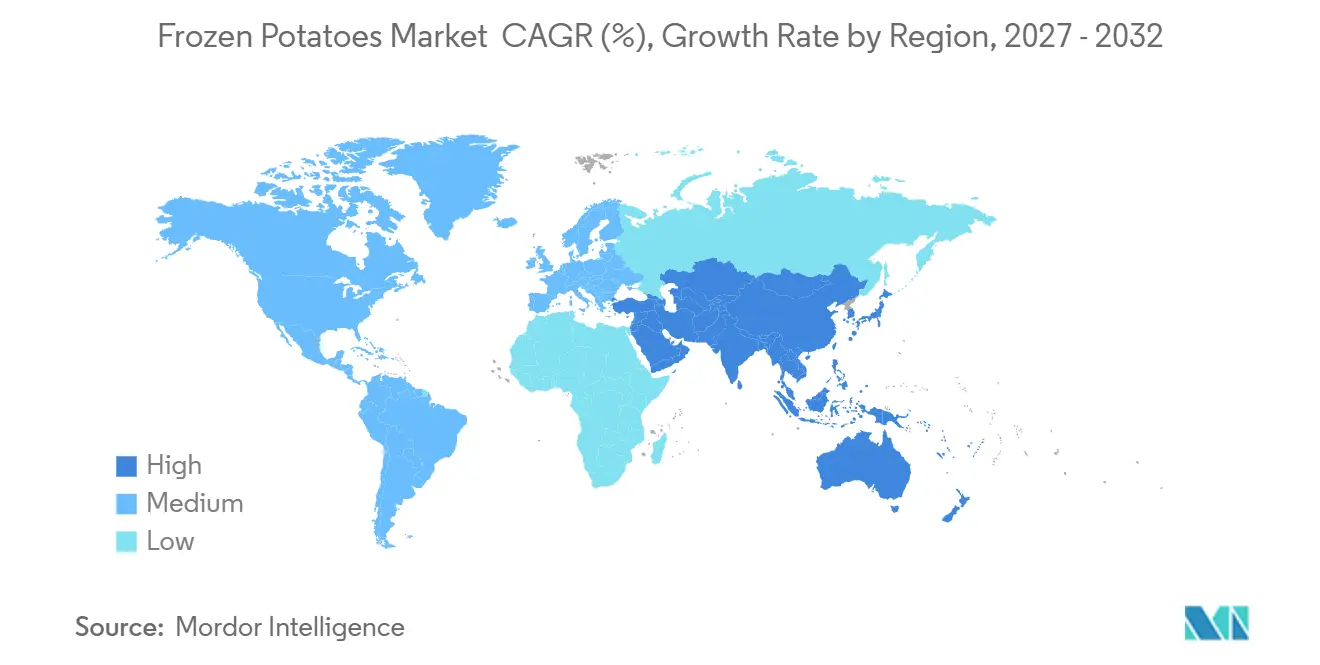
North America accounts for 36.29% of the global frozen potatoes market in 2026, supported by an established quick-service restaurant infrastructure, widespread household freezer ownership, and strong consumer familiarity with frozen potato products. The region benefits from extensive cold-chain networks and well-developed retail distribution, enabling consistent product availability across foodservice and household channels. The popularity of convenient meal preparation and air-fryer cooking further supports demand, as frozen fries, wedges, and other potato products can be prepared quickly with minimal effort. These established consumption habits and distribution capabilities reinforce the region's substantial market position.
Asia-Pacific is the fastest-growing geography in the frozen potatoes market, projected to register a CAGR of 6.49% over 2027–2032. Growth is driven by the expansion of quick-service restaurants, increasing adoption of Western-style fast food, and rising demand for convenient snacks and side dishes. Improvements in cold-chain infrastructure and the wider availability of frozen foods through supermarkets, convenience stores, and online grocery platforms are expanding market access. The growing presence of international restaurant chains and the development of modern food retail formats are also encouraging greater use of standardized frozen potato products, supporting continued market expansion across the region.
Europe remains a major production hub and an established consumption market for frozen potato products, supported by advanced processing capabilities, mature supply chains, and sustained demand from foodservice operators and households. In South America, market growth is supported by expanding foodservice networks, increasing availability of frozen convenience foods, and demand for quick-to-prepare meal accompaniments, although cold-chain limitations can restrict penetration in some areas. The Middle East and Africa market benefits from foodservice development, tourism-related catering, and the availability of imported frozen potato products; however, import dependence, storage infrastructure, and distribution costs continue to influence market development across individual countries.
Competitive Landscape
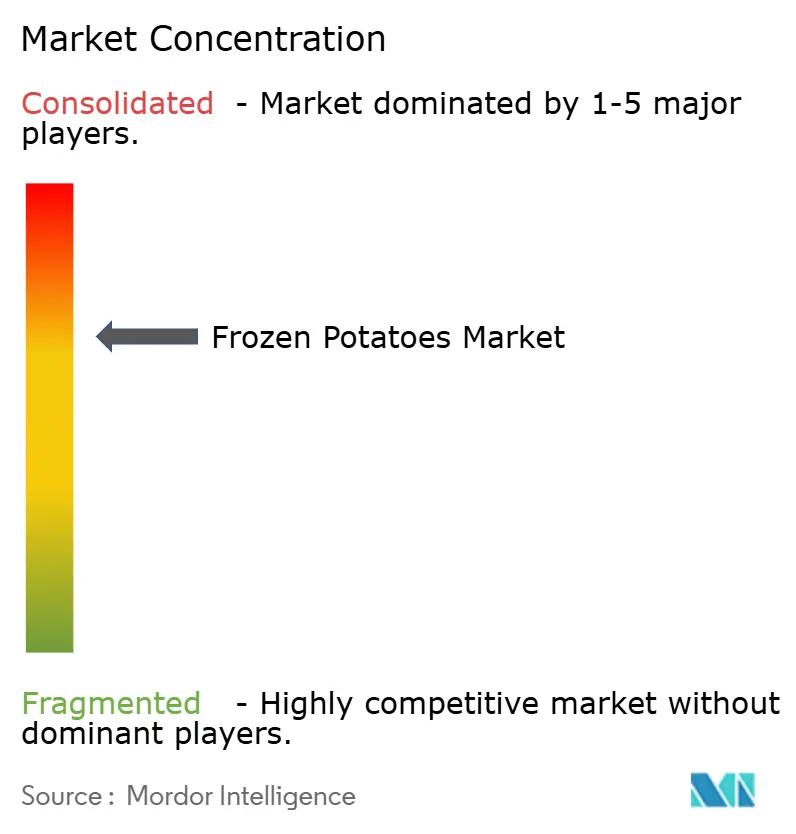
The global frozen potatoes market is relatively consolidated, with a limited number of large multinational manufacturers holding significant positions through extensive processing capabilities, established distribution networks, and long-standing relationships with potato growers, retailers, and foodservice operators. Major participants include McCain Foods Limited, Lamb Weston Holdings, Inc., J.R. Simplot Company, Agristo NV and Farm Frites International B.V. Competitive positioning depends on production capacity, raw material sourcing, product quality, operational efficiency, geographic reach, and the ability to maintain consistent supply. Companies are strengthening their competitive presence by expanding processing facilities, increasing regional production capacity, and improving supply chain infrastructure to meet demand across established and emerging markets.
Capacity expansion, acquisitions, and geographic diversification are key strategies shaping competition in the market. Manufacturers are investing in processing infrastructure and storage capabilities to improve production efficiency, reduce transportation costs, and strengthen access to regional customers. Strategic acquisitions enable companies to expand their manufacturing footprint, gain access to established distribution channels, and increase their presence in key consumption markets. These approaches help companies improve supply reliability, respond to changing demand patterns, and reinforce relationships with large foodservice operators and retail customers.
Product innovation and technological development are additional competitive priorities as manufacturers seek to differentiate their offerings and meet evolving customer requirements. Companies are focusing on improvements in product texture, crispness retention, cooking performance, coating formulations, and consistency to strengthen product appeal across foodservice and retail applications. Research and development activities, including patent development related to processing methods, product formulations, freezing technologies, and coating systems, support efforts to improve product quality and manufacturing efficiency. Portfolio diversification and the development of specialized products also enable companies to address different preparation requirements and customer preferences.
Frozen Potatoes Industry Leaders
-
McCain Foods Limited
-
Lamb Weston Holdings, Inc.
-
J.R. Simplot Company
-
Agristo NV
-
Farm Frites International B.V.
- *Disclaimer: Major Players sorted in no particular order
Recent Industry Developments
- October 2026: McCain Foods announced an agreement to acquire Falcon Agrifriz Foods' frozen potato processing business in Gujarat, India. Falcon Agrifriz operates a purpose-built potato processing facility in Gujarat, producing a range of frozen potato products for domestic and international markets.
- November 2025: Farm Frites confirmed its first Australian potato processing plant at the Wimmera Agricultural and Logistics Hub in Dooen, near Horsham, Victoria. The company is investing more than AUD 300 million in the facility, with commissioning planned for early 2027.
- October 2025: Lamb Weston Holdings, Inc. opened its 40,000-square-meter production facility in Mar del Plata, Buenos Aires, Argentina. The facility has the capacity to process 200 million pounds of potatoes per year.
Global Frozen Potatoes Market Report Scope
Frozen potatoes are processed potato products that are blanched, cut into fries, wedges, hash browns, or cubes, and rapidly flash-frozen to lock in flavor and texture. The Frozen Potatoes Market is segmented by product type, processing method, distribution channel, and geography. Based on product type, the market is segmented into French fries, potato wedges, hash browns, potato slices, mashed potatoes, baked and twice-baked potatoes, and others. Based on processing method, the market is segmented into par-fried frozen potatoes, non-fried frozen potatoes, and other processing methods. Based on distribution channel, the market is segmented into foodservice (HoReCa) and retail, with retail further segmented into supermarkets and hypermarkets, convenience stores, specialist retailers, online retail, and others. Based on geography, the market is segmented into North America, Europe, Asia-Pacific, South America, and the Middle East and Africa. The report provides market size and forecasts in both value (USD) and volume (tons) for all the mentioned segments.
| French Fries |
| Potato Wedges |
| Hash Browns |
| Potato slices |
| Mashed Potatoes |
| Baked and Twice-Baked Potatoes |
| Others |
| Par-Fried Frozen Potatoes |
| Non-Fried Frozen Potatoes |
| Other Processing Methods |
| Foodservice (HoReCa) | |
| Retail | Supermarkets and Hypermarkets |
| Convenience Stores | |
| Specialist Retailers | |
| Online Retail | |
| Others |
| North America | United States |
| Canada | |
| Mexico | |
| Rest of North America | |
| Europe | United Kingdom |
| Germany | |
| France | |
| Italy | |
| Spain | |
| Netherlands | |
| Poland | |
| Belgium | |
| Sweden | |
| Rest of Europe | |
| Asia-Pacific | China |
| Japan | |
| India | |
| Australia | |
| Indonesia | |
| South Korea | |
| Thailand | |
| Singapore | |
| Rest of Asia-Pacific | |
| South America | Brazil |
| Argentina | |
| Colombia | |
| Chile | |
| Peru | |
| Rest of South America | |
| Middle East and Africa | South Africa |
| Saudi Arabia | |
| United Arab Emirates | |
| Nigeria | |
| Egypt | |
| Morocco | |
| Turkey | |
| Rest of Middle East and Africa |
| By Product Type | French Fries | |
| Potato Wedges | ||
| Hash Browns | ||
| Potato slices | ||
| Mashed Potatoes | ||
| Baked and Twice-Baked Potatoes | ||
| Others | ||
| By Processing Method | Par-Fried Frozen Potatoes | |
| Non-Fried Frozen Potatoes | ||
| Other Processing Methods | ||
| By Distribution Channel | Foodservice (HoReCa) | |
| Retail | Supermarkets and Hypermarkets | |
| Convenience Stores | ||
| Specialist Retailers | ||
| Online Retail | ||
| Others | ||
| By Geography | North America | United States |
| Canada | ||
| Mexico | ||
| Rest of North America | ||
| Europe | United Kingdom | |
| Germany | ||
| France | ||
| Italy | ||
| Spain | ||
| Netherlands | ||
| Poland | ||
| Belgium | ||
| Sweden | ||
| Rest of Europe | ||
| Asia-Pacific | China | |
| Japan | ||
| India | ||
| Australia | ||
| Indonesia | ||
| South Korea | ||
| Thailand | ||
| Singapore | ||
| Rest of Asia-Pacific | ||
| South America | Brazil | |
| Argentina | ||
| Colombia | ||
| Chile | ||
| Peru | ||
| Rest of South America | ||
| Middle East and Africa | South Africa | |
| Saudi Arabia | ||
| United Arab Emirates | ||
| Nigeria | ||
| Egypt | ||
| Morocco | ||
| Turkey | ||
| Rest of Middle East and Africa | ||
Key Questions Answered in the Report
What is the projected value of the frozen potatoes market by 2032?
The frozen potato products market is projected to reach USD 93.65 billion by 2032, up from USD 74.22 billion in 2027.
What is the forecast growth rate for frozen potato products through 2032?
The category is forecast to grow at a CAGR of 4.76% between 2027 and 2032.
Which frozen potato product holds the largest share?
French fries lead product demand, accounting for 46.54% of revenue in 2026, supported by high usage across quick-service restaurants and foodservice operators.
Which frozen potato product is growing the fastest?
Hash browns are expected to be the fastest-growing product type, with a projected CAGR of 5.63% through 2032.