
Freeze-Dried Candy Market Size and Share
Market Overview
| Study Period | 2021 - 2031 |
|---|---|
| Market Size (2026) | USD 1.42 Billion |
| Market Size (2031) | USD 2.01 Billion |
| Fastest Growing Market | Asia-Pacific |
| Largest Market | North America |
| Market Concentration | Medium |
Major Players
*Disclaimer: Major Players sorted in no particular order Image © Mordor Intelligence. Reuse requires attribution under CC BY 4.0. |
|
Freeze-Dried Candy Market Analysis by Mordor Intelligence
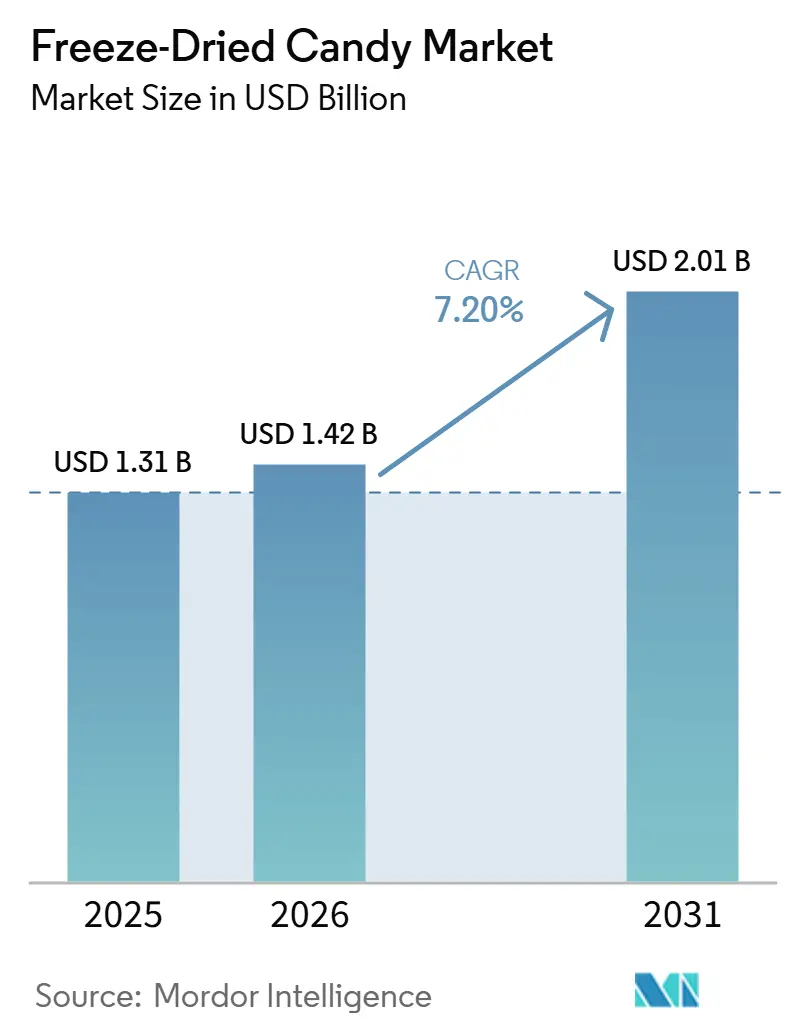
The global freeze-dried candy market was valued at USD 1.31 billion in 2025 and is estimated to reach USD 1.42 billion in 2026. The market is projected to grow to USD 2.01 billion by 2031, registering a CAGR of 7.20% during the forecast period (2026–2031). Growth is driven by rising consumer demand for novel confectionery experiences, increasing popularity of freeze-dried products through social media and digital commerce, and continuous product innovation in flavors, textures, and packaging formats. Advancements in freeze-drying technology, expanding retail availability, and the introduction of premium, clean-label, and fruit-based offerings are further supporting market expansion. Manufacturers are also leveraging seasonal launches, gifting formats, and direct-to-consumer channels to broaden consumer reach, making freeze-dried candy one of the fastest-growing categories within the global confectionery industry.
Key Report Takeaways
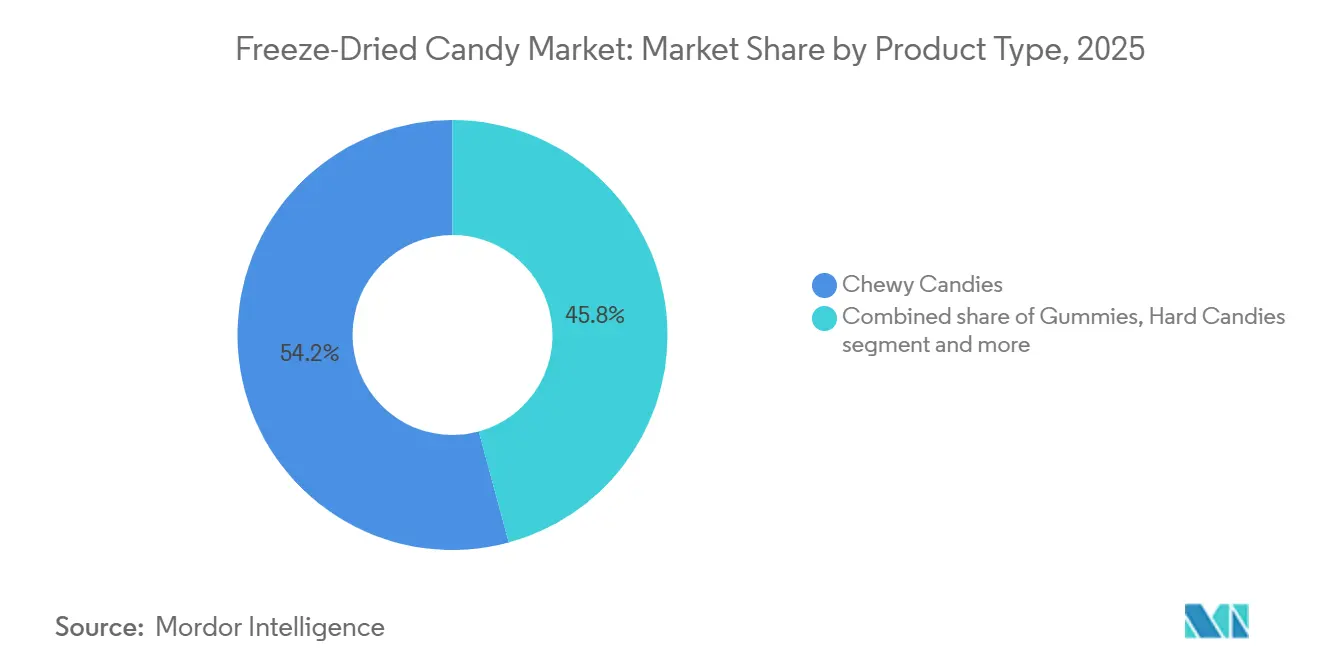
- By product type, chewy candy held 54.21% of the freeze-dried candy market share in 2025, while gummies are forecast to grow at a 9.50% CAGR through 2031.
- By flavor profile, sweet products accounted for 41.30% of the freeze-dried candy market size in 2025, while sour flavors are forecast to grow at an 8.17% CAGR through 2031.
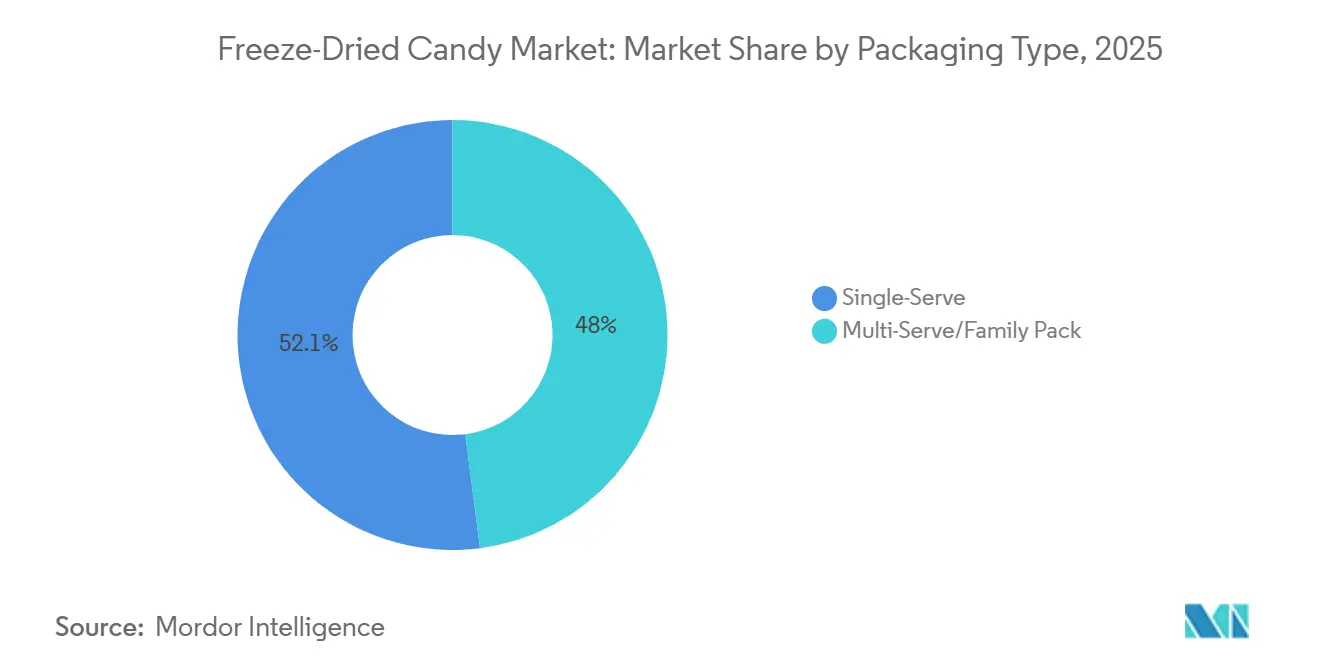
- By packaging type, single-serve packs held 52.05% of revenue in 2025, while multi-serve and family packs are forecast to advance at a 7.80% CAGR through 2031.
- By distribution channel, supermarkets and hypermarkets accounted for 36.45% of revenue in 2025, while online retail is forecast to expand at a 10.80% CAGR through 2031.
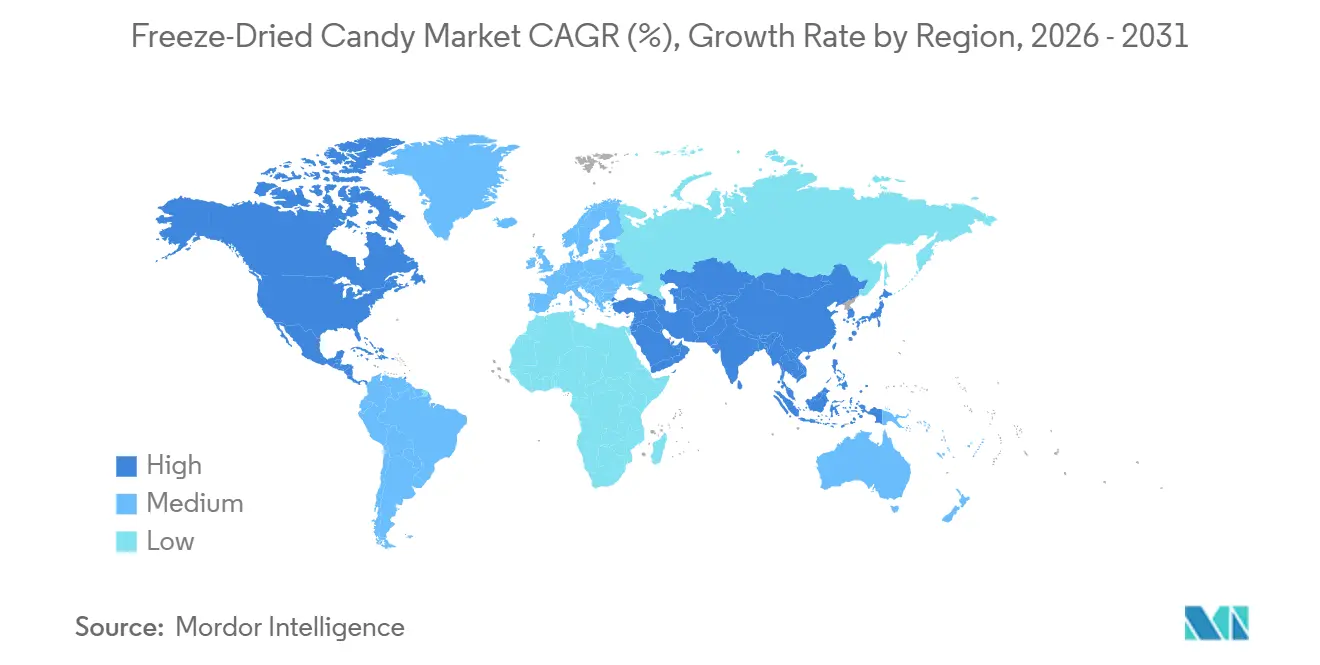
- By geography, North America held 44.81% of revenue in 2025, while Asia-Pacific is forecast to grow at a 10.15% CAGR through 2031.
Note: Market size and forecast figures in this report are generated using Mordor Intelligence’s proprietary estimation framework, updated with the latest available data and insights as of January 2026.
Market Trends and Insights
Drivers Impact Analysis of Freeze-Dried Candy Market*
| Driver | (~) % Impact on CAGR Forecast | Geographic Relevance | Impact Timeline |
| Rising demand for novel and experiential confectionery | +2.1% | Global, with concentrated intensity in North America and Europe | Medium term (2–4 years) |
| Increasing preference for convenient and portable snacks | +0.9% | Global, particularly strong in North America, Europe, and urban Asia-Pacific | Medium term (2–4 years) |
| Growth of social media and viral food trends | +1.6% | Global; highest platform density in North America, United Kingdom, South Korea, Southeast Asia | Short term (≤ 2 years) |
| Expansion of gifting and seasonal confectionery offerings | +0.7% | North America and Europe core; spill-over to Asia-Pacific urban centers | Medium term (2–4 years) |
| Continuous product innovation in flavors and formats | +0.8% | Global | Medium term (2–4 years) |
| Advancements in freeze-drying technology | +0.6% | Global; manufacturing hubs in China, United States, Germany | Long term (≥ 4 years) |
| Source: Mordor Intelligence | |||
Rising demand for novel and experiential confectionery
Consumers are increasingly seeking confectionery products that offer experiences beyond traditional taste, with texture, appearance, and sensory appeal becoming key purchasing factors. Freeze-dried candy meets this demand by transforming familiar candies into light, airy, and crunchy products while preserving their original flavors and vibrant colors, creating a distinctly different eating experience. The expansion in size and crisp texture achieved through freeze-drying adds novelty that differentiates these products from conventional gummies, taffies, and chewy candies. As consumer preferences shift toward unique and memorable snack experiences, manufacturers are expanding their freeze-dried candy portfolios with new flavor combinations, limited-edition offerings, and visually distinctive products that encourage trial and repeat purchases.
Increasing preference for convenient and portable snacks
The growing preference for convenient, portable, and ready-to-eat snacks is driving demand for freeze-dried candy. Consumers increasingly seek products that are easy to carry, store, and consume across various settings. The freeze-drying process removes nearly all moisture, producing lightweight candies that are non-sticky, resistant to melting, and easier to handle than many conventional confectionery products. This stability allows the products to retain their crisp texture and flavor over extended periods when stored in appropriate packaging, making them well suited for on-the-go consumption. Compact packaging, minimal mess, and long shelf life further add to their convenience, while the ability to maintain product quality without refrigeration increases their practicality. As convenience continues to influence snack purchasing decisions, freeze-dried candy is gaining wider consumer acceptance, reinforcing its position as an innovative and accessible confectionery option.
Growth of social media and viral food trends
The rapid growth of social media platforms has significantly increased product visibility and consumer engagement, acting as a major catalyst for the freeze-dried candy market. Short-form video platforms such as TikTok, Instagram Reels, and YouTube Shorts have popularized freeze-dried candy through product demonstrations and reaction videos that showcase its dramatic expansion, vibrant appearance, and distinctive crunchy texture. At the 2024 Sweets & Snacks Expo, the National Confectioners Association (NCA) identified freeze-dried sweets as one of the notable confectionery trends of the year, reflecting the category's growing mainstream recognition. This momentum has been further amplified by creator-generated content and home freeze-drying experiments, with more than 122 million TikTok posts related to freeze-dried sweets recorded as of August 2024, highlighting the category's strong digital presence and its role in driving consumer awareness and market expansion.
Expansion of gifting and seasonal confectionery offerings
Growing demand for premium and visually distinctive confectionery during gifting occasions and seasonal celebrations is positioning freeze-dried candy as an attractive market option. Manufacturers are introducing themed flavors, colorful packaging, and exclusive festive editions for occasions such as Halloween, Christmas, Easter, and Valentine's Day to capitalize on seasonal purchasing patterns and encourage impulse buying. Seasonal demand for confectionery remains strong; according to the National Retail Federation (NRF), consumers in the United States spent approximately USD 3.9 billion on candy during the 2025 Halloween season [1]Source: National Retail Federation (NRF), "Consumer spending on Halloween candy in the United States", nrf.com. This sustained seasonal demand, combined with increasing consumer preference for premium and novelty gift items, continues to support the expansion of freeze-dried candy offerings and drive overall market growth.
Restraints Impact Analysis of Freeze-Dried Candy Market*
| Restraint | (~) % Impact on CAGR Forecast | Geographic Relevance | Impact Timeline |
|---|---|---|---|
| High production costs associated with freeze-drying technology | -1.0% | Global, most acute for small and mid-scale producers in North America and Europe | Long term (≥ 4 years) |
| Competition from conventional and innovative confectionery products | -0.7% | Global | Medium term (2–4 years) |
| Limited consumer awareness in developing markets | -0.4% | South America, Middle-East and Africa, Southeast Asia | Medium term (2–4 years) |
| Supply chain challenges for specialized equipment and maintenance | -0.3% | North America, Europe; spill-over to Asia-Pacific manufacturing hubs | Short term (≤ 2 years) |
| Source: Mordor Intelligence | |||
High production costs associated with freeze-drying technology
High production costs associated with freeze-drying technology remain one of the primary restraints on the freeze-dried candy market. Freeze-drying is a complex, energy-intensive process that involves freezing the product and then removing moisture under deep vacuum through sublimation. This requires specialized equipment, precise temperature and pressure controls, and extended processing cycles that can last several hours or days. Compared to conventional confectionery manufacturing, the process consumes significantly more energy and requires higher capital investment in industrial freeze dryers, vacuum systems, and quality monitoring equipment. Manufacturers also incur ongoing expenses related to equipment maintenance, skilled technical personnel, and moisture-resistant packaging to preserve the product's characteristic crunchy texture.
Competition from conventional and innovative confectionery products
The freeze-dried candy market faces intense competition from a wide range of conventional and innovative confectionery products that already have strong consumer recognition, established distribution networks, and extensive product portfolios. Traditional candies, chocolates, gummies, hard candies, chewy confections, fruit snacks, and sugar-free alternatives continue to dominate retail shelves, offering consumers a diverse selection of flavors, textures, and price points. At the same time, confectionery manufacturers are continuously introducing new products featuring unique flavors, texture combinations, reduced-sugar formulations, functional ingredients, and premium packaging, increasing competition for consumer attention. The rapid pace of innovation across the broader confectionery industry raises consumer expectations for novelty, requiring freeze-dried candy manufacturers to continuously invest in product development, flavor innovation, and packaging differentiation to remain competitive.
*Our forecasts treat driver/restraint impacts as directional, not additive. The impact forecasts reflect baseline growth, mix effects, and variable interactions.
Freeze-Dried Candy Market Segment Analysis
By Product Type:
Chewy Candy Leads, Gummies Drive Next-Phase GrowthChewy candy accounted for a 54.21% share of the freeze-dried candy market in 2025, primarily due to its physical and sensory transformation during the freeze-drying process. As moisture is removed under low-temperature vacuum conditions, gummies, taffies, and other chewy confections expand to as much as three times their original size, forming a porous internal structure that delivers a light, airy, and crunchy texture while preserving the candy's original shape and flavor profile. This transformation creates a product that is fundamentally different from conventional chewy candy, offering enhanced texture, intensified flavor perception, and a distinctive eating experience. The enlarged appearance and crisp bite also increase the product's novelty and perceived value, making it attractive to consumers seeking innovative confectionery.
Gummies are projected to be the fastest-growing product segment, registering a CAGR of 9.50% through 2031, driven by their unique composition, which enables significant expansion and texture development during the freeze-drying process. Their gelatin- or pectin-based structure creates a light, porous, and crispy texture while preserving vibrant colors and concentrated flavors, resulting in a differentiated confectionery experience. The wide availability of gummy shapes, flavors, and formulations also provides manufacturers with greater flexibility for product innovation, seasonal offerings, and limited-edition releases. Additionally, gummies consistently deliver uniform processing performance and visual appeal after freeze-drying, supporting the introduction of premium and novelty products that continue to drive the segment's growth.



By Flavor Profile:
Sweet Anchors Volume, Sour Commands the Growth CurveThe sweet flavor profile accounted for a 41.30% share of the freeze-dried candy market in 2025, supported by its broad consumer appeal and strong compatibility with the freeze-drying process. Sweet fruit-flavored and confectionery-inspired candies retain their recognizable taste while gaining a light, crispy texture through moisture removal, creating a familiar yet differentiated sensory experience. Freeze-drying preserves flavor intensity while enhancing texture, allowing classic candy profiles to be reintroduced in a more innovative format without altering their core taste characteristics. This combination of established flavor recognition, concentrated sweetness, vibrant appearance, and distinctive crunch has enabled sweet-flavored freeze-dried candies to maintain widespread consumer acceptance and remain the dominant flavor category in the market.
Sour flavors are projected to be the fastest-growing segment, registering a CAGR of 8.17% through 2031, driven by increasing demand for bold and multi-sensory confectionery experiences. Freeze-drying preserves the candy's acidic coating and tart flavor compounds while creating a crisp, porous structure that intensifies the contrast between sourness and sweetness during consumption. The enhanced texture and concentrated flavor profile amplify the sensory impact, offering a more pronounced and longer-lasting taste experience compared to conventional sour candies. In addition, manufacturers are expanding the variety of fruit-inspired sour flavor combinations and innovative formulations, further increasing consumer interest and supporting the rapid growth of the sour flavor segment.
By Packaging Type:
Single-Serve Dominates, Family Packs Signal Category MaturationSingle-serve packaging accounted for a 52.05% share of the freeze-dried candy market in 2025. This is driven by its ability to preserve product freshness and maintain the characteristic crunchy texture throughout consumption. Since freeze-dried candies are highly sensitive to moisture, individually portioned packs help minimize exposure to humidity after opening, ensuring consistent product quality and extended shelf stability. The compact format also enhances convenience, portability, and portion control while reducing the likelihood of product breakage during handling. Additionally, single-serve packaging supports product trial by allowing consumers to explore different flavors and candy varieties in smaller pack sizes, contributing to its strong position in the market.
Multi-serve and family pack formats are projected to be the fastest-growing packaging segment, registering a CAGR of 7.80% through 2031. Growth is driven by increasing demand for larger pack sizes that offer greater versatility and support extended consumption. Manufacturers are incorporating resealable and high-barrier packaging materials that protect freeze-dried candies from moisture ingress after repeated opening, helping retain their texture and flavor across multiple uses. Larger pack formats also provide flexibility for sharing, stocking, and purchasing a wider assortment of freeze-dried candies in a single transaction. Improvements in packaging technology and product protection have further enhanced the practicality of multi-serve formats, supporting their growing adoption across the freeze-dried candy market.
By Distribution Channel:
Supermarkets Anchor Volume, Online Retail Redefines DiscoverySupermarkets and hypermarkets accounted for a 36.45% share of the freeze-dried candy market in 2025, supported by their ability to offer broad product visibility and facilitate impulse purchases. These retail environments allow consumers to physically examine the unique appearance, enlarged shape, and vibrant colors of freeze-dried candies, which builds purchase confidence for a relatively new confectionery category. Dedicated confectionery aisles, promotional displays, and seasonal merchandising further increase product exposure and encourage trial. The wide assortment of brands, flavors, and packaging formats available in supermarkets and hypermarkets also enables consumers to compare products conveniently, reinforcing the channel's dominant position in the market.
Online retail is projected to be the fastest-growing distribution channel, registering a CAGR of 10.80% through 2031, driven by expanding digital product discovery and the rapid adoption of direct-to-consumer and e-commerce platforms. Freeze-dried candies have gained considerable online visibility through product imagery, consumer reviews, influencer content, and short-form videos that effectively showcase their distinctive texture and appearance. Digital platforms also enable manufacturers to introduce limited-edition flavors, customized assortments, and exclusive product launches more quickly and with greater reach than traditional retail. The ease of browsing a wide product selection, accessing niche brands, and purchasing from any location continues to support online retail's position as the fastest-growing channel for freeze-dried candies.
Geography Analysis
North America Freeze-Dried Candy Market
North America accounted for 44.81% of the global freeze-dried candy market in 2025, driven by the region's strong confectionery innovation ecosystem, high consumer awareness of freeze-dried products, and well-established retail and e-commerce infrastructure. The United States represents the largest contributor to regional revenue, supported by the early commercialization of freeze-dried confectionery and continuous product innovation across the candy category. Consumer acceptance remains exceptionally high, with confectionery deeply embedded in purchasing habits. According to the National Confectioners Association (NCA), 99.8% of United States households purchased confectionery products at least once in 2025, providing a broad consumer base for premium and novelty formats such as freeze-dried candy [2]Source: National Confectioners Association (NCA), "Confectionery Sales Climb to USD 55 Billion in 2025", candyusa.com. The region also benefits from strong digital marketing, influencer-driven product discovery, and rapid adoption of new confectionery formats, reinforcing its position in the global market.
APAC Freeze-Dried Candy Market
Asia-Pacific is projected to be the fastest-growing regional market, registering a CAGR of 10.15% through 2031, supported by the rapid expansion of modern confectionery retail, increasing consumer interest in innovative snack formats, and the growing influence of digital commerce. The region is witnessing rising demand for premium and novelty confectionery products that offer differentiated textures and sensory experiences, making freeze-dried candy increasingly appealing. Strong manufacturing capabilities, expanding food processing investments, and continuous product innovation are further accelerating market development. Additionally, the widespread adoption of social media-driven food trends and the rapid expansion of online retail platforms are improving product visibility and consumer engagement, enabling freeze-dried candy to gain traction across both mature and emerging markets in the region.
EMEA and South America Freeze-Dried Candy Market
Europe represents a significant market for freeze-dried candy, with Germany and the United Kingdom leading regional adoption due to their well-established confectionery industries, high demand for premium sweets, and continuous product innovation. However, the Association of the German Confectionery Industry (BDSI) has reported persistent challenges affecting manufacturers, including elevated production costs, energy-related pressures, and supply chain constraints, which continue to influence market expansion [3]Source: Association of the German Confectionery Industry (BDSI), "Germany’s BDSI expresses concern over year of ‘drastic’ ingredients price rises", bdsi.de. Meanwhile, South America is gradually emerging as a promising market, supported by growing consumer interest in innovative confectionery and the increasing availability of specialty candy products through organized retail and digital channels. The Middle East and Africa is also witnessing steady development, driven by the expansion of modern retail networks, rising demand for premium imported confectionery, and increasing exposure to global food trends through e-commerce and social media, creating new opportunities for freeze-dried candy manufacturers.

Competitive Landscape
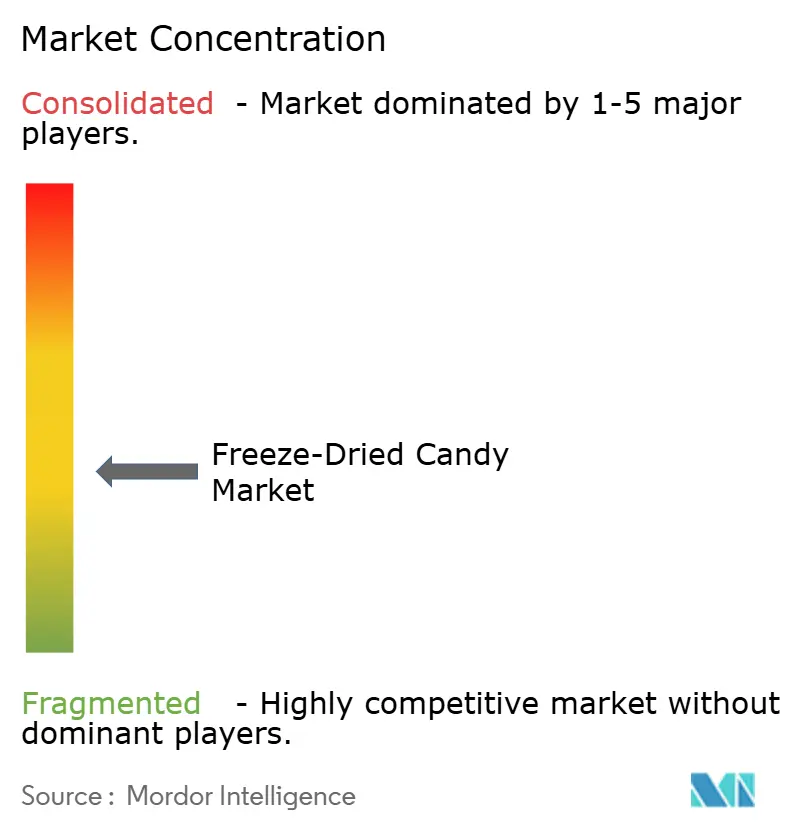
The freeze-dried candy market is fragmented, with competition comprising established global confectionery manufacturers, specialized freeze-dried candy producers, and emerging premium brands. Companies compete by expanding their freeze-dried product portfolios, introducing innovative flavor combinations, enhancing texture quality, and strengthening their presence across retail and e-commerce channels. Key participants include The Hershey Company, Mars, Incorporated, Ferrero International S.A., The Freeze Dried Candy Company, and Sow Good Inc., alongside numerous regional manufacturers that cater to niche consumer preferences and limited-edition product offerings.
Competition is increasingly centered on product differentiation and processing capabilities rather than conventional confectionery alone. Manufacturers are investing in freeze-drying technologies that improve product consistency, flavor retention, structural expansion, and production efficiency while reducing product breakage. Companies are also focusing on premium packaging, moisture-resistant solutions, and flavor innovation to enhance product quality and strengthen brand positioning. The ability to consistently produce visually appealing, crunchy products with uniform quality has become a key competitive advantage within the market.
A significant growth opportunity lies in the development of clean-label and functional freeze-dried confectionery. Manufacturers are increasingly exploring products made with natural sweeteners, fruit-based ingredients, plant-derived colors and flavors, functional ingredients such as vitamins, probiotics, or collagen, and organic-certified formulations to align with evolving consumer preferences. In parallel, investments in next-generation freeze-drying technology are enabling better preservation of ingredient functionality and flavor while supporting the commercialization of premium, health-oriented freeze-dried candy products. These innovation strategies are expected to shape future competition and provide differentiation in an increasingly dynamic market.
Freeze-Dried Candy Industry Leaders
-
Mars, Incorporated
-
The Freeze Dried Candy Company
-
Sow Good Inc.
-
The Hershey Company
-
Ferrero International S.A. (Ferrara Candy)
- *Disclaimer: Major Players sorted in no particular order
Freeze-Dried Candy Market Companies Covered in this Report
- Mars, Incorporated
- The Freeze Dried Candy Company
- Sow Good Inc.
- The Hershey Company
- Ferrero International S.A. (Ferrara Candy)
- SweetyTreatyCo
- The Candy Space
- Happy Candy UK
- Candy Copia
- Esquilo Candies
- Andersen's Crazy Candy
- Unicorn Fluff Candy Company
- Tru Fru, LLC
- Nantong Litai Jianlong Food Co., Ltd.
- Meiji Holdings Company, Ltd.
- Top Heart Food Soft Candy Company
- Crunch Punch
- Bebeto
- Arctic Farms
- La Casa de las Golosinas

Recent Industry Developments in Freeze-Dried Candy Market
- May 2026: YumEarth introduced Organic Freeze Dried Giggles, a crunchy variation of its Organic Giggles candy line. The freeze-dried candies feature a light, airy texture and are available in Strawberry, Orange, Lemon, Grape, and Green Apple flavors.
- October 2025: M&M'S, part of Mars, Inc., launched M&M'S POP'd, the brand's first freeze-dried candy, available initially in a 5.5 oz small stand-up pouch on TikTok Shop and MMS.com.
- July 2025: Trader Joe's launched Watermelon Freeze-Dried Candies. They combine a light, airy crunch with a bold sweet-and-sour watermelon flavor and a fizzy sensation.


Global Freeze-Dried Candy Market Report Scope
Freeze-dried candy is regular confectionery that has had its moisture removed through a deep-freezing and vacuum process. The freeze-dried candy market is segmented by product type, flavor profile, packaging type, distribution channel, and geography. Based on product type, the market is segmented into gummies, chewy candies, hard candies, sour candies, and others. Based on flavor profile, the market is segmented into fruity, sweet, sour, and others. Based on packaging type, the market is segmented into single-serve and multi-serve/family pack. Based on distribution channel, the market is segmented into hypermarkets/supermarkets, convenience stores, online retail stores, and other retail channels. Based on geography, the market is segmented into North America, Europe, Asia-Pacific, South America, and Middle East and Africa. The report provides market size and forecasts in both value (USD) and volume (tons) for all the mentioned segments.
| Gummies |
| Chewy Candies |
| Hard Candies |
| Sour Candies |
| Others |
| Fruity |
| Sweet |
| Sour |
| Others |
| Single-Serve |
| Multi-Serve/Family Pack |
| Hypermarkets/Supermarkets |
| Convenience Stores |
| Online Retail Stores |
| Other Retail Channels |
| North America | United States |
| Canada | |
| Mexico | |
| Rest of North America | |
| Europe | Germany |
| United Kingdom | |
| France | |
| Spain | |
| Italy | |
| Netherlands | |
| Sweden | |
| Norway | |
| Rest of Europe | |
| Asia-Pacific | China |
| India | |
| Japan | |
| Australia | |
| South Korea | |
| Vietnam | |
| Indonesia | |
| Rest of Asia-Pacific | |
| South America | Brazil |
| Argentina | |
| Colombia | |
| Chile | |
| Rest of South America | |
| Middle East and Africa | United Arab Emirates |
| South Africa | |
| Saudi Arabia | |
| Nigeria | |
| Egypt | |
| Morocco | |
| Turkey | |
| Rest of Middle East and Africa |
| By Product Type | Gummies | |
| Chewy Candies | ||
| Hard Candies | ||
| Sour Candies | ||
| Others | ||
| By Flavor Profile | Fruity | |
| Sweet | ||
| Sour | ||
| Others | ||
| By Packaging Type | Single-Serve | |
| Multi-Serve/Family Pack | ||
| By Distribution Channel | Hypermarkets/Supermarkets | |
| Convenience Stores | ||
| Online Retail Stores | ||
| Other Retail Channels | ||
| By Geography | North America | United States |
| Canada | ||
| Mexico | ||
| Rest of North America | ||
| Europe | Germany | |
| United Kingdom | ||
| France | ||
| Spain | ||
| Italy | ||
| Netherlands | ||
| Sweden | ||
| Norway | ||
| Rest of Europe | ||
| Asia-Pacific | China | |
| India | ||
| Japan | ||
| Australia | ||
| South Korea | ||
| Vietnam | ||
| Indonesia | ||
| Rest of Asia-Pacific | ||
| South America | Brazil | |
| Argentina | ||
| Colombia | ||
| Chile | ||
| Rest of South America | ||
| Middle East and Africa | United Arab Emirates | |
| South Africa | ||
| Saudi Arabia | ||
| Nigeria | ||
| Egypt | ||
| Morocco | ||
| Turkey | ||
| Rest of Middle East and Africa | ||


Key Questions Answered in the Report
What is the forecast for freeze-dried candy through 2031?
The category is forecast to rise from USD 1.42 billion in 2026 to USD 2.01 billion by 2031 at a 7.20% CAGR. Growth is supported by product launches, social commerce, portable formats, and seasonal programs.
Which freeze-dried candy product type leads sales?
Chewy candy led with 54.21% of revenue in 2025, while gummies are forecast to grow fastest at a 9.50% CAGR. Chewy products draw on familiar flavor identities and change substantially in texture during drying.
Why are freeze-dried sweets attracting consumers?
A crisp texture, concentrated flavor, portability, and social media visibility support consumer interest. The format allows established candy brands to offer a different eating experience without abandoning familiar flavors.
Which sales channel is growing fastest for freeze-dried candy?
Online retail is forecast to grow at a 10.80% CAGR through 2031, supported by social commerce and direct-to-consumer sales. Digital channels also let companies test products and learn from early demand before wider distribution.
Page last updated on:





