
France Seed Processing Machinery Market Size and Share
Market Overview
| Study Period | 2021 - 2031 |
|---|---|
| Forecast Data Period | 2026 - 2031 |
| Base Year Market Size (2025) | USD 287.40 Million |
| Market Size (2026) | USD 298.20 Million |
| Market Size (2031) | USD 357.5 Million |
| Growth Rate (2026 - 2031) | 3.69 % |
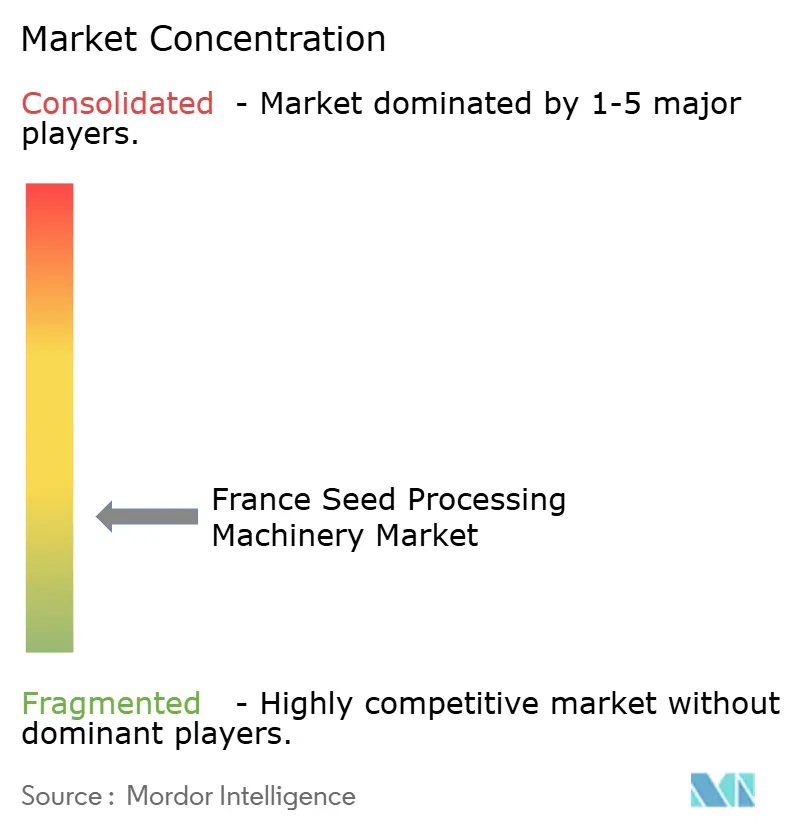
| Market Concentration | Low |
Major Players
*Disclaimer: Major Players sorted in no particular order Image © Mordor Intelligence. Reuse requires attribution under CC BY 4.0. |
|
France Seed Processing Machinery Market Analysis by Mordor Intelligence
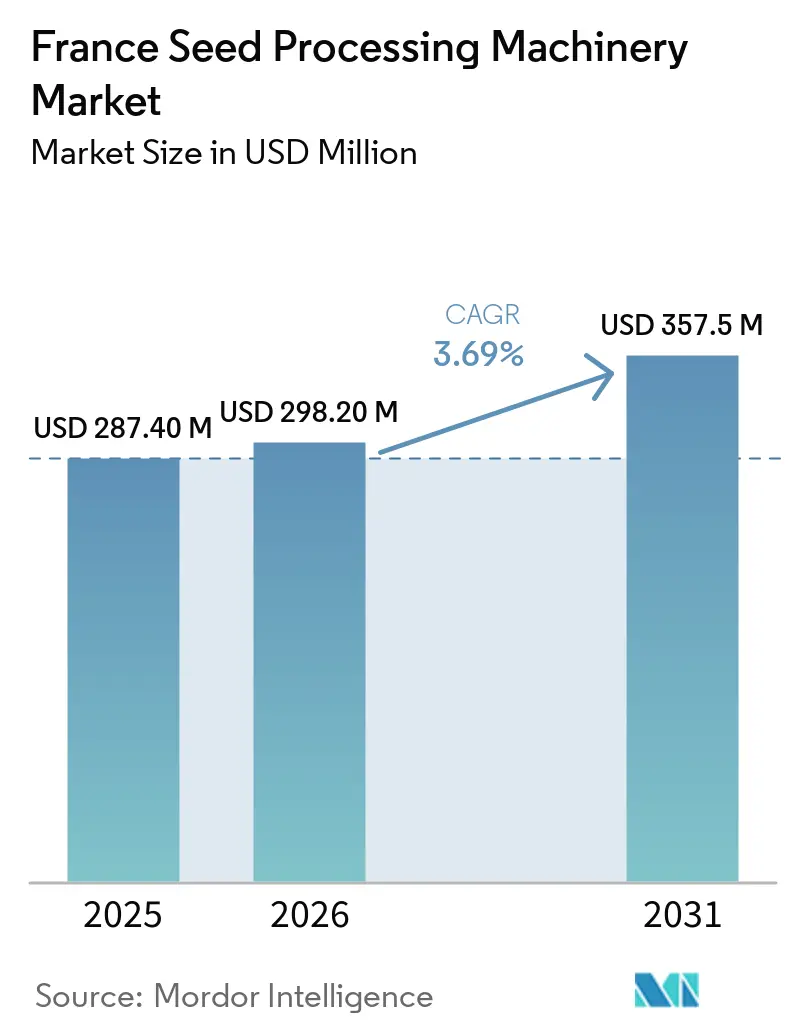
The France seed processing machinery market size is forecast to increase from USD 287.40 million in 2025 to USD 298.20 million in 2026, and reach USD 357.50 million by 2031, at a CAGR of 3.69% during the forecast period 2026–2031. According to the European Seed Certification Agencies Association, France remained the European Union leader in approved field-crop seed multiplication area, with 349,252 hectares in 2025[1]Source: ESCAA, "Seed production in EU - 2025," escaa.org. This supports a large base of certified-seed conditioning activity and a broad installed base of equipment users. Certification requirements make consistent cleaning, separation, testing, and traceability central to plant operations, particularly when facilities process multiple lots with distinct quality records. Replacement demand remains active as established lines must manage a wider crop mix, tighter lot-level controls, and more demanding operational documentation. Automation is increasingly relevant when facilities need to maintain throughput with fewer skilled technicians while limiting disruption during short processing periods. The France seed processing machinery market therefore depends more on certification standards, export readiness, equipment reliability, and practical service support.
Key Report Takeaways
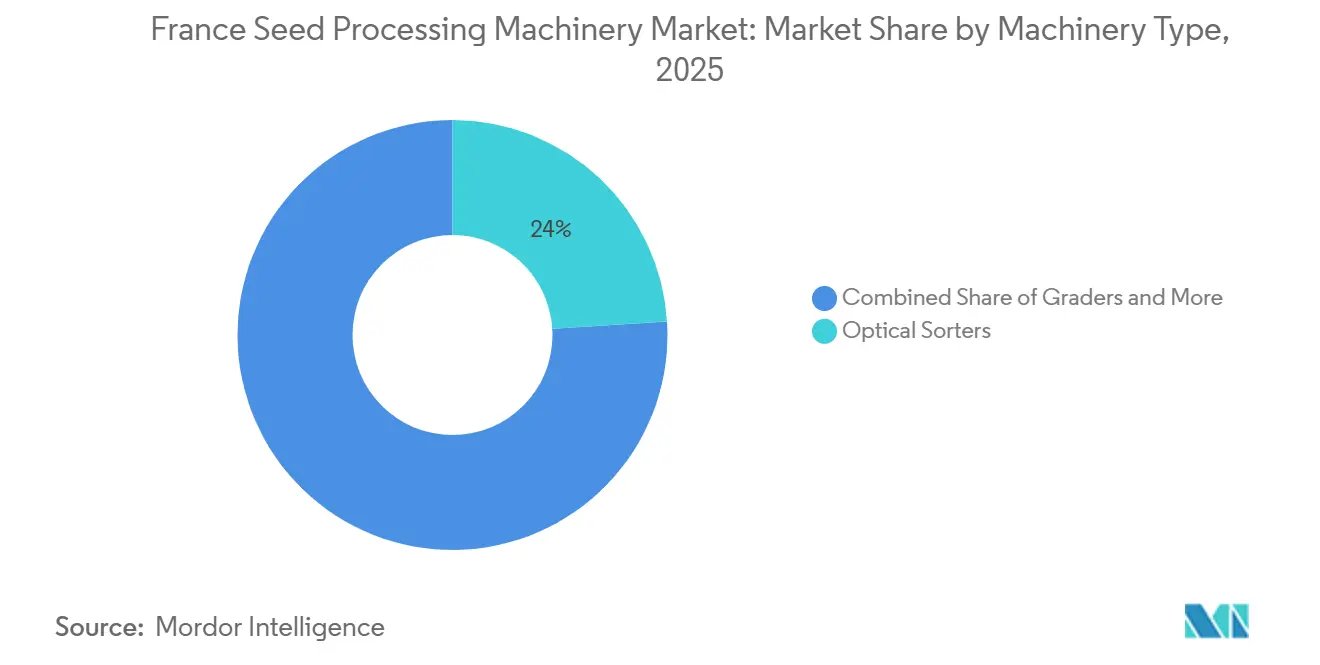
- By machinery type, optical sorters segment accounted for 24.0% of France seed processing machinery market share in 2025 and is forecast to grow at a 7.5% CAGR from 2026 to 2031, making it the largest and fastest-growing machinery segment.
- By operation mode, automatic systems were the largest segment and held 57.0% of the France seed processing machinery market size in 2025, while automatic systems are the fastest-growing segment and are forecast to expand at a 5.2% CAGR between 2026 and 2031.
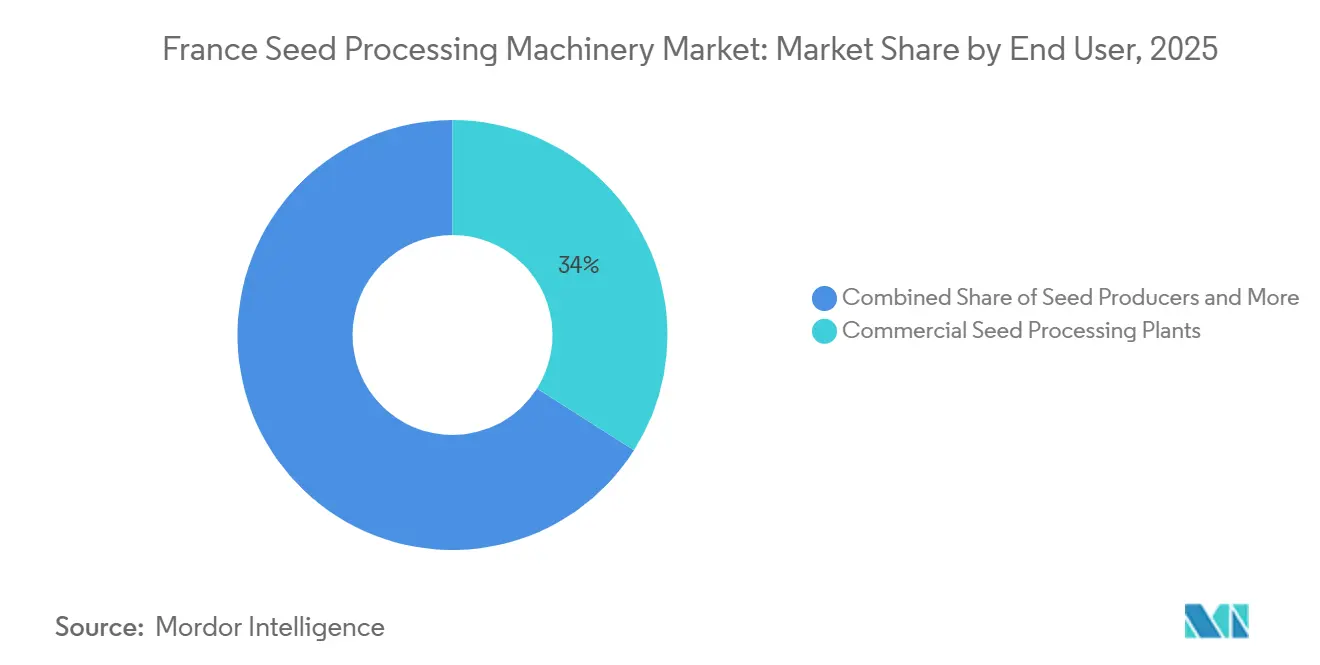
- By end user, commercial seed processing plants were the largest segment, holding a 34.0% share in 2025, and are also the fastest-growing segment, forecast to expand at a 6.5% CAGR between 2026 and 2031.
Note: Market size and forecast figures in this report are generated using Mordor Intelligence’s proprietary estimation framework, updated with the latest available data and insights as of January 2026.
France Seed Processing Machinery Market Trends and Insights
Drivers Impact Analysis*
| Driver | (~) % Impact on CAGR Forecast | Geographic Relevance | Impact Timeline |
|---|---|---|---|
| Mandatory Varietal Purity and Germination Compliance | +1.0% | National, concentrated in Bassin Parisien, Occitanie, and Loire Valley | Long term (≥ 4 years) |
| Expansion of Certified Seed and Export-Oriented Production | +0.8% | National, with export-grade upgrade clusters in northern and southwestern France | Long term (≥ 4 years) |
| Replacement of Aging Cleaning and Grading Lines | +0.7% | National, concentrated in established commercial conditioning plants | Medium term (2-4 years) |
| Automation to Offset Rural Technician Scarcity | +0.6% | National, most acute in rural Occitanie and Nouvelle-Aquitaine | Medium term (2-4 years) |
| Retrofit Demand from Multi-Crop, Small-Lot Changeovers | +0.5% | National, with early gains in specialty seed and organic production regions | Medium term (2-4 years) |
| Optical Sorting for Identity-Preserved Organic and Specialty Lots | +0.7% | National, amplified in Loire Valley and Provence-Alpes-Côte d'Azur | Short term (≤ 2 years) |
| Source: Mordor Intelligence | |||
Mandatory Varietal Purity and Germination Compliance
France's official seed certification system establishes stringent quality standards that directly influence demand for seed processing equipment. Certification is administered by the French National Seed and Plant Association (Société Nationale des Agriculteurs Multiplicateurs de Semences, SEMAE) through the Official Quality and Control Directorate (Direction de la Qualité et du Contrôle Officiel, DQCO), which evaluates seed lots for varietal purity, germination capacity, moisture content, and freedom from harmful organisms before granting certification. Maize seed must achieve a minimum germination rate of 90% to qualify for the SOC France label, making precise cleaning, grading, sorting, and lot uniformity essential throughout the processing chain. As a result, the France seed processing machinery market sees sustained demand for high-precision processing technologies, as equipment that consistently meets certification requirements helps processors minimize lot rejection and maintain compliance with national quality standards.
Expansion of Certified Seed and Export-Oriented Production
France plays a significant role in certified seed production, and its large multiplication base supports demand for reliable conditioning capacity. SEMAE identifies the country as a major supplier of large-crop certified seed, which sustains the relevance of export-quality processing for plant investment. Export-oriented buyers require traceable lots, controlled packaging, and reliable purity verification. The Organization for Economic Co-operation and Development (OECD) Seed Schemes provide the common framework used for varietal certification and international trade. Processing plants, therefore, require equipment that supports repeatable results and clear lot identification. This operational requirement provides the France seed processing machinery market with a stable base among facilities serving certified and export channels.
Replacement of Aging Cleaning and Grading Lines
Many established seed plants use cleaning, grading, and conveying equipment built for earlier production requirements. These lines were often designed for high-volume cereal processing rather than frequent processing of pulses, oilseeds, or specialty crops. Worn screens, indented cylinders, and gravity tables can make impurity control more difficult during certification-sensitive work. Buyers increasingly treat line condition as a commercial concern, as inconsistent output can affect customer confidence. Replacement projects commonly combine mechanical upgrades with automation and optical inspection. This pattern favors suppliers that can deliver an integrated line rather than a single component to the France seed processing machinery market.
Automation to Offset Rural Technician Scarcity
Limited availability of qualified agricultural technicians is increasing the incentive for French seed processors to reduce manual intervention in equipment operation. France Travail's 2025 labor-market survey found that 65.9% of recruitment projects for agricultural technicians and supervisory staff were considered difficult, highlighting persistent challenges in securing skilled personnel. In seed processing, automated cleaning, grading, treatment, and monitoring systems can reduce dependence on continuous manual adjustments and specialized operator input, enabling fewer personnel to manage more standardized processing activities. Suppliers are increasingly incorporating programmable controls, automated settings, diagnostics, and operator-assistance features to simplify equipment operation and maintain consistent processing parameters. Westrup ApS, for example, offers automated seed-processing systems designed to simplify setup and operation, while Cimbria A/S provides automated process-control and monitoring solutions for seed and grain processing. This labor-saving potential strengthens the business case for automated machinery among French processors facing difficulties in recruiting and retaining skilled technical staff.
Restraints Impact Analysis*
| Restraint | (~) % Impact on CAGR Forecast | Geographic Relevance | Impact Timeline |
|---|---|---|---|
| High Upfront Cost and Long Project Payback | -0.8% | National, most acute for cooperative and on-farm operators | Medium term (2-4 years) |
| Stringent CE, ATEX, and Documentation Compliance | -0.5% | National, intensified for enclosed processing facilities | Long term (≥ 4 years) |
| Small-Lot Changeover and Cleaning Validation Burden | -0.3% | National, concentrated in organic and specialty seed facilities | Medium term (2-4 years) |
| Limited Utilization Outside Seasonal Conditioning Windows | -0.2% | National, most pronounced in single-crop cereal conditioning regions | Long term (≥ 4 years) |
| Source: Mordor Intelligence | |||
High Upfront Cost and Long Project Payback
The high capital investment required for advanced seed processing facilities remains a key restraint in the France seed processing machinery market. Modern processing lines integrating optical sorters, gravity separators, automated seed treatment systems, and digital inspection technologies require substantial upfront expenditure, while financial returns are typically realized over several production cycles through improved throughput and lower processing losses. Recognizing these investment challenges, FranceAgriMer allocated a EUR 20 million (USD 23.2 million) budget under the France 2030 program to support investments in innovative agricultural equipment, with public funding covering 20–40% of eligible equipment costs[2]Source: French Republic, "Support for investments in innovative agricultural equipment solutions for the fruit and vegetable sectors," franceagrimer.fr. This ongoing need for capital subsidies underscores the financial burden of adopting advanced processing technologies. As a result, small and medium-sized seed processors often defer equipment modernization due to limited investment capacity and extended payback periods, thereby slowing the adoption of next-generation seed processing systems.
Limited Utilization Outside Seasonal Conditioning Windows
The seasonal nature of seed production limits the annual utilization of seed processing machinery, reducing the return on investment for processors. Most cleaning, grading, treatment, and packaging operations are concentrated around harvest and conditioning periods, leaving processing lines underutilized for a significant portion of the year. According to the French Academy of Agriculture, seed production in France is carried out by approximately 16,500 contract seed growers across 380,000 hectares during the annual production cycle as of 2025, highlighting the campaign-based nature of the seed industry[3]Source: French Academy of Agriculture, "Evolution of French foreign trade for the seeds and plants sector (2007-2025)," academie-agriculture.fr. As a result, seed processors must recover the cost of capital-intensive equipment over relatively short operating windows, making investments in high-capacity automated processing lines less attractive, particularly for small and medium-sized enterprises. The inability to maintain year-round utilization increases operating costs per processed unit and extends equipment payback periods, constraining the adoption of advanced seed processing technologies in the France seed processing machinery market.
*Our forecasts treat driver/restraint impacts as directional, not additive. The impact forecasts reflect baseline growth, mix effects, and variable interactions.
Segment Analysis
By Machinery Type: Optical Sorters Hold the Highest Value Position
By machinery type, optical sorters accounted for 24.0% of the France seed processing machinery market size in 2025. This position reflects the role of machine vision in identifying defects and supporting purity checks for certified lots that must remain distinguishable during processing. Cleaners and pre-cleaners remove foreign material and perform primary size separation, while graders, separators, destoners, and seed packagers support higher-volume cereal and maize programs. Coating and seed treatment equipment are gaining importance as organic seed producers prepare for the transition to approved coating substances. Polishers and other specialized machines remain relevant for vegetable and specialty seed work, where surface quality and careful lot handling are particularly important.
Optical sorters are forecast to expand at a 7.5% CAGR between 2026 and 2031, supported by their ability to manage small, traceable, and specification-sensitive lots. The equipment complements screening and gravity separation, enabling plants to add inspection capability without altering the role of core mechanical stages. Suppliers continue to invest in test capability and advanced sorting platforms, helping operators evaluate a machine against the characteristics of their own crop and lot mix.



By Operation Mode: Automatic Lines Change Plant Operations
By operation mode, the automatic systems accounted for 57.0% of the France seed processing machinery market share in 2025, and the segment is forecast to grow at a 5.2% CAGR between 2026 and 2031. Semi-automatic equipment remains relevant in on-farm facilities and research settings, where budgets and production scales differ from those of commercial plants. Commercial sites increasingly opt for automated lines when reliable batch processing, repeatable settings, and reduced labor are required. Automated installations can include programmable logic controller (PLC) controls, weight dosing, batch tracking, and remote monitoring, which help reduce the operational burden of running several connected conditioning steps. These functions address labor constraints while still requiring trained staff to oversee quality, maintenance, and exception handling.
Suppliers in the France seed processing machinery market are increasingly differentiating their automatic systems by reliability, on-site support, and the ability to integrate controls with mechanical equipment. Operators prioritize equipment availability, rapid diagnostic support, and timely software updates, as an unplanned stoppage can delay certified lots during a narrow seasonal window. In 2025, MAS Seeds modernized its Haut-Mauco, France, factory with 3D camera-enabled optical sorting on the calibration line. The modernization also added automated dosing and the integration of bio-based coatings in the seed treatment area. Suppliers capable of coordinating these related functions are better positioned for projects that modernize a full processing area rather than a single machine.
By End User: Commercial Plants Set Equipment Standards
Commercial seed processing plants held 34.0% of the France seed processing machinery market by end user in 2025 and are forecast to expand at a CAGR of 6.5% between 2026 and 2031. Commercial seed processors have the highest demand for seed processing machinery, as they handle high processing volumes, certified seed conditioning, and diverse crop portfolios that require efficient cleaning, grading, sorting, treatment, and packaging operations. These facilities typically invest in advanced, integrated processing lines to improve throughput, seed quality, and compliance with certification standards. In contrast, seed producers and cooperative networks generally procure machinery at the individual-site level and often prioritize equipment upgrades or retrofits over complete processing-line replacements. Research institutions represent a smaller end-user segment, focusing on precision sorting, traceability, and documentation capabilities rather than high-capacity processing.
On-farm and grain-handling facilities complete the buyer landscape, but they face documentation and lot-control requirements when processing certified seed. These requirements can make commercial processing more practical than the investment and ongoing administration required for a dedicated small facility. The France seed processing machinery market therefore favors centralized operators that spread certification, service, and maintenance costs across higher throughput. Commercial plants can also run multiple crop programs and utilize equipment across a broader portion of the calendar. Smaller facilities are more likely to prioritize targeted upgrades, maintenance, and flexible additions that fit their available capital.
Geography Analysis
France is one of the leading producers of certified seeds in the European Union, supported by a well-established seed multiplication and conditioning network. The Bassin Parisien and northern France are major centers for cereal and rapeseed seed multiplication, while Occitanie and Nouvelle-Aquitaine play a significant role in maize seed processing. The Loire Valley and Provence-Alpes-Côte d'Azur specialize in vegetable seed and other high-value specialty crop conditioning. These regional production patterns create diverse equipment requirements, driving demand for machinery with varying capacities, precision cleaning and separation capabilities, gentle seed handling, and robust lot traceability systems.
The largest geographic demand is concentrated in regions with intensive certified-seed production and established commercial conditioning plants. French maize seed production places particular emphasis on traceable lots, as a significant share is supplied to markets outside France. This drives investment in equipment that maintains consistent purity and documentation without adding delays to seasonal operations. Suppliers with established French service networks and reference installations hold an advantage when plant managers require proven support and access to replacement parts. Cimbria A/S strengthened its seed partnership activity in France through a cleaning-line upgrade at Exélience Vernouillet.
The fastest-growing geographic demand comes from specialty and organic crop regions that require flexible processing arrangements. Expansion in flax and hemp multiplication activity is adding demand for modular and mobile processing solutions. These facilities typically process smaller lots and change crops more frequently than cereal-focused sites, making fast cleaning and setting adjustments important. Flexible equipment allows operators to adjust screens, separation settings, and cleaning practices between programs without redesigning the entire line. The France seed processing machinery market is therefore distributed across large cereal clusters and smaller specialty-processing locations, where local service capability and crop-specific engineering can be decisive factors.
Competitive Landscape
The France seed processing machinery market is fragmented, with the top five companies holding a moderate share in 2025, while the remaining demand is served by mid-tier suppliers, French specialists, and regional integrators. Bühler AG, Cimbria A/S, Westrup ApS, PETKUS Technologie GmbH, and Satake Corporation form the principal global supplier group. DOREZ SAS, MERIS Services Industries, and Etablissements Schneider-Jaquet provide French engineering and retrofit capability. Global suppliers compete through technology depth, full-line integration, and documentation support, while French specialists compete through proximity, response time, and familiarity with specialty crop requirements.
Optical sorting remains a visible area of competition, as it connects inspection performance with product differentiation and can serve both conventional and specialty seed programs. Cimbria A/S's France activity includes a 2024 cleaning line at Exélience Vernouillet with a capacity of 4 metric tons per hour for cereals, flaxseed, peas, lentils, and other specialty seeds. The project illustrates how suppliers compete with adaptable lines rather than standardized cereal-only systems. Westrup's service offering in France includes on-site diagnostics, preventive maintenance, repairs, commissioning, and operator training, demonstrating that ongoing equipment performance and after-sales support are integral to the competitive offering. Customer needs differ by crop and site, so a supplier's overall market position does not by itself determine outcomes for individual projects.
PETKUS presented a modular seed plant concept at EUROTIER 2024 in November 2024. The concept addressed customer interest in more standardized configurations and shorter project timelines. MAS Seeds completed a 2024 modernization project that integrated optical sorting, automated dosing, and coating. Such projects favor suppliers that can coordinate mechanical, digital, and treatment-related equipment. The France seed processing machinery market remains contested, as no supplier group controls a dominant share of demand.
France Seed Processing Machinery Industry Leaders
-
Bühler AG
-
Westrup ApS
-
PETKUS Technologie GmbH
-
Satake Corporation
-
Cimbria A/S ( Grain & Protein Technologies)
- *Disclaimer: Major Players sorted in no particular order

Recent Industry Developments
- May 2026: Cérience, a subsidiary of Terrena Group, acquired a majority stake in SEED IN TECH, a French company specializing in seed priming and seed-activation technologies, expanding Cérience's seed-technology services to include disinfection, film coating, and priming.
- February 2026: February 2026: The French National Seed and Plant Association (Société Nationale des Agriculteurs Multiplicateurs de Semences, SEMAE) reported that France’s seed and plant industry allocated EUR 450.0 million (USD 523.7 million) in research and development, equivalent to 13% of industry revenue, with investment anticipated to rise by a further 10% in the coming years. The sustained investment supports demand for advanced seed-processing, conditioning, and quality-control technologies.
- January 2026: The European Commission released the sixth edition of ATEX Directive 2014/34/EU guidelines, updating conformity assessment procedures for equipment used in potentially explosive dust atmospheres, with compliance implications for all seed processing equipment installed or modified in France after this date.


France Seed Processing Machinery Market Report Scope
Seed processing machinery encompasses equipment used in agriculture to clean, sort, grade, dry, treat, and package seeds, improving their quality and viability for planting. These machines play a critical role in removing impurities, ensuring uniformity, and safeguarding seeds from pests and diseases
The France Seed Processing Machinery Market Report is Segmented by Machinery Type (Pre-Cleaners, Cleaners, Dryers, Graders, Polishers, Optical Sorters, Seed Packagers, Coaters and Treaters, Separators and Destoners, and Other Specialized Equipment), by Operation Mode (Automatic and Semi-Automatic), and by End-User (Commercial Seed Processing Plants, Seed Producers, On-Farm Facilities, and Grain Handling Facilities). The Market Forecasts are Provided in Terms of Value (USD).
| Pre-Cleaners |
| Cleaners |
| Dryers |
| Graders |
| Coaters and Treaters |
| Separators and Destoners |
| Polishers |
| Optical Sorters |
| Seed Packagers |
| Other Specialized Equipment |
| Automatic |
| Semi-Automatic |
| Commercial Seed Processing Plants |
| Seed Producers |
| Research Institutions |
| On-Farm Facilities |
| Grain Handling Facilities |
| By Machinery Type | Pre-Cleaners |
| Cleaners | |
| Dryers | |
| Graders | |
| Coaters and Treaters | |
| Separators and Destoners | |
| Polishers | |
| Optical Sorters | |
| Seed Packagers | |
| Other Specialized Equipment | |
| By Operation Mode | Automatic |
| Semi-Automatic | |
| By End User | Commercial Seed Processing Plants |
| Seed Producers | |
| Research Institutions | |
| On-Farm Facilities | |
| Grain Handling Facilities |


Key Questions Answered in the Report
What is the market size of France seed processing machinery in 2026?
The France seed processing machinery market is valued at USD 298.20 million in 2026.
Which equipment category leads seed processing machinery sales in France?
Optical sorters led machinery-type demand with 24.0% share in 2025 and is forecasted to record a 7.5% CAGR between 2026 and 2031.
Why are automatic seed processing lines gaining adoption in France?
Automatic systems support batch tracking, dosing, remote monitoring, and more consistent operation where skilled technician availability is constrained.
What compliance issues influence seed-processing equipment purchases in France?
Certification requirements, CE marking, and ATEX requirements influence equipment selection, documentation, validation, and site design.
Page last updated on:





