
Fortified Yogurt Market Size and Share
Market Overview
| Study Period | 2027 - 2032 |
|---|---|
| Market Size (2027) | USD 8.39 Billion |
| Market Size (2032) | USD 11.12 Billion |
| Growth Rate (2027 - 2032) | 5.80 % |
| Fastest Growing Market | Asia-Pacific |
| Largest Market | North America |
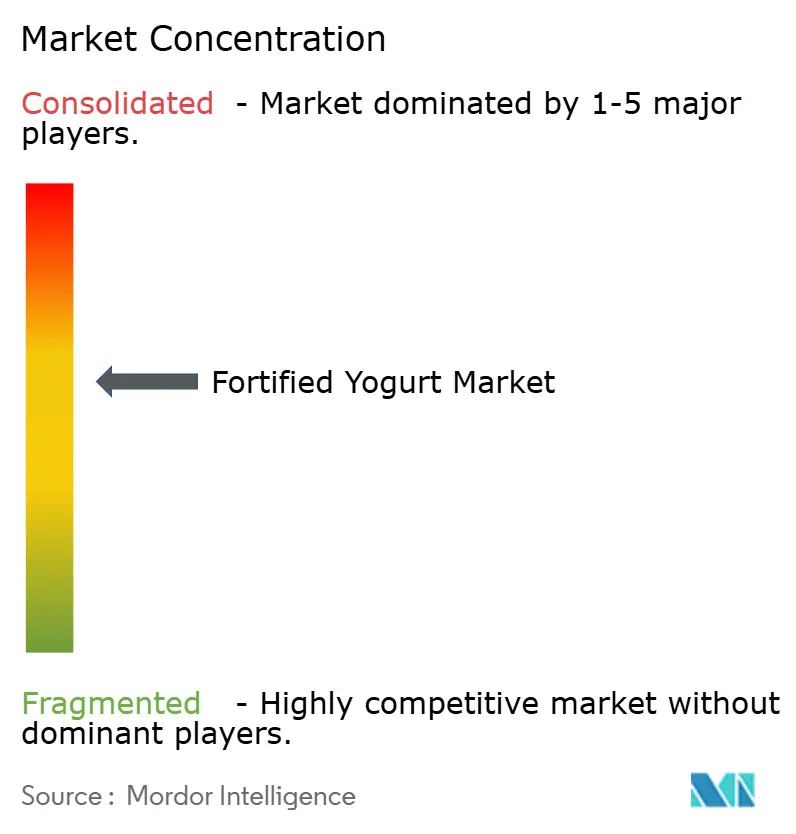
| Market Concentration | Medium |
Major Players *Disclaimer: Major Players sorted in no particular order Image © Mordor Intelligence. Reuse requires attribution under CC BY 4.0. | |
Fortified Yogurt Market Analysis by Mordor Intelligence
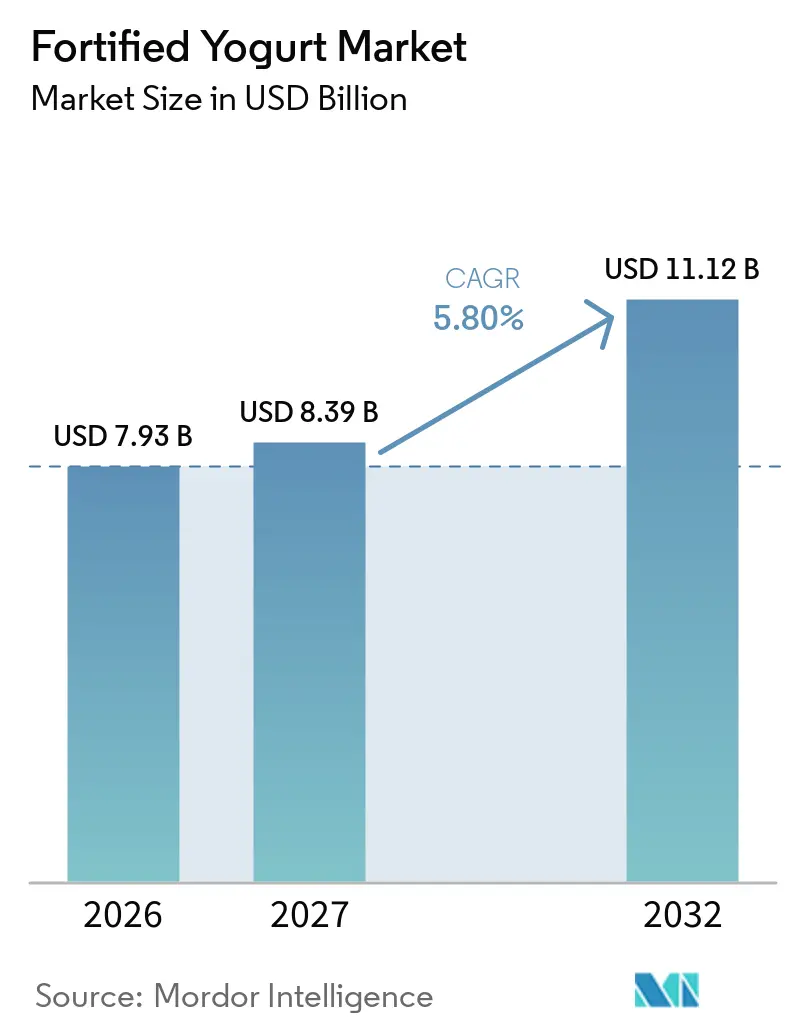
The global fortified yogurt market is valued at USD 7.93 billion in 2026 and is projected to reach USD 11.12 billion by 2032, following a CAGR of 5.80% during 2027–2032. Demand is supported by growing consumer interest in functional dairy products that combine everyday nutrition with benefits such as digestive health, protein intake, and micronutrient supplementation. Spoonable yogurt remains the leading product format, while drinkable yogurt offers a faster-growing alternative for consumers seeking convenient, portable nutrition. Probiotic-fortified products are gaining relevance as manufacturers expand functional formulations, while products targeting children and other specific demographic groups support differentiated product development. Supermarkets and hypermarkets remain the principal distribution channel, although online retail is projected to expand faster, creating opportunities for targeted product discovery and direct-to-consumer engagement. Competition spans multinational dairy companies, regional manufacturers, and specialist functional-nutrition brands, with opportunities in differentiated formulations, age-specific products, and emerging markets.
Key Report Takeaways
- By product type, spoonable yogurt accounted for 57.40% of the fortified yogurt market share in 2026, while drinkable yogurt is projected to record a 6.90% CAGR through 2032.
- By nutrient positioning, probiotic-fortified yogurt commanded a 35.70% market share in 2026 and is projected to grow at an 8.50% CAGR through 2032.
- By customer demographics, children accounted for 42.50% of the fortified yogurt market share in 2026, while adults are projected to expand at a 6.80% CAGR through 2032.
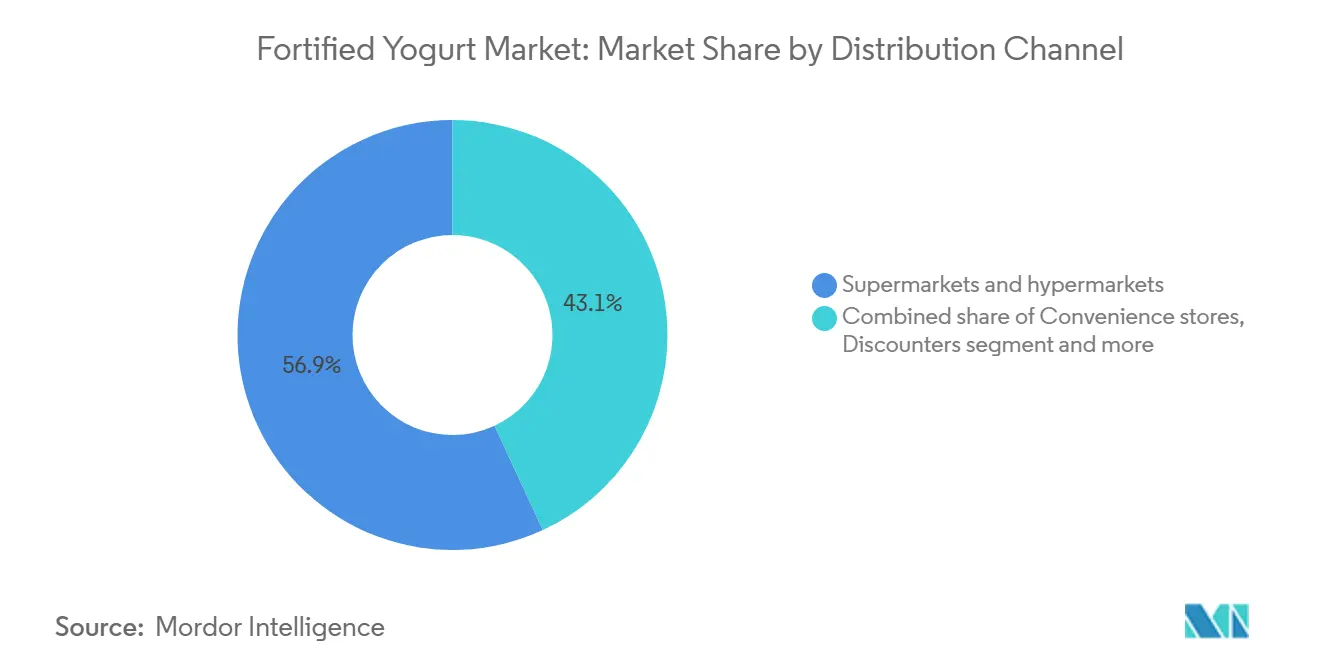
- By distribution channel, supermarkets/hypermarkets held a 56.90% market share in 2026, while online retail is forecast to grow at a 9.80% CAGR through 2032.
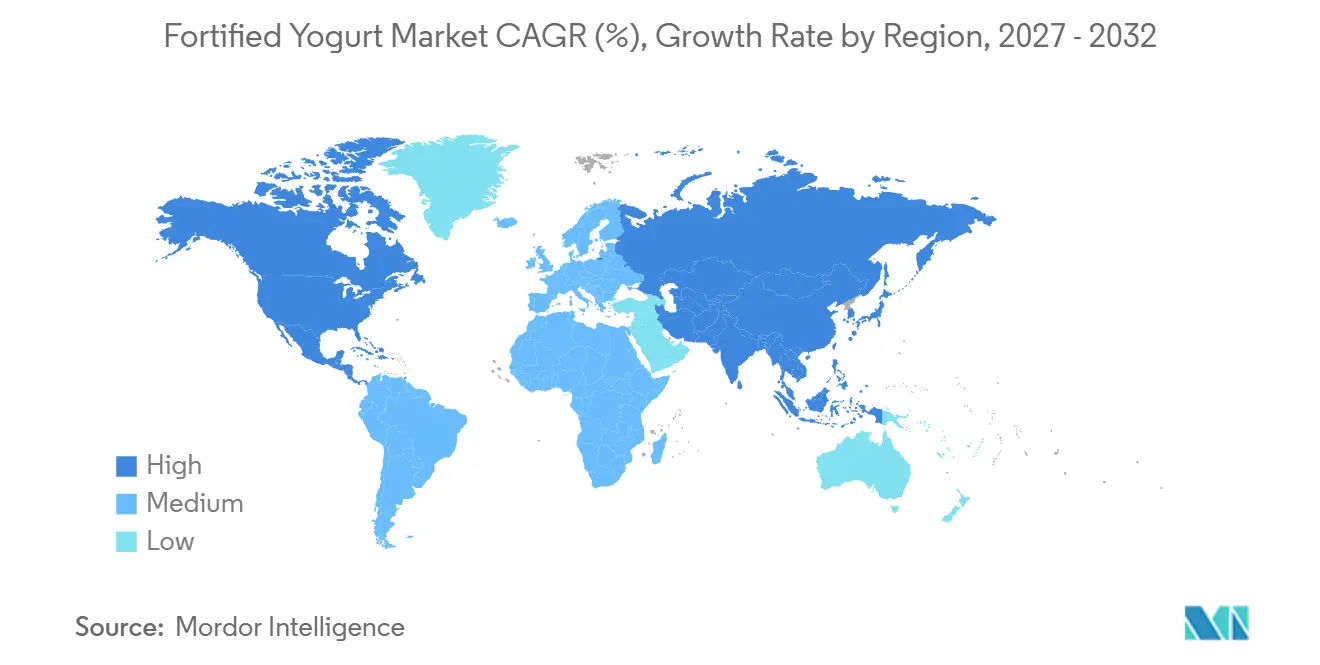
- By geography, North America led with a 34.80% market share in 2026, while Asia-Pacific is projected to register an 8.90% CAGR through 2032.
Note: Market numbers in this report are based on Mordor Intelligence's proprietary estimation framework, which combines nine months of actuals with Q4 projections for base year 2026.
Market Trends and Insights
Drivers Impact Analysis of Fortified Yogurt Market*
| Driver | (~) % Impact on CAGR Forecast | Geographic Relevance | Impact Timeline |
|---|---|---|---|
| Rising awareness of micronutrient deficiencies | +0.8% | Global; particularly markets with documented micronutrient gaps | More than 4 years |
| Growing demand for functional dairy products | +0.9% | Global, including North America, Europe and Asia-Pacific | 2–4 years |
| Increasing demand for probiotic yogurt for digestive health | +1.0% | Global; established dairy markets and expanding Asian markets | 2–4 years |
| Rising preference for protein-enriched yogurt | +0.7% | Global, particularly North America and Europe | 2–4 years |
| Innovation in age-specific fortified yogurt products | +0.5% | Global, subject to local nutritional needs and regulations | More than 4 years |
| Expanding online and modern retail distribution | +0.6% | Global; strongest relevance where cold-chain retail and e-commerce are accessible | Less than 2 years |
| Source: Mordor Intelligence | |||
Rising Awareness of Micronutrient Deficiencies
Growing awareness of inadequate micronutrient intake creates opportunities for fortified yogurt to deliver selected vitamins and minerals through a familiar food format. A 2024 global modelling analysis estimated that more than five billion people had inadequate dietary intake of iodine, vitamin E, and calcium, highlighting the broader nutritional relevance of food fortification. Although these estimates cover the general population rather than yogurt consumers specifically, they support the potential role of fortified foods in addressing nutritional gaps.[1] Manufacturers can differentiate their products through targeted nutrient combinations, clear nutrition labelling, and formulations aligned with recognised dietary needs. This creates opportunities to position fortified yogurt as a convenient component of everyday nutrition.
Growing Demand for Functional Dairy Products
Functional dairy products combine conventional nutritional value with additional attributes such as added vitamins, minerals, protein, and beneficial cultures. This positioning allows yogurt manufacturers to differentiate their offerings beyond flavour, texture, and basic dairy nutrition. Fortified yogurt can serve multiple consumption occasions, including breakfast, snacking, and everyday nutritional supplementation. Manufacturers can expand their portfolios through differentiated formulations and targeted nutritional benefits while maintaining taste, affordability, and product convenience. These factors support opportunities for functional dairy innovation across established and developing markets.
Increasing Demand for Probiotic Yogurt for Digestive Health
Probiotic-fortified yogurt offers manufacturers an opportunity to differentiate products through live cultures and digestive-wellness positioning. Consumer interest in digestive health supports product development focused on specific cultures, formulation quality, and appropriate health-related communication.[2]However, probiotic performance depends on the microorganism used, product formulation, processing conditions, and viability throughout shelf life. Manufacturers must therefore balance culture stability and product quality with applicable regulations governing nutrition and health claims. Products combining credible functional attributes with acceptable taste and texture can strengthen differentiation within the fortified yogurt market.
Rising Preference for Protein-Enriched Yogurt
Protein enrichment creates opportunities to position yogurt as a convenient food option for consumers seeking protein at breakfast, during snacking occasions, or around physical activity. In February 2025, Danone announced the Canadian launch of Oikos PRO Greek yogurt products containing 18–24 grams of protein per serving.[3] This company-level product example demonstrates how manufacturers are differentiating yogurt through higher protein content and specialised product positioning. Protein-enriched formulations can appeal to consumers seeking convenient nutritional options without changing their established eating habits. Manufacturers must balance protein content with taste, texture, serving size, and price to maintain product acceptability.
Restraints Impact Analysis of Fortified Yogurt Market*
| Restraint | (~) % Impact on CAGR Forecast | Geographic Relevance | Impact Timeline |
|---|---|---|---|
| High production costs and premium prices | -0.8% | Global, particularly price-sensitive markets | 2–4 years |
| Nutrient stability and sensory challenges | -0.6% | Global, across different fortified yogurt formulations | 2–4 years |
| Regulatory requirements for fortification and labeling | -0.5% | Global, with requirements varying by jurisdiction | Less than 2 years |
| Refrigeration requirements and limited shelf life | -0.7% | Global, particularly markets with limited cold-chain infrastructure | 2–4 years |
| Source: Mordor Intelligence | |||
High Production Costs and Premium Prices
Fortified yogurt can incur additional costs from vitamin and mineral ingredients, specialised cultures, formulation trials, quality testing, and production controls. Refrigerated storage and distribution further increase operational requirements compared with products that do not require continuous temperature control. These costs can translate into higher retail prices, potentially limiting adoption among price-sensitive consumers and in markets where conventional yogurt is more affordable. Manufacturers can address this challenge through efficient ingredient sourcing, formulation optimisation, production scale, and differentiated product positioning. Maintaining a balance between nutritional benefits and affordability is essential to broaden the consumer base.
Nutrient Stability and Sensory Challenges
The addition of vitamins, minerals, protein, and probiotic cultures can create formulation challenges because ingredients must remain compatible with the yogurt matrix and processing conditions. Certain nutrients may be affected by storage conditions, while mineral fortification and higher protein concentrations can influence taste, texture, colour, and mouthfeel. Probiotic formulations also require attention to culture viability throughout the intended shelf life. Manufacturers may need additional formulation development, stability testing, and quality-control procedures to maintain nutritional specifications and consistent product quality. These requirements can increase development complexity and delay commercialisation if the desired nutritional profile compromises consumer acceptability.
*Our forecasts treat driver/restraint impacts as directional, not additive. The impact forecasts reflect baseline growth, mix effects, and variable interactions.
Fortified Yogurt Market Segment Analysis
By Product Type:
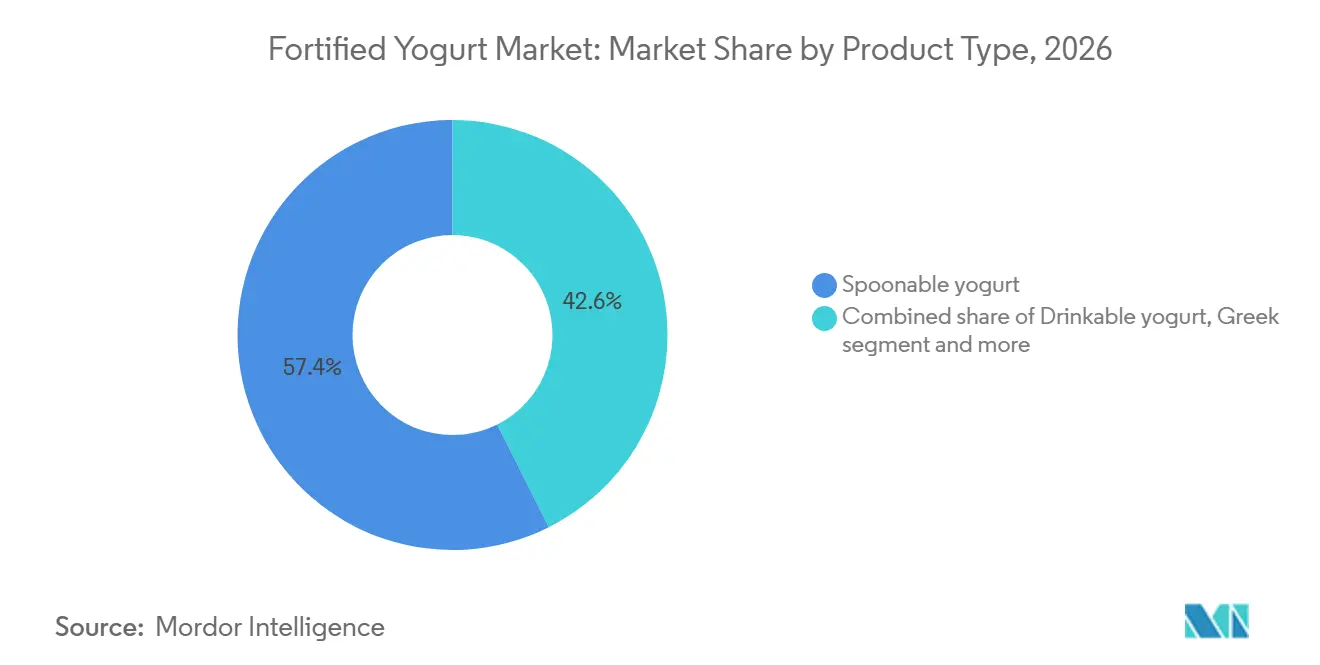
Spoonable Yogurt Leads While Drinkable Formats ExpandSpoonable yogurt accounted for 57.40% of the fortified yogurt market in 2026, making it the largest product-type segment. Its leading position reflects the established consumption format of yogurt as a breakfast food, snack, and vehicle for added nutrients. Spoonable products also accommodate a range of formulations, including probiotic, vitamin-fortified, mineral-enriched, and high-protein varieties, allowing manufacturers to serve different nutritional needs within a familiar format.
Drinkable yogurt is projected to be the fastest-growing product-type segment, with a CAGR of 6.90% from 2027 to 2032. Its portability and suitability for consumption outside the home support its potential across convenience-oriented occasions. Manufacturers can also develop drinkable formulations with added cultures, vitamins, and protein to differentiate products. For the fortified yogurt market size assessment, the distinction between spoonable and drinkable formats is important because each supports different consumption occasions and formulation requirements.

By Nutrient Positioning:
Probiotic Fortification Leads Functional NutritionProbiotic-fortified yogurt accounted for 35.70% of the fortified yogurt market in 2026, making it the largest supplied category by nutrient positioning. Probiotic formulations align yogurt with digestive-wellness positioning while retaining its role as an everyday dairy food. Manufacturers can differentiate products through culture selection, formulation quality, and clear communication of permitted product benefits, while maintaining culture viability and acceptable taste throughout shelf life.
Probiotic-fortified yogurt is also projected to be the fastest-growing category within nutrient positioning, with a CAGR of 8.50% from 2027 to 2032. This growth outlook points to opportunities for manufacturers to develop products combining live cultures with other nutritional attributes, provided that formulation compatibility and labelling requirements are addressed. The nutrient-positioning segmentation also includes vitamins, minerals, and protein, each serving different nutritional objectives. The supplied figures establish probiotic-fortified yogurt's 2026 lead and forecast growth, but do not provide individual market shares for the other categories.
By Customer Demographic:
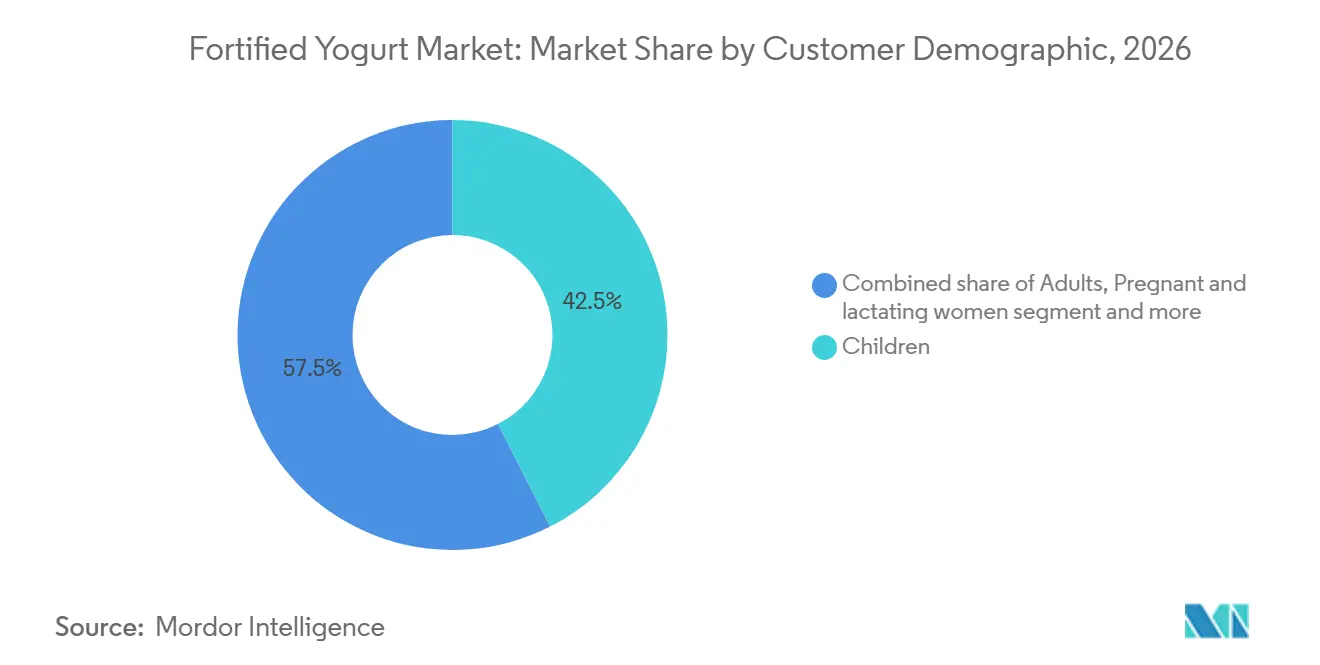
Children's Products Lead Targeted NutritionChildren accounted for 42.50% of the fortified yogurt market in 2026, making them the largest customer-demographic segment. Fortified yogurt can be positioned for children's nutritional needs through age-appropriate formulations and convenient serving formats. Product development must consider nutrient levels, serving sizes, taste acceptance, and applicable requirements for foods marketed to children. These factors make formulation and communication particularly important when developing products for this demographic.
The adult segment is projected to be the fastest-growing demographic category, with a CAGR of 6.80% from 2027 to 2032. Manufacturers can address adult demand through products positioned around protein intake, digestive health, and everyday nutritional convenience. Older adults and pregnant and lactating women also represent distinct consumer groups, although the supplied data does not establish their individual market shares or growth rates. Understanding differences in nutritional needs can help companies develop targeted product portfolios without assuming that one formulation suits every demographic.
By Distribution Channel:
Supermarkets Lead as Online Retail AcceleratesSupermarkets and hypermarkets accounted for 56.90% of the fortified yogurt market in 2026, making them the largest distribution subchannel. Their position reflects the role of established grocery retail in offering refrigerated dairy products, supporting product comparison, and providing access to multiple brands and formats. Refrigerated display infrastructure is particularly relevant for fortified yogurt, which generally requires temperature-controlled handling. In-store availability also allows manufacturers to reach consumers through routine grocery shopping rather than relying solely on specialist nutrition outlets.
Online retail is projected to be the fastest-growing distribution subchannel, with a CAGR of 9.80% from 2027 to 2032. Digital channels can improve product discovery by presenting nutritional information, ingredient lists, and product comparisons, although refrigerated fulfilment and last-mile delivery remain important operational considerations. Other channels in the finalized TOC include convenience stores, discounters, and other off-trade channels, alongside on-trade distribution. The market share figures supplied for supermarkets and hypermarkets establish the channel's 2026 lead, while the forecast for online retail highlights a faster-growing route to consumers.
Geography Analysis
North America Fortified Yogurt Market
North America was the largest regional market for fortified yogurt in 2026, accounting for 34.80% of the global market. The region's established dairy industry, availability of functional dairy products, and consumer interest in protein-enriched and probiotic yogurt support demand for fortified formulations. Manufacturers can differentiate their portfolios through targeted nutritional benefits, convenient packaging, and product variants designed for different consumer groups. The verified 2025 regional market share has not been provided, so the 2026 figure is used for the regional comparison.
APAC Fortified Yogurt Market
Asia-Pacific is projected to be the fastest-growing regional market, with a CAGR of 8.90% from 2027 to 2032. Opportunities are supported by the potential to expand access to fortified dairy products, rising interest in convenient nutritional foods, and product development tailored to local dietary preferences. China, India, Japan, Indonesia, and other markets within the region have different dairy-consumption patterns, distribution infrastructure, and regulatory requirements, creating varied opportunities for manufacturers. Market expansion will depend on product affordability, appropriate formulations, refrigerated distribution, and compliance with local food-fortification and labelling regulations.
EMEA and South America Fortified Yogurt Market
Across the global market, regional strategies need to reflect differences in consumer needs, retail infrastructure, and product affordability. North America offers an established market for differentiated fortified yogurt products, while Asia-Pacific presents the strongest forecast growth opportunity among the supplied regional comparisons. Europe, South America, and the Middle East and Africa also provide opportunities for product development and distribution expansion, but country-level market shares and growth rates have not been supplied.
Competitive Landscape
The fortified yogurt market is characterised by competition among multinational dairy companies, regional dairy producers, and specialist functional-nutrition brands. Competition centres on product innovation, nutritional positioning, brand portfolios, manufacturing capabilities, refrigerated distribution, and retail reach. Key barriers to entry include product formulation, quality control, regulatory compliance, cold-chain infrastructure, and the cost of establishing distribution networks and consumer recognition.
Key players include Danone S.A., Nestlé S.A., Yili Group, Arla Foods amba, GCMMF (Amul), Fonterra Co-operative Group, FrieslandCampina, Inner Mongolia Mengniu Dairy, Lactalis Group, Yakult Honsha Co., Ltd., Chobani LLC, Vinamilk, Yeo Hiap Seng, Morinaga Milk Industry Co., Ltd., Abbott Laboratories, China Feihe Ltd., Grupo Lala, Clover Industries, Dairy Farmers of America, General Mills, Inc., and Oikos. These companies represent a mix of dairy manufacturers, fermented-food producers, nutrition businesses, and consumer brands. Their product portfolios and distribution capabilities span different markets and consumer groups, with competition shaped by functional formulations, protein enrichment, probiotic positioning, and established dairy product offerings.
Product innovation remains an important competitive strategy, particularly in protein-enriched, probiotic, vitamin-fortified, and mineral-enriched yogurt. In February 2025, Danone announced the Canadian launch of Oikos PRO Greek yogurt products containing 18–24 grams of protein per serving. This development illustrates the use of protein content as a product differentiation strategy within the yogurt category. Companies can also pursue differentiation through age-specific formulations, improved product stability, packaging innovation, and distribution expansion to address changing nutritional preferences and consumption occasions.
Fortified Yogurt Industry Leaders
-
Danone S.A.
-
Yili Group
-
Nestlé S.A.
-
GCMMF
-
Morinaga Milk Industry Co., Ltd.
- *Disclaimer: Major Players sorted in no particular order
Fortified Yogurt Market Companies Covered in this Report
- Danone S.A.
- Nestlé S.A.
- Yili Group
- Arla Foods amba
- GCMMF (Amul)
- Fonterra Co-operative Group
- FrieslandCampina
- Inner Mongolia Mengniu Dairy
- Lactalis Group
- Yakult Honsha Co., Ltd.
- Chobani LLC
- Vinamilk
- Yeo Hiap Seng
- Morinaga Milk Industry Co., Ltd.
- Abbott Laboratories
- China Feihe Ltd.
- Grupo Lala
- Clover Industries
- Dairy Farmers of America
- General Mills, Inc.
Recent Industry Developments in Fortified Yogurt Market
- September 2026: Danone Canada announced a portfolio-wide reformulation of Activia yogurt in Canada, combining active probiotics with vitamins A and D to support digestive health, immune function, and bone health. The reformulation also replaces gelatin with plant-derived pectin across core products, positioning the range around multiple functional benefits and a simplified ingredient profile.
- July 2026: Danone expanded its Silk Protein portfolio in the United States with Silk Protein Yogurt, a plant-based product delivering at least 12 g of complete plant protein and 4 g of fiber per serving, alongside five essential nutrients: calcium, vitamin D, vitamin B12, iodine, and phosphorus. Available in Vanilla, Strawberry, Peach, and Mixed Berry, the range broadens nutrient-enriched yogurt alternatives for consumers seeking protein and additional nutritional benefits.
- February 2026: Danone Japan announced the launch of Oikos PRO Protein Drink Rich Vanilla, the first product in its PRO series, containing 25 g of protein per 240 ml serving, nine essential amino acids, and vitamins B1, B6 and D. The product was scheduled for nationwide release in convenience stores from March 2, 2026, followed by supermarkets from March 30, 2026. The drink also retains the brand’s zero-fat and no-added-sugar positioning.
- August 2025: Danone Canada launched Activia EXPERT, a yogurt range combining probiotics and prebiotics to support digestive health. The launch extends the brand’s functional-nutrition positioning beyond conventional probiotic yogurt by pairing the two ingredient categories in a single product range for Canadian consumers
Global Fortified Yogurt Market Report Scope
Fortified yogurt refers to yogurt products marketed and sold with added nutritional ingredients, including vitamins, minerals, probiotics, prebiotics, or protein, to provide specific nutritional or functional benefits. The global fortified yogurt market is classified by product type, nutrient positioning, customer demographics, distribution channel, and geography. Based on product type, the market is classified into spoonable yogurt, drinkable yogurt, Greek and high-protein yogurt, and others. Based on nutrient positioning, the market is classified into vitamin-fortified, mineral-fortified, probiotic-fortified, prebiotic-fortified, protein-fortified, and other fortified yogurt products. Based on target consumer demographics, the fortified yogurt market is segmented into children, adults, pregnant and lactating women, and older adults. Based on distribution channel, the market is segmented into off-trade and on-trade channels. Based on geography, the market is classified into North America, Europe, Asia-Pacific, the Middle East and Africa, and South America. The market forecasts are provided in terms of value (USD) and volume (tons).
Segmentation Overview
| Spoonable yogurt |
| Drinkable yogurt |
| Greek and high-protein yogurt |
| Other fortified yogurt |
| Vitamins |
| Minerals |
| Probiotics and prebiotics |
| Protein |
| Children |
| Adults |
| Pregnant and lactating women |
| Older adults |
| Off-Trade | Hypermarkets and Supermarkets |
| Convenience Stores | |
| Discounters | |
| Online Retail Stores | |
| Other off-trade channels | |
| On-Trade |
| North America | United States |
| Canada | |
| Mexico | |
| Rest of North America | |
| Europe | United Kingdom |
| Germany | |
| France | |
| Italy | |
| Spain | |
| Sweden | |
| Belgium | |
| Poland | |
| Netherlands | |
| Europe | |
| Asia-Pacific | China |
| Japan | |
| India | |
| Thailand | |
| Singapore | |
| Indonesia | |
| Korea | |
| Australia | |
| Rest of Asia-Pacific | |
| South America | Brazil |
| Argentina | |
| Colombia | |
| Peru | |
| Chile | |
| Rest of South America | |
| Middle East and Africa | South Africa |
| Saudi Arabia | |
| United Arab Emirates | |
| Nigeria | |
| Egypt | |
| Morocco | |
| Turkey | |
| Rest of Middle East and Africa |
| By Product Type | Spoonable yogurt | |
| Drinkable yogurt | ||
| Greek and high-protein yogurt | ||
| Other fortified yogurt | ||
| By nutrient Positioning | Vitamins | |
| Minerals | ||
| Probiotics and prebiotics | ||
| Protein | ||
| By customer demographic | Children | |
| Adults | ||
| Pregnant and lactating women | ||
| Older adults | ||
| By distribution channel | Off-Trade | Hypermarkets and Supermarkets |
| Convenience Stores | ||
| Discounters | ||
| Online Retail Stores | ||
| Other off-trade channels | ||
| On-Trade | ||
| By Geography | North America | United States |
| Canada | ||
| Mexico | ||
| Rest of North America | ||
| Europe | United Kingdom | |
| Germany | ||
| France | ||
| Italy | ||
| Spain | ||
| Sweden | ||
| Belgium | ||
| Poland | ||
| Netherlands | ||
| Europe | ||
| Asia-Pacific | China | |
| Japan | ||
| India | ||
| Thailand | ||
| Singapore | ||
| Indonesia | ||
| Korea | ||
| Australia | ||
| Rest of Asia-Pacific | ||
| South America | Brazil | |
| Argentina | ||
| Colombia | ||
| Peru | ||
| Chile | ||
| Rest of South America | ||
| Middle East and Africa | South Africa | |
| Saudi Arabia | ||
| United Arab Emirates | ||
| Nigeria | ||
| Egypt | ||
| Morocco | ||
| Turkey | ||
| Rest of Middle East and Africa | ||
Key Questions Answered in the Report
What is the fortified yogurt market size?
The fortified yogurt market is valued at USD 7.93 billion in 2026 and is projected to reach USD 11.12 billion by 2032.
What is the expected growth rate of the fortified yogurt market?
The market is projected to grow at a CAGR of 5.80% during 2027–2032, supported by demand for yogurt products offering additional nutritional and functional benefits.
Which region leads the fortified yogurt market, and which is expected to grow fastest?
North America is the largest regional market, accounting for 34.80% of the market in 2026. Asia-Pacific is projected to be the fastest-growing region, with a CAGR of 8.90% during 2027–2032.
Which distribution channel dominates the fortified yogurt market?
Supermarkets and hypermarkets lead the distribution landscape, accounting for 56.90% of the market in 2026. Online retail is projected to grow faster, with a CAGR of 9.80% during 2027–2032.