
Fish Pumps Market Size and Share
Market Overview
| Study Period | 2022 - 2032 |
|---|---|
| Market Size (2027) | USD 153.80 Million |
| Market Size (2032) | USD 216.41 Million |
| Growth Rate (2027 - 2032) | 7.07 % |
| Fastest Growing Market | Asia-Pacific |
| Largest Market | Europe |
| Market Concentration | Medium |
Major Players *Disclaimer: Major Players sorted in no particular order Image © Mordor Intelligence. Reuse requires attribution under CC BY 4.0. | |
Fish Pumps Market Analysis by Mordor Intelligence
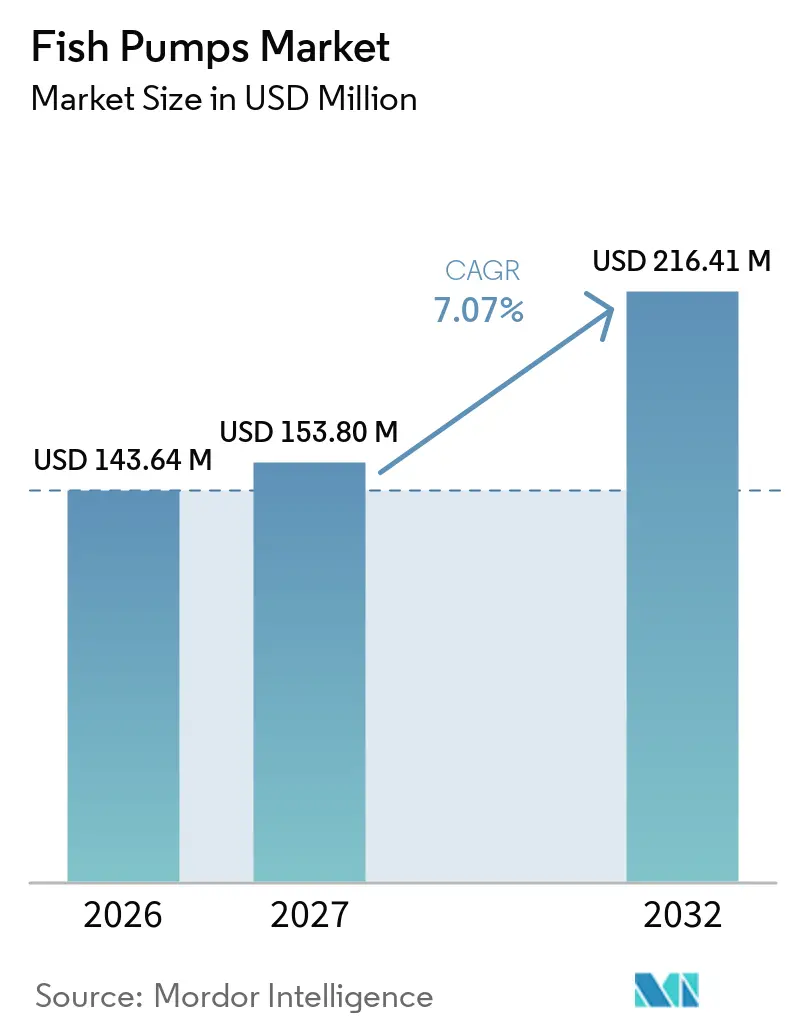
The fish pumps market size was valued at USD 143.64 million in 2026 and is forecast to grow from USD 153.80 million in 2027 to USD 216.41 million by 2032, at a CAGR of 7.07% from 2027 to 2032. Demand is shifting toward land-based and recirculating aquaculture systems, where operators require controlled water circulation and gentle live-fish transfer across production stages, including intake, grow-out, grading, tank-to-tank movement, harvest, and water treatment. In these systems, pumps are planned as part of the facility build rather than purchased after construction, as the selected equipment must be compatible with the site layout, pipework, treatment equipment, and controls.
Operators are placing greater emphasis on equipment that supports fish welfare, biosecurity, and automated operations, as poor flow control or inadequate separation between functions can affect daily production, regulatory compliance, and overall farm system reliability. This favors suppliers that can contribute to design, commissioning, and ongoing system monitoring. High project costs, limited service availability in remote areas, and species-specific validation requirements continue to slow some purchasing decisions, particularly when farms must coordinate multiple contractors, or demonstrate that a pump configuration is suitable for their stock before committing to a broader investment.
Key Report Takeaways
- By product type, centrifugal pumps accounted for 33.2% of the fish pumps market share in 2026, while vacuum pumps are forecast to grow at a CAGR of 8.7% from 2027 to 2032.
- By drive technology, electric motor accounted for 54% of the fish pumps market size in 2026, while solar and other renewable drive configurations are forecast to grow at a CAGR of 9% from 2027 to 2032.
- By installation and farm system, land-based aquaculture accounted for 41% of the market share in 2026 and is forecast to grow at a CAGR of 9.1% from 2027 to 2032.
- By capacity, the 200 to 500 cubic meters per hour segment accounted for 34% of the market share in 2026, while the 50 to 200 cubic meters per hour segment was forecast to grow at a CAGR of 8% from 2027 to 2032.
- By geography, Europe accounted for 32.6% of the market share in 2026, while Asia-Pacific is forecast to grow at a CAGR of 8.4% from 2027 to 2032.
Note: Market numbers in this report are based on Mordor Intelligence's proprietary estimation framework, which combines nine months of actuals with Q4 projections for base year 2026.
Market Trends and Insights
Drivers Impact Analysis of Fish Pumps Market*
| Driver | (~) % Impact on CAGR Forecast | Geographic Relevance | Impact Timeline |
|---|---|---|---|
| Expansion of Land-Based and Recirculating Aquaculture | +1.8% | Global, strongest in Europe and Asia-Pacific | Medium term (2-4 years) |
| Rising Demand for Sustainable Seafood and Fish Welfare | +1.3% | Global, highest impact in Europe and North America | Medium term (2-4 years) |
| Automation of Harvesting, Grading, and Live-Fish Transfer | +1.2% | Global, early leadership in Norway, Chile, and Japan | Medium term (2-4 years) |
| Capacity Expansion in Salmon, Trout, Shrimp, and Warm-Water Farming | +1.4% | Global, concentrated in Asia-Pacific and South America | Short term (≤ 2 years) |
| Low-Shear Pumping Standards Becoming a Procurement Gate | +0.8% | Europe and North America, emerging in Asia-Pacific | Long term (≥ 4 years) |
| Biosecurity-Driven Separation of Water and Biomass Flows | +0.8% | Global, with regulatory reinforcement in Norway and the European Union | Medium term (2-4 years) |
| Source: Mordor Intelligence | |||
Expansion of Land-Based and Recirculating Aquaculture
Recirculating aquaculture systems require pumps at each stage of production, including intake, grow-out, biomass transfer, and harvest. This creates demand for multiple pump units within a single facility. Land-based farms also require dedicated circulation equipment, redundancy, and controls to maintain stable water conditions. The fish pumps market benefits when projects scale from pilot facilities to commercial operations. Suppliers are increasingly selected during the design phase, before final commissioning begins. This gives engineering capability and operating documentation a greater role in supplier selection, as the pump layout must align with tank design, water treatment equipment, pipework, biomass movement, cleaning requirements, control systems, and the planned sequence of daily farm operations from the outset.
Rising Demand for Sustainable Seafood and Fish Welfare
Fish welfare has become more relevant to equipment selection as retailers, certification programs, and regulators review farm practices. The European Union published a Code of Good Practices on Fish Welfare and Fish Welfare Indicators in October 2025, establishing benchmarks applicable across aquaculture production methods.[1] The Aquaculture Stewardship Council (ASC) Farm Standard includes impact-based sustainability requirements that cover animal welfare. These requirements increase the value of documented low-shear and low-mortality handling performance.[2]Farm operators may face more scrutiny when equipment lacks clear evidence of welfare. Established suppliers benefit when they can provide records across multiple fish species and operating conditions, allowing operators to review practical results from comparable environments, assess handling methods before purchase, and align equipment decisions with the welfare evidence requested by customers, certification programs, and internal farm management teams.
Automation of Harvesting, Grading, and Live-Fish Transfer
Automation is more closely linking pump performance to grading, counting, and harvest operations. Variable-speed equipment can adjust flow to match the pace of downstream systems, helping farms avoid abrupt transfer conditions during periods of high throughput. It also makes equipment monitoring more useful for operators managing multiple tanks or buildings. VAKI offers a SmartFlow system that uses a Smart Counter to monitor fish flow speed and regulate a connected Smart Pump. The fish pumps market presents opportunities for suppliers that combine transfer equipment with control systems suitable for daily farm operations, particularly when those systems provide clear information, support timely adjustments to operating settings, and reduce the coordination required among pumping, grading, counting, harvesting, and routine supervision activities.
Capacity Expansion in Salmon, Trout, Shrimp, and Warm-Water Farming
Higher output from salmon, shrimp, trout, and warm-water finfish farms increases the need for pumping, transfer, and handling equipment. In Chile, cultivated salmon biomass in the seawater phase increased by 17% year over year in 2025, indicating higher activity across marine farming operations and potentially greater requirements for fish transfer capacity [3]. Production growth across different species also creates varied pumping requirements, as equipment must accommodate differences in fish size, life stage, and sensitivity to handling. This supports demand for fish pumps with suitable flow rates and handling characteristics across different aquaculture applications.
Restraints Impact Analysis of Fish Pumps Market*
| Restraint | (~) % Impact on CAGR Forecast | Geographic Relevance | Impact Timeline |
|---|---|---|---|
| High Capital Cost of Integrated Fish-Handling Systems | -1.5% | Global, most acute for smaller operators in Africa and South America | Short term (≤ 2 years) |
| Skilled-Service Scarcity in Remote Farm Locations | -0.9% | Africa, Middle East, remote South America, and Oceania | Short term (≤ 2 years) |
| Species-Specific Validation Requirements for New Pump Designs | -0.7% | Global, strongest constraint in Asia-Pacific and North America | Long term (≥ 4 years) |
| Mortality Risk from Poorly Matched Flow, Shear, and Pressure Settings | -0.8% | Global, with heightened buyer caution in Europe and North America | Long term (≥ 4 years) |
| Source: Mordor Intelligence | |||
High Capital Cost of Integrated Fish-Handling Systems
Fish pump purchases are often included in wider facility investments. A project can combine pumps with filtration, oxygenation, controls, pipelines, installation, and commissioning work. This structure improves system compatibility but increases the farm's capital requirements. Smaller and mid-sized operators may delay a complete installation when financing is limited. Some farms instead purchase individual pump units and postpone broader integration. This approach can reduce the value of initial equipment orders and create future demand for retrofit-capable products. Operators who start with a narrower equipment scope may later add filtration, oxygenation, controls, pipelines, and commissioning services when production volumes, financing conditions, and internal operating capability support broader integration.
Skilled-Service Scarcity in Remote Farm Locations
Remote aquaculture sites often have limited access to technicians with commissioning and maintenance expertise. This is relevant in parts of Africa, the Middle East, remote South America, and Oceania. Equipment downtime can be costly when fish transfer or circulation cannot be interrupted. Farms in these locations value controls that simplify fault detection and routine maintenance. Suppliers may also need to provide remote support and clearer service documentation. The fish pumps market faces a slower adoption path, as local service networks remain limited, and farms must account for technician travel time, access to replacement parts, availability of routine inspections, staff training needs, and the practical consequences of delays when circulation or live-fish transfer equipment requires attention.
*Our forecasts treat driver/restraint impacts as directional, not additive. The impact forecasts reflect baseline growth, mix effects, and variable interactions.
Fish Pumps Market Segment Analysis
By Product Type:
Centrifugal Pumps Lead, While Vacuum Pumps Register the Fastest GrowthCentrifugal pumps accounted for 33.2% of the fish pumps market in 2026, supported by their widespread use in recirculating aquaculture systems, hatcheries, and water-intake applications. Their ability to support continuous water circulation across different farm systems makes them suitable for routine aquaculture operations. Fish-friendly designs help minimize stress on stock during water movement, while axial-flow pumps serve high-volume, low-head circulation requirements in sea-cage and pond systems. Mixed-flow and airlift systems are also used in applications requiring the gentle handling of juveniles and sensitive species. Positive-displacement pumps serve specialized applications requiring precise flow control, including grading and injection lines, while material selection and equipment configuration influence durability and maintenance requirements, particularly in saltwater environments.
Vacuum pumps are forecast to grow at a CAGR of 8.7% from 2027 to 2032, driven by their suitability for low-shear fish transfer involving salmonids and warm-water species. Demand for specialized pump designs is also supported by the need to match equipment with production stages, species sensitivity, required flow rates, and operating conditions. Marine-grade polymers and duplex stainless steel offer corrosion resistance in saltwater applications, while impeller geometry and material composition influence equipment service life and cleaning requirements. These factors support demand for coordinated pump portfolios and technical support to ensure reliable performance across diverse aquaculture systems.
By Drive Technology:
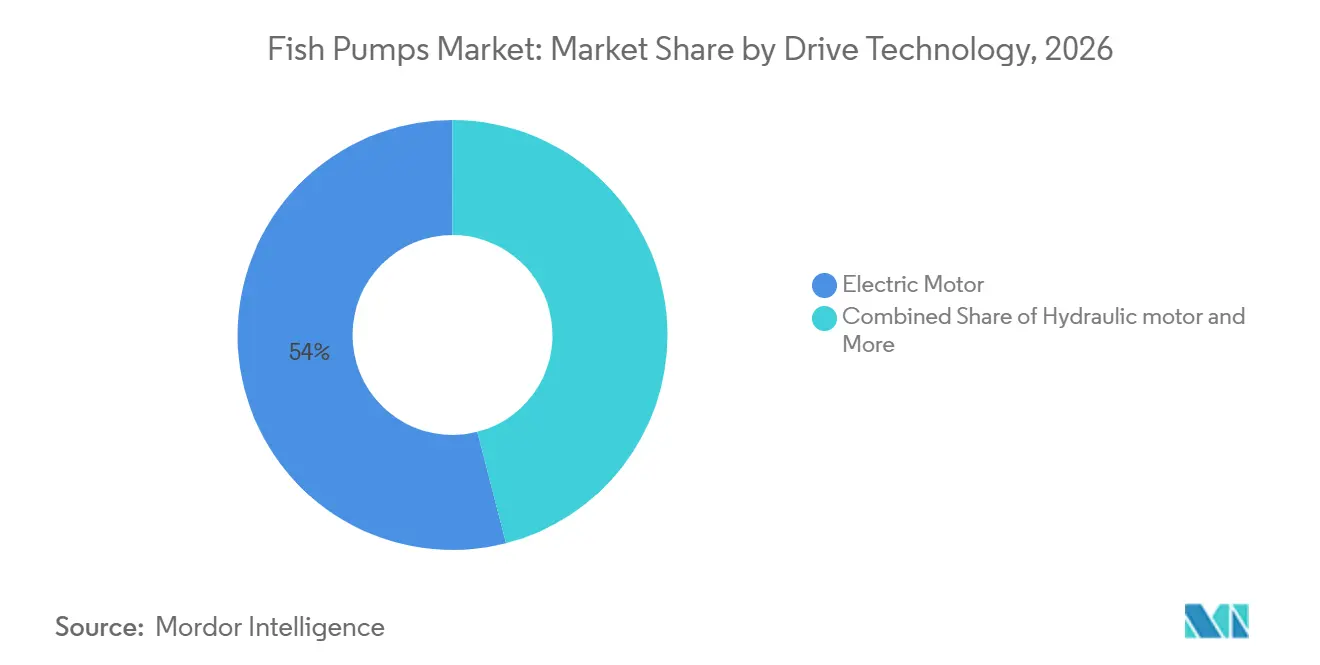
Electric Motors Support Facility-Level ControlElectric motor-driven pumps accounted for 54% of the fish pumps market in 2026. Their leading position reflects compatibility with variable-frequency controls, remote monitoring, and energy-management systems. Solar and other renewable-driven configurations are forecast to grow at a 9% CAGR from 2027 to 2032. These systems are relevant for farms where grid access is unreliable or expensive. Remote coastal operations in Indonesia, Africa, and South America can benefit from alternatives to conventional power supply. Hydraulic drives continue to play a role in vessel applications where existing hydraulic circuits provide a practical power source. Diesel- and gas-engine-driven units are used for remote operations and backup duties. Fuel costs and emissions requirements limit their appeal in some locations. Drive decisions also depend on whether a facility needs continuous operation or temporary emergency capacity. This creates a practical reason for farms to retain a single-drive approach across the site.
Variable-frequency drives are becoming common in newly built recirculating facilities. They allow operators to change flow speed in response to fish density, water temperature, and oxygen loading. This supports more controlled routine operation and can contribute to fish welfare. Electric drive systems also provide a practical route for linking pumps with facility data platforms. The fish pumps industry benefits when farms adopt monitoring systems that require consistent and adjustable pump operation. However, the value of digital control depends on commissioning and staff ability to interpret operating data. Suppliers that provide straightforward controls and service support may be better positioned in remote farm locations. Drive selection will continue to reflect both energy availability and the level of automation at the site.
By Installation and Farm System:
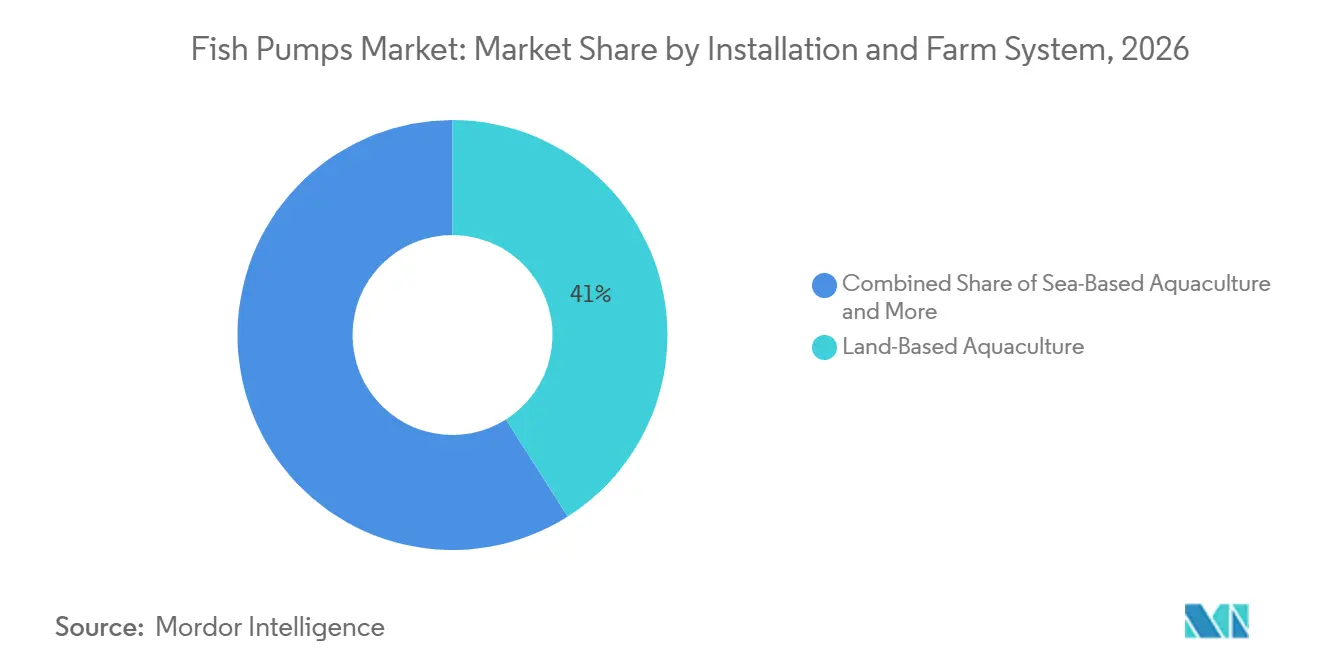
Land-Based Aquaculture Lead New Equipment DemandLand-based aquaculture accounted for 41% of the fish pumps market in 2026 and is forecast to grow at a CAGR of 9.1% from 2027 to 2032. Recirculating facilities require pumps for circulation, transfer, intake, water treatment, and harvest activities. This creates a higher equipment requirement per site than many conventional farming systems. Sea-based cage farms, pen systems, and well-boats retain a significant installed base, generating ongoing replacement and upgrade demand for circulation and live-fish transfer equipment. Hatcheries and research facilities form a stable part of demand as operators improve biosecurity and expand species programs. Fishing vessels and onshore receiving operations represent an established base for several suppliers. Growth in these applications is more closely tied to harvest volumes. The existing base still provides suppliers with opportunities to offer replacements that improve control and welfare performance, helping to maintain customer relationships as land-based projects become more central to new orders.
Land-based projects give pump suppliers an opportunity to engage with engineering teams at an early stage, helping to align pipework, valves, controls, and pumps with the intended production process. Cflow Fish Handling AS signed a contract at Aqua Nor 2025 to supply a complete fish-handling system for Pure Salmon Japan across six production buildings. Such contracts illustrate why suppliers value early involvement in facility design. The fish pumps market benefits when equipment providers take responsibility for system coordination rather than individual units alone. This approach may improve accountability during installation and commissioning and can raise switching costs once a supplier's equipment and documentation are embedded in the site. For operators, the primary consideration remains whether the system performs reliably under daily operating conditions.

By Capacity:
200 to 500 Cubic Meters per Hour Dominates, While 50 to 200 Cubic Meters per Hour is the Fastest-Growing SegmentThe 200 to 500 cubic meters per hour capacity tier accounted for 34% of the fish pumps market in 2026. This range matches the flow needs of mid-sized and large grow-out buildings and processing facilities. The 50 to 200 cubic meters per hour tier is forecast to grow at a CAGR of 8% from 2027 to 2032, reflecting the expansion of smaller and modular recirculating facilities. These projects may be below the scale of the largest salmon farms, but can account for substantial unit demand. Pumps rated up to 50 cubic meters per hour are used in hatcheries, nursery tanks, and research settings, where precise flow control is often valued over maximum capacity. Equipment above 500 cubic meters per hour serves the largest land-based installations and well-boat operations.
Capacity selection is closely linked to the tank layout, production stage, and design of the water-treatment system. Larger pumps can require customized materials and construction for saltwater durability. In 2025, Lykkegaard assembled 13 LMSALT 600 hybrid pumps for Cermaq Norway, with 600-mm-diameter units made from HDPE pipe and duplex alloys for saltwater service. This illustrates how large installations can require more specialized technical choices. The fish pumps market includes both standardized smaller units and highly configured systems for large projects. Suppliers need sufficient product breadth to serve each capacity tier without compromising welfare or operating reliability. Modular farms may favor equipment that can be expanded with additional tanks or buildings, while large facilities may prioritize engineering support and long-term service arrangements. Each capacity tier therefore requires a distinct balance of standard equipment, customized engineering, and operational support, which limits the suitability of a single standardized design across all projects.
Geography Analysis
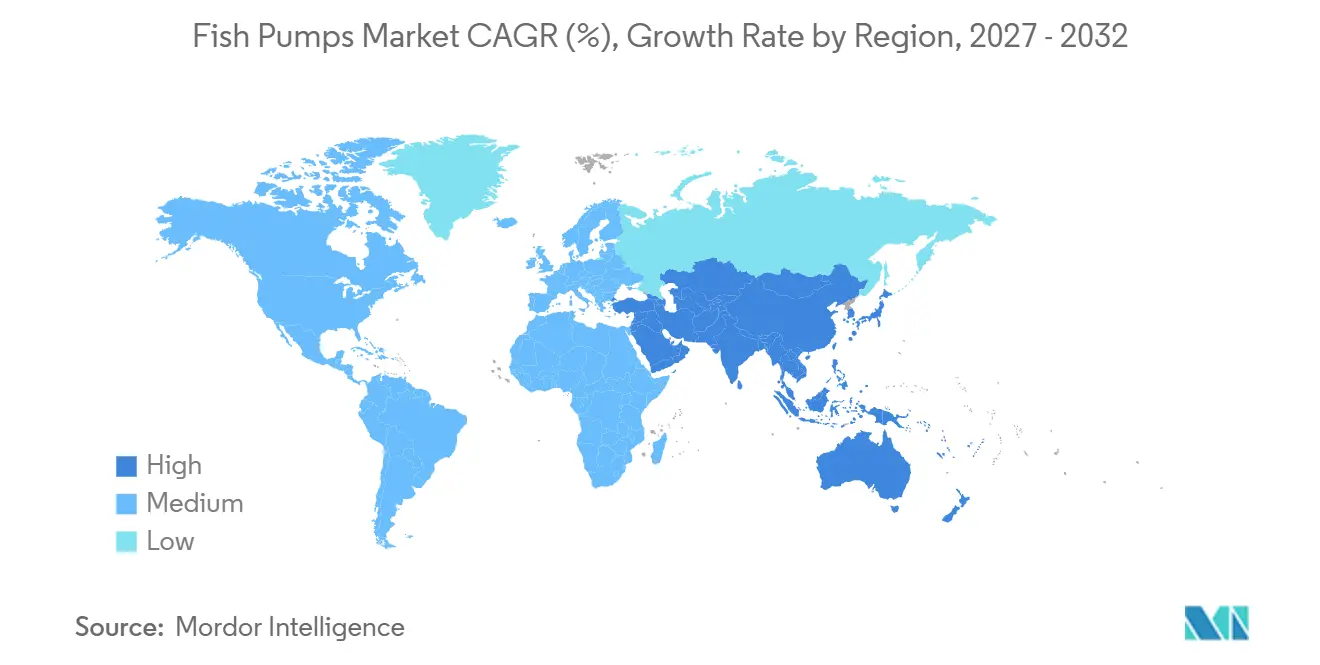
Europe accounted for 32.6% of the fish pumps market in 2026. Norway anchors demand through its salmon sector and continues investment in land-based facilities. The region has demanding requirements for animal welfare, water treatment, and biosecurity, which increases the need for coordinated engineering support from pump suppliers. Norway's 2025 regulatory amendment requires new land-based facilities to filter and disinfect intake water, linking pump design more directly with treatment equipment. European farms, therefore, place significant value on validated equipment performance, practical documentation, and the ability to maintain controlled water flows across multiple production stages.
Asia-Pacific is forecast to grow at a CAGR of 8.4% from 2027 to 2032, the fastest rate across all regions covered. Growth is distributed across recirculating aquaculture development in China and Japan, shrimp production in India, Vietnam, and Indonesia, and farm modernization in Australia and South Korea. These markets differ in species, site conditions, labor availability, and power infrastructure, requiring suppliers to adapt both equipment and service plans accordingly. The fish pumps market has strong potential where projects span multiple facilities and require integrated systems managing circulation, transfer, water treatment, and operational controls. Equipment with established performance records across species can help reduce the validation burden for operators developing new facilities.
South America growth is supported by salmon production in Chile and shrimp activity in Ecuador, while Faivre Group’s Pescamotion range is distributed through aquaculture equipment channels in Chile. The Middle East growth is supported as Saudi Arabia and the United Arab Emirates invest in land-based production, while Africa is forecast to expand from a low installed base, supported by growing hatchery, pond-farming, and food-security-linked programs. North America growth is driven by replacement demand and automation upgrades in its established equipment base. Service limitations remain material in Africa, the Middle East, and remote parts of South America, making maintenance support and diagnostic features more valuable to operators.
Competitive Landscape
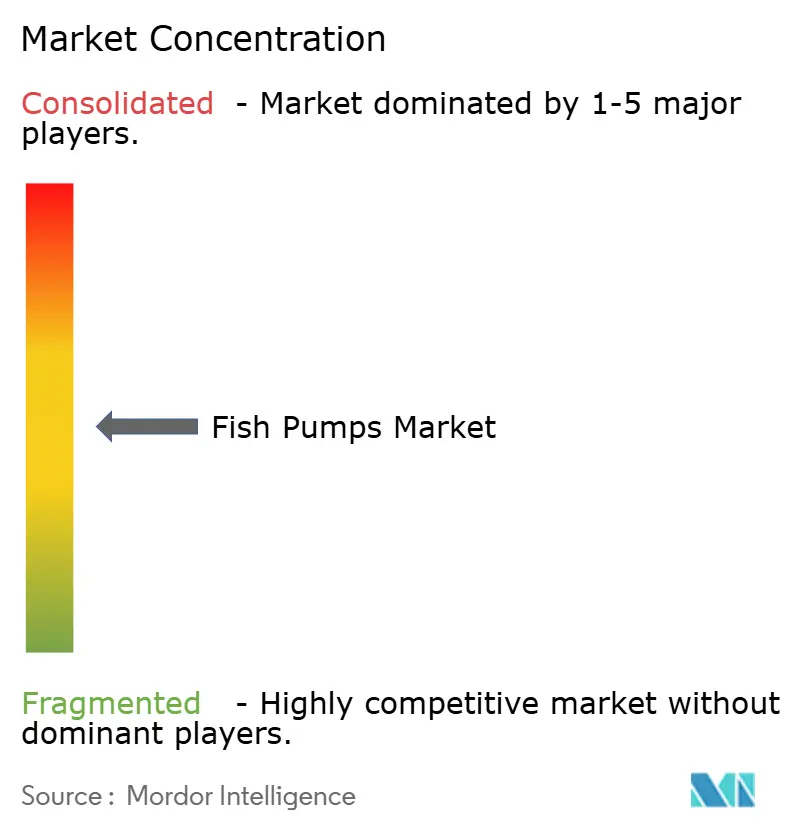
The fish pumps market was moderately consolidated in 2026, with several established global and regional suppliers competing across different aquaculture and fish-handling applications. The remaining revenue was distributed among specialized hydraulic pump makers, regional assemblers, and suppliers with aquaculture-focused product lines. Cflow Fish Handling AS, PG Flow Solutions AS, Pentair Aquatic Eco-Systems Inc., MMC First Process AS, and Faivre Group were the leading suppliers identified in the draft. DESMI A/S, Maskon AS, Hidrostal, and Fishtech AS occupy positions in recirculating aquaculture circulation, hydraulic transfer, screw-centrifugal design, and electric vessel pumps. Competition increasingly centers on design support, commissioning, monitoring, and operating performance rather than unit price alone.
MMC First Process AS announced in 2025 that it would deliver fish logistics equipment for Samherji Fiskeldi's Eldisgarður facility in Iceland, including three AQU Gentle Pumps, automation, and live-fish transport piping. PG Flow Solutions AS presented the PG-600 high-flow pump and Hydroflow fish-transfer system at Aqua Nor 2025, with an emphasis on energy efficiency and fish-friendly handling. DESMI A/S has positioned its AquaShield control software around aquaculture intake-water treatment and compliance requirements. These examples show how suppliers are linking pumping equipment with automation, water treatment, and system-level accountability. Smaller providers can retain defensible positions where they offer specialized designs or close local service relationships.
Digital integration is an important area of competition, as it links operating parameters with fish movement and water conditions. New entrants may seek to combine pump hardware with mortality detection, biomass estimation, and remote monitoring, although operators still need reliable validation across species and sites. The fish pumps market remains favorable to established suppliers that can show welfare performance and coordinate equipment across a complete system.
Fish Pumps Industry Leaders
-
Cflow Fish Handling AS
-
PG Flow Solutions AS
-
Pentair Aquatic Eco-Systems, Inc. (Pentair plc)
-
MMC FIRST PROCESS AS
-
Faivre Group
- *Disclaimer: Major Players sorted in no particular order
Fish Pumps Market Companies Covered in this Report
- Cflow Fish Handling AS
- PG Flow Solutions AS
- Pentair Aquatic Eco-Systems, Inc. (Pentair plc)
- MMC FIRST PROCESS AS
- Faivre Group
- Maskon AS (ScaleAQ Group)
- DESMI A/S
- Hidrostal
- InWater Technologies (Aqualife)
- Inventive Marine Products Limited
- Samson Pumps
- Maskinfabrikken Apollo A/S
- Fuzhou Beken Machinery Equipment Co., Ltd.
Recent Industry Developments in Fish Pumps Market
- June 2026: DESMI A/S presented its AquaShield UV Control Software at Aquaculture UK. The platform integrates compliance logic, dose regulation, and customer control system connectivity for aquaculture intake-water treatment.
- September 2025: MMC FIRST PROCESS AS secured a contract with Samherji Fiskeldi to supply a fish logistics system for the Eldisgarður land-based aquaculture facility in Iceland. The delivery includes automation, sorting machines, three AQU Gentle Pumps, and live-fish transport systems for a facility designed to produce 36,000 metric tons of salmon annually.
- August 2025: Cflow Fish Handling AS signed a contract with Pure Salmon Technology to deliver a complete fish-handling system, including valves, pipelines, pumps, and machines for sorting, screening, and counting, for the Pure Salmon Japan facility under construction, covering all 6 production buildings from smolt to slaughterhouse. The contract was signed at Aqua Nor 2025 in Trondheim.
Global Fish Pumps Market Report Scope
The fish pumps market encompasses the design, manufacture, and supply of pumping equipment for commercial fish-handling operations. These systems support fish movement and related operational processes, helping aquaculture and fisheries operators improve handling efficiency and maintain consistent operational performance.
The Fish Pumps Market Report is Segmented by Product Type (Centrifugal Pumps, Axial-Flow Pumps, Mixed-Flow Pumps, Vacuum Pumps, Airlift Pumps, Positive-Displacement Pumps, and Other Pumps), by Drive Technology (Electric Motor, Hydraulic Motor, Diesel and Gas Engine, and Solar and Other Renewable Drives), by Installation and Farm System (Land-Based Aquaculture, Sea-Based Aquaculture, Hatcheries and Research Facilities, and Fishing Vessels and Onshore Receiving), by Capacity (Up to 50 Cubic Meters per Hour, 50 to 200 Cubic Meters per Hour, 200 to 500 Cubic Meters per Hour, and Above 500 Cubic Meters per Hour), and by Geography (North America, South America, Europe, Asia-Pacific, Middle East, and Africa). The Market Forecasts are Provided in Terms of Value (USD).
Segmentation Overview
| Centrifugal Pumps |
| Axial-Flow Pumps |
| Mixed-Flow Pumps |
| Vacuum Pumps |
| Airlift Pumps |
| Positive-Displacement Pumps |
| Other Pumps |
| Electric Motor |
| Hydraulic Motor |
| Diesel and Gas Engine |
| Solar and Other Renewable Drives |
| Land-Based Aquaculture |
| Sea-Based Aquaculture |
| Hatcheries and Research Facilities |
| Fishing Vessels and Onshore Receiving |
| Up to 50 Cubic Meters per Hour |
| 50 to 200 Cubic Meters per Hour |
| 200 to 500 Cubic Meters per Hour |
| Above 500 Cubic Meters per Hour |
| North America | United States |
| Canada | |
| Mexico | |
| Rest of North America | |
| South America | Brazil |
| Chile | |
| Rest of South America | |
| Europe | Norway |
| United Kingdom | |
| France | |
| Spain | |
| Germany | |
| Russia | |
| Rest of Europe | |
| Asia-Pacific | China |
| India | |
| Japan | |
| South Korea | |
| Vietnam | |
| Indonesia | |
| Australia | |
| Rest of Asia-Pacific | |
| Middle East | Turkey |
| Saudi Arabia | |
| United Arab Emirates | |
| Rest of Middle East | |
| Africa | Egypt |
| South Africa | |
| Nigeria | |
| Rest of Africa |
| By Product Type | Centrifugal Pumps | |
| Axial-Flow Pumps | ||
| Mixed-Flow Pumps | ||
| Vacuum Pumps | ||
| Airlift Pumps | ||
| Positive-Displacement Pumps | ||
| Other Pumps | ||
| By Drive Technology | Electric Motor | |
| Hydraulic Motor | ||
| Diesel and Gas Engine | ||
| Solar and Other Renewable Drives | ||
| By Installation and Farm System | Land-Based Aquaculture | |
| Sea-Based Aquaculture | ||
| Hatcheries and Research Facilities | ||
| Fishing Vessels and Onshore Receiving | ||
| By Capacity | Up to 50 Cubic Meters per Hour | |
| 50 to 200 Cubic Meters per Hour | ||
| 200 to 500 Cubic Meters per Hour | ||
| Above 500 Cubic Meters per Hour | ||
| By Geography | North America | United States |
| Canada | ||
| Mexico | ||
| Rest of North America | ||
| South America | Brazil | |
| Chile | ||
| Rest of South America | ||
| Europe | Norway | |
| United Kingdom | ||
| France | ||
| Spain | ||
| Germany | ||
| Russia | ||
| Rest of Europe | ||
| Asia-Pacific | China | |
| India | ||
| Japan | ||
| South Korea | ||
| Vietnam | ||
| Indonesia | ||
| Australia | ||
| Rest of Asia-Pacific | ||
| Middle East | Turkey | |
| Saudi Arabia | ||
| United Arab Emirates | ||
| Rest of Middle East | ||
| Africa | Egypt | |
| South Africa | ||
| Nigeria | ||
| Rest of Africa | ||
Key Questions Answered in the Report
What is the size of the fish pumps market in 2026?
The fish pumps market was valued at USD 143.64 million in 2026 and is forecast to reach USD 216.41 million by 2032.
Which fish pump product is growing fastest?
Vacuum pumps are forecast to grow at a CAGR of 8.7% from 2027 to 2032 as they support low-shear live-fish transfer.
Which region has the strongest growth outlook for fish pumps?
Asia-Pacific is forecast to grow at a CAGR of 8.4% from 2027 to 2032.
Why are land-based aquaculture facilities important for pump suppliers?
Land-based aquaculture held 41% of demand in 2026 and needs pumps for circulation, treatment, transfer, and harvest activities.