
Europe Modern Methods Of Construction (MMC) Market Size and Share
Market Overview
| Study Period | 2021 - 2032 |
|---|---|
| Forecast Data Period | 2027 - 2032 |
| Base Year Market Size (2026) | USD 84.10 Billion |
| Market Size (2027) | USD 90.10 Billion |
| Market Size (2032) | USD 127.28 Billion |
| Growth Rate (2027 - 2032) | 7.15 % |
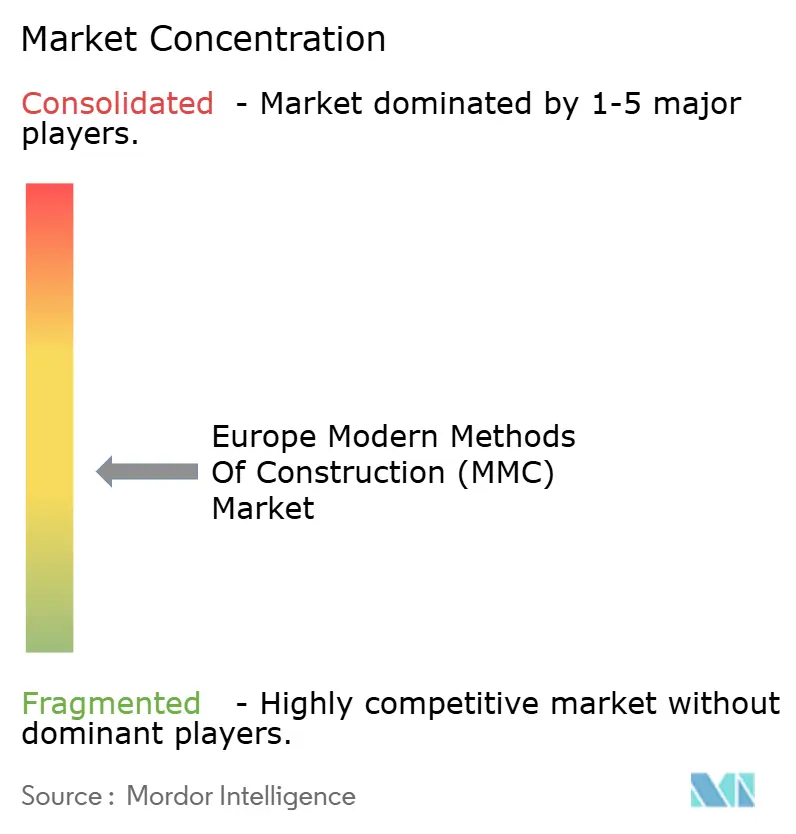
| Market Concentration | Medium |
Major Players *Disclaimer: Major Players sorted in no particular order Image © Mordor Intelligence. Reuse requires attribution under CC BY 4.0. | |
Europe Modern Methods Of Construction (MMC) Market Analysis by Mordor Intelligence
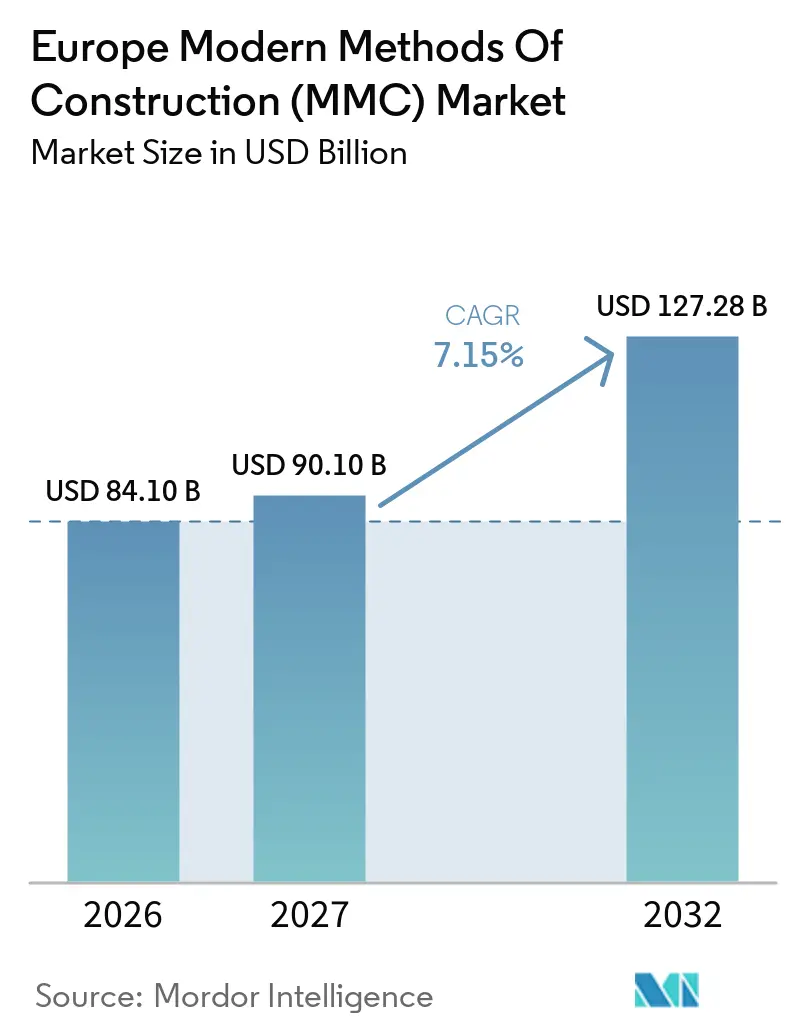
The Europe Modern Methods Of Construction Market size is projected to expand from USD 84.10 billion in 2026 and USD 90.10 billion in 2027 to USD 127.28 billion by 2032, registering a CAGR of 7.15% between 2027 and 2032.
A persistent gap between housing needs and conventional construction delivery capacity supports the Europe modern methods of construction market. Factory-based production can shorten project schedules and reduce on-site disruption, benefiting housing, health care, education, and infrastructure projects. Regulatory focus on operational and embodied carbon also favors construction systems that can document materials and replicate processes more consistently. Manufacturers are balancing standardized production with the need to comply with local planning and building requirements. However, the Europe modern methods of construction market faces challenges from high factory investment requirements, energy costs, and uneven project order books, making predictable demand essential for profitability.
Key Report Takeaways
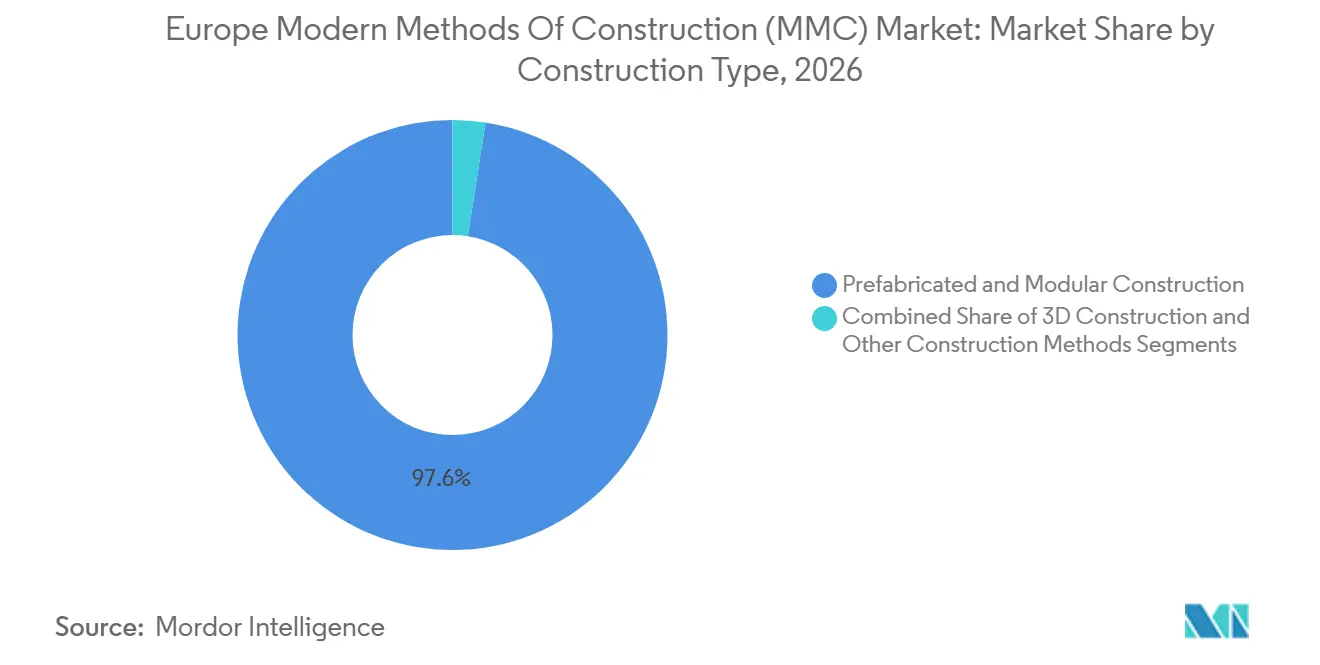
- By construction type, prefabricated and modular construction held 97.55% of Europe modern methods of construction market share in 2026, while 3D construction is forecast to grow at a CAGR of 33.2% through 2032.
- By material type, metal held 52% of Europe modern methods of construction market share in 2026, while timber is forecast to expand at a CAGR of 9.4% through 2032.
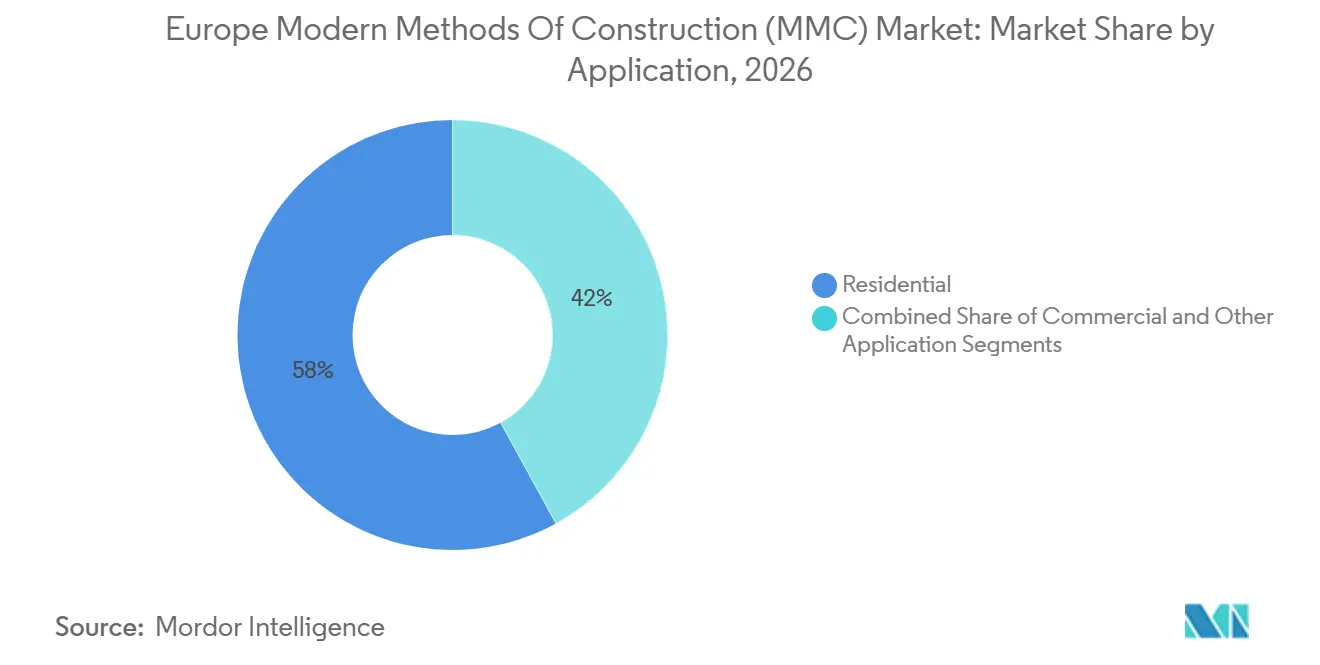
- By application, residential accounted for 58% of the Europe modern methods of construction market size in 2026, while other applications are forecast to grow at a CAGR of 8.7% through 2032.
- By geography, Germany held 35% of Europe modern methods of construction market share in 2026, while the Netherlands is forecast to grow at a CAGR of 9.2% through 2032.
Note: Market numbers in this report are based on Mordor Intelligence's proprietary estimation framework, which combines nine months of actuals with Q4 projections for base year 2026.
Europe Modern Methods Of Construction (MMC) Market Trends and Insights
Drivers Impact Analysis*
| Drivers | (~) % Impact on CAGR Forecast | Geographic Relevance | Impact Timeline |
|---|---|---|---|
| European Housing Supply Deficits and Urban Regeneration | +1.8% | Pan-European, concentrated in Germany, Netherlands, UK, and France | Short term (≤ 2 years) |
| EU and National Building Decarbonization Requirements | +1.5% | EU-wide, with early movers in Germany, France, and the Netherlands | Medium term (2-4 years) |
| Shortages of Skilled Construction Labor | +1.2% | Pan-European, most acute in Nordics, Germany, UK, and Benelux | Short term (≤ 2 years) |
| Public-Sector Social Housing and Healthcare Programs | +1% | UK, Netherlands, Germany, France, and Nordics | Short term (≤ 2 years) |
| Demand for Low-Waste and Circular Construction | +0.8% | Northern Europe, with spillover to France and Spain | Medium term (2-4 years) |
| Industrialized Timber, Steel, and Concrete Building Systems | +0.6% | Germany, Sweden, and the UK, with growing uptake in Poland and Spain | Long term (≥ 4 years) |
| Source: Mordor Intelligence | |||
European Housing Supply Deficits and Urban Regeneration
Europe requires additional housing at a pace that conventional construction methods have struggled to achieve. The European Commission is expected to prioritize affordable housing as a major policy issue in 2025, driven by supply shortages, high costs, and local planning barriers[1]. Germany, the Netherlands, and France face significant requirements for affordable and social housing, sustaining demand for construction methods that reduce project timelines. Serial construction supports repeatable apartment layouts, building extensions, and renovation projects in dense urban areas. Building extensions and adaptive reuse projects can also incorporate prefabricated components when full demolition would cause significant disruption. These factors expand the role of the Europe modern methods of construction market beyond new-build housing.
EU and National Building Decarbonization Requirements
The revised Energy Performance of Buildings Directive requires member states to implement measures that enhance building performance and support zero-emission new buildings[2]. It also incorporates life-cycle global warming potential reporting into the policy framework for specified new buildings. These provisions encourage developers and contractors to select materials and systems with traceable environmental information. Factory-built panels and modules can standardize material documentation and reduce waste, although they do not inherently guarantee lower carbon outcomes. Timber, recycled-content products, and hybrid systems can benefit when project specifications prioritize stored carbon and circularity. Overall, these requirements provide the Europe modern methods of construction market with a clearer pathway into renovation and public procurement programs.
Shortages of Skilled Construction Labor
Labor availability remains a practical constraint on construction output in Europe. Factory-based production enables repetitive work under controlled conditions and reduces the number of trades required at project sites. However, it does not eliminate the need for skilled labor, as design coordination, transportation, assembly, and quality control remain critical. It can shift work toward production routines that are easier to schedule and support with equipment. This model is particularly relevant in markets where aging workforces and limited recruitment make on-site project delivery slower and less reliable. The Europe modern methods of construction market benefits as contractors increasingly view offsite production as a capacity solution rather than a niche construction option.
Public-Sector Social Housing and Healthcare Programs
Public buyers can provide the larger, more predictable order pipelines that manufacturing plants require. Framework agreements also enable public bodies to procure standardized buildings while maintaining competition among qualified suppliers. Healthcare projects prioritize rapid installation because prolonged on-site activity can disrupt clinical services and affect patients. Education and social housing projects can similarly benefit when buildings must be operational by a fixed date. Germany, the Netherlands, and the United Kingdom have implemented public procurement tools and housing programs that can support modular delivery. This demand base can strengthen the Europe modern methods of construction market by translating stated policy targets into multi-year orders[3].
Restraints Impact Analysis*
| Restraints | (~) % Impact on CAGR Forecast | Geographic Relevance | Impact Timeline |
|---|---|---|---|
| Country-Level Permitting and Building-Code Fragmentation | -1.5% | EU-wide, most severe in Southern Europe and smaller member states | Medium term (2-4 years) |
| High Energy and Financing Costs for Manufacturing Plants | -1% | Western and Northern Europe, where factory concentrations are highest | Short term (≤ 2 years) |
| Cross-Border Logistics and Module-Dimension Constraints | -0.6% | Inter-country routes, especially Central to Western Europe, and national logistics networks | Long term (≥ 4 years) |
| Conservative Procurement and Warranty Requirements | -0.4% | Southern and Eastern Europe, plus private developer markets across the EU | Medium term (2-4 years) |
| Source: Mordor Intelligence | |||
Country-Level Permitting and Building-Code Fragmentation
Modern methods of construction must comply with national, regional, and local regulations that remain inconsistent across Europe. A module approved in one country may require a project-specific review before deployment in another, limiting the benefits of repeatable designs and extending cross-border implementation timelines. Carbon standards and planning requirements can further delay approvals, particularly when authorities lack familiarity with a specific system. The Netherlands demonstrates how streamlined procedures can strengthen the business case for industrialized construction, while other markets continue to require lengthy review processes. The Europe modern methods of construction market will remain constrained until regulatory frameworks more effectively recognize standardized components and repeatable designs.
High Energy and Financing Costs for Manufacturing Plants
Volumetric factories require substantial fixed investment before production reaches efficient levels. Companies must cover energy expenses, automation equipment costs, building leases, and financing costs even when project orders are delayed. Recent business failures in the United Kingdom have highlighted the risks of relying on projected high volumes that fail to materialize. While these failures do not indicate a lack of demand for modular construction, they demonstrate the need to align plant capacity with secured project pipelines. Suppliers with rental fleets, diversified product portfolios, or long-term public contracts may be more resilient than single-product producers. These cost pressures constrain growth in the Europe modern methods of construction market, as investment decisions depend on uncertain demand.
*Our forecasts treat driver/restraint impacts as directional, not additive. The impact forecasts reflect baseline growth, mix effects, and variable interactions.
Segment Analysis
By Construction Type: Prefabricated Systems Dominate, 3D Printing Builds From a Small Base.
Prefabricated and modular construction is projected to account for 97.55% of the Europe modern methods of construction market in 2026. This position reflects the established adoption of panelized systems, volumetric units, and hybrid assemblies across residential and public-sector projects. Panelized timber, structural insulated panels, and light-gauge steel systems are well suited to single-family homes, extensions, and retrofit projects. Volumetric modules are widely used for apartments, student housing, hotels, and facilities requiring repeatable room layouts. Hybrid systems combine a structural frame with factory-manufactured elements, providing architects with greater flexibility for mid-rise developments. This established production base gives manufacturers a familiar route to customers, installers, lenders, and building-control authorities.
3D construction is forecast to register a CAGR of 33.2% through 2032, although it starts from a substantially smaller base than prefabricated systems. In France, the ViliaSprint² project used a COBOD printer and Holcim TectorPrint concrete ink to construct a 12-apartment building, demonstrating the technology’s application in multifamily construction rather than in a single demonstration unit. Denmark’s Skovsporet student housing project also demonstrated the potential of printed construction for cost-controlled residential delivery. The technology is most relevant where designs can be simplified, site conditions support printing, and approval processes accept the method. Before 3D construction can materially alter the product mix of the Europe modern methods of construction market, it will require reliable material supply, trained operators, and repeatable quality-assurance processes.

By Material Type: Metal Retains Structural Leadership, Timber Expands Its Role
Metal is projected to account for 52% of the Europe modern methods of construction market in 2026. Steel-framed modules provide structural strength, dimensional control, and stackability for mid-rise buildings. These features support health care, education, and residential projects with demanding delivery schedules and building-control requirements. Light-gauge steel is also used in panelized facades and renovation applications due to its low weight. Concrete continues to play a role in precast systems, infrastructure-related projects, and industrial facilities with mature local supply chains. Glass serves a more focused role in modular facades for commercial and institutional buildings that prioritize daylighting and aesthetics.
Timber is forecast to grow at a CAGR of 9.4% through 2032, supported by life-cycle carbon requirements and growing interest in bio-based construction. The WOODCIRCLES project produced cross-laminated timber panels using recycled wood at Stora Enso’s Ybbs an der Donau mill in Austria. Lindbäcks Bygg manufactures timber modules for multifamily housing in Sweden, demonstrating that timber systems can operate at an industrial scale. However, timber does not replace metal or concrete in every application, as fire safety, acoustics, supply availability, insurance requirements, and local building codes continue to influence material selection. Its growth provides the Europe modern methods of construction industry with a strong option for projects where carbon performance and faster assembly are both priorities.
By Application: Residential Leads While Institutional Demand Broadens the Pipeline
Residential is projected to account for 58% of the Europe modern methods of construction market size in 2026. Demand for social housing, student accommodation, and affordable multifamily projects supports the segment. These projects often feature repetitive apartment layouts, making them well suited to factory-based production. The Netherlands is expected to record significant prefabricated housing output in 2025, with housing associations representing an important customer group. The Waldorp Four project in The Hague demonstrates the scale achievable for prefabricated residential towers. However, residential demand remains sensitive to mortgage rates, developer financing, and local approval processes and, therefore, may not provide stable capacity utilization for every manufacturer.
Other applications are forecast to grow at a CAGR of 8.7% through 2032. This category includes industrial, institutional, energy and utilities, and infrastructure projects. Health care facilities represent an important use case, as construction-related disruptions can affect patient care and hospital operations. KLEUSBERG is expected to complete a 94-module Normal and Intermediate Care project at Freiburg University Hospital in December 2025. Education projects can use modular systems to add classrooms or replace aging facilities while reducing on-site construction timelines. Demand across these applications can reduce reliance on housing cycles and enhance the attractiveness of the Europe modern methods of construction market for diversified suppliers.
Geography Analysis
Germany is projected to hold a 35% share of the Europe modern methods of construction market in 2026. This position reflects its large manufacturing base, long history of prefabricated housing, and ongoing pressure to expand housing supply. Policy discussions in the country focus on accelerating permitting processes and simplifying housing delivery regulations. Large modular projects, including Daiwa House Europe’s Berlin development for Gewobag, demonstrate that public and institutional buyers can commission projects at substantial scale. Labor constraints further strengthen the case for shifting repetitive construction activities to factory settings. Germany therefore remains a major demand center and production hub for the Europe modern methods of construction market.
The Netherlands is forecast to grow at a CAGR of 9.2% through 2032. Prefabricated housing is projected to account for 21.2% of residential new-build output in 2025, reflecting strong policy support and an established offsite construction supply base. Faster permitting under the Omgevingswet can enhance the scheduling advantages of factory-based delivery for priority projects. The government’s target to increase factory-built housing provides suppliers with a clear policy direction, although execution will continue to depend on land availability, financing, and local approvals. Dutch producers also benefit from proximity to dense urban demand centers and well-developed logistics infrastructure. The country’s experience demonstrates how coordinated policy and procurement can increase the adoption of modern methods of construction across Europe.
France has significant social housing requirements and a policy framework that emphasizes building carbon performance. RE2020 can support the adoption of bio-based and low-carbon construction systems, although detailed assessment requirements can delay approvals. Italy, Spain, and Russia maintain strong precast concrete activity in industrial and infrastructure construction. Spain’s CREE Iberia venture introduces a timber-concrete-steel approach for mid-rise projects in the Iberian region. Poland, the Czech Republic, and Southeast Europe are emerging as secondary demand centers and manufacturing locations. These varying conditions require suppliers to adapt their products and delivery models to local regulations rather than assume a uniform European market.
Competitive Landscape
The Europe modern methods of construction market is moderately fragmented, with no single provider holding more than a high-single-digit share across the region. Nordic industrialized builders, German system-house specialists, and rental-fleet companies compete alongside regional manufacturers. Lindbäcks Bygg and Derome are established Nordic participants, while KLEUSBERG, HUF HAUS, and GOLDBECK operate from Germany. Modulaire Group and Adapteo leverage rental fleets and acquisitions to expand their presence across several countries. The competitive landscape extends beyond volumetric housing to include temporary space, panel systems, permanent modular buildings, and construction services. Customers assess suppliers based on delivery reliability, regulatory compliance, design support, project financing, and unit cost.
Adapteo plans to acquire Belgian modular-space company Degotte in October 2026, expanding its presence across the Benelux region. Saint-Gobain’s Offsite Solutions business combines structural, gypsum, facade, and panelized capabilities for the offsite building market. In August 2026, Victaulic plans to acquire Arumani in Spain to add modular mechanical-assembly capacity for complex projects. These initiatives demonstrate how companies are expanding capabilities around the module, including installation, building services, and regional delivery networks. They also indicate that larger materials and engineering groups can enter the Europe modern methods of construction market through adjacent activities rather than by establishing a full-scale housing factory.
Digital production is becoming increasingly important for competitive positioning. KLEUSBERG and KUKA have announced a collaboration on robotic welding systems for floor and ceiling frames, with operations planned to begin in 2027. EcoModular’s planned integration with Modul Consult and IDS focuses on connecting design, manufacturing, and project management. However, operators still require secure order pipelines, as technology cannot eliminate the fixed-cost risks associated with underutilized factories. Regulatory fragmentation also favors companies with local approvals expertise or platforms operating across multiple countries.
Europe Modern Methods Of Construction (MMC) Industry Leaders
-
Lindbäcks Bygg AB
-
Derome AB
-
KLEUSBERG GmbH & Co. KG
-
Algeco UK Limited (Modulaire Group)
-
Wernick Group Limited
- *Disclaimer: Major Players sorted in no particular order
Recent Industry Developments
- October 2026: Adapteo Group acquires Degotte (Belgium): Adapteo signed an agreement to acquire Degotte, a modular space solutions company with a strong presence in Belgium and Luxembourg, with the transaction expected to close at the end of October 2026. The deal creates a pan-Benelux platform combining Adapteo's Dutch operations with Degotte's established Benelux public-sector relationships, targeting long-duration modular rental for education and social infrastructure.
- August 2026: Victaulic acquires Arumani (Spain): Victaulic completed the acquisition of Arumani, a mechanical assemblies and modular construction specialist based in Castellón, Spain. The deal expands Victaulic's European modular mechanical assembly capability for healthcare, industrial, and complex infrastructure projects.
- July 2026: EcoModular signs definitive agreement for Modul Consult and IDS integration: EcoModular signed a combination agreement to acquire a 60% interest in Modul Consult's Latvia-based modular design and manufacturing operations and a 20% interest in IDS, creating an AI-native volumetric modular delivery platform spanning Europe and the Gulf Cooperation Council region.
Europe Modern Methods Of Construction (MMC) Market Report Scope
| Prefabricated & Modular Construction | Panelized Systems | Structural Insulated Panels (SIPs) |
| Timber / Wood Frame Panels | ||
| Light Gauge Steel (LGS) Panels | ||
| Others | ||
| Volumetric Modules | Steel-Framed Volumetric Modules | |
| Timber-Framed Volumetric Modules | ||
| Concrete (Precast/Monolithic) Volumetric Modules | ||
| Others | ||
| Hybrid Modular Construction | ||
| 3D Construction | Extrusion Method | |
| Power Bonding Method | ||
| Others | ||
| Other Construction Methods | ||
| Concrete |
| Glass |
| Metal |
| Timber |
| Other Material Type |
| Residential |
| Commercial |
| Other Application (Industrial, Institutional, Energy and Utilities, Infrastructure) |
| Germany |
| United Kingdom |
| France |
| Italy |
| Spain |
| Russia |
| Rest of Europe |
| By Construction Type | Prefabricated & Modular Construction | Panelized Systems | Structural Insulated Panels (SIPs) |
| Timber / Wood Frame Panels | |||
| Light Gauge Steel (LGS) Panels | |||
| Others | |||
| Volumetric Modules | Steel-Framed Volumetric Modules | ||
| Timber-Framed Volumetric Modules | |||
| Concrete (Precast/Monolithic) Volumetric Modules | |||
| Others | |||
| Hybrid Modular Construction | |||
| 3D Construction | Extrusion Method | ||
| Power Bonding Method | |||
| Others | |||
| Other Construction Methods | |||
| By Material Type | Concrete | ||
| Glass | |||
| Metal | |||
| Timber | |||
| Other Material Type | |||
| By Application | Residential | ||
| Commercial | |||
| Other Application (Industrial, Institutional, Energy and Utilities, Infrastructure) | |||
| By Geography | Germany | ||
| United Kingdom | |||
| France | |||
| Italy | |||
| Spain | |||
| Russia | |||
| Rest of Europe | |||
Key Questions Answered in the Report
What is the size of the Europe modern methods of construction market?
It is valued at USD 84.1 billion in 2026 and is forecast to reach USD 127.28 billion by 2032, at a 7.15% CAGR from 2027 to 2032.
Which construction type has the largest share in Europe?
Prefabricated and modular construction leads with a 97.55% share in 2026, while 3D construction has the fastest forecast growth at 33.2% CAGR.
Which material is growing fastest for offsite construction in Europe?
Timber is forecast to expand at a 9.4% CAGR through 2032, supported by life-cycle carbon requirements and bio-based construction demand.
Why is residential construction important for modern methods of construction?
Residential work held a 58% share in 2026 because social housing, student housing, and multi-family projects can use repeated designs and shorter construction schedules.
Which country leads European adoption of modern construction methods?
Germany leads with a 35% share in 2026, while the Netherlands is the fastest-growing country at a 9.2% CAGR through 2032.
What limits wider use of modular construction in Europe?
Different building codes and permit procedures, plus factory energy and financing costs, limit cross-border scale and increase commercial risk.