
Europe Mobile Homes Market Size and Share
Market Overview
| Study Period | 2020 - 2031 |
|---|---|
| Forecast Data Period | 2026 - 2031 |
| Base Year Market Size (2025) | USD 2.55 Billion |
| Market Size (2026) | USD 2.71 Billion |
| Market Size (2031) | USD 3.66 Billion |
| Growth Rate (2026 - 2031) | 6.19 % |
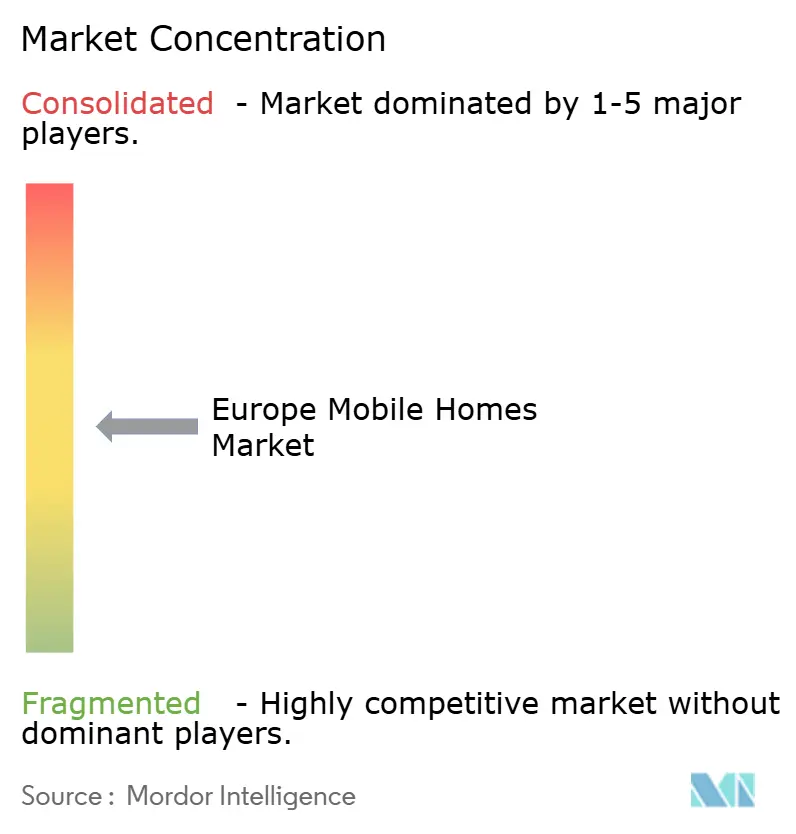
| Market Concentration | Medium |
Major Players *Disclaimer: Major Players sorted in no particular order Image © Mordor Intelligence. Reuse requires attribution under CC BY 4.0. | |
Europe Mobile Homes Market Analysis by Mordor Intelligence
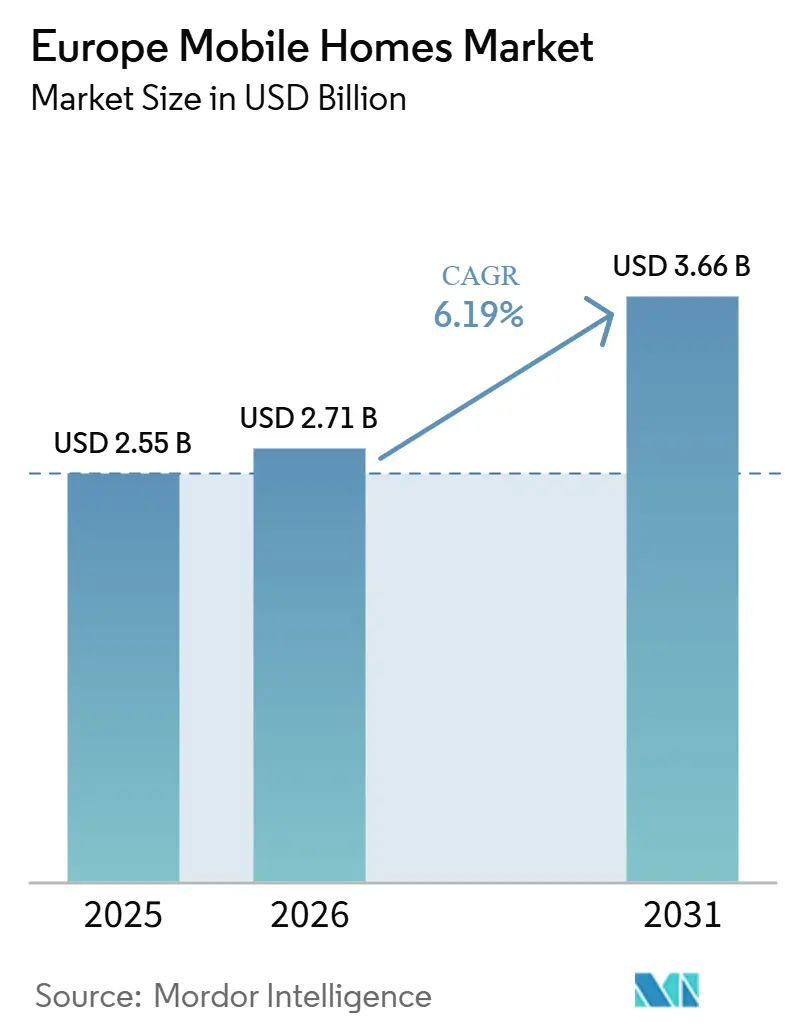
The Europe Mobile Homes Market size is expected to grow from USD 2.55 billion in 2025 to USD 2.71 billion in 2026 and is forecast to reach USD 3.66 billion by 2031 at 6.19% CAGR over 2026-2031.
A persistent shortage of housing under construction is driving demand for factory-built homes that installers can deploy more quickly than conventional dwellings, especially in Germany. German housing completions are projected to fall to roughly 206,600 units in 2025, the lowest level since 2012, compared with an estimated annual requirement of more than 320,000 units. The country also has a backlog of 760,700 approved-but-unbuilt apartments, while average construction timelines now extend to 26 months. This gap between approvals and delivery leaves households and local authorities with fewer immediate options and is directing policy and industry attention toward serial and modular construction as faster alternatives.
Holiday park operators are also becoming more important buyers. They are replacing older caravans with higher-specification mobile homes across their sites and seeking consistent accommodation standards for guests, residents, and park staff. Energy regulations and buyer expectations are shifting demand toward better insulation, all-electric systems, and designs that support year-round use in colder and more regulated locations.
This shift favors manufacturers that can provide reliable delivery, documented energy performance, consistent designs for larger fleet orders, and installation support that reduces disruption at active parks during peak periods. Therefore, the Europe mobile homes market combines residential affordability needs, leisure accommodation investment, and public or commercial housing requirements, reducing the demand balance’s dependence on any single buyer group across Europe’s varied housing and accommodation settings.
Key Report Takeaways
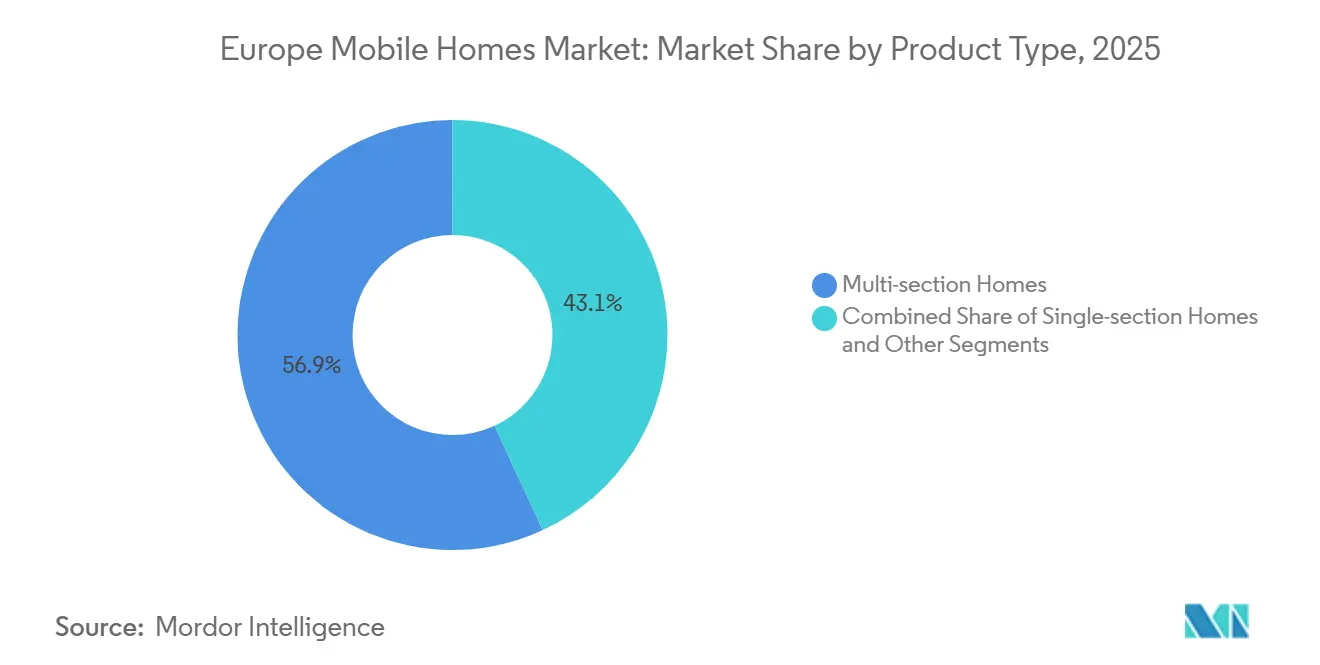
- By product type, multi-section homes accounted for 56.9% of demand in 2025, while the other category is forecast to grow at a 7.86% CAGR through 2031.
- By material, timber-based construction accounted for 52.6% of the Europe mobile homes market size in 2025, while composite and other materials are forecast to expand at a 7.44% CAGR through 2031.
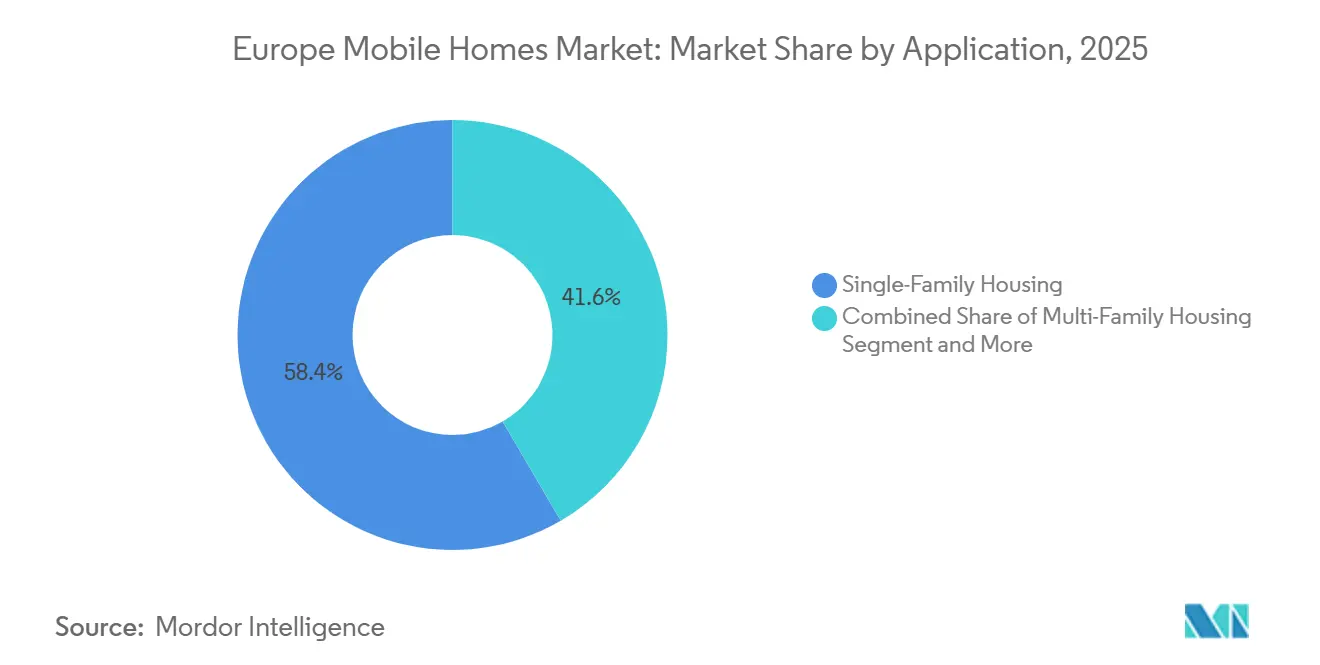
- By application, single-family housing held 58.4% of demand in 2025, while other applications are forecast to grow at a 7.92% CAGR through 2031.
- By geography, Germany held 22.7% of the Europe mobile homes market in 2025, while the United Kingdom is forecast to grow at a 7.35% CAGR through 2031.
Note: Market size and forecast figures in this report are generated using Mordor Intelligence’s proprietary estimation framework, updated with the latest available data and insights as of January 2026.
Europe Mobile Homes Market Trends and Insights
Drivers Impact Analysis*
| Drivers | (~) % Impact on CAGR Forecast | Geographic Relevance | Impact Timeline |
|---|---|---|---|
| Housing Affordability and Supply Shortages | +1.4% | Europe, strongest in Germany, the United Kingdom, and France | Short term (≤ 2 years) |
| Holiday Parks and Outdoor Hospitality Growth | +1% | Western Europe, with spillover to Nordic and Central and Eastern European markets | Medium term (2-4 years) |
| Factory-Built Construction Deployment | +0.8% | Germany, the Netherlands, the United Kingdom, and the Nordic countries | Medium term (2-4 years) |
| Energy-Efficient, Year-Round Homes | +0.7% | Europe, with early demand in Germany, France, the United Kingdom, and Scandinavia | Long term (≥ 4 years) |
| Rural and Coastal Land Development | +0.5% | United Kingdom coastlines, French coasts, and Spanish coastal areas | Medium term (2-4 years) |
| Digital Configuration Platforms | +0.4% | Europe, with the highest use in Western and Nordic markets | Short term (≤ 2 years) |
| Source: Mordor Intelligence | |||
Housing Affordability Challenges and Supply Shortages Increase Mobile Home Demand
Germany completed 206,600 dwellings in 2025, its lowest output since 2012, while the time from permit to completion reached 27 months[1]German Federal Statistical Office, “18.0% weniger fertiggestellte Wohnungen im Jahr 2025,” Destatis, destatis.de. . This gap limits the capacity of conventional construction to meet housing needs within normal project schedules and encourages consideration of homes assembled off-site. The Europe mobile home market benefits when households need lower-maintenance homes, local development programs need quicker delivery, and existing sites can accommodate residential units without a full new-build process. Single-level layouts can also suit older households and residents seeking to remain in familiar communities without taking on extensive property maintenance, larger gardens, or a lengthy refurbishment project. These conditions support demand for both permanent residential units and homes in rural areas, where access to conventional supply may be limited.
Growth of Holiday Parks and Outdoor Hospitality Expands Market Opportunities
More than 215,000 leisure vehicles were registered across Europe in 2025, marking the eighth consecutive year with more than 200,000 registrations[2]Caravaning Industrie Verband Deutschland, “Over 215,000 New Registrations, European Caravanning Market Proves Robust and Versatile,” Caravaning Industrie Verband Deutschland, civd.de. . This level of activity supports the wider outdoor accommodation base, where mobile homes are installed, maintained, upgraded, and replaced over time by operators serving different types of holiday guests. Professionally managed parks increasingly purchase units in bulk rather than relying solely on individual owners with varying purchasing preferences and replacement schedules. The Europe mobile homes market gains when these operators standardize layouts, energy systems, interior specifications, and maintenance requirements across several sites and use common designs for more efficient management. Replacement programs can sustain more consistent demand, as operators need to maintain the quality, safety, and appeal of their accommodation fleets as guest expectations change.
Factory-Built Construction Accelerates Mobile Home Deployment
Factory-built homes accounted for 26.5% of approved German single- and two-family house permits in 2025, up from 22.2% in 2020[3]Federal Association of German Prefab Builders, “Fertighausanteil Rund 27 Prozent,” Fertighaus.de, fertighaus.de. . The increase shows that buyers and developers continue to value controlled production, clearer scheduling, and shorter installation periods, even as conventional projects face delays and site conditions become more difficult to manage. These same advantages support mobile home manufacturers, particularly when sites require fast installation, consistent quality, and less intrusive on-site construction during a busy operating season. The Europe mobile homes market can benefit when park operators, municipalities, and housing providers compare off-site delivery with longer conventional building cycles and uncertain contractor availability. Factory capacity and standardized assembly also help producers manage large projects with repeatable specifications, coordinated deliveries, and fewer site-level changes.
Rising Demand for Energy-Efficient and Year-Round Mobile Homes Drives Adoption
Directive 2024/1275 requires European Union member states to incorporate its building-performance provisions into national law by May 2026. The directive underscores the importance of insulation, efficient heating, and renewable-ready design for new buildings subject to national rules and related national implementation measures. The Europe mobile home market is responding with more energy-efficient specifications and homes designed for all-season use, particularly in parks that operate beyond the peak holiday season or serve residents year-round. Higher-performing units can help operators meet their sustainability commitments, control utility use, and provide a more comfortable stay for residents or guests in colder weather. This shift makes thermal engineering, equipment selection, and credible performance documentation more important in purchasing decisions.
Restraints Impact Analysis*
| Restraints | (~) % Impact on CAGR Forecast | Geographic Relevance | Impact Timeline |
|---|---|---|---|
| Planning, Siting, and Occupancy Rules | -0.9% | Europe, especially the United Kingdom, Germany, France, and the southern coastal zones | Medium term (2-4 years) |
| Timber, Steel, and Transportation Cost Volatility | -0.8% | Europe, with pressure in the Nordic and Central European supply chains | Short term (≤ 2 years) |
| Financing, Insurance, and Valuation Limits | -0.6% | United Kingdom, Germany, France, and Southern Europe | Medium term (2-4 years) |
| Seasonal Use and Park Dependence | -0.5% | Coastal areas in France, Spain, Italy, and the United Kingdom, and leisure parks | Long term (≥ 4 years) |
| Source: Mordor Intelligence | |||
Diverse Planning, Siting, and Occupancy Regulations Limit Market Growth
Rules on permanent occupancy, zoning, environmental review, and site licensing differ widely across European jurisdictions. In Germany, permanent living on camping plots generally requires local residential zoning permission, which can limit the conversion of leisure sites into long-term housing locations and affect potential residential demand. Coastal restrictions in France and planning decisions in the United Kingdom can also constrain new sites or expansions in environmentally sensitive areas where development review is stricter. The Europe mobile homes market faces higher development costs when operators must manage multiple local approval processes, uncertain review periods, differing occupancy classifications, and the costs of preparing supporting documents. Existing sites with established permissions can therefore hold an advantage over new entrants and can be more attractive to manufacturers seeking dependable order pipelines.
Volatile Timber, Steel, and Transportation Costs Increase Manufacturing Expenses
Mobile home production relies on timber, steel, fittings, insulation, and specialized transport, so rapid cost changes can pressure margins and disrupt quoted prices for homes already in the production pipeline. The Europe mobile homes market is more exposed when smaller manufacturers lack the purchasing scale or forward contracts used by larger groups, and have less ability to absorb cost increases. Long production lead times can make it difficult to pass on a sudden increase in input costs to customers who have already agreed to project budgets and delivery dates. Transport costs are also material because completed units must reach parks or residential sites safely, often along routes with limited access, seasonal traffic, or strict delivery windows. Producers with flexible sourcing, careful inventory planning, and efficient factory schedules are better positioned to manage these pressures.
*Our forecasts treat driver/restraint impacts as directional, not additive. The impact forecasts reflect baseline growth, mix effects, and variable interactions.
Segment Analysis
By Product Type: Multi-Section Homes Lead While Alternative Formats Expand
Multi-section homes accounted for 56.9% of the Europe mobile home market in 2025. Their larger floor plans can include separate bedrooms, bathrooms, and living spaces that more closely resemble a conventional house, making them suitable for households that expect to use the unit for extended periods rather than for occasional breaks. These units are suited to residential park residents and buyers who use their homes year-round, including those who prioritize accessible, single-level living and distinct private and shared spaces. They can also be installed from factory-built sections, which can reduce on-site work and limit disruption caused by longer building programs, weather delays, or multiple trade visits. Manufacturers can offer a range of internal layouts within this format, allowing park operators to serve households of different sizes while maintaining a familiar construction approach. Single-section homes remain relevant for holiday buyers and for smaller parks with limited plot dimensions, lower entry-price requirements, or a need for straightforward placement.
The others category is forecast to grow at a 7.86% CAGR through 2031. This group includes volumetric modular homes, panelized homes, and container-based units, each of which can be adapted to different physical sites and intended occupancies without following a single standard floor plan. Its expansion reflects demand for formats that can fit difficult sites and serve workforce, student, senior, or emergency accommodation needs without relying on one conventional layout. The Europe mobile homes market gives these formats a route into projects that need flexible layouts, temporary accommodation, or units that can be configured for specific user groups with particular privacy or service needs. They may be especially useful where a buyer needs rapid deployment, clear internal zoning, or units that can be moved or repositioned after a project changes. Their use also widens the range of buyers beyond individual holiday-home customers and encourages manufacturers to develop products for institutional procurement.



By Material: Timber-Based Construction Holds the Largest Position
Timber-based construction accounted for 52.6% of the Europe mobile homes market share in 2025. Timber supports lightweight structures and works well with insulation systems used for more energy-efficient homes, while also allowing manufacturers to use familiar factory processes and established assembly methods. It is also familiar to European factory-built housing producers and many park-home manufacturers, which can support material availability, workforce knowledge, and the ability to maintain product consistency over repeated production runs. German data showed that prefab homes accounted for 26.5% of approved single- and two-family house permits in 2025, underscoring the continued role of factory-built construction in the country. This wider acceptance of manufactured homes provides a supportive setting for timber-based mobile home production and for buyers considering more permanent forms of occupancy. Steel remains important for chassis, reinforcements, and structural frames, while concrete can be used where fire resistance, flood resilience, or sound control is important.
Composite and other materials are projected to grow at a 7.44% CAGR through 2031. Manufacturers are using structural insulated panels, reinforced cladding, and bio-composite elements to reduce weight and improve thermal performance without losing the strength required for transport and installation. These materials can support faster assembly and help manufacturers meet demand for year-round homes that need dependable insulation, controlled air leakage, and compatible systems for more efficient heating. The Europe mobile homes industry is also using these materials where heat-pump compatibility and airtight construction matter to operators managing accommodation in cooler seasons or in locations with higher energy expectations. This development is most relevant for fleet buyers who require consistent specifications across a large number of units, with predictable installation work and repeatable maintenance requirements. It also gives producers another way to distinguish higher-specification homes from entry-level units that may not meet the same performance expectations.
By Application: Single-Family Housing Generates the Largest Demand
Single-family housing held 58.4% of the Europe mobile homes market size in 2025. Demand comes from downsizers, rural residents, and households seeking a less costly alternative to conventional homes, particularly where the supply of suitable smaller properties is constrained, and conventional purchases require high levels of ongoing maintenance. Larger residential mobile homes can offer a practical layout without the maintenance requirements of many traditional properties, while retaining separate spaces for daily living, sleeping, personal storage, and visits from family members. The segment also benefits where local communities need more housing options but cannot wait for long conventional building programs or extensive site preparation before a dwelling can be occupied. Park settings can offer shared management and a community atmosphere that appeals to residents who value a simpler housing arrangement and access to nearby services. These factors make single-family use central to the Europe mobile homes market and keep residential demand important alongside holiday accommodation.
Other applications are forecast to grow at a 7.92% CAGR through 2031. This category includes disaster-relief housing, workforce accommodation, student housing, and senior housing, each of which requires different layouts, levels of service, and provisions for short- or long-term occupancy. Such projects can involve public authorities, employers, education providers, or infrastructure developers rather than individual buyers, resulting in different order volumes and purchasing processes from those in residential sales. Commercial, hospitality, and institutional buildings also create demand when operators need accommodation that can be replaced or expanded quickly without lengthy conventional construction, repeated site disruption, or large-scale permanent building works. The Europe mobile homes industry can serve these customers through longer procurement cycles and more detailed requirements for delivery, durability, interior fit-out, safety, accessibility, and ongoing site support. This application group gives manufacturers access to demand that is less dependent on individual buyer confidence and more linked to the practical needs of a defined project, facility, or accommodation program, giving the Europe mobile homes market wider exposure to institutional buyers with planned accommodation requirements.
Geography Analysis
Germany held 22.7% of the Europe mobile homes market share in 2025. The country completed 206,600 dwellings in 2025, an 18% decline from 2024 and the lowest total since 2012. This construction shortage supports interest in factory-built housing formats that can be delivered more quickly and with more controlled work schedules than conventional construction. Factory-built homes accounted for 26.5% of approved single- and two-family housing permits in 2025, demonstrating acceptance of off-site housing methods within the broader German residential construction system. The United Kingdom is expected to record the highest growth, with a forecast CAGR of 7.35% through 2031, supported by demand for residential park homes that suit older buyers and households seeking lower-maintenance living.
France remains an important continental location for the Europe mobile homes market because of its established network of campsites and residential leisure parks. European Camping Group launched its first wholly owned campsite in Spain and acquired La Pointe du Médoc in France in January 2025, underscoring continued investment in its managed accommodation network. Coastal planning rules can limit new development, increasing the value of existing permitted sites and making replacement homes more important than new-site construction. Spain is moving beyond its traditional reliance on foreign leisure buyers as institutional operators add capacity, standardize their sites, and expand their accommodation portfolios. European Camping Group acquired Alannia in July 2025, adding nearly 1,000 accommodation units and more than 1,600 pitches across 5 resorts. Italy also recorded double-digit growth in leisure vehicle registrations in 2025, which supports the wider travel and accommodation base for mobile homes.
The rest of Europe includes the Netherlands, Sweden, Poland, the Czech Republic, and other national markets. Poland is becoming a production base for factory-built mobile homes that can be supplied to Western European markets, where installation labor costs and construction schedules can be challenging. Sweden demonstrated the effect of tax policy: a change in caravan taxation led to a 46.6% increase in motor caravan registrations in 2025. Nordic buyers often place more emphasis on high insulation levels, triple glazing, heat-recovery ventilation, and roofs prepared for solar equipment, creating demand for homes intended to operate comfortably across different climates.
Competitive Landscape
The Europe mobile home market has moderate concentration, as large groups have manufacturing capacity, dealer relationships, and connections with park operators, while regional producers still compete through customization, local delivery, and responsive customer service. Trigano strengthened its position through the December 2024 acquisition of BIO Habitat, the Groupe Beneteau housing division that includes O'Hara, IRM, and Coco Sweet. The transaction added established brands and production capacity in France and Italy, broadening Trigano's ability to serve both holiday-park operators and other mobile home buyers. It also gave Trigano greater scale in purchasing, logistics, and manufacturing, which can be important when input costs and delivery schedules are volatile. Smaller producers in Poland, Slovenia, and Central Europe remain relevant because they can supply export markets and respond to local customer requirements.
Product strategy increasingly focuses on energy performance, digital configuration, and closer relationships with park operators that purchase multiple units at a time. Willerby introduced its All-E all-electric specification for holiday parks, compatible with standard 32-amp park infrastructure. This type of product helps operators reduce emissions from their accommodation fleets while providing a clear specification for park-based installation. Manufacturers also use online configuration tools to let customers select layouts, cladding, and interior packages before dealer discussions, thereby clarifying buyers' requirements before production begins. The Europe mobile home market rewards producers that can combine energy performance, design choice, reliable production, and installation support without making the buying process difficult for customers.
The wider competitive landscape also includes holiday park operators expanding their portfolios and shaping demand through large fleet purchases across several national markets. European Camping Group expanded its Southern European footprint in 2025 through acquisitions in Spain and France, including the Alannia resort portfolio. These moves support demand for standardized, durable, and energy-efficient units that can be deployed consistently across multiple sites. Manufacturers that meet these operator requirements can secure repeat orders, while smaller firms must differentiate through design, service, or regional delivery capabilities.
Europe Mobile Homes Industry Leaders
BIO HABITAT
Trigano SA
Knaus Tabbert AG
Adria Mobil d.o.o.
Willerby Ltd
- *Disclaimer: Major Players sorted in no particular order

Recent Industry Developments
- March 2026: Belvilla, the European short-term rental brand owned by PRISM, added Hambachtal Holiday Park in Oberhambach, Germany, to its German portfolio. The acquisition includes 254 apartments and holiday homes and supports Belvilla’s focus on nature-based, driveable leisure destinations across Western Europe.
- January 2026: Capfun, part of PHA Group, expanded its Dutch portfolio to 21 campsites by acquiring De Wâldsang in Bakkeveen, Friesland, Netherlands. The 341-pitch, 13-hectare site is located within the De Slotplaats nature reserve. The acquisition increased Capfun’s European footprint to 254 properties and its Dutch portfolio to 10,600 pitches.
- October 2025: Sandaya acquired the 5-star Camping Interlude, a 309-pitch site on Île de Ré, France. In 2026, the company allocated EUR 70 million, equivalent to USD 75.8 million, for upgrades at recently acquired parks and for more than 100 new premium accommodation units across 2 acquisitions.


Europe Mobile Homes Market Report Scope
| Single-section Homes |
| Multi-section Homes |
| Others (Volumetric Modular Homes, Panelized Mobile Homes, and Container-based Mobile Homes) |
| Timber-Based Construction |
| Steel-Based Construction |
| Concrete-Based Construction |
| Composite and Other Materials |
| Single-Family Housing |
| Multi-Family Housing |
| Commercial, Hospitality, and Institutional Buildings |
| Others (Disaster Relief and Temporary Housing, Student and Senior Housing, Student and Senior Housing, Workforce Housing, and Container-based Mobile Homes) |
| United Kingdom |
| Germany |
| France |
| Italy |
| Spain |
| Rest of Europe |
| By Product Type | Single-section Homes |
| Multi-section Homes | |
| Others (Volumetric Modular Homes, Panelized Mobile Homes, and Container-based Mobile Homes) | |
| By Material | Timber-Based Construction |
| Steel-Based Construction | |
| Concrete-Based Construction | |
| Composite and Other Materials | |
| By Application | Single-Family Housing |
| Multi-Family Housing | |
| Commercial, Hospitality, and Institutional Buildings | |
| Others (Disaster Relief and Temporary Housing, Student and Senior Housing, Student and Senior Housing, Workforce Housing, and Container-based Mobile Homes) | |
| By Geography | United Kingdom |
| Germany | |
| France | |
| Italy | |
| Spain | |
| Rest of Europe |


Key Questions Answered in the Report
What is the forecast for the Europe mobile homes market?
The Europe mobile homes market is projected to grow from USD 2.71 billion in 2026 to USD 3.66 billion by 2031, at a 6.19% CAGR. Housing delivery constraints, managed holiday-park investment, and demand for higher-specification homes support this outlook.
Which product type leads mobile home sales in Europe?
Multi-section homes led with a 56.9% share in 2025 because their layouts support residential and year-round use. They offer more living space and can be installed from factory-built sections, which helps the Europe mobile homes market serve households that want practical layouts and predictable site work.
What materials are used most often in Europe mobile homes?
Timber-based construction held 52.6% of demand in 2025, while composites are expected to grow fastest at a 7.44% CAGR through 2031. Timber is well-suited to lightweight structures and insulated construction.
Which application is the most common for mobile homes in Europe?
Single-family housing was the largest application, accounting for 58.4% of demand in 2025. Demand includes downsizers, rural residents, and households looking for simpler housing arrangements.
Which country has the strongest growth outlook for mobile homes?
The United Kingdom is expected to grow fastest, at a 7.35% CAGR through 2031. Residential park-home demand and interest in lower-maintenance homes support this outlook.
How do leading Europe mobile home producers compete?
Leading producers compete through production scale, established dealer and park-operator relationships, energy-efficient specifications, and the ability to support repeat orders across multiple sites.
Page last updated on:


 Your data is secure and never sold or shared.


