
Europe Low Smoke Zero Halogen (LSZH) Cables Market Size and Share
Market Overview
| Study Period | 2020 - 2031 |
|---|---|
| Forecast Data Period | 2026 - 2031 |
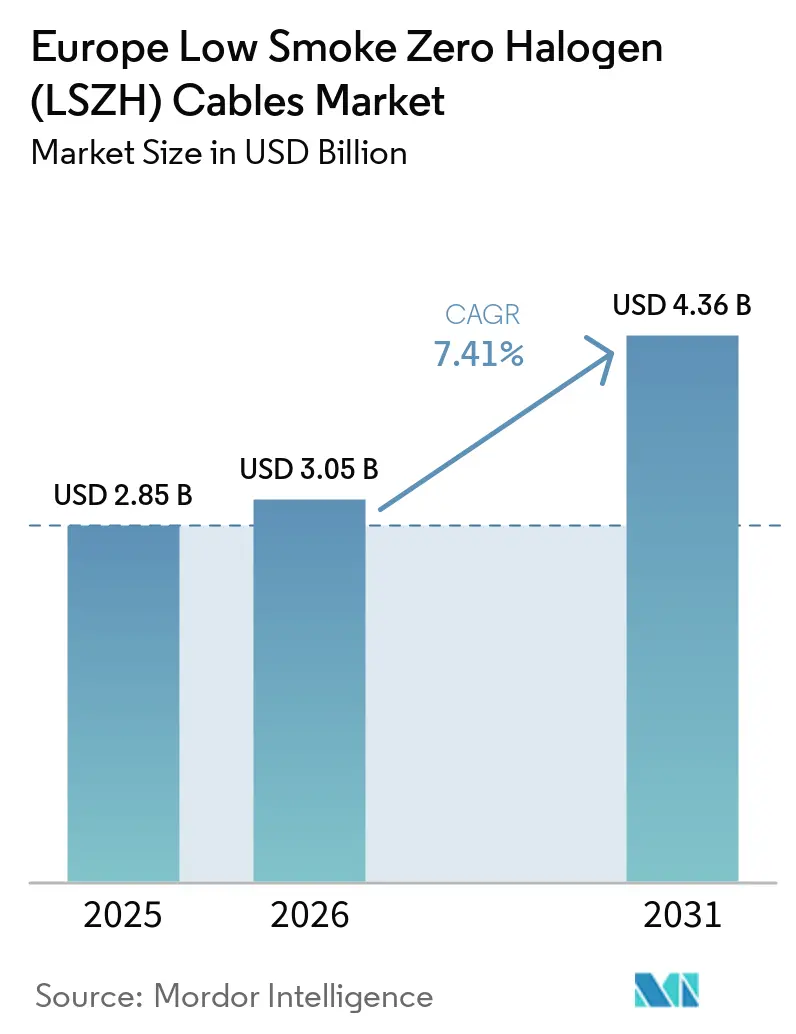
| Base Year Market Size (2025) | USD 2.85 Billion |
| Market Size (2026) | USD 3.05 Billion |
| Market Size (2031) | USD 4.36 Billion |
| Growth Rate (2026 - 2031) | 7.41 % |
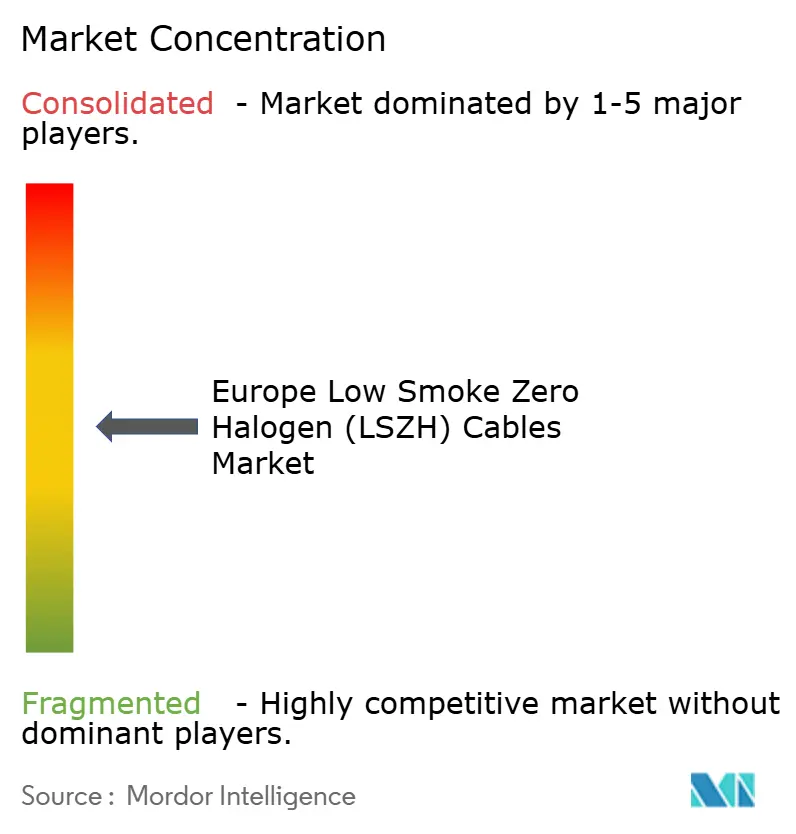
| Market Concentration | Medium |
Major Players *Disclaimer: Major Players sorted in no particular order Image © Mordor Intelligence. Reuse requires attribution under CC BY 4.0. | |
Europe Low Smoke Zero Halogen (LSZH) Cables Market Analysis by Mordor Intelligence
The Europe low-smoke zero-halogen cables (LSZH) market size is projected to expand from USD 2.85 billion in 2025 to USD 3.05 billion in 2026, and to USD 4.36 billion by 2031, registering a CAGR of 7.41% from 2026 to 2031. Regulation (EU) 2024/3110 and the continuing Euroclass framework make certified reaction-to-fire performance central to cable selection in European construction. Digital infrastructure, grid reinforcement, rail projects, and electrification programs are creating demand that is linked to long project cycles rather than short procurement cycles. Design specifications are often fixed 2-4 years before installation, which gives qualified suppliers visibility when construction plans convert into orders. The European LSZH cables market also faces higher compound and certification costs, varying national enforcement practices, and uneven timing of retrofit projects. These conditions favor manufacturers with broad certification coverage, proven material systems, and the capacity to support customers through technical documentation.
Key Report Takeaways
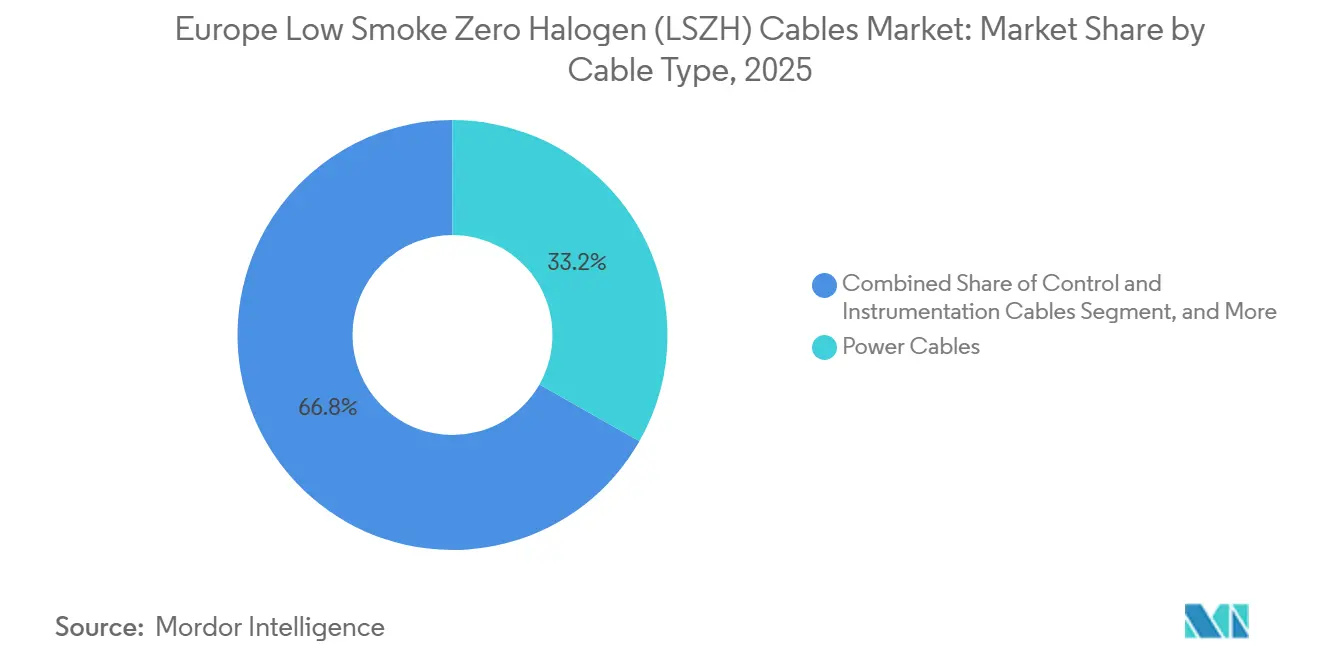
- By cable type, power cables held a 33.23% share of the Europe low smoke zero halogen (LSZH) market in 2025, while fiber-optic cables are projected to expand at a 9.15% CAGR through 2031.
- By voltage rating, the below-1 kV tier held 64.78% share of the Europe low smoke zero halogen (LSZH) market in 2025, while the 1-35 kV tier is projected to expand at an 8.25% CAGR through 2031.
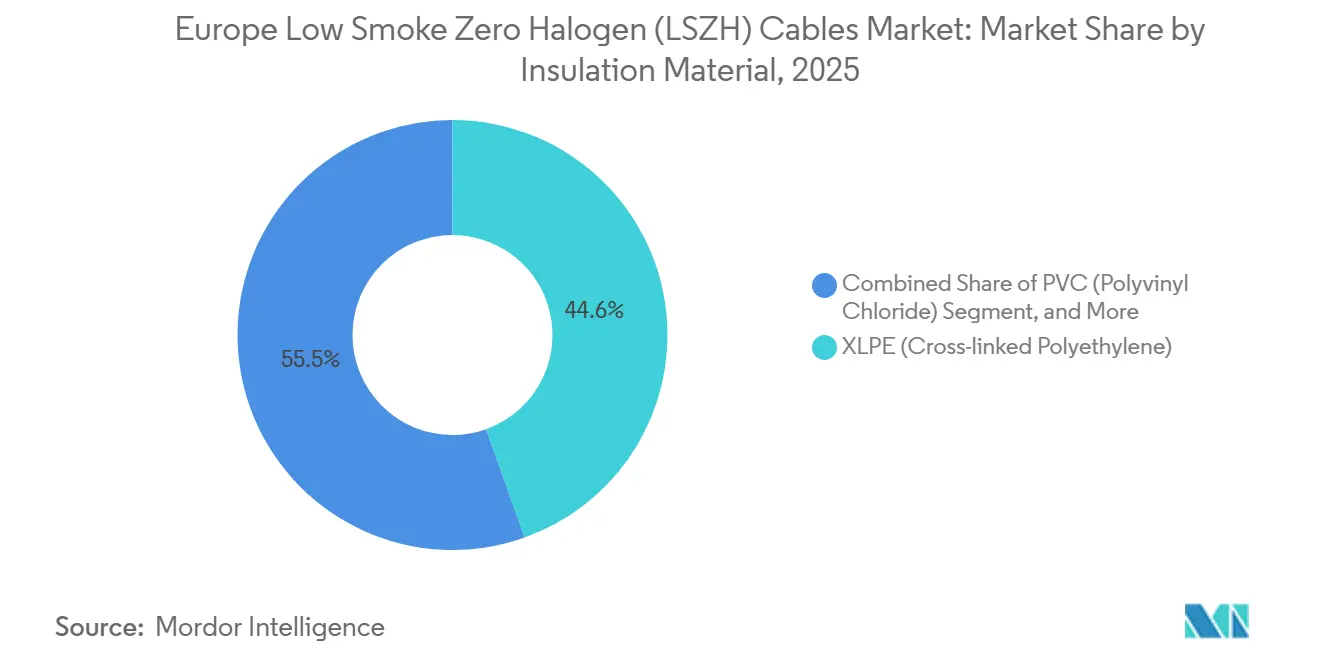
- By insulation material, XLPE (Cross-linked Polyethylene) held 44.55% share of the Europe low smoke zero halogen (LSZH) market in 2025, while other specialty insulation materials are projected to expand at an 8.85% CAGR through 2031.
- By end-user industry, commercial buildings held 22.69% share of the Europe low smoke zero halogen (LSZH) market in 2025, while data centers are projected to expand at a 9.55% CAGR through 2031.
- By country, Germany held 23.80% share of the Europe low smoke zero halogen (LSZH) market in 2025, while the rest of Europe is projected to expand at an 8.20% CAGR through 2031.
Note: Market size and forecast figures in this report are generated using Mordor Intelligence’s proprietary estimation framework, updated with the latest available data and insights as of January 2026.
Europe Low Smoke Zero Halogen (LSZH) Cables Market Trends and Insights
Drivers Impact Analysis*
| Driver | (~) % Impact on CAGR Forecast | Geographic Relevance | Impact Timeline |
|---|---|---|---|
| Construction Products Regulation and Mandatory Reaction-to-Fire Classification | +2.5% | EU-wide, with immediate effects in France, Germany, and Nordic markets | Short term (≤ 2 years) |
| Expansion of Data Centers and High-Density Digital Infrastructure | +1.5% | Northern and Western Europe, including the Netherlands, Finland, France, Germany, Ireland, and the United Kingdom | Short term (≤ 2 years) |
| Rail, Metro, Tunnel, and Airport Safety-Critical Cabling Projects | +1.0% | Western and Central Europe, including Germany, France, Italy, Spain, and the United Kingdom | Medium term (2-4 years) |
| Renewable Power, Grid Modernization, and Battery Energy Storage Build-Out | +0.8% | Pan-European, with early gains in Germany, Spain, Italy, and the Netherlands | Medium term (2-4 years) |
| Industrial Electrification and Automation in Existing European Plants | +0.6% | Germany, France, Italy, and Central Europe | Medium term (2-4 years) |
| Retrofit Demand from Legacy PVC Installations in High-Occupancy Buildings | +0.4% | Western Europe, including the United Kingdom, France, Germany, and Nordic countries | Long term (≥ 4 years) |
| Source: Mordor Intelligence | |||
Construction Products Regulation and Mandatory Reaction-to-Fire Classification
Regulation (EU) 2024/3110 and Commission Delegated Regulation (EU) 2026/331 retain the Euroclass reaction-to-fire system from Aca through Fca in accordance with EN 50575.[1] The framework preserves regulatory continuity while moving manufacturers toward updated compliance requirements. A Declaration of Performance shifts more responsibility for documented cable performance from contractors to manufacturers. Cables classified B2ca and above require continuous factory production surveillance and annual notified-body audit testing under System 1+. Generic LSZH labeling does not establish compliance when a project requires a defined Euroclass rating. This makes certified production capacity more important than product labeling alone in the Europe LSZH cables market.
Expansion of Data Centers and High-Density Digital Infrastructure
Data center construction is increasing the demand for fiber-optic and structured copper cable systems used in enclosed facilities. Prysmian signed an agreement with Molex in July 2026 worth up to EUR 5.5 billion (USD 6.29 billion) for optical cables used inside data centers. The company also committed EUR 1.25 billion (USD 1.43 billion) to European and U.S. production capacity through 2031. Permanent fixed installations in regulated buildings require appropriate CPR-rated cable designs, limiting the scope for lower-compliance substitutions. Greater fiber density in AI computing environments adds cable demand per rack as interconnect requirements increase. This supports a durable demand base for the European low-smoke zero-halogen (LSZH) cables market as data-center projects progress from design to installation.
Rail, Metro, Tunnel, and Airport Safety-Critical Cabling Projects
Implementing Regulation (EU) 2019/776 requires exposed cables in railway tunnels of 100 m or more to meet at least B2ca,s1a,a1 performance requirements.[2] The rule applies to new, renewed, and upgraded railway tunnels in EU member states. Rail extensions, cross-border high-speed routes, and metro projects, therefore, create a defined application base for qualified LSZH cable designs. Airport terminal and airside projects are also increasingly applying fire-safety practices that resemble those used in rail infrastructure. The EN 50264 series remained under revision in 2026, with tighter smoke-toxicity requirements expected for railway rolling-stock cables. These requirements raise the performance threshold for cable makers that serve safety-critical transport projects in the European low-smoke zero-halogen (LSZH) cables market.
Renewable Power, Grid Modernization, and Battery Energy Storage Build-Out
ENTSO-E reported that installed battery energy storage capacity nearly doubled year over year to 29 GW by spring 2026.[3] Partially enclosed battery energy storage systems require cable connections from battery racks to medium-voltage switchgear, where fire containment remains important. The European Commission's Electrification Action Plan confirmed a 200 GW energy-storage target for 2030 and a 500 GW target for 2050. Prysmian agreed a framework with Enedis worth up to EUR 550 million (USD 594 million) for French medium-voltage grid modernization cables during 2026-2032. Nexans signed a EUR 600 million (USD 684 million) agreement with Enedis in February 2026 for medium-voltage cables supporting France's distribution network. These agreements indicate multi-year demand for medium-voltage cable systems in the European low-smoke zero-halogen (LSZH) cables market.
Restraints Impact Analysis*
| Restraint | (~) % Impact on CAGR Forecast | Geographic Relevance | Impact Timeline |
|---|---|---|---|
| Higher Material and Qualification Cost Than Halogenated Alternatives | -1.5% | Global, with the greatest effect in Southern and Eastern Europe | Short term (≤ 2 years) |
| Fragmented National Interpretation of CPR Euroclasses | -0.8% | EU member states, especially France, Germany, Italy, Spain, and Eastern Europe | Short term (≤ 2 years) |
| Long Replacement Cycles for Installed Cable Infrastructure | -0.6% | Western Europe | Long term (≥ 4 years) |
| Processing and Installation Complexity of High-Filler Halogen-Free Compounds | -0.4% | EU manufacturing hubs in Germany, Italy, and France | Medium term (2-4 years) |
| Source: Mordor Intelligence | |||
Higher Material and Qualification Cost Than Halogenated Alternatives
Halogen-free compounds based on aluminum trihydrate, Al(OH)₃, or magnesium dihydroxide, Mg(OH)₂, require 60%-65% filler loading by weight to provide flame suppression. Conventional PVC formulations use 15%-25% filler content. Higher filler loading increases compound density, accelerates extrusion-tooling wear, and raises the cost of finished cable by 20%-40% relative to PVC alternatives. Cables classified B2ca and above also require continuing factory production control and annual audit testing by an EU-notified body. Annual certification overhead was EUR 30,000-80,000 (USD 34,000-91,000) per product family. This cost burden is most significant for smaller manufacturers and cost-sensitive tenders in Southern and Eastern Europe.
Fragmented National Interpretation of CPR Euroclasses
EN 50575 provides a common Euroclass system, but national authorities continue to set different practical thresholds for building applications. This can require contractors to change a Declaration of Performance for projects that appear similar across national borders. Post-qualification amendments can add 4-12 weeks to procurement lead times. Europacable noted that the B2ca,s1a,a1 minimum for railway tunnel cables was not uniformly reflected in all national rail safety plans. Contractors in stricter markets may select a rating above the minimum to reduce compliance risk. The difference between common CPR principles and national enforcement practices is expected to constrain forecast visibility through at least 2028.
*Our forecasts treat driver/restraint impacts as directional, not additive. The impact forecasts reflect baseline growth, mix effects, and variable interactions.
Segment Analysis
By Cable Type: Power Cables Lead While Fiber Optic Cables Accelerate
Power cables held 33.23% of the Europe low smoke zero halogen (LSZH) cables market share in 2025, supported by utility grid investment and industrial electrification activity in Germany, France, and Central Europe. Their scale reflects the long cable runs required for grid-connected installations and the move away from PVC-insulated medium-voltage cables in enclosed substations, where fire-containment requirements increasingly support halogen-free systems. Control and instrumentation cables serve industrial plants, process-control facilities, and rail signaling networks, where LSZH requirements are increasingly paired with ATEX or IECEx hazardous-area certifications. Data and communication cables support smart-building systems and industrial internet of things backbones, and dense cable trays increase the potential for flame propagation in commercial construction. These conditions make CPR-compliant LSZH products a common specification for new installations across several cable categories.
Fiber optic cables are projected to expand at a 9.15% CAGR from 2026 to 2031, making them the fastest-growing cable type in the Europe LSZH cables market. Data-center interconnects, national broadband programs, and campus-backbone upgrades support this outlook, while high-count fiber needs closely controlled halogen-free jackets that meet outside-diameter and fire-classification requirements. Furukawa Electric began mass production of 13,824-fiber cables in March 2026, with a sub-40 mm outer diameter for AI data center applications. Building wires remain a high-volume category for single-dwelling and low-rise commercial construction, with Ecodesign requirements encouraging certified alternatives to conventional PVC wire. Specialty LSZH cables used in marine, mining, nuclear, and rolling-stock applications retain a premium position for manufacturers with EN 45545, NEK 606, or offshore-standard certifications.

By Voltage Rating: Low-Voltage Dominates as Medium-Voltage Tier Accelerates
The below-1 kV tier held 64.78% in 2025, reflecting the substantial volume of building wire, structured cabling, and control-cable installations used in CPR-regulated construction and renovation projects. This broad tier is highly price-competitive, which concentrates margin pressure where compliance costs are uniform, and product differentiation is difficult without specialty compound capability. The 36-65 kV and above-65 kV ranges serve transmission and interconnector applications, where smaller addressable volumes are balanced by higher cable value per meter. These ranges commonly use XLPE insulation and LSZH sheath systems in enclosed ducts and cable galleries. ENTSO-E planning practices and national grid codes increasingly reference halogen-free sheath materials for high-voltage cables installed in confined routes.
The 1-35 kV tier is projected to expand at an 8.25% CAGR from 2026 to 2031, supported by renewable generation-to-grid interconnects, battery energy storage ring-main connections, and urban distribution-network upgrades. Nexans signed a EUR 600 million (USD 684 million) 7-year agreement with Enedis in February 2026 for medium-voltage cables for France's distribution grid modernization. Medium-voltage LSZH cable systems used in battery storage projects must meet CPR reaction-to-fire requirements and IEC 60502-2 electrical performance requirements. This dual qualification narrows the field of certified suppliers and can bolster pricing power for qualified producers. Grid-connection permitting remains a volume risk for 2026 and 2027, and the European Grids Package seeks to address it through streamlined approval processes.
By Insulation Material: XLPE Leads While Specialty Compounds Post Fastest Growth
XLPE, or cross-linked polyethylene, held a 44.55% share in 2025, making it the leading insulation material in the European low-smoke zero-halogen (LSZH) cables market. It has been deployed for decades in medium-voltage and high-voltage power cables, offshore-wind interconnects, and industrial plant wiring because it has a thermal operating limit of 90°C, and enhanced grades can operate at 105°C. Resistance to water treeing supports utility-grade uses, while compatibility with halogen-free systems enables its use in LSZH power and signal cable designs. PE, or polyethylene, is primarily used in external sheaths and bedding layers for outdoor-rated cables because it offers moisture resistance and ultraviolet stability without requiring a crosslinking step. PVC remains within the scope for applications that use intermediate CPR fire ratings and do not require complete halogen elimination.
Other specialty insulation materials are projected to expand at an 8.85% CAGR from 2026 to 2031, driven by ceramifying polyolefins and elastomeric LSZH formulations for railway rolling stock, offshore platforms, nuclear facilities, and enclosed tunnels. Ceramifying compounds form a rigid ceramic char during combustion rather than collapsing into molten droplets, thereby supporting fire-resistance requirements in evacuation-critical environments. EN 45545-2 provides the European fire-protection framework for railway vehicles, setting requirement levels HL1 through HL3 that can require specialized insulation materials for passenger-carrying rolling stock. Belden launched Classics Essential-Lite LSZH IEC-EN-rated cables and expanded its NewGen LSZH portfolio in August 2025, showing how certification requirements are expanding specialty product portfolios. These products are used in applications where standard halogen-free thermoplastics cannot meet the required fire-performance threshold.
By End-User Industry: Commercial Buildings Anchor Demand While Data Centers Drive Growth
Commercial buildings accounted for 22.69% in 2025, with offices, retail centers, hospitals, schools, and public assembly facilities requiring extensive cable installations during construction and renovation. Compliance upgrades encourage the replacement of older systems in occupied buildings, and the Energy Performance of Buildings Directive supports a large European renovation pipeline through 2030. Energy and utilities are also important because battery storage, solar-plus-storage facilities, and electric-vehicle charging infrastructure create cabling requirements within enclosed facilities. Industrial manufacturers use LSZH cable systems for factory automation upgrades, where enclosed conduits and cable trays in multistory production sites raise the relevance of fire-performance specifications. Eurelectric reported that capital expenditure for electrified battery assembly rooms was 50% higher than for fossil-fuel equivalents, indicating continued infrastructure investment.
Data centers are projected to expand at a 9.55% CAGR from 2026 to 2031, the fastest rate among end-user categories in the European low-smoke zero-halogen (LSZH) cables market. AI clusters using 400G and 800G Ethernet require more fiber per rack than earlier server installations, linking CPR-rated cable selection to equipment density and building area. Transportation infrastructure offers another demand channel across rail stations, tunnels, airports, and port facilities, where EN 45545 and CPR classifications can apply across signaling, power, and communication circuits. Telecommunications demand remains stable through 5G backhaul deployment and fiber-to-the-premises expansion, with CPR-rated LSZH indoor fiber commonly specified for building-entry and riser installations. Together, these end uses create a broad and recurring set of applications for qualified LSZH cable systems.
Geography Analysis
Germany held 23.80% of the Europe low smoke zero halogen (LSZH) cables market share in 2025, the largest national position in the region. The country had more than 2,000 data centers and more than 2,700 MW of installed IT power demand. Rail electrification, road tunnels, and urban transit projects support demand for rail-rated LSZH cables. Automotive, chemicals, and precision-engineering manufacturing also support demand for factory electrification. The United Kingdom uses a separate post-Brexit regulatory framework that aligns with EN 50575 and BS EN 13501-6. Commercial and multi-occupancy residential projects support continuing demand for compliant cable systems. Germany and the United Kingdom are mature specification markets where contractors often select Euroclass ratings above the minimum requirement.
France and Italy have distinct demand profiles shaped by their infrastructure programs. In France, building-related compliance upgrades and medium-voltage grid investment support cable demand. Nexans and Prysmian signed multi-year frameworks with Enedis worth EUR 600 million (USD 684 million) and up to EUR 550 million (USD 594 million), respectively. Italy's renewable-energy plans and TEN-T rail-corridor projects support the medium-voltage and transport-cable requirements. ENTSO-E identified Italy and Germany as the 2 EU countries with the most concentrated large-scale grid battery capacity in 2025. Spain maintains demand through solar and wind projects and subway expansion programs in Madrid and Barcelona. These projects use Euroclass LSZH cables in enclosed generation sites and EN 45545-certified rolling-stock applications.
The rest of Europe is projected to expand at an 8.20% CAGR from 2026 to 2031, making it the fastest-growing geographic segment. Nordic data-center construction, Central European industrialization, and broader CPR adoption support this performance. Finland, the Netherlands, and Ireland are recording increased demand linked to data-center campuses. Nexans signed a 5-year agreement with Hydro in July 2026 for 85,000 tons of low-carbon aluminum wire rod through 2030. Poland, the Czech Republic, Romania, and Hungary are earlier in the CPR adoption cycle but are receiving investment in rail and public-building infrastructure, widening the European low-smoke zero-halogen (LSZH) cables market base. This investment is progressively raising minimum Euroclass specifications across public infrastructure projects.
Competitive Landscape
The Europe low smoke zero halogen (LSZH) cables market is moderately consolidated at the cable-manufacturing level. Prysmian Group and Nexans have broad European manufacturing networks and extensive Euroclass-certified portfolios spanning power, fiber-optic, and data cables. Belden, TE Connectivity, Corning, and Amphenol compete more selectively in data and communication cables. These companies can enter specific applications where investment requirements and certification cycles are shorter. Product differentiation centers on ceramifying and intumescent compounds that exceed minimum Euroclass requirements. Suppliers also compete through management of Declarations of Performance, certification support, and post-sale fire-performance documentation. These services are valuable for contractors operating across differing national compliance requirements.
Prysmian unified the legacy Draka product line under the Prysmian identity in Nordic markets in January 2026. The change simplified the product portfolio and can improve certification management across related cable lines. Nexans expanded its grid position through its February 2026 agreement with Enedis for France's distribution network. Patent activity in the European low-smoke zero-halogen (LSZH) cables market focuses on low-smoke compound systems and constructions that achieve higher Euroclass ratings with lower aluminum trihydrate or magnesium dihydroxide loadings. Progress in these areas could reduce the cost gap between LSZH and PVC systems. This could improve the position of higher-rated cable systems in cost-sensitive applications.
Specialty compounds for tunnels, nuclear installations, and battery energy storage systems present opportunities in which no single supplier has a clearly disclosed leadership position. Certified cable assembly programs for enclosed battery storage systems are another area of opportunity for suppliers with technical documentation capabilities. Central and Eastern European cable manufacturers are expanding their CPR certification portfolios with industrial investment support. These companies are increasing competition in sub-Cca building wire and cost-sensitive infrastructure projects. Recyclable LSZH systems bring CPR compliance together with Ecodesign for Sustainable Products Regulation requirements. The Europe low-smoke zero-halogen (LSZH) cables market may therefore see greater competition in established building-wire products and more specialized competition in advanced material systems.
Europe Low Smoke Zero Halogen (LSZH) Cables Industry Leaders
-
Prysmian Group
-
Nexans S.A.
-
Southwire Company, LLC
-
Belden Inc.
-
NKT A/S
- *Disclaimer: Major Players sorted in no particular order
Recent Industry Developments
- July 2026: Prysmian Group signed a long-term agreement worth up to EUR 5.5 billion (USD 6.29 billion) with Molex (Koch Inc.) for the supply of optical cables for deployment in data centers, committing EUR 1.25 billion (USD 1.43 billion) to European and U.S. production capacity expansion through 2031. The deal was part of a broader set of hyperscaler agreements expected to deliver over EUR 10 billion (USD 11.41 billion) in cumulative incremental revenue through 2035, reinforcing Prysmian's position as the only major domestic fiber optic cable manufacturer in Europe.
- July 2026: Nexans and Hydro (Norway) signed a 5-year long-term supply agreement for 85,000 tons of low-carbon aluminum wire rod to support Nexans' European power cable manufacturing operations across medium-voltage grids, overhead transmission, and subsea high-voltage infrastructure. The aluminum carried a verified CO₂ footprint below 4.0 kg per kg, supporting decarbonization of cable supply chains for European grid modernization projects.
- February 2026: Nexans signed a EUR 600 million (USD 684 million) 7-year framework agreement with Enedis, the French distribution network operator, for medium-voltage cables supporting grid modernization, electric-vehicle charging infrastructure connections, underground cable burial, and renewable-energy park integration across France.
Europe Low Smoke Zero Halogen (LSZH) Cables Market Report Scope
The Europe low smoke zero halogen (LSZH) cables market revenue is generated through the sale of LSZH power, control and instrumentation, data and communication, fiber optic, building wire, and specialty cables across multiple voltage ratings and insulation materials, as well as associated value-added cable solutions supplied to end-user industries including commercial buildings, industrial manufacturing, data centers, energy and utilities, transportation infrastructure, and telecommunications throughout the region.
The Europe low smoke zero halogen (LSZH) cables market report is segmented by cable type (LSZH power cables, LSZH control and instrumentation cables, LSZH data and communication cables, LSZH fiber optic cables, LSZH building wires, and specialty LSZH cables), voltage rating (less than 1 kV, 1-35 kV, 36-65 kV, and above 65 kV), insulation material (PVC (polyvinyl chloride), XLPE (cross-linked polyethylene), PE (polyethylene), and other specialty insulation materials), end-user industry (commercial buildings, industrial manufacturing, data centers, energy and utilities, transportation infrastructure, telecommunications, renewable energy, and other end-user industries), and country (Germany, United Kingdom, France, Italy, Spain, and rest of Europe). The market forecasts are provided in terms of value (USD).
| LSZH Power Cables |
| LSZH Control and Instrumentation Cables |
| LSZH Data and Communication Cables |
| LSZH Fiber Optic Cables |
| LSZH Building Wires |
| Specialty LSZH Cables |
| Less Than 1 kV |
| 1-35 kV |
| 36-65 kV |
| Above 65 kV |
| PVC (Polyvinyl Chloride) |
| XLPE (Cross-linked Polyethylene) |
| PE (Polyethylene) |
| Other Specialty Insulation Materials |
| Commercial Buildings |
| Industrial Manufacturing |
| Data Centers |
| Energy and Utilities |
| Transportation Infrastructure |
| Telecommunications |
| Renewable Energy |
| Other End-User Industries |
| Germany |
| United Kingdom |
| France |
| Italy |
| Spain |
| Rest of Europe |
| By Cable Type | LSZH Power Cables |
| LSZH Control and Instrumentation Cables | |
| LSZH Data and Communication Cables | |
| LSZH Fiber Optic Cables | |
| LSZH Building Wires | |
| Specialty LSZH Cables | |
| By Voltage Rating | Less Than 1 kV |
| 1-35 kV | |
| 36-65 kV | |
| Above 65 kV | |
| By Insulation Material | PVC (Polyvinyl Chloride) |
| XLPE (Cross-linked Polyethylene) | |
| PE (Polyethylene) | |
| Other Specialty Insulation Materials | |
| By End-User Industry | Commercial Buildings |
| Industrial Manufacturing | |
| Data Centers | |
| Energy and Utilities | |
| Transportation Infrastructure | |
| Telecommunications | |
| Renewable Energy | |
| Other End-User Industries | |
| By Country | Germany |
| United Kingdom | |
| France | |
| Italy | |
| Spain | |
| Rest of Europe |
Key Questions Answered in the Report
What is the Europe LSZH cables market size?
The Europe LSZH cables market was valued at USD 2.85 billion in 2025 and is estimated at USD 3.05 billion in 2026. It is forecast to reach USD 4.36 billion by 2031 at a 7.41% CAGR.
Which cable type leads Europe LSZH cable demand?
Power cables led with 33.23% share in 2025, supported by utility grid investment and industrial electrification projects.
Which Europe LSZH cable application is expected to expand fastest?
Data centers are projected to expand at a 9.55% CAGR through 2031, supported by fiber-intensive AI computing and data-center interconnects.
Why are LSZH cables used in European buildings and infrastructure?
Reaction-to-fire requirements under CPR and Euroclass classifications support their use in enclosed buildings, rail tunnels, and other safety-critical facilities.
Which insulation material is most widely used in these cable systems?
XLPE held 44.55% share in 2025 because its thermal performance and water-tree resistance support power, renewable-energy, and industrial applications.
Which geographic area is expected to expand fastest through 2031?
The rest of Europe is projected to expand at an 8.20% CAGR, supported by Nordic data centers, Central European industrialization, and wider CPR adoption.