
Europe Induction Cooktops Market Size and Share
Market Overview
| Study Period | 2020 - 2031 |
|---|---|
| Forecast Data Period | 2026 - 2031 |
| Base Year Market Size (2025) | USD 8.71 Billion |
| Market Size (2026) | USD 9.04 Billion |
| Market Size (2031) | USD 11.17 Billion |
| Growth Rate (2026 - 2031) | 4.31 % |
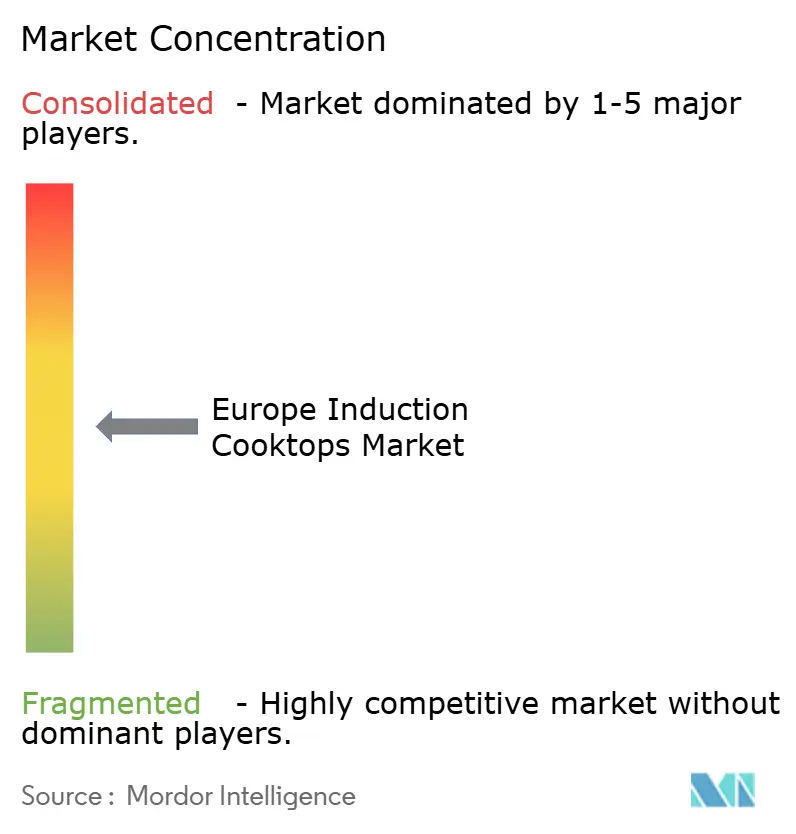
| Market Concentration | Medium |
Major Players *Disclaimer: Major Players sorted in no particular order Image © Mordor Intelligence. Reuse requires attribution under CC BY 4.0. | |
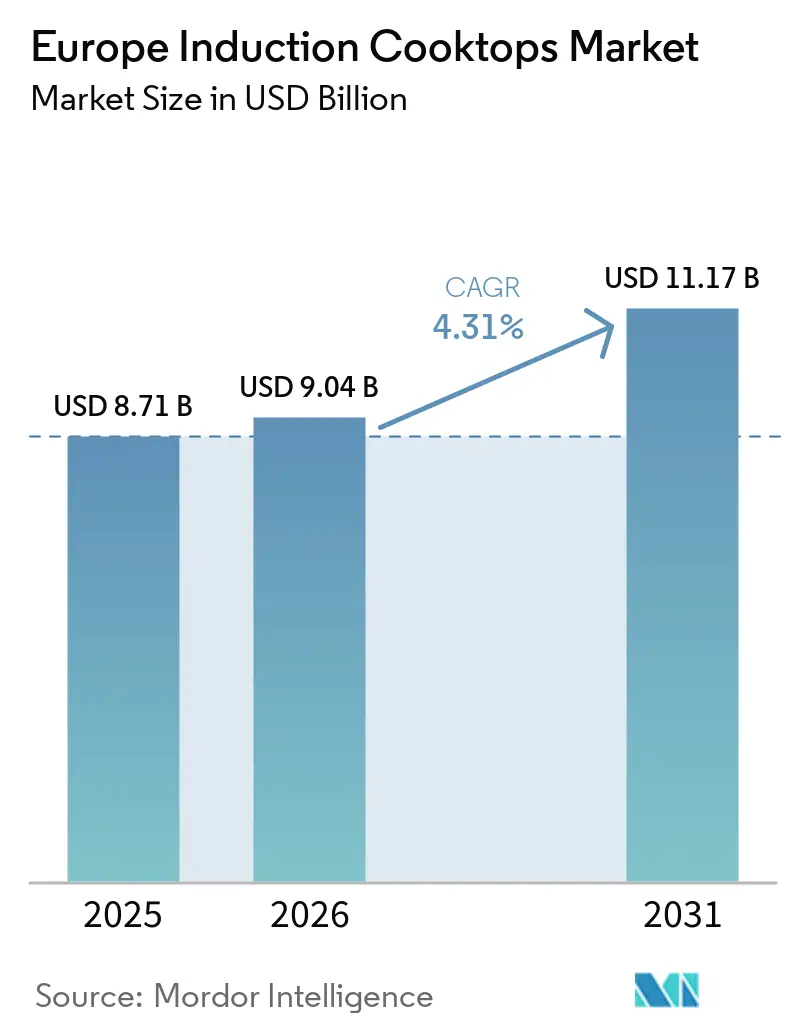
Europe Induction Cooktops Market Analysis by Mordor Intelligence
The European induction cooktops market size is projected to be USD 8.7 billion in 2025, USD 9.0 billion in 2026, and reach USD 11.2 billion by 2031, growing at a CAGR of 4.3% from 2026 to 2031. The European induction cooktops market is being supported by policies that favor electrified homes, higher demand for built-in kitchens, and commercial kitchen upgrades. These factors support demand beyond the normal replacement cycle for cooking appliances. Buyers are also giving greater weight to operating costs, energy performance, and kitchen design when choosing a cooktop. Manufacturers are responding with integrated ventilation, connected controls, and a wider range of built-in formats. The European induction cooktops market also faces slower retrofit activity, where homes need electrical work or new cookware.
Key Report Takeaways
- By product type, built-in units held 60.6% of the European induction cooktops market share in 2025, while free-standing and portable units are forecast at a 5.2% CAGR through 2031.
- By burner configuration, 4-zone hobs accounted for 43.3% of the Europe induction cooktops market share in 2025, while 5-zone and above configurations are projected to expand at a 4.6% CAGR through 2031.
- By end user, residential applications held 74.3% of revenue in 2025, while commercial applications are forecast to advance at a 4.8% CAGR through 2031.
- By distribution channel, B2C and retail channels held 81.2% of revenue in 2025 and are forecast at a 4.5% CAGR through 2031.
- By geography, Germany held 22.2% of revenue in 2025, while Spain is forecast at a 5.5% CAGR through 2031.
Note: Market size and forecast figures in this report are generated using Mordor Intelligence’s proprietary estimation framework, updated with the latest available data and insights as of January 2026.
Market Trends and Insights
Drivers Impact Analysis of Europe Induction Cooktops Market*
| Driver | (~) % Impact on CAGR Forecast | Geographic Relevance | Impact Timeline |
|---|---|---|---|
| Energy-Efficiency Benefits Over Gas Cooking | +1.0% | Europe, with strong relevance in the Netherlands, Germany, the United Kingdom, and the Nordics | Short term (≤ 2 years) |
| Electrification and Gas-Phase-Out Policies | +1.2% | Netherlands, France, and the European Union | Medium term (2-4 years) |
| Premium Renovation and Built-In Appliance Demand | +0.8% | Germany, the United Kingdom, France, and Spain | Medium term (2-4 years) |
| Connected and Assisted-Cooking Appliances | +0.5% | Germany, the United Kingdom, France, and the Nordics | Medium term (2-4 years) |
| Commercial Kitchen Electrification | +0.4% | The United Kingdom, the Nordics, Germany, and Spain | Long term (≥ 4 years) |
| Flexible-Zone Features for Compact Kitchens | +0.3% | Germany, France, BENELUX, and the Nordics | Long term (≥ 4 years) |
| Source: Mordor Intelligence | |||
Energy-Efficiency Benefits Over Gas Cooking
Induction cooktops heat compatible cookware directly, which limits heat loss into the surrounding kitchen. United Kingdom Hospitality reported that induction can achieve energy conversion rates near 90%, compared with 40% to 60% for gas hobs[1]. This efficiency advantage matters most where electricity costs and kitchen operating hours make energy use highly visible. A 2026 CLASP assessment found that electric hob technologies had lower lifetime ownership costs than gas hobs across the European Union and the United Kingdom[2]. The finding reduces the importance of the initial price difference when households and commercial buyers assess ownership over time. The European Commission reported that 75% of respondents in its 2024 survey said the EU energy label had influenced a recent appliance purchase. This gives manufacturers a clear reason to make energy use easy to understand at the point of sale.
Electrification and Gas-Phase-Out Policies
Government policy is creating a clearer route toward electric cooking in several European countries. The Netherlands implemented a gas-boiler ban in 2026, and IKEA Netherlands removed gas cooktops from its range. France has included electrification credits in its recovery plan, which supports appliance choices that align with wider building upgrades. The European Commission requested detailed gas-phase-out strategies from member states by December 2025. CLASP estimated that a phase-down beginning in 2027 and a full phase-out requirement in 2030 could reduce emissions by 17 million tonnes of carbon dioxide equivalent by 2040 and 59 million tonnes by 2050. These measures encourage retailers and manufacturers to plan induction assortments earlier than they would under a standard replacement cycle.
Premium Renovation and Built-In Appliance Demand
Built-in kitchens remain important to the European induction cooktops market because a renovation often changes several appliance choices at the same time. BSH reported that its European built-in appliance business grew 4% in 2025, while its overall European revenue rose 1.2%. The difference points to sustained demand for integrated appliances even in a more cautious consumer environment. BSH invested EUR 847 million in research and development in 2025, or 5.6% of its annual revenue, with investment focused on future appliance formats. Electrolux stated that its AEG and Electrolux brands strengthened their built-in kitchen positions during the first quarter of 2026. Flush-mounted induction cooktops and integrated downdraft ventilation support higher-value kitchen specifications. This gives suppliers a way to compete through design and function rather than price alone.
Connected and Assisted-Cooking Appliances
Connected cooking features are moving from premium offerings into a broader range of induction appliances. Miele introduced its KM 8000 induction hobs and M Sense cookware at EuroCucina in April 2026. The system uses up to 3 temperature sensors in compatible cookware to regulate heat in real time. Miele also uses its CulinaryCoach application to send cooking settings to connected hobs. BSH has introduced AI-supported recipe conversion through its Bosch Cookit platform, which shows how appliance companies are building digital services around the kitchen. In France, smart major domestic appliances represented 17.8% of GEM revenue in 2025, up from 11.3% in 2021. Smart cooking appliances grew 18% in value during 2025, while the wider cooking category declined 8.1%.
Restraints Impact Analysis of Europe Induction Cooktops Market*
| Restraint | (~) % Impact on CAGR Forecast | Geographic Relevance | Impact Timeline |
|---|---|---|---|
| Installer and Electrical-Panel Capacity Bottlenecks | -0.70% | United Kingdom, France, NORDICS, Germany (high retrofit demand) | Short to medium term (1–3 years) |
| Repairability, Warranty, and End-of-Life Compliance Costs | -0.40% | Pan-European; led by France (Right-to-Repair Law, 2024), Germany | Medium to long term (2–5 years) |
| High Upfront Cost and Electrical-Retrofit Requirements | -0.90% | Pan-European; amplified in Southern and Eastern Europe | Short to medium term (1–4 years) |
| Induction-Compatible Cookware Replacement Costs | -0.30% | Pan-European; most pronounced in Southern Europe and lower-income segments | Short term (≤ 2 years) |
| Source: Mordor Intelligence | |||
Upfront Costs and Electrical Retrofit Needs
The higher initial price of induction remains a barrier for some buyers. In older homes, installation can require a wiring upgrade or changes to the household electrical panel. These requirements can delay a switch even when a buyer prefers the energy performance of induction. CLASP found that induction had a higher average purchase price than other electric technologies, even where its lifetime ownership cost was lower. The report also stated that moderate government incentives can make induction accessible to more households. Spain's Plan Renove offered a EUR 105 subsidy for an induction cooktop, limited to 25% of the purchase price, and the Madrid application round closed within 15 days [3]. The pace of adoption in lower-income markets will remain linked to the availability of subsidies and consumer credit.
Installer and Electrical-Panel Capacity Limits
A gas-to-induction conversion can require electrical work that is not needed for a direct appliance replacement. A certified electrician may need to upgrade the circuit breaker panel, install a dedicated circuit, or replace cabling. This can create delays when skilled installer capacity is limited. The United Kingdom Hospitality identified electrical upgrade requirements as a cost and timing challenge for hospitality operators moving to induction. The issue is especially relevant in older rental homes and regions with strong retrofit demand. Germany's Federal Environment Agency promotes induction as the most energy-efficient type of hob. Product innovation cannot solve this issue alone because the response also depends on housing policy, electrical standards, and training for installers.
*Our forecasts treat driver/restraint impacts as directional, not additive. The impact forecasts reflect baseline growth, mix effects, and variable interactions.
Europe Induction Cooktops Market Segment Analysis
By Product Type:
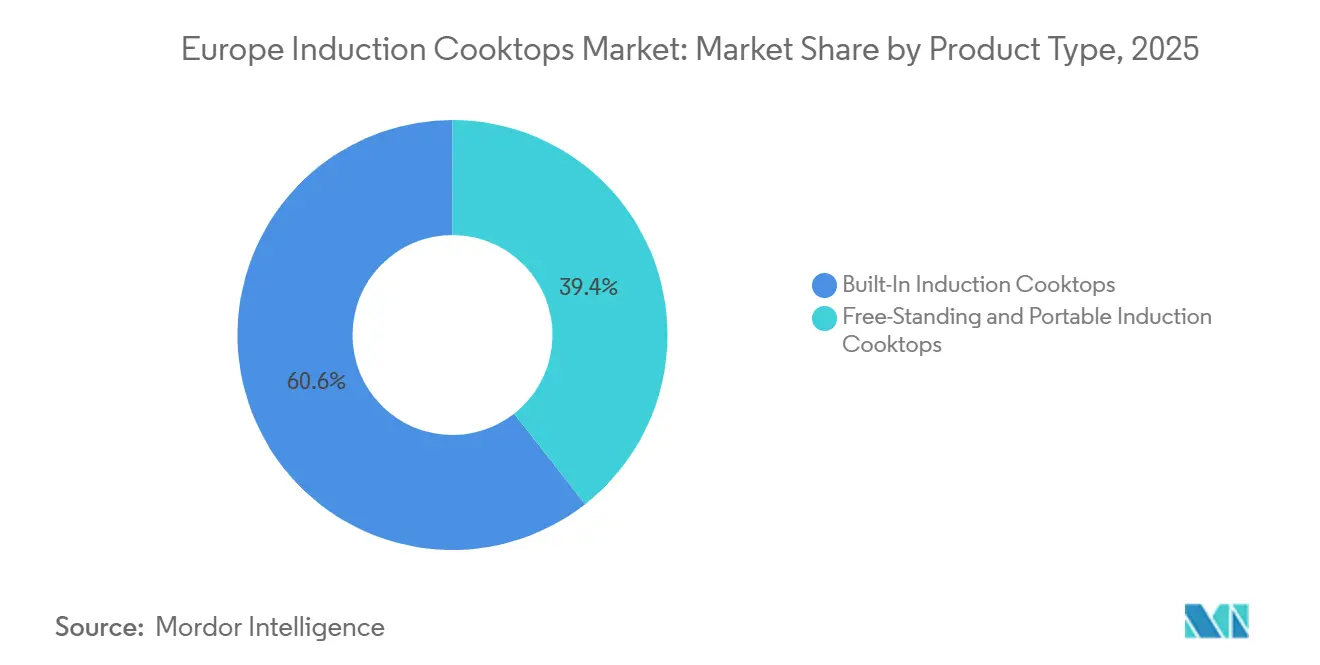
Built-In Units Hold the Largest Position While Portable Formats Grow FasterBuilt-in units accounted for 60.6% of the Europe induction cooktops market share in 2025. Their position reflects the role of fitted kitchens in renovation projects, especially in Germany and the Nordics. Built-in models are often selected with ovens, ventilation, cabinetry, and work surfaces as one package. This supports demand for flush-mounted products and cooktops with integrated extraction. BSH reported that sales of its hobs and extractor hoods rose 2.6% in 2025. The company noted a clear shift toward hobs with integrated extractor fans. Electrolux presented the AEG SaphirMatt induction hob, which has a matte surface described as 10 times more scratch-resistant than standard glass. These product features help sustain higher-value built-in purchases.
Free-standing and portable units are projected to grow at a 5.2% CAGR through 2031. This is the highest growth rate among product types in the Europe induction cooktops market. These products meet the needs of renters, small households, and operators who want to test electric cooking without a full kitchen renovation. A portable unit can also be used in a secondary kitchen or catering setting. The format can reduce the practical barriers of a permanent appliance installation. In France, cooktops with integrated hoods increased 2.4% in value during 2025, while matte-finish variants rose 369.1% in value. These results show that differentiated formats can still attract buyers when the broader cooking category is weak. Both built-in and portable products will remain relevant because they serve different housing and buying conditions.
By Burner Configuration:
4-Zone Hobs Remain Standard While Larger Formats Gain Demand4-zone hobs represented 43.3% of the Europe induction cooktops market size by burner configuration in 2025. The format fits the common 60 cm kitchen width used across much of Europe. It also meets the everyday expectation of preparing several dishes at the same time. This gives 4-zone models a strong position in replacement purchases and standard fitted kitchens. Their installed base supports repeat demand as owners upgrade features or redesign kitchens. The segment is also supported by familiar cabinetry sizes and existing worktop cutouts. These practical advantages make 4-zone hobs a dependable volume category. They remain important even as suppliers expand their premium ranges.
5-zone and above models are forecast to advance at a 4.6% CAGR through 2031. These products are linked to larger kitchens, wider worktops, and buyers who want flexible cooking areas. Miele's KM 8000 series is available in widths from 60 cm to 90 cm and offers PowerFlex zones for up to 6 pans. This approach allows a brand to address varied kitchen layouts within one product family. Single-zone and 2-zone models continue to serve portable and modular applications. Three-zone products are used in smaller fixed kitchens and secondary cooking areas. As flexible-zone technology develops, fixed burner count may become a less complete measure of how a cooktop can be used.
By End User:
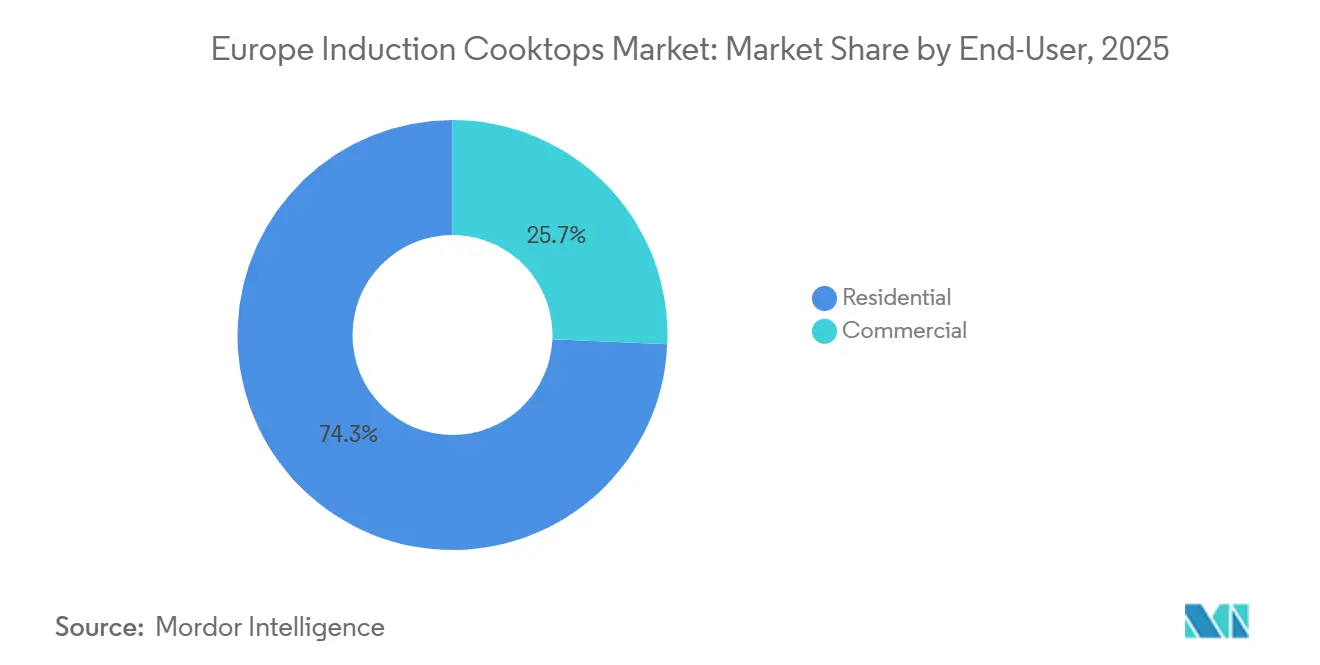
Residential Demand Leads While Commercial Applications Expand FasterResidential users held 74.3% of the Europe induction cooktops market share in 2025. Household purchases remain the main source of unit demand because cooktops are a core kitchen appliance. Residential demand is tied to renovations, housing moves, replacement needs, and changing preferences for electric cooking. Germany, France, and Spain remain important household markets because of their large appliance bases and renovation activity. Connected features give households a reason to upgrade beyond basic heating performance. Built-in designs also support a move from ceramic or gas products to induction during kitchen renovation. This makes the residential segment the foundation of the European induction cooktops market.
Commercial applications are projected to grow at a 4.8% CAGR through 2031. Hotels, restaurants, corporate cafeterias, transport catering, and institutional kitchens are the main users in this segment. Their purchases are influenced by energy costs, safety goals, and carbon reporting requirements. The British Safety Council case study reported lower energy use and a 3-year payback after an electric cooking conversion. Electrolux Professional's free-zone induction platform also shows continued supplier attention to professional kitchens. Commercial demand can be less affected by household renovation sentiment because it is connected to operational plans. It can therefore provide a separate source of growth for equipment manufacturers.
By Distribution Channel:
B2C and Retail Lead Both Revenue and GrowthB2C and retail channels accounted for 81.2% of revenue in 2025. This channel also has the highest projected growth rate, at 4.5% CAGR through 2031. Multi-brand retailers remain useful for buyers who want to compare product types and prices. Exclusive brand outlets are more focused on product demonstrations and kitchen design consultation. Online platforms have expanded the research and buying process for appliances. Brand websites also use kitchen configurators and virtual consultations to guide customers through product selection. These channels keep consumer-facing communication important for the European induction cooktops industry. They also make energy performance, dimensions, and installation needs easier to compare before purchase.
B2B and direct sales are smaller but remain important for commercial projects. Hotel chains, restaurant groups, and institutional caterers may buy directly from manufacturers for multi-site programs. This route can support longer contracts and coordinated installation planning. It can also help commercial buyers specify equipment that matches professional kitchen layouts. Fagor Industrial serves professional kitchen operators through direct supply arrangements. Direct supply can reduce the need for a retail intermediary, although it can place greater service and project-management demands on the supplier. B2B demand will remain important where a commercial operator is upgrading several sites at once. Retail will nevertheless retain the larger role because household purchases represent the core volume base.
Geography Analysis
Western Europe Induction Cooktops Market
Germany held 22.2% of the Europe induction cooktops market share in 2025. Its position reflects its large appliance market, strong kitchen manufacturing base, and demand for built-in products. German buyers have access to a broad range of premium and mid-priced brands. The country's renovation activity also supports integrated cooktops and ventilation products. Germany's Federal Environment Agency promotes induction as the most energy-efficient hob option. Spain is forecast to grow at a 5.5% CAGR through 2031. The country benefits from renovation activity, a Plan Renove subsidy, and hospitality refurbishment. The United Kingdom is also expanding across residential and commercial applications as more operators assess electric cooking.
France, Italy and BENELUX Induction Cooktops Market
France presents a mixed demand environment. Its overall large-appliance cooking category declined 8.1% in 2025 because of weaker real-estate conditions. However, smart cooking appliances rose 18% in value, and integrated cooktop formats continued to grow. Italy remains an important design and manufacturing location for brands such as Elica and SMEG. Italian product development influences premium product launches across Europe. BENELUX benefits from the Netherlands' 2026 policy direction and the removal of gas cooktops from IKEA Netherlands. These conditions create a stronger policy-led reason to consider electric cooking.
Nordics and Broader European Markets
The Nordics have high induction adoption because of established electric cooking use, environmental awareness, and renewable electricity availability. Their total contribution is smaller than major Western European markets because of population size. The Europe induction cooktops market size in the rest of Europe is supported by building and energy codes linked to wider European standards. These markets are at earlier stages of the shift from gas to electric cooking. Lower household incomes can slow replacement decisions in some countries. Electrical infrastructure can also limit the pace of retrofits. Suppliers need different product and pricing approaches across the region. This makes broad European coverage valuable, but it also requires local distribution and installation support.
Competitive Landscape
The Europe induction cooktops market is moderately concentrated. BSH Home Appliances uses Bosch, Siemens, Neff, and Gaggenau to address several price tiers and retail formats. This multi-brand approach gives BSH broad visibility in mass, premium, and specialist kitchen channels. Miele competes in the premium segment through German production, kitchen design relationships, and connected cooking features. Electrolux serves different price points through its AEG and Electrolux brands. Samsung and LG use their wider home electronics ecosystems to position connected hobs within a smart-home offering. Competition is therefore based on appliance performance, brand position, service, and digital features.
Integrated ventilation is becoming a key area of product competition. BSH identified rising interest in hobs with integrated extractor fans in its 2025 results. Elica introduced ID Technology and the Matrix user interface at EuroCucina 2026. The company stated that the system uses more than 3,840 LEDs and that its new inductors use 30% less copper than conventional designs. Miele's April 2026 KM 8000 launch added sensor-enabled cookware and app-based cooking support. These launches show that leading companies are using integrated systems to differentiate their premium products.
Beko Europe relaunched its European operations in 2025 and announced EUR 300 million of planned investment, including EUR 100 million for research and development. Its Italian cooking center supports further work in built-in cooking products. SMEG introduced the Isola and Musa ranges at EuroCucina 2026, strengthening its premium built-in offer. Novy competes from the ventilation side in cooktop-with-extraction products. Smaller online-focused brands compete at entry prices, while established brands protect their position through retail reach, service, and product development. Regulation affecting gas appliances can also shift investment toward induction over time.
Europe Induction Cooktops Industry Leaders
-
BSH Home Appliances
-
Electrolux AB
-
Whirlpool Corporation
-
Miele & Cie. KG
-
Arçelik A.Ş.
- *Disclaimer: Major Players sorted in no particular order
Europe Induction Cooktops Market Companies Covered in this Report
- BSH Home Appliances
- Electrolux AB
- Whirlpool Corporation
- Miele & Cie. KG
- Arçelik A.Ş.
- Haier Smart Home Co., Ltd.
- Samsung Electronics Co., Ltd.
- LG Electronics Inc.
- BORA GmbH & Co. KG
- Gorenje Group, Hisense Europe
- SMEG S.p.A.
- Elica S.p.A.
- Fulgor Milano S.p.A.
- Fagor Industrial S. Coop.
- Fisher & Paykel Appliances Holdings Ltd.
- V-ZUG Holding AG
- Teka Industrial S.A.
- Beko Europe
- Novy N.V.
- Groupe Brandt
Recent Industry Developments in Europe Induction Cooktops Market
- April 2026: Miele launched the KM 8000 series induction hobs at EuroCucina 2026 in Milan, pairing the hobs with M Sense cookware (featuring up to 3 integrated temperature sensors) and the AI-powered CulinaryCoach app assistant. The system automatically regulates temperature and power in real time, available in 60, 75, 80, and 90 cm widths across European markets, marking Miele's largest cooking-platform launch in over a decade.
- April 2026: SMEG launched its Isola collection (induction hobs with integrated hood and lighting, developed with Stefano Boeri Interiors) and Musa range (full built-in suite including induction hobs, developed with BorromeodeSilva) at EuroCucina 2026.
- April 2026: Elica debuted its proprietary ID Technology and the Matrix UI (a pixel-based interface with over 3,840 individual LEDs) at Salone del Mobile / EuroCucina 2026
- March 2026: BSH Home Appliances Group confirmed cumulative investment in its Montañana factory in Zaragoza, Spain, of more than EUR 113 million over a 5-year period, a facility that produces 1 in every 4 induction hobs manufactured globally each year.
Europe Induction Cooktops Market Report Scope
Segmentation Overview
| Built-In Induction Cooktops |
| Free-Standing and Portable Induction Cooktops |
| 1 Zone |
| 2 Zones |
| 3 Zones |
| 4 Zones |
| 5 Zones or Above |
| Residential | |
| Commercial | HoReCa (Hotels, Restaurants and Cafes/Catering) |
| Institutional Kitchens | |
| Corporate and Office Cafeterias | |
| Other Commercial Applications, including Transportation, Retail and Healthcare |
| B2B / Direct from Manufacturers | |
| B2C / Retail | Multi-Brand Stores |
| Exclusive Brand Outlets | |
| Online | |
| Other Distribution Channels |
| United Kingdom |
| Germany |
| France |
| Spain |
| Italy |
| BENELUX (Belgium, Netherlands, and Luxembourg) |
| NORDICS (Denmark, Finland, Iceland, Norway, and Sweden) |
| Rest of Europe |
| By Product Type | Built-In Induction Cooktops | |
| Free-Standing and Portable Induction Cooktops | ||
| By Burner Configuration | 1 Zone | |
| 2 Zones | ||
| 3 Zones | ||
| 4 Zones | ||
| 5 Zones or Above | ||
| By End-User | Residential | |
| Commercial | HoReCa (Hotels, Restaurants and Cafes/Catering) | |
| Institutional Kitchens | ||
| Corporate and Office Cafeterias | ||
| Other Commercial Applications, including Transportation, Retail and Healthcare | ||
| By Distribution Channel | B2B / Direct from Manufacturers | |
| B2C / Retail | Multi-Brand Stores | |
| Exclusive Brand Outlets | ||
| Online | ||
| Other Distribution Channels | ||
| By Geography | United Kingdom | |
| Germany | ||
| France | ||
| Spain | ||
| Italy | ||
| BENELUX (Belgium, Netherlands, and Luxembourg) | ||
| NORDICS (Denmark, Finland, Iceland, Norway, and Sweden) | ||
| Rest of Europe | ||
Key Questions Answered in the Report
What is driving demand for induction cooktops in Europe?
Electrification policies, lower lifetime ownership costs for electric hobs, built-in kitchen renovations, and commercial electrification are supporting demand.
How large is the Europe induction cooktops market?
The sector is projected to grow from USD 9.0 billion in 2026 to USD 11.2 billion by 2031 at a 4.3% CAGR.
Which product type leads European induction cooktop sales?
Built-in units led with a 60.6% share in 2025, supported by fitted kitchen and renovation demand.
Which European country is growing fastest for induction cooktops?
Spain is forecast to grow at a 5.5% CAGR through 2031, supported by renovation activity and the Plan Renove scheme.
What is the main barrier to induction adoption in older homes?
Higher purchase costs and electrical retrofit needs can slow replacement decisions, even when lifetime ownership costs are lower.