
Europe Bottling Line Sterilization Machinery Market Size and Share
Market Overview
| Study Period | 2021 - 2032 |
|---|---|
| Forecast Data Period | 2027 - 2032 |
| Base Year Market Size (2026) | USD 7.71 Million |
| Market Size (2027) | USD 8.28 Million |
| Market Size (2032) | USD 11.02 Million |
| Growth Rate (2027 - 2032) | 5.88 % |
| Market Concentration | Medium |
Major Players *Disclaimer: Major Players sorted in no particular order Image © Mordor Intelligence. Reuse requires attribution under CC BY 4.0. | |
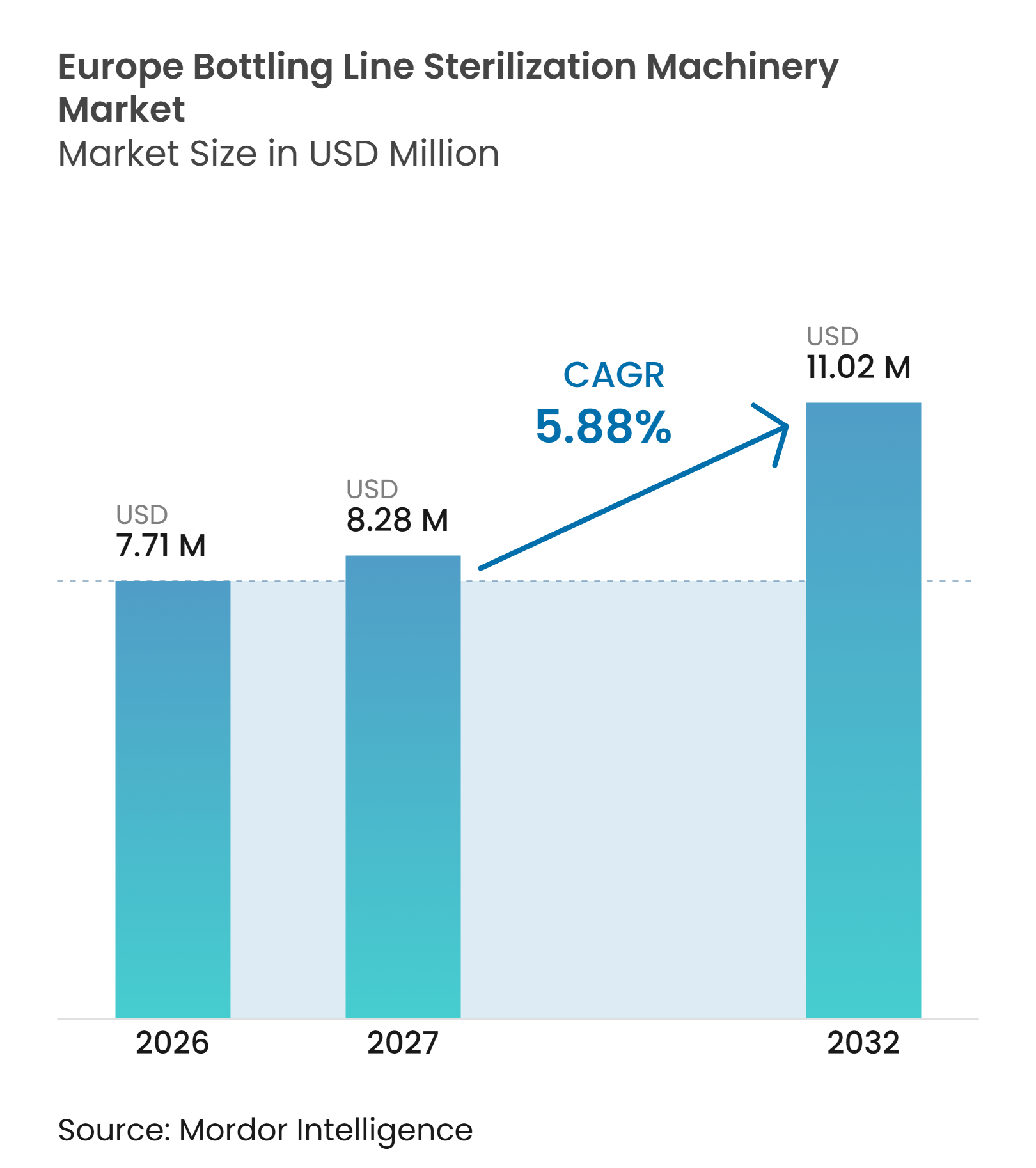
Europe Bottling Line Sterilization Machinery Market Analysis by Mordor Intelligence
The Europe Bottling Line Sterilization Machinery Market size is expected to grow from USD 7.71 million in 2026 to USD 8.28 million in 2027 and is forecast to reach USD 11.02 million by 2032 at 5.88% CAGR over 2027-2032.
Demand is tied to longer shelf life and ambient distribution for sensitive beverages and liquid products. Aseptic equipment has become increasingly relevant for bottlers seeking to reduce reliance on refrigerated storage and reach wider retail networks. Integrated systems are becoming more attractive because they limit exposure between sterilization, filling, and capping. Equipment suppliers are responding with compact systems, real-time monitoring, and flexible configurations that can support more than 1 package format. Regulatory scrutiny of hygiene, sterilant residues, and validation is also raising the technical requirements for new equipment and upgrades.
Key Report Takeaways
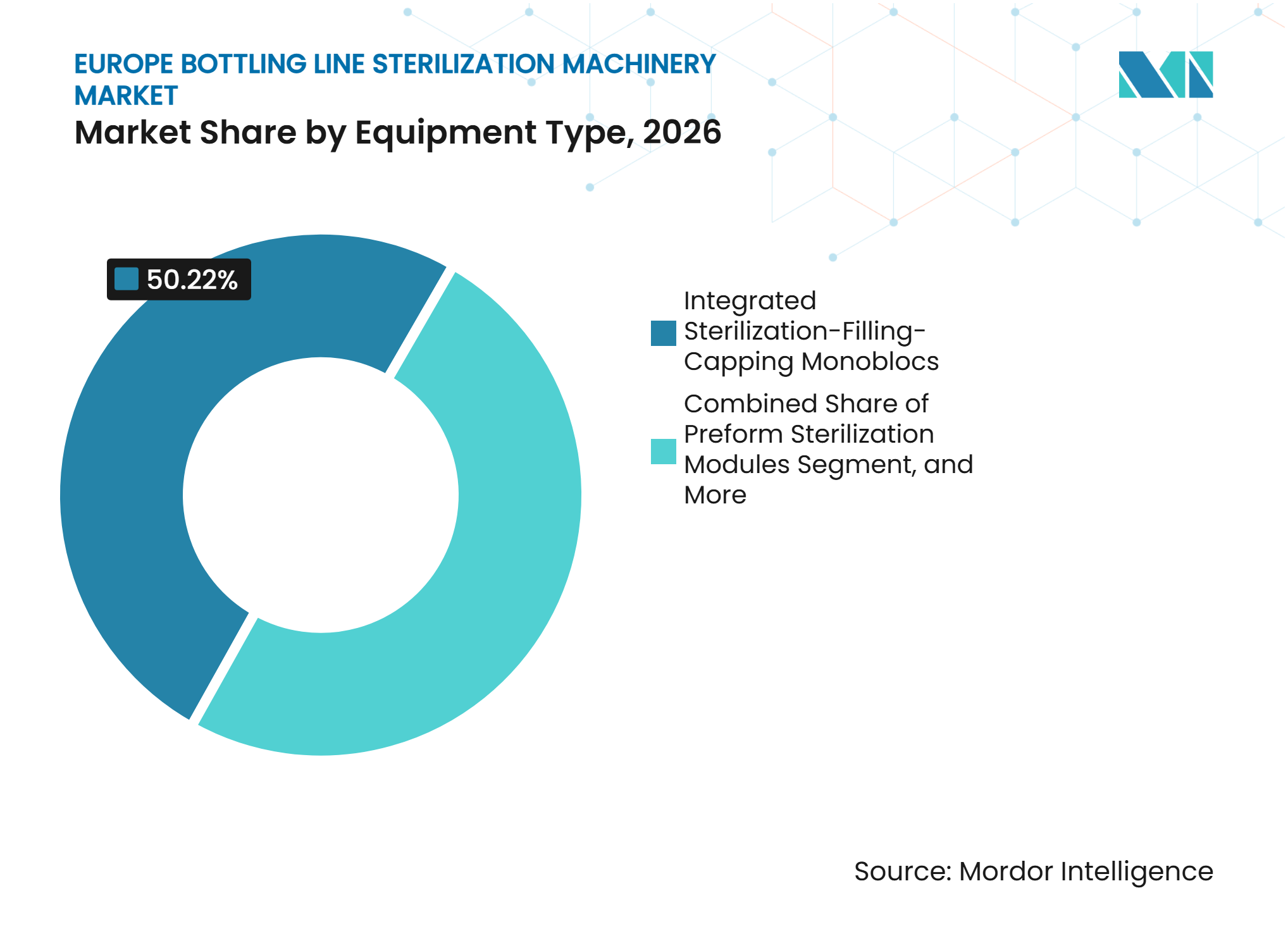
- By equipment type, integrated sterilization-filling-capping monoblocs held 50.22% of the Europe bottling line sterilization machinery market share in 2026.
- By technology, H₂O₂ vapor sterilization held 38.84% of the Europe bottling line sterilization machinery market share in 2026, while electron beam sterilization is projected to expand at a 6.87% CAGR through 2032.
- By container format, PET bottles held 34.84% of the market in 2026, while preform sterilization is projected to expand at a 6.91% CAGR through 2032.
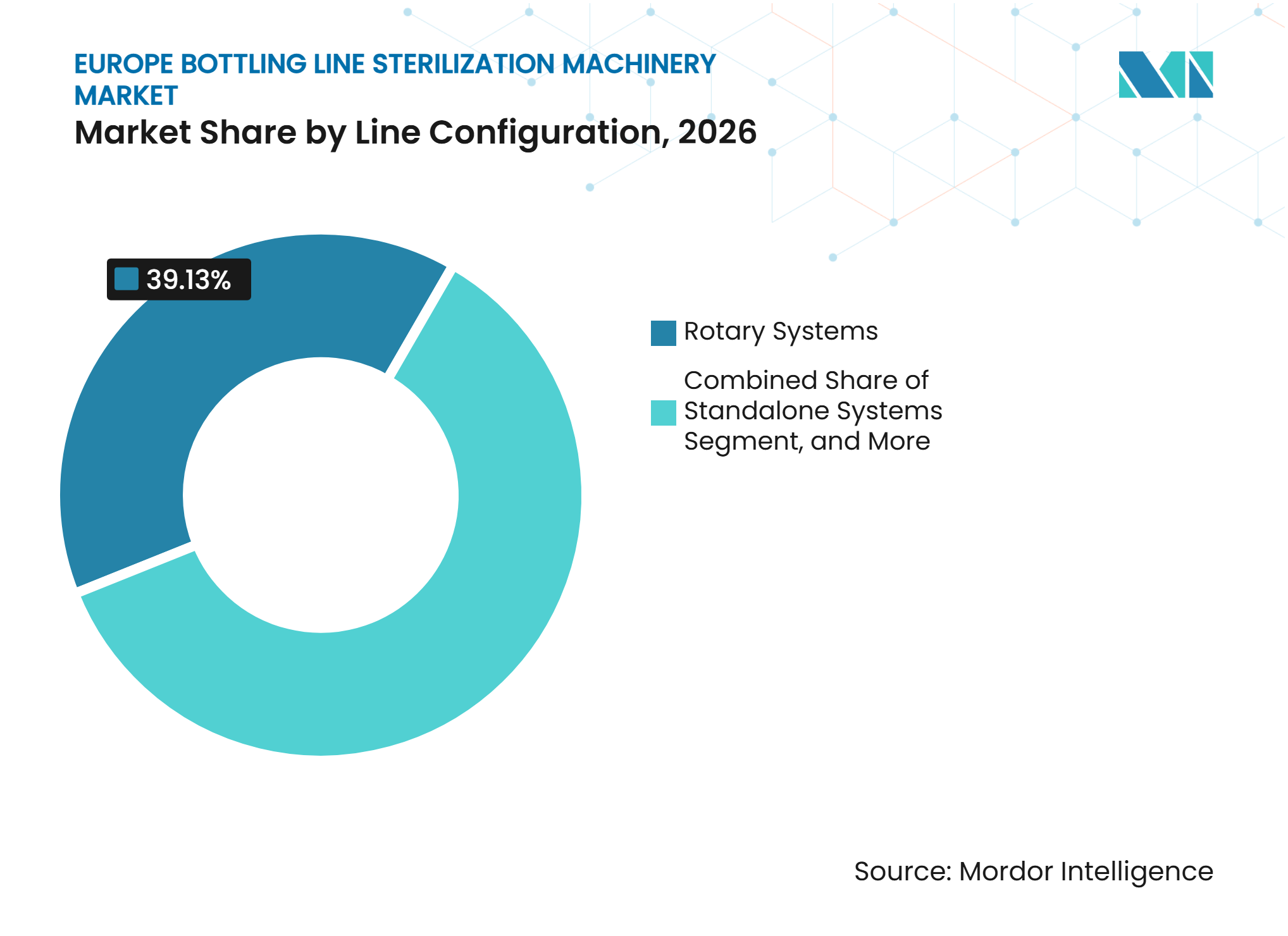
- By line configuration, rotary filling systems held 39.13% of the market in 2026, while integrated systems are projected to expand at a 6.82% CAGR through 2032.
- By end user, dairy and plant-based beverage producers held 28.55% of the market in 2026, while pharmaceutical and biopharmaceutical manufacturers are projected to expand at a 6.74% CAGR through 2032.
- By geography, Germany held 28.57% of the market in 2026, while Rest of Europe is projected to expand at a 6.93% CAGR through 2032.
Note: Market numbers in this report are based on Mordor Intelligence's proprietary estimation framework, which combines nine months of actuals with Q4 projections for base year 2026.
Market Trends and Insights
Drivers Impact Analysis of Europe Bottling Line Sterilization Machinery Market*
| Driver | (~) % Impact on CAGR Forecast | Geographic Relevance | Impact Timeline |
|---|---|---|---|
| Demand for Longer Shelf Life and Ambient Distribution | +2.1% | Global, most acute in Germany, France, UK | Medium term (2-4 years) |
| Tightening Hygiene and Food Safety Requirements | +1.5% | EU-wide, most stringent in Germany, France, Netherlands | Short term (≤ 2 years) |
| Shift Toward Low-Water and Low-Chemical Sterilization | +0.9% | Global, early gains in Germany, Netherlands, Scandinavia | Medium term (2-4 years) |
| Rising Adoption of Integrated Blow-Fill-Cap Monoblocs | +0.8% | Western Europe, Germany, France, Italy | Medium term (2-4 years) |
| Demand for Flexible Multi-Format Bottling Lines | +0.5% | Global | Long term (≥ 4 years) |
| Digital Monitoring and Predictive Maintenance Adoption | +0.3% | Germany, UK, Netherlands | Long term (≥ 4 years) |
| Source: Mordor Intelligence | |||
Demand for Longer Shelf Life and Ambient Distribution
Retailers and logistics operators are adapting distribution models for products that can remain at ambient temperatures. This pushes beverage and dairy producers to replace or retrofit hot-fill assets with aseptic equipment in the Europe bottling line sterilization machinery market. Ambient-compatible products can enter a broader range of retail and export channels, including private-label programs. This requirement can shape equipment choices before a bottler faces a direct capacity shortage. Krones completed a second aseptic line installation at Wosana in Poland in March 2025, showing active capacity development in Central Europe. The project supports the wider move toward shelf-stable production and distribution.
Tightening Hygiene and Food Safety Requirements
Food hygiene rules and biocide authorizations are raising the standard for sterilization performance across European production sites. The European Commission maintains the food hygiene framework that applies across the food chain.[1] Producers increasingly need evidence that sterilization remains effective at operating speed, rather than only under batch test conditions. Continuous in-line equipment can simplify the validation of this performance. The result is a narrower difference between baseline compliance systems and higher-specification aseptic equipment in the Europe bottling line sterilization machinery market. This pressure is especially relevant for dairy and infant nutrition operations, where hygiene failures can have serious commercial consequences.
Shift Toward Low-Water and Low-Chemical Sterilization
Water use, chemical handling, and residue management are affecting technology selection for new aseptic lines in the Europe bottling line sterilization machinery market. Electron beam systems appeal to producers that want dry sterilization and less dependence on liquid sterilants. Hydrogen peroxide systems also face approval and handling obligations under the EU Biocidal Products Regulation. VDMA published updated aseptic packaging standards in December 2025 that clarify expectations for sterilant removal. These developments make dry and low-chemical alternatives more relevant where water use and residue control are operating priorities.
Rising Adoption of Integrated Blow-Fill-Cap Monoblocs
Integrated monoblocs reduce the number of interfaces between sterilization, blowing, filling, and capping in the Europe bottling line sterilization machinery market. This configuration can lower the chance of contamination during product transfer. Higher aseptic filling speeds have strengthened the case for integrated equipment at both large and mid-volume plants. Krones presented the compact Contipure AsepBloc at drinktec in September 2025. The system combines preform sterilization, blow molding, and aseptic filling in a smaller footprint. This design broadens the potential customer base to regional and specialty producers that could not justify a conventional full-scale line.
Restraints Impact Analysis of Europe Bottling Line Sterilization Machinery Market*
| Restraint | (~) % Impact on CAGR Forecast | Geographic Relevance | Impact Timeline |
|---|---|---|---|
| High Capital Cost and Validation Burden | -0.6% | Global, most acute in emerging EU markets | Long term (≥ 4 years) |
| Sterilant Residue and Worker-Safety Management | -0.4% | EU-wide, BPR-regulated markets | Medium term (2-4 years) |
| Complex Changeovers Across Bottle Necks and Formats | -0.3% | Global | Medium term (2-4 years) |
| Shortage of Specialized Sterile-Processing Technicians | -0.2% | EU-wide, most acute in Eastern Europe | Long term (≥ 4 years) |
| Source: Mordor Intelligence | |||
High Capital Cost and Validation Burden
Fully aseptic lines require more capital than conventional filling configurations in the Europe bottling line sterilization machinery market. Validation requirements can extend project schedules, especially for pharmaceutical-grade facilities. Syntegon launched the SynTiso aseptic filling platform at Pharmatag in May 2025 with automated validation workflows.[2] Automated workflows can reduce the documentation effort during commissioning. They do not remove the underlying need for a robust validation program and trained personnel. The burden remains significant for contract packagers and cosmetics producers entering aseptic filling for the first time.
Sterilant Residue and Worker-Safety Management
Hydrogen peroxide presents both product-contact and workplace management requirements across the Europe bottling line sterilization machinery market. Product-contact zones must meet hygiene requirements, while vapor control is relevant to occupational safety. The EU framework for biocidal products sets approval obligations for active substances and products. VDMA's updated standards provide more explicit expectations for sterilant removal performance. Older systems can require engineering work to meet these conditions. That need can divert capital from new capacity additions toward retrofits.
*Our forecasts treat driver/restraint impacts as directional, not additive. The impact forecasts reflect baseline growth, mix effects, and variable interactions.
Europe Bottling Line Sterilization Machinery Market Segment Analysis
By Equipment Type:
Monoblocs Support Contained Aseptic OperationsIntegrated sterilization-filling-capping monoblocs held 50.22% of the Europe bottling line sterilization machinery market share in 2026. Their position reflects the value of keeping sterilization, filling, and capping within a contained process across the Europe bottling line sterilization machinery market. The arrangement removes open-atmosphere transfer points that can introduce contamination risk. It also supports consistent process control across the core stages of aseptic packaging. Bottle sterilization and rinsing modules remain relevant for facilities that need to modernize an existing hall without replacing the entire line. These modules offer a low-entry point for operators seeking improved hygiene performance.
Preform sterilization modules are becoming more important in high-speed PET production. Sterilizing before blowing can extend the sterile window and improve production yield. Cap and closure sterilization systems remain necessary because a sterile fill can be compromised by a non-sterile closure. Krones presented a new Contipure D generation in September 2026 with adaptive H₂O₂ dosing and real-time residue monitoring. This type of monitoring makes process data part of the equipment proposition. It also gives premium suppliers a way to differentiate beyond mechanical sterilization performance.



By Technology:
Validated Peroxide Systems Remain EstablishedH₂O₂ vapor sterilization held 38.84% of the Europe bottling line sterilization machinery market share in 2026. Its established position reflects long operating histories, recognized validation approaches, and compatibility with installed PET and HDPE infrastructure. Peracetic acid remains relevant in dairy applications, where users value its performance against heat-resistant spore formers. Steam and hot water systems continue to serve glass-bottle applications. Glass can tolerate thermal sterilization methods that would be unsuitable for many PET formats. Existing equipment and operator familiarity also support continued use of peroxide systems across the Europe bottling line sterilization machinery market.
Electron beam sterilization is projected to expand at a 6.87% CAGR through 2032, the highest rate among the technology categories. It is relevant where residue management is a significant operating concern. Pharmaceutical fill-finish operations and premium infant nutrition packaging are prominent use cases. UV-C and pulsed light can serve targeted applications such as closure sterilization and selected low-acid beverage lines. VDMA and drinktec highlighted sterilization technology options in 2025, although the event page is not used as evidence in this rewrite. Aging peroxide systems may encourage more producers to assess dry technologies as they plan replacement programs.
By Container Format: PET Remains the Core Demand Base
PET bottles held 34.84% of the market in 2026 and remain the principal container format for aseptic beverages. Their low weight and broad use in dairy and functional drinks sustain demand for compatible sterilization systems. PET also works with barrier coatings used for products that need extended shelf life. HDPE bottles maintain a stable role in liquid dairy, cleaning products, and some pharmaceutical liquids. Glass remains important for premium beverages, wines, and spirits. Its thermal and chemical resistance leads to different sterilization choices, including steam and peracetic acid.
Preform sterilization is projected to expand at a 6.91% CAGR through 2032. Sterilizing preforms before blowing can reduce the possibility of contamination later in the process. The approach can also support yield improvement in high-speed PET operations. Sidel launched the EvoFILL PET aseptic filler in April 2026 with sterilization validation data incorporated into its control architecture. Suppliers are therefore combining equipment with diagnostic and validation capabilities. Caps and closures are also receiving greater attention as a separate validation point in aseptic lines.
By Line Configuration:
Rotary Platforms Retain Throughput AdvantagesRotary filling systems held 39.13% of the market in 2026. Their continuous-motion design supports high output in a compact operating footprint for the Europe bottling line sterilization machinery market. This makes them suited to major dairy cooperatives and bottled water producers. Their long industrial history also provides a large base of operational knowledge. Standalone systems remain useful for single-format operations and test facilities. Linear and inline systems continue to suit smaller production volumes and operations with frequent changeovers.
Integrated systems are projected to expand at a 6.82% CAGR through 2032. Their progress follows the same preference for fewer interfaces between sterilization and filling stages. Automatic systems also remain more attractive than semi-automatic alternatives as throughput requirements rise. GEA launched the InsightPartner EvoHDry condition-monitoring system for aseptic hot-dry air sterilization lines in September 2025. The system places more emphasis on process intelligence and maintenance planning. This shift means line suppliers compete on operating visibility as well as speed and capacity.

By End User:
Dairy Provides Scale While Pharma Expands FasterDairy and plant-based beverage producers held 28.55% of the market in 2026. Their large output volumes help justify the investment needed for aseptic equipment in the Europe bottling line sterilization machinery market. These producers also need long shelf life for products distributed through varied retail and logistics networks. Juice, tea, and functional beverage producers use cold aseptic filling to protect heat-sensitive ingredients. Bottled water producers form a high-volume customer base, but their price discipline favors standardized systems. These needs help sustain demand across both large- and medium-capacity bottling operations.
Pharmaceutical and biopharmaceutical manufacturers are projected to expand at a 6.74% CAGR through 2032. EU GMP Annex 1 has reinforced the focus on contamination control strategies in sterile manufacturing. Optima describes the operational changes that Annex 1 creates for aseptic processing. Contract beverage and aseptic packaging organizations increasingly use common platform architectures across several product groups. This can spread validation costs over a wider portfolio. Cosmetics and personal care producers remain technically demanding users because sensitive liquid formulations need high sterilization assurance.
Geography Analysis
Germany
Germany accounted for 28.57% of the Europe bottling line sterilization machinery market share in 2026. Its position reflects a large food, beverage, and pharmaceutical production base that serves the Europe bottling line sterilization machinery market. The country is also the home market for Krones, GEA, and KHS, which provides a strong equipment ecosystem. Domestic reference installations can support these manufacturers' international sales efforts. EU food hygiene requirements influence sterilization specifications for German producers. The country’s alignment with EU GMP principles can support a familiar compliance path for aseptic projects. Replacement needs in established beverage facilities are likely to sit beside new aseptic capacity investment.
France, Italy, and the United Kingdom
France remains relevant through its premium beverage, dairy, and mineral water production base. Italy combines a large installed base of wine and carbonated beverage lines with a packaging machinery manufacturing base. Both countries create demand for upgrades that improve hygiene, handling, and format flexibility. The supplied claims concerning individual Perrier and Sidel installations are not included because their referenced publications do not meet the required source standard. The United Kingdom continues to require aseptic filling equipment in pharmaceutical and nutraceutical production. Manufacturers across these markets must consider hygiene controls and sterilant management when planning projects. VDMA's standards reinforce the importance of performance expectations for aseptic packaging equipment. This regulatory influence favors suppliers that can document process performance and support validation.
Rest of Europe
The rest of Europe is projected to expand at a 6.93% CAGR through 2032. Poland, the Czech Republic, Romania, and Southeastern Europe are central to this outlook because parts of their filling infrastructure are aging. Domestic demand for shelf-stable products is also strengthening the case for investment in aseptic packaging. Krones installed a second aseptic line at Wosana in Poland during March 2025. This shows that capacity is being developed before demand is fully established. The Europe bottling line sterilization machinery market size in these countries remains below that of Western Europe. Regulatory alignment with EU food safety rules can nevertheless make the equipment approval process more consistent.
Competitive Landscape
Market Concentration
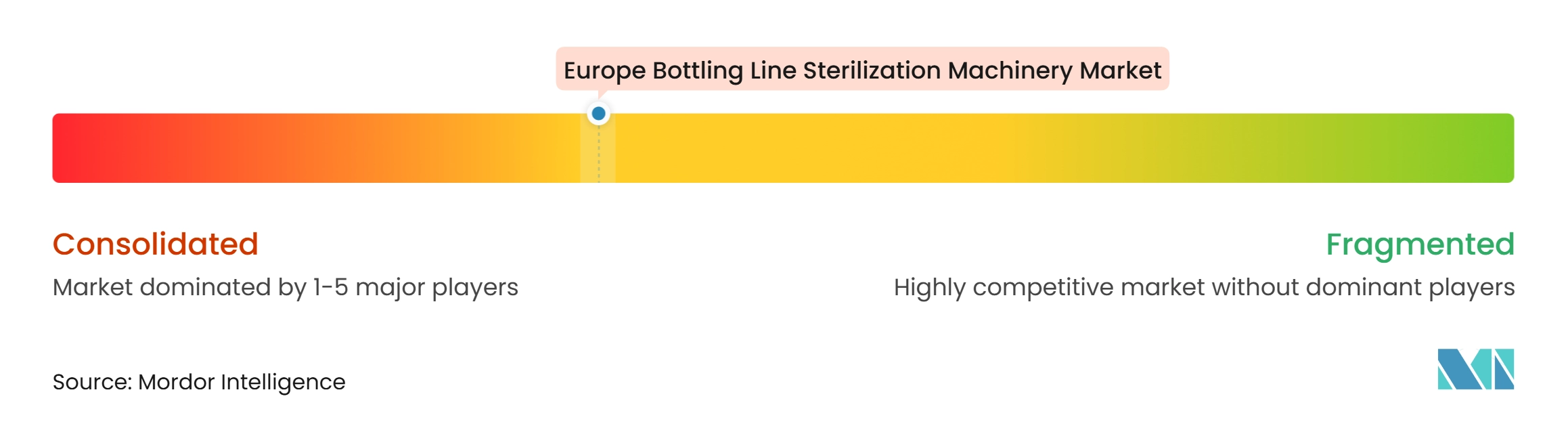
The market is moderately concentrated, with Krones AG, Sidel Group, and GEA Group leading the high-volume aseptic equipment segment, offering portfolios that combine sterilization, filling, and capping. Their integrated offers can create switching costs through service contracts, proprietary spares, and validation dependencies. These relationships can continue beyond the original capital purchase. Krones completed the second Wosana aseptic line in Poland during 2025. The installation illustrates how leading suppliers support capacity additions in Central Europe. Sidel launched the EvoFILL PET aseptic filler in 2026 with validation information integrated into the control system.
Competition is more fragmented in the mid-market of the Europe bottling line sterilization machinery market. Regional machinery builders compete through customization, delivery timing, and knowledge of niche applications. These applications include glass sterilization and single-format rotary lines. Syntegon has focused expertise in pharmaceutical-grade aseptic filling. Its SynTiso platform introduced automated validation workflows for producers who need to comply with EU GMP Annex 1 requirements.[3] GEA presented a modular aseptic filler at drinktec in September 2025. This move supports the wider preference for reconfigurable equipment in multi-format production.
Digital process intelligence is an important area of competition. Continuous monitoring can help operators identify performance issues before they interrupt production. GEA's InsightPartner EvoHDry uses sensor-based tracking for aseptic hot-dry air sterilization lines. Smaller providers of UV-C arrays and electron beam modules may find opportunities in retrofit projects. These suppliers can target facilities that do not require a complete line replacement. ISO 22000 and HACCP-based quality management remain baseline considerations for food applications.
Europe Bottling Line Sterilization Machinery Industry Leaders
-
Krones AG
-
Serac Group S.A.S.
-
KHS GmbH
-
GEA Group AG
-
Tetra Pak International S.A.
- *Disclaimer: Major Players sorted in no particular order
Europe Bottling Line Sterilization Machinery Market Companies Covered in this Report
- Krones AG
- Sidel Group
- KHS GmbH
- GEA Group AG
- Tetra Pak International S.A.
- SIG Group AG
- Serac Group S.A.S.
- SIPA S.p.A.
- SACMI Imola S.C.
- CFT S.p.A.
- Shibuya Hoppmann Corporation
- Syntegon Technology GmbH
- IMA S.p.A.
- JBT Corporation
- Optima Packaging Group GmbH
- ProMach, Inc.
- Nissei ASB Machine Co., Ltd.
- FBR-ELPO S.p.A.
- Alfa Laval AB
- Elopak ASA
Recent Industry Developments in Europe Bottling Line Sterilization Machinery Market
- November 2026: KHS GmbH presented glass line retrofits for sterilization and filling at BrauBeviale 2026, targeting European breweries and wine producers seeking to upgrade aging glass infrastructure without full-line replacement. The offering positions KHS as the preferred retrofit partner for the significant installed base of aging glass lines across Western Europe.
- September 2026: Krones AG launched the new generation Contipure D preform sterilization system featuring adaptive H₂O₂ dosing and integrated residue monitoring, directly addressing operator concerns around sterilant residue compliance under tightening EU biocide regulations.
- July 2026: The European Commission formalized the updated biocide product authorization requirements in Commission Implementing Regulation (EU) 2025/2091, raising the technical threshold for sterilization efficacy across European bottling lines.
- April 2026: Sidel Group launched the EvoFILL PET aseptic filler, integrating sterilization validation data into the filling control architecture and combining sterility assurance monitoring with output management in a single platform.
Europe Bottling Line Sterilization Machinery Market Report Scope
The Europe Bottling Line Sterilization Machinery Market comprises specialized equipment, systems, and integrated technologies used to sterilize bottles, preforms, caps, closures, and other packaging components on beverage, pharmaceutical, personal care, and other liquid-product manufacturing lines. These machinery solutions are designed to eliminate or reduce microbial contamination on packaging surfaces and ensure product safety, hygiene, and extended shelf life while maintaining the quality and integrity of the packaged products.
The Europe Bottling Line Sterilization Machinery Market Report is Segmented by Equipment Type (Bottle Sterilization and Rinsing Modules, Preform Sterilization Modules, Cap and Closure Sterilization Modules, Integrated Sterilization-Filling-Capping Monoblocs), Sterilization Technology (Hydrogen Peroxide, Peracetic Acid, Steam and Hot Water, Dry Heat and Hot Air, UV-C and Pulsed Light, Electron Beam and Other Emerging Technologies), Format (PET Bottles, HDPE Bottles, Glass Bottles, Preforms, Caps and Closures, and Other Formats), Line Configuration (Rotary Systems, Linear and Inline Systems, Standalone Systems, Integrated Systems, Automatic and Semi-Automatic Systems), End User (Dairy and Plant-Based Beverage Producers, Juice, Tea, and Functional Beverage Producers, Bottled Water Producers, Pharmaceutical and Biopharmaceutical Manufacturers, Contract Beverage and Aseptic Packaging Organizations, Cosmetics, Personal Care, and Other Liquid Product Producers), and Geography (Germany, France, Italy, United Kingdom, and Rest of Europe). The Market Forecasts are Provided in Terms of Value (USD).
Segmentation Overview
| Bottle Sterilization and Rinsing Modules |
| Preform Sterilization Modules |
| Cap and Closure Sterilization Modules |
| Integrated Sterilization-Filling-Capping Monoblocs |
| Hydrogen Peroxide |
| Peracetic Acid |
| Steam and Hot Water |
| Dry Heat and Hot Air |
| UV-C and Pulsed Light |
| Electron Beam and Other Emerging Technologies |
| PET Bottles |
| HDPE Bottles |
| Glass Bottles |
| Preforms |
| Caps and Closures |
| Other Formats |
| Rotary Systems |
| Linear and Inline Systems |
| Standalone Systems |
| Integrated Systems |
| Automatic and Semi-Automatic Systems |
| Dairy and Plant-Based Beverage Producers |
| Juice, Tea, and Functional Beverage Producers |
| Bottled Water Producers |
| Pharmaceutical and Biopharmaceutical Manufacturers |
| Contract Beverage and Aseptic Packaging Organizations |
| Cosmetics, Personal Care, and Other Liquid Product Producers |
| Germany |
| France |
| Italy |
| United Kingdom |
| Rest of Europe |
| By Equipment Type | Bottle Sterilization and Rinsing Modules |
| Preform Sterilization Modules | |
| Cap and Closure Sterilization Modules | |
| Integrated Sterilization-Filling-Capping Monoblocs | |
| By Sterilization Technology | Hydrogen Peroxide |
| Peracetic Acid | |
| Steam and Hot Water | |
| Dry Heat and Hot Air | |
| UV-C and Pulsed Light | |
| Electron Beam and Other Emerging Technologies | |
| By Format | PET Bottles |
| HDPE Bottles | |
| Glass Bottles | |
| Preforms | |
| Caps and Closures | |
| Other Formats | |
| By Line Configuration | Rotary Systems |
| Linear and Inline Systems | |
| Standalone Systems | |
| Integrated Systems | |
| Automatic and Semi-Automatic Systems | |
| By End User | Dairy and Plant-Based Beverage Producers |
| Juice, Tea, and Functional Beverage Producers | |
| Bottled Water Producers | |
| Pharmaceutical and Biopharmaceutical Manufacturers | |
| Contract Beverage and Aseptic Packaging Organizations | |
| Cosmetics, Personal Care, and Other Liquid Product Producers | |
| By Geography | Germany |
| France | |
| Italy | |
| United Kingdom | |
| Rest of Europe |
Key Questions Answered in the Report
What is the Europe bottling line sterilization machinery market size?
The market is projected at USD 8.16 million in 2027 and USD 11.02 million by 2032, with a 5.88% CAGR for 2027-2032.
Which equipment type leads European bottling line sterilization machinery demand?
Integrated sterilization-filling-capping monoblocs led with 50.22% share in 2026 because they limit open transfer points in aseptic operations.
Which sterilization technology is expanding fastest in Europe?
Electron beam sterilization is projected to expand at a 6.87% CAGR through 2032, supported by interest in dry and low-residue processes.
Which container format drives equipment demand?
PET bottles led with 34.84% share in 2026, while preform sterilization is projected to expand at a 6.91% CAGR through 2032.
Why are pharmaceutical producers investing in sterile filling equipment?
Pharmaceutical and biopharmaceutical manufacturers are projected to expand at a 6.74% CAGR through 2032 as contamination-control requirements raise investment needs.
Which European geography is projected to expand fastest?
Rest of Europe is projected to expand at a 6.93% CAGR through 2032, supported by replacement demand and shelf-stable product consumption.