
Europe Bottling Line Accumulating and Collating Machinery Market Size and Share
Market Overview
| Study Period | 2021 - 2032 |
|---|---|
| Forecast Data Period | 2027 - 2032 |
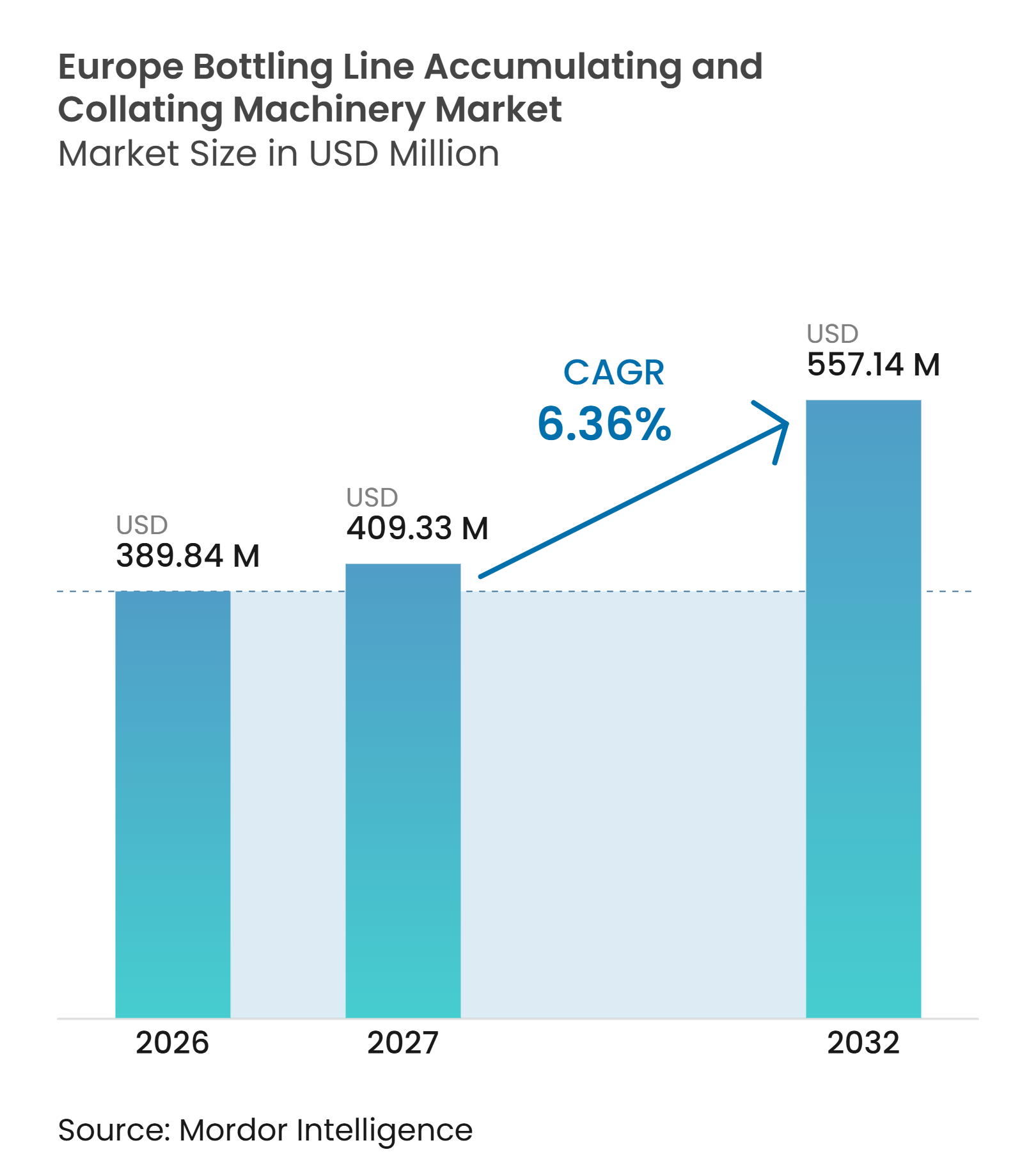
| Base Year Market Size (2026) | USD 389.84 Million |
| Market Size (2027) | USD 409.33 Million |
| Market Size (2032) | USD 557.14 Million |
| Growth Rate (2027 - 2032) | 6.36 % |
| Market Concentration | Medium |
Major Players *Disclaimer: Major Players sorted in no particular order Image © Mordor Intelligence. Reuse requires attribution under CC BY 4.0. | |
Europe Bottling Line Accumulating and Collating Machinery Market Analysis by Mordor Intelligence
The Europe bottling line accumulating and collating machinery market size is projected to be USD 389.84 million in 2026, USD 409.33 million in 2027, and reach USD 557.14 million by 2032, growing at a CAGR of 6.36% from 2027 to 2032. Regulation (EU) 2025/40 is increasing the need for equipment capable of handling reusable packaging, deposit-return volumes, and redesigned containers. Labor costs and shortages of qualified operators are strengthening the case for automated buffering, collating, and changeover systems. Returnable glass programs are creating a larger role for pressureless handling because reused bottles vary in surface condition and geometry. Suppliers are responding with modular systems, connected controls, and lifecycle service packages that help customers improve existing lines without replacing every machine. Capital spending remains uneven among smaller producers, but retrofit activity supports demand for controls, format parts, and aftermarket services across the Europe bottling line accumulating and collating machinery market.
Key Report Takeaways
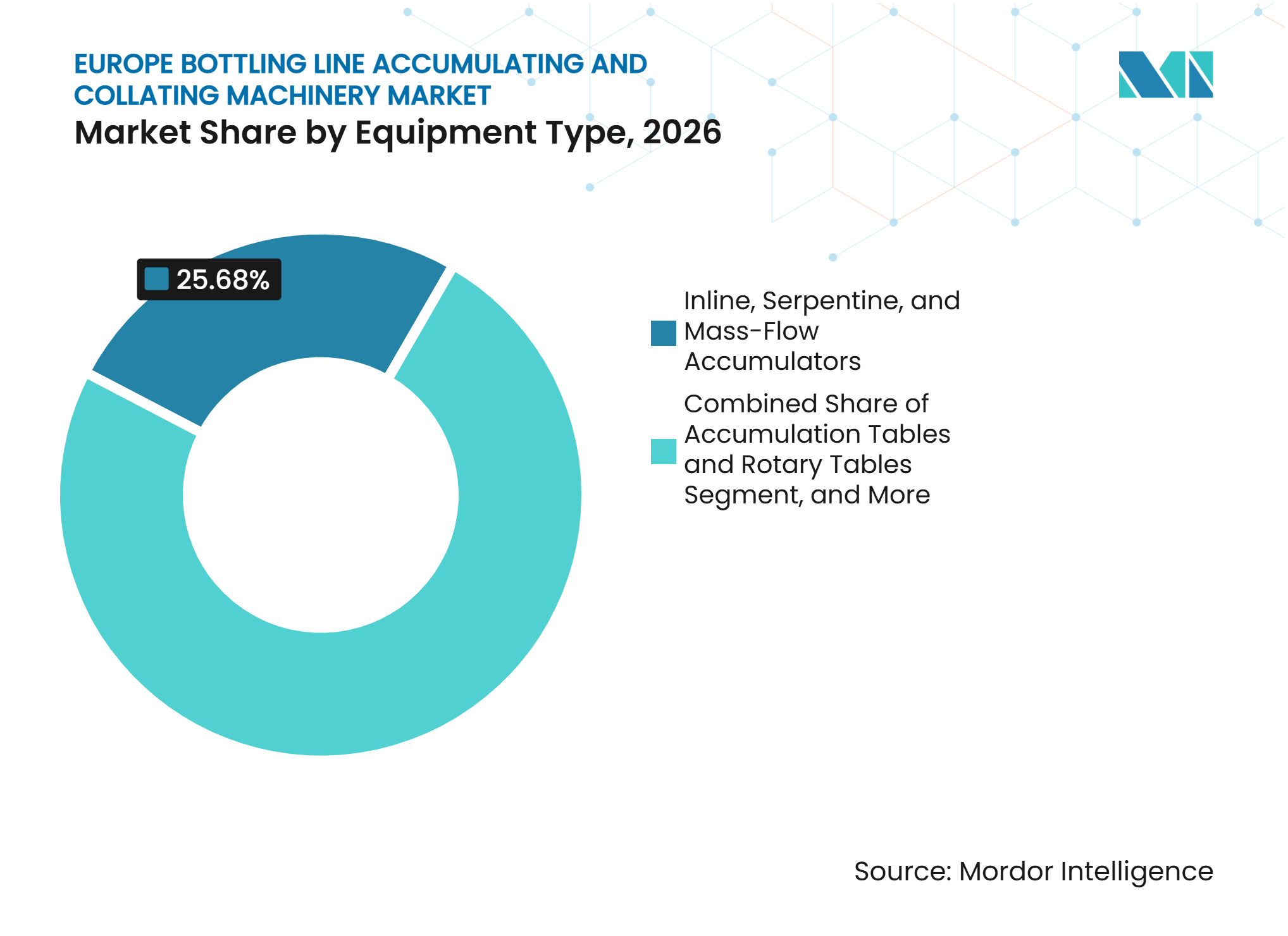
- By equipment type, Inline, Serpentine, and Mass-Flow Accumulators held 25.68% of the Europe bottling line accumulating and collating machinery market share in 2026, while Alpine, Spiral, and Vertical Accumulators are projected to expand at a 7.19% CAGR through 2032.
- By material type, Glass held a 41.37% share in 2026 in the Europe bottling line accumulating and collating machinery market, while Metal and Aluminum are projected to expand at a 7.24% CAGR through 2032.
- By container shape, Round Containers held a 61.94% share in 2026, while Specialty and Irregular Geometries Containers are projected to expand at a 7.51% CAGR through 2032.
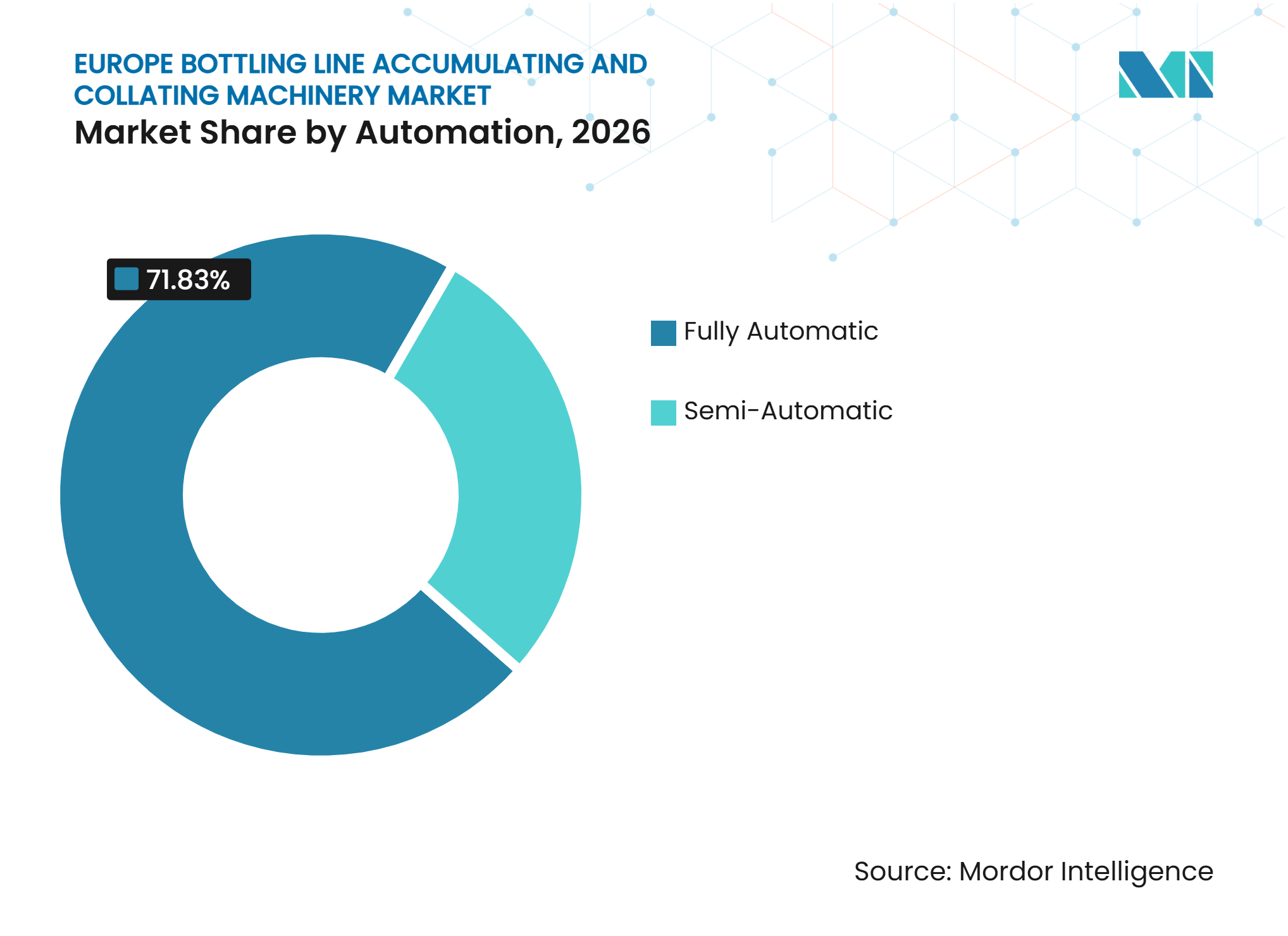
- By automation, Fully Automatic systems held a 71.83% share in 2026 and are projected to expand at a 7.32% CAGR through 2032.
- By end user, Beverage Producers held a 52.46% share in 2026, while Pharmaceutical and Healthcare Producers are projected to expand at a 7.56% CAGR through 2032.
- By geography, Germany held a 24.79% share in 2026, while Spain is projected to expand at a 7.49% CAGR through 2032.
Note: Market numbers in this report are based on Mordor Intelligence's proprietary estimation framework, which combines nine months of actuals with Q4 projections for base year 2026.
Market Trends and Insights
Drivers Impact Analysis of Europe Bottling Line Accumulating and Collating Machinery Market*
| Driver | (~) % Impact on CAGR Forecast | Geographic Relevance | Impact Timeline |
|---|---|---|---|
| EU Packaging and Packaging Waste Regulation Compliance | +1.5% | EU-27, particularly Germany, France, Italy, and Spain | Short term (≤ 2 years) |
| Rising Labor Costs and Skilled-Operator Scarcity | +1.3% | EU-wide, especially Germany, Austria, Netherlands, and Scandinavia | Short term (≤ 2 years) |
| Growth in Returnable Glass and Refillable Beverage Loops | +1.0% | Germany, France, Italy, and other deposit-system markets | Medium term (2-4 years) |
| Shorter Runs and Rising Beverage SKU Complexity in Asia-Pacific and Middle East and Africa | +0.7% | Asia-Pacific core and Middle East and Africa, with spillover to Europe | Medium term (2-4 years) |
| Shorter Runs and Rising Beverage SKU Complexity | +0.7% | EU-wide, especially Germany, Spain, and the United Kingdom | Medium term (2-4 years) |
| Brownfield Line Modernization and Retrofit Demand | +0.5% | Germany, France, Italy, and the United Kingdom | Long term (≥ 4 years) |
| Source: Mordor Intelligence | |||
EU Packaging and Packaging Waste Regulation Compliance Reshapes Accumulation Specifications
Regulation (EU) 2025/40 establishes binding packaging requirements that affect accumulation and collating equipment at several points along a bottling line. Its 90% separate-collection target for single-use plastic bottles and metal beverage containers by 2029 raises throughput requirements for return handling, lane division, and rinser-infeed systems. The regulation also requires that at least 10% of beverages be available in reusable packaging by 2030, rising to 40% by 2040. These requirements are driving increased investment in multi-trip glass equipment, in which containers can complete 15 to 50 reuse cycles and exhibit varied surface conditions.
Rising Labor Costs and Skilled-Operator Scarcity Accelerates Full-Automation Investment
Eurostat recorded 3.9% year-over-year growth in nominal manufacturing labor costs across EU member states in the second quarter of 2025.[1] Germany recorded 3.5% growth, Italy recorded 3.8%, and Spain recorded 3.7% during the same period. Qualified-worker shortages add to this cost pressure because production sites need staff for format changes, line supervision, and jam clearance. Semi-automatic accumulation tables require more direct intervention during these activities than systems using servo adjustment and recipe-based controls.
Growth in Returnable Glass and Refillable Beverage Loops Sustains Specialized Accumulation Demand
FEVE reported that around 40% of glass beverage containers in Europe circulated as returnables in 2025. The association also reported that the EU glass recycling rate exceeded 80%, while the average container weight fell to 277 grams. These trends support equipment that can handle reused glass without creating excessive pressure or surface damage. Accumulation tables and mass-flow conveyors need adjustable settings because returnable bottles can differ from virgin bottles after repeated handling cycles.
Shorter Runs and Rising Beverage SKU Complexity Drive Flexible Collating Architecture
PMMI reported in 2025 that 68% of beverage companies expected moderate-to-significant increases in packaging machinery investment within the following 2 to 3 years. Producers are adding more pack formats, variety packs, and health-focused products, which makes changeover time more important. Mechanical guide-rail adjustments can consume a disproportionate share of available production time when runs become shorter. Flexible accumulation architecture, therefore, needs to deliver a repeatable setup without disrupting upstream filling or downstream packing.
Restraints Impact Analysis of Europe Bottling Line Accumulating and Collating Machinery Market*
| Restraint | (~) % Impact on CAGR Forecast | Geographic Relevance | Impact Timeline |
|---|---|---|---|
| High Capital Cost and Long Replacement Cycles | -0.8% | EU-wide, most pronounced among small and mid-tier producers in other European markets and Spain | Long term (≥ 4 years) |
| Integration Complexity Across Mixed-Vendor Lines | -0.5% | EU-wide, especially on established German and Italian lines | Medium term (2-4 years) |
| Container Instability and Damage Risk at High Back-Pressure | -0.3% | Germany, Italy, and France | Medium term (2-4 years) |
| Cybersecurity and Interoperability Exposure in Connected Lines | -0.2% | EU-wide | Long term (≥ 4 years) |
| Source: Mordor Intelligence | |||
High Capital Cost and Long Replacement Cycles Compress Near-Term Order Volumes
A complete high-speed aseptic filling line with accumulation, buffering, and collating equipment can require a major capital commitment. Smaller wine and spirits producers can face long payback periods, especially where line utilization does not support a full replacement. Beverage equipment often remains in service for 15 to 20 years, which delays natural replacement decisions even when newer systems offer better controls. Financing structures such as operating leases, performance contracts, and usage-fee models remain unevenly accepted across European procurement practices.
Integration Complexity Across Mixed-Vendor Lines Slows Upgrade Decisions
European bottling facilities often combine filling, labeling, conveying, and accumulation equipment from different suppliers. Their control systems can also span several generations of proprietary programmable logic controller platforms. Replacing one accumulation module requires the producer to revalidate speed signals, emergency-stop logic, and data interfaces with adjacent equipment. This process can lengthen commissioning compared with a single-supplier installation. The uncertainty around future packaging specifications can further delay projects when format parts cannot be finalized.
*Our forecasts treat driver/restraint impacts as directional, not additive. The impact forecasts reflect baseline growth, mix effects, and variable interactions.
Europe Bottling Line Accumulating and Collating Machinery Market Segment Analysis
By Equipment Type:
Inline Systems Lead While Vertical Designs Gain GroundInline, Serpentine, and Mass-Flow Accumulators held 25.68% revenue share in the Europe bottling line accumulating and collating machinery market in 2026. Their position reflects their suitability for continuous-motion filling lines and pressureless handling of glass and lightweight PET containers. These systems create a first-in, first-out buffer between upstream and downstream machinery, allowing filling, labeling, and packing operations to continue through short disruptions without forcing a full line stop. The buffer reduces disruptive pressure buildup that can destabilize containers on high-speed lines, especially when lightweight bottles and variable production conditions make the line more sensitive to tipping.
Alpine, Spiral, and Vertical Accumulators are projected to expand at a 7.19% CAGR through 2032. Urban brownfield sites favor vertical layouts because they preserve limited horizontal space. Krones introduced LinaFlex eSync in September 2025, integrating a dynamic buffer with a single-lane pasteurizer and reducing wet-end floor space by up to 40%.[2] Bi-directional, recirculating, standalone collating, bottle laning, and rotary-table systems remain relevant where products need specific buffer behavior. Suppliers are shifting development work toward flexible formats and intelligent changeovers because throughput gains are harder to achieve at established speed levels.



By Material Type:
Glass Leads While Metal and Aluminum Gain MomentumGlass held 41.37% of the Europe bottling line accumulating and collating machinery market size in 2026. Europe has a mature returnable-glass system, and glass remains important for premium products, deposit programs, and reusable beverage packaging. FEVE reported that food and beverage glass production reached 73.3 billion units in 2025. It also recorded 2% growth in both tonnage and units, supporting the scale of glass-handling activity.
Returnable glass requires careful accumulation because handling marks and varying friction can affect its movement through mass-flow conveyors. Adjustable pressure settings help operators maintain stability across different bottle conditions. Metal and Aluminum are projected to expand at a 7.24% CAGR through 2032. Rhodius Mineralquellen is investing in an aluminum bottle filling line in Burgbrohl that is scheduled to start in the third quarter of 2026. Plastic remains material to large-format water operations, but recycled-content rules and deposit systems are shifting investment toward glass and metal formats.
By Container Shape:
Round Containers Remain the Standard While Irregular Forms Create DemandRound Containers held 61.94% share in 2026 because their cylindrical form provides predictable friction and balance on bottling lines. Most installed lane dividers and combiners are configured for circular cross-sections. Fully automated controls for these containers are also well established across beverage, dairy, and pharmaceutical plants. This installed base supports continued demand for equipment designed around round-container performance.
Specialty and Irregular Geometries Containers are projected to expand at a 7.51% CAGR through 2032. Premium spirits, ready-to-drink products, and functional beverages use distinctive packaging forms to differentiate themselves. Recent bottle development has continued to broaden the range of non-round container portfolios used for nitrogen-dosed water and other premium beverage formats. Square, oval, flared-base, and contoured shapes can become unstable under high back-pressure. Zero-pressure and individually controlled accumulation zones are therefore increasingly relevant for producers using these formats.
By Automation:
Fully Automatic Systems Lead in Share and GrowthFully Automatic systems held 71.83% share in 2026 and are projected to expand at a 7.32% CAGR through 2032. This is the only segmentation area where the same subsegment leads in both current share and forecast growth. The pattern indicates an ongoing upgrade cycle rather than a simple displacement of older equipment. Semi-automatic systems still have a large installed base, leaving room for retrofit demand across the Europe bottling line accumulating and collating machinery industry.
Labor-cost growth is strengthening the case for automatic recipe management, servo-driven lane adjustments, and electronic monitoring. Recent automated-line projects have combined automatic depalletizing, robotic palletizing, and electronic monitoring to raise capacity and reduce manual intervention. Semi-Automatic systems remain well-suited to craft producers, specialty fillers, and pharmaceutical facilities that handle small batches. These users may not reach an acceptable payback period for a fully automatic installation at individual production sites.

By End User:
Beverage Producers Lead While Pharmaceutical Demand AcceleratesBeverage Producers held a 52.46% share in 2026, supported by established glass and PET bottling capacity across Europe. Beer, carbonated soft drinks, still water, and juice plants depend on high-speed buffering and collating systems. Packaging redesigns linked to reuse targets and returnable-glass capacity expansion are renewing investment in these facilities. Spadel began a EUR 40 million (USD 43 million) investment program at its Spa Monopole site in 2025, covering a new line and refurbishment of the G60 line through 2027.
Pharmaceutical and Healthcare Producers are projected to expand at a 7.56% CAGR through 2032. Biologics, GLP-1 injectables, and cell-and-gene therapies require aseptic lines for vials, syringes, and cartridges. These containers require controlled handling that limits contact, supports hygiene procedures, and maintains consistent spacing before inspection, filling, closure, labeling, and secondary packaging. Food and dairy, personal care and cosmetics, and chemical and household product producers continue to provide stable demand for equipment calibrated to their container and hygiene requirements.
Geography Analysis
Germany
Germany accounted for a 24.79% revenue share of the Europe bottling line accumulating and collating machinery market in 2026. The country benefits from a large beverage manufacturing base and a dense cluster of filling and packaging equipment suppliers. VDMA German food and packaging machinery production reached nearly USD 18.4 billion in 2025, while packaging machinery production grew by 8% to USD 9.7 billion.[3] Germany also produced one-third of the world’s beverage packaging machines and half of the world’s brewery machines in 2024. In 2025, Coca-Cola Europacific Partners Deutschland committed USD 162 million to its German sites, including USD 48.6 million for a Krones canning line in Halle with a capacity of up to 120,000 cans per hour.
Spain
Spain is projected to expand at a 7.49% CAGR through 2032, the highest rate among the covered geographies. Craft brewing, functional beverages, and replacement activity on lines built during the 2005-2010 expansion period support this outlook. Local producers are seeking equipment that can handle frequent product changes without sacrificing output. This favors flexible accumulation, pressureless conveying, and modular collating systems. Spain’s role as a packaging machinery exporter also supports the availability of localized engineering capabilities.
France, Italy, the United Kingdom, and Other European Markets
France combines established wine and spirits bottling operations with investments in refillable beverage systems. CCEP invested USD 162 million in its Grigny facility to install a returnable glass line capable of producing 60,000 bottles per hour. Italy’s packaging machinery sector is expected to record nearly USD 11.34 billion in revenue in 2025, including USD 2.74 billion from beverage machinery. Italian producers of wine, spirits, and sparkling water continue to require systems tailored to diverse bottle formats and operating conditions. The United Kingdom’s contract packaging base supports demand for integrated line solutions. Krones installed a wine filling line for Encirc in Avonmouth that accommodates bottles ranging from 187 milliliters to 1.25 liters and operates at speeds of up to 26,000 bottles per hour.
Competitive Landscape
Market Concentration
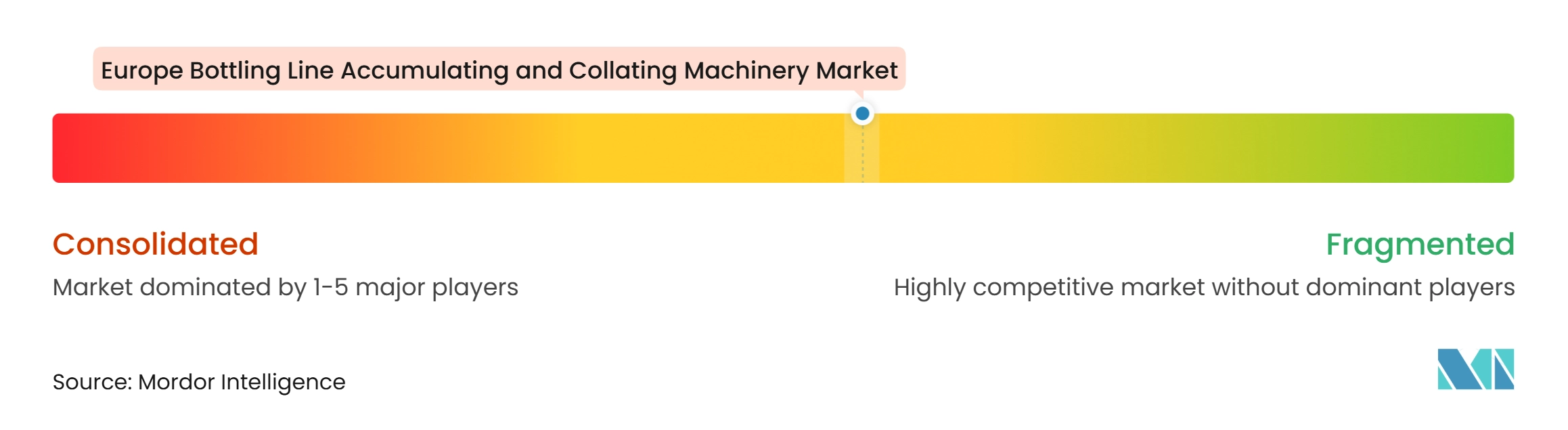
The Europe bottling line accumulating and collating machinery market is moderately concentrated, with German and Italian original equipment manufacturers holding a strong position in technology and installed capacity. Leading suppliers offer accumulation and collating modules within broader filling-line packages. This allows them to sell integrated equipment, controls, service, and spare parts under a single customer relationship. Krones provides the Krones Connect platform for remote monitoring, predictive maintenance, and real-time operational data. KHS is also developing digital connectivity for existing filling and conveying systems through KHS Connect.
Smaller producers often seek modular equipment that does not require a full-line replacement. This creates room for specialists such as ACMI S.p.A., OCME S.r.l., and C.E. King Limited. Garvey Corporation used Emulate3D simulation to validate improvements to accumulation-table performance for beverage lines in a Rockwell Automation case study during 2025.[4] Simulation-led design can reduce commissioning uncertainty and help suppliers demonstrate performance before equipment is installed.
ISO 22400 and IEC 62264 are also becoming increasingly relevant to pharmaceutical projects that require audit-ready operational data. Krones introduced LinaFlex eSync in 2025 to integrate a dynamic buffer and single-lane pasteurization process for canning lines. These moves show that competitive strategies increasingly combine container development, line integration, and digital services. The available supplier set indicates a moderately concentrated structure, with global line builders and specialized providers serving different types of installations.
Europe Bottling Line Accumulating and Collating Machinery Industry Leaders
-
Krones AG
-
Tetra Laval International S.A.
-
KHS GmbH
-
SACMI Cooperativa Meccanica Imola Società Cooperativa
-
Coesia S.p.A.
- *Disclaimer: Major Players sorted in no particular order
Europe Bottling Line Accumulating and Collating Machinery Market Companies Covered in this Report
- Krones AG
- Tetra Laval International S.A.
- KHS GmbH
- SACMI Cooperativa Meccanica Imola Società Cooperativa
- Coesia S.p.A.
- Serac Group S.A.S.
- GEA Group AG
- Aetna Group S.p.A.
- SMI S.p.A.
- OCME S.r.l.
- ACMI S.p.A.
- Zambelli Packaging S.r.l.
- C.E. King Limited
- PDC Europe S.A.S.
- Linapack Ltd.
- Vetromeccanica S.r.l.
- TGM Tecnoindustriale S.r.l.
- GPI S.p.A.
Recent Industry Developments in Europe Bottling Line Accumulating and Collating Machinery Market
- May 2026: KHS invested more than EUR 11 million (USD 12 million) in a new 4,300 m² production facility in Hamburg dedicated to Plasmax barrier-coating technology. The facility consolidates all Plasmax departments at Hellmesbergerweg, has commissioning targeted for the first quarter of 2027, and supports capacity for silicon-oxide-coated PET containers that answer beverage-producer demand for lightweight barrier-enhanced alternatives to glass.
- May 2026: Sidel premiered the Cermex RoboSELEX robotic collating system at interpack 2026 in Düsseldorf, Germany, introducing an accumulation-free, dual-Delta robot infeed for case packers capable of handling lightweight bottles in unlimited shapes at up to 320 products per minute with 1-minute collation changeovers and 2-minute bottle format.
- May 2026: Krones AG debuted the Robobox SynFlow parallel-kinematics sorting and collating system at interpack 2026 in Düsseldorf, distributing container flows across three to nine lanes at up to 105,000 containers per hour without upstream grouping gaps while pairing with its Ingeniq autonomous material-handling ecosystem.
- May 2026: Krones AG also demonstrated the LinaFlex eSync single-lane dynamic buffer at Interpack 2026, demonstrating up to 40% floor-space savings in the wet-end section and 25% across the entire line by replacing wide bulk accumulation conveyors with an integrated pasteurizer buffer.
Europe Bottling Line Accumulating and Collating Machinery Market Report Scope
The Europe bottling line accumulating and collating machinery market comprises equipment designed to accumulate, organize, and arrange bottles, containers, or packaged products during bottling operations. These machines support efficient production flow by managing product movement between processing and packaging stages, helping manufacturers minimize line stoppages and improve operational efficiency across beverage, food, pharmaceutical, and other packaging applications.
The Europe Bottling Line Accumulating and Collating Machinery Market Report is Segmented by Equipment Type (Bi-Directional and Recirculating Accumulators, Alpine, Spiral, and Vertical Accumulators, Inline, Serpentine, and Mass-Flow Accumulators, Standalone Collators and Grouping Systems, Bottle Laners, Combiners, and Lane Dividers, Accumulation Tables and Rotary Tables, and Other Equipment Types), Material Type (Plastic, Glass, Metal and Aluminum, and Carton and Composite Containers), Container Shape (Round Containers, Non-Round/Shaped Containers, and Specialty and Irregular Geometries Containers), Automation (Semi-Automatic and Fully Automatic), End User (Beverage Producers, Food and Dairy Producers, Pharmaceutical and Healthcare Producers, Personal Care and Cosmetics Producers, Chemical and Household Product Producers, and Other End Users), and Geography (Germany, France, Italy, United Kingdom, Spain, and Rest of Europe). The Market Forecasts are Provided in Terms of Value (USD).
Segmentation Overview
| Bi-Directional and Recirculating Accumulators |
| Alpine, Spiral, and Vertical Accumulators |
| Inline, Serpentine, and Mass-Flow Accumulators |
| Standalone Collators and Grouping Systems |
| Bottle Laners, Combiners, and Lane Dividers |
| Accumulation Tables and Rotary Tables |
| Other Equipment Types |
| Plastic |
| Glass |
| Metal and Aluminum |
| Carton and Composite Containers |
| Round Containers |
| Non-Round / Shaped Containers |
| Specialty and Irregular Geometries Containers |
| Semi-Automatic |
| Fully Automatic |
| Beverage Producers |
| Food and Dairy Producers |
| Pharmaceutical and Healthcare Producers |
| Personal Care and Cosmetics Producers |
| Chemical and Household Product Producers |
| Other End Users |
| Germany |
| France |
| Italy |
| United Kingdom |
| Spain |
| Rest of Europe |
| By Equipment Type | Bi-Directional and Recirculating Accumulators |
| Alpine, Spiral, and Vertical Accumulators | |
| Inline, Serpentine, and Mass-Flow Accumulators | |
| Standalone Collators and Grouping Systems | |
| Bottle Laners, Combiners, and Lane Dividers | |
| Accumulation Tables and Rotary Tables | |
| Other Equipment Types | |
| By Material Type | Plastic |
| Glass | |
| Metal and Aluminum | |
| Carton and Composite Containers | |
| By Container Shape | Round Containers |
| Non-Round / Shaped Containers | |
| Specialty and Irregular Geometries Containers | |
| By Automation | Semi-Automatic |
| Fully Automatic | |
| By End User | Beverage Producers |
| Food and Dairy Producers | |
| Pharmaceutical and Healthcare Producers | |
| Personal Care and Cosmetics Producers | |
| Chemical and Household Product Producers | |
| Other End Users | |
| By Geography | Germany |
| France | |
| Italy | |
| United Kingdom | |
| Spain | |
| Rest of Europe |
Key Questions Answered in the Report
What is the Europe bottling line accumulating and collating machinery market size?
The Europe bottling line accumulating and collating machinery market size is projected to be USD 389.84 million in 2026 and USD 409.33 million in 2027, reaching USD 557.14 million by 2032, supported by replacement activity and automation investment.
What is driving demand for bottling line accumulation and collating equipment in Europe?
Packaging and Packaging Waste Regulation requirements, labor shortages, and investment in reusable packaging are supporting demand for more flexible and automated line equipment across both new lines and retrofits.
Which equipment type has the largest share in this market?
Inline, Serpentine, and Mass-Flow Accumulators held 25.68% share in 2026, supported by their use in continuous high-speed bottling operations while helping absorb short line interruptions.
Which material requires the most accumulation and collating equipment?
Glass held 41.37% share in 2026, reflecting Europe’s returnable-glass infrastructure and demand from premium beverage formats and reusable-container programs.
Which end user is expected to grow the fastest through 2032?
Pharmaceutical and Healthcare Producers are projected to expand at a 7.56% CAGR through 2032 as aseptic lines for vials, syringes, and cartridges require controlled handling across aseptic and high-value product lines.
Which European country is expected to grow the fastest through 2032?
Spain is projected to expand at a 7.49% CAGR through 2032, supported by packaging replacement activity and demand for flexible bottling systems that support changing package portfolios.