
Essential Tremor Treatment With Ultrasound Market Size and Share
Market Overview
| Study Period | 2020 - 2031 |
|---|---|
| Market Size (2026) | USD 292.40 Million |
| Market Size (2031) | USD 502.10 Million |
| Growth Rate (2026 - 2031) | 11.42 % |
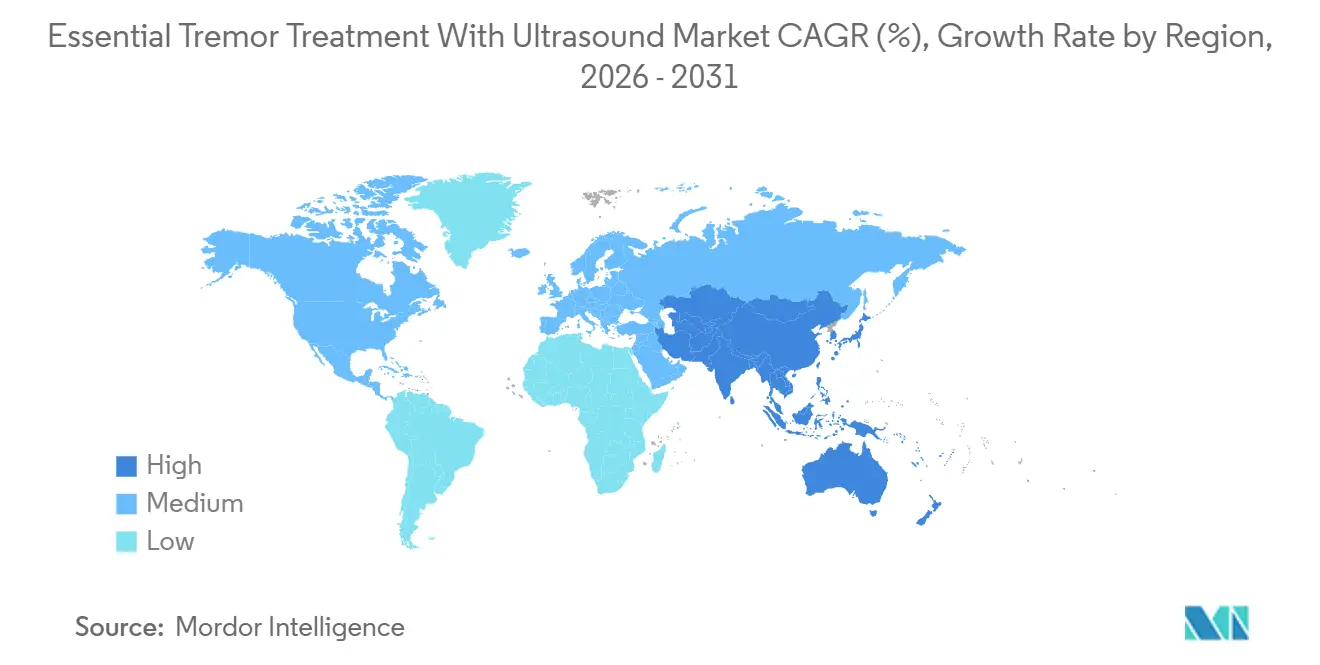
| Fastest Growing Market | Asia-Pacific |
| Largest Market | North America |
| Market Concentration | High |
Major Players *Disclaimer: Major Players sorted in no particular order Image © Mordor Intelligence. Reuse requires attribution under CC BY 4.0. | |
Essential Tremor Treatment With Ultrasound Market Analysis by Mordor Intelligence
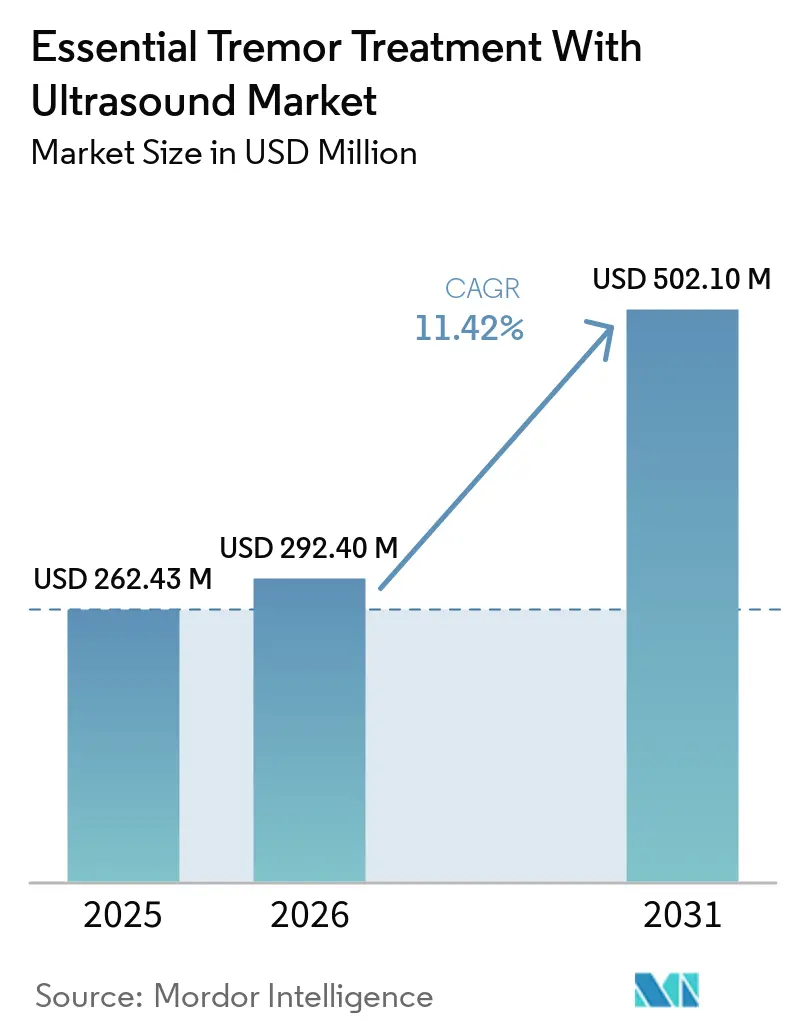
The Essential Tremor Treatment With Ultrasound Market size is expected to grow from USD 262.43 million in 2025 to USD 292.40 million in 2026 and is forecast to reach USD 502.10 million by 2031 at 11.42% CAGR over 2026-2031.
The essential tremor treatment with ultrasound market is supported by a growing population of patients whose symptoms remain uncontrolled after first-line medicines. Focused ultrasound use has moved beyond a limited clinical base, with nearly 75,000 patients treated across all indications in 2025 and 27,563 cumulative essential tremor treatments, representing 81% of neurological focused ultrasound procedures to date. The essential tremor treatment with ultrasound market also benefits from a preference for an incisionless procedure that does not leave an implanted device. Staged bilateral use is widening treatment scope, while reimbursement decisions, MRI compatibility, and trained clinical teams determine how quickly hospitals can expand capacity. High equipment costs, limited specialist availability, and skull-related eligibility limits continue to narrow access, particularly outside established treatment centers.
Key Report Takeaways
- By indication, head tremor held 42.5% revenue share in 2025, while hand tremor is forecast to grow at a 12.87% CAGR through 2031.
- By treatment type, high-intensity focused ultrasound held 58.7% revenue share in 2025, while ultrasound-guided focused ultrasound is forecast to grow at a 12.99% CAGR through 2031.
- By end user, hospitals held 43.7% of revenue in 2025, while specialty neurology clinics are forecast to grow at a 13.76% CAGR through 2031.
- By patient demographics, adult patients held 55.3% of revenue in 2025, while pediatric patients are forecast to grow at a 13.43% CAGR through 2031.
- By geography, North America held 41.67% of revenue in 2025, while Asia-Pacific is forecast to grow at a 12.54% CAGR through 2031.
Note: Market size and forecast figures in this report are generated using Mordor Intelligence’s proprietary estimation framework, updated with the latest available data and insights as of January 2026.
Global Essential Tremor Treatment With Ultrasound Market Trends and Insights
Drivers Impact Analysis*
| Driver | (~) % Impact on CAGR Forecast | Geographic Relevance | Impact Timeline |
|---|---|---|---|
| Rising Essential Tremor Prevalence and Aging Patient Pool | +3.20% | Global, with a concentrated burden in North America, Europe, and Japan | Long term (≥ 4 years) |
| Preference for Incisionless, Implant-Free Treatment | +2.40% | Global, strongest in North America and Western Europe | Medium term (2-4 years) |
| Clinical Evidence and Bilateral Treatment Adoption | +2% | North America and Europe, with spillover to Asia-Pacific | Medium term (2-4 years) |
| Reimbursement for Medication-Refractory Essential Tremor | +1.80% | North America, Europe, Japan, South Korea, and Norway | Medium term (2-4 years) |
| AI-Assisted Targeting and Adaptive Treatment Planning | +0.80% | North America and East Asia, with spillover to Europe | Long term (≥ 4 years) |
| MRI Suite Use and Lower-Field System Innovation | +0.60% | Global, with accelerated potential in Asia-Pacific and the Middle East and Africa | Long term (≥ 4 years) |
| Source: Mordor Intelligence | |||
Increasing Prevalence of Essential Tremor and Aging-Linked Patient Pool
Essential tremor creates a large clinical need, although treatment use remains below the number of people living with the condition. A 2024 U.S. claims study identified 1.1 million adults with a diagnosed essential tremor classification. The broader case definition in the same study increased the figure to 2.1 million adults. The essential tremor treatment with ultrasound market draws its future patient base from the difference between diagnosed cases and people receiving adequate care. Pooled prevalence was 1.3% across all ages and reached 5.8% among adults aged 65 years and older. Prevalence rose by 74% with each additional decade of age in the available evidence base.
Medication does not control tremor for an estimated 30% to 50% of patients, leaving a recurring group of potential procedural candidates. This supports referrals into movement-disorder and functional-neurosurgery services as patients age. Misclassification as physiologic tremor or early Parkinson’s disease can delay specialist assessment and treatment selection. Germany recorded an increase in essential tremor incidence from 10.7 to 24.8 per 100,000 people between 2010 and 2021. The increase reflected stronger awareness as well as demographic aging. The essential tremor treatment with ultrasound market therefore has a durable demand base in North America, Europe, and East Asia, where older populations increasingly enter specialist care.
Patient Preference for Incisionless, Implant-Free Treatment
MR-guided focused ultrasound offers an outpatient alternative to procedures that require implanted hardware or open surgery. MRgFUS thalamotomy surpassed deep brain stimulation as the most common procedural intervention for essential tremor in the United States. More than 20,000 MRgFUS neurosurgical procedures had been performed worldwide by 2024. The essential tremor treatment with ultrasound market gains from the appeal of same-day tremor improvement for appropriate patients. The procedure also avoids the maintenance and replacement requirements associated with implanted stimulation systems. These features can matter to patients who have delayed intervention because they were concerned about surgery.
Five-year data showed a 51.9% improvement in tremor and motor function after unilateral MRgFUS treatment. The same study found that 87% of subjects retained at least 25% improvement, while 52.2% retained at least 50% improvement at 5 years. It reported that 60.3% of related adverse events resolved within 6 months. No new safety signals emerged beyond the first year in that dataset. Public disclosure of successful treatment by Lord Julian Fellowes in September 2025 increased awareness of incisionless options among patients. The essential tremor treatment with ultrasound market can benefit when awareness encourages patients to seek a specialist opinion earlier.
Expanding Clinical Evidence and Bilateral Treatment Adoption
Staged bilateral treatment increases the number of patients who may pursue a second procedure after an initial unilateral treatment. The approach targets the opposite thalamus at least 9 months after the first procedure. Data presented at the 2026 American Academy of Neurology meeting showed an 81% reduction in tremor severity at 3 months[1]American Academy of Neurology, “Staged Bilateral MRgFUS Thalamotomy Efficacy, Safety, and Utilization Growth Abstract,” American Academy of Neurology Annual Meeting, index.mirasmart.com.. The presentation also reported a 73% reduction in functional disability and a 66% reduction in tremor and motor scores. These outcomes give clinicians additional evidence for managing bilateral symptoms. They also support the essential tremor treatment with ultrasound market by extending treatment from 1 side to 2 sides for suitable patients.
Staged bilateral procedure use increased 69% from 2023 to 2024, compared with 30% growth in unilateral use. The difference suggests that patients and clinicians are making greater use of the bilateral pathway. The EMBRACE trial began in April 2025 as an international multicenter randomized study of staged bilateral focused ultrasound. Its primary completion was targeted for July 2026. Each staged treatment can create a separate procedure, disposable kit, and facility-use event. This makes bilateral adoption important to procedure volumes and hospital planning within the essential tremor treatment with ultrasound market.
Reimbursement Expansion for Medication-Refractory Essential Tremor
Reimbursement converts a clinically eligible patient into a patient who can more readily receive care. By the end of 2025, 18 countries offered reimbursement for focused ultrasound across 19 indications. France published national reimbursement for unilateral MRgFUS for medication-refractory essential tremor in March 2026. The policy followed a positive assessment by the Haute Autorité de Santé. It enabled hospitals to offer the procedure nationwide under a clinical outcomes registry requirement. The decision may support access for 1,500 new medication-refractory patients each year in France.
Health Canada issued a Medical Device License for Exablate Prime in February 2026. The approval expanded compatibility to select Philips MRI systems alongside GE and Siemens platforms. In the United States, the 2025 outpatient payment system assigned CPT 61715 to APC 5463, improving billing consistency for providers. National coverage decisions can influence payer discussions in nearby countries with similar clinical standards. The essential tremor treatment with ultrasound market gains when hospitals can align treatment pathways, coding, and financing. These decisions remain particularly important where a high upfront equipment investment has slowed program development.
Restraints Impact Analysis*
| Restraint | (~) % Impact on CAGR Forecast | Geographic Relevance | Impact Timeline |
|---|---|---|---|
| High Capital Cost of MR-Guided Focused Ultrasound Systems | -1.40% | Global, most acute in emerging markets and smaller hospital systems | Short term (≤ 2 years) |
| Limited Availability of Specialized Neurosurgical Teams | -1% | Global, most acute in Asia-Pacific outside Japan, the Middle East and Africa, and South America | Medium term (2-4 years) |
| Skull-Related Patient Exclusion and Acoustic Access | -0.80% | Global, partly mitigated by skull-optimization protocols | Long term (≥ 4 years) |
| Post-Treatment Sensory and Gait Events | -0.50% | Global, with greater concern in conservative prescriber settings | Medium term (2-4 years) |
| Source: Mordor Intelligence | |||
High Capital Cost of MR-Guided Focused Ultrasound Systems
An MRgFUS installation requires USD 2.2 million to USD 2.8 million for the focused ultrasound system alone. This excludes the MRI platform and concentrates adoption in academic medical centers and large hospital networks. Norton Healthcare Foundation committed USD 2.8 million in October 2024 to establish Kentucky’s first center. The essential tremor treatment with ultrasound market faces a slower rollout where hospitals cannot use philanthropy, public funding, or large capital budgets. Smaller hospitals and ambulatory surgical centers usually have less ability to absorb the initial investment. This limits how quickly treatment access can spread beyond regional referral centers.
Annual service contracts add USD 185,000, while disposable kits cost USD 3,300 per procedure. Site preparation costs USD 35,000 to USD 50,000, adding to the total program commitment. Medicare facility reimbursement was USD 12,388 per procedure in 2025. Typical volumes of 100 to 150 cases per year can lead to extended payback periods. The burden is especially relevant in India and Brazil, where system purchases may require donor support or government subsidy. The Vattikuti Foundation donated a system to AIIMS New Delhi for an institutional program in 2025.
Limited Availability of Specialized Neurosurgical Teams
Focused ultrasound thalamotomy needs specialized personnel during treatment, creating a constraint beyond equipment availability. Japan requires defined experience and designated society training for neurosurgeons undertaking functional stereotactic brain surgery under billing code K154-4. This favors a narrow group of established academic centers. Protocols also require real-time coordination between a functional neurosurgeon and a movement-disorder neurologist[2]Journal of Neurosurgery, “Successful Magnetic Resonance-Guided Focused Ultrasound Treatment of Tremor in Patients with a Skull Density Ratio of 0.4 or Less,” Journal of Neurosurgery, thejns.org.. The need for 2 senior specialists limits daily throughput. It can also delay new program launches in regions with few movement-disorder services.
There were 391 focused ultrasound clinical research sites worldwide in 2025. This was a 23% increase in 1 year, but the number remained below potential patient demand. Established centers benefit from their installed systems, referral relationships, and certified teams. These features can give a center a strong position within its practical travel area. The essential tremor treatment with ultrasound market depends on training pathways that expand teams without weakening procedural oversight. New locations will need both technical readiness and a stable multidisciplinary referral base.
*Our forecasts treat driver/restraint impacts as directional, not additive. The impact forecasts reflect baseline growth, mix effects, and variable interactions.
Segment Analysis
By Indication: Head Tremor Anchors Volume While Hand Tremor Accelerates
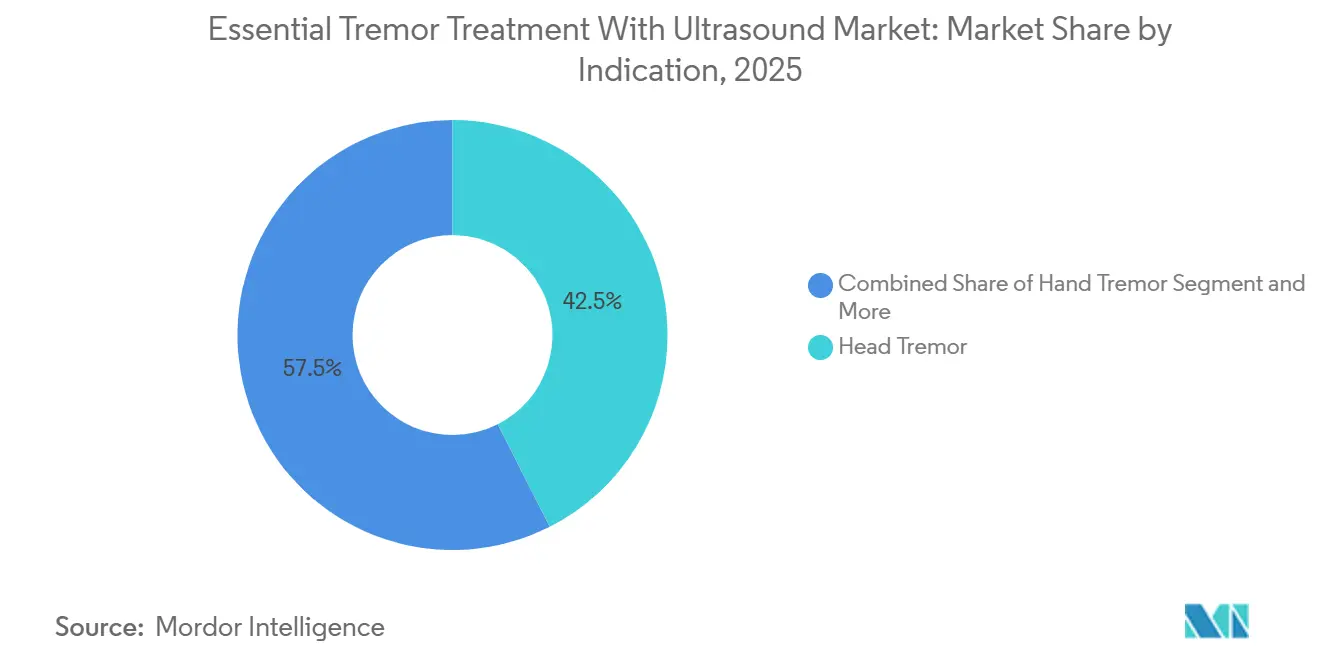
Head tremor held 42.5% of the essential tremor treatment with ultrasound market share in 2025. Its leading position reflects the visible and socially disruptive effects of cervical and cephalic tremor. Symptoms can affect eating, social interaction, and work activities. These effects can lead patients to seek a specialist assessment sooner. The ventral intermediate thalamus is the main target for MRgFUS treatment. That target has relevance for tremor affecting multiple body regions. The segment, therefore, includes patients with upper-extremity and axial manifestations. Head tremor has remained important to the procedure mix because of its effect on daily function.
Hand tremor is forecast to grow at a 12.9% CAGR through 2031. The original U.S. clearance addressed unilateral thalamotomy for medication-refractory hand tremor. The staged bilateral pathway can support a later procedure for tremor on the opposite side. Bilateral adoption grew 69% from 2023 to 2024. This allows a sequential treatment cycle for patients with tremor in both hands. Voice tremor, trunk tremor, upper extremity tremor, and lower extremity tremor are smaller indication groups. Their future use depends on broader diagnostic awareness and expanding clinical evidence. The essential tremor treatment with ultrasound market can widen gradually as referral patterns recognize these different functional needs.



By Treatment Type: HIFU Leads While Ultrasound-Guided Focused Ultrasound Expands
High-intensity focused ultrasound held 58.7% of the essential tremor treatment with ultrasound market share in 2025. It remains the main treatment modality in settings with established MRI workflows and procedural registries. Hospital teams are familiar with its clinical process and treatment planning requirements. This familiarity supports consistent use in developed treatment markets. MR-guided focused ultrasound thalamotomy remains the established regulatory approach in the United States and Europe. Real-time thermal imaging supports lesion control during the procedure. This feature remains central to clinical confidence and institutional governance. The essential tremor treatment with ultrasound industry relies on such validated pathways as new modalities develop.
Ultrasound-guided focused ultrasound is forecast to grow at a 13% CAGR through 2031. Facilities are exploring approaches that may reduce dependence on high-field MRI suite access. MRI scheduling can constrain capacity when multiple clinical departments compete for time. This is relevant in Asia-Pacific and lower-resource settings. Exablate Prime received FDA approval and CE Mark for use with select Philips MRI systems in November 2024. The approval broadened the potential hospital base for MR-guided treatment. Other treatment types include experimental transcranial neuromodulation and low-frequency protocols. The essential tremor treatment with ultrasound market will continue to compare access benefits with the value of real-time thermal monitoring.
By End User: Hospitals Anchor Capacity While Specialty Clinics Reshape Referrals
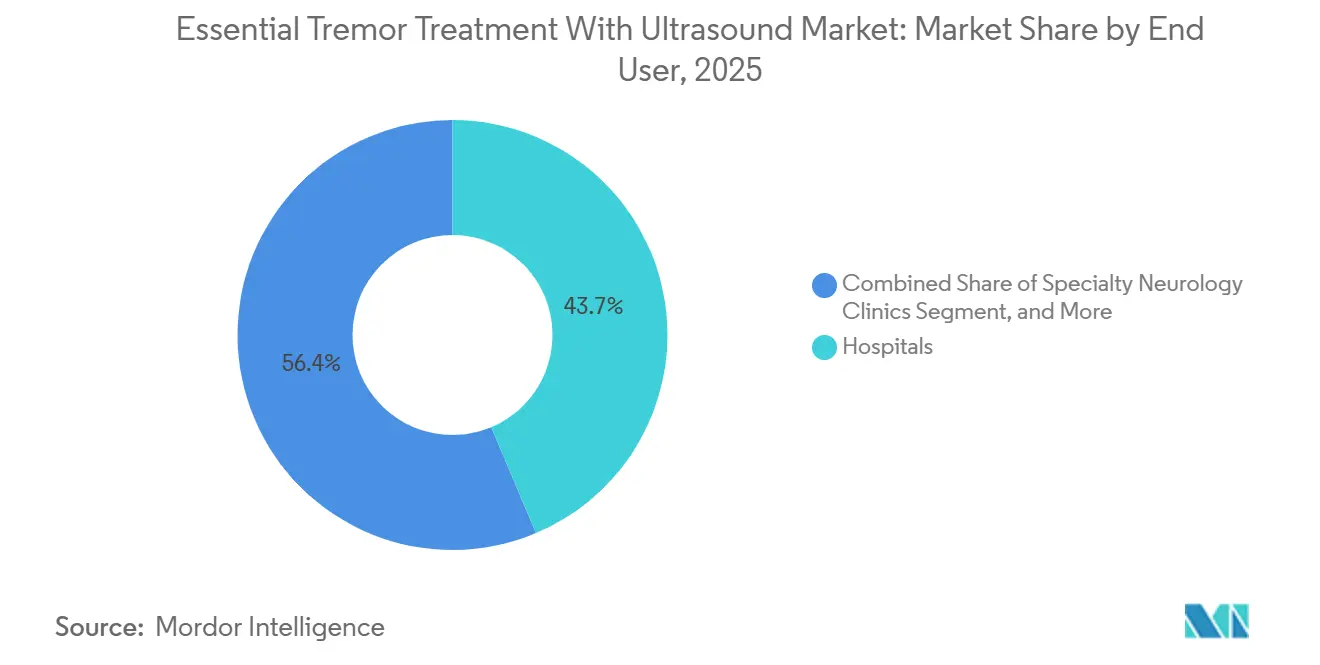
Hospitals accounted for 43.7% of revenue in 2025. Their position reflects the ability to combine MRI capacity, functional neurosurgery, and movement-disorder expertise within 1 organization. Hospitals also have the clinical governance and billing structure needed for a complex procedure. The USD 2.2 million to USD 2.8 million system cost favors providers with larger capital budgets. Hospitals can also manage the service contracts and site preparation needed for a new program. Academic centers combine treatment delivery with clinical research activity. This supports physician familiarity and patient referral. The essential tremor treatment with ultrasound market remains dependent on hospitals while MRI-guided systems are capital intensive.
Specialty neurology clinics are forecast to grow at a 13.8% CAGR through 2031. Their growth reflects closer integration of focused ultrasound into subspecialty referral pathways. Clinics can improve identification of medication-refractory patients and coordinate specialist assessments. Broader MRI compatibility may support more flexible facility arrangements over time. Ambulatory Surgical Centers remain an emerging end-user group. Their adoption is limited by capital access and payer rules that favor hospital facility codes. Other end users include academic research centers that combine trials with procedural care. The essential tremor treatment with ultrasound market may decentralize referrals before it decentralizes full procedural delivery. Real-time neurological assessment continues to favor a multidisciplinary hospital or hospital-outpatient setting.
By Patient Demographics: Adults Lead While Pediatric Patients Reflect Future Scope
Adult patients accounted for 55.3% of revenue in 2025. This group represents the broadest eligible population within the U.S. indication for Exablate Neuro. The approved minimum age is 22 years. Working-age adults can experience material occupational and functional effects from tremor. Community-level treatment centers may reduce travel requirements for this group. Adults also include people whose symptoms have progressed despite medication. The essential tremor treatment with ultrasound market reaches this group through movement-disorder referrals and hospital programs. Its revenue leadership reflects both clinical eligibility and the number of adults seeking functional improvement.
Pediatric patients are forecast to grow at a 13.4% CAGR through 2031. Current U.S. approval still applies to patients aged 22 years and older. Investigational work in other jurisdictions is generating early clinical data for younger people with essential tremor. Medication may provide inadequate control for some of these patients. Long-term implanted-device management can also be a concern in younger populations. Geriatric patients remain a major clinically suitable sub-group because prevalence reaches 5.8% among adults aged 65 years and older. This group may be medication refractory or unsuitable for deep brain stimulation. The essential tremor treatment with ultrasound market will broaden only as clinical evidence and regulatory pathways support earlier-life treatment.
Geography Analysis
North America held 41.7% of global revenue in 2025. The region benefits from FDA clearance, Medicare facility coverage, and an established clinical base. Staged bilateral use rose 69% from 2023 to 2024. That increase adds second-procedure volume for suitable patients. U.S. coding under CPT 61715 and APC 5463 provided greater billing clarity in 2025. Canada gained a Medical Device License for Exablate Prime in February 2026. The approval included select Philips MRI platforms and may support wider use by compatible centers.
Europe is expanding reimbursement arrangements across national markets. NHS England has commissioned MRgFUS thalamotomy at 4 specialist centers since 2021. Its annual cap of 150 patients remains below the potential eligible population. France published national reimbursement in March 2026 after a positive HAS benefit assessment. The policy provides a clearer route for hospitals to offer care under an outcomes registry. Germany enabled routine reimbursement for HIFU therapy at centers including Freiburg University Hospital[3]Universitätsklinikum Freiburg, “Ultrasound Treatment Helps Immediately Against Severe Tremors,” Universitätsklinikum Freiburg, uniklinik-freiburg.de.. Spain and Italy continue to contribute to the region’s treatment base under CE Mark authorization.
Asia-Pacific is forecast to grow at a 12.5% CAGR through 2031. Japan has national insurance coverage for MRgFUS under billing code K154-4. South Korea has approved MRgFUS for essential tremor under national device regulations. India established an institutional focused ultrasound program at AIIMS New Delhi through a 2025 partnership involving Insightec and the Vattikuti Foundation. The program also serves as a training route for South Asian clinicians. China’s domestic HIFU manufacturers are expanding neurology application portfolios. The essential tremor treatment with ultrasound market remains early-stage in the Middle East and Africa and South America, where private-pay use and institutional partnerships are still building access.

Competitive Landscape
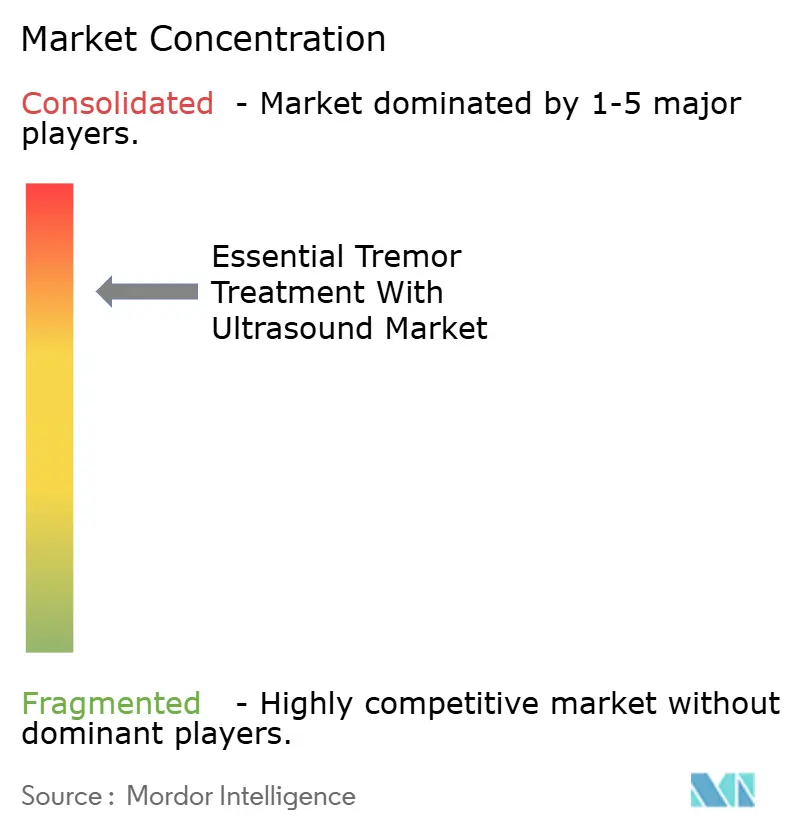
The essential tremor treatment with ultrasound market is concentrated around Insightec’s MRgFUS platforms. Exablate Neuro and Exablate Prime had treated more than 30,000 patients at 214 centers worldwide by March 2026. The company’s position includes devices, physician certification, clinical follow-up evidence, and MRI-based thermal monitoring. These linked capabilities make it difficult for a new supplier to replicate the existing workflow quickly. Insightec’s first-mover position also benefits from hospital relationships and reimbursement experience. Its platform functions as a reference system for many clinical programs. This concentration does not mean every enabling technology is supplied by the same company.
GE HealthCare, Siemens Healthineers, and Philips participate as MRI platform providers in the Exablate ecosystem. Philips entered the compatible MRI group following FDA approval and CE Mark for Exablate Prime in November 2024. Chongqing Haifu Medical Technology is expanding neurological applications in China. Its position is relevant where MRI-guided workflows are difficult to deploy. ClearPoint Neuro contributes MRI-guided neurosurgical navigation capabilities. Alpinion Medical Systems contributes therapeutic-ultrasound capabilities. The essential tremor treatment with ultrasound market has a fragmented group of adjacent and regional participants outside the leading MRgFUS platform.
Insightec spun out Lotus Neuro in December 2025 to advance low-frequency focused ultrasound for blood-brain barrier opening and central nervous system drug delivery. This move extends the company’s acoustic-energy expertise into neurological applications beyond ablation. AI-assisted planning and lower-field MRI compatibility are important areas for future competition. Faster planning tools could change how treatment teams prepare and adapt procedures. However, competitors will still need clinical evidence, regulatory support, and trained sites. The essential tremor treatment with ultrasound industry has room for enabling technologies, but established procedural workflows remain important.
Essential Tremor Treatment With Ultrasound Industry Leaders
Insightec Ltd.
Siemens Healthineers AG
Koninklijke Philips N.V.
Medtronic plc
Boston Scientific Corporation
- *Disclaimer: Major Players sorted in no particular order

Recent Industry Developments
- June 2026: Insightec announced publication of pivotal staged bilateral MRgFUS pallidothalamic tractotomy results for Parkinson’s disease in The Lancet Neurology, reporting substantial and durable motor improvement. While the primary indication is Parkinson’s disease, the bilateral procedural framework and safety profile directly inform the growing body of evidence supporting bilateral essential tremor treatment and are expected to accelerate payer acceptance of second-side thalamotomy procedures globally.
- February 2026: Health Canada issued a Medical Device License for Insightec’s next-generation Exablate Prime system, extending access in Canada to incisionless MRgFUS for essential tremor and Parkinson’s disease. The approval expanded MRI compatibility to include select Philips systems in addition to GE and Siemens, reducing hardware constraints for Canadian neurosurgical centers and broadening the addressable hospital base.
- December 2025: Insightec announced the spin-out of Lotus Neuro, a clinical-stage biotechnology company advancing low-frequency focused ultrasound for blood-brain barrier opening and central nervous system drug delivery. Funded by Nexus NeuroTech Ventures, Lotus Neuro will initially target neuro-oncology programs including glioblastoma, representing a deliberate extension of Insightec’s acoustic-energy platform into central nervous system therapeutics beyond ablation.
- March 2025: Insightec and the Vattikuti Foundation announced a strategic partnership with AIIMS New Delhi to expand focused ultrasound access in India and advance essential tremor and Parkinson’s disease research. The Vattikuti Foundation donated an Insightec MRgFUS system to AIIMS, establishing an institutionally supported program and a training hub for South Asian clinicians.


Global Essential Tremor Treatment With Ultrasound Market Report Scope
According to the report’s scope, essential tremor treatment with ultrasound involves focused ultrasound thalamotomy to reduce tremors by targeting specific brain areas non-invasively. It offers a minimally invasive option for managing symptoms when medication is ineffective.
The essential tremor treatment with ultrasound market is segmented into indication, treatment type, end user, patient demographics, and geography. By indication, the market is segmented into hand tremor, head tremor, voice tremor, trunk tremor, upper extremity tremor, and lower extremity tremor. By treatment type, the market is segmented into MR-guided focused ultrasound thalamotomy, high-intensity focused ultrasound, ultrasound-guided focused ultrasound, and other treatment types. By end user, the market is segmented into hospitals, specialty neurology clinics, ambulatory surgical centers, and other end users. By patient demographics, the market is segmented into adult patients and pediatric patients. By geography, the market is segmented into North America, Europe, Asia-Pacific, the Middle East and Africa, and South America. The report also covers the estimated market sizes and trends for 17 countries across major regions globally. The report offers values (USD) for all the above segments.
| Hand Tremor |
| Head Tremor |
| Voice Tremor |
| Trunk Tremor |
| Upper Extremity Tremor |
| Lower Extremity Tremor |
| MR-Guided Focused Ultrasound Thalamotomy |
| High-Intensity Focused Ultrasound |
| Ultrasound-Guided Focused Ultrasound |
| Other Treatment Types |
| Hospitals |
| Specialty Neurology Clinics |
| Ambulatory Surgical Centers |
| Other End Users |
| Adult Patients |
| Pediatric Patients |
| North America | United States |
| Canada | |
| Mexico | |
| Europe | Germany |
| United Kingdom | |
| France | |
| Italy | |
| Spain | |
| Rest of Europe | |
| Asia-Pacific | China |
| Japan | |
| India | |
| Australia | |
| South Korea | |
| Rest of Asia-Pacific | |
| Middle East and Africa | GCC |
| South Africa | |
| Rest of Middle East and Africa | |
| South America | Brazil |
| Argentina | |
| Rest of South America |
| By Indication | Hand Tremor | |
| Head Tremor | ||
| Voice Tremor | ||
| Trunk Tremor | ||
| Upper Extremity Tremor | ||
| Lower Extremity Tremor | ||
| By Treatment Type | MR-Guided Focused Ultrasound Thalamotomy | |
| High-Intensity Focused Ultrasound | ||
| Ultrasound-Guided Focused Ultrasound | ||
| Other Treatment Types | ||
| By End User | Hospitals | |
| Specialty Neurology Clinics | ||
| Ambulatory Surgical Centers | ||
| Other End Users | ||
| By Patient Demographics | Adult Patients | |
| Pediatric Patients | ||
| Geography | North America | United States |
| Canada | ||
| Mexico | ||
| Europe | Germany | |
| United Kingdom | ||
| France | ||
| Italy | ||
| Spain | ||
| Rest of Europe | ||
| Asia-Pacific | China | |
| Japan | ||
| India | ||
| Australia | ||
| South Korea | ||
| Rest of Asia-Pacific | ||
| Middle East and Africa | GCC | |
| South Africa | ||
| Rest of Middle East and Africa | ||
| South America | Brazil | |
| Argentina | ||
| Rest of South America | ||


Key Questions Answered in the Report
What is the projected value of essential tremor treatment with ultrasound by 2031?
The essential tremor treatment with ultrasound market is forecast to reach USD 408.3 million by 2031, growing at an 11.4% CAGR from 2026.
Which treatment type currently leads essential tremor ultrasound procedures?
High-Intensity Focused Ultrasound led with 58.7% share in 2025, while Ultrasound-Guided Focused Ultrasound is forecast to grow at a 13% CAGR through 2031.
Why are hospitals the main providers of focused ultrasound for essential tremor?
Hospitals held 43.7% of revenue in 2025 because they combine MRI infrastructure, functional neurosurgery, clinical governance, and movement-disorder expertise.
Which region is growing fastest for focused ultrasound treatment of essential tremor?
Asia-Pacific is forecast to grow at a 12.5% CAGR through 2031, supported by Japan's coverage, South KoreaÕs capacity, and IndiaÕs new institutional program.
Can focused ultrasound treat tremor on both sides of the body?
Staged bilateral treatment can address the opposite side at least 9 months after the first procedure, and bilateral use grew 69% from 2023 to 2024.
What limits broader access to focused ultrasound treatment?
Costs of USD 2.2 million to USD 2.8 million per focused ultrasound system, specialist-team shortages, and skull-related eligibility limits constrain broader access.
Page last updated on:





