
Enterprise AI Agent Safety Platforms Market Size and Share
Market Overview
| Study Period | 2020 - 2031 |
|---|---|
| Market Size (2026) | USD 1.68 Billion |
| Market Size (2031) | USD 4.57 Billion |
| Growth Rate (2026 - 2031) | 22.16 % |
| Fastest Growing Market | Asia-Pacific |
| Largest Market | North America |
| Market Concentration | Low |
Major Players *Disclaimer: Major Players sorted in no particular order Image © Mordor Intelligence. Reuse requires attribution under CC BY 4.0. | |
Enterprise AI Agent Safety Platforms Market Analysis by Mordor Intelligence
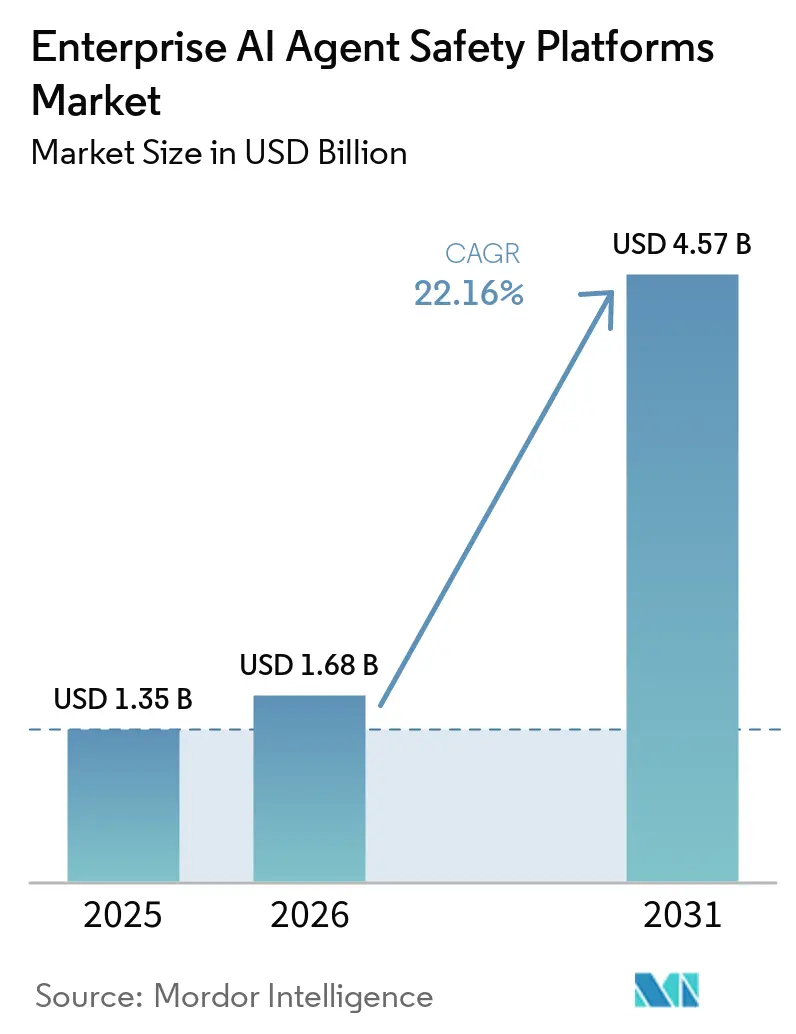
The Enterprise AI Agent Safety Platforms Market size is projected to expand from USD 1.35 billion in 2025 to USD 1.68 billion in 2026, and to USD 4.57 billion by 2031, registering a CAGR of 22.16% between 2026 and 2031. Growth follows the movement of autonomous agents from trials into live enterprise workflows. These agents can call APIs, write to databases, and initiate financial transactions without approval for each action. This makes identity gaps and weak access controls more consequential for organizations. CyberArk reported that fewer than 10% of surveyed organizations had adequate controls for AI agents, while nearly 40% of financial institutions and software companies had agentic AI in production in 2025. The Enterprise AI Agent Safety Platforms Market is therefore being shaped by demand for agent inventory, access governance, activity monitoring, and accountability controls.
Key Report Takeaways
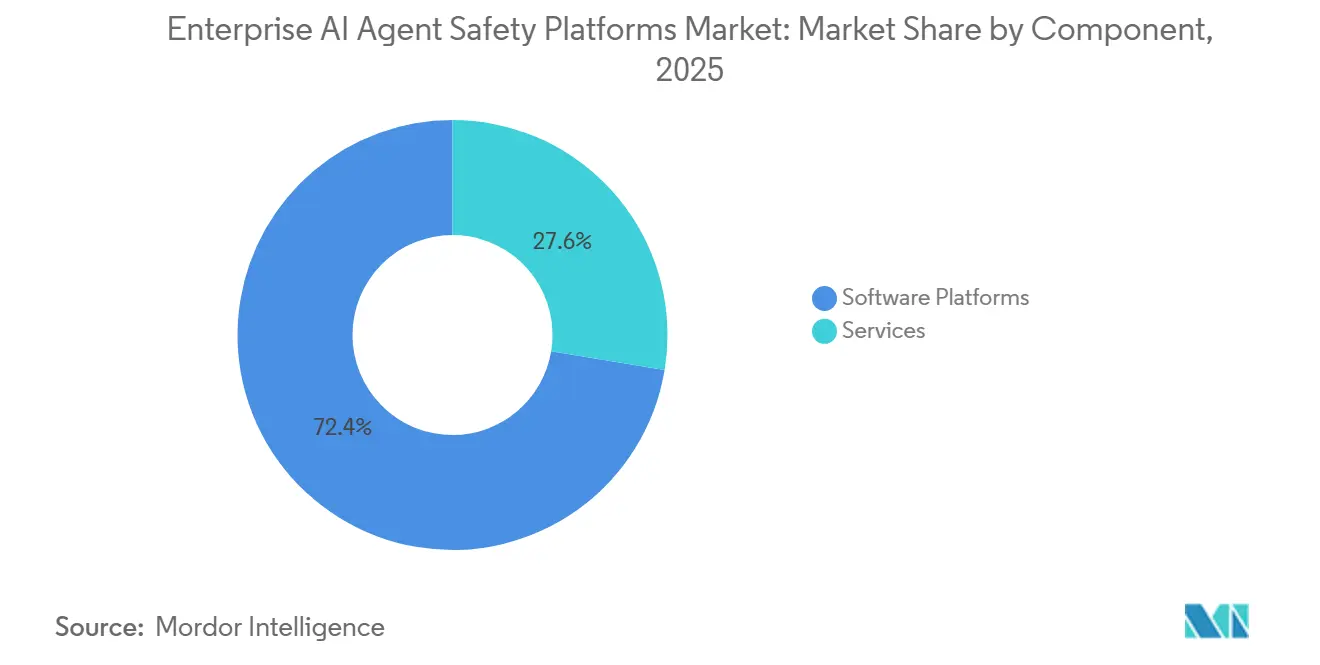
- By component, Software Platforms held 72.39% of the Enterprise AI Agent Safety Platforms Market share in 2025, while Services is forecast to grow at a 22.78% CAGR through 2031.
- By deployment, Cloud-Based held 59.55% of the Enterprise AI Agent Safety Platforms Market share in 2025 and is projected to record a 22.94% CAGR through 2031.
- By security function, Identity and Access Security accounted for 26.73% of the Enterprise AI Agent Safety Platforms Market share in 2025, while Threat Detection and Response is expected to grow at a 22.63% CAGR through 2031.
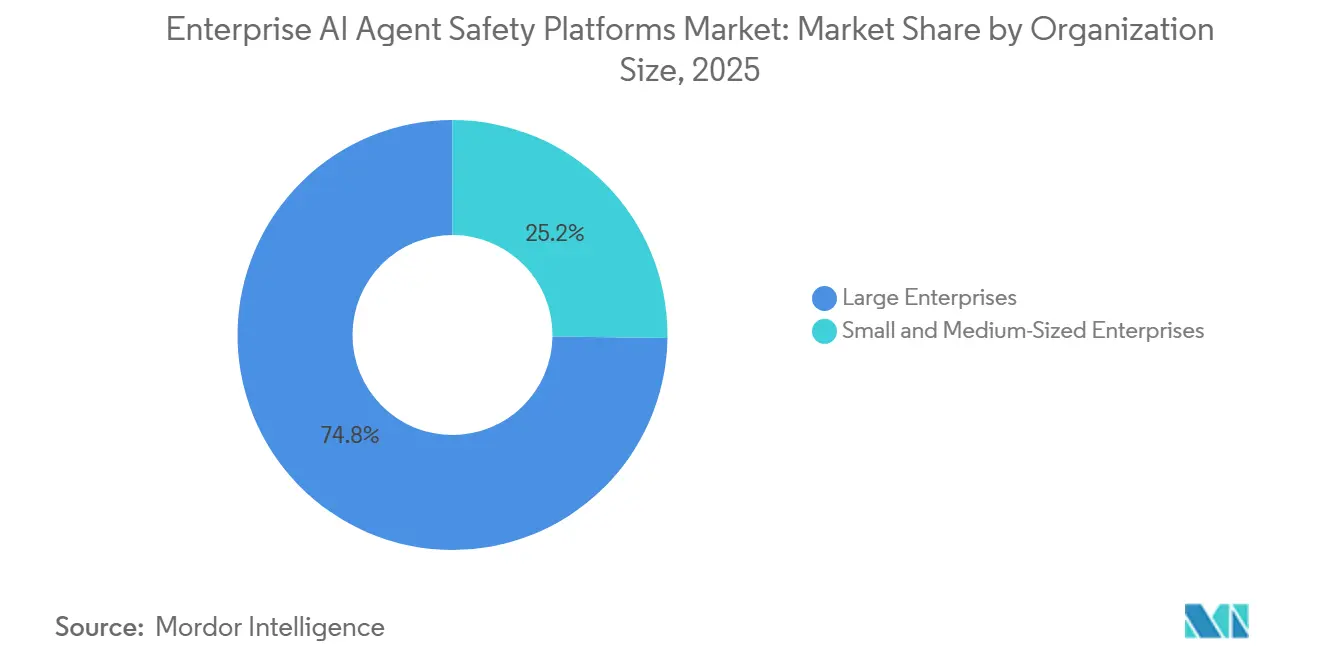
- By organization size, Large Enterprises held 74.78% of the Enterprise AI Agent Safety Platforms Market share in 2025, while Small and Medium-Sized Enterprises are projected to expand at a 22.71% CAGR through 2031.
- By industry vertical, Banking, Financial Services, and Insurance accounted for 27.31% of the Enterprise AI Agent Safety Platforms Market size in 2025, while Healthcare and Life Sciences are forecast to grow at a 23.04% CAGR through 2031.
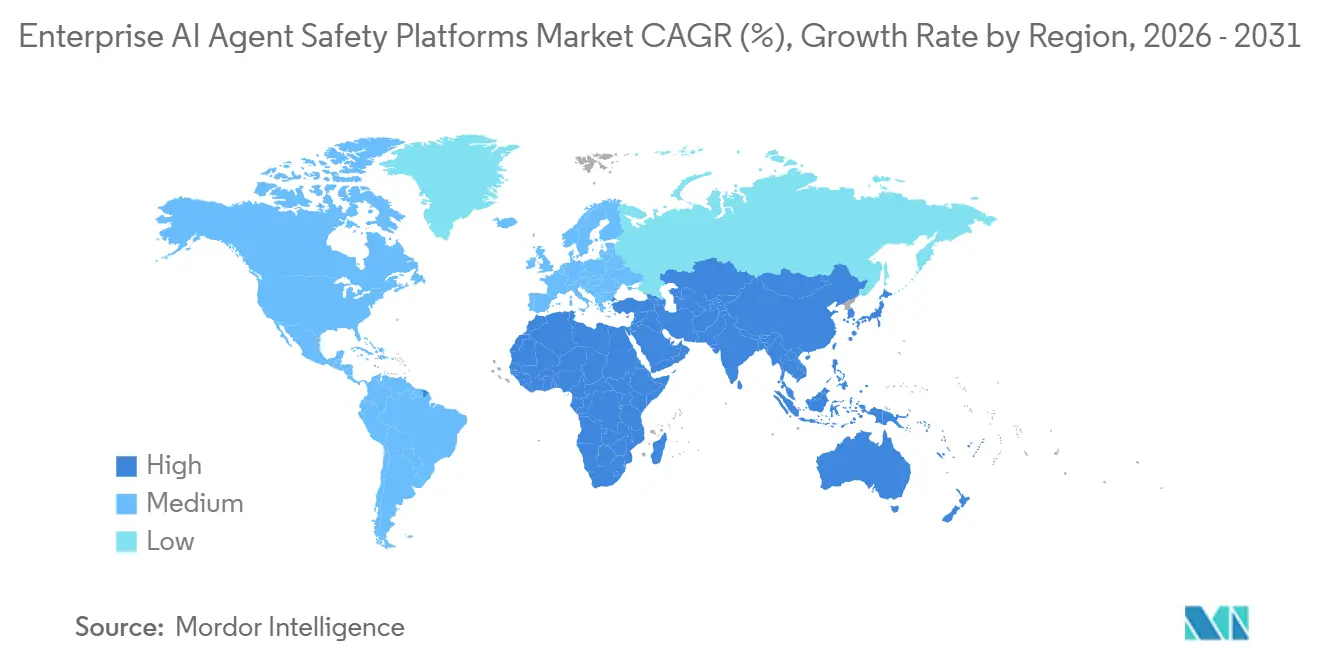
- By geography, North America held 40.22% of the Enterprise AI Agent Safety Platforms Market share in 2025, while Asia-Pacific is projected to grow at a 23.15% CAGR through 2031.
Note: Market size and forecast figures in this report are generated using Mordor Intelligence’s proprietary estimation framework, updated with the latest available data and insights as of January 2026.
Market Trends and Insights
Drivers Impact Analysis of Enterprise AI Agent Safety Platforms Market*
| Driver | (~) % Impact on CAGR Forecast | Geographic Relevance | Impact Timeline |
|---|---|---|---|
| Enterprise Deployment of Autonomous Workflow Agents | +6.5% | Global, with concentration in North America and Western Europe | Short term (≤ 2 years) |
| Regulatory Accountability for High-Impact AI Decisions | +4.2% | European Union, North America, with spillover to Asia-Pacific | Long term (≥ 4 years) |
| Non-Human Identity Sprawl and Least-Privilege Requirements | +3.8% | North America and European Union, Asia-Pacific core markets | Short term (≤ 2 years) |
| Prompt Injection and Tool Misuse Risk | +3.1% | Global | Short term (≤ 2 years) |
| Delegated Authority Across Multi-Agent Handoffs | +2.4% | North America, with spillover to Asia-Pacific and Middle East and Africa | Medium term (2-4 years) |
| MCP Tool Ecosystem Expansion and Tool-Provenance Requirements | +1.9% | Global, with early regulatory pressure in the European Union | Medium term (2-4 years) |
| Source: Mordor Intelligence | |||
Enterprise Deployment of Autonomous Workflow Agents
Enterprise adoption of autonomous workflow agents is expanding the scope of security in the Enterprise AI Agent Safety Platforms Market. Agents combine tool use, memory, and multistep reasoning in workflows that can span several systems. A compromised or misbehaving agent can therefore execute linked actions before a reviewer identifies the issue. Organizations need to discover agent identities, restrict permissions, and monitor sessions as deployments scale. The EchoLeak vulnerability, CVE-2025-32711, showed that a crafted email could enable remote data exfiltration through Microsoft 365 Copilot without user interaction. This exposure makes concurrent security design more important than adding controls after an agent reaches production.
Regulatory Accountability for High-Impact AI Decisions
Regulatory activity is raising the importance of documented controls for autonomous AI systems. Regulatory attention is increasing the importance of privilege management, system design, behavioral monitoring, and accountability for autonomous AI systems. The EU AI Act requires certain systems that interact with people to disclose their AI nature and the identity of the party they represent under Article 50.[1] High-risk system obligations under Annex III are scheduled for December 2027 under the amended timetable. NIST launched its AI Agent Standards Initiative in January 2026 to address interoperability and security standards for agent systems. These developments make monitoring, identity verification, and audit records more relevant in enterprise procurement.[2]
Non-Human Identity Sprawl and Least-Privilege Requirements
AI agents create non-human identities that can be dynamic, context-aware, and capable of obtaining permissions during a task. This differs from a conventional service account or static API key. CyberArk reported in 2026 that 68% of organizations lacked identity security controls for AI systems. Static identity governance processes do not fit agents that receive delegated tokens, act for a user, and terminate within one workflow. Organizations are applying time-limited access, just-in-time elevation, and continuous session monitoring to sensitive agent activities. Cisco introduced Duo Agentic Identity in 2025 with controls at the identity and network layers, reflecting the need to address both planes.
Prompt Injection and Tool Misuse Risk
Prompt injection is becoming a practical concern when agents retrieve content from documents, emails, and web sources. Malicious instructions can be embedded in content that an agent processes without direct user input. Microsoft describes a layered defense approach that combines model hardening, classifiers for malicious instructions, and system-level information-flow controls. Tool access raises the potential impact because an affected agent may call APIs, write files, or send information outside the organization. Each tool permission can expand the scope of an incident. The Enterprise AI Agent Safety Platforms Market benefits from demand for controls that assess both tool-call meaning and prompt content.[3]
Restraints Impact Analysis of Enterprise AI Agent Safety Platforms Market*
| Restraint | (~) % Impact on CAGR Forecast | Geographic Relevance | Impact Timeline |
|---|---|---|---|
| Fragmented Standards Across Agent Frameworks and Protocols | -2.8% | Global | Medium term (2-4 years) |
| Shortage of Agent-Security Engineering Skills | -2.1% | Global, most acute in Asia-Pacific and Middle East and Africa | Long term (≥ 4 years) |
| Runtime Security Latency and Compute Overhead | -1.9% | Global, most acute in cost-sensitive Asia-Pacific deployments | Short term (≤ 2 years) |
| False Positives Across Dynamic Agent Workflows | -1.4% | Global | Medium term (2-4 years) |
| Source: Mordor Intelligence | |||
Fragmented Standards Across Agent Frameworks and Protocols
Agent frameworks and protocols handle identity, tool calling, and memory in different ways. This makes consistent policy enforcement difficult for buyers with varied agent environments. The Model Context Protocol has expanded the connection between agents and tools, but it also introduces new security concerns. The National Vulnerability Database recorded CVE-2026-25536 for cross-client data leakage in the official MCP software development kit. NIST is developing interoperability guidance through its AI Agent Standards Initiative. Until standards mature, vendors must support several runtimes, and buyers may face higher integration and testing costs.
Shortage of Agent-Security Engineering Skills
Agent-security work combines adversarial AI testing, non-human identity governance, and prompt-injection testing. These capabilities do not align fully with existing cybersecurity or AI engineering roles. ISC2 identified a global cybersecurity workforce gap in its 2025 study. The smaller pool with agent-security expertise can limit deployment depth and weaken policy configuration. It also supports demand for managed security, deployment, and advisory services. The Enterprise AI Agent Safety Platforms Market services opportunity is especially relevant where local specialist talent is limited, including parts of Asia-Pacific and Middle East, and Africa.[4]
*Our forecasts treat driver/restraint impacts as directional, not additive. The impact forecasts reflect baseline growth, mix effects, and variable interactions.
Enterprise AI Agent Safety Platforms Market Segment Analysis
By Component:
Software Platforms Lead While Services Address Skills GapsSoftware Platforms held 72.39% of the Enterprise AI Agent Safety Platforms Market share in 2025. Buyers favor a consolidated governance console over separate point solutions because it enables a single policy layer across different agent runtimes. A unified control layer can reduce integration work and gaps in activity visibility. The component supports identity control, policy enforcement, tool oversight, and audit functions from a common interface. Platform providers are also building service partner ecosystems to support regional and mid-market accounts. Microsoft made Agent 365 generally available in May 2026 and identified services partners, including Accenture, Capgemini, KPMG, and Protiviti.
Services are the fastest-growing component at a 22.78% CAGR through 2031. It includes managed security services, professional deployment, and advisory work. This growth reflects the shortage of teams capable of designing and operating controls across multiple agent frameworks. Service providers can help enterprises establish governance policies and review high-risk workflows. Platform vendors are combining their products with partner-delivered implementation support. This approach may reduce the addressable work for independent service firms while increasing the total volume of services tied to platform adoption.
By Deployment:
Cloud-Based Architectures Lead AdoptionCloud-Based deployment accounted for 59.55% of the Enterprise AI Agent Safety Platforms Market size in 2025. Many agents use managed large language model APIs and serverless tool runtimes that are already cloud-resident. Cloud-delivered security tools can be deployed alongside these architectures with less operational friction. This makes cloud platforms a practical option for agent inventory, policy distribution, and monitoring. Cloud adoption also supports consistent updates across distributed enterprise teams. The Enterprise AI Agent Safety Platforms Market continues to favor cloud delivery, where agent workflows use managed services.
Cloud-based deployment is also the fastest-growing model, with a 22.94% CAGR through 2031. On-premises deployments retain a role in air-gapped government settings, regulated financial infrastructure, and environments with sovereign data requirements. Hybrid architectures can combine an on-premises orchestration layer with cloud-based tool registries. Buyers can isolate agent compute environments and limit network reachability when managing sensitive workflows. Private-cloud and on-premises environments can provide more detailed network segmentation for organizations that need it. These needs sustain a mixed deployment pattern even as cloud-based delivery expands.
By Security Function:
Identity Leads and Threat Detection ExpandsIdentity and Access Security held 26.73% of the Enterprise AI Agent Safety Platforms Market share in 2025. An agent needs a verified and limited identity to act safely across enterprise systems. Without that control, an agent may impersonate users, gain unnecessary privileges, or move across systems with inadequate records. This function supports identity registration, delegated authority, least-privilege access, and session oversight. CyberArk made its Secure AI Agents Solution generally available in December 2025 with just-in-time access, zero standing privileges, and continuous session monitoring. Identity controls remain central when agents manage sensitive workflows.
Threat Detection and Response is the fastest-growing security function at a 22.63% CAGR through 2031. Buyers need runtime monitoring to identify unexpected tool calls, unusual data access, and cross-agent movement. AI Governance and Risk Platforms address decision auditability and policy enforcement. Data Security and Privacy tools address oversharing and data-exfiltration risks in retrieval-augmented generation workflows. Vulnerability Assessment and Remediation addresses the software supply chain around MCP tools and connected components. Together, these functions show that the Enterprise AI Agent Safety Platforms Market is moving beyond perimeter controls toward safeguards across design, runtime, and post-deployment review.
By Organization Size:
Large Enterprises Hold the Largest BaseLarge Enterprises accounted for 74.78% of the Enterprise AI Agent Safety Platforms Market share in 2025. Their larger agent deployments require centralized oversight across business units, cloud environments, and data systems. These organizations also face more extensive regulatory obligations and have budgets for enterprise-grade security tools. Their purchasing decisions often prioritize control coverage, audit records, and integration with existing identity systems. Multi-cloud operations make a unified governance layer more useful. These factors explain why large enterprises formed the largest customer group in the base year.
Small and Medium-Sized Enterprises are the fastest-growing organization-size segment, with a 22.71% CAGR through 2031. No-code agent-building tools are lowering the barrier to creating autonomous workflows. This can lead to agents being deployed faster than governance tools are adopted. Smaller organizations may not have specialist staff to design complex policies. SentinelOne introduced Prompt AI Agent Security in March 2026 with discovery and governance controls for agentic workflows. Simplified onboarding and prebuilt policy templates can make safety platforms more accessible to this segment.
By Industry Vertical:
BFSI Leads and Healthcare and Life Sciences Grows FastestBanking, Financial Services, and Insurance accounted for 27.31% of the Enterprise AI Agent Safety Platforms Market size in 2025. Agents in this sector can support loan origination, fraud detection, treasury operations, and other high-privilege processes. These workflows increase the importance of identity controls and auditable actions. CyberArk reported that two-thirds of financial-services CISOs ranked agentic AI among their top 3 cybersecurity risks in its 2025 survey. The sector's transaction automation and regulatory scrutiny make it an important testing ground for agent security controls. This gives BFSI a leading position in the Enterprise AI Agent Safety Platforms Market.
Healthcare and Life Sciences is the fastest-growing vertical at a 23.04% CAGR through 2031. Clinical AI agents can support diagnostic work, patient triage, and administrative automation. These uses involve patient records and other protected health information. Providers must consider auditability, access restrictions, and data-residency requirements as deployment expands. Government and Defense requires human-review checkpoints for high-impact decisions. IT and ITES, Telecommunications, and Retail and E-Commerce have different security requirements, with retail agents often managing higher-volume but lower-privilege workflows. These vertical differences support demand for policies tailored to the purpose and authority of each agent.
Geography Analysis
North America Enterprise AI Agent Safety Platforms Market
North America held 40.22% of the Enterprise AI Agent Safety Platforms Market share in 2025. The region benefits from strong enterprise AI adoption and an established cybersecurity vendor ecosystem. The United States has federal procurement requirements for testing and human-review pathways that support demand for compliant agent controls. Canada contributes to demand in financial services, while Mexico adds to demand through the digitization of financial infrastructure. Regulated buyers place greater value on privilege management, monitoring, and accountability. These conditions support North America's leading position.
Europe Enterprise AI Agent Safety Platforms Market
Europe has a compliance-led purchasing pattern for the Enterprise AI Agent Safety Platforms Market. Article 50 of the EU AI Act applies transparency requirements to certain agentic systems that interact with users. High-risk Annex III obligations are expected in December 2027 under the current timetable. Germany expanded mandatory federal cybersecurity supervision through its NIS2 implementation in December 2025. European buyers can therefore place added value on documented governance, access control, and audit capability. European vendors can compete with U.S. hyperscalers in accounts where compliance requirements guide purchasing decisions.
APAC and MEA Enterprise AI Agent Safety Platforms Market
Asia-Pacific is the fastest-growing region at a 23.15% CAGR through 2031. Japan has developed specialized offerings, including GMO Cybersecurity, an IERAE AI Agent Penetration Testing service launched in April 2026. India's IT and ITES sectors drive demand for domestic deployments and for international clients that require compliance attestations for offshore AI workflows. China, South Korea, and Australia contribute separate regulatory and commercial conditions. Saudi Arabia and the United Arab Emirates are investing in sovereign AI infrastructure, while South Africa and Nigeria are early adopters in financial services. This spread of activity supports growth that is not dependent on one Asia-Pacific country.
Competitive Landscape
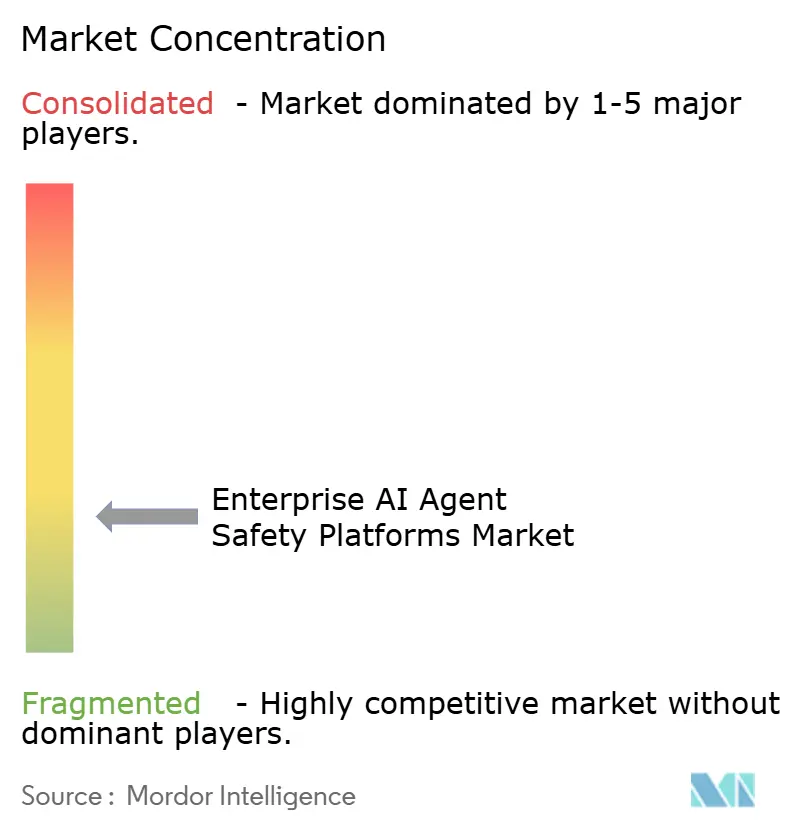
The Enterprise AI Agent Safety Platforms Market is fragmented at the platform layer and fragmented among specialized point solutions. Microsoft, Google, and Amazon Web Services distribute agent safety capabilities through broader cloud and security suites. Their existing enterprise agreements give them an advantage in reaching established customers. Microsoft offers Agent 365, while Amazon Web Services offers Bedrock AgentCore Identity. These larger providers compete with security vendors that add agent controls to existing identity, endpoint, and cloud-security products. The result is an active field of integrated platforms and specialized providers.
Palo Alto Networks and CyberArk combined their network, cloud, and identity capabilities through the Idira platform. CrowdStrike launched the Charlotte AI AgentWorks Ecosystem on March 25, 2026, with partners including Anthropic, NVIDIA, Amazon Web Services, and Accenture. SentinelOne integrated its Prompt AI Agent Security offering with Amazon Bedrock AgentCore in June 2026 to provide runtime guardrails for agents on Amazon Web Services. These moves show how established security vendors are expanding their product portfolios to include agent discovery, governance, and runtime protection. Partnerships also enable vendors to integrate their controls into common agent development environments.
Specialized vendors focus on areas such as agent testing, model and inference-layer security, non-human identity governance, and machine-learning pipeline assessment. A remaining opportunity is the multi-agent orchestration layer, where agents delegate work and permissions to other agents in real time. Existing identity and endpoint tools do not fully address these delegation chains. NIST released a preliminary draft of the Cyber AI Profile, NISTIR 8596, in December 2025 to map security controls to AI system requirements. Alignment with NIST AI RMF and NISTIR 8596 can support vendor evaluation in regulated-sector procurement. Competitive positions will depend on the breadth of integration, runtime controls, and credible evidence of policy enforcement.
Enterprise AI Agent Safety Platforms Industry Leaders
-
Microsoft Corporation
-
Palo Alto Networks, Inc.
-
CyberArk Software Ltd.
-
Cisco Systems, Inc.
-
Okta, Inc.
- *Disclaimer: Major Players sorted in no particular order
Enterprise AI Agent Safety Platforms Market Companies Covered in this Report
- Microsoft Corporation
- Palo Alto Networks, Inc.
- CyberArk Software Ltd.
- Cisco Systems, Inc.
- Okta, Inc.
- CrowdStrike Holdings, Inc.
- SentinelOne, Inc.
- Google LLC
- Amazon Web Services, Inc.
- Cato Networks Ltd.
- Proofpoint, Inc.
- Zenity, Inc.
- Lakera AI AG
- Protect AI, Inc.
- HiddenLayer, Inc.
- Prompt Security, Inc.
- Astrix Security, Inc.
- Oasis Security Ltd.
- Saviynt, Inc.
- Cranium AI, Inc.
Recent Industry Developments in Enterprise AI Agent Safety Platforms Market
- June 2026: SentinelOne announced an integration with Amazon Bedrock AgentCore to deliver runtime guardrails for AI agents operating on AWS infrastructure, available via a bring-your-own-license path for existing Prompt Security customers. Concurrently, SentinelOne opened Purple AI Agentic Investigation, zero-click autonomously initiated threat investigations, to all customers under a complimentary trial, with Singularity Credits introduced as a unified consumption currency.
- June 2026: Microsoft Build 2026 brought the Agent 365 SDK to general availability, enabling developers to embed compliance enforcement, observability, and access controls directly into custom agents built on any AI platform. Microsoft Purview controls for agentic risk detection were extended to cover local coding agents including Claude Code, GitHub Copilot, and OpenAI Codex.
- June 2026: Japan-based CyberSecurity Cloud launched "AI MONBAN," an AI governance platform enabling enterprises to visualize, control, and audit AI agent activity, with planned expansion to integrate non-MCP SaaS systems and internal databases. The product targets the governance gap created by rapid agentic AI deployment across Japan's corporate sector.
- May 2026: Microsoft made Agent 365 generally available at USD 15 per user per month, or bundled within Microsoft 365 E7 at USD 99 per user per month, introducing an enterprise-grade, at-scale control plane for AI agent inventory, governance, and threat response. The launch included cloud registry synchronization with AWS Bedrock and Google Cloud, and services partnerships with Accenture, Capgemini, KPMG, and Protiviti
Global Enterprise AI Agent Safety Platforms Market Report Scope
The enterprise AI agent safety platforms market refers to software and services designed to secure, govern, and manage the risks associated with autonomous AI agents. This includes capabilities for identity and access security, threat detection, data privacy, and vulnerability assessment. Deployed via cloud or on-premises models, these platforms help organizations ensure their AI agents operate safely, comply with regulations, and prevent unauthorized actions or data breaches.
The Enterprise AI Agent Safety Platforms Market Report is Segmented by Component (Software Platforms and Services), Deployment (Cloud-Based and On-Premises), Function (Identity and Access Security, AI Governance and Risk Platforms, Threat Detection and Response, Data Security and Privacy, Vulnerability Assessment and Remediation, and Other Functions), Organization Size (Large Enterprises and Small and Medium-Sized Enterprises), Industry Vertical (Banking, Financial Services and Insurance, Healthcare and Life Sciences, Government and Defense, IT and IT-Enabled Services, Telecommunications, Retail and E-Commerce, and Other Industry Verticals), and Geography (North America, South America, Europe, Asia-Pacific, Middle East, and Africa). The Market Forecasts are Provided in Terms of Value (USD).
Segmentation Overview
| Software Platforms |
| Services |
| Cloud-Based |
| On-Premises |
| Identity and Access Security |
| AI Governance and Risk Platforms |
| Threat Detection and Response |
| Data Security and Privacy |
| Vulnerability Assessment and Remediation |
| Other Functions |
| Large Enterprises |
| Small and Medium-Sized Enterprises |
| Banking, Financial Services and Insurance |
| Healthcare and Life Sciences |
| Government and Defense |
| IT and IT-Enabled Services |
| Telecommunications |
| Retail and E-Commerce |
| Other Industry Verticals |
| North America | United States |
| Canada | |
| Mexico | |
| Europe | Germany |
| United Kingdom | |
| France | |
| Italy | |
| Spain | |
| Rest of Europe | |
| Asia-Pacific | China |
| Japan | |
| India | |
| South Korea | |
| Australia | |
| Rest of Asia-Pacific | |
| South America | Brazil |
| Argentina | |
| Chile | |
| Rest of South America | |
| Middle East | United Arab Emirates |
| Saudi Arabia | |
| Qatar | |
| Rest of Middle East | |
| Africa | South Africa |
| Egypt | |
| Nigeria | |
| Rest of Africa |
| By Component | Software Platforms | |
| Services | ||
| By Deployment | Cloud-Based | |
| On-Premises | ||
| By Function | Identity and Access Security | |
| AI Governance and Risk Platforms | ||
| Threat Detection and Response | ||
| Data Security and Privacy | ||
| Vulnerability Assessment and Remediation | ||
| Other Functions | ||
| By Organization Size | Large Enterprises | |
| Small and Medium-Sized Enterprises | ||
| By Industry Vertical | Banking, Financial Services and Insurance | |
| Healthcare and Life Sciences | ||
| Government and Defense | ||
| IT and IT-Enabled Services | ||
| Telecommunications | ||
| Retail and E-Commerce | ||
| Other Industry Verticals | ||
| By Geography | North America | United States |
| Canada | ||
| Mexico | ||
| Europe | Germany | |
| United Kingdom | ||
| France | ||
| Italy | ||
| Spain | ||
| Rest of Europe | ||
| Asia-Pacific | China | |
| Japan | ||
| India | ||
| South Korea | ||
| Australia | ||
| Rest of Asia-Pacific | ||
| South America | Brazil | |
| Argentina | ||
| Chile | ||
| Rest of South America | ||
| Middle East | United Arab Emirates | |
| Saudi Arabia | ||
| Qatar | ||
| Rest of Middle East | ||
| Africa | South Africa | |
| Egypt | ||
| Nigeria | ||
| Rest of Africa | ||
Key Questions Answered in the Report
What is the projected value of enterprise AI agent safety platforms by 2031?
The category is forecast to reach USD 4.57 billion by 2031, expanding at a 22.16% CAGR from 2026 to 2031.
Which component leads spending on enterprise AI agent safety platforms?
Software Platforms led with 72.39% share in 2025 because buyers need centralized governance across agent environments.
Why is identity and access security important for AI agents?
It led the security-function segment with 26.73% share in 2025 because agents need verified identities and limited access to enterprise systems.
Which deployment model is growing fastest for AI agent safety platforms?
Cloud-Based deployment held 59.55% share in 2025 and is forecast to expand at a 22.94% CAGR through 2031.
Which sector has the strongest demand for enterprise AI agent safety platforms?
Banking, Financial Services and Insurance held 27.31% share in 2025 because agents can access high-privilege financial workflows.
Which region will grow fastest through 2031?
Asia-Pacific is projected to expand at a 23.15% CAGR, supported by enterprise adoption and emerging specialist offerings.