
ENT Disorder Treatment Market Size and Share
Market Overview
| Study Period | 2020 - 2031 |
|---|---|
| Market Size (2026) | USD 27.22 Billion |
| Market Size (2031) | USD 36.86 Billion |
| Growth Rate (2026 - 2031) | 6.25 % |
| Fastest Growing Market | Asia-Pacific |
| Largest Market | North America |
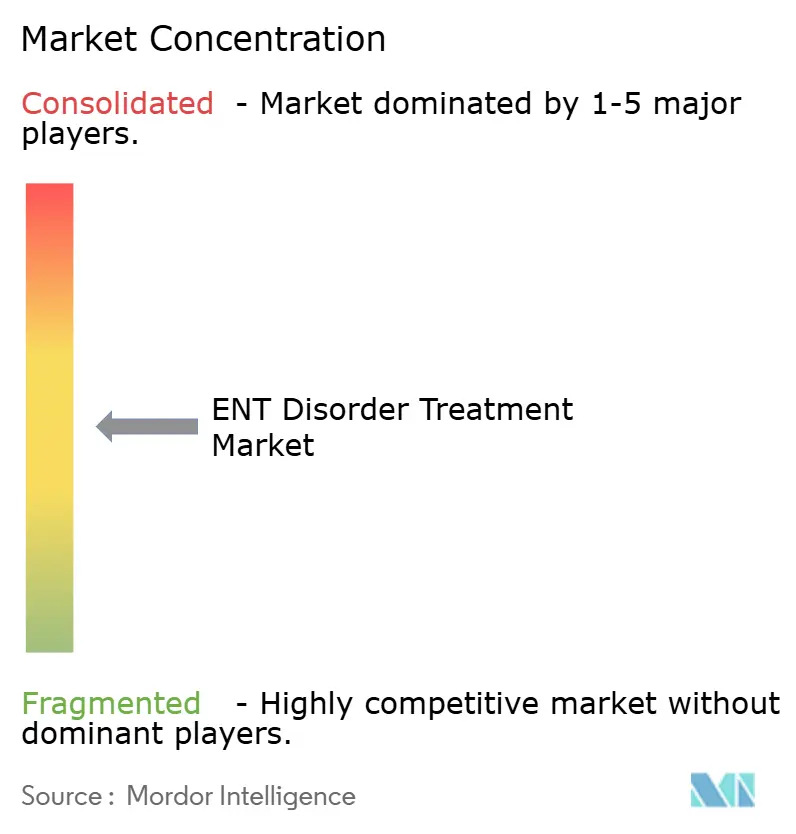
| Market Concentration | Medium |
Major Players *Disclaimer: Major Players sorted in no particular order Image © Mordor Intelligence. Reuse requires attribution under CC BY 4.0. | |
ENT Disorder Treatment Market Analysis by Mordor Intelligence
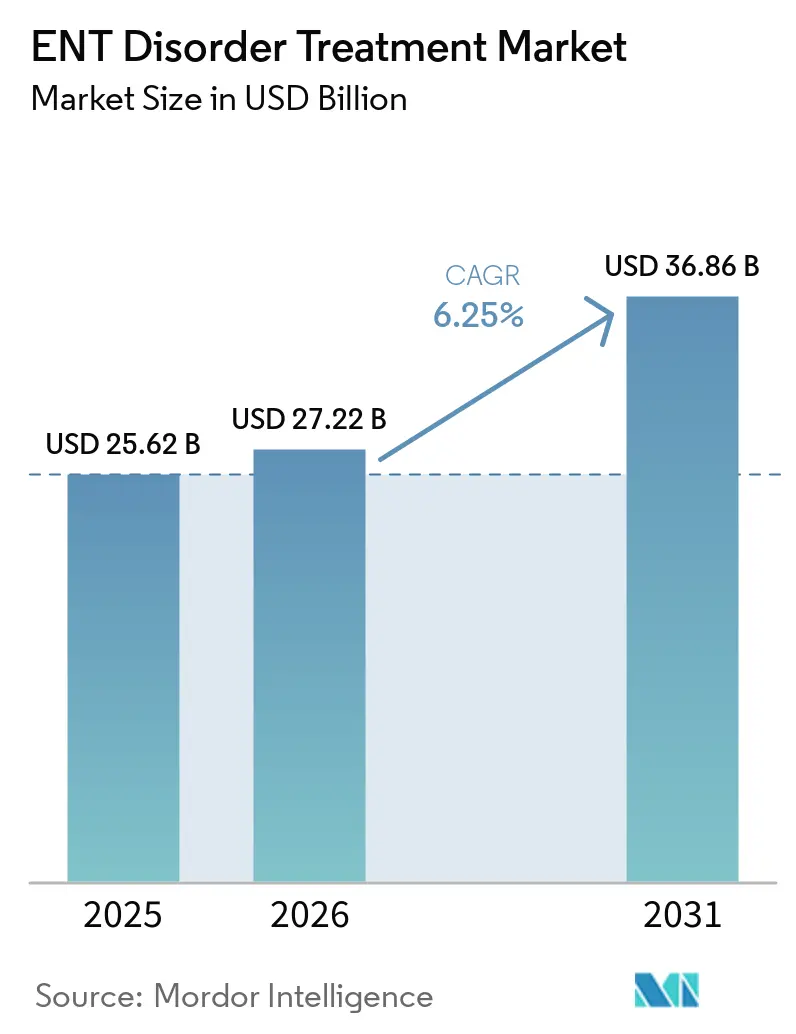
The ENT Disorder Treatment Market size is expected to increase from USD 25.62 billion in 2025 to USD 27.22 billion in 2026 and reach USD 36.86 billion by 2031, growing at a CAGR of 6.25% over 2026-2031.
Aging populations are increasing demand for hearing rehabilitation, implants, balance care, and related services across the ENT disorder treatment market. More than 25% of people older than 60 live with disabling hearing loss, while more than 700 million people are expected to need hearing rehabilitation by 2050. Unaddressed hearing loss costs the global economy nearly USD 1 trillion each year, which strengthens the case for broader payer support. Biologics for sinonasal disease and connected surgical platforms are changing treatment choices in the ENT disorder treatment market. Providers that combine diagnosis, procedures, device fitting, and follow-up are better placed to capture demand as access improves.
Key Report Takeaways
- By product type, Pharmaceuticals held 57.31% of the ENT disorder treatment market share in 2025, while Medical Devices are forecast to grow at a CAGR of 7.58% through 2031.
- By organ type, the Ear held 38.24% in 2025, while the Throat, Larynx, and Related Structures are forecast to grow at a CAGR of 7.22% through 2031.
- By disease type, Hearing and Balance Disorders held 60.14% in 2025, while Sleep-Related Breathing Disorders are forecast to grow at a CAGR of 8.42% through 2031.
- By patient age group, Adults aged 18–64 held 64.65% in 2025, while the Geriatric is forecast to grow at a CAGR of 7.65% through 2031.
- By distribution channel, Hospital Pharmacies held 42.65% in 2025, while Online Pharmacies and Digital Platforms are forecast to grow at a CAGR of 8.25% through 2031.
- By geography, North America held 42.61% of revenue in 2025, while Asia-Pacific is forecast to grow at a 7.75% CAGR through 2031.
Note: Market size and forecast figures in this report are generated using Mordor Intelligence’s proprietary estimation framework, updated with the latest available data and insights as of January 2026.
Market Trends and Insights
Drivers Impact Analysis of ENT Disorder Treatment Market*
| Driver | (~) % Impact on CAGR Forecast | Geographic Relevance | Impact Timeline |
|---|---|---|---|
| Aging-Related Hearing Loss and ENT Disease Burden | +1.6% | Global, with the highest intensity in East Asia, Western Europe, and North America | Long term (≥ 4 years) |
| Chronic Sinusitis, Rhinitis, and Otitis Media Prevalence | +1.3% | Global, with the highest burden in South Asia and Sub-Saharan Africa | Medium term (2-4 years) |
| Minimally Invasive ENT Procedures and Image-Guided Surgery | +1.2% | North America, Europe, and high-income Asia-Pacific | Medium term (2-4 years) |
| Healthcare Access, Reimbursement, and ENT Infrastructure | +0.9% | Asia-Pacific, the Middle East and Africa, and South America | Long term (≥ 4 years) |
| Tele-Otoscopy and Remote ENT Consultations | +0.6% | Global, with immediate relevance in rural APAC, Sub-Saharan Africa, and Latin America | Short term (≤ 2 years) |
| Microbiome and Probiotic Therapies for Pediatric Ear Infections | +0.3% | North America and the EU, with spillover to APAC | Long term (≥ 4 years) |
| Source: Mordor Intelligence | |||
Rising Aging-Related Hearing Loss and ENT Disease Burden
More than 430 million people globally require rehabilitation for disabling hearing loss. Hearing loss ranked as the third most common cause of years lived with disability among adults older than 60 in a 2025 analysis. This population requires more than hearing aids and cochlear implants. It also creates demand for tympanoplasty, balance rehabilitation, and vestibular pharmacotherapy. Cognitive decline, depression, and social isolation make earlier treatment more relevant for health systems. The ENT disorder treatment market, therefore, benefits when hearing care is treated as part of broader clinical management rather than as a discretionary audiology purchase.
Increasing Prevalence of Chronic Sinusitis, Rhinitis, and Otitis Media
Chronic rhinosinusitis affected an estimated 12% of adults in Western countries in a 2025 systematic review. Many patients still move between primary-care antibiotics and elective surgery without sustained evidence-based treatment. Tezepelumab became the first TSLP-targeting biologic approved for chronic rhinosinusitis with nasal polyps in October 2025[1]. Dupilumab received U.S. approval for allergic fungal rhinosinusitis in February 2026. These approvals support a chronic disease management model for sinonasal inflammation within the ENT disorder treatment market. Companies with respiratory immunology platforms have an advantage in treating patients who need long-term biologic care.
Adoption of Minimally Invasive ENT Procedures and Image-Guided Surgery
Image-guided navigation is becoming a standard part of complex sinus and skull-base care. Medtronic received FDA clearance for the Stealth AXiS Surgical System for cranial and ENT procedures on March 27, 2026. The system combines navigation, imaging, and robotics for ENT workflows. A 2025 study found that photon-counting computed tomography supported image-guided accuracy within 1.5 mm at low radiation doses. Higher technical standards can increase referrals from community hospitals to more specialized centers. This pattern favors suppliers with integrated technology portfolios in the ENT disorder treatment market.
Tele-Otoscopy and Remote ENT Consultations Extending Diagnosis to Underserved Areas
Store-and-forward tele-otoscopy reached diagnostic sensitivity of 72%–94% and specificity of 93%–98% for pediatric otitis media in a 2026 scoping review[2]. A remote Australian model produced diagnostic-quality live video-otoscopy images in 92% of cases. The model reached Aboriginal and Torres Strait Islander patients who had limited access to in-person specialists. An asynchronous study reported a Cohen’s Kappa of 0.96 for rhinology diagnoses. Digital assessment can identify untreated groups before they receive empirical antibiotics. Device suppliers may gain value when diagnostic tools also support triage and follow-up.
Restraints Impact Analysis of ENT Disorder Treatment Market*
| Restraint | (~) % Impact on CAGR Forecast | Geographic Relevance | Impact Timeline |
|---|---|---|---|
| Cost of Advanced ENT Devices and Surgical Procedures | -0.8% | Global, with the greatest effect in the Middle East and Africa, and South America | Long term (≥ 4 years) |
| Antimicrobial Resistance and Antibiotic-Stewardship Constraints | -0.6% | Global, with the highest relevance in the Eastern Mediterranean and Southeast Asia | Medium term (2-4 years) |
| Fragmented Reimbursement for Advanced Otic Devices | -0.5% | Asia-Pacific excluding Japan, the Middle East and Africa, and South America | Long term (≥ 4 years) |
| Shortage of ENT Specialists, Audiologists, and Fitting Capacity | -0.7% | Global, with critical shortages in Sub-Saharan Africa and rural South Asia | Long term (≥ 4 years) |
| Source: Mordor Intelligence | |||
High Cost of Advanced ENT Devices and Surgical Procedures
Cochlear implants, premium hearing aids, and image-guided sinus procedures remain costly for many patients[3]. A PLOS analysis reported U.S. hearing-aid prices from USD 500 to USD 3,000. Total cochlear implant costs, including surgery and fitting, can reach USD 100,000 in some health systems. These price barriers are most significant in low- and middle-income countries where disease burdens are high. China’s volume-based procurement policy is also compressing average selling prices for premium devices. Cochlear identified the policy as a headwind for premium cochlear implant sales in China in its FY2026 results.
Antimicrobial Resistance and Antibiotic-Stewardship Constraints
Otitis media, sinusitis, and pharyngitis often lead to empirical broad-spectrum antibiotic use. The WHO reported continued overuse of Watch-group antibiotics where Access-group alternatives remain effective. Its AWaRe framework supports national policies that seek to improve prescribing choices. A 2026 inpatient study found antibiotics in 100% of ENT prescriptions, with 86.4% administered by injection. Stronger stewardship can narrow the commercial role of broad-spectrum antibiotics in the ENT disorder treatment market. It also supports investment in biologics, bacteriophage therapies, and microbiome-focused approaches.
*Our forecasts treat driver/restraint impacts as directional, not additive. The impact forecasts reflect baseline growth, mix effects, and variable interactions.
ENT Disorder Treatment Market Segment Analysis
By Product Type:
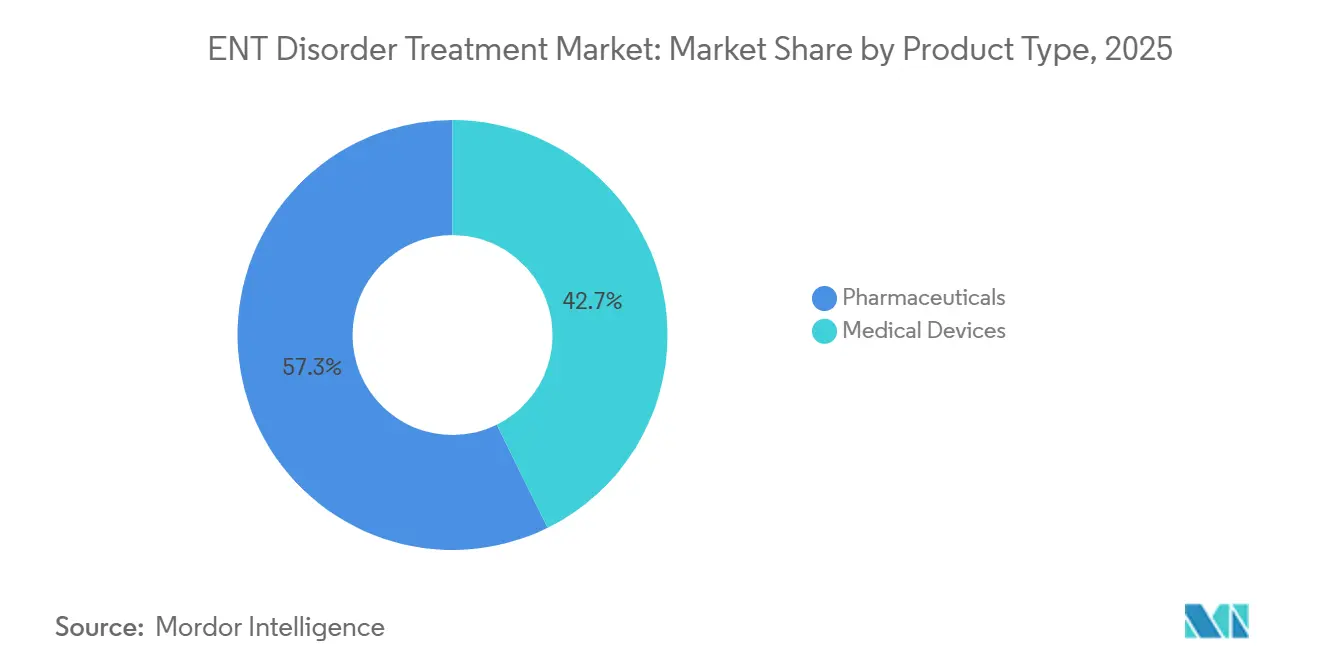
Devices Are Gaining Value While Pharmaceuticals Retain Volume LeadershipPharmaceuticals held 57.31% of the ENT disorder treatment market share in 2025. Their position reflected frequent prescribing of antibiotics, antihistamines, and corticosteroids in primary care. Medical Devices is forecast to grow at a CAGR of 7.58% between 2026 and 2031. Hearing implants, balloon dilation systems, navigation platforms, and advanced endoscopes support this faster expansion. Devices also capture a higher value per intervention than many established drug therapies.
Biologics are changing the pharmaceutical mix in the ENT disorder treatment market. Tezepelumab blocks TSLP, while dupilumab blocks IL-4 and IL-13 pathways. These mechanisms serve patients whose needs are not addressed by small-molecule ENT therapies. Medical device consumables and accessories provide recurring revenue linked to procedure activity. Hearing devices and implants retain the highest unit values within the device category. FDA 510(k) and PMA pathways continue to shape product-launch timing and research priorities.
By Organ Type:
Ear Care Leads While Throat and Larynx Care Expands FasterEar disorders commanded 38.24% of the ENT disorder treatment market size in 2025. Hearing loss, otitis media, and cochlear implant demand supported this leadership. The category also benefits from established audiometry, imaging, and implant technology. Its treatment pathways are supported by long-standing clinical evidence. The scale of hearing care gives the Ear category a durable base in the ENT disorder treatment market.
Throat, Larynx, and Related Structures is projected to grow at a CAGR of 7.22% through 2031. Higher obstructive sleep apnea diagnosis, hypoglossal nerve stimulation, and transoral robotic surgery support demand. The American Academy of Otolaryngology–Head and Neck Surgery recognizes several surgical options when CPAP therapy is insufficient. Nose and Sinuses also remains important because of chronic rhinosinusitis and allergic rhinitis. Biologic eligibility tied to nasal-polyp burden can increase use of diagnostic imaging. When biologics defer surgery, drug revenue can rise while near-term procedure volumes may slow.
By Disease Type:
Hearing and Balance Care Holds the Largest Base, While Sleep Care AcceleratesHearing and Balance Disorders represented 60.14% in 2025. Presbycusis and multi-year cochlear implant treatment cycles supported this position. Implant recipients also generate demand for processor upgrades and accessories. Cochlear launched the Nucleus Nexa System in July 2025 with upgradeable implant firmware. This approach supports ongoing technology relationships after implantation.
Sleep-Related Breathing Disorders are forecast to grow at a CAGR of 8.42% between 2026 and 2031. Home sleep testing and increased surgical candidacy among people intolerant of CPAP are increasing demand. ENT pathways are taking a larger role in sleep disorder management. Infectious disorders and inflammatory or allergic disorders continue to support substantial pharmaceutical spending. Structural and obstructive disorders produce steady procedure volumes across regions. Tezepelumab targets patients with chronic rhinosinusitis with nasal polyps who do not respond to intranasal corticosteroids.
By Patient Age Group:
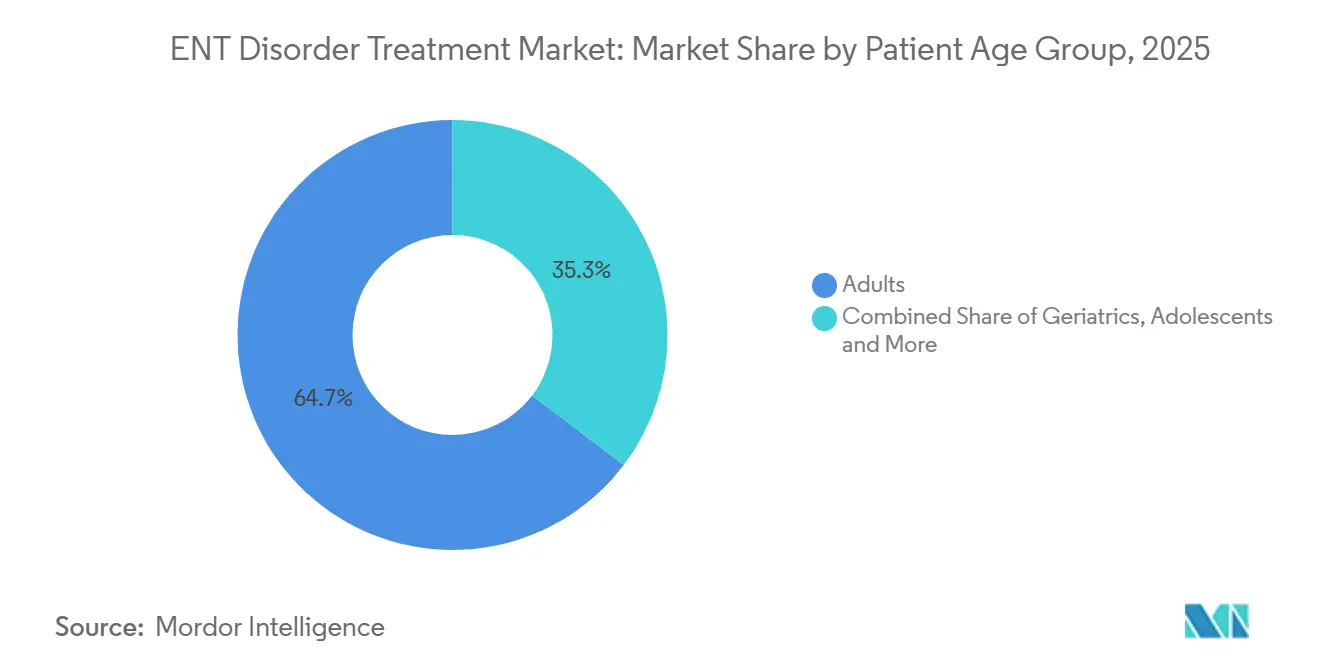
Adult Care Leads While Geriatric Demand ExpandsAdults aged 18–64 held 64.65% in 2025. This group forms the main prescribing base for ENT drugs and the key candidate pool for minimally invasive surgery. It also includes many working-age people who seek treatment for hearing, sinus, and sleep-related conditions. Adult demand, therefore, supports both pharmaceutical volume and procedure use. The group remains central to current revenue across care settings.
The Geriatric segment is forecast to grow at a CAGR of 7.65% through 2031. Aging, implant candidacy in late-onset profound hearing loss, and sleep-disordered breathing care support its growth. Cochlear reported 10% growth in U.S. adult cochlear implant referrals in FY2026. Japan approved the upgradeable Nexa implant system in June 2026. Pediatrics and adolescents remain clinically important for otitis media and tympanostomy tubes. A 2025 meta-analysis associated probiotics with a 20% lower probability of acute otitis media.

By Distribution Channel:
Hospitals Retain High-Value Care While Digital Dispensing GrowsHospital Pharmacies accounted for 42.65% in 2025. ENT procedures, inpatient antibiotics, and device dispensing are concentrated in tertiary-care institutions. Reimbursement often links device acquisition and procedure payment within the same provider system. This makes hospital channels important for cochlear implants and surgical navigation platforms. Their role remains strong for high-value treatment pathways.
Online Pharmacies and Digital Platforms are forecast to grow at a CAGR of 8.25% through 2031. E-pharmacy use for antihistamines, decongestants, and nasal sprays supports this expansion. Subscription delivery also supports repeat purchases of suitable medications. U.S. over-the-counter hearing-aid rules are directing some device-adjacent purchases to digital channels. Retail pharmacies remain important in high OTC-use markets. Specialty clinics and mail-order programs serve managed-care formularies and specialty biologic distribution.
Geography Analysis
North America ENT Disorder Treatment Market
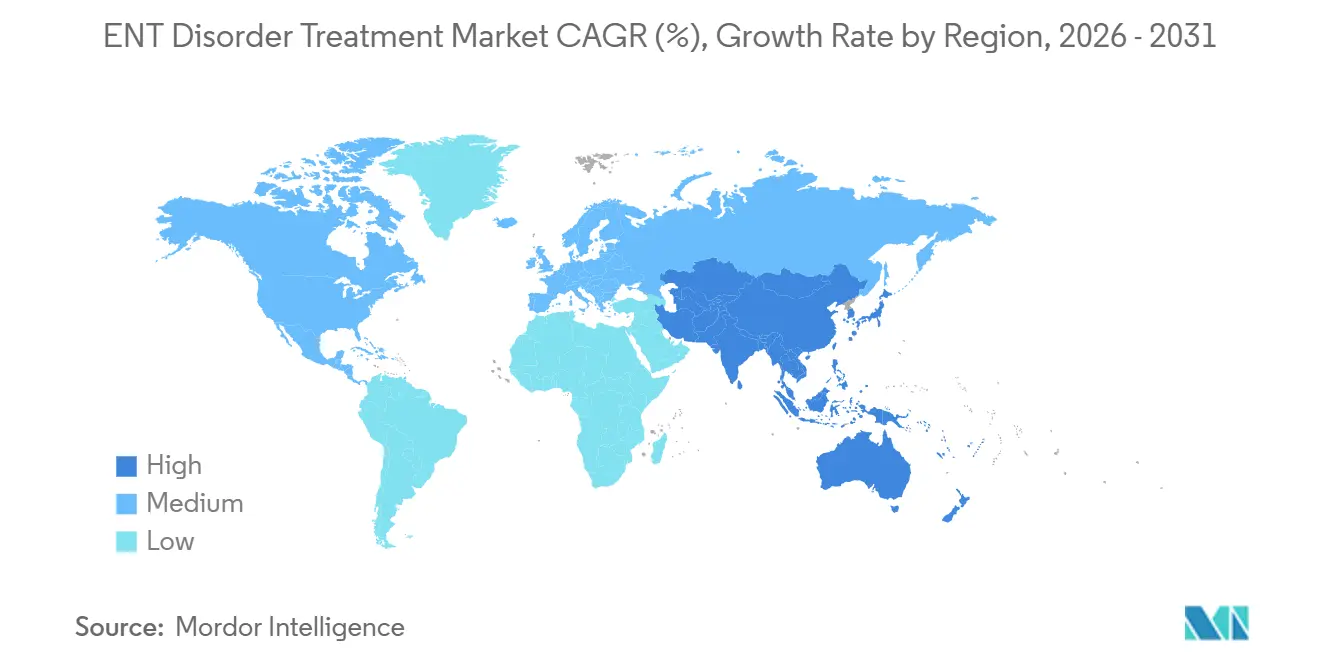
North America held 42.61% of the ENT disorder treatment market share in 2025. Advanced reimbursement systems, specialist density, and high spending on hearing devices and biologics underpin its leading position. U.S. regulatory reviews supported the 2025 and 2026 approvals of tezepelumab and dupilumab for sinonasal conditions. Rural access remains a concern despite high overall spending. A 2024 JAMA study found that 75% of U.S. counties qualified as shortage areas for hearing health professionals.
APAC ENT Disorder Treatment Market
Asia-Pacific is forecast to expand at a CAGR of 7.75% from 2026 to 2031. Japan’s aging population, Chinese investment in ENT capacity, and Indian demand for specialist care support this pace. Japan approved the Cochlear Nucleus Nexa implant in June 2026. The source reported hearing loss in 11% of Japan’s total population and more than 70% of adults aged 75 and older. China’s volume-based procurement is constraining premium implant revenue, while community hospital expansion is lifting procedure volumes and generic drug use.
EMEA and South America ENT Disorder Treatment Market
Europe maintained a substantial share in 2025 through established reimbursement pathways in Germany, the UK, France, Italy, and Spain. EU MDR 2017/745 CE-marking requirements remain central to device access in the region. Medtronic received CE mark approval for Stealth AXiS for ENT procedures on June 8, 2026. The Middle East and Africa combine private investment in GCC hospital care with significant workforce limitations in Sub-Saharan Africa. Global OHNS reported a clinician density of 0.18 per 100,000 people in Sub-Saharan Africa. South America is supported by hearing-aid programs and greater biologic access, although currency volatility and fragmented insurance slow adoption.
Competitive Landscape
The ENT disorder treatment market is moderately fragmented because devices and pharmaceuticals operate through distinct competitive groups. Cochlear implant and hearing technology suppliers compete separately from large biopharmaceutical companies. Cochlear Limited, Sonova Holding, Demant, GN Store Nord, and WS Audiology are important device participants. Sanofi, AstraZeneca, GSK, and Pfizer have broader pharmaceutical portfolios that include relevant ENT treatments. This separation limits direct cross-segment competition in the ENT disorder treatment market.
Cochlear, Sonova, and MED-EL collectively account for the majority of global cochlear implant revenue. Their competition centers on technology, rehabilitation tools, and upgrade systems rather than price. Sonova announced plans in 2026 to divest its Sennheiser consumer hearing brand and focus investment on hearing instruments and cochlear implants. Demant reported 9% organic sales growth for Oticon Zeal in Q1 2026. GN launched ReSound Sensia in August 2026 with deep neural network-based environmental classification.
Targeted biologics create an important opportunity for pharmaceutical companies in the ENT disorder treatment industry. IL-4, IL-13, and TSLP-blocking therapies are expanding options beyond corticosteroids and antibiotics. Medtronic and KARL STORZ announced an integration collaboration in June 2026 for U.S. ENT operating rooms. The arrangement combines navigation and endoscopy visualization in a single workflow. Acousia Therapeutics and Spiral Therapeutics are developing approaches for otoprotection and hair-cell regeneration. Their progress may determine whether inner-ear pharmacology becomes a meaningful future category.
ENT Disorder Treatment Industry Leaders
-
Sonova Holding AG
-
Demant A/S
-
Cochlear Limited
-
Medtronic plc
-
Olympus Corporation
- *Disclaimer: Major Players sorted in no particular order
ENT Disorder Treatment Market Companies Covered in this Report
- Abbott Laboratories
- Acousia Therapeutics GmbH
- Ambu
- AstraZeneca
- Cochlear
- Demant
- GN Store Nord
- GlaxoSmithKline
- Johnson & Johnson
- Karl Storz
- MED-EL Elektromedizinische Gerate GmbH
- Medtronic
- Merck
- Novartis
- Olympus
- Pfizer
- Sanofi
- Sonova
- Spiral Therapeutics
- Stryker
- Teva Pharmaceutical Industries
- WS Audiology A/S
Recent Industry Developments in ENT Disorder Treatment Market
- August 2026: GN Store Nord launched ReSound Sensia, a premium hearing aid family built on a new AI platform incorporating deep neural network noise reduction and a four-microphone directional beamformer, available initially in the US, Germany, and Austria.
- June 2026: Medtronic received CE mark for the Stealth AXiS Surgical System for ENT procedures, expanding the platform's availability to European ENT surgeons for minimally invasive sinus, skull-base, and balloon sinuplasty procedures. The system integrates into Medtronic's AiBLE ENT smart ecosystem.
Global ENT Disorder Treatment Market Report Scope
As per the scope of the report, ENT disorder treatment refers to the medical interventions and therapies used to manage and cure conditions affecting the ear, nose, and throat (ENT).
The ENT disorder treatment market is segmented by product type into medical devices, including surgical and interventional devices, hearing devices, and implants, and consumables and accessories; and pharmaceuticals, including antibiotics, analgesics, and nonsteroidal anti-inflammatory drugs (NSAIDs), antihistamines, corticosteroids, antivirals, decongestants, biologics, and other pharmaceuticals. By organ type, the market is segmented into the ear, nose and sinuses, and throat, larynx, and related structures. By disease type, the market is segmented into infectious ENT disorders, inflammatory and allergic ENT disorders, hearing and balance disorders, structural and obstructive disorders, sleep-related breathing disorders, and other disease types. By patient age group, the market is segmented into pediatrics (0–12 years), adolescents (13–17 years), adults (18–64 years), and geriatrics (65 years and older). By distribution channel, the market is segmented into hospital pharmacies, retail pharmacies and drug stores, online pharmacies and digital platforms, and other distribution channels. By geography, the market is segmented into North America, Europe, Asia-Pacific, the Middle East and Africa, and South America. The market report also covers the estimated market sizes and trends for 17 countries across major regions globally. For each segment, the market size and forecast are provided in terms of value (USD).
Segmentation Overview
| Medical Devices | Surgical and Interventional Devices |
| Hearing Devices and Implants | |
| Consumables and Accessories | |
| Pharmaceuticals | Antibiotics |
| Analgesics and Nonsteroidal Anti-Inflammatory Drugs | |
| Antihistamines | |
| Corticosteroids | |
| Antivirals | |
| Decongestants | |
| Biologics | |
| Others |
| Ear |
| Nose and Sinuses |
| Throat, Larynx, and Related Structures |
| Infectious ENT Disorders |
| Inflammatory and Allergic ENT Disorders |
| Hearing and Balance Disorders |
| Structural and Obstructive Disorders |
| Sleep-Related Breathing Disorders |
| Other Disease Types |
| Pediatrics (0-12 Years) |
| Adolescents (13-17 Years) |
| Adults (18-64 Years) |
| Geriatrics (65 Years and Older) |
| Hospital Pharmacies |
| Retail Pharmacies and Drug Stores |
| Online Pharmacies and Digital Platforms |
| Other Distribution Channels |
| North America | United States |
| Canada | |
| Mexico | |
| Europe | Germany |
| United Kingdom | |
| France | |
| Italy | |
| Spain | |
| Rest of Europe | |
| Asia-Pacific | China |
| Japan | |
| India | |
| Australia | |
| South Korea | |
| Rest of Asia-Pacific | |
| Middle East and Africa | GCC |
| South Africa | |
| Rest of Middle East and Africa | |
| South America | Brazil |
| Argentina | |
| Rest of South America |
| By Product Type | Medical Devices | Surgical and Interventional Devices |
| Hearing Devices and Implants | ||
| Consumables and Accessories | ||
| Pharmaceuticals | Antibiotics | |
| Analgesics and Nonsteroidal Anti-Inflammatory Drugs | ||
| Antihistamines | ||
| Corticosteroids | ||
| Antivirals | ||
| Decongestants | ||
| Biologics | ||
| Others | ||
| By Organ Type | Ear | |
| Nose and Sinuses | ||
| Throat, Larynx, and Related Structures | ||
| By Disease Type | Infectious ENT Disorders | |
| Inflammatory and Allergic ENT Disorders | ||
| Hearing and Balance Disorders | ||
| Structural and Obstructive Disorders | ||
| Sleep-Related Breathing Disorders | ||
| Other Disease Types | ||
| By Patient Age Group | Pediatrics (0-12 Years) | |
| Adolescents (13-17 Years) | ||
| Adults (18-64 Years) | ||
| Geriatrics (65 Years and Older) | ||
| By Distribution Channel | Hospital Pharmacies | |
| Retail Pharmacies and Drug Stores | ||
| Online Pharmacies and Digital Platforms | ||
| Other Distribution Channels | ||
| By Geography | North America | United States |
| Canada | ||
| Mexico | ||
| Europe | Germany | |
| United Kingdom | ||
| France | ||
| Italy | ||
| Spain | ||
| Rest of Europe | ||
| Asia-Pacific | China | |
| Japan | ||
| India | ||
| Australia | ||
| South Korea | ||
| Rest of Asia-Pacific | ||
| Middle East and Africa | GCC | |
| South Africa | ||
| Rest of Middle East and Africa | ||
| South America | Brazil | |
| Argentina | ||
| Rest of South America | ||
Key Questions Answered in the Report
What is the projected growth rate for ENT disorder treatment?
The ENT disorder treatment market is projected to grow at a CAGR of 6.25% from 2026 to 2031, reaching USD 36.86 billion.
Which ENT treatment category held the largest share in 2025?
Pharmaceuticals held 57.31% in 2025 because antibiotics, corticosteroids, and antihistamines are frequently used in primary care.
Which ENT disease category is expanding fastest?
Sleep-Related Breathing Disorders is forecast to grow at a CAGR of 8.42% through 2031, supported by broader sleep apnea diagnosis and surgical care.
Which region is forecast to grow fastest?
Asia-Pacific is forecast to grow at a CAGR of 7.75% from 2026 to 2031, supported by aging, infrastructure expansion, and greater specialist-care demand.
How are online channels affecting ENT care?
Online Pharmacies and Digital Platforms is forecast to grow at a CAGR of 8.25% through 2031, especially for OTC medications and selected device-adjacent products.