
Employee Digital Onboarding Platform Market Size and Share
Market Overview
| Study Period | 2021 - 2032 |
|---|---|
| Market Size (2027) | USD 2.14 Billion |
| Market Size (2032) | USD 3.86 Billion |
| Growth Rate (2027 - 2032) | 12.52 % |
| Fastest Growing Market | Asia-Pacific |
| Largest Market | North America |
| Market Concentration | Medium |
Major Players *Disclaimer: Major Players sorted in no particular order Image © Mordor Intelligence. Reuse requires attribution under CC BY 4.0. | |
Employee Digital Onboarding Platform Market Analysis by Mordor Intelligence
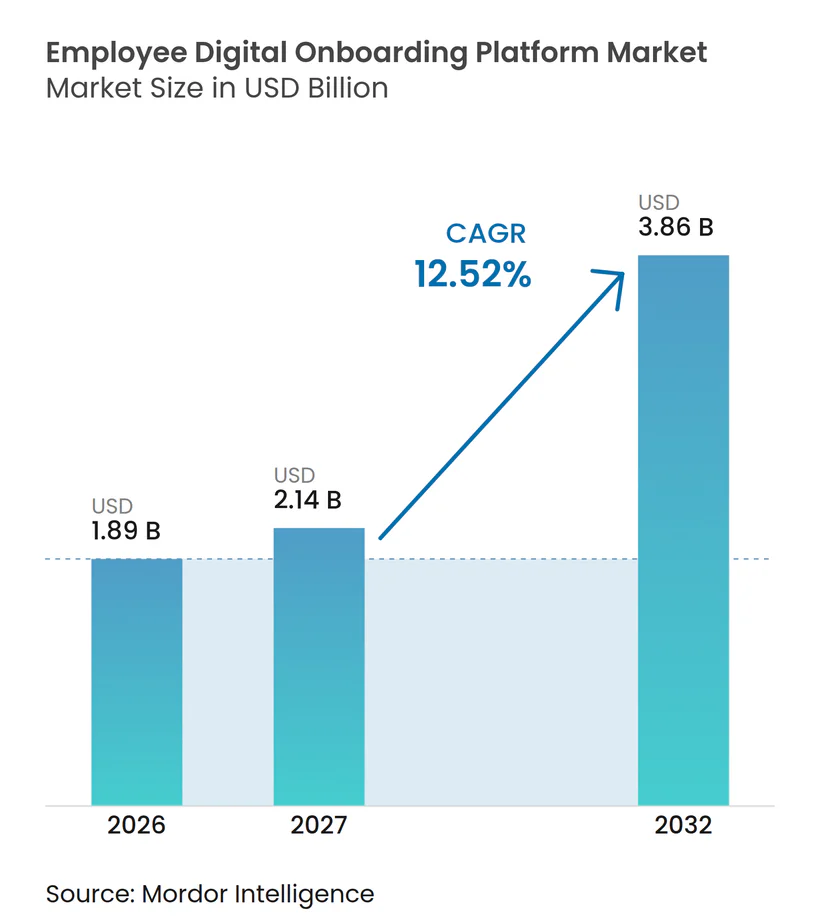
The Employee digital onboarding platform market size is projected to be USD 1.89 billion in 2026, USD 2.14 billion in 2027, and reach USD 3.86 billion by 2032, growing at a CAGR of 12.52% from 2027 to 2032. The Employee digital onboarding platform market is moving away from disconnected forms, email follow-ups, and paper files toward linked workflows that cover pre-boarding, document collection, training, and task coordination across several teams. Digital onboarding is also becoming part of the employee experience because early interactions can shape engagement, the time needed to become productive, the quality of communication with a manager, and an employee’s understanding of workplace expectations. Remote and hybrid work, compliance requirements, and the need for reliable handoffs between HR, IT, managers, payroll, security, and learning teams are increasing the value of connected platforms that show who owns each action. Vendors are responding with configurable workflows, mobile access, analytics, and AI-supported journey design, while buyers are placing more weight on measurable outcomes, integration reliability, security controls, and a clear record of completed employee actions. The Employee digital onboarding platform market, therefore, favors providers that can combine a simple employee experience with secure data handling, practical connections to existing workforce systems, and sufficient flexibility for different locations, roles, and staffing models.
Key Report Takeaways
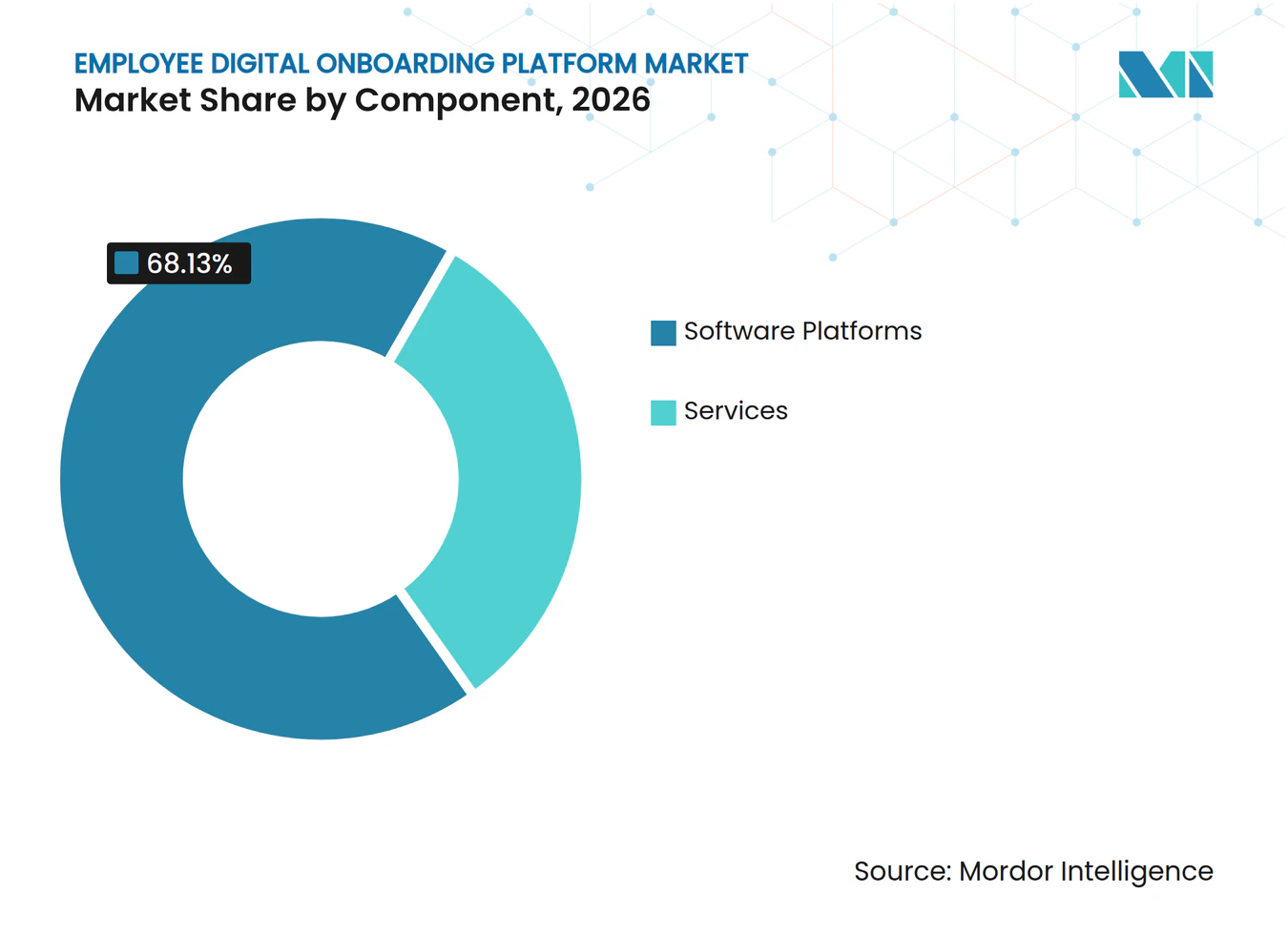
- By component, software platforms held 68.13% of revenue in 2026, while services remained important for implementation, customization, integration support, and compliance guidance when standard workflows did not meet an organization’s operating requirements.
- By deployment model, cloud-based deployment held 73.24% of revenue in 2026, while hybrid deployment is projected to expand at a 13.09% CAGR through 2032 as regulated employers balance accessible workflow coordination with sensitive-data controls.
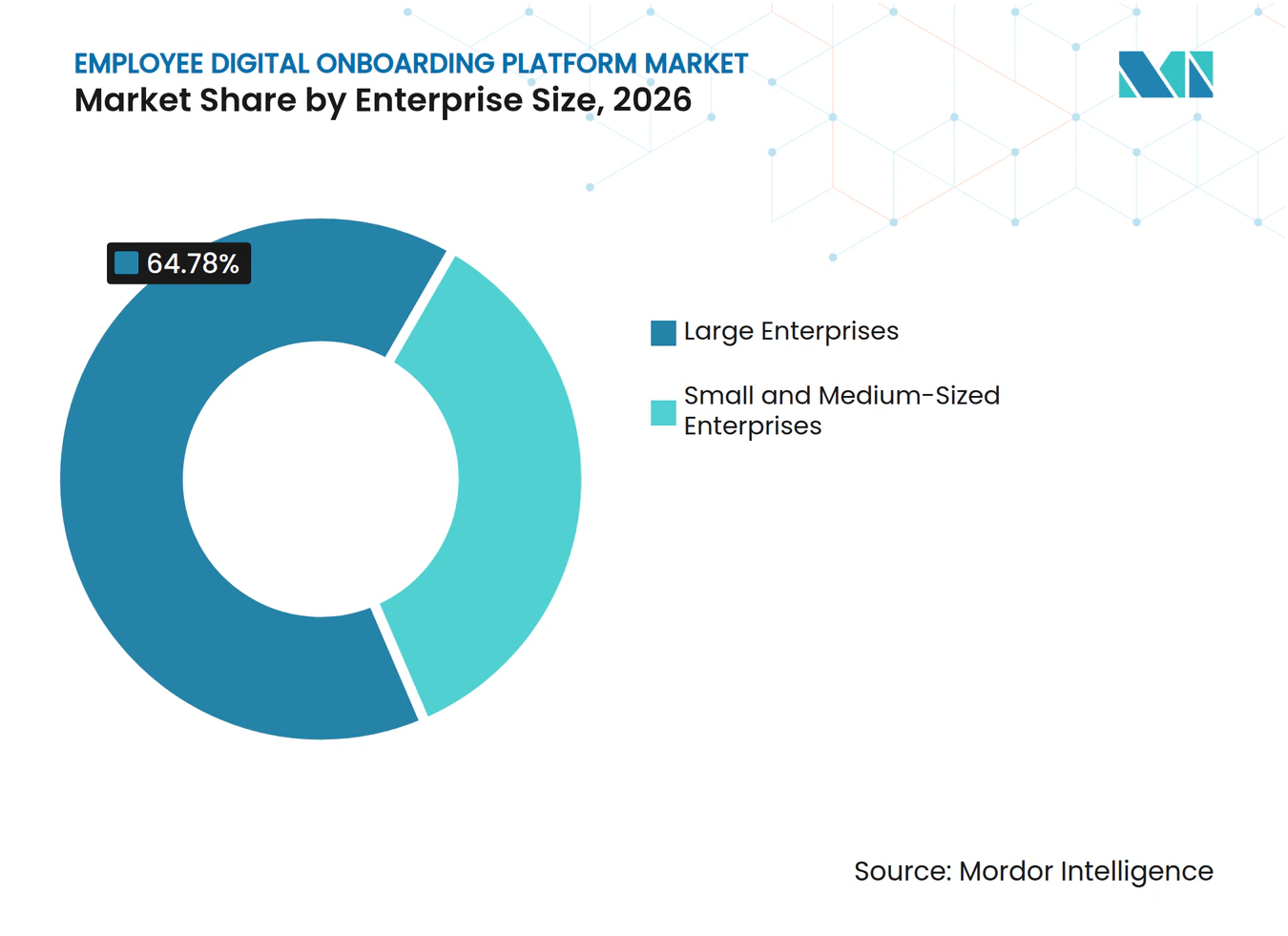
- By enterprise size, large enterprises accounted for 64.78% of revenue in 2026, while SMEs are projected to expand at a 12.89% CAGR through 2032 as smaller employers seek easier setup, reduced administrative work, and more structured employee journeys.
- By end-user industry, IT and telecom held 29.54% of the Employee digital onboarding platform market in 2026, while BFSI is projected to expand at a 14.11% CAGR through 2032 as regulated employers manage training, credentials, licensing, and audit documentation.
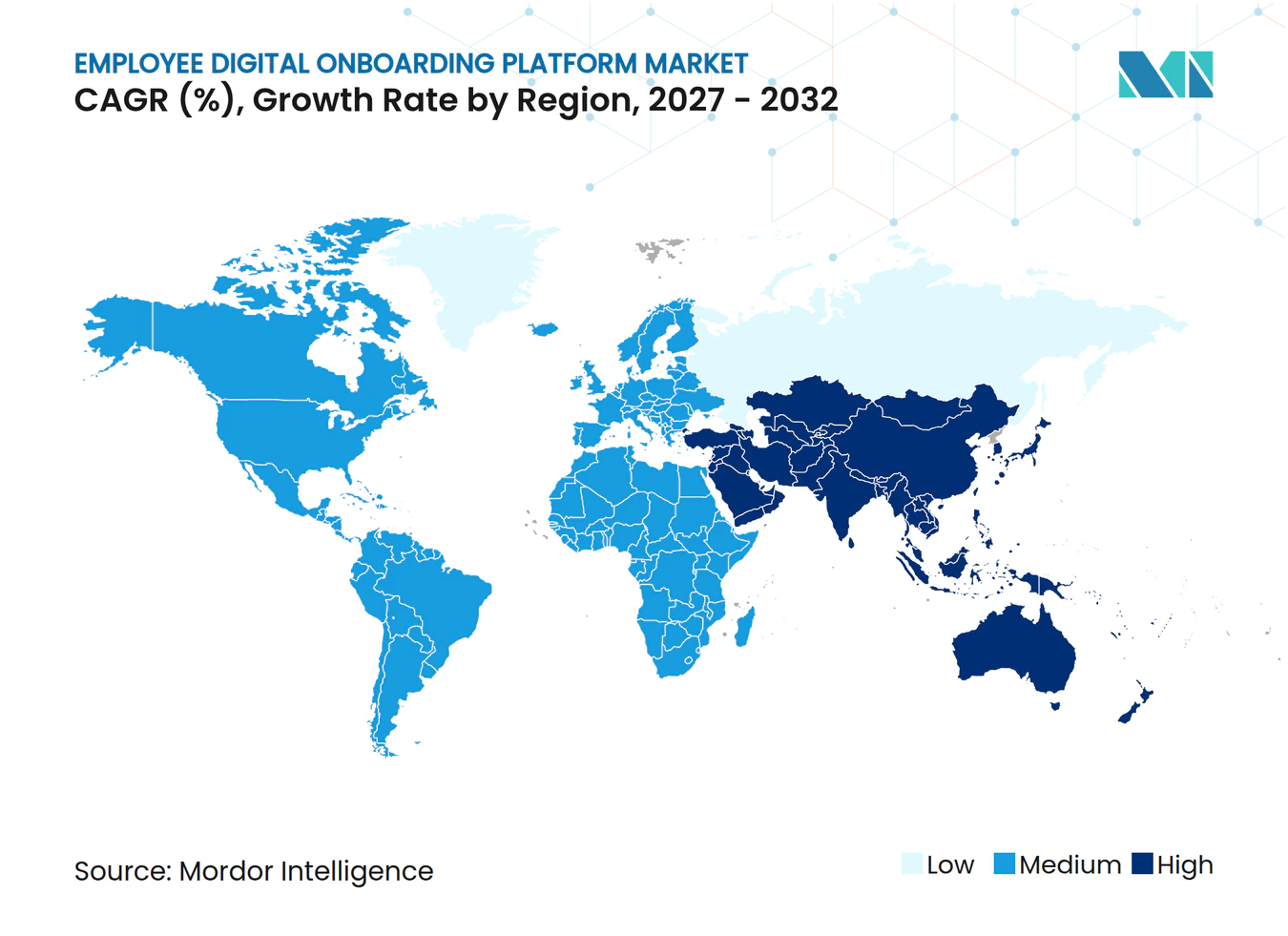
- By geography, North America held 39.69% of revenue in 2026, while Asia-Pacific is projected to expand at a 13.53% CAGR through 2032, supported by workforce digitization, technology employment, and more formal employment processes.
Note: Market numbers in this report are based on Mordor Intelligence's proprietary estimation framework, which combines nine months of actuals with Q4 projections for base year 2026.
Market Trends and Insights
Drivers Impact Analysis of Employee Digital Onboarding Platform Market*
| Driver | (~) % Impact on CAGR Forecast | Geographic Relevance | Impact Timeline |
|---|---|---|---|
| Expansion of Remote and Hybrid Workforces | +2.8% | Global, with the strongest intensity in North America and Western Europe | Medium term (2-4 years) |
| Increasing Demand for Automated HR Workflows | +2.5% | Global, with Asia-Pacific acceleration in financial services and manufacturing | Medium term (2-4 years) |
| Growing Focus on Employee Experience and Early Retention | +2.1% | Global, with the highest urgency in North America and Northern Europe | Short term (≤ 2 years) |
| Rising Compliance Requirements for Workforce Documentation | +1.8% | BFSI, healthcare, and government sectors globally, with the highest regulatory pressure in Europe and North America | Medium term (2-4 years) |
| Mobile-First Onboarding for Frontline and Deskless Workers | +1.5% | Asia-Pacific, South America, Middle East, and Africa, with high-density frontline industries globally | Long term (≥ 4 years) |
| AI-Powered Personalization of New-Hire Journeys | +1.3% | North America and Europe initially, then global | Long term (≥ 4 years) |
| Source: Mordor Intelligence | |||
Expansion of Remote and Hybrid Workforces
In May 2026, 52% of remote-capable U.S. employees worked in hybrid arrangements, while 26% worked exclusively remotely. This sustained pattern has changed the operating conditions for onboarding because HR teams, hiring managers, IT provisioning staff, and new hires often work from different locations and on different schedules. Document collection, equipment coordination, identity checks, access requests, and cultural orientation must therefore proceed asynchronously without compromising accountability. The Employee digital onboarding platform market benefits because a shared system can assign each step, show its status, record its completion, and alert a manager when a required approval or document is missing. Digital processes first introduced for fully remote hiring can also support internal transfers, promotions, reorganizations, and team changes when employees return to an office for only part of the week. This broader use gives employers a reason to create reusable journeys for the employee lifecycle rather than maintaining separate manual processes for each staffing event.
Increasing Demand for Automated HR Workflows
Organizations are seeking to reduce administrative work without making the first weeks of employment feel impersonal or poorly coordinated. The Global Payroll Association reported that data accuracy and timely handoffs between systems remained central causes of onboarding errors in its 2025 survey.[1] Automated routing can begin IT provisioning after HR verification, sequence required learning after a background check, send reminders for unfinished actions, and escalate exceptions to a responsible owner. Enboarder reported that a healthcare IT customer saved USD 1.68 million after using automated workflows and reducing 90-day attrition by 36%. The Employee digital onboarding platform market is supported when buyers view automation as a means to improve employee retention and communication, not merely as a way to reduce manual work. This shifts attention toward products that connect data, workflow decisions, employee messages, and manager responsibilities in a process that can be measured and improved.
Growing Focus on Employee Experience and Early Retention
Early employee exits make recruiting, training, and workload planning harder to manage, which has increased attention on the quality of the first 90 days. Enboarder found that 29% of surveyed HR leaders identified high attrition during the first 90 days as their main onboarding challenge in 2025. The same survey found that 60.8% said early attrition had increased during the preceding 12 months. BambooHR reported that younger employees were more likely to use AI to ask onboarding questions rather than ask a manager, reinforcing the need for accessible, timely information. The Employee digital onboarding platform market is gaining from demand for mobile-friendly support that can provide answers, task guidance, and relevant communications without requiring a new hire to locate the right individual. Products that adapt tasks to role, location, work arrangement, and stage in the journey are better positioned to meet these expectations while providing managers with visibility into where personal support is needed.
Rising Compliance Requirements for Workforce Documentation
Workforce documentation is becoming more demanding as employers navigate varying employment, privacy, and sector-specific rules across locations. The European Commission states that the EU AI Act imposes obligations on high-risk AI systems, including those used in employment-related contexts. The Employee digital onboarding platform market benefits when platforms can apply location-specific document rules, capture approvals, retain audit trails, and provide evidence that a required action was completed at the right point in the process. This is especially important in BFSI, healthcare, and government, where employers may need to show training completion, credential status, or the basis for an employee’s access to controlled information. Digital workflows can also help organizations manage US I-9 re-verification and remote identity verification processes with more consistent ownership and records. Compliance is therefore becoming part of the core product design, rather than a separate administrative task handled after the employee is already hired.
Restraints Impact Analysis of Employee Digital Onboarding Platform Market*
| Restraint | (~) % Impact on CAGR Forecast | Geographic Relevance | Impact Timeline |
|---|---|---|---|
| Integration Complexity Across HR, IT, Payroll, and Learning Systems | -1.8% | Global, most acute in large enterprises with multi-country operations and legacy ERP environments | Medium term (2-4 years) |
| Data Privacy, Sovereignty, and Biometric Compliance Requirements | -1.4% | Europe and Asia-Pacific, with GDPR, EU AI Act, and PIPEDA among key compliance factors | Medium term (2-4 years) |
| Low Digital Readiness Among Small and Medium-Sized Businesses | -0.8% | South America, Middle East, Africa, and fragmented SME markets in Asia-Pacific and Europe | Long term (≥ 4 years) |
| Inconsistent Manager and New-Hire Adoption of Digital Workflows | -0.6% | Global, with the largest gaps in organizations without structured change management programs | Short term (≤ 2 years) |
| Source: Mordor Intelligence | |||
Integration Complexity Across HR, IT, Payroll, and Learning Systems
A platform provides its greatest value when it can coordinate HR information, applicant tracking, IT provisioning, payroll, and learning systems into a single connected process. This is difficult for large organizations that operate across countries, use separate systems by business unit, or continue to rely on legacy enterprise applications. A failed connection can delay access to equipment, create duplicate employee records, leave a compliance file incomplete, or cause a new hire to receive conflicting instructions from several teams. The Employee digital onboarding platform market is constrained when buyers expect a long, resource-intensive implementation that disrupts operations before benefits are visible. Vendors with tested, two-way connectors for major HCM systems can reduce this burden and improve their standing in enterprise buying decisions. Providers that rely on generic connection tools may face longer deployments, greater implementation fatigue, and lower buyer confidence, as buyers need reliable workflows from the first day of employment.
Data Privacy, Sovereignty, and Biometric Compliance Requirements
Employee identity checks can involve sensitive personal information, including biometric data used in face verification or liveness detection. The U.K. Information Commissioner’s Office explains that biometric recognition data requires a lawful basis and, in many cases, additional safeguards under data protection law.[2] Buyers may extend legal, privacy, and security reviews when an onboarding product processes biometric information, transfers data across borders, or stores records in a location that does not comply with internal policy. The Employee digital onboarding platform market can therefore face slower procurement in regulated sectors and public-sector contracts, even when a platform has clear operational value. Regional data residency, configurable consent capture, documented controls, and clear audit records can reduce this friction for employers that need to show how data is used. Vendors that cannot demonstrate these capabilities may lose opportunities in Europe and Canada, where buyers can have more demanding privacy and procurement requirements.
*Our forecasts treat driver/restraint impacts as directional, not additive. The impact forecasts reflect baseline growth, mix effects, and variable interactions.
Employee Digital Onboarding Platform Market Segment Analysis
By Component:
Software Platforms Support Recurring Revenue and DifferentiationSoftware platforms accounted for 68.13% of revenue in 2026, reflecting demand for subscription products that remain embedded in daily HR operations rather than being treated as a one-time implementation project completed after a new system is first installed. The Employee digital onboarding platform market is supported by this model because employers can manage communications, documents, task assignments, reminders, approvals, and reporting from a common environment that can be used by HR teams, managers, IT staff, and new hires. Each completed journey provides information on completion rates, engagement patterns, overdue tasks, and points at which employees disengage from the process or require an additional prompt from a manager. Providers can use that information to improve later journey designs, while customers can identify stages that need clearer ownership, more useful content, better timing, or a more direct escalation path. This creates an ongoing relationship between a customer and the software provider after the initial configuration is complete, rather than limiting the product to a brief administrative task at the start of employment.
Services represented a smaller portion of revenue, but remain necessary when customers require configuration, change support, integration work, or advice on local compliance needs that cannot be handled through a standard template. Large organizations often need a partner to adapt the product to internal approvals, regional hiring practices, separate legal entities, and systems already used by HR, payroll, IT, security, and learning teams. The Society for Human Resource Management found that 87% of organizations using AI in HR reported efficiency improvements and 75% reported better work quality. This evidence supports demand for products that demonstrate practical operational benefits, such as clearer workflow ownership and more consistent employee communication, rather than simply offering a new interface or a longer list of features. Providers are embedding generative AI tools that can turn policy documents into initial workflow templates, which can reduce work once delivered through services, although specialist assistance remains important when large employers need processes tested before use.


By Deployment Model:
Cloud Leads Adoption While Hybrid Supports Sensitive Data NeedsCloud-based deployment accounted for 73.24% of revenue in 2026, supported by faster setup, simpler scaling during periods of rapid hiring, reduced internal infrastructure demands, and the ability to maintain a common experience across locations. The Employee digital onboarding platform market uses cloud-based delivery to provide remote and mobile employees with a consistent entry point for documents, communications, training, and assigned tasks, without requiring local software installation or access to a corporate office. Subscription delivery can provide regular feature updates, security improvements, and product enhancements without a full internal upgrade program, which can be difficult to coordinate across a large organization. It also enables providers to maintain common product standards while customers configure workflows for their own policy, staffing, location, and employee-group requirements. This approach is well-suited to employers who need to begin new-hire communications before an employee has access to internal systems and before equipment or credentials are issued.
On-premises deployment remains relevant for defense contractors, nuclear utilities, national intelligence agencies, and other organizations that require tightly controlled information environments and limited movement of sensitive employee records. Hybrid deployment is projected to expand at a 13.09% CAGR through 2032, the fastest rate among deployment types. Hybrid designs can place journey coordination in the cloud while retaining identity records, government IDs, biometric templates, and payroll information in a private or local environment under the employer’s preferred controls. This structure can address data residency expectations while preserving a modern digital experience for managers and new hires, who may still need to complete actions through a simple mobile or browser interface. It is especially relevant for European employers managing GDPR obligations and AI governance requirements, for whom a hybrid design can be a deliberate architectural choice rather than an interim compromise.
By Enterprise Size:
Large Enterprises Sustain Spending While SMEs Expand AdoptionLarge enterprises accounted for 64.78% of revenue in 2026 because multi-country hiring, larger technology budgets, more detailed compliance requirements, and the need to serve many employee groups drive higher platform spending. The Employee digital onboarding platform market benefits from these buyers because a platform can become integrated with established HR, payroll, IT, security, and learning processes that would otherwise require separate manual coordination. Large organizations often use multiyear agreements that include integration work, dedicated customer support, custom workflow design, and assistance for business units with different operating needs. Such contracts can provide more predictable revenue for specialist providers and broader HCM suite vendors, while also making reliable product performance a key factor in renewals. They also make consistency essential, since the same employer may need different workflows across offices, legal entities, worker categories, countries, and managers, without sacrificing a common standard for oversight.
SMEs are projected to expand at a 12.89% CAGR through 2032. The OECD found that 22% of firms remained at a basic level of digital maturity, while 39% cited maintenance costs and 38% cited a lack of training time as barriers to adopting digital tools.[3] These constraints mean smaller employers need products that are affordable, quick to configure, easy to explain, and clear enough to use without a large HR technology team or extensive technical support. They also need enough capability to manage local employment requirements, guide managers with limited time for training, and provide employees with a clear record of what must be completed. Providers are using prebuilt templates, no-code journey builders, and AI-supported setup tools to reduce that burden, although limited budgets and low digital readiness can still reduce conversion and increase customer churn.

By End-User Industry:
IT and Telecom Leads While BFSI Has the Fastest OutlookIT and telecom accounted for 29.54% of revenue in 2026, supported by frequent hiring, distributed teams, and a workforce that is generally comfortable using digital workplace tools for communication, training, and task management. These conditions reduce change-management effort because employees are accustomed to accessing information, collaborating across locations, and completing role-related steps through software rather than relying solely on in-person guidance. Technology employers still need reliable coordination when new staff receive systems access, security training, hardware, credentials, and role-specific information from different internal teams. The Employee digital onboarding platform market has a strong base in this sector because connected workflows can support global hiring, frequent organizational changes, and the need to create a consistent first-day experience for technical employees. The sector also allows providers to demonstrate integration, analytics, personalization, and secure workflow capabilities in a demanding operational setting.
BFSI is projected to expand at a 14.11% CAGR through 2032, as banks, insurers, and other financial organizations need to document training, licensing, competency checks, and anti-money laundering controls in a timely and traceable way. These requirements make onboarding a recurring compliance process rather than a simple HR checklist completed during an employee’s first week, especially when roles have different access permissions or regulatory responsibilities. Platforms can issue reminders, record completion, retain supporting evidence, and adapt task sequences for different roles, legal entities, locations, and local rules without requiring each process to be rebuilt from scratch. Healthcare and life sciences also require structured approaches to credential checks, HIPAA training, and controlled-substance procedures, while retail, e-commerce, manufacturing, energy, transportation, logistics, and government have varying readiness levels. Government deployments may take longer to procure, yet multiyear contracts can create durable demand after implementation and make dependable audit records a meaningful product advantage.
Geography Analysis
North America Employee Digital Onboarding Platform Market
North America held 39.69% of revenue in 2026, making it the largest regional contributor to the Employee digital onboarding platform market and reflecting a mature base of enterprise software buyers. Established SaaS purchasing practices, widespread hybrid work, and dispersed workforces make location-independent onboarding more important for employers that want a consistent process across offices and home-based staff. U.S. employers also manage employment eligibility requirements, electronic I-9 verification, and growing state-level scrutiny of biometric information, which increases the value of auditable digital records with clear ownership. The United States accounts for the largest share of regional demand, while Canada requires platforms that can accommodate provincial employment rules, bilingual documentation, and the expanding needs of small businesses. Mexico offers a further opportunity as near-shoring supports manufacturing and service-sector hiring, increasing demand for more structured employee documentation, provisioning, and orientation processes.
Europe and South America Employee Digital Onboarding Platform Market
Europe is the second-largest geography for the Employee digital onboarding platform market, with the United Kingdom, Germany, France, Italy, Spain, and the Netherlands among the main revenue contributors. German mid-market employers are replacing manual onboarding with compliant digital processes while managing works council expectations, remote-work policies, and the need to keep employee communications clear and consistent. The European Commission identifies employment-related AI systems as an area covered by the EU AI Act’s risk-based rules. GDPR and AI governance requirements can encourage investment in capable platforms while raising expectations for data residency, consent management, documented oversight, privacy assessments, and a clear account of how employee information is handled. South America, led by Brazil and Argentina, is a developing opportunity where adoption is concentrated among multinational subsidiaries and technology employers that are formalizing digital employment processes and managing complex labor-code requirements.
APAC, Middle East and Oceania Employee Digital Onboarding Platform Market
Asia-Pacific is projected to expand at a 13.53% CAGR through 2032, making it the fastest-growing geographic area for the Employee digital onboarding platform market. India’s expanding technology workforce, Southeast Asia’s greater formalization of employment relationships, and China’s large enterprise digitization programs support the regional outlook, particularly where organizations are bringing more employee records and operational processes into digital systems. Japan and South Korea are increasing HR technology investment as labor costs and demographic pressures raise the need for stronger productivity, faster employee integration, and more reliable communication during the first months of employment. Australia and New Zealand have established HR technology environments and strong expectations for Fair Work documentation, while Saudi Arabia and the United Arab Emirates are supported by workforce nationalization programs that require structured hiring and records.
Competitive Landscape
Market Concentration
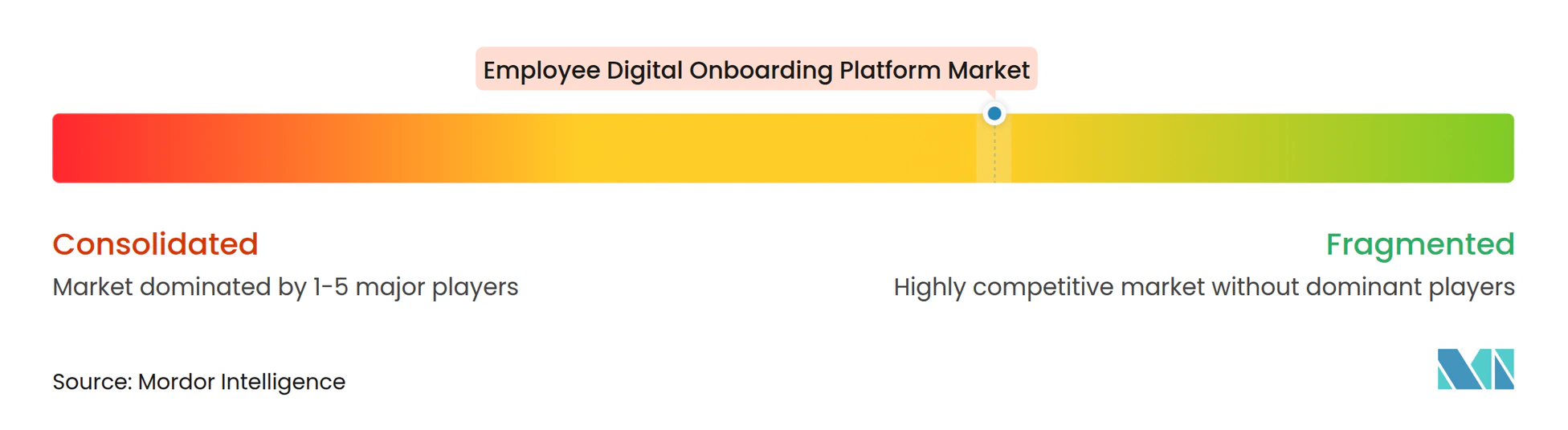
The Employee digital onboarding platform market is moderately fragmented among purpose-built providers, with no combined leading-vendor share available in the supplied evidence. Enboarder, Talmundo, Click Boarding, WorkBright, Appical, Sapling HR, and Leapsome compete through experience design, integration breadth, mobile capability, role-specific communications, and AI-enabled workflow design. Broader HR providers, including Employment Hero and Factorial, are also extending onboarding capabilities from adjacent HR, payroll, and workforce-management products, which lets them offer customers a connected employee-data environment. This places pressure on specialists because suite providers can tie onboarding to familiar administrative processes and leverage existing customer relationships to expand their product footprint. The Employee digital onboarding platform market still leaves room for focused vendors that provide a more tailored experience or deeper support for a regulated, high-volume, or mobile workforce use case.
A central strategy is to connect recruiting and onboarding data so that a candidate’s accepted offer can initiate the appropriate employee journey without manual data transfer between systems or duplicate data entry. Enboarder and SmartRecruiters announced a partnership in September 2025 to link offer acceptance with AI-powered onboarding and enablement journeys. Leapsome launched a unified AI HR platform in July 2026 that combined recruiting, onboarding, performance, engagement, learning, and compensation into a single people-data foundation.[4] Factorial announced a USD 150 million Series D round in September 2026 at a USD 2.5 billion valuation and described an AI workforce operations platform that reshaped product architecture and customer workflows. These moves show that competing providers are seeking a broader role in the HR technology stack, including the data and processes that occur before and after a formal onboarding journey.
Specialized opportunities remain in government, healthcare credentialing, and frontline or deskless workforces, where generic systems may not provide sufficient depth of compliance, local flexibility, or simplicity for everyday users. Mobile access, role-specific content, local document requirements, and dependable manager workflows can help a provider stand apart in these settings, especially when hires have limited desk access or must complete regulated steps quickly. The Employee digital onboarding platform market also rewards vendors that make AI controls visible through approval steps, activity logs, human oversight, and clear limits on actions involving sensitive employee information. No combined share for the leading vendors is available, so a numerical market concentration score cannot be assigned without creating unsupported data.
Employee Digital Onboarding Platform Industry Leaders
-
Enboarder Pty Ltd
-
Click Boarding, LLC
-
WorkBright, LLC
-
Appical B.V.
-
Talentech
- *Disclaimer: Major Players sorted in no particular order
Employee Digital Onboarding Platform Market Companies Covered in this Report
- Enboarder Pty Ltd
- Talentech
- Click Boarding, LLC
- WorkBright, LLC
- HROnboard Pty Ltd
- Appical B.V.
- Onboarded Ltd
- EMP Trust Solutions, LLC
- Xpand.io, Inc.
- Trainual, Inc.
- Sapling HR, Inc.
- Zavvy GmbH
- Leapsome GmbH
- HR-ON ApS
- Valamis Group Oy
- Factorial HR, S.L.
- Teamtailor AB
- WorkMotion Software GmbH
- Employment Hero Pty Ltd.
- Greenhouse Software, Inc.
Recent Industry Developments in Employee Digital Onboarding Platform Market
- October 2026: Factorial HR and WorkMotion formalized an expanded global employment partnership, enabling seamless handoffs between Factorial's HR management workflows and WorkMotion's employer-of-record onboarding infrastructure across more than 160 countries, targeting mid-market enterprises managing distributed international teams.
- September 2026: Factorial HR announced the close of a USD 150 million Series D funding round at a USD 2.5 billion valuation, led by General Catalyst with participation from Atomico and Four Rivers. The round also included a commitment of up to an additional USD 540 million through General Catalyst's Customer Value Fund, bringing total committed capital to over USD 700 million. Factorial said it was opening a corporate office in Munich to accelerate its Germany expansion, which it cited as its fastest-growing international market.
- July 2026: Leapsome launched a unified AI HR platform consolidating recruiting, onboarding, performance, engagement, learning, and compensation into a single people data foundation. The release included five EU AI Act-compliant, EU-hosted AI agents, a new applicant tracking system in early access, and Model Context Protocol connectivity. Leapsome stated the platform was ISO 27001-certified and GDPR-compliant, with every agent action logged and human sign-off required for sensitive decisions.
- June 2026: Greenhouse Analytics reached open beta, introducing calculated fields, global dashboard filters, an AI chart builder, and expanded data coverage including approvals and scorecards. Customers who had joined the waitlist between June 2025 and May 2026 were automatically enrolled.
Global Employee Digital Onboarding Platform Market Report Scope
The Employee Digital Onboarding Platform Market comprises software platforms and associated services that enable organizations to digitize, automate, and manage employee onboarding processes, from pre-boarding and document collection to employee data verification, policy acknowledgment, training, and integration with human resource management systems. These solutions help organizations streamline onboarding workflows, improve operational efficiency, enhance the new-hire experience, ensure compliance with organizational policies and regulatory requirements, and facilitate seamless integration of employees into the workplace.
The Employee Digital Onboarding Platform Report is Segmented by Component (Software Platforms, and Services), Deployment Model (Cloud-Based, On-Premises, and Hybrid), Enterprise Size (Large Enterprises, and Small and Medium-Sized Enterprises), End-User Industry (BFSI, Healthcare and Life Sciences, IT and Telecom, Retail and E-commerce, Industrial Manufacturing, Government and Public Sector, Energy and Utilities, and Transportation and Logistics), and Geography (North America, South America, Europe, Asia-Pacific, Middle East, and Africa). The Market Forecasts are Provided in Terms of Value (USD).
Segmentation Overview
| Software Platforms |
| Services |
| Cloud-Based |
| On-Premises |
| Hybrid |
| Large Enterprises |
| Small and Medium-Sized Enterprises |
| BFSI |
| Healthcare and Life Sciences |
| Information Technology and Telecom |
| Retail and E-commerce |
| Industrial Manufacturing |
| Government and Public Sector |
| Energy and Utilities |
| Transportation and Logistics |
| North America | United States |
| Canada | |
| Mexico | |
| South America | Brazil |
| Argentina | |
| Rest of South America | |
| Europe | United Kingdom |
| Germany | |
| France | |
| Italy | |
| Spain | |
| Netherlands | |
| Rest of Europe | |
| Asia-Pacific | China |
| Japan | |
| India | |
| South Korea | |
| Australia and New Zealand | |
| Rest of Asia-Pacific | |
| Middle East | Saudi Arabia |
| United Arab Emirates | |
| Rest of Middle East | |
| Africa | South Africa |
| Nigeria | |
| Rest of Africa |
| By Component | Software Platforms | |
| Services | ||
| By Deployment Model | Cloud-Based | |
| On-Premises | ||
| Hybrid | ||
| By Enterprise Size | Large Enterprises | |
| Small and Medium-Sized Enterprises | ||
| By End-User Industry | BFSI | |
| Healthcare and Life Sciences | ||
| Information Technology and Telecom | ||
| Retail and E-commerce | ||
| Industrial Manufacturing | ||
| Government and Public Sector | ||
| Energy and Utilities | ||
| Transportation and Logistics | ||
| By Geography | North America | United States |
| Canada | ||
| Mexico | ||
| South America | Brazil | |
| Argentina | ||
| Rest of South America | ||
| Europe | United Kingdom | |
| Germany | ||
| France | ||
| Italy | ||
| Spain | ||
| Netherlands | ||
| Rest of Europe | ||
| Asia-Pacific | China | |
| Japan | ||
| India | ||
| South Korea | ||
| Australia and New Zealand | ||
| Rest of Asia-Pacific | ||
| Middle East | Saudi Arabia | |
| United Arab Emirates | ||
| Rest of Middle East | ||
| Africa | South Africa | |
| Nigeria | ||
| Rest of Africa | ||
Key Questions Answered in the Report
What is the size of the employee digital onboarding platform market?
The Employee digital onboarding platform market size is projected to be USD 1.89 billion in 2026 and USD 2.14 billion in 2027. It is projected to reach USD 3.86 billion by 2032 at a 12.52% CAGR, supported by more connected workflows for documents, training, task assignment, and communication.
What is driving demand for digital employee onboarding platforms?
Remote and hybrid work, automated HR workflows, early retention priorities, and workforce documentation requirements are supporting demand for connected onboarding processes. Employers also need reliable coordination among HR, IT, managers, payroll, security, learning teams, and employees working in different locations.
Which deployment model is used most widely for employee onboarding?
Cloud-based deployment held 73.24% of revenue in 2026 because it supports faster setup, scaling, regular updates, and accessible workflows for distributed teams. Hybrid deployment has the fastest outlook because it can combine cloud-based journey coordination with tighter control over sensitive employee and identity information.
Which end-user sector has the fastest outlook?
BFSI is projected to expand at a 14.11% CAGR through 2032 as employers manage training, licensing, employee credentials, and audit documentation requirements. These needs make onboarding an ongoing compliance workflow, rather than only a first-week HR activity, for many financial-services roles.
Which region has the fastest outlook for onboarding platforms?
Asia-Pacific is projected to expand at a 13.53% CAGR through 2032, supported by technology employment, formalization of work, enterprise digitization programs, and rising need for structured employee documentation. The Employee digital onboarding platform market also benefits from demand for mobile-friendly processes in workforces that include deskless or distributed employees.
How do data privacy requirements affect onboarding platform selection?
Employers increasingly look for data residency, consent management, audit records, secure identity verification, and human oversight when sensitive employee information is involved. These requirements can lengthen security and legal reviews, especially in regulated sectors, while creating an advantage for providers that can show documented controls.