
Electric Commercial Boiler Market Size and Share
Market Overview
| Study Period | 2025 - 2032 |
|---|---|
| Market Size (2027) | USD 2.57 Billion |
| Market Size (2032) | USD 3.93 Billion |
| Growth Rate (2027 - 2032) | 11.19 % |
| Fastest Growing Market | Asia-Pacific |
| Largest Market | North America |
| Market Concentration | Medium |
Major Players *Disclaimer: Major Players sorted in no particular order Image © Mordor Intelligence. Reuse requires attribution under CC BY 4.0. | |
Electric Commercial Boiler Market Analysis by Mordor Intelligence
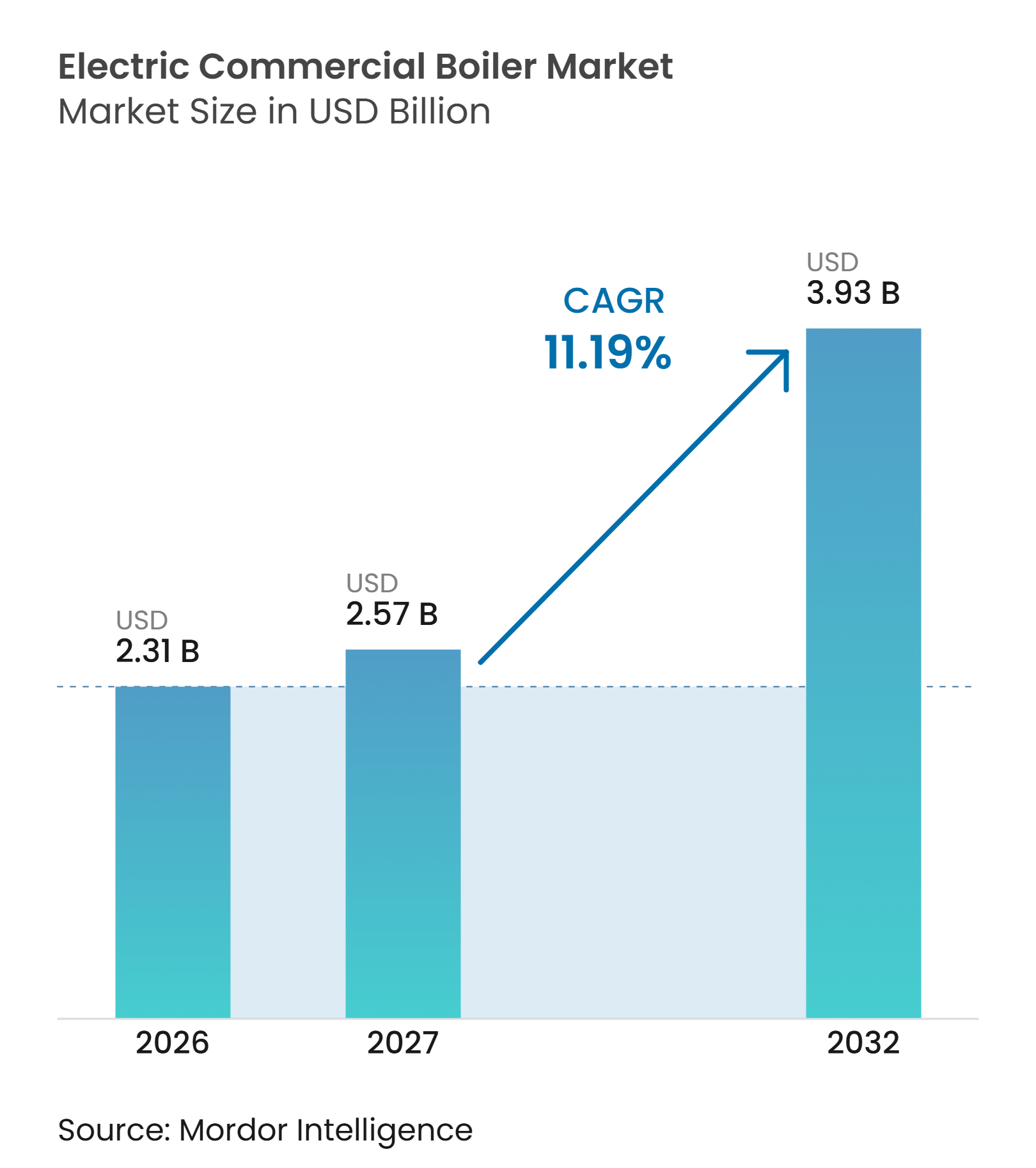
The Electric Commercial Boiler Market size is projected to expand from USD 2.31 billion in 2026 and USD 2.57 billion in 2027 to USD 3.93 billion by 2032, registering a CAGR of 11.19% between 2027 and 2032.
The electric commercial boiler market is being shaped by building decarbonization programs, tighter limits on onsite combustion, and greater demand for heating equipment that can use renewable electricity. Commercial property owners are also weighing the cost of carbon compliance and the risk that gas-fired systems become harder to operate under future building rules. Equipment suppliers are responding with modular units, controls that link to building management systems, and products designed for retrofits with limited boiler-room space. The electric commercial boiler market also benefits where operators can combine boilers with thermal storage and use flexible electricity demand to support the grid.
Key Report Takeaways
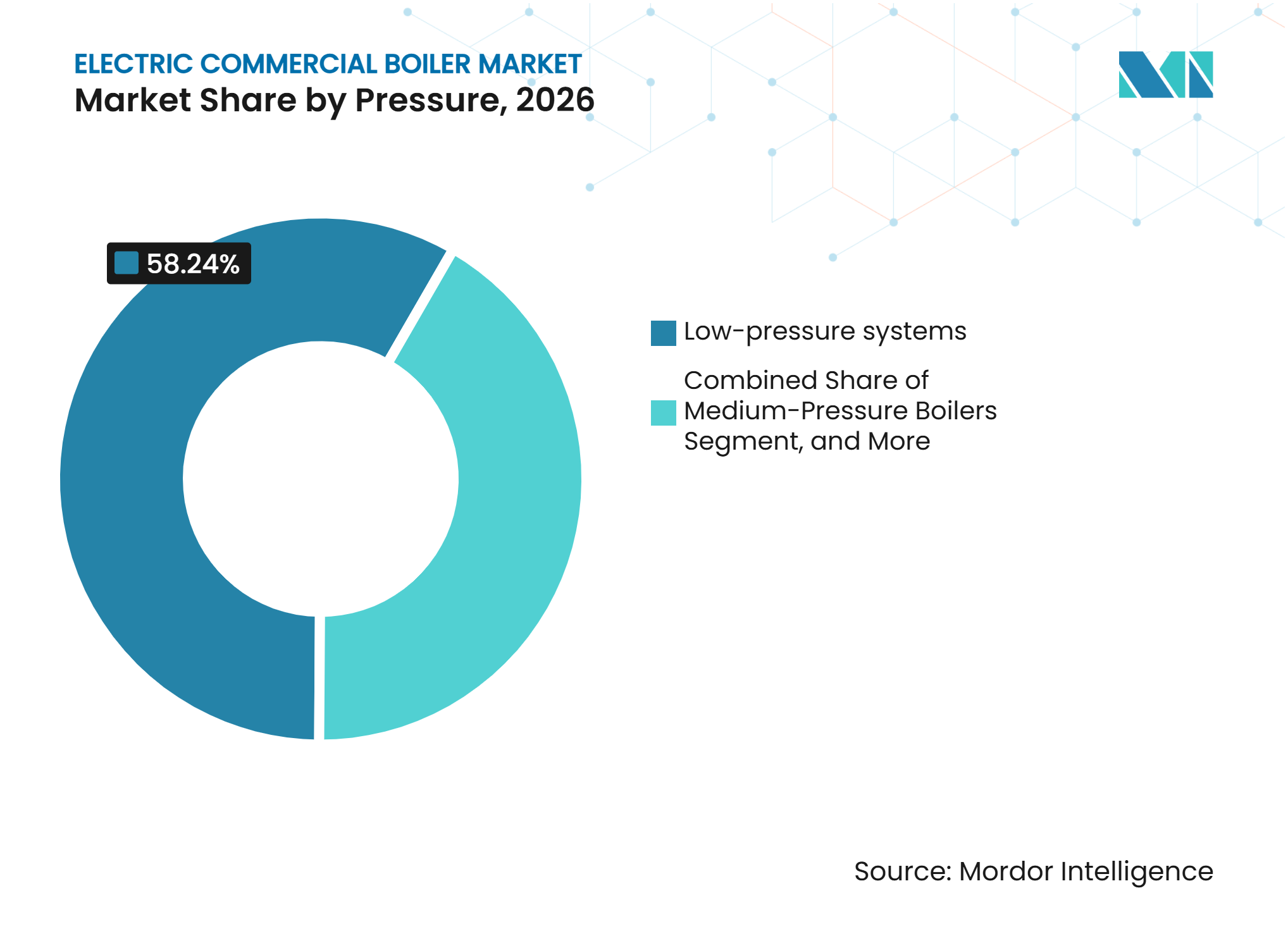
- By pressure, low-pressure boilers held 58.24% of the electric commercial boiler market share in 2026, while medium-pressure boilers are projected to expand at a CAGR of 12.13% through 2032.
- By stage and configuration, single-stage systems held 64.17% of the electric commercial boiler revenue share in 2026, while multistage systems are projected to expand at a CAGR of 11.82% through 2032.
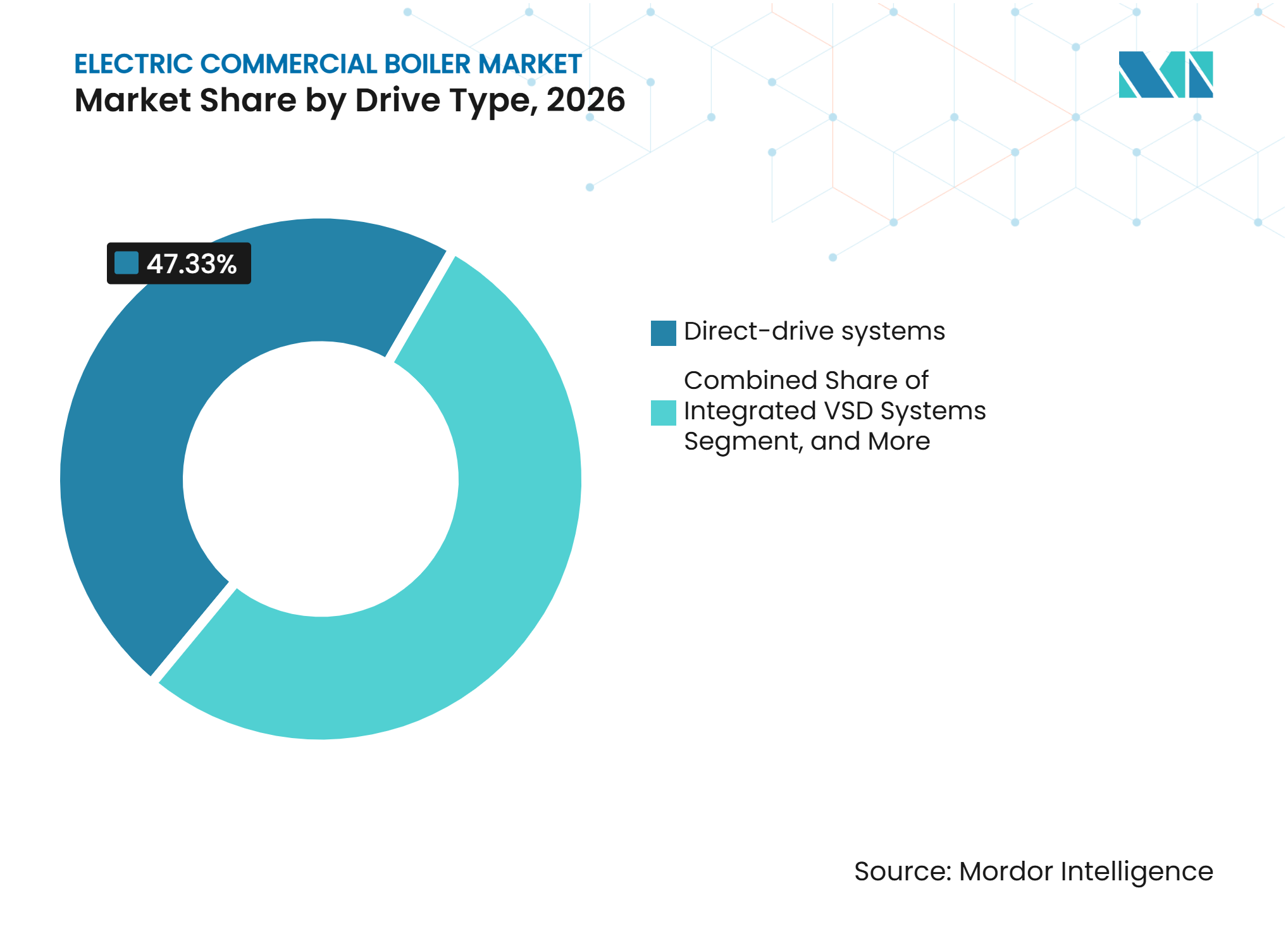
- By drive type, direct-drive systems held 47.33% of the electric commercial boiler revenue share in 2026, while integrated VSD systems are projected to expand at a CAGR of 12.41% through 2032.
- By end-use industry, HVAC and commercial buildings held 42.07% of the electric commercial boiler revenue share in 2026, while water and wastewater treatment is projected to expand at a CAGR of 12.62% through 2032.
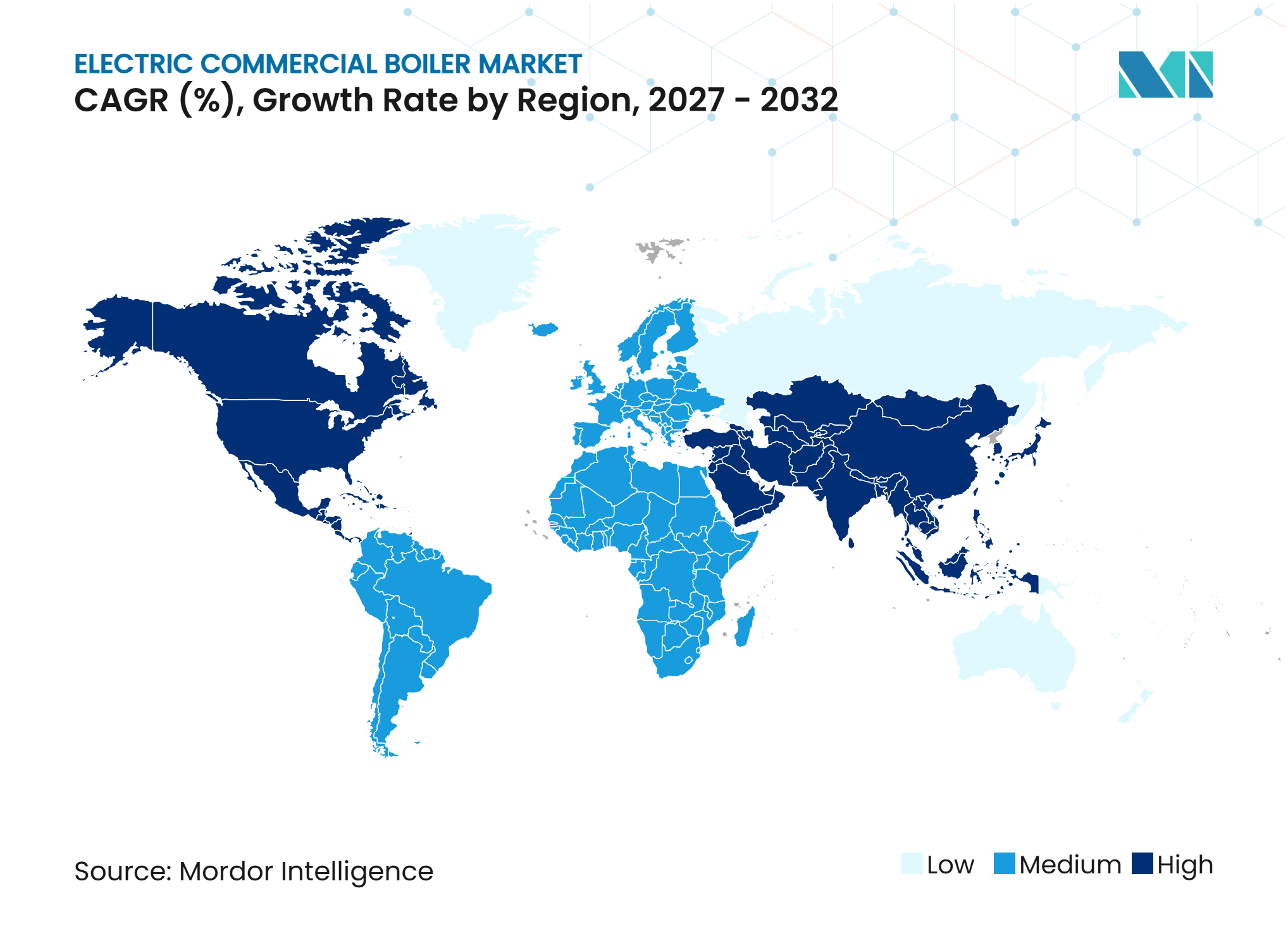
- By geography, North America held 34.11% of the electric commercial boiler market share in 2026, while Asia-Pacific is projected to expand at a CAGR of 12.43% through 2032.
Note: Market numbers in this report are based on Mordor Intelligence's proprietary estimation framework, which combines nine months of actuals with Q4 projections for base year 2026.
Market Trends and Insights
Drivers Impact Analysis of Electric Commercial Boiler Market*
| Driver | (~) % Impact on CAGR Forecast | Geographic Relevance | Impact Timeline |
|---|---|---|---|
| Decarbonization of Commercial Heating | +3.2% | Global | Short term (≤ 2 years) |
| Stricter Emissions and Building Performance Rules | +2.5% | North America and Europe | Short term (≤ 2 years) |
| Renewable Power and Grid-Interactive Heating | +2.1% | Europe and Asia-Pacific | Medium term (2-4 years) |
| Commercial Building and Healthcare Infrastructure Expansion | +1.7% | Asia-Pacific and North America | Medium term (2-4 years) |
| Rapid-Startup and Modular Steam Requirements | +1.0% | Global | Medium term (2-4 years) |
| Electrification of Legacy Boiler Rooms | +0.7% | Europe and North America | Long term (≥ 4 years) |
| Source: Mordor Intelligence | |||
Decarbonization of Commercial Heating
Commercial heating is moving toward electric equipment as property owners work to reduce direct emissions from their buildings. This shift supports demand in the electric commercial boiler market, where existing gas systems face higher compliance costs and future replacement risks. Electric resistance boilers can be technically suitable for low-temperature industrial heat, particularly when electricity prices and operating patterns support electrification. The electric commercial boiler market can also benefit when owners use hybrid boiler arrangements as a staged transition away from combustion rather than replacing all systems simultaneously. Real estate owners with emissions targets also have an incentive to address heating systems before regulations require changes. This creates an opportunity for suppliers that can provide site assessments, controls, service, and financing support alongside boiler hardware.
Stricter Emissions and Building Performance Rules
Building regulations are changing equipment choices in new commercial projects and major renovations. The Energy Performance of Buildings Directive required European Union member states to discontinue financial incentives for standalone fossil fuel boilers effective January 1, 2025. In the United States, Denver's 2025 Energy Code requires electric-ready infrastructure for specified new commercial and multifamily boiler applications.[1] New York City Local Law 154 sets emissions limits for combustion equipment in new buildings beginning in July 2027. These measures provide the electric commercial boiler market with a clearer project pipeline, even when buildings install electric-ready equipment before replacing their boilers. Manufacturers offering pre-certified packages can reduce permitting requirements and help contractors manage changing local code requirements.
Renewable Power and Grid-Interactive Heating
Electric boilers can convert surplus electricity into useful heat when paired with thermal storage and responsive controls. Electric boilers and heat storage can reduce wind-power curtailment and lower district-heating production costs in Nordic systems. Electric boilers can also participate in grid-flexibility arrangements. This capability adds a use case beyond direct fuel substitution in the electric commercial boiler market. It can support demand-response revenue where market rules and metering arrangements allow participation. Suppliers that integrate controls, storage, and operating software may therefore compete based on operating value rather than boiler capacity alone.
Commercial Building and Healthcare Infrastructure Expansion
New healthcare, hospitality, education, and commercial projects create demand for systems designed around electric heating from the outset. Hospitals and clinics require reliable steam and hot water for sterilization, HVAC, and other essential services while managing on-site emissions and noise. Cleaver-Brooks introduced its LVR electric hydronic boiler for healthcare, university, hospitality, and multifamily applications, with a compact platform rated from 90 kW to 540 kW.[2] This product example demonstrates the relevance of modular equipment for new projects and space-constrained retrofits. Construction activity in commercial districts can therefore create demand that does not depend on replacing an existing gas boiler. The electric commercial boiler market is likely to benefit most where project developers can plan electrical capacity, space, and controls during the design phase.
Restraints Impact Analysis of Electric Commercial Boiler Market*
| Restraint | (~) % Impact on CAGR Forecast | Geographic Relevance | Impact Timeline |
|---|---|---|---|
| High Electricity Cost Relative to Gas in Some Markets | -1.4% | Global, except Nordic markets | Short term (≤ 2 years) |
| Grid Capacity and Electrical-Interconnection Constraints | -1.0% | Europe, Asia-Pacific, and North America | Medium term (2-4 years) |
| High-Voltage Safety, Permitting, and Skilled-Service Requirements | -0.7% | Global | Short term (≤ 2 years) |
| Limited Electrification Suitability for High-Temperature and Peak-Load Duties | -0.5% | Global | Long term (≥ 4 years) |
| Source: Mordor Intelligence | |||
High Electricity Cost Relative to Gas in Some Markets
Operating cost remains a central barrier where retail electricity prices are materially higher than natural gas prices. The economics of electric boilers depend on local power prices, carbon costs, and the ability to operate flexibly. Demand charges and capacity charges can further weaken a project's business case when a facility adds a large electric load. These conditions limit the electric commercial boiler market in locations where operators cannot secure favorable tariffs or use off-peak electricity. Hybrid configurations can reduce exposure by using electricity at selected times while retaining another heat source for peak demand. This restraint increases the value of suppliers that can model tariffs, controls, storage, and the full operating schedule for a customer site.
Grid Capacity and Electrical-Interconnection Constraints
Grid access can delay projects even when the owner has an approved electrification plan. By mid-2025, grid-connection queues existed in at least 16 European Union member states, with some industrial projects facing waits of 2 to 10 years. A boiler replacement may also require a new transformer, switchgear, or substation upgrade, adding cost and time. The constraint affects the electric commercial boiler market most strongly in dense commercial districts and industrial zones with limited spare capacity. Developers can reduce delays by assessing connection needs before final equipment selection. European Union grid investment plans may improve conditions over time, but available local capacity remains the deciding factor for many near-term installations.
*Our forecasts treat driver/restraint impacts as directional, not additive. The impact forecasts reflect baseline growth, mix effects, and variable interactions.
Electric Commercial Boiler Market Segment Analysis
By Pressure:
Low-Pressure Systems Lead Installed Demand While Medium-Pressure Units AdvanceLow-pressure systems held 58.24% of electric commercial boiler revenue in 2026. Their position reflects broad use in space heating, domestic hot water, and low-pressure steam applications across commercial buildings. These systems are suitable for many retrofit projects because they can connect with existing hot-water distribution systems while eliminating combustion-air and flue-related requirements from the boiler room. Hot-water boiler systems serve a substantial share of commercial building floor area in the United States, demonstrating the scale of the addressable retrofit base.[3] Low-pressure units are particularly relevant in the electric commercial boiler market for property owners seeking to reduce direct heating emissions without replacing all downstream heating components.
Medium-pressure boilers are projected to expand at a 12.13% CAGR through 2032. The electric commercial boiler market size for this category is supported by water and wastewater treatment, pharmaceutical, food processing, and light industrial users that require process steam. A 2025 study found that combining a 100 kW heat pump with a 150 kW electric boiler in a municipal wastewater treatment application reduced carbon dioxide emissions by 98.1%, reduced operating costs by 74%, and achieved a 6.55-year payback period. High-pressure systems remain smaller because their users face greater exposure to electricity pricing and connection requirements, although electrode boiler technology continues to serve heavy industrial and district heating applications. The pressure category requires different sales approaches because building heating projects prioritize integration and simplicity, while process-steam projects place greater emphasis on electrical engineering and production reliability.



By Stage and Configuration:
Single-Stage Systems Retain Scale as Multistage Designs Gain UseSingle-stage systems held 64.17% of the electric commercial boiler revenue share in 2026. These designs use straightforward resistance heating and suit common commercial hot-water and low-temperature steam applications, while fewer components can simplify controls and reduce installation space requirements. Cleaver-Brooks' LVR platform and the Sussman EWx series illustrate how suppliers use modular designs to serve facilities with space limitations. Electric resistance boilers can achieve thermal efficiency of up to 99%, compared with 75% to 85% for conventional gas boilers. This efficiency advantage does not eliminate power-cost concerns, but it supports the case for simple, compact systems in suitable applications.
Multistage systems are projected to expand at a 11.82% CAGR through 2032. They allow facilities to stage heat output across changing loads and can support thermal buffering or tighter steam management. Food processing, pharmaceutical, and steam-and-power applications can use these systems when demand varies throughout the day. Electric boilers can move rapidly from near-zero to full output, making them suitable for flexible operating schedules. Turbo and integrally geared configurations are more specialized, but they may appeal where rapid response and limited space are important. This portion of the electric commercial boiler market will depend on suppliers that can demonstrate control performance and integrate the boiler with a site's broader heat system.
By Drive Type:
Direct Drive Holds the Largest Base While Integrated VSD Systems IncreaseDirect-drive systems held 47.33% of the electric commercial boiler revenue share in 2026. Their use reflects mechanical simplicity, lower initial cost, and suitability for continuous-duty applications. They are common in smaller commercial packages where the added expense of variable-speed control does not provide sufficient operating benefits. Existing buildings also often use staged elements or on-off cycling rather than continuous speed control. Belt-drive units retain a place in some older retrofits and installations that require mechanical isolation for vibration or noise management. Direct drive remains relevant where project owners prioritize reliable operation and straightforward maintenance over advanced modulation
Integrated VSD systems are projected to expand at a 12.41% CAGR through 2032. Variable-speed drives can provide 20% to 60% energy savings at part load compared with fixed-speed operation in district-heating applications.[4] The electric commercial boiler revenue share of these products can increase as building owners seek equipment that follows actual thermal demand. Permanent-magnet motors and integrated controls also help suppliers meet efficiency requirements for auxiliary systems, while magnetic-bearing configurations are emerging in high-speed applications where reduced lubrication needs and longer service intervals are important. Precise electrical input control represents a core advantage of electric boiler technology, supporting the case for systems with improved output modulation.

By End-Use Industry:
HVAC and Commercial Buildings Lead While Water and Wastewater Treatment RisesHVAC and commercial buildings held 42.07% of the electric commercial boiler revenue share in 2026. This category includes offices, hotels, campuses, healthcare facilities, and retail properties replacing gas-fired central heating systems. Demand is supported by building regulations, corporate emissions targets, and the need to remove combustion equipment from dense urban sites. The remaining demand spans mining, cement, steel, chemicals and petrochemicals, power generation, food and beverage, construction, pulp and paper, and other applications. Seventy-five percent of heat demand in less energy-intensive sectors, such as food processing and textiles, is below 200°C. This temperature range is within the technical scope of commercial electric boilers, although site economics still depend on electricity costs and load patterns.
Water and wastewater treatment is projected to expand at a 12.62% CAGR through 2032. Treatment facilities require consistent heat for sludge digestion, bioreactor temperature control, and membrane processes, which can support electric boiler operation. Hamburger Energiewerke invested more than EUR 60 million, equivalent to USD 65.6 million, in a 60 MW heat pump project at the Dradenau sewage treatment plant, with electric boiler capacity planned for peak-demand periods. In March 2026, Parat Halvorsen delivered a 60 MW high-voltage electrode steam boiler to Boyer Paper Mill in Tasmania, indicating that large users are considering electric heating alongside heat recovery and district energy systems. The electric commercial boiler industry can benefit in these applications when developers coordinate power supply, thermal storage, and operating controls early in the project planning process.
Geography Analysis
North America
North America is projected to hold 34.11% of the electric commercial boiler revenue share in 2026. The United States supports regional demand through building policies that prepare commercial projects for electric heating, including Denver's 2025 Energy Code, which will require electric-ready boiler infrastructure in new commercial and multifamily projects with inputs of 200,000 Btu/hr or more. New York City Local Law 154 will limit combustion equipment in new buildings from July 2027. These compliance factors make low-pressure resistance boilers relevant to new construction and future retrofit plans. Vicinity Energy is expected to advance the installation of a 9 MW electric boiler at its Grand Rapids district-energy facility in February 2026, indicating that district-energy operators are also examining electric boilers at a larger scale.
Asia-Pacific
Asia-Pacific is projected to expand at a 12.43% CAGR through 2032, giving it the fastest regional outlook in the electric commercial boiler market. China's coal-to-electricity initiatives and tariff structures for electric heating support interest in commercial electric steam generation in areas that have historically relied on coal and biomass, while India's Perform-Achieve-Trade framework creates an energy-efficiency compliance context for large industrial consumers. New commercial and institutional buildings in cities such as Bengaluru and Gurugram can be designed with electrical capacity for heating equipment. Healthcare and food processing sites offer practical applications because they require reliable heat while facing pressure to improve operating efficiency. South Korea's Industrial Decarbonization Fund has supported electric-heating investments, while Japan's Green Transformation policy supports advanced power-management technologies. Regional suppliers in the electric commercial boiler market need to account for local equipment approvals, utility conditions, and service capacity rather than treating the region as a single purchasing market.
Europe, South America, and the Middle East and Africa
Europe is projected to hold the second-largest electric commercial boiler revenue share in 2026, with Germany and Nordic countries supporting adoption. The European Union's first heat auction under IF25 is expected to award EUR 396.5 million, equivalent to USD 433.4 million, to 65 industrial heat-decarbonization projects in 14 countries in May 2026, with 50 selected projects expected to use electric resistance heating. Norske Skog is expected to upgrade the K8 power-to-heat boiler at its Bruck mill in 2025 to absorb 25 MW of renewable surplus electricity and support Austria's balancing market. In South America, industrial users are considering electric steam as renewable power increases and exporters seek lower-emissions production, while Gulf commercial projects with net-zero objectives offer early opportunities in the Middle East and Africa. However, power-supply constraints in some sub-Saharan African markets, grid-connection availability, and building-performance rules determine whether project interest translates into installed demand.
Competitive Landscape
Market Concentration
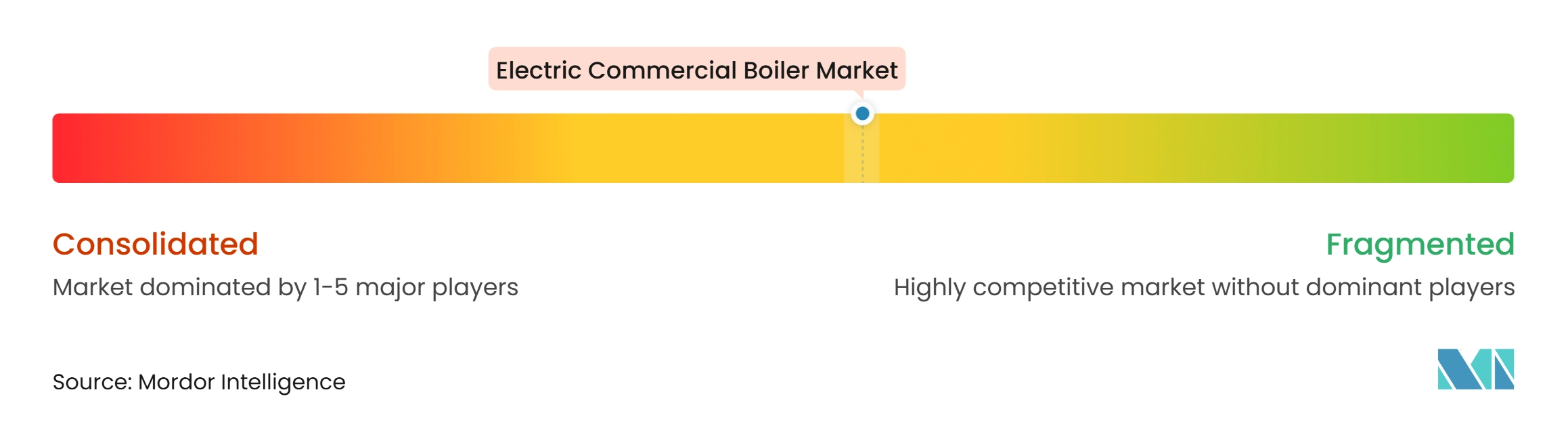
The electric commercial boiler market is moderately fragmented. It includes diversified thermal equipment companies, specialized electric boiler manufacturers, and regional suppliers with established distributor networks. Larger suppliers compete through research capacity, global service coverage, and relationships with engineering and construction firms, while specialized suppliers focus on modular installation, digital controls, and short lead times. Certifications such as ASME Section I and Section IV, UL and cUL listings, and integration protocols such as BACnet and Modbus remain relevant purchasing requirements. These compliance factors can favor manufacturers with pre-certified product packages and experienced local service teams.
Miura, through Cleaver-Brooks, is expected to enter into a stock purchase agreement in August 2026 to acquire R.F. MacDonald Company, strengthening its service and sales infrastructure in California and Nevada. The move demonstrates that distribution and service relationships are important competitive assets in the electric commercial boiler market. Bosch Industriekessel and A.E.P. Thermal are expected to form a partnership in December 2025 to develop and commercialize medium-voltage electrode boilers for industrial applications, district heating, and grid stabilization. Such partnerships can help suppliers address projects that require higher-voltage equipment and specialized engineering, although permitting, electrical codes, and limited high-voltage service capabilities can slow market entry in the 1 MW to 5 MW range. Companies that provide technical support throughout these processes may gain an advantage over hardware-only competitors.
Competition is also shifting toward controls that help operators manage flexible load, demand response, and maintenance, while the operating value of an installation increasingly depends on controls, storage, and utility coordination. Manufacturers are investing in systems that can integrate with building-management platforms and support variable electricity use. Product examples from Cleaver-Brooks and Sussman indicate that compact modular packages and open-protocol connectivity are becoming more common. The competitive field extends beyond boiler manufacturing, favoring firms that combine reliable equipment with project support, controls expertise, and an established local service presence.
Electric Commercial Boiler Industry Leaders
-
A. O. Smith Corporation
-
Bosch Industriekessel GmbH
-
Cleaver-Brooks, Inc.
-
The Fulton Companies / Fulton Boiler Works, Inc.
-
Chromalox, Inc.
- *Disclaimer: Major Players sorted in no particular order
Electric Commercial Boiler Market Companies Covered in this Report
- A. O. Smith Corporation
- ACME Engineering Products, Inc.
- Alfa Laval AB
- Babcock Wanson Group
- Bosch Industriekessel GmbH
- Chromalox, Inc.
- Cleaver-Brooks, Inc.
- Cochran Ltd.
- Danstoker A/S
- Electro-Steam Generator Corp.
- Fulton Boiler Works, Inc.
- Laars Heating Systems Company
- Lochinvar, LLC
- Miura Co., Ltd.
- Precision Boilers, LLC
- Reimers Electra Steam, Inc.
- Sussman-Automatic Corporation
- Thermon, Inc.
- Thermolec Ltd.
- Vapor Power International LLC
- Viessmann Climate Solutions SE
- Zeta Boiler AB
Recent Industry Developments in Electric Commercial Boiler Market
- November 2026: Alfa Laval hosted its Capital Markets Day on November 18, 2026, in Lund, outlining strategic priorities and growth ambitions, with a stated path toward SEK 100 billion in turnover by 2030. The event focused on data centers, pumping systems, and hygienic fluid handling.
- August 2026: Miura’s subsidiary, Cleaver-Brooks, entered into a Stock Purchase Agreement on August 25, 2026, to acquire R.F. MacDonald Company, a long-standing Cleaver-Brooks representative in California and Nevada. The transaction was expected to close on October 1, 2026, subject to US antitrust clearance, and was completed on October 2, 2026.
- August 2026: Helen commenced operations at the Eiranranta heat-pump and electric-boiler plant in Helsinki. The facility has approximately 90 MW of district-heating capacity, 60 MW of district-cooling capacity, and a 30 MW electric boiler. It recovers heat from treated wastewater at temperatures as low as 5°C.
- May 2026: The European Commission selected 65 projects across 10 countries for EUR 396.5 million in grants under the IF25 Heat Auction. Electric-resistance heating, both direct and indirect, was used in 47 of the 65 selected projects, while medium-temperature projects were dominated by electric boilers and resistance-heating technologies.
- March 2026: Parat Halvorsen delivered a 60 MW high-voltage electrode steam boiler, operating at 22 kV and 25 barg, with a 3.3 MW superheater, to Boyer Paper Mill in Tasmania. This was Parat’s first high-voltage electrode boiler delivery to Australia.
- February 2026: Vicinity Energy continued installing a 9 MW electric boiler at its Fulton Street facility in Grand Rapids, Michigan. The project included mechanical connection work and supplemental water-treatment installation, ahead of planned service in summer 2026. The project supports Vicinity’s eSteam electrification strategy and its 2050 net-zero target.
Global Electric Commercial Boiler Market Report Scope
The Electric Commercial Boiler Market Report is Segmented by Pressure (High Pressure, Medium Pressure, Low Pressure), Configuration (Single-Stage, Multistage, High-Speed Turbo, Integrally Geared), Drive Type (Direct Drive, Belt Drive, Integrated VSD Drive, Magnetic-Bearing Drive), End-Use (Mining, Cement, Pulp and Paper, Construction, Steel, Chemicals and Petrochemicals, Power Generation, Water and Wastewater Treatment, Food and Beverage, HVAC and Commercial Buildings, Other End-use Industries), and Geography (North America, South America, Europe, Asia-Pacific, MEA). The Market Forecasts are Provided in Terms of Value (USD).
Segmentation Overview
| High Pressure |
| Medium Pressure |
| Low Pressure |
| Single-Stage |
| Multistage |
| High-Speed Turbo |
| Integrally Geared |
| Direct Drive |
| Belt Drive |
| Integrated VSD Drive |
| Magnetic-Bearing Drive |
| Mining |
| Cement |
| Pulp and Paper |
| Construction |
| Steel |
| Chemicals and Petrochemicals |
| Power Generation |
| Water and Wastewater Treatment |
| Food and Beverage |
| HVAC and Commercial Buildings |
| Other End-use Industries |
| North America | United States | |
| Canada | ||
| Mexico | ||
| South America | Brazil | |
| Argentina | ||
| Rest of South America | ||
| Europe | Germany | |
| United Kingdom | ||
| France | ||
| Italy | ||
| Russia | ||
| Rest of Europe | ||
| Asia-Pacific | China | |
| Japan | ||
| India | ||
| South Korea | ||
| ASEAN | ||
| Rest of Asia-Pacific | ||
| Middle East and Africa | Middle East | Saudi Arabia |
| United Arab Emirates | ||
| Rest of Middle East | ||
| Africa | South Africa | |
| Nigeria | ||
| Rest of Africa | ||
| By Pressure | High Pressure | ||
| Medium Pressure | |||
| Low Pressure | |||
| By Stage/Configuration | Single-Stage | ||
| Multistage | |||
| High-Speed Turbo | |||
| Integrally Geared | |||
| By Drive Type | Direct Drive | ||
| Belt Drive | |||
| Integrated VSD Drive | |||
| Magnetic-Bearing Drive | |||
| By End-use Industry | Mining | ||
| Cement | |||
| Pulp and Paper | |||
| Construction | |||
| Steel | |||
| Chemicals and Petrochemicals | |||
| Power Generation | |||
| Water and Wastewater Treatment | |||
| Food and Beverage | |||
| HVAC and Commercial Buildings | |||
| Other End-use Industries | |||
| By Geography | North America | United States | |
| Canada | |||
| Mexico | |||
| South America | Brazil | ||
| Argentina | |||
| Rest of South America | |||
| Europe | Germany | ||
| United Kingdom | |||
| France | |||
| Italy | |||
| Russia | |||
| Rest of Europe | |||
| Asia-Pacific | China | ||
| Japan | |||
| India | |||
| South Korea | |||
| ASEAN | |||
| Rest of Asia-Pacific | |||
| Middle East and Africa | Middle East | Saudi Arabia | |
| United Arab Emirates | |||
| Rest of Middle East | |||
| Africa | South Africa | ||
| Nigeria | |||
| Rest of Africa | |||
Key Questions Answered in the Report
What is the electric commercial boiler market size?
The electric commercial boiler market size is USD 2.31 billion in 2026 and is projected to reach USD 3.93 billion by 2032 at an 11.19% CAGR.
Which pressure category has the largest share?
Low-pressure boilers hold 58.24% of 2026 revenue because they are widely used for commercial space heating, domestic hot water, and low-pressure steam.
Which electric commercial boiler application is expanding fastest?
Water and wastewater treatment is projected to expand at a 12.62% CAGR through 2032, supported by steady process-heat requirements and heat-recovery projects.
Which region has the largest electric commercial boiler demand?
North America holds 34.11% of 2026 revenue, supported by electric-ready building codes and district-energy projects.
Which region has the fastest forecast expansion?
Asia-Pacific is projected to expand at a 12.43% CAGR through 2032, supported by electrification programs and new commercial infrastructure.
What constraints affect adoption of electric commercial boilers?
High electricity costs, demand charges, grid-connection queues, and the need for upgraded electrical infrastructure can delay projects or weaken their operating economics.