
Elastocaloric Materials Market Size and Share
Market Overview
| Study Period | 2021 - 2031 |
|---|---|
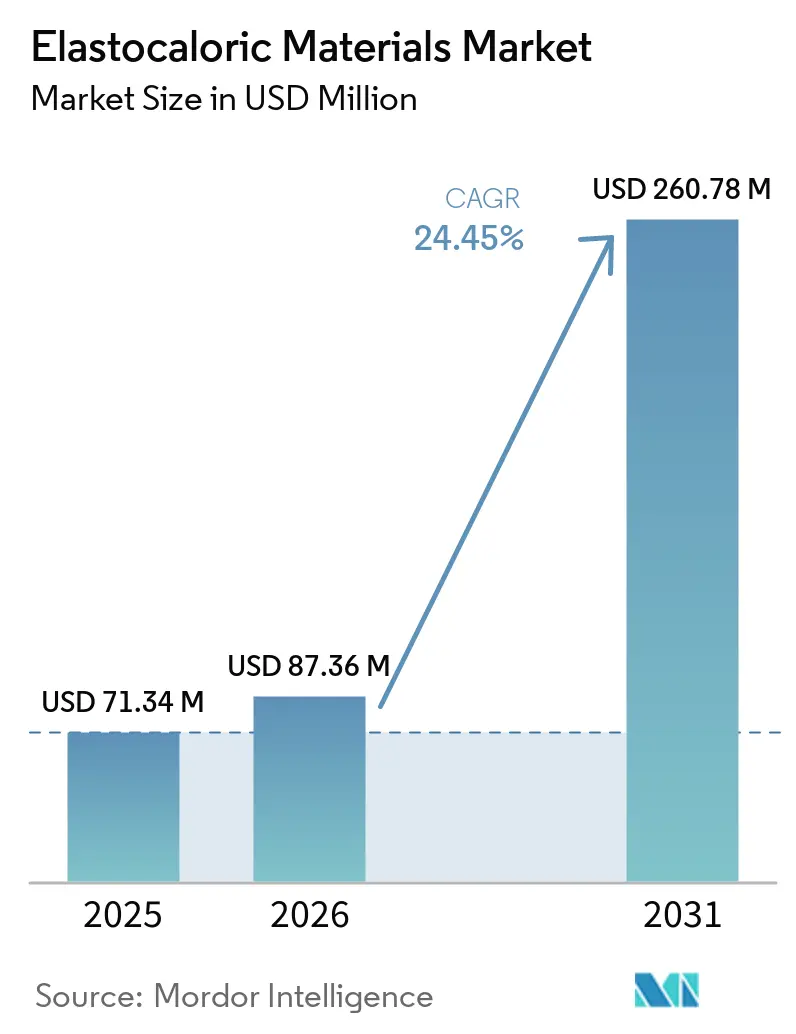
| Market Size (2026) | USD 87.36 Million |
| Market Size (2031) | USD 260.78 Million |
| Growth Rate (2026 - 2031) | 24.45 % |
| Fastest Growing Market | Asia-Pacific |
| Largest Market | North America |
| Market Concentration | Medium |
Major Players *Disclaimer: Major Players sorted in no particular order Image © Mordor Intelligence. Reuse requires attribution under CC BY 4.0. | |
Elastocaloric Materials Market Analysis by Mordor Intelligence
The Elastocaloric materials market size is estimated at USD 71.34 million in 2025 and is estimated to grow from USD 87.36 million in 2026 to USD 260.78 million by 2031, at a CAGR of 24.45% during the forecast period (2026-2031). Refrigerant phase-down regulations are creating the most immediate near-term demand for cooling systems that do not use fluorinated gases, particularly in sealed appliances. The technology is also gaining relevance for compact cooling applications in electric vehicles, power electronics, and data centers. Recent device demonstrations have moved the field beyond small laboratory prototypes, though durability, system efficiency, and cost continue to limit broad adoption. Suppliers are pursuing alloy improvements and system designs to reduce actuation requirements, while developers focus on refrigeration and heat pump applications. The elastocaloric materials market is therefore advancing most rapidly in regions where regulation is well-established, research support is sustained, and prototype-to-product timelines are practical.
Key Report Takeaways
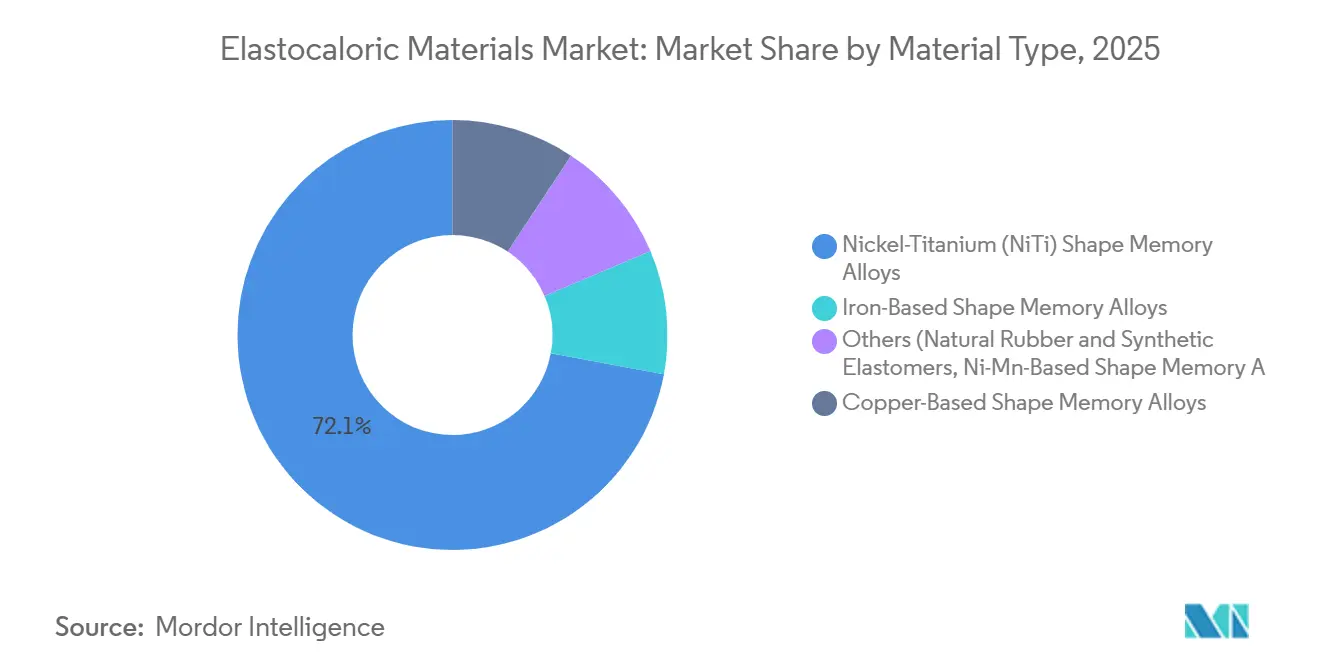
- By material type, NiTi shape memory alloys held 72.08% of the Elastocaloric materials market share in 2025, while copper-based shape memory alloys are forecast to grow at a 27.89% CAGR through 2031.
- By material form, wire held 42.13% of the Elastocaloric materials market share in 2025, while thin film is forecast to grow at a 26.16% CAGR through 2031.
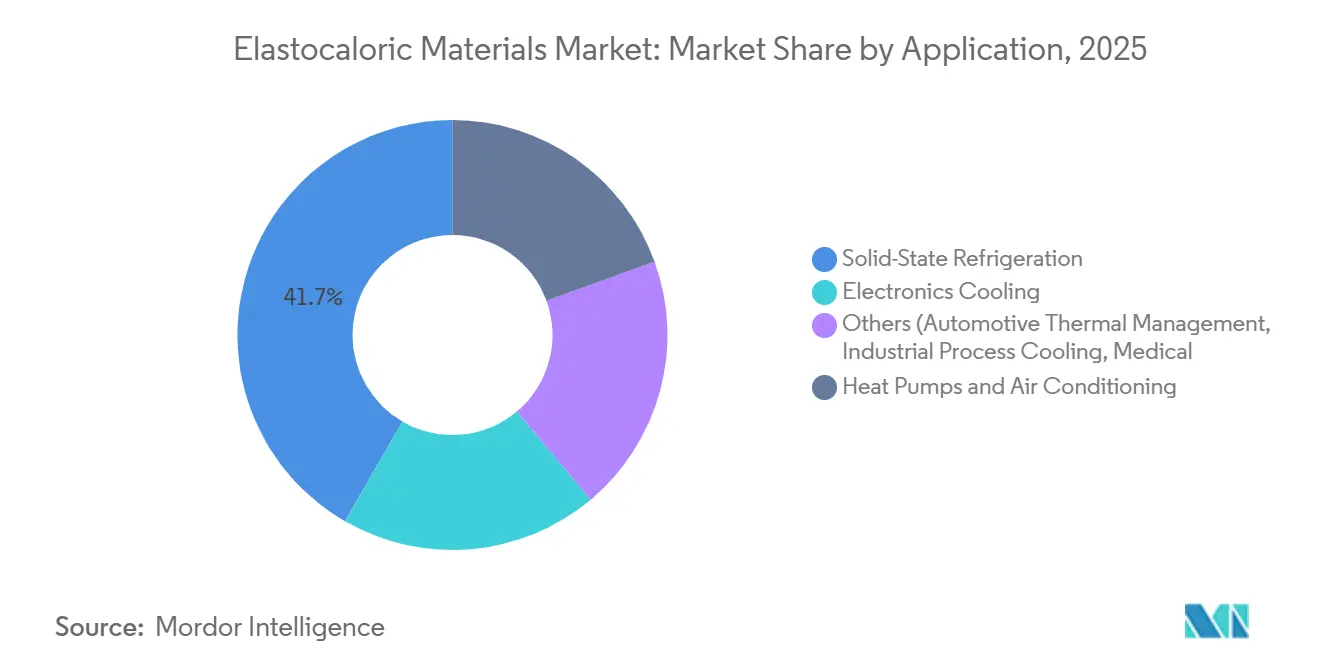
- By application, solid-state refrigeration accounted for 41.66% of the Elastocaloric materials market share in 2025, while heat pumps and air conditioning are projected to expand at a 27.22% CAGR through 2031.
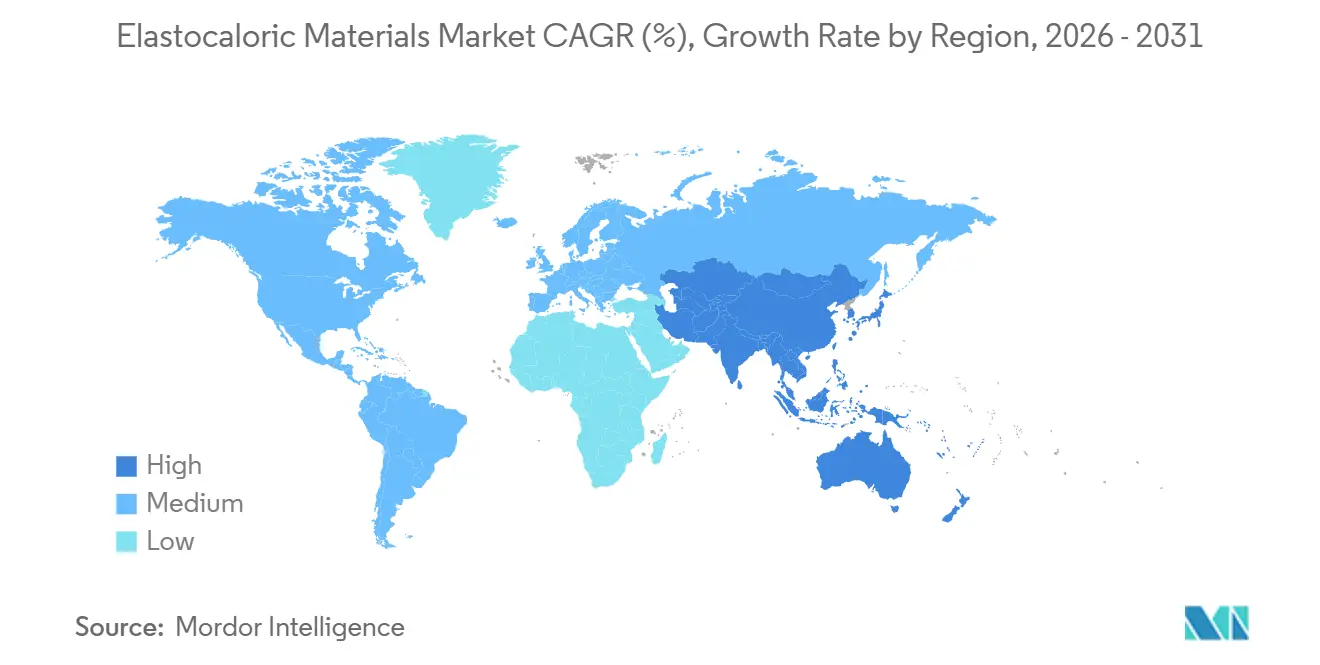
- By geography, North America held 35.34% of revenue in 2025, while Asia-Pacific is forecast to grow at a 26.28% CAGR through 2031.
Note: Market size and forecast figures in this report are generated using Mordor Intelligence’s proprietary estimation framework, updated with the latest available data and insights as of January 2026.
Market Trends and Insights
Drivers Impact Analysis of Elastocaloric Materials Market*
| Drivers | (~) % Impact on CAGR Forecast | Geographic Relevance | Impact Timeline |
|---|---|---|---|
| Refrigerant Phase-Down and Zero-Global Warming Potential (GWP) Cooling Requirements | +4.5% | Global | Short term (≤ 2 years) |
| Kilowatt-Scale Multi-Cell Device Demonstrations | +3.8% | Global, APAC early gains | Medium term (2-4 years) |
| EV Battery and Power-Electronics Thermal Management | +3.2% | APAC core, spillover to NA and the EU | Medium term (2-4 years) |
| Data-Center Heat Flux and Compact Cooling Demand | +2.8% | North America and the EU | Medium term (2-4 years) |
| Public Funding and Strategic Corporate Investment in Solid-State Cooling | +2.2% | North America and the EU | Short term (≤ 2 years) |
| Recycled-Rubber Elastocaloric Materials and Circular Cooling Design | +0.8% | EU | Long term (≥ 4 years) |
| Source: Mordor Intelligence | |||
Refrigerant Phase-Down and Zero-Global Warming Potential (GWP) Cooling Requirements
The Kigali Amendment and the EU F-Gas Regulation have strengthened the case for refrigerant-free cooling technologies. Regulation (EU) 2024/573 requires a 95% reduction in hydrofluorocarbon consumption from 2015 levels by 2030 and provides for a full phase-out by 2050. The regulation also exerts early pressure on household refrigerators, with the 2026 restriction on F-gas-containing products favoring compact cooling systems. Those applications align with thin-film and wire-based elastocaloric devices because their small dimensions are closer to current prototype capabilities. Most Group 1 developing-country parties began their HFC consumption freeze in January 2024 under the Kigali Amendment, widening the policy base for alternative cooling technologies. These compliance schedules require manufacturers to qualify alternatives before incumbent equipment can continue unchanged, creating a path to early adoption for the elastocaloric materials market.
Kilowatt-Scale Multi-Cell Device Demonstrations
A February 2025 device from the Hong Kong University of Science and Technology delivered 1,284 W of cooling power at 12.3 W/g and operated through more than 500,000 initial cycles. This result moved elastocaloric cooling beyond the earlier sub-300 W prototype range and expanded the range of systems that developers can consider. Its multi-cell design uses shape-memory alloys in series and fluid in parallel, enabling scaling by adding cells rather than redesigning the core actuation approach. In January 2026, HKUST reported a sub-zero elastocaloric freezer that reached -12°C using a 24°C heat sink, with a coefficient of performance of 3.4[1]. A 2026 study also reported a 3D-printed NiTi prototype that generated 50 W of cooling power with a 20°C temperature span over 31,500 cycles. These results support applications in room cooling, frozen-food storage, and pharmaceutical cold chains, though production-scale validation is still required.
Electric Vehicle (EV) Battery and Power-Electronics Thermal Management
Electric vehicle powertrains require stable temperature control, high cooling density, and vibration resistance in confined spaces. Wire and thin-film devices can reduce dependence on refrigerant plumbing and may fit multi-zone battery thermal management designs. Fraunhofer IPM, Volkswagen AG, and Ingpuls GmbH have been working on a mobile elastocaloric cooling system through the SMArtCool project since December 2024. A 2026 review found that low-GWP thermal-management alternatives can improve electric-vehicle cooling or heating performance by 10% to 25% compared with conventional vapor-compression systems, depending on the design. The elastocaloric materials market can benefit from automakers' need for smaller thermal systems and from alternative refrigerant designs under active development. Power electronics add a separate demand path, as rising chip heat flux increases the value of cooling solutions that operate at the component level.
Data-Center Heat Flux and Compact Cooling Demand
AI workloads are increasing cabinet power density and making heat removal more difficult for air-cooled equipment. Cooling can account for up to 40% of data-center energy use, which has increased interest in systems that simplify cooling circuits and reduce reliance on refrigerant. Elastocaloric devices could support direct-contact cooling designs at the chip or rack level. A NiTi wire-array prototype showed a coefficient of performance of 6.5 and a temperature span of 23.8 K for electronic-circuit cooling. A 2026 study reported a cooling power of 81 W/m² from a composite thermal interface material integrated into an all-solid-state cooling cycle. The European Innovation Council has identified data-center cooling as a target environment for next-generation caloric systems, which require cold-source temperatures of 6°C to 11°C.
Restraints Impact Analysis of Elastocaloric Materials Market*
| Restraints | (~) % Impact on CAGR Forecast | Geographic Relevance | Impact Timeline |
|---|---|---|---|
| Fatigue Life Below Commercial Duty-Cycle Requirements | -1.6% | Global | Medium term (2-4 years) |
| High NiTi and Precision-Actuation Cost | -2.2% | Global | Short term (≤ 2 years) |
| Hysteresis and System-Level Coefficient of Performance (COP) Losses | -1.4% | Global | Medium term (2-4 years) |
| Heat-Transfer and Regeneration Bottlenecks | -1.0% | Global | Long term (≥ 4 years) |
| Source: Mordor Intelligence | |||
Fatigue Life Below Commercial Duty-Cycle Requirements
Commercial heating, ventilation, air conditioning, and refrigeration equipment must operate reliably for 10 to 15 years. NiTi materials under repeated loading can develop transformation-induced plasticity, which reduces the elastocaloric temperature change and can cause fatigue cracks. A 2025 study found that higher actuation stress accelerates failure and that functional fatigue can reduce the temperature change below its initial value. Thermal annealing between operating periods can partially restore performance, but it increases system complexity in sealed equipment. A SUSTech research team reported in 2026 that a quaternary NiTi alloy remained stable over 200 million cycles over the 20°C to 100°C range[2]. The elastocaloric materials market still requires this laboratory-demonstrated durability to be replicated in production-grade wire and tube products before major buyers can specify the technology.
High NiTi and Precision-Actuation Cost
NiTi carries a material cost premium due to its high nickel content, tight compositional control requirements, and complex thermomechanical processing. Systems using NiTi also require high-load actuators, guide mechanisms capable of withstanding 950 MPa compressive stress, and high-frequency drives. Copper-based alloys such as CuAlMn can operate at 70% lower transformation stress than NiTi, reducing the required actuation force and material cost. Iowa State University presented work on copper-based elastocaloric materials for cost-sensitive applications at the 2026 Shape Memory and Superelastic Technologies (SMST) conference. ATI Inc. stated that its partnership with Confluent Medical Technologies includes a USD 50 million investment intended to more than triple nitinol capacity by fiscal year 2027. The added capacity may improve supply, but medical-grade nitinol and elastocaloric cooling materials require different compositions and processing approaches.
*Our forecasts treat driver/restraint impacts as directional, not additive. The impact forecasts reflect baseline growth, mix effects, and variable interactions.
Elastocaloric Materials Market Segment Analysis
By Material Type:
NiTi Leads, Copper Alloys Close InNiTi shape memory alloys held 72.08% of the elastocaloric materials market share in 2025. Their position is supported by adiabatic temperature changes of up to 30 K and an established specialty wire-and-tube supply chain. ATI Inc., Fort Wayne Metals, Nippon Seisen, and SAES Getters have supported the broader manufacturing base for NiTi components. This supply network gives development teams a practical route from alloy selection to semi-finished materials. NiTi also remains familiar to manufacturers working with wire, tube, and actuator-based device designs.
Copper-based shape memory alloys are projected to grow at a 27.89% CAGR from 2026 to 2031, making them the fastest-growing material category within the elastocaloric materials market. CuAlMn alloys can provide lower transformation stress and near-zero hysteresis in selected variants. Their lower raw material costs make them relevant for residential cooling and automotive applications, where system cost is a key consideration. Fort Wayne Metals Ireland presented research on laser powder bed fusion of in situ alloyed nitinol, while Iowa State University presented work on copper-based alloys at Shape Memory and Superelastic Technologies (SMST) 2026. Iron-based alloys, Ni-Mn-based alloys, and natural rubber materials remain relatively small but active areas within the research base.

By Material Form:
Wire Dominates, Thin Film SurgesWire held 42.13% of the material-form segment in 2025. It is compatible with the rotary-stretching and linear-actuation architecture that has received the most device-level testing. Saarland University has demonstrated cooling concepts using bundles of 200-micrometer NiTi wires that rotate around a circular cooling chamber. This geometry increases surface area while avoiding the need for specialized bulk-form tooling. Sheet and strip forms support plate-style regenerator designs and are being tested for improved fatigue behavior and heat transfer.
The thin-film segment is forecast to record a 26.16% CAGR through 2031 in the elastocaloric materials market. TiNiCuCo films have shown a 14 K temperature span and 19 W/g specific cooling capacity at 4 Hz in a single-stage device. A parallelized five-film device reached 900 mW of cooling capacity in the same research stream. These results are relevant to electronics cooling, biomedical chips, and compact modules where high performance density is more important than total cooling output. The 2026 3D-printed Nickel-Titanium (NiTi) result also indicates that thin-section forms may be adapted to larger cooling requirements.
By Application:
Solid-State Refrigeration Anchors Demand, Heat Pumps AccelerateSolid-state refrigeration accounted for 41.66% of the elastocaloric materials market share in 2025. This application addresses the need to replace high-global-warming-potential refrigerants in domestic and commercial cooling equipment. Hong Kong University of Science and Technology (HKUST) reported in January 2026 that its device cooled a chamber to -4 °C and froze 20 mL of water in 2 hours from a room-temperature heat sink. The result indicates a route toward frozen-food storage and pharmaceutical cold-chain uses. Electronics cooling, automotive thermal management, medical equipment, aerospace systems, and portable devices comprise additional application areas.
Heat pumps and air conditioning are projected to grow at a 27.22% CAGR from 2026 to 2031. Residential electrification, European HFC restrictions, and expanding prototype work are supporting this application. A simulation of an elastocaloric heat pump for Mediterranean homes reported an equivalent coefficient of performance of 6.5 at 0.5 Hz and up to 80% lower annual energy consumption than a conventional vapor-compression system under the same thermal load. The E-CO-HEAT project aims to develop an elastocaloric heating and cooling device at Technology Readiness Level 5. The SMACool project is also pursuing higher efficiency for residential air conditioning.
Geography Analysis
North America Elastocaloric Materials Market
North America accounted for 35.34% of the elastocaloric materials market share in 2025. The region has a substantial base of NiTi materials companies, including ATI Inc., Fort Wayne Metals, and Nitinol Devices and Components, and has received public research support through the US Department of Energy and the National Science Foundation. Research programs have connected thermoelastic materials to prospective residential cooling applications. The US Environmental Protection Agency finalized a rule in May 2026 that extended HFC compliance deadlines for some residential air-conditioning and retail food refrigeration applications. This change may slow some refrigerant-driven demand, while data center and electric vehicle applications continue to develop.
Europe Elastocaloric Materials Market
Europe represents a significant share of the elastocaloric materials market, with activity centered in Germany, Ireland, Italy, and Slovenia. The EU F-Gas Regulation provides the region with a strong policy basis for refrigerant-free systems. Saarland University and Fraunhofer IPM are advancing research through the automotive-focused SMArtCool project and the DEPART Saar platform, while Exergyn received a EUR 15 million (USD 17.30 million) investment from Carrier Global Corporation in December 2024 to support the commercialization of nitinol heat pumps. Germany is also supporting work on 3D-printed porous NiTi lattices through the T!Raum program. These projects connect materials research with appliance and vehicle applications that require commercially viable thermal systems.
APAC, MEA and South America Elastocaloric Materials Market
Asia-Pacific is expected to grow at a CAGR of 26.28% from 2026 to 2031. China introduced formal hydrofluorocarbon (HFC) consumption controls in 2024 and projects cumulative reductions of 9.2 ± 0.3 Gt CO₂-equivalent through 2060. The Hong Kong University of Science and Technology (HKUST) developed a device in 2025 and a freezer in 2026, reflecting a broader research network across Greater China. Japan contributes copper-alloy and fine-wire expertise through Furukawa Electric and Nippon Seisen. Smaller opportunities in South America, the Middle-East, and Africa are linked to industrial and space-cooling needs but remain constrained by limited NiTi production.
Competitive Landscape
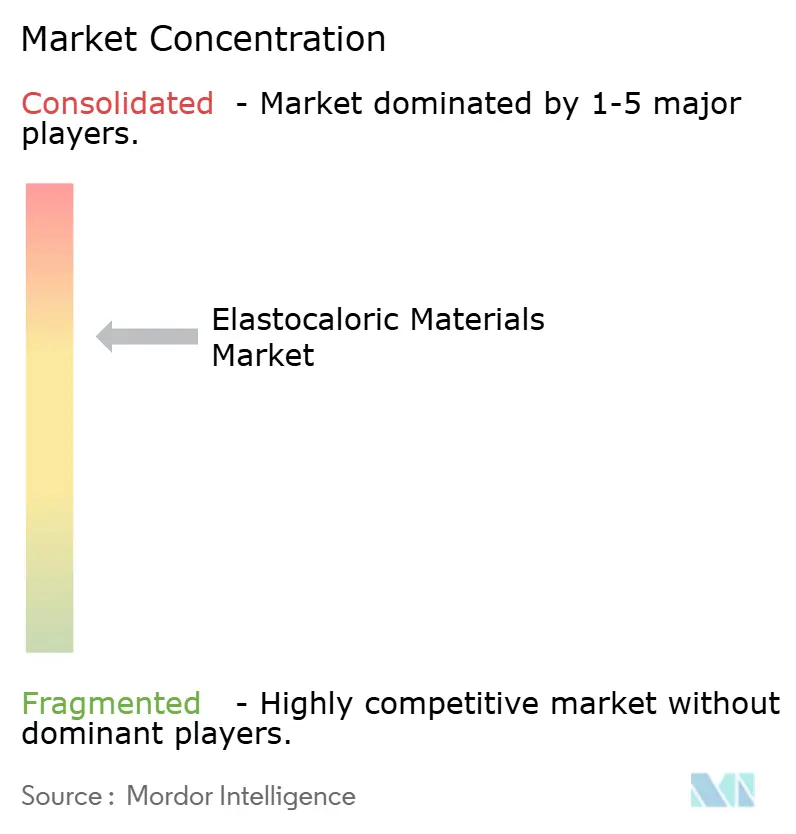
The elastocaloric materials market is moderately consolidated, with competition more concentrated in materials supply than in finished cooling equipment. Fort Wayne Metals, Nippon Seisen, SAES Getters, and G.RAU GmbH compete on alloy control, processing consistency, and cycle-tested fatigue performance. These factors determine the cooling output designers can achieve per gram of material. Developers must also balance alloy performance with the actuator and heat-transfer requirements of the full cooling system.
Exergyn combines materials research with heat pump system development and holds more than 100 patents. In July 2024, Ingpuls GmbH entered an agreement with the Bender Group for quaternary shape-memory-alloy wire used in heat pumps and refrigeration systems. Mateligent GmbH and Elastokalorik GmbH are developing HVAC modules for European residential applications. Elastokalorik reported that its HVAC module prototype was under construction as of August 2026.
Copper-based system design, recycled-rubber devices, and multi-stage regenerators for sub-zero cooling remain less developed areas. Competitive focus is shifting toward system-level intellectual property covering drive mechanisms, tube geometry, and heat-transfer design. Exergyn's core actuation patent and its collaboration with Carrier Global illustrate this commercialization approach. AI-based alloy discovery was presented at the Shape Memory and Superelastic Technologies (SMST) 2026 conference as a method to more efficiently identify shape-memory-alloy compositions.
Elastocaloric Materials Industry Leaders
-
Exergyn
-
mateligent GmbH
-
Barrow Green, LLC
-
Elastokalorik GmbH
-
FURUKAWA ELECTRIC CO., LTD.
- *Disclaimer: Major Players sorted in no particular order
Elastocaloric Materials Market Companies Covered in this Report
- ATI Inc.
- Barrow Green, LLC
- Dynalloy, Inc.
- Elastokalorik GmbH
- Exergyn
- Fort Wayne Metals Research Products, LLC
- FURUKAWA ELECTRIC CO., LTD.
- G.RAU GmbH and Co. KG
- Ingpuls GmbH
- mateligent GmbH
- Metalwerks
- Nippon Seisen Co., Ltd.
- Nitinol Devices and Components, Inc.
- SAES Getters S.p.A.
- Ultimate NiTi Technologies, Inc.
Recent Industry Developments in Elastocaloric Materials Market
- June 2026: Exergyn opened a EUR 2 million (USD 2.2 million) global center of excellence for shape-memory-alloy research and prototyping in Zdiby, Central Bohemia, Czech Republic. The facility focuses on NiTi alloys for refrigerant-free solid-state heat pumps.
- January 2026: HKUST published findings on the first reported sub-zero elastocaloric freezer in Nature. The freezer achieved a cold-source temperature of −12°C from a 24°C ambient heat sink, with a 36°C temperature lift and a coefficient of performance of 3.4.
Global Elastocaloric Materials Market Report Scope
Elastocaloric materials are shape-memory alloys that generate heat under mechanical stress (compression or tension) and absorb heat from their surroundings when the stress is released, resulting in rapid cooling. They offer a high-efficiency, environmentally friendly alternative to conventional vapor-compression refrigeration systems because they do not rely on harmful greenhouse-gas refrigerants.
The elastocaloric materials market is segmented by material type, material form, application, and geography. By material type, the market is segmented into elastocaloric materials nickel-titanium (NiTi) shape memory alloys, copper-based shape memory alloys, iron-based shape memory alloys, and others (natural rubber and synthetic elastomers, Ni-Mn-based shape memory alloys, high-entropy and other advanced elastocaloric materials). By material form, the market is segmented into wire, sheet and strip, thin film, and others (tube, foam, spring and customized components). By application, the market is segmented into solid-state refrigeration, heat pumps and air conditioning, electronics cooling, and others (automotive thermal management, industrial process cooling, medical and laboratory cooling, aerospace and portable cooling). The report also covers market size and forecasts for elastocaloric materials across 15 countries in major regions. The market sizes and forecasts are provided in terms of value (USD).
Segmentation Overview
| Nickel-Titanium (NiTi) Shape Memory Alloys |
| Copper-Based Shape Memory Alloys |
| Iron-Based Shape Memory Alloys |
| Others (Natural Rubber and Synthetic Elastomers, Ni-Mn-Based Shape Memory Alloys, High-Entropy and Other Advanced Elastocaloric Materials) |
| Wire |
| Sheet and Strip |
| Thin Film |
| Others (Tube, Foam, Spring and Customized Components) |
| Solid-State Refrigeration |
| Heat Pumps and Air Conditioning |
| Electronics Cooling |
| Others (Automotive Thermal Management, Industrial Process Cooling, Medical and Laboratory Cooling, Aerospace and Portable Cooling) |
| Asia-Pacific | China |
| India | |
| Japan | |
| South Korea | |
| ASEAN Countries | |
| Rest of Asia-Pacific | |
| North America | United States |
| Canada | |
| Mexico | |
| Europe | Germany |
| United Kingdom | |
| France | |
| Italy | |
| NORDIC Countries | |
| Rest of Europe | |
| South America | Brazil |
| Argentina | |
| Rest of South America | |
| Middle-East and Africa | Saudi Arabia |
| South Africa | |
| Rest of Middle-East and Africa |
| By Material Type | Nickel-Titanium (NiTi) Shape Memory Alloys | |
| Copper-Based Shape Memory Alloys | ||
| Iron-Based Shape Memory Alloys | ||
| Others (Natural Rubber and Synthetic Elastomers, Ni-Mn-Based Shape Memory Alloys, High-Entropy and Other Advanced Elastocaloric Materials) | ||
| By Material Form | Wire | |
| Sheet and Strip | ||
| Thin Film | ||
| Others (Tube, Foam, Spring and Customized Components) | ||
| By Application | Solid-State Refrigeration | |
| Heat Pumps and Air Conditioning | ||
| Electronics Cooling | ||
| Others (Automotive Thermal Management, Industrial Process Cooling, Medical and Laboratory Cooling, Aerospace and Portable Cooling) | ||
| By Geography | Asia-Pacific | China |
| India | ||
| Japan | ||
| South Korea | ||
| ASEAN Countries | ||
| Rest of Asia-Pacific | ||
| North America | United States | |
| Canada | ||
| Mexico | ||
| Europe | Germany | |
| United Kingdom | ||
| France | ||
| Italy | ||
| NORDIC Countries | ||
| Rest of Europe | ||
| South America | Brazil | |
| Argentina | ||
| Rest of South America | ||
| Middle-East and Africa | Saudi Arabia | |
| South Africa | ||
| Rest of Middle-East and Africa | ||
Key Questions Answered in the Report
What is current market size of Elastocaloric Materials Market?
The Elastocaloric materials market size is estimated at USD 71.34 million in 2025 and is estimated to grow from USD 87.36 million in 2026 to USD 260.78 million by 2031, at a CAGR of 24.45% during the forecast period (2026-2031).
Which material type is used in elastocaloric cooling applications?
Nickel-Titanium (NiTi) shape memory alloys led with a 72.08% share in 2025 due to their strong thermal response and established wire and tube supply base.
Which application is expanding fastest?
Heat pumps and air conditioning are projected to grow at a 27.22% CAGR through 2031, supported by refrigerant restrictions and prototype development.
What limits the commercial adoption of elastocaloric cooling?
Functional fatigue, NiTi and actuator cost, hysteresis losses, and heat-transfer constraints remain the main barriers to large-scale deployment.