
Egypt Turf Protection Market Size and Share
Market Overview
| Study Period | 2021 - 2031 |
|---|---|
| Forecast Data Period | 2026 - 2031 |
| Base Year Market Size (2025) | USD 35.52 Million |
| Market Size (2026) | USD 37.81 Million |
| Market Size (2031) | USD 51.63 Million |
| Growth Rate (2026 - 2031) | 6.43 % |
| Market Concentration | Medium |
Major Players *Disclaimer: Major Players sorted in no particular order Image © Mordor Intelligence. Reuse requires attribution under CC BY 4.0. | |
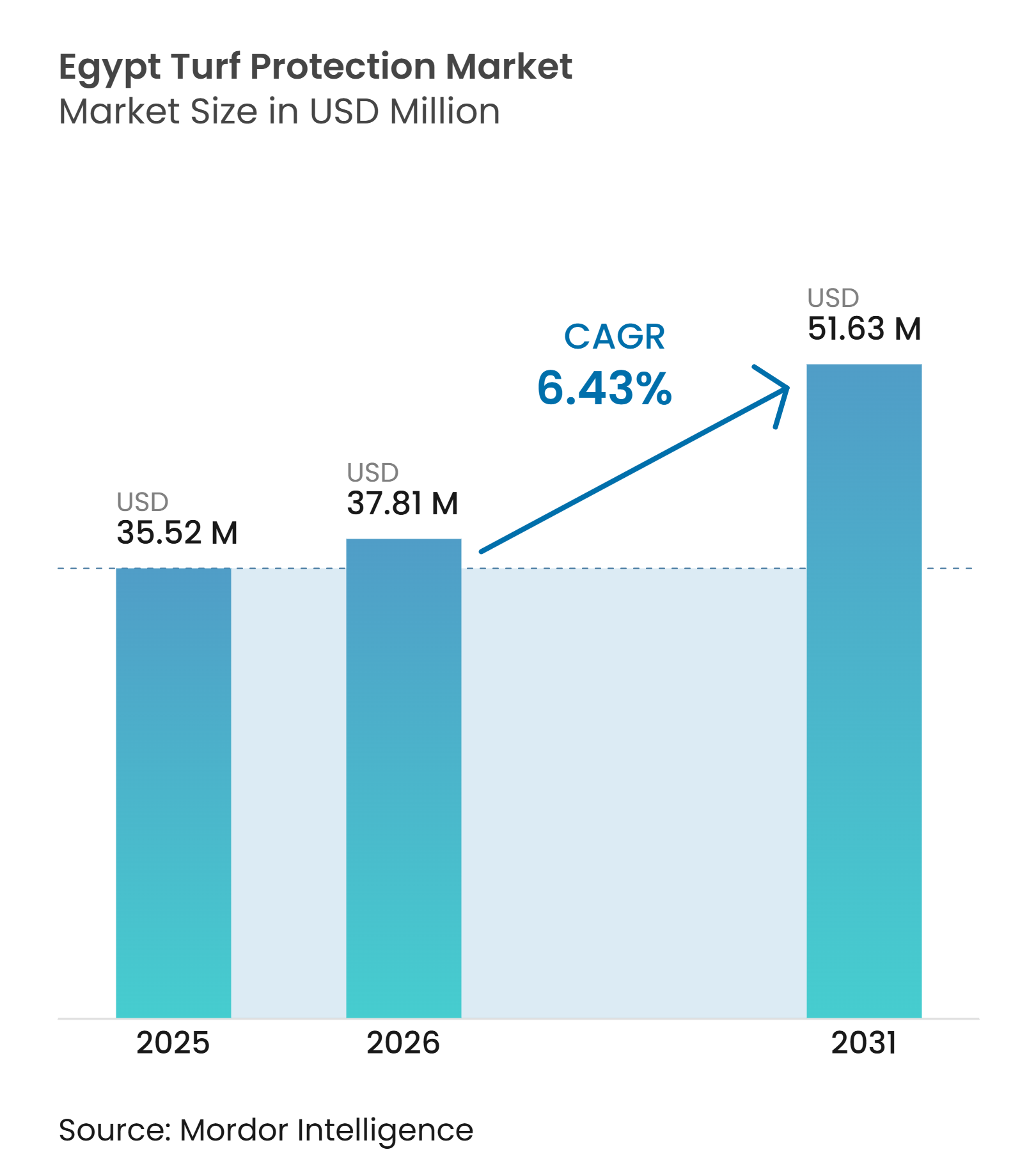
Egypt Turf Protection Market Analysis by Mordor Intelligence
The Egypt turf protection market size is projected to expand from USD 35.52 million in 2025 and USD 37.81 million in 2026 to reach USD 51.63 million by 2031, registering a CAGR of 6.43% during the forecast period (2026-2031). Growth is tied to the expanding base of golf courses, sports facilities, resorts, and landscaped urban developments that require regular turf care. Water limits and high summer temperatures make preventive treatment programs more important for operators of premium natural turf. Suppliers are responding with liquid products, biological inputs, and programs that link plant health with water management. Competition is centered on technical support, registered product portfolios, and products suited to warm-season grasses. Artificial turf creates pressure in cost-sensitive facilities, while resorts, golf courses, and premium residential projects continue to support demand for natural-turf maintenance.
Key Report Takeaways
- By product type, fungicides accounted for 38.2% of the Egypt turf protection market share in 2025, whereas biostimulants and bio-fertilizers are forecast to grow at the fastest CAGR of 8.3% from 2026 to 2031.
- By application, the landscaping segment accounted for a 39.5% share of the Egypt turf protection market size in 2025, while sports fields are forecast to grow at the highest CAGR of 7.8% from 2026 to 2031.
- By end-user, residential customers accounted for 34.8% of the Egypt turf protection market share in 2025, whereas sports facility owners are forecast to grow at the fastest CAGR of 7.6% from 2026 to 2031.
- By mode of action, chemical products represented 68.1% of the Egypt turf protection market share in 2025, while the biological segment is forecast to grow at the highest CAGR of 8.1% from 2026 to 2031.
- By formulation, liquid concentrates held a 55.6% share of the Egypt turf protection market share in 2025, and are estimated to grow at the highest CAGR of 7.2% from 2026 to 2031.
Note: Market size and forecast figures in this report are generated using Mordor Intelligence’s proprietary estimation framework, updated with the latest available data and insights as of January 2026.
Market Trends and Insights
Drivers Impact Analysis of Egypt Turf Protection Market*
| Driver | (~) % Impact on CAGR Forecast | Geographic Relevance | Impact Timeline |
|---|---|---|---|
| Golf Course and Professional Sports Venue Development | +1.20% | Red Sea Coast, Greater Cairo, and North Coast | Medium term (2-4 years) |
| Expansion of Urban Landscaping and Recreational Green Spaces | +1.10% | New Administrative Capital, Greater Cairo, and Alexandria | Short term (≤ 2 years) |
| Rising Turf Disease and Pest Pressure Under Hot, Arid Conditions | +1.00% | National, especially coastal and desert-edge turf zones | Short term (≤ 2 years) |
| Adoption of Biological Products and Biostimulants | +0.90% | National, with early gains in Red Sea and North Coast resorts | Medium term (2-4 years) |
| Demand for Water-Efficient Turf Management | +0.90% | National, especially Upper Egypt and desert expansion zones | Long term (≥ 4 years) |
| Growth of Precision Turf Monitoring and Application | +0.80% | Greater Cairo, Red Sea resorts, and the New Administrative Capital | Long term (≥ 4 years) |
| Source: Mordor Intelligence | |||
Golf Course and Professional Sports Venue Development
Golf and professional sports projects are creating a stable source of demand for the Egypt turf protection market. In May 2026, Legacy Hotels, a Talaat Moustafa Group subsidiary, signed a partnership with Robert Trent Jones II Golf Course Architects to redesign the Mena House golf course near the Giza Pyramids. The project includes climate-resilient regrassing and a water-efficient irrigation system, reflecting the growing focus on sustainable course management. SouthMED and Sharm Bay add to the pipeline of golf courses under construction. The Hidden Coves Golf Course at Somabay opened its back nine in December 2025 and scheduled to open the front nine by the end of 2026[1]. These projects require fungicides, herbicides, biostimulants, and plant growth regulators during establishment and routine maintenance. Tournament venues also face high playing-standard requirements, increasing the value placed on reliable turf protection programs. New football academies and multi-purpose sports centers broaden this need beyond golf, supporting recurring demand across the Egypt turf protection market.
Expansion of Urban Landscaping and Recreational Green Spaces
The New Administrative Capital is adding a large area of professionally managed green space to the Egypt turf protection market. Capital Central Park covers 440 hectares and includes lawns, gardens, and recreational areas that require ongoing weed, disease, and stress management. The Green River extends 35 kilometers through the city and connects residential and civic zones. These public spaces create recurring treatment demand after landscaping work is completed. Smart-city projects also use maintenance contracts that establish clearer quality standards for landscaped areas. Similar developments along the North Coast and in Ain Sokhna further expand the addressable base for commercial landscape contractors. This is shifting demand toward branded products supported by technical advice, rather than low-cost inputs applied only after turf damage appears.
Rising Turf Disease and Pest Pressure Under Hot, Arid Conditions
Hot weather, coastal humidity, and saline irrigation water place persistent pressure on natural turf in Egypt. Daytime summer temperatures frequently exceed 38°C, while coastal sites also face elevated humidity. These conditions favor Pythium species, dollar spot, brown patch, and other root and foliar diseases affecting Bermudagrass and Paspalum. Paspalum provides salt tolerance but still requires tailored disease management under saline irrigation conditions. A study titled Projection of Thermal Bioclimate projected the mean temperature during the wettest quarter to increase by 1.8°C in 2020–2059[2]. Longer stress periods can increase the frequency of preventive and curative applications required at premium sites. High soil temperatures can also narrow the effective treatment window for conventional products. This supports demand for fungicide rotations, biostimulants, and integrated programs that protect turf through increasingly difficult summer conditions.
Adoption of Biological Products and Biostimulants
Biological products and biostimulants are becoming more relevant as operators seek to manage stress, disease risk, and nutrient efficiency within integrated programs. Biostimulants and bio-fertilizers are anticipated to be the fastest-growing segment during the forecast period. The Biocontrol and Biostimulants North Africa 2026 conference is scheduled in Cairo, with participation from the Egyptian Government, the Ministry of Agriculture, and the Food and Agriculture Organization of the United Nations[3]. This activity reflects growing institutional attention to biological inputs. Turf managers use these products to support heat tolerance and nutrient use while supplementing conventional treatment rotations. The Agricultural Pesticides Committee has also published a biopesticide registration pathway, giving suppliers a defined route to market. Adoption is likely to begin at resorts and golf courses, where managers can closely assess program performance. As product knowledge improves, biological solutions can become a more regular component of the Egypt turf protection market.
Restraints Impact Analysis of Egypt Turf Protection Market*
| Restraint | (~) % Impact on CAGR Forecast | Geographic Relevance | Impact Timeline |
|---|---|---|---|
| Water Scarcity and Irrigation-Cost Pressure | -0.70% | National, especially Upper Egypt and desert-fringe expansion zones | Short term (≤ 2 years) |
| Substitution by Artificial Turf | -0.60% | National, mainly municipal venues, youth centers, and cost-sensitive schools | Medium term (2-4 years) |
| Pesticide Registration and Label-Use Constraints | -0.50% | National | Medium term (2-4 years) |
| Limited Skilled Turf-Management Labor | -0.40% | National, especially Upper Egypt and developing new-city districts | Long term (≥ 4 years) |
| Source: Mordor Intelligence | |||
Water Scarcity and Irrigation-Cost Pressure
Water scarcity limits the amount of natural turf that owners can maintain, although it also increases demand for water-efficient products. Annual renewable water availability does not exceed 60 billion cubic meters, while national needs are estimated at above 80 billion cubic meters. This gap makes facility owners more cautious about new natural-turf installations in cost-sensitive settings. A September 2026 U.S. Geological Survey (USGS) analysis found that Egypt and Sudan together account for 97% of irrigation water use in the Nile Basin. Concerns over future Nile allocations further affect long-term planning for water-intensive landscapes. Some owners may reduce the area of turf maintained at premium quality or shift toward lower-maintenance surfaces. Suppliers can respond by demonstrating how their products reduce irrigation frequency, improve drought recovery, or work at lower spray volumes. This positions turf protection as part of a resource-efficiency program rather than an added cost. Even so, water pressure remains a constraint on the total potential volume of the Egypt turf protection market.
Pesticide Registration and Label-Use Constraints
Egypt's registration process can delay the availability of new turf protection products. The Agricultural Pesticides Committee is the sole authority responsible for pesticide registration, handling, and use under Ministerial Decree No. 974/2017[4]. Applicants must complete efficacy testing across 2 consecutive agricultural seasons before receiving a certificate. Registrations run for 6 years and include a formulated-product review in the third year. The committee approved 39 new pesticide registrations, including 10 raw materials, during its November 2025 session. The system supports oversight, but it adds time and cost to product launches. Newly developed biological agents and biostimulants may reach Egypt later than established conventional products. Suppliers with complete technical dossiers and early engagement with the committee can manage this process more effectively. The rule framework therefore shapes both the speed and the range of products available to the Egypt turf protection market.
*Our forecasts treat driver/restraint impacts as directional, not additive. The impact forecasts reflect baseline growth, mix effects, and variable interactions.
Egypt Turf Protection Market Segment Analysis
By Product Type:
Fungicides Anchor Demand While Bio stimulants AccelerateFungicides held a 38.2% share of the Egypt turf protection market in 2025, making them the largest product category. Their leading position reflects recurring disease pressure on Paspalum and Bermudagrass across coastal resorts, golf courses, and irrigated landscapes. Premium golf greens and sports fields often use preventive programs involving 6 to 8 seasonal applications, supporting recurring fungicide demand. Pythium root rot, dollar spot, and brown patch further reinforce repeat applications. Herbicides address weed control in transition areas, while insecticides manage surface pests. Plant growth regulators help control vertical growth and reduce mowing requirements. This product structure keeps fungicides central to routine spending across high-value turf sites. Syngenta Group also reported double-digit global sales growth in biologicals in 2025, highlighting increasing supplier attention to broader turf-management programs.
Biostimulants and bio-fertilizers are estimated to grow at a CAGR of 8.3% through 2031, making them the fastest-growing product type during the forecast period. Their use supports stress tolerance and nutrient efficiency during difficult summer conditions. Turf managers also apply them alongside conventional products when disease and environmental stress are high. The Egypt turf protection market for this category benefits from increasing interest in biological inputs, supported by growing institutional attention to biocontrol and biostimulants. The Agricultural Pesticides Committee also provides a defined registration pathway for biopesticides. Herbicides, insecticides, and plant growth regulators will remain necessary for specific turf-management requirements. Product selection will increasingly depend on program fit, resistance management, and water-use efficiency. This supports a broader product mix while maintaining fungicides as the core category in Egypt’s turf protection market.
By Application:
Landscaping Provides Scale While Sports Fields Lead GrowthLandscaping accounted for a 39.5% share of the Egypt turf protection market in 2025, making it the largest application category. This position is supported by residential developments, resorts, commercial sites, and public parks. Capital Central Park alone covers 440 hectares of managed urban space in 2026. Such projects require regular weed, disease, and stress control after construction is completed. Contractors increasingly work to defined maintenance standards at high-profile sites. This favors technically supported herbicide and biostimulant programs over irregular commodity purchases. Golf courses have fewer sites but use high input volumes per hectare across greens and tee boxes. Sod farms remain smaller, although regrassing activity creates targeted fungicide and biostimulant demand. Landscaping therefore provides the Egypt turf protection market with its broadest base of treated turf area.
Sports fields are estimated to grow at a CAGR of 7.8% through 2031, making them the fastest-growing application segment. New football pitches, private academies, and multi-purpose facilities require reliable playing surfaces. Their treatment programs address wear, disease, weeds, and heat stress. Golf courses will also add demand as Egypt expands and upgrades its golf infrastructure. The Mena House Golf Course near the Giza Pyramids is being redesigned by Legacy Hotels in partnership with Robert Trent Jones II Golf Course Architects, including climate-resilient regrassing and water-efficient irrigation in 2025. Sharm Bay, a resort development in Sharm El Sheikh, includes a planned golf course, creating future demand during turf establishment and maintenance. Emaar Misr a prominentreal estate development company hosted an international golf tournament at Marassi in January 2026, demonstrating growing use of North Coast venues for professional events and the need for consistently maintained playing surfaces. Sod farms will also benefit from regrassing and new turf establishment across these projects.
By End-User:
Residential Customers Lead Volume While Contractors Raise StandardsResidential customers accounted for 34.8% of the Egypt turf protection market in 2025, making them the largest end-user segment. Demand comes from villas, gated communities, and luxury residences across Greater Cairo, the North Coast, and Ain Sokhna. These properties use lawn-care programs that include fungicides and herbicides, typically purchased through licensed distributors or landscape contractors. Residential buyers generally prefer simpler formulations and less frequent treatment than professional facilities. Their broad number of sites nevertheless creates significant demand volume. Commercial landscape contractors serve a different role by managing larger and more demanding properties. Sports facility owners, municipalities, and schools represent smaller customer groups with varied procurement requirements. Residential demand therefore provides scale, while professional users influence the technical standards expected across the Egypt turf protection market.
The sports facility segment is forecast to grow at the fastest CAGR of 7.6% from 2026 to 2031, supported by new football pitches, private academies, training grounds, and multi-purpose sports facilities. These users require structured turf programs addressing wear, disease, weeds, and heat stress while maintaining consistent playing quality. Commercial landscape contractors also influence spending through structured programs combining rotating chemistries, label-rate applications, and complementary biostimulant treatments. Resort and golf-course contracts typically require these higher technical standards. Sports facilities and municipalities often emphasize efficacy, cost transparency, and maintenance reliability. Schools and municipal sites may consider synthetic surfaces where water or maintenance budgets are constrained. Direct supplier support and locally adapted labels remain important for institutional buyers. Overall, residential customers provide market scale, while sports facilities and professional operators increasingly support value growth in the Egypt turf protection market.
By Mode of Action:
Chemical Products Remain Dominant While Biological Products Gain MomentumChemical products held a 68.1% share of Egypt turf protection spending in 2025, confirming their dominant role in routine turf-management programs. Conventional systemic and contact chemistries remain familiar to operators seeking predictable disease and pest control. Triazoles and strobilurins are widely used where summer disease pressure leaves limited room for treatment failure. Golf courses and resorts favor established products because their registration status, application practices, and performance characteristics are well understood. Integrated programs are also gaining attention among sophisticated turf managers. These approaches combine chemical reliability with biological tools to support resistance management, stress tolerance, and more sustainable turf care. The established chemical base will therefore remain important as managers gradually add complementary products. This creates a measured transition rather than a rapid replacement of conventional inputs in the Egypt turf protection market.
Biological products are estimated to grow at a CAGR of 8.1% through 2031, the fastest rate among the segmentation categories. Growth reflects increasing interest in resistance management, resort sustainability commitments, and broader supplier investment in biological formulations. Envu launched Signature XTRA Stressgard Liquid in July 2026 for golf and fine turf applications in the United States, illustrating continued product development for warm-season turf. Biological adoption is also supported by demand for stress management alongside disease control. Registration requirements remain a near-term hurdle for new biopesticides, while suppliers with experience navigating the Agricultural Pesticides Committee can better manage approval requirements. Chemical products will retain the majority position, while biological momentum will broaden program options and gradually expand the Egypt turf protection market through 2031.
By Formulation:
Liquid Concentrates Lead Professional Application ProgramsLiquid concentrates held a 55.6% share of the Egypt turf protection market in 2025, making them the leading formulation. Their position reflects compatibility with automated and semi-automated sprayers used at golf courses and resorts. Professional managers value rapid foliar uptake and the ability to combine products in tank mixes. Paspalum and Bermudagrass respond well to foliar programs during active growth, making liquids practical during summer stress periods. ICL Group Ltd. launched Greenmaster Liquid Advance in January 2026 with MTU and Pidolic Acid for professional turf managers. The product illustrates the move toward liquid formulations that combine nutrition and stress management. Liquid concentrates therefore remain central to the Egypt turf protection market.
Liquid concentrates are estimated to grow at the highest CAGR of 7.2% from 2026 to 2031, supported by increasing use across professionally managed golf courses, resorts, sports fields, and landscaping projects. Granular and wettable powder products will retain defined roles during the forecast period. Granular formats suit slow-release nutrition and pre-emergent herbicide applications where even soil placement is important. ICL Group Ltd. expanded H2Pro TriSmart into granular and tablet formats for localized dry patch management. Wettable powders remain relevant for conventional active ingredients not yet offered as liquid concentrates. Their transport and storage profile can also support importers serving inland distribution routes. Liquid programs will benefit from automation and foliar compatibility, while granular products will remain useful for soil-oriented tasks. Wettable powders will preserve a smaller but stable role, giving operators multiple formulation options across the Egypt turf protection market.
Geography Analysis
Greater Cairo and the New Administrative Capital are the leading demand clusters by managed turf area, although no geographic share was provided. Greater Cairo has a high concentration of commercial landscape contractors, hotels, residential communities, and institutional turf managers. In May 2026, Legacy Hotels partnered with Robert Trent Jones II to redesign the Mena House Golf Course, a historic golf venue located at the base of the Giza Pyramids, with regrassing and new irrigation forming part of the redevelopment. The New Administrative Capital adds Capital Central Park, a 440-hectare urban park and recreational green space designed as the city’s main landscaped area. These areas require disease surveillance, weed control, and stress management as turf matures. Purchasing decisions are often shaped by landscape contractors and supplier technical support, making the cluster important for structured turf-management programs.
The Red Sea Coast is the highest-intensity area for turf-protection spending per hectare because it concentrates golf courses, luxury resorts, and tourism developments. Hurghada, Somabay, and Sharm El-Sheikh face intense solar radiation, high summer temperatures, coastal winds, and saline irrigation conditions. At Somabay, a large integrated coastal resort destination near Hurghada, the Hidden Coves Golf Course was developed as an 18-hole sustainable championship course using Pure Dynasty Paspalum. The front nine opened in November 2025, with the full 18 holes scheduled for late 2026 or early 2027. Its use of salt-tolerant Paspalum reflects the requirements of golf-course management in a desert coastal environment. A new 18-hole championship golf course at Four Seasons Resort Sharm El Sheikh, a luxury Red Sea resort, is scheduled to open in 2026. These projects require tailored fungicide, herbicide, biostimulant, and plant growth regulator programs. Suppliers with expertise in Paspalum, saline root-zone management, and water-efficient turf maintenance can address the specific requirements of these premium sites.
The North Coast, extending from Alexandria toward Marsa Matrouh, forms the third major cluster for the Egypt turf protection market. The region is characterized by luxury beachfront resorts, residential communities, hotels, and golf-oriented developments, creating demand for professionally maintained landscapes and playing surfaces. Marassi, developed by Emaar Misr, is a luxury integrated beachfront resort and residential destination on Egypt’s North Coast, with golf and hospitality facilities. In January 2026, Emaar Misr hosted an international golf tournament at the Address Golf Resort in Marassi, involving professional and amateur players and highlighting the need for consistently maintained turf at premium venues. Mediterranean conditions moderate peak summer temperatures relative to the Red Sea Coast, although disease pressure remains relevant during seasonal transitions. Overall, the geography favors suppliers that can support warm-season turf, water-efficient programs, and the higher maintenance standards required by luxury resorts, golf facilities, and professional sports venues.
Competitive Landscape
Market Concentration
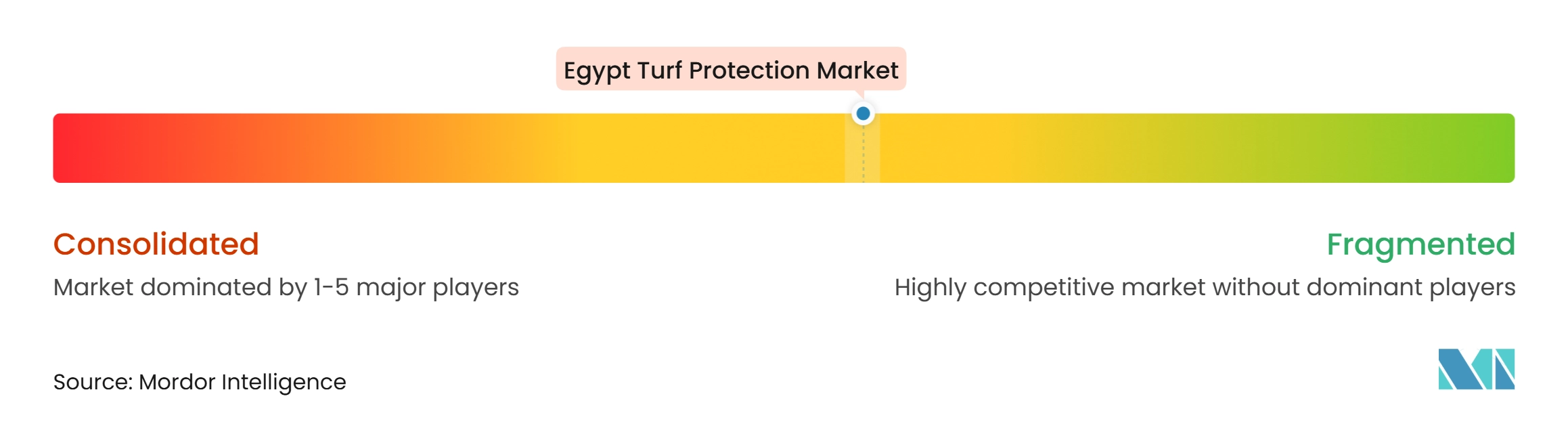
The Egypt turf protection market is moderately concentrated, with a group of leading international suppliers competing alongside importers, distributors, and specialized biological-input providers. Syngenta Group maintains a strong position through fungicide and herbicide registrations and a broader biologicals portfolio. The company reported double-digit global biologicals sales growth in 2025. BASF SE competes through fungicides, plant growth regulators, and herbicides used in planned turf-management programs. UPL Limited and Corteva Agriscience serve landscaping and sports-field requirements through broad crop-protection portfolios. The competitive structure leaves opportunities for differentiated suppliers with specialized products and technical support.
Envu uses a dedicated golf and fine-turf platform to support its strong position in the market. In July 2026, the company launched Signature XTRA Stressgard Liquid, a liquid fosetyl-aluminum formulation for golf and fine turf applications in the United States. It also introduced Tarvecta fungicide in May 2025 for soilborne disease control on golf courses, athletic fields, and sod farms. These launches demonstrate continued focus on disease management where high-value turf is particularly sensitive to heat and environmental stress. ICL Group Ltd. and Syngenta Group also released 2026 Ultimate Offers combining Primo Maxx II with turf nutrition and biostimulant packages. This type of bundled offering can make supplier programs more useful for professional turf managers. It also reflects competition based on integrated program design rather than individual products. Product development and technical support are likely to remain central to supplier differentiation.
The lower tier is fragmented and includes specialized biological, herbicide, insecticide, and water-management suppliers. Bioceres Crop Solutions Corp. and Plant Health Care plc have potential in biological products, although registration timelines remain important. Nufarm Limited and Gowan Company, L.L.C. compete in specialized crop-protection categories. American Vanguard Corporation and SePRO Corporation serve specialty insecticide and aquatic or turf-management requirements. The competitive landscape therefore separates technology-led suppliers from value-oriented providers. Technology-led firms invest in formulation development, biological pipelines, and technical services, while value-oriented suppliers compete on cost efficiency in municipal and institutional contracts. Both strategies are relevant because Egypt contains premium resorts alongside budget-sensitive public sites. This creates opportunities for suppliers offering differentiated products, localized technical support, and cost-effective turf-management programs.
Egypt Turf Protection Industry Leaders
-
Syngenta Group
-
Envu
-
BASF SE
-
Corteva Agriscience
-
UPL Limited
- *Disclaimer: Major Players sorted in no particular order
Egypt Turf Protection Market Companies Covered in this Report
- Syngenta Group
- Envu
- BASF SE
- Corteva Agriscience
- UPL Limited
- Nufarm Limited
- Sumitomo Chemical Co., Ltd.
- ICL Group Ltd.
- American Vanguard Corporation
- Bioceres Crop Solutions Corp.
- Plant Health Care plc
- The Andersons, Inc.
- Nutrien Ltd.
- SePRO Corporation
- Gowan Company, L.L.C.
Recent Industry Developments in Egypt Turf Protection Market
- July 2026: Envu’s Signature XTRA Stressgard Liquid fungicide, a liquid fosetyl-aluminum formulation developed for golf and fine-turf applications, strengthens the company’s turf portfolio for Egypt. Its focus on disease management and stress tolerance aligns with the needs of Egypt’s expanding golf courses, resorts, and professionally managed turf sites facing heat and water-related stress.
- May 2026: Legacy Hotels, a Talaat Moustafa Group hospitality subsidiary, partnered with Robert Trent Jones II Golf Course Architects to redesign and redevelop the Mena House golf course in Cairo. The project is estimated to support demand for turf protection products for turf establishment and ongoing maintenance.
- November 2025: The Agricultural Pesticides Committee approved 39 new pesticide registrations, including 10 raw materials, during Session No. 11/2025, expanding the range of registered turf-protection products available in Egypt.
Egypt Turf Protection Market Report Scope
For this study, the turf protection market is defined as products and solutions used to prevent, control, and reduce pest, disease, and stress damage in natural turfgrass across residential, commercial, and sports surfaces, with market value measured at the point of sale in USD.
Scope exclusions: Synthetic turf installation materials and heavy temporary event flooring panels are not counted in this market sizing.
The Egypt Turf Protection Market Report is segmented by Product Type (Fungicides, Herbicides, Insecticides, Plant Growth Regulators, and Biostimulants and Bio-fertilizers), by Application (Landscaping, Golf Courses, Sports Fields, and Sod Farms), by End-user (Residential Customers, Commercial Landscape Contractors, Sports Facility Owners, and Municipalities and Schools), by Mode of Action (Chemical, Biological, and Integrated Solutions), and by Formulation (Granular, Liquid Concentrate, and Wettable Powder). The Report Offers Forecasts in Terms of Value (USD).
Segmentation Overview
| Fungicides |
| Herbicides |
| Insecticides |
| Plant Growth Regulators |
| Biostimulants and Bio-fertilizers |
| Landscaping |
| Golf Courses |
| Sports Fields |
| Sod Farms |
| Residential Customers |
| Commercial Landscape Contractors |
| Sports Facility Owners |
| Municipalities and Schools |
| Chemical |
| Biological |
| Integrated Solutions |
| Granular |
| Liquid Concentrate |
| Wettable Powder |
| By Product Type | Fungicides |
| Herbicides | |
| Insecticides | |
| Plant Growth Regulators | |
| Biostimulants and Bio-fertilizers | |
| By Application | Landscaping |
| Golf Courses | |
| Sports Fields | |
| Sod Farms | |
| By End-user | Residential Customers |
| Commercial Landscape Contractors | |
| Sports Facility Owners | |
| Municipalities and Schools | |
| By Mode of Action | Chemical |
| Biological | |
| Integrated Solutions | |
| By Formulation | Granular |
| Liquid Concentrate | |
| Wettable Powder |
Key Questions Answered in the Report
What is the value of Egypt turf protection in 2026?
The Egypt turf protection market size is USD 37.81 million in 2026.
Which product category leads turf protection demand in Egypt?
Fungicides accounted for 38.2% of the Egypt turf protection market share in 2025
Which application is growing fastest in Egypt?
Sports fields are forecast to grow at the highest CAGR of 7.8% from 2026 to 2031.
What limits natural turf-care demand in Egypt?
Water scarcity, artificial-turf substitution, registration requirements, and limited specialized labor can constrain demand.