
Size and Share of Egypt Liquid Packaging Cartons Market
Market Overview
| Study Period | 2021 - 2032 |
|---|---|
| Forecast Data Period | 2027 - 2032 |
| Base Year Market Size (2026) | USD 13.91 Million |
| Market Size (2027) | USD 14.68 Million |
| Market Size (2032) | USD 20.56 Million |
| Growth Rate (2027 - 2032) | 6.97 % |
| Market Concentration | Medium |
Major Players *Disclaimer: Major Players sorted in no particular order Image © Mordor Intelligence. Reuse requires attribution under CC BY 4.0. | |
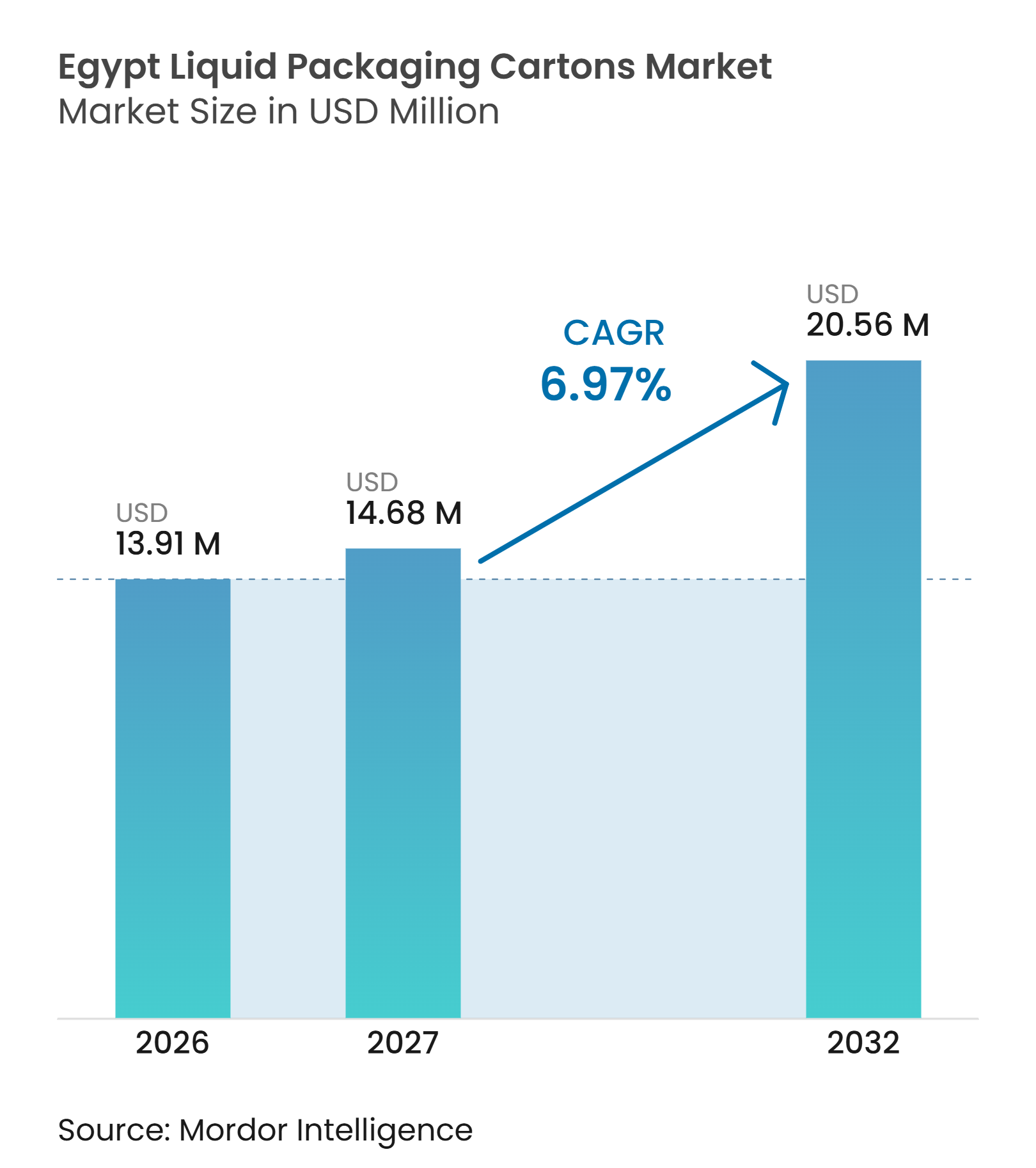
Analysis of Egypt Liquid Packaging Cartons Market by Mordor Intelligence
The Egypt liquid packaging cartons market size was valued at USD 13.91 million in 2026 and is estimated to grow from USD 14.68 million in 2027 to reach USD 20.56 million by 2032, at a CAGR of 6.97% during the forecast period (2027-2032). The Egypt liquid packaging cartons market benefits from demand for shelf-stable foods and beverages, especially where refrigerated distribution remains uneven. Packaged dairy, juice, and ready-to-drink products support recurring carton demand across retail, institutional, and export channels. Domestic aseptic capacity is expanding, which can shorten supply chains and improve access to local converters. Carton suppliers are also placing greater weight on recycling partnerships, quality controls, and local technical support as processor requirements become more demanding. At the same time, PET competition, high equipment costs, and foreign-exchange exposure continue to shape investment decisions in the Egypt liquid packaging cartons market.
Key Report Takeaways
- By product type, aseptic cartons held 69.74% of revenue in 2026 and are projected to expand at a 7.56% CAGR through 2032.
- By application, juices accounted for 36.48% of revenue in 2026, while energy and functional drinks are projected to expand at a 7.39% CAGR through 2032.
- By pack size, below-250-ml cartons held 45.93% of revenue in 2026, while 250-500-ml cartons are projected to expand at a 7.43% CAGR through 2032.
Note: Market numbers in this report are based on Mordor Intelligence's proprietary estimation framework, which combines nine months of actuals with Q4 projections for base year 2026.
Market Trends and Insights
Drivers Impact Analysis of Egypt Liquid Packaging Cartons Market*
| Driver | (~) % Impact on CAGR Forecast | Geographic Relevance | Impact Timeline |
|---|---|---|---|
| Convenient and Sustainable Packaging Demand | +2.1% | National, strongest in Greater Cairo, Alexandria, and Delta governorates | Medium term (2-4 years) |
| Food Safety and Hygiene Requirements | +1.5% | National, with early compliance gains in Cairo, Alexandria, and industrial corridors | Short term (≤ 2 years) |
| Packaged Dairy, Juice, and Beverage Consumption | +1.2% | National, with volume concentration in Cairo, Alexandria, and the Suez Canal corridor | Medium term (2-4 years) |
| Ambient and On-the-Go Product Demand | +0.9% | National, with greatest traction in urban governorates and tourism zones | Short term (≤ 2 years) |
| Regional Aseptic Packaging Supply Hub | +0.6% | Suez Canal Economic Zone, Ain Sokhna, and Qantara West Industrial Zone | Long term (≥ 4 years) |
| Local Carton Collection and Recycling Systems | +0.4% | Greater Cairo, 6th of October City, Sadat City, and Delta governorates | Long term (≥ 4 years) |
| Source: Mordor Intelligence | |||
Growing Demand for Convenient and Sustainable Packaging
Convenience and environmental considerations are supporting demand for compact beverage packaging in Egypt. Aseptic cartons allow products to remain stable at ambient temperatures, which suits distribution routes with inconsistent refrigerated storage. Smaller formats also allow households to manage each purchase while preserving access to branded products. This supports the Egypt liquid packaging cartons market because single-serve cartons can serve school, commuting, and convenience occasions. The broad printable surface of a carton also gives brands room for product information and clear visual differentiation. Brands can use that surface to communicate product information, handling guidance, and visible packaging attributes at the point of purchase.
Rising Food Safety and Hygiene Requirements
Food processors increasingly need packaging systems that support consistent hygiene control and clear product identification. Aseptic structures protect products through controlled processing, sealed filling, and multilayer barrier materials. These features are relevant to milk, juice, and other liquid products that travel along long distribution routes. Tamper-evident closures and traceable labeling also help processors manage retail and export requirements. The Egypt liquid packaging cartons market therefore benefits when processors upgrade packaging systems to meet higher operating standards. These upgrades favor packaging suppliers that can provide reliable technical support during line operation and product changeovers.
Expansion of Packaged Dairy, Juice, and Beverage Consumption
Demand from dairy, juice, and beverage processors creates a direct need for carton-filling capacity. Juice remains the largest application category, reflecting its established role in domestic consumption and export-oriented production. Aseptic formats help processors reach outlets where cold storage is limited or unavailable. They also help preserve products during transport to export markets. This demand base provides the Egypt liquid packaging cartons market with recurring volume across several beverage categories. Processors can balance domestic retail demand with export orders when their products retain stable quality through longer distribution cycles.
Increasing Demand for Ambient and On-the-Go Products
Urban retail and food-service channels favor formats that are portable, sealed, and easy to store. Cartons can meet those needs for juices, flavored dairy drinks, and functional beverages without depending on refrigerated handling. The below-250-ml format is particularly suited to impulse purchases and portion-controlled consumption. Its established role in school and institutional channels also provides a dependable volume base. These use cases support continued format innovation within the Egypt liquid packaging cartons market. They also create room for different closures, shapes, and carton designs that fit separate retail occasions.
Restraints Impact Analysis of Egypt Liquid Packaging Cartons Market*
| Restraint | (~) % Impact on CAGR Forecast | Geographic Relevance | Impact Timeline |
|---|---|---|---|
| High Aseptic Filling and Processing Line Investment | -1.2% | National, most acute for small and mid-size processors outside Greater Cairo | Long term (≥ 4 years) |
| Foreign-Exchange Exposure for Materials and Equipment | -0.9% | National, with greatest impact in import-dependent industrial clusters | Medium term (2-4 years) |
| Competition from Plastic, Glass, Pouches, and Metal | -0.7% | National, with PET competition most pronounced in dairy-dense corridors | Short term (≤ 2 years) |
| Limited Formal Collection and Recycling Infrastructure | -0.4% | Upper Egypt, Sinai, and rural Delta governorates with weak waste collection networks | Long term (≥ 4 years) |
| Source: Mordor Intelligence | |||
High Initial Investment in Carton Filling and Aseptic Processing Lines
Aseptic filling lines require major investment before a processor can begin commercial production. The expense includes filling equipment, UHT treatment systems, utilities, commissioning, and specialized operational controls. This hurdle is most difficult for smaller processors without access to large capital budgets. Costs can rise further outside the main industrial centers because installation and technical support are less accessible. As a result, established processors are better placed than smaller entrants to convert production into carton formats. The constraint can also slow capacity decisions even when a processor sees clear demand for ambient products.
Foreign-Exchange Exposure for Barrier Materials, Equipment, and Spare Parts
Carton production relies on materials and equipment that can be priced in foreign currencies. Paperboard, polymer layers, aluminum foil, spare parts, and specialized filling components can therefore raise costs when exchange conditions become unfavorable. The multilayer structure of aseptic cartons leaves converters exposed across several imported inputs. Processors may find it difficult to offset these increases through efficiency alone. This exposure can delay procurement decisions and constrain margins throughout the Egypt liquid packaging cartons market. Local material sourcing can reduce some exposure, but it does not eliminate the need for specialized equipment and components.
*Our forecasts treat driver/restraint impacts as directional, not additive. The impact forecasts reflect baseline growth, mix effects, and variable interactions.
Egypt Liquid Packaging Cartons Market Segment Analysis
By Product Type:
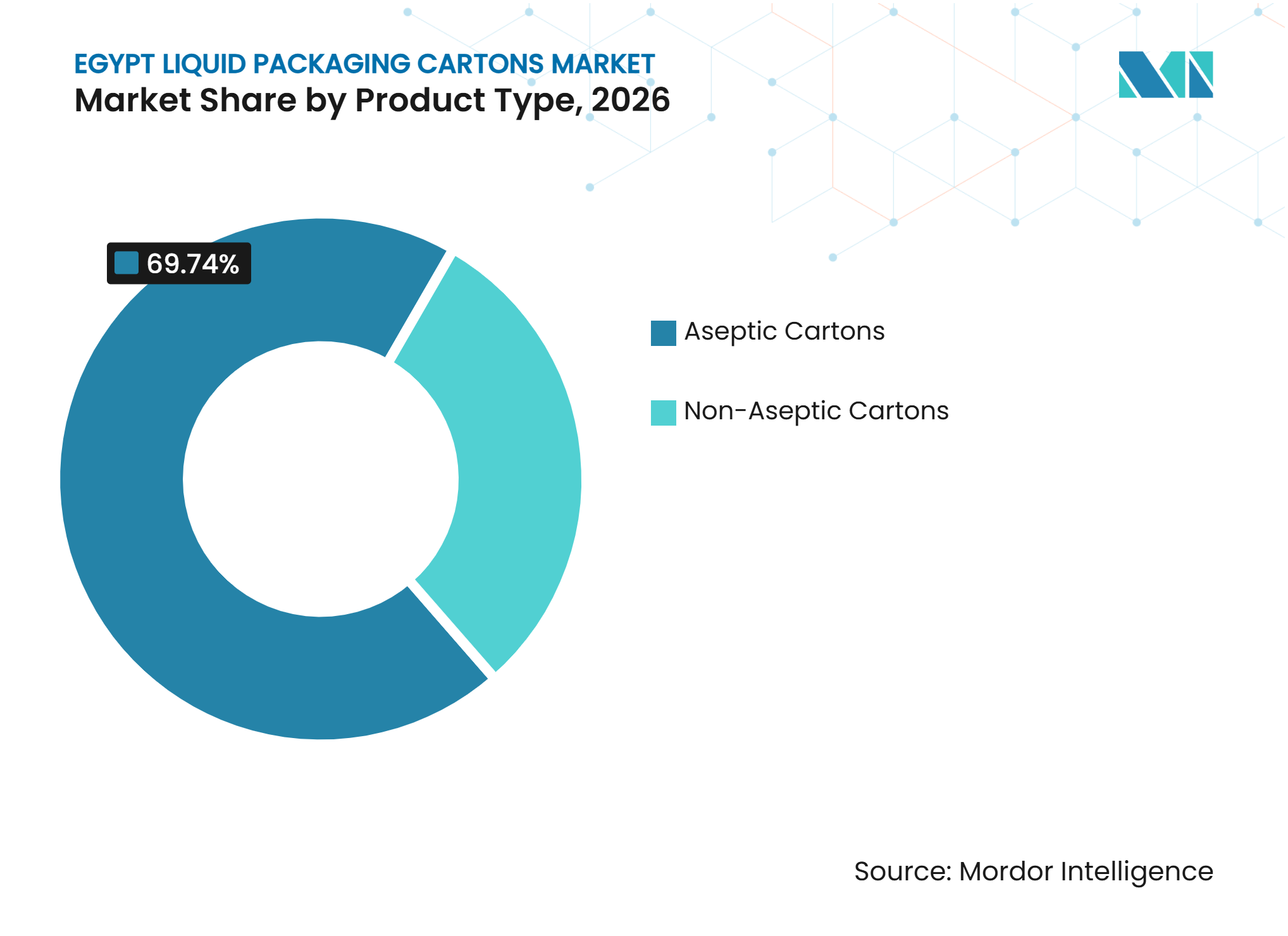
Aseptic Cartons Retain the Strongest PositionAseptic cartons accounted for 69.74% of the Egypt liquid packaging cartons market share in 2026 and are projected to expand at a 7.56% CAGR through 2032. Their position reflects the importance of ambient shelf life in a distribution system where refrigeration is not consistently available. Products can remain stable for extended periods without cold storage when they are processed and packed under aseptic conditions. This makes the format relevant for domestic retailers, institutional channels, and exporters serving distant markets.
The size of Egypt's liquid packaging cartons market for aseptic cartons is driven by the suitability of these cartons for dairy, juice, and ready-to-drink beverages. Local manufacturing investment can reduce material lead times and give processors more options for adapting pack specifications. Aseptic packaging also gives brand owners a controlled format for tamper evidence, labeling, and product presentation. SIG and its partners launched a closed-loop beverage carton recycling system in Egypt during September 2025, linking collection, sorting, and material recovery activities.[1] Non-aseptic cartons continue to serve chilled dairy and juice products, although their expansion depends on broader cold-chain availability.


By Application:
Juices Lead While Functional Drinks AdvanceJuices held 36.48% of the Egypt liquid packaging cartons market share in 2026. The category benefits from domestic beverage consumption, seasonal demand, and its relevance to processors that serve export channels. Cartons support ambient distribution of juice products and help preserve quality during lengthy transport and storage. Milk also remains important because established processors operate broad retail networks across Egypt.
Energy and functional drinks are projected to expand at a 7.39% CAGR through 2032, making them the fastest-growing application segment. Their development reflects greater consumer interest in convenient refreshment formats and products positioned for active consumption occasions. Shaped cartons and premium designs can help these brands stand apart from standard bottles and cans on retail shelves. Plant-based beverages, drinking yogurt, flavored cream, soups, sauces, and specialty liquids offer additional opportunities for the liquid packaging carton industry in Egypt.
By Pack Size:
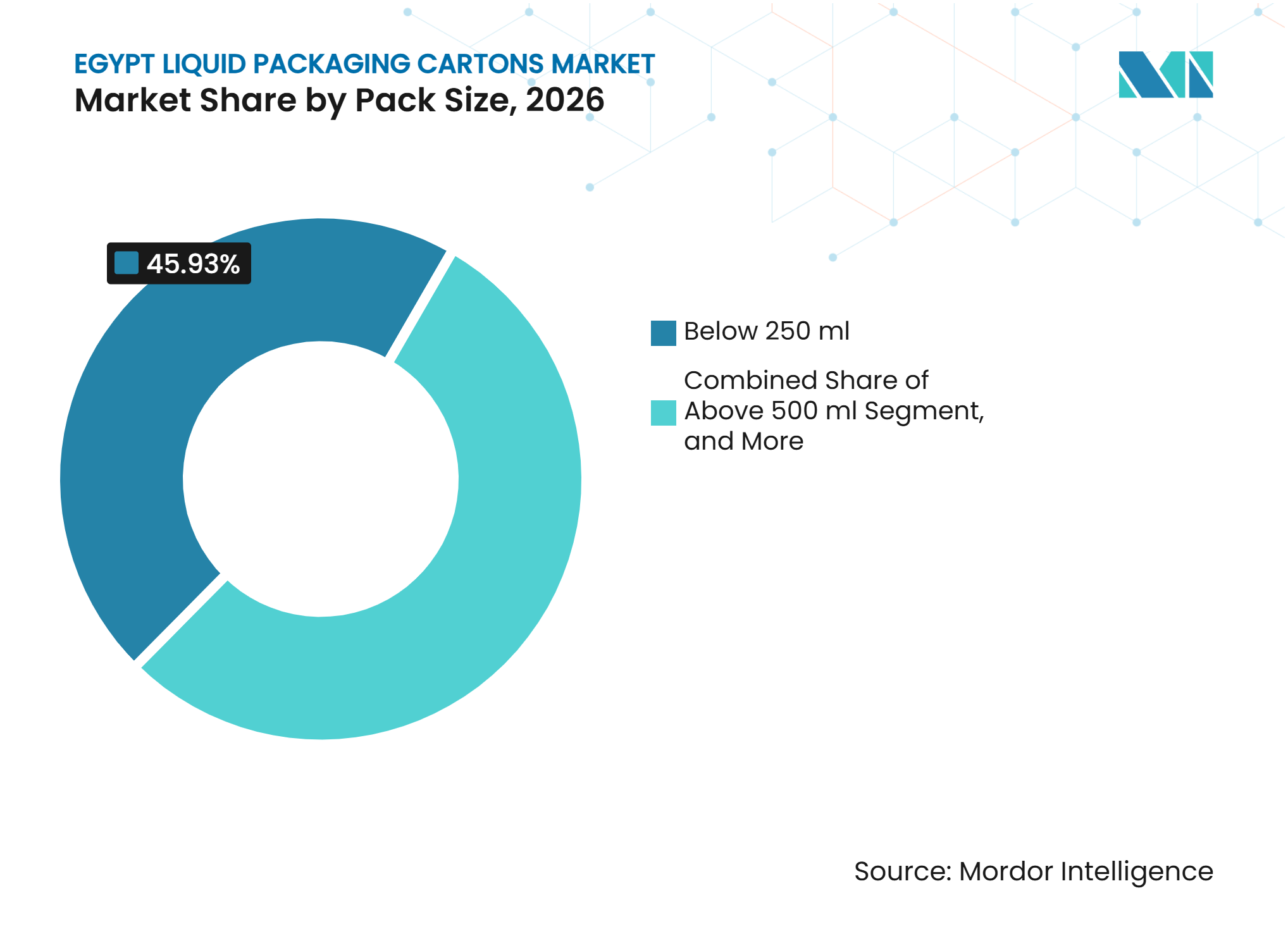
Small Packs Lead While Mid-Size Formats Gain GroundBelow-250-ml cartons captured 45.93% of revenue in 2026. Their lead is tied to school-channel distribution, impulse purchases, and consumers seeking manageable per-purchase spending. These cartons also fit well within institutional supply programs and modern convenience retail. Filling lines configured for high-volume small packs reinforce the category's presence in the Egypt liquid packaging cartons market.
The 250-500-ml category is projected to expand at a 7.43% CAGR through 2032. This format serves consumers who want more volume than a single-serve carton but don't want to switch to a large family pack. It is relevant for functional beverages and other products sold through convenience stores and modern trade. Above-500-ml cartons remain important for household and food-service demand, but inflation can constrain large-format purchases. Multipack offers can help brand owners retain household volume while keeping individual purchase values manageable.


Geography Analysis
Greater Cairo
Greater Cairo is the main consumption center for liquid cartons because it combines dense population, food and beverage production, and modern retail access. Processors in and around the metropolitan area can serve a wide set of grocery, food-service, and institutional accounts. Stronger distribution coverage supports both ambient and chilled products from a single operating base. The Egypt liquid packaging cartons market benefits from this concentration because large filling volumes can move quickly through established retail channels.[2] Small-format and convenience products are particularly relevant in areas with dense commuting and retail activity.
Alexandria and the Nile Delta
Alexandria and the Nile Delta form an important processing corridor for dairy, juice, and export-oriented food production. Agricultural proximity supports processors by reducing the distance between inputs and production sites. Port access also supports exports, especially for shelf-stable products that can travel without chilled distribution. The region's food plants therefore create continuing demand for aseptic carton filling. Competition from PET remains important in dairy applications, which encourages processors to maintain more than one packaging option.
Suez Canal Zone and Emerging Regions
The Suez Canal Economic Zone is gaining importance as a manufacturing location for aseptic packaging. New capacity in Ain Sokhna and planned capacity in Qantara West can improve domestic supply and extend Egypt's role in regional trade. This changes the Egypt liquid packaging cartons market from one centered on consumption toward one with stronger manufacturing potential. Access to shipping routes supports service to Europe, Africa, the Gulf, the Americas, and CIS markets.
Competitive Landscape
Market Concentration
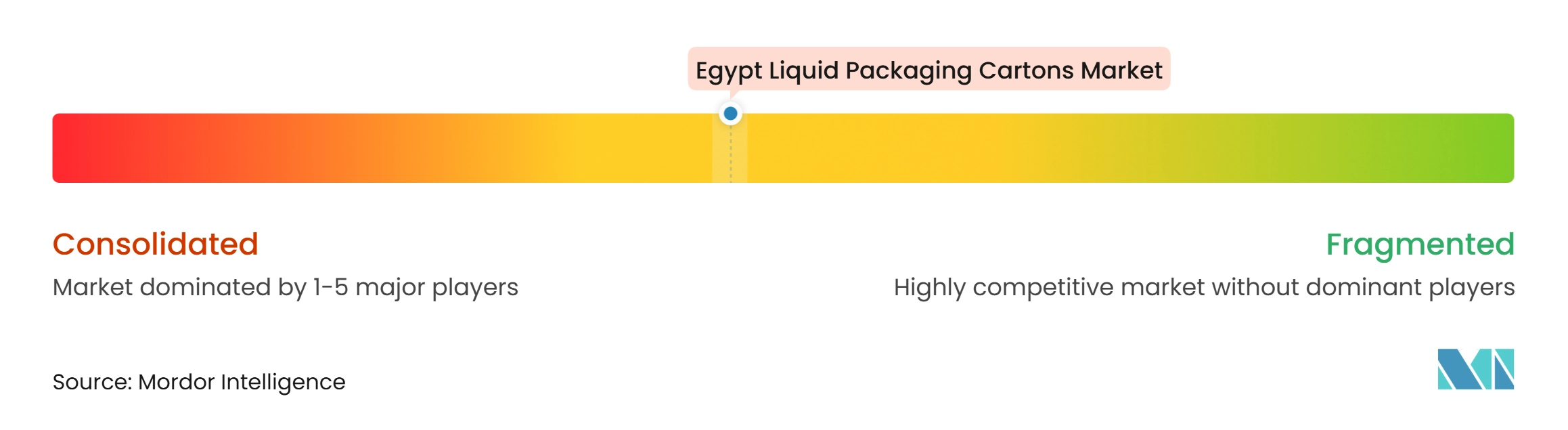
Global carton suppliers retain strong positions because many dairy and juice processors have long-standing relationships with their installed filling systems. Tetra Pak International S.A. and SIG Group AG are established participants in the Egypt liquid packaging cartons market. Greatview Aseptic Packaging Co. Ltd., Shandong Bihai Packaging Materials Co. Ltd., IPI S.r.l., and regional suppliers add price and format competition. Local capacity additions are shifting the balance by providing customers with more supply options closer to their filling facilities.
UFlex's Asepto facility in Ain Sokhna added domestic aseptic manufacturing capacity during 2026. Its investment can shorten lead times and offer local customization for processors.[3]Eroğlu Global's planned Qantara West facility is expected to further broaden the supply base once operational. SIG's September 2025 recycling initiative, developed with GIZ Egypt, Plastic Bank, Carta Misr, and TileGreen, provides a distinct circularity proposition for beverage brands.
Competition is also moving beyond price toward quality assurance, recycling partnerships, and local technical service. Digital laboratory systems can support aseptic quality control as production capacity increases. Suppliers with established regional networks can offer procurement and distribution support across North Africa and nearby export markets. Open opportunities remain in food-processing clusters outside the main metropolitan regions. Plant-based beverages are another opportunity, as local carton supply remains less established for that application.
Leaders of Egypt Liquid Packaging Cartons Market
-
Tetra Pak International S.A.
-
SIG Group AG
-
Elopak ASA
-
Greatview Aseptic Packaging Co. Ltd.
-
Nippon Paper Industries Co., Ltd.
- *Disclaimer: Major Players sorted in no particular order
Egypt Liquid Packaging Cartons Market Companies Covered in this Report
- Tetra Pak International S.A.
- SIG Group AG
- Elopak ASA
- Greatview Aseptic Packaging Co. Ltd.
- Nippon Paper Industries Co., Ltd.
- UFlex Limited
- IPI S.r.l.
- Lami Packaging (Kunshan) Co. Ltd.
- Obeikan Industrial Investment Group
- Nampak Limited
- Italpack S.r.l.
- Novolex Holdings, LLC
- Shandong Bihai Packaging Materials Co. Ltd.
- Southern Packaging Group Ltd.
- Lamipak (Suzhou) Co., Ltd.
- Xiamen Hexing Packaging Group Co., Ltd.
Recent Industry Developments in Egypt Liquid Packaging Cartons Market
- September 2026: UFlex's aseptic packaging arm Asepto inaugurated its USD 126 million greenfield facility in Ain Sokhna within Egypt's Suez Canal Economic Zone, adding 12 billion aseptic carton packs of annual capacity and raising the company's combined India-Egypt capacity to approximately 24 billion packs per year. The plant uses 2 Heidelberg Boardmaster printing lines and an SML extrusion line. It targets Europe, Africa, the Gulf, the Americas, and CIS export markets via Suez Canal shipping routes.
- April 2026: ABB secured an order from Flex Asepto Egypt, part of the UFlex Group, to supply L&W laboratory testing instruments and a Lab Management System for the Ain Sokhna aseptic packaging facility. The system integrates real-time quality-control dashboards with production KPIs. It extends ABB's established instrumentation deployment from Asepto's Sanand, India plant to the new Egyptian operation.
- January 2026: Tetra Pak Egypt Area and Zulfa, an Alushibe Group subsidiary, commenced operations at a EUR 14 million (USD 15.1 million) greenfield facility in Benghazi, Libya. The 140,000-m² plant features UHT and pasteurization systems and 3 filling lines for milk and juice. It expands Tetra Pak's Egypt Area operating footprint into the Libyan market for the first time.
- January 2026: Egypt's Suez Canal Economic Zone Authority signed a USD 175 million agreement with Türkiye-based Eroğlu Global Holding to build a carton and packaging factory in the Qantara West Industrial Zone. The project targets production of 10 million 1-liter aseptic carton packages and 75,000 carton boxes daily, plus 400,000 tonnes of paperboard sheets annually. Approximately 2,000 direct jobs are expected, with 50% of output earmarked for export markets. This capacity can broaden local availability of carton materials while supporting export-oriented manufacturing.
Scope of Report on Egypt Liquid Packaging Cartons Market
The Egypt liquid packaging cartons market comprises cartons designed to package and preserve liquid food and beverage products, including milk, juices, dairy drinks, and other beverages. These cartons typically use multilayer materials, such as paperboard, polyethylene, and aluminum, to protect products from contamination, extend shelf life, and support convenient storage and transportation.
The Egypt Liquid Packaging Cartons Market Report is Segmented by Product Type (Aseptic Cartons, and Non-Aseptic Cartons), Applications (Milk, Juices, Plant Based Beverages, Dairy Products Excluding Milk, Energy and Functional Drinks, Liquid Food, and Other Applications), and Pack Size (Below 250 Ml, 250-500 Ml, and Above 500 Ml). The Market Forecasts are Provided in Terms of Value (USD).
Segmentation Overview
| Aseptic Cartons |
| Non-Aseptic Cartons |
| Milk |
| Juices |
| Plant Based Beverages |
| Dairy Products (Excluding Milk) |
| Energy and Functional Drinks |
| Liquid Food |
| Other Applications |
| Below 250 ml |
| 250-500 ml |
| Above 500 ml |
| By Product Type | Aseptic Cartons |
| Non-Aseptic Cartons | |
| By Applications | Milk |
| Juices | |
| Plant Based Beverages | |
| Dairy Products (Excluding Milk) | |
| Energy and Functional Drinks | |
| Liquid Food | |
| Other Applications | |
| By Pack Size | Below 250 ml |
| 250-500 ml | |
| Above 500 ml |
Key Questions Answered in the Report
What is the Egypt liquid packaging cartons market size?
The market is valued at USD 13.91 million in 2026, is estimated at USD 14.68 million in 2027, and is forecast to reach USD 20.56 million by 2032. The outlook reflects ongoing demand for shelf-stable beverage and liquid-food formats. It also incorporates the current base of packaged dairy, juice, and ready-to-drink consumption.
What is the projected growth rate for liquid packaging cartons in Egypt?
The market is projected to grow at a 6.97% CAGR from 2027 to 2032. Growth is supported by aseptic use in dairy, juices, ready-to-drink products, and other ambient distribution applications. New local manufacturing capacity may improve access to carton supply for processors.
Which product type leads liquid carton demand in Egypt?
Aseptic cartons lead with 69.74% share in 2026 and are projected to grow at a 7.56% CAGR through 2032. Their advantage comes from long shelf life without continuous refrigerated distribution. This format is particularly useful where retail distribution reaches beyond established cold-chain coverage.
Which application has the strongest growth outlook?
Energy and functional drinks are projected to grow at a 7.39% CAGR through 2032. Juices remain the largest application segment, supported by domestic consumption and export-oriented beverage processing. Other applications include plant-based beverages, dairy drinks, liquid foods, and specialty products.
Which carton size has the highest growth outlook?
The 250-500-ml format is projected to expand at a 7.43% CAGR through 2032. Below-250-ml packs lead current demand because they serve institutional, school, impulse, and convenience occasions. Format choice allows brand owners to address different household budgets and consumption needs.