
EdTech Marketing Services Market Size and Share
Market Overview
| Study Period | 2020 - 2031 |
|---|---|
| Market Size (2026) | USD 4.89 Billion |
| Market Size (2031) | USD 7.36 Billion |
| Growth Rate (2026 - 2031) | 8.52 % |
| Fastest Growing Market | Asia-Pacific |
| Largest Market | North America |
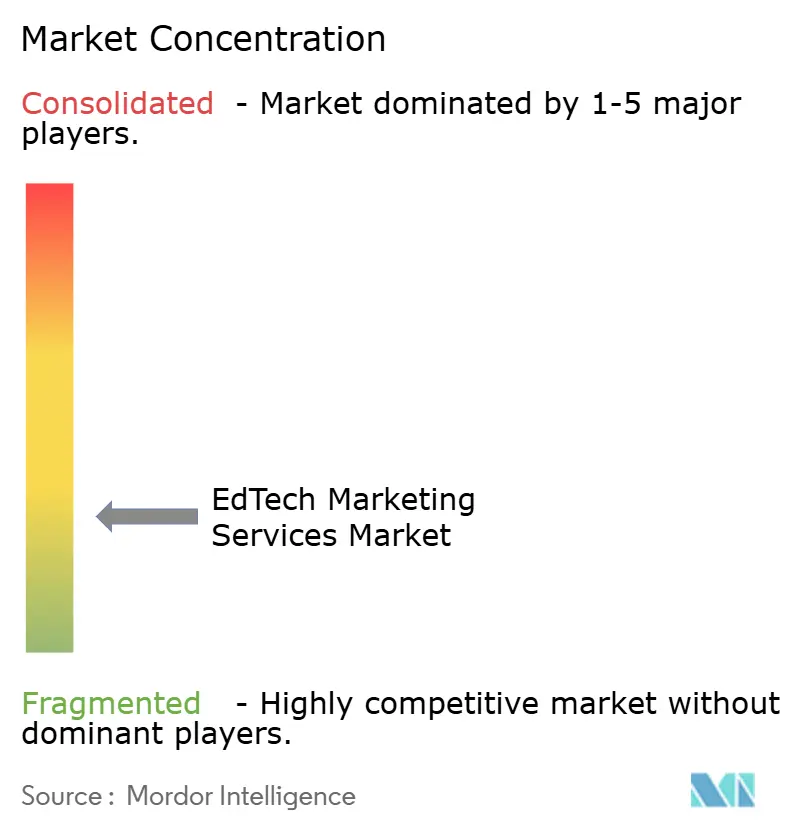
| Market Concentration | Low |
Major Players *Disclaimer: Major Players sorted in no particular order Image © Mordor Intelligence. Reuse requires attribution under CC BY 4.0. | |
EdTech Marketing Services Market Analysis by Mordor Intelligence
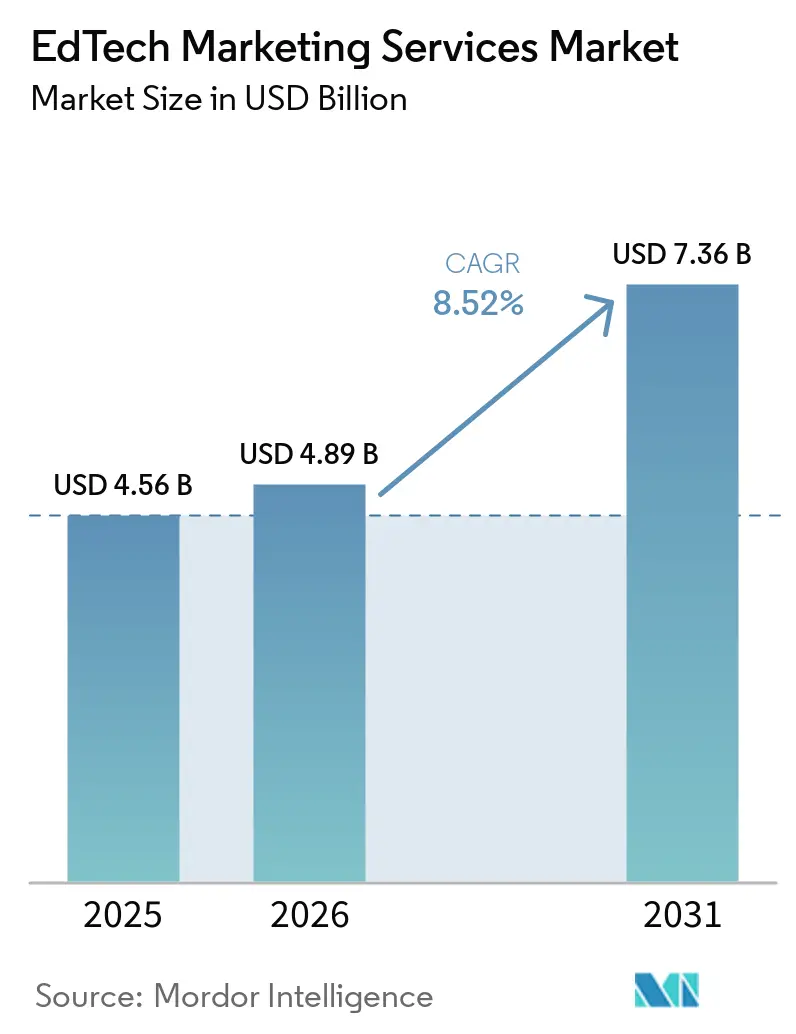
The EdTech marketing services market size is projected to expand from USD 4.56 billion in 2025 and USD 4.89 billion in 2026 to USD 7.36 billion by 2031, registering a CAGR of 8.52% between 2026 and 2031. The EdTech marketing services market is growing as higher education providers, online learning platforms, and professional development organizations compete for qualified learners and seek more reliable ways to manage enrollment demand. Institutions are moving beyond general lead generation toward enrollment programs that use first-party data, revenue attribution, and coordinated communication across search, social, email, websites, and admissions teams. This shift expands service needs beyond paid media to include customer relationship management integration, content visibility, lifecycle communication, reporting, and learner engagement that continues after an initial inquiry. Providers are also adapting their strategies as generative AI changes how prospective students discover programs, compare options, and reach a provider's website or application pathway.
Key Report Takeaways
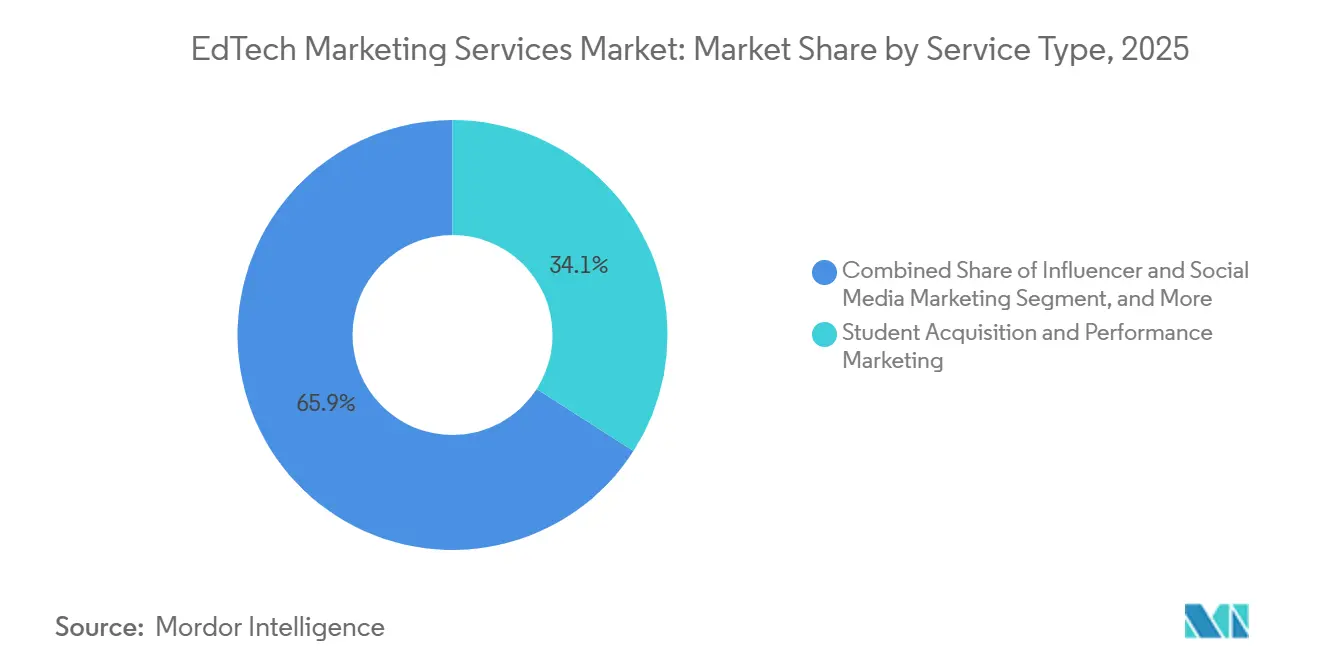
- By service type, Student Acquisition and Performance Marketing held 34.08% of the EdTech marketing services market share in 2025, while Strategy, Analytics and Martech Integration is projected to expand at a 9.16% CAGR through 2031.
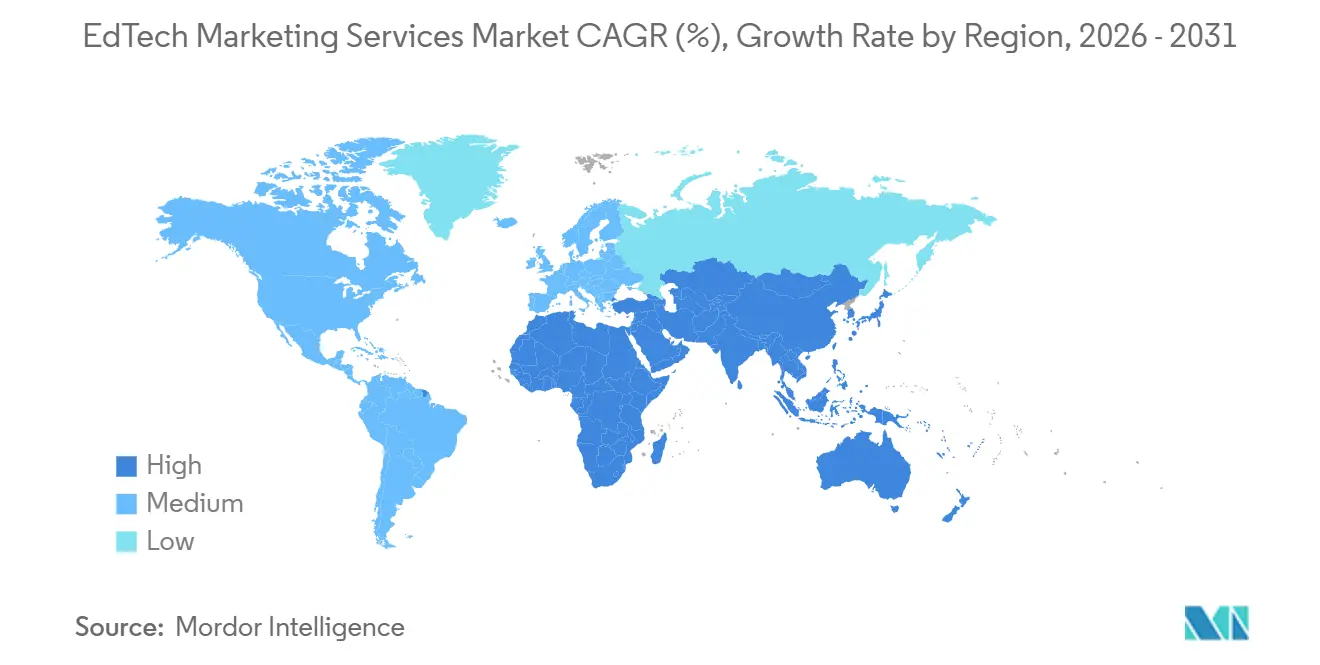
- By geography, North America accounted for a 40.13% share in 2025, while Asia-Pacific is projected to grow at a 9.23% CAGR through 2031.
Note: Market size and forecast figures in this report are generated using Mordor Intelligence’s proprietary estimation framework, updated with the latest available data and insights as of January 2026.
Market Trends and Insights
Drivers Impact Analysis of EdTech Marketing Services Market*
| Driver | (~) % Impact on CAGR Forecast | Geographic Relevance | Impact Timeline |
|---|---|---|---|
| Greater Adoption of AI-Powered Personalization and Marketing Automation | +2.1% | Global, with concentrated near-term relevance in North America and Asia-Pacific | Medium term (2-4 years) |
| Rising Need for Measurable Student Acquisition Efficiency | +1.8% | Global, with early adoption in North America and rapid spread to Europe and Asia-Pacific | Short term (≤ 2 years) |
| Growth in Online and Hybrid Learning Offerings | +1.5% | Global, with the strongest relevance in Asia-Pacific and North America | Medium term (2-4 years) |
| Expansion of International Student Recruitment and Cross-Border Enrollment | +1.3% | Asia-Pacific, Europe, the Middle East, and Africa | Medium term (2-4 years) |
| AI Answer-Engine Visibility Becoming a New Demand-Capture Layer | +0.9% | North America and Europe, with emerging relevance in Asia-Pacific | Short term (≤ 2 years) |
| Creator-Led Trust Signals Improving Conversion in High-Consideration Education Purchases | +0.7% | Global, with strong adoption among Gen Z-focused EdTech brands in North America and Asia-Pacific | Medium term (2-4 years) |
| Source: Mordor Intelligence | |||
Greater Adoption of AI-Powered Personalization and Marketing Automation
AI-powered personalization became a core operating priority in higher education marketing during 2025 and 2026. Research on higher education marketing identified data-based segmentation, predictive enrollment management, personalized communication, digital student journeys, and governance as linked areas of practice. The research shows that AI use affects institutional accountability and tuition-revenue planning, rather than serving only as a campaign efficiency tool. Within the EdTech marketing services market, this expands the role of strategy, analytics, and marketing technology integration teams. Institutions need service partners that can audit data practices, connect approved data flows with enrollment workflows, train staff on new processes, and avoid adding disconnected tools. In April 2026, NMIMS University deployed Salesforce Agentforce Marketing and Education solutions across its admissions process, using real-time data integration and personalized digital engagement. Providers that connect predictive enrollment intelligence with customer relationship management workflows can offer a more complete service than agencies focused only on media execution.
Rising Need for Measurable Student Acquisition Efficiency
Rising media costs and constrained institutional budgets are shifting attention from inquiry volume toward cost per enrollment. EducationDynamics reported that non-brand paid-search cost per click rose 30.9% year over year in 2025. The same report found that stealth applicants accounted for 9.7% of applications in 2026, compared with 1% in 2020, making conventional lead-based reporting less complete. These students conduct independent research before entering an inquiry funnel, so institutions need to understand the contribution of search, content, brand exposure, and direct visits. The EdTech marketing services market has a greater need for attribution programs that identify early research signals across multiple channels and link them to application and enrollment outcomes. Agencies that trace a learner's research path and improve conversion processes can distinguish their work from basic paid media management.
Growth in Online and Hybrid Learning Offerings
Online and hybrid program growth is widening the potential client base for the EdTech marketing services market. Each digital program launch requires learner acquisition, content discovery, admissions support, and continued engagement, and many institutional marketing teams lack the capacity to deliver all of those functions internally. Digital programs can reach learners beyond a campus catchment area, requiring attention to different locations, language preferences, program formats, and discovery channels. This creates a service need that extends beyond an initial advertising campaign, as institutions must maintain clear communication throughout the learner's decision-making process. In April 2026, NMIMS University deployed Salesforce solutions across its lead-to-admission process, illustrating the use of connected data and personalized engagement at a large institution. These deployments create demand for implementation, campaign design, measurement, and operational support after the technology is adopted.
Expansion of International Student Recruitment and Cross-Border Enrollment
International recruitment is increasing the need for multilingual content and locally relevant student communications. Statistics Canada estimated a 26% decline in Canada's international student population in 2025-2026. This change encourages institutions and their service partners to reconsider the countries, program messages, and channels used for recruitment. Recruitment teams must adapt content to different academic expectations, family decision processes, language needs, and digital discovery habits. The Institute of International Education's Spring 2026 Snapshot drew on responses from 585 U.S. higher education institutions, showing that international recruitment remained an active institutional priority.[1] The EdTech marketing services market benefits when institutions need coordinated campaigns across multiple source countries, and service providers need platform expertise and culturally appropriate content to support prospective students.
Restraints Impact Analysis of EdTech Marketing Services Market*
| Restraint | (~) % Impact on CAGR Forecast | Geographic Relevance | Impact Timeline |
|---|---|---|---|
| Tightening Privacy and Consent Requirements for Student Data Use | -1.2% | Global, with the greatest relevance in North America and Europe | Short term (≤ 2 years) |
| Rising Media Costs and Keyword Competition in Education Advertising | -1.0% | Global, with the highest cost pressure in North America and the United Kingdom | Short term (≤ 2 years) |
| Zero-Click Search and AI Summaries Reducing Attributable Web Traffic | -0.8% | Global, with particular relevance for paid-search-dependent institutions in North America and Europe | Medium term (2-4 years) |
| Fragmented CRM and Student Data Stacks Limiting Lifecycle Activation | -0.6% | Global, with pronounced relevance for mid-tier institutions in North America and emerging markets | Long term (≥ 4 years) |
| Source: Mordor Intelligence | |||
Tightening Privacy and Consent Requirements for Student Data Use
Student-data rules limit the targeting and profiling practices that support many education marketing programs. In January 2025, the Federal Trade Commission finalized changes to the Children's Online Privacy Protection Rule that require separate parental consent for the disclosure of children's data to third parties, including for targeted advertising. The rule also requires parents to separately consent to certain uses of children’s data, which narrows the data available for K-12 audience-building activities. Institutions serving U.S. and European learners also need to address requirements under FERPA and the General Data Protection Regulation in their data practices. The EdTech marketing services market must support consent management, approved data flows, limited access controls, and clear accountability for the use of student information. These requirements raise delivery costs, lengthen campaign preparation, and create a compliance barrier for smaller agencies with limited legal and technical resources.
Rising Media Costs and Keyword Competition in Education Advertising
Paid-search inflation is weakening the economics of some student acquisition campaigns. EducationDynamics reported a 30.9% increase in non-brand paid-search cost per click in 2025. Everspring reported in 2025 that university pages can receive 70%-90% lower click-through rates when AI Overviews appear in search results. Institutions may therefore pay more for traffic while receiving fewer visits and having less certainty over which contacts will progress to application. This puts greater importance on brand terms, program-specific searches, landing-page conversion, content visibility, and budget allocation in the EdTech marketing services market. Agencies that depend on a percentage of media spending face pressure when clients move routine media buying in-house.
*Our forecasts treat driver/restraint impacts as directional, not additive. The impact forecasts reflect baseline growth, mix effects, and variable interactions.
EdTech Marketing Services Market Segment Analysis
By Service Type:
Performance Marketing Leads While Data Integration Gains MomentumStudent Acquisition and Performance Marketing commanded a 34.08% share of the EdTech marketing services market in 2025. Its position reflects long-standing institutional demand for services that connect marketing activity with admissions outcomes, including cost per inquiry and cost per enrollment. The segment remains important because many institutions still treat enrollment marketing as a directly measured operating cost. Higher advertising prices and independent student research behavior, however, make conventional lead-generation reporting less complete. This has increased the value of services that combine paid acquisition with broader attribution and conversion work.
Strategy, Analytics, and Martech Integration is projected to record the highest CAGR of 9.16% through 2031. The EdTech marketing services market size for this segment is supported by demand for connected data systems that replace fragmented marketing tools. Research on Indonesian universities found that the quality of AI-based recommendations and interactions can affect application intention, with institutional trust mediating the effect. Carnegie Higher Ed reported an average AI visibility score of 35% in its 2026 institutional audits.[2] This gap supports demand for answer-engine visibility work and for advisory services that align content, analytics, and enrollment systems. Content and search services also need to account for generative AI retrieval rather than only traditional keyword rankings.

Geography Analysis
North America EdTech Marketing Services Market
North America held 40.13% of the EdTech marketing services market share in 2025. The region is supported by a large base of U.S. public and private universities, established enrollment agencies, performance-based service contracts, and a mature group of technology suppliers. Institutions often need external support to connect marketing programs with admissions systems and to measure results through the enrollment process. The Institute of International Education confirmed that international recruitment remained a priority for the 585 U.S. institutions represented in its Spring 2026 Snapshot IIE.ORG. Canada faced a different situation, with Statistics Canada estimating a 26% decline in international students in 2025-2026. This can redirect institutional budgets toward domestic recruitment, program messaging, and brand management while retaining a need for specialized services.
APAC EdTech Marketing Services Market
Asia-Pacific is projected to grow at a 9.23% CAGR through 2031, the fastest rate among the regions. The region's position in the EdTech marketing services market is linked to large digital learner populations, growing interest in cross-border enrollment, and the increasing use of digital channels across higher education and professional learning. Institutions must manage different language requirements, media platforms, admission expectations, and learner preferences across the region. In April 2026, NMIMS University deployed Salesforce tools for personalized engagement across its lead-to-admission process. Such adoption creates related demand for data integration, implementation, campaign management, and performance measurement services. Local expertise is important because a program that works in one Asia-Pacific country may not align with the platforms or communication practices used in another.
EMEA and South America EdTech Marketing Services Market
Europe is developing greater demand for multilingual education marketing as institutions compete for international learners. The EdTech marketing services market size in Europe is supported by programs that need localized content, media planning, and communications that reflect different national settings. Institutions may use a wider range of recruitment channels when their target learners are spread across countries and language groups. Service firms need to understand local regulation, content requirements, and student decision processes. South America, the Middle East, and Africa have smaller positions, supported by private education activity and the increasing use of digital advertising. These markets need programs that fit local access, language, and platform conditions.
Competitive Landscape
The EdTech marketing services market is fragmented because agencies, technology providers, and online program management firms serve different parts of the institutional budget. EAB Global, Carnegie, SimpsonScarborough, and EducationDynamics compete through institutional relationships, enrollment data, service expertise, and platform capability, while other providers focus on paid media, content operations, student communications, conversion support, or marketing technology. EducationDynamics acquired United Kingdom-based Net Natives in June 2026, combining Net Natives' Akero attribution platform with EducationDynamics' EDDY Intelligence offering.[3] The combined organization serves more than 400 institutional clients across more than 50 countries. The transaction shows that providers are seeking connected data and attribution capabilities as well as geographic reach.
Noodle Partners acquired Unsaddl in April 2026 to expand its Scholars Network with employer-sponsored student loan repayment and tuition reimbursement technology.[4] The acquisition extended Noodle's offering across learner financing, employer relationships, education pathways, and the services available after a student begins a program. EducationDynamics launched the EDDY Intelligence Platform in February 2026, combining predictive enrollment modeling, AI engagement agents, and institution-specific AI systems. These moves shift competition in the EdTech marketing services market toward integrated platforms that connect intelligence, outreach, and measurement across institutional workflows. Smaller agencies may find it difficult to fund the legal, technical, and data-governance work required for privacy-safe attribution.
Opportunity remains in answer-engine optimization, multilingual recruitment, and lifecycle marketing for subscription-based education platforms. Institutions that have not adjusted their content for AI-led discovery may need specialized support to improve how program information is structured and found. Non-Anglophone institutions competing for international learners may also need localized campaign planning and platform knowledge. The EdTech marketing services market also faces pressure from enterprise customer relationship management providers, AI-agent vendors, and international recruitment platforms. The competitive structure remains diverse because no provider is described as controlling the complete service stack.
EdTech Marketing Services Industry Leaders
-
EAB Global, Inc.
-
Keystone Education Group
-
EducationDynamics, LLC
-
Liaison International, Inc.
-
Noodle Partners, LLC
- *Disclaimer: Major Players sorted in no particular order
EdTech Marketing Services Market Companies Covered in this Report
- EAB Global, Inc.
- Keystone Education Group
- EducationDynamics, LLC
- Liaison International, Inc.
- Noodle Partners, LLC
- Carnegie Dartlet LLC
- Archer Education, Inc.
- OHO Interactive, LLC
- SimpsonScarborough, LLC
- Search Influence, LLC
- Everspring, Inc.
- Keypath Education
- ApplyBoard Inc.
- Element451, Inc.
- Encoura, LLC
- Intead LLC
Recent Industry Developments in EdTech Marketing Services Market
- July 2026: Encoura and Element451 showcased Encoura Connect at the Encoura and RNL National Conference. The platform embeds Encoura's predictive enrollment intelligence directly into Element451's Bolt AI agents, enabling enrollment teams to move from data insight to automated student outreach within a single system covering more than 350 higher education institutions.
- June 2026: EducationDynamics acquired UK-based Net Natives, a global technology-enabled enrollment marketing agency known for its Akero attribution and performance platform. The combined organization serves over 400 institutional clients across 50+ countries and plans to integrate Net Natives' audience capabilities with the EDDY Intelligence Platform, delivering a single growth-partner model from institutional insight to enrolled student.
- April 2026: Noodle Partners acquired Unsaddl, an education benefits technology provider enabling employer-sponsored student loan repayment and tuition reimbursement. The acquisition expands Noodle's Scholars Network, which connects learners, universities, lenders, and employers to create debt-reduced pathways into high-need healthcare workforce roles, deepening Noodle's vertical integration across the student lifecycle.
- February 2026: EducationDynamics launched the EDDY Intelligence Platform, a higher education-specific AI ecosystem powered by Bay6.AI, combining predictive enrollment modeling, automated AI engagement agents, and custom institutional AI systems into a unified operating environment designed to replace legacy enrollment management architectures. The platform was unveiled at the InsightsEDU Conference and positions EducationDynamics as both a professional services firm and an AI product company.
Global EdTech Marketing Services Market Report Scope
The EdTech Marketing Services Market encompasses the range of marketing solutions and services that help education technology companies promote their products, platforms, and services to target audiences, including educational institutions, students, parents, educators, and corporate learning providers.
The EdTech Marketing Services Market Report is Segmented by Service Type (Student Acquisition and Performance Marketing, Content and SEO Services, Influencer and Social Media Marketing, Lifecycle and Retention Marketing, and Strategy, Analytics and Martech Integration) and Geography (North America, South America, Europe, Asia-Pacific, Middle East, and Africa). The Market Forecasts are Provided in Terms of Value (USD).
Segmentation Overview
| Student Acquisition and Performance Marketing |
| Content and SEO Services |
| Influencer and Social Media Marketing |
| Lifecycle and Retention Marketing |
| Strategy, Analytics and Martech Integration |
| North America | United States |
| Canada | |
| Mexico | |
| South America | Brazil |
| Argentina | |
| Chile | |
| Rest of South America | |
| Europe | Germany |
| United Kingdom | |
| France | |
| Italy | |
| Spain | |
| Rest of Europe | |
| Asia-Pacific | China |
| Japan | |
| India | |
| South Korea | |
| Australia | |
| Rest of Asia-Pacific | |
| Middle East | United Arab Emirates |
| Saudi Arabia | |
| Qatar | |
| Rest of Middle East | |
| Africa | South Africa |
| Egypt | |
| Nigeria | |
| Rest of Africa |
| By Service Type | Student Acquisition and Performance Marketing | |
| Content and SEO Services | ||
| Influencer and Social Media Marketing | ||
| Lifecycle and Retention Marketing | ||
| Strategy, Analytics and Martech Integration | ||
| By Geography | North America | United States |
| Canada | ||
| Mexico | ||
| South America | Brazil | |
| Argentina | ||
| Chile | ||
| Rest of South America | ||
| Europe | Germany | |
| United Kingdom | ||
| France | ||
| Italy | ||
| Spain | ||
| Rest of Europe | ||
| Asia-Pacific | China | |
| Japan | ||
| India | ||
| South Korea | ||
| Australia | ||
| Rest of Asia-Pacific | ||
| Middle East | United Arab Emirates | |
| Saudi Arabia | ||
| Qatar | ||
| Rest of Middle East | ||
| Africa | South Africa | |
| Egypt | ||
| Nigeria | ||
| Rest of Africa | ||
Key Questions Answered in the Report
What is the size of the EdTech marketing services market?
The EdTech marketing services market was USD 4.89 billion in 2026 and is projected to reach USD 7.36 billion by 2031 at an 8.52% CAGR. The figures point to continued demand for specialized enrollment, data, content, campaign, and learner-engagement support as institutions compete for qualified applicants across more digital channels.
What service type holds the largest share?
Student Acquisition and Performance Marketing held 34.08% share in 2025. It remains important because institutions seek measurable connections between marketing activity, prospective student response, application conversion, and final admissions outcomes throughout the recruitment cycle.
Which service type is expected to grow fastest?
Strategy, Analytics and Martech Integration is projected to expand at a 9.16% CAGR through 2031. The EdTech marketing services market is increasingly using connected data, analytics, and marketing technology services to support decisions across recruitment, admissions, content, and communication teams with shared performance information.
Which region is expected to grow fastest?
Asia-Pacific is projected to record a 9.23% CAGR through 2031. Its growth reflects digital learner populations, expanding online delivery, cross-border recruitment needs, and varied language and platform requirements across the region's many education systems. The EdTech marketing services market must address these different conditions through locally relevant content, platform selection, campaign measurement, and ongoing learner communication.
How are AI tools changing education marketing services?
Institutions are using AI for personalized engagement, predictive enrollment work, content visibility, and integrated admissions workflows. The EdTech marketing services market is responding with greater demand for implementation, measurement, governance, staff-support, and data-integration services that connect technology with operational enrollment work and approved data practices.
What restricts education marketing service growth?
Privacy requirements, higher media costs, AI-led zero-click search behavior, and fragmented student data systems can limit campaign efficiency. These issues require providers to improve consent management, attribution, content planning, conversion processes, and coordination with institutional technology and admissions teams before campaign activity begins. The EdTech marketing services market also needs service models that can work within these limits.