
Diacetone Alcohol Market Size and Share
Market Overview
| Study Period | 2021 - 2031 |
|---|---|
| Market Size (2026) | USD 1.42 Billion |
| Market Size (2031) | USD 1.82 Billion |
| Growth Rate (2026 - 2031) | 5.09 % |
| Fastest Growing Market | Asia-Pacific |
| Largest Market | Asia-Pacific |
| Market Concentration | Medium |
Major Players *Disclaimer: Major Players sorted in no particular order Image © Mordor Intelligence. Reuse requires attribution under CC BY 4.0. | |
Diacetone Alcohol Market Analysis by Mordor Intelligence
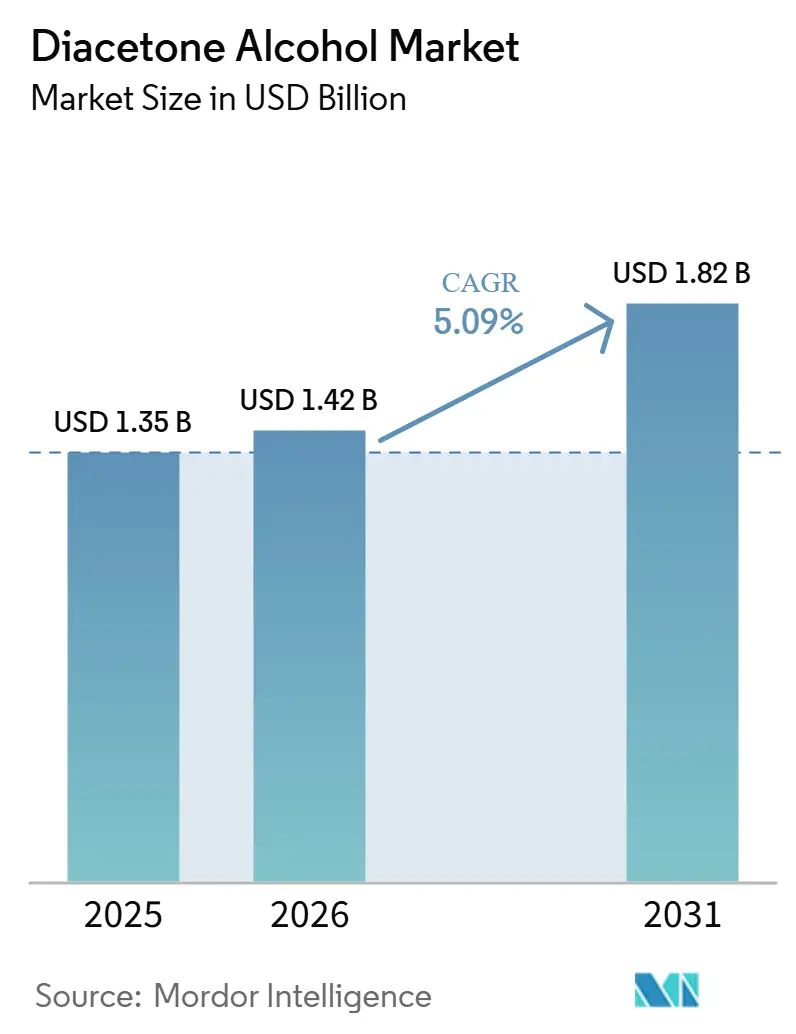
The diacetone alcohol market size is projected to expand from USD 1.35 billion in 2025 and USD 1.42 billion in 2026 to USD 1.82 billion by 2031, and is expected to register a CAGR of 5.09% between 2026 and 2031. Diacetone alcohol serves both as an oxygenated solvent and as a reactive intermediate, which limits reliance on any single end-use sector. Its alcohol and ketone groups support separate uses in coatings formulations and chemical production. Regulatory limits on volatile organic compounds are steering formulators toward lower-reactivity oxygenated solvents. Producers are also seeking higher-purity grades for regulated and technically demanding applications. These factors support the diacetone alcohol market as buyers place greater value on consistent performance, compliance documentation, and secure supply.
Key Report Takeaways
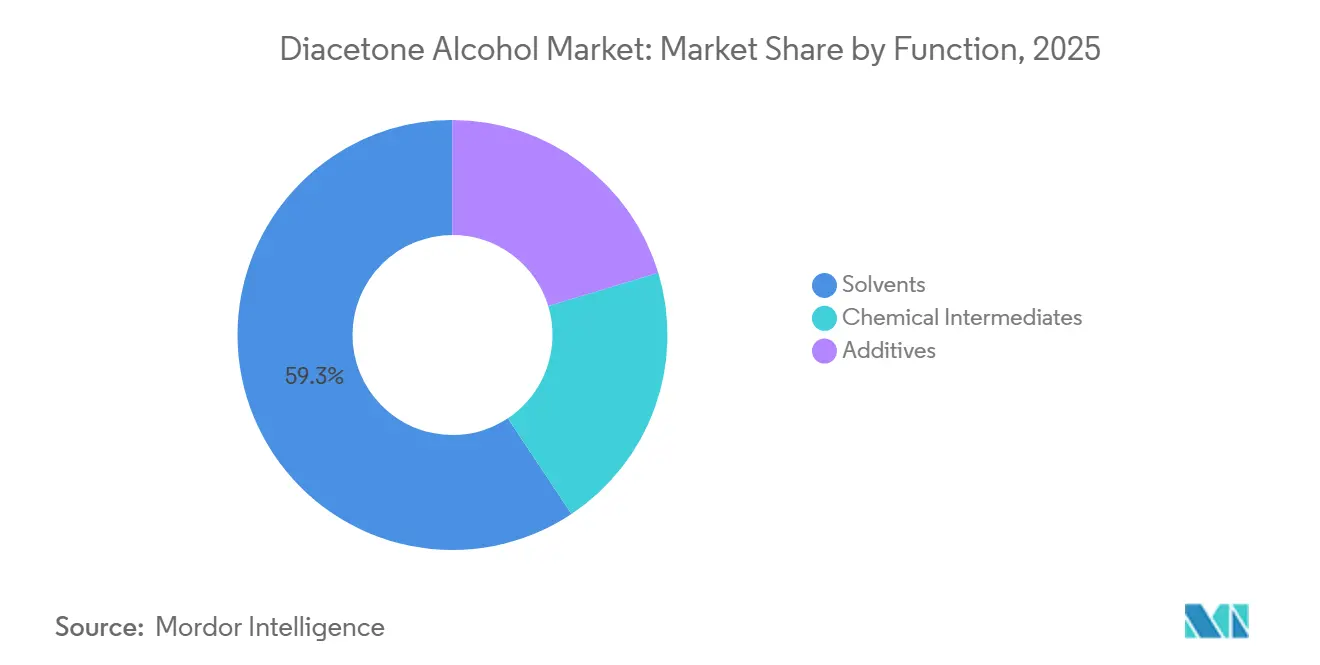
- By function, solvents held 59.34% of the diacetone alcohol market share in 2025, while chemical intermediates are expected to record the highest projected CAGR at 5.61% through 2031.
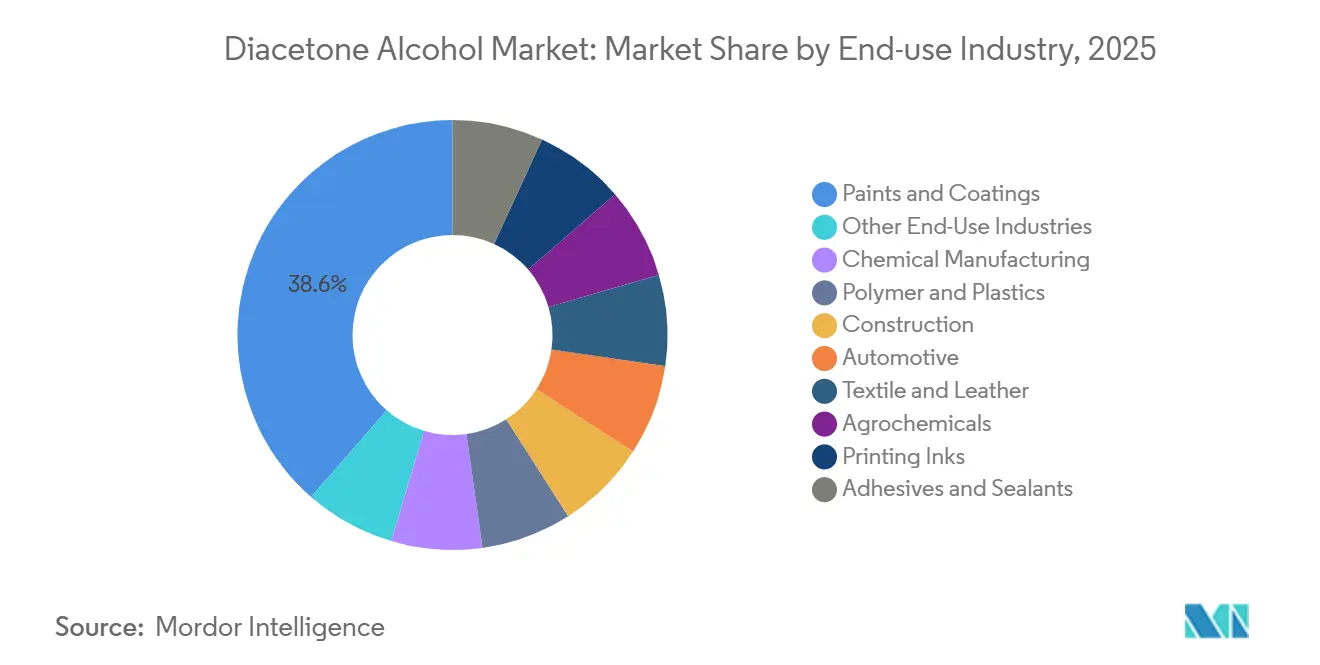
- By end-use industry, paints and coatings accounted for 38.57% of the diacetone alcohol market size in 2025, while adhesives and sealants are expected to record the highest projected CAGR at 5.89% through 2031.
- By geography, Asia-Pacific held 44.92% of the diacetone alcohol market share in 2025 and is expected to record the highest projected CAGR at 5.73% through 2031.
Note: Market size and forecast figures in this report are generated using Mordor Intelligence’s proprietary estimation framework, updated with the latest available data and insights as of January 2026.
Market Trends and Insights
Drivers Impact Analysis of Diacetone Alcohol Market*
| Driver | (~) % Impact on CAGR Forecast | Geographic Relevance | Impact Timeline |
|---|---|---|---|
| Demand for Low-VOC Solvents in Coatings and Industrial Formulations | +1.5% | Global, with highest intensity in North America, Europe, and East Asia | Short term (≤ 2 years) |
| Substitution of High-Odor and High-VOC Solvents in Cleaning and Specialty Uses | +0.9% | North America and Europe, with spillover into Asia-Pacific regulatory clusters | Medium term (2-4 years) |
| Use as an Intermediate for Specialty Chemicals and Derivatives | +1.2% | Asia-Pacific, particularly China, India, and South Korea, and global MIBK and hexylene glycol chains | Medium term (2-4 years) |
| Demand for High-Purity Grades for Environmental and Product Standards | +0.8% | Japan, South Korea, Taiwan, and Europe | Long term (≥ 4 years) |
| Process Optimization and Capacity Expansion | +0.6% | Asia-Pacific, with selected additions in North America and Europe | Medium term (2-4 years) |
| Source: Mordor Intelligence | |||
Growing Demand for Low-VOC Solvents in Paints, Coatings, and Industrial Formulations
Architectural coatings and industrial surface-finishing operations are changing formulations as volatile organic compound limits become stricter. The U.S. Environmental Protection Agency finalized amendments to aerosol-coating emission standards in January 2025 and adjusted implementation timelines in July 2025[1]U.S. Environmental Protection Agency, “Aerosol Coatings: National Volatile Organic Compound Emission Standards,” U.S. Environmental Protection Agency, epa.gov. Diacetone alcohol supports these systems because its evaporation rate helps formulators manage open time and film formation. Arkema lists its product with a purity of at least 99.5%, a boiling point of 168°C, and complete water solubility. These properties support its use in both solvent-borne and waterborne coating systems. Oregon also proposed volatile organic compound limits for architectural coatings in 2025, extending this policy direction to the state level. The proposal reinforces the need for coatings suppliers to evaluate solvent selection, formulation performance, and reporting obligations together, rather than treating compliance as a separate purchasing decision. This regulatory environment supports the diacetone alcohol market, as customers require a solvent that serves established coating processes while meeting evolving air-quality expectations.
Rising Substitution of High-Odor and High-VOC Solvents in Cleaning and Specialty Applications
Industrial cleaning, metal degreasing, and precision cleaning applications are moving away from some aromatic and halogenated solvents. Commission Regulation (EU) 2025/1090 restricts N,N-dimethylacetamide and 1-ethylpyrrolidin-2-one after December 2026 under the REACH framework. The change narrows the available solvent options for European industrial users. Diacetone alcohol has a documented REACH pathway through the European Solvent Industry Group framework for oxygenated solvents. This status can favor suppliers that maintain the required compliance records and product documentation. Demand from agrochemical and pharmaceutical applications can also support higher-purity material where solvent performance and traceability matter. These customers tend to assess documentation, repeatability, and supply continuity alongside basic solvent effectiveness, which raises the importance of qualified product grades. The diacetone alcohol market can benefit when a supplier has both the technical records and the production controls needed for these specialized uses.
Expanding Use as a Chemical Intermediate for Specialty Chemicals and Downstream Derivatives
Diacetone alcohol serves as an input for methyl isobutyl ketone and a direct precursor to hexylene glycol. Manufacturers use methyl isobutyl ketone in lube-oil dewaxing, surface coatings, and rubber processing, while they use hexylene glycol as a humectant, plasticizer, and coupling solvent. The pathway through diacetone alcohol and mesityl oxide has been documented in the catalytic-distillation production of methyl isobutyl ketone. This intermediate role links diacetone alcohol demand to downstream coatings, plastics, and specialty chemical production. KH Neochem’s February 2025 business plan includes its Basic Chemicals field with a target to increase accumulated EBITDA from JPY 12.9 billion (~ USD 78.81 million) to JPY 13.6 billion (~ USD 83.08 million). Cost-efficiency measures can help producers protect returns as competition increases in standard chemical grades. They can also support the reliable production of intermediate materials for downstream customers that depend on methyl isobutyl ketone and hexylene glycol supply. The diacetone alcohol market remains tied to the commercial health of these derivative chains, as each chain creates a separate outlet for material beyond conventional solvent sales.
Process Optimization and Capacity Expansion Improving Production Efficiency and Cost Competitiveness
Process efficiency remains critical because acetone serves as the principal feedstock for diacetone alcohol production. Producers that effectively manage feedstock availability, yields, and purification can strengthen supply reliability for downstream users. Capacity investment is most relevant in regions where coatings, adhesives, specialty chemicals, and electronics materials production are expanding together. KH Neochem’s business plan combines growth targets with cost-efficiency measures across its basic chemicals activities. Such programs can improve competitiveness without changing the product’s underlying role in coatings and intermediate chains. Therefore, the diacetone alcohol market benefits when producers pair operational improvements with customer-specific quality controls. Better yields and disciplined purification can help producers balance standard-volume applications with higher-specification orders. These capabilities also help distributors and formulators receive material that performs consistently across coatings, cleaning, and intermediate applications.
Restraints Impact Analysis of Diacetone Alcohol Market*
| Restraint | (~) % Impact on CAGR Forecast | Geographic Relevance | Impact Timeline |
|---|---|---|---|
| Volatility in Acetone and Other Petrochemical Feedstock Prices | -0.5% | Global, with high exposure in Asia-Pacific and North America | Short term (≤ 2 years) |
| Quality and Purity Requirements Raising Manufacturing and Qualification Costs | -0.3% | Europe, North America, Japan, and South Korea | Long term (≥ 4 years) |
| Regional Production Concentration Creating Supply and Pricing Risks | -0.4% | Global, with high exposure in North America and Europe as net-import regions | Medium term (2-4 years) |
| Source: Mordor Intelligence | |||
Volatility in Acetone and Other Petrochemical Feedstock Prices
Diacetone alcohol is produced through the base-catalyzed aldol condensation of acetone, making feedstock cost a key variable for producers and buyers. Lower acetone costs can improve input economics, while rapid price changes can complicate procurement planning under fixed-price supply arrangements. The absence of exchange-traded acetone futures can also limit hedging options for some participants. Integrated producers with internal acetone supply are better positioned during periods of price volatility. In contrast, toll manufacturers and specialty reformulators can face more variable margins when feedstock conditions shift quickly. Their exposure increases when purchase contracts, product pricing, and customer commitments operate across different timeframes. As a result, the diacetone alcohol market can show uneven profitability across the supply chain, even when end-use demand remains stable.
Stringent Product Quality and Purity Requirements Increasing Manufacturing and Qualification Costs
Users in electronics, aerospace, and pharmaceutical packaging increasingly require high-purity diacetone alcohol with documented quality profiles. Suppliers must invest in analytical testing, controlled manufacturing conditions, and traceability systems to meet these specifications. Monument Chemical lists diacetone alcohol products that meet U.S. and European safety documentation requirements. The REACH framework also requires manufacturers and importers to maintain technical information on health, safety, and environmental risks[2]European Solvent Industry Group, “REACH and Oxygenated Solvents,” European Solvent Industry Group, esig.org. These obligations can increase qualification costs and timelines for smaller suppliers. Established producers can retain an advantage when customers require consistent documentation across several regions. Smaller plants may find it difficult to absorb the cost of keeping records current, validating analytical methods, and responding to customer audits. This requirement can limit rapid capacity additions in the diacetone alcohol market, despite demand for higher-purity product grades.
*Our forecasts treat driver/restraint impacts as directional, not additive. The impact forecasts reflect baseline growth, mix effects, and variable interactions.
Diacetone Alcohol Market Segment Analysis
By Function:
Solvents Lead Volume While Chemical Intermediates Grow FasterSolvents accounted for 59.34% of the diacetone alcohol market size in 2025, making this the largest functional category. The segment serves applications in paints, inks, industrial cleaning, textile processing, and agrochemical carriers. Its broad end-use base makes it the primary volume outlet for the product. Diacetone alcohol supports coating film formation and controlled evaporation in solvent-borne and waterborne formulations. Its documented water solubility and physical properties help explain its use across these systems. Additives represent the smallest functional category and serve narrower requirements in polymerization inhibition and specialty chemical synthesis. Demand in this category is linked to controlled-evaporation solvent needs in precision chemical and pharmaceutical processes.
Chemical intermediates are forecast to grow at a CAGR of 5.61% through 2031, the fastest rate among functional uses. This category depends on diacetone alcohol’s role in synthesis routes for methyl isobutyl ketone and hexylene glycol. Research has described the catalytic route that uses diacetone alcohol and mesityl oxide in methyl isobutyl ketone production. Demand from automotive coatings, lubricant processing, and plasticizer-related applications supports these derivative chains. Producers can address both baseline solvent demand and higher-value intermediate requirements through a balanced portfolio. High-purity solvent offerings can create a separate premium layer within the broader solvents category. KH Neochem’s investment focus on semiconductor materials illustrates the commercial importance of this higher-specification layer.



By End-Use Industry:
Paints and Coatings Provide Scale While Adhesives and Sealants Lead GrowthPaints and coatings held 38.57% of the diacetone alcohol market share in 2025, making them the leading end-use industry. The category uses diacetone alcohol as a coalescing agent and solvent in systems that require controlled drying and film formation. Regulatory interest in lower-reactivity solvents supports this use case. The 2025 U.S. EPA aerosol-coatings amendments are relevant to formulation choices for compliant coating products. Industrial coatings and architectural applications remain important because they require steady solvent performance. Chemical manufacturing is another significant end use because it consumes diacetone alcohol in downstream synthesis of mesityl oxide, phorone, isophorone, and hexylene glycol. These products connect demand to rubber, plastics, fragrance, and specialty chemical applications.
Adhesives and sealants are forecast to record a 5.89% CAGR through 2031, the highest rate across end-use industries. Diacetone alcohol can adjust open time in reactive and non-reactive adhesive systems. This property supports its use in structural, automotive, and construction sealant formulations. The shift toward lightweight vehicle assembly can increase bonding requirements where adhesives replace some mechanical fastening. Textile and leather, printing inks, and agrochemicals remain smaller specialized outlets. Polymer and plastics, construction, and automotive applications provide continuing structural demand through coatings and assembly uses. The diacetone alcohol industry also benefits from its role as a carrier solvent in water-miscible agrochemical concentrates.
Geography Analysis
APAC Diacetone Alcohol Market
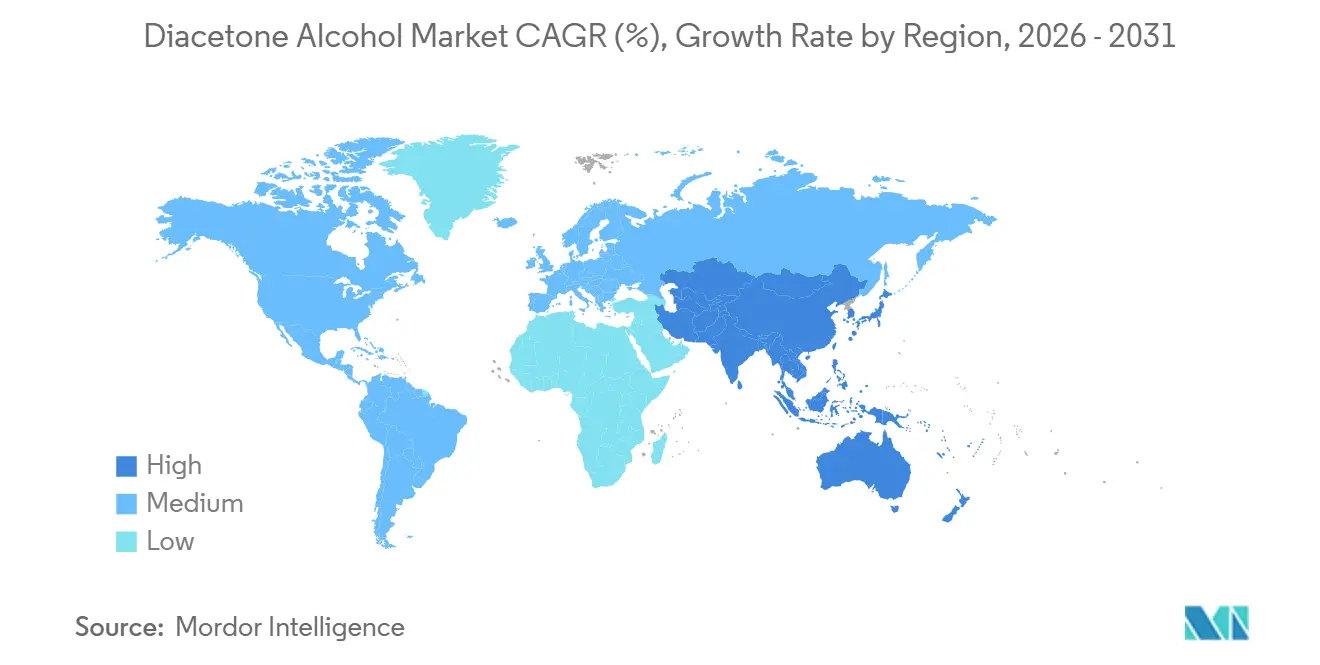
Asia-Pacific accounted for 44.92% of the diacetone alcohol market share in 2025 and is forecast to grow at a CAGR of 5.73% through 2031. China serves as a major regional demand center, supported by its integrated petrochemical base and extensive coatings production. Japan and South Korea play distinct roles in supplying high-purity materials for semiconductor-related applications. KH Neochem’s quality-control investment at Yokkaichi reflects the region’s emphasis on stringent electronics material specifications. Regional demand spans coatings, adhesives, chemical intermediates, and precision-grade solvents. This demand mix gives Asia-Pacific scale in standard applications and strengthens its role in specialized grades.
Europe Diacetone Alcohol Market
Europe holds the second-largest regional position in the diacetone alcohol market. Germany, France, and the United Kingdom drive demand through industrial coatings, automotive manufacturing, and specialty chemicals. REACH provides a compliance framework for oxygenated solvents and creates documentation requirements for suppliers. These requirements can increase entry costs, but they also support established registered suppliers. Sasol’s EUR 60 million investment in advanced materials and specialty chemicals at Brunsbüttel, Germany, announced for June 2026, highlights continued regional investment in specialty chemical capacity. Italy and France also support demand through automotive coatings and textile processing.
The Americas and MEA Diacetone Alcohol Market
North America benefits from demand in the United States, where volatile organic compound regulations influence coating formulation requirements. The United States EPA’s aerosol coatings standards guide compliance decisions for formulators that use oxygenated solvent alternatives. Monument Chemical supplies the region with products for paints, coatings, cleaners, and chemical synthesis applications. Canada and Mexico add demand through maintenance coatings, adhesive production, and agricultural chemical applications. South America is an emerging demand area, led by Brazil and Argentina, where construction and infrastructure activity support coatings and adhesives. The Middle East and Africa generate smaller volumes through petrochemical-linked coatings and maintenance applications in industrial and mining environments.

Competitive Landscape
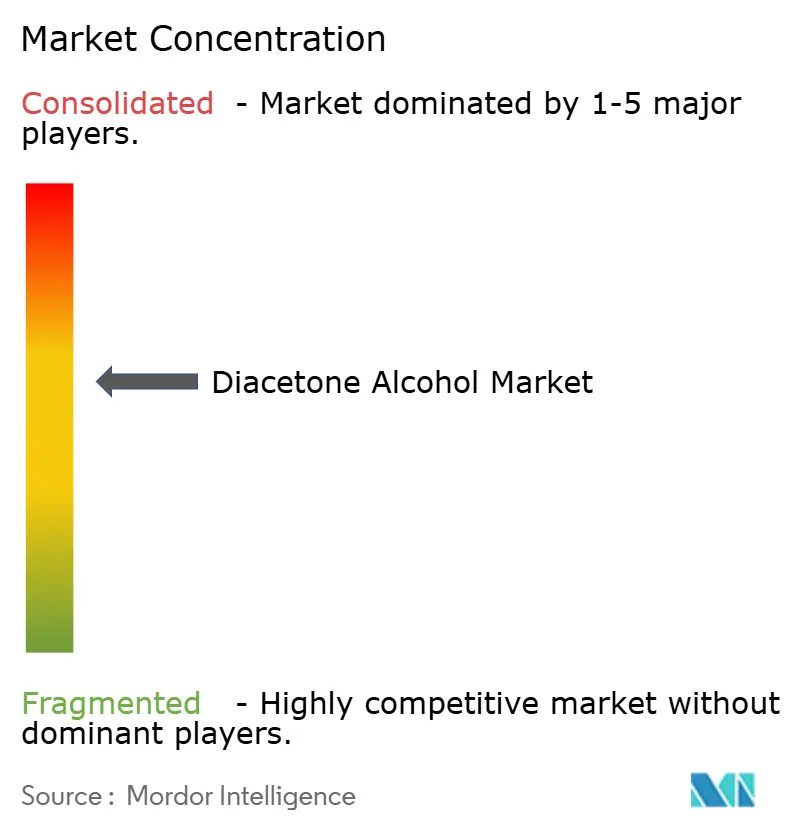
Arkema, KH Neochem Co., Ltd., Solvay, SI Group, Inc., and Mitsubishi Chemical Corporation are expected to collectively hold 50% of the global diacetone alcohol market share in 2025. As a result, the diacetone alcohol market remains moderately concentrated at the production level, while distribution and specialty reformulation remain more fragmented. Large suppliers compete on purity consistency, supply reliability, and application support. Regional suppliers in China and India compete more directly on delivered cost for local buyers. Backward integration into the acetone supply or long-term feedstock agreements can improve cost stability for larger producers. This structure creates opportunities for regional producers that can meet local customer requirements and respond quickly to demand.
Arkema partnered with Catalyxx in September 2025 to develop low-carbon, bio-based acrylic resins using bio-alcohol feedstocks. This move aligns its broader oxygenated-solvent portfolio with the development of lower-carbon materials. KH Neochem is pursuing high-purity solvent expansion for semiconductor applications through its current medium-term plan. This strategy shifts focus from standard volumes to applications with tighter specifications. Competition increasingly depends on suppliers’ ability to support product qualification, ensure supply continuity, and maintain compliance records across major regions.
Prasol Chemicals is expected to file a Draft Red Herring Prospectus with the Securities and Exchange Board of India in October 2025 as it pursues capacity expansion and broader international distribution. Rotterdam Chemicals Group also announced an exclusive European distribution partnership with Prasol for hexylene glycol and diacetone alcohol. These developments show how mid-sized suppliers can use capacity expansion and distribution partnerships to reduce reliance on a single domestic customer base. High-purity specialization remains a key opportunity because semiconductor and pharmaceutical users require stronger quality controls. Dual compliance with REACH and United States standards can create a meaningful barrier for exporters without established technical documentation. Each supplier’s competitive position will depend on its ability to combine cost discipline with consistently qualified material.
Diacetone Alcohol Industry Leaders
Solvay
Arkema
Mitsubishi Chemical Corporation
KH Neochem Co., Ltd.
SI Group, Inc.
- *Disclaimer: Major Players sorted in no particular order
Diacetone Alcohol Market Companies Covered in this Report
- Arkema
- Chang Chun Group
- Daigin Co., Ltd.
- Haihang Industry Co., Ltd.
- Jiangsu Hualun Chemical Co., Ltd.
- KH Neochem Co., Ltd.
- MGC Pure Chemicals America
- Mitsubishi Chemical Corporation
- Monument Chemical
- Prasol Chemicals Ltd.
- Recochem Inc.
- Sasol Limited
- SI Group, Inc.
- Solvay
- Zhejiang Xinhua Chemical Co., Ltd.

Recent Industry Developments in Diacetone Alcohol Market
- June 2026: Sasol International Chemicals announced a EUR 60 million (USD 68.62 million) investment at its Brunsbüttel, Germany, facility to expand its advanced materials and specialty chemicals capabilities, including the debottlenecking of high-purity alumina assets used in advanced catalyst systems. The company had secured all construction approvals as of the announcement, started the general contractor selection process, and targeted beneficial operation around 2029. The project includes energy optimization measures expected to reduce the product carbon footprint by up to 15% per ton, strengthening Sasol's competitive position in the supply of specialty materials for the chemicals industry.
- September 2025: Arkema and Catalyxx announced a strategic partnership to develop low-carbon, bio-based acrylic resins using bio-alcohols with a lower carbon footprint than fossil-based alternatives. Catalyxx plans to build an industrial facility for bio-alcohol production. Arkema is evaluating these materials as feedstocks for commercial-scale bio-based acrylic resins used in coatings, adhesives, e-mobility, and sustainable infrastructure applications.


Global Diacetone Alcohol Market Report Scope
Diacetone alcohol (DAA) is a colorless, water-soluble liquid (C₆H₁₂O₂) with a mild, pleasant odor. Manufacturers primarily derive it from acetone and widely use it as a heavy-duty industrial solvent in lacquers, paints, coatings, and inks. It also serves as an essential chemical intermediate in the synthesis of methyl isobutyl ketone (MIBK).
The diacetone alcohol market is segmented by function, end-use industry, and geography. By function, the market is segmented into solvents, chemical intermediates, and additives. By end-use industry, the market is segmented into paints & coatings, chemical manufacturing, polymer & plastics, construction, automotive, textile & leather, agrochemicals, printing inks, adhesives & sealants, and other end-use industries. The report also covers the diacetone alcohol market size and forecasts for the diacetone alcohol market in 16 countries across major regions. For each segment, the market sizing and forecasts have been done on the basis of value (USD).
| Solvents |
| Chemical Intermediates |
| Additives |
| Paints & Coatings |
| Chemical Manufacturing |
| Polymer & Plastics |
| Construction |
| Automotive |
| Textile & Leather |
| Agrochemicals |
| Printing Inks |
| Adhesives & Sealants |
| Other End-Use Industries |
| Asia-Pacific | China |
| India | |
| Japan | |
| South Korea | |
| Rest of Asia-Pacific | |
| North America | United States |
| Canada | |
| Mexico | |
| Europe | Germany |
| United Kingdom | |
| France | |
| Italy | |
| Russia | |
| Rest of Europe | |
| South America | Brazil |
| Argentina | |
| Rest of South America | |
| Middle-East and Africa | Saudi Arabia |
| South Africa | |
| Rest of Middle-East and Africa |
| By Function | Solvents | |
| Chemical Intermediates | ||
| Additives | ||
| By End-Use Industry | Paints & Coatings | |
| Chemical Manufacturing | ||
| Polymer & Plastics | ||
| Construction | ||
| Automotive | ||
| Textile & Leather | ||
| Agrochemicals | ||
| Printing Inks | ||
| Adhesives & Sealants | ||
| Other End-Use Industries | ||
| By Geography | Asia-Pacific | China |
| India | ||
| Japan | ||
| South Korea | ||
| Rest of Asia-Pacific | ||
| North America | United States | |
| Canada | ||
| Mexico | ||
| Europe | Germany | |
| United Kingdom | ||
| France | ||
| Italy | ||
| Russia | ||
| Rest of Europe | ||
| South America | Brazil | |
| Argentina | ||
| Rest of South America | ||
| Middle-East and Africa | Saudi Arabia | |
| South Africa | ||
| Rest of Middle-East and Africa | ||


Key Questions Answered in the Report
What is the forecast growth rate for diacetone alcohol through 2031?
The diacetone alcohol market is forecast to grow at a 5.09% CAGR from 2026 to 2031 and reach USD 1.82 billion by 2031. This outlook reflects demand from solvent uses and chemical-intermediate applications rather than dependence on a single end-use channel, which gives producers exposure to several manufacturing activities and reduces the effect of a short-term slowdown in one specific customer category.
Which function accounts for the largest diacetone alcohol demand?
Solvents led with 59.34% share in 2025 because coatings, inks, cleaning, and processing applications require controlled evaporation and reliable solvency. This broad base makes solvents the central volume application in the diacetone alcohol market, because the same material can address different formulation needs where customers value manageable evaporation, resin compatibility, and stable performance across industrial processes.
Which end-use application is growing fastest?
Adhesives and sealants are forecast to grow at a 5.89% CAGR through 2031, supported by construction and automotive assembly needs. Their use of controlled-drying solvent systems gives this application a growth rate above the overall diacetone alcohol market forecast, especially where formulators need a balance between workable open time, application consistency, and the demands of construction or vehicle assembly lines.
Which region leads global demand?
Asia-Pacific led with 44.92% share in 2025 and is forecast to grow at a 5.73% CAGR through 2031. The region combines large standard solvent demand with high-purity requirements from electronics-related supply chains in the diacetone alcohol market, linking large-scale coatings and chemical production with smaller but technically demanding applications that require sustained supplier qualification and controlled manufacturing conditions.
What is the current market size of diacetone alcohol market?
The diacetone alcohol market size is projected to expand from USD 1.35 billion in 2025 and USD 1.42 billion in 2026 to USD 1.82 billion by 2031, and is expected to register a CAGR of 5.09% between 2026 and 2031.
Page last updated on:





