
Detox Products Market Size and Share
Market Overview
| Study Period | 2021 - 2032 |
|---|---|
| Market Size (2027) | USD 66.39 Billion |
| Market Size (2032) | USD 92.18 Billion |
| Growth Rate (2027 - 2032) | 6.79 % |
| Fastest Growing Market | Asia-Pacific |
| Largest Market | North America |
| Market Concentration | Medium |
Major Players *Disclaimer: Major Players sorted in no particular order Image © Mordor Intelligence. Reuse requires attribution under CC BY 4.0. | |
Detox Products Market Analysis by Mordor Intelligence
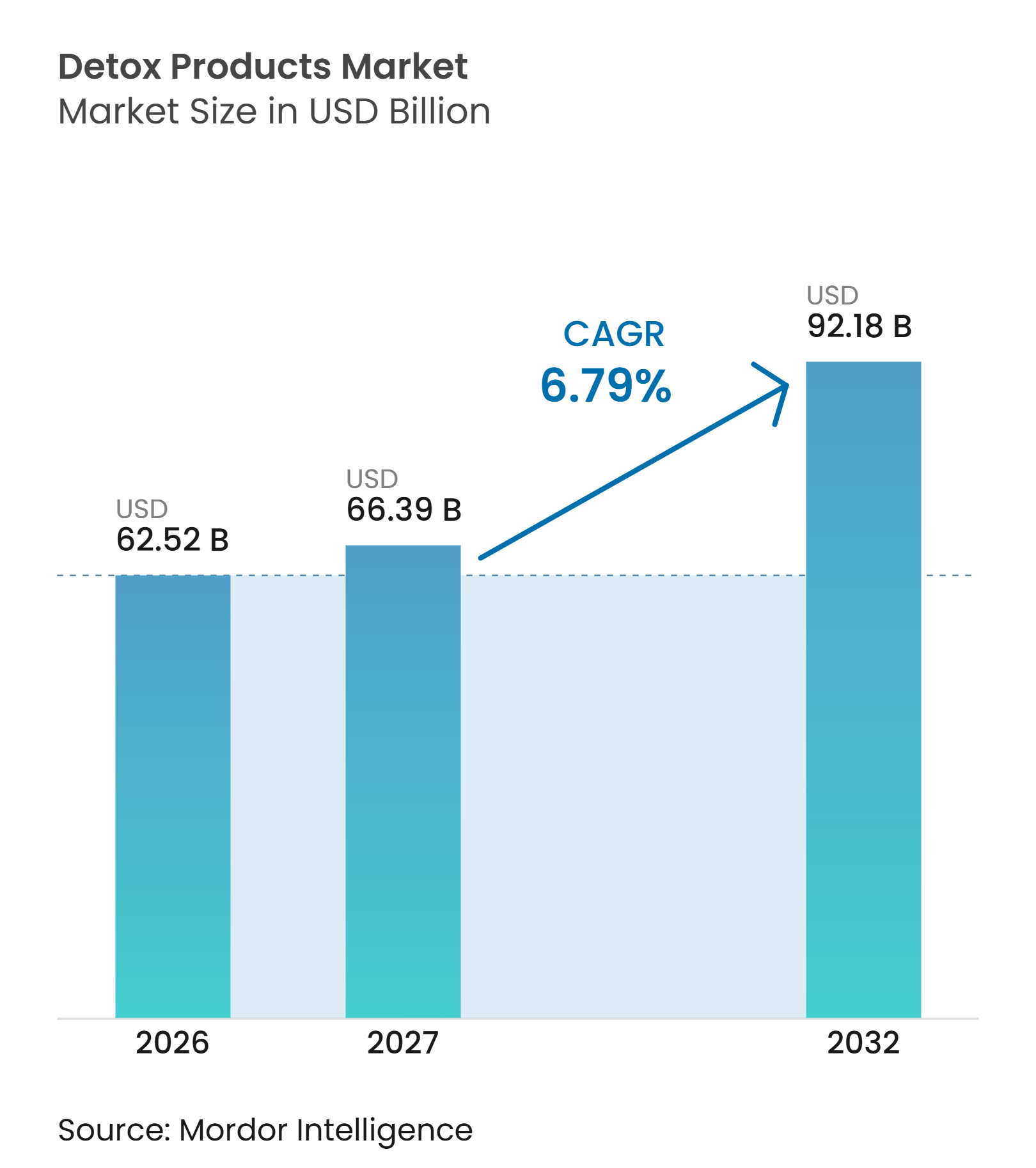
The Detox Products Market size is projected to be USD 62.52 billion in 2026, USD 66.39 billion in 2027, and reach USD 92.18 billion by 2032, growing at a CAGR of 6.79% from 2027 to 2032.
The category is moving from seasonal cleanse purchases toward routine preventive-health purchases, supported by consumer interest in daily supplements, functional drinks, and digestive support. Demand is strongest where products can fit established wellness routines and offer clear ingredient information, practical formats, and credible claims. Competition is increasingly shaped by traceable supply chains, evidence-led formulation, and access to both mainstream retail and direct online channels. Regulatory scrutiny remains a central constraint because U.S. authorities do not approve over-the-counter products for chelation or heavy-metal detoxification, and they can act against products promoted with unlawful disease claims. The detox products market also faces different botanical ingredient and advertising rules across regions, which raises formulation and labeling costs for companies selling internationally.
Key Report Takeaways
- By product type, detox dietary supplements held a 28.83% category share in 2026, while detox beverages are forecast to expand at a 9.06% CAGR through 2032.
- By application, full-body wellness and daily detox support accounted for 29.38% of the detox products market size in 2026, while Gut Detoxification and Digestive Comfort is projected to grow at a 9.65% CAGR through 2032.
- By form, capsules and softgels held a 36.16% share in 2026, while liquid and ready-to-drink formats are forecast to grow at a 9.76% CAGR through 2032.
- By distribution channel, supermarkets and hypermarkets held a 32.63% share in 2026, while online retail and e-commerce platforms are forecast to grow at a 9.38% CAGR through 2032.
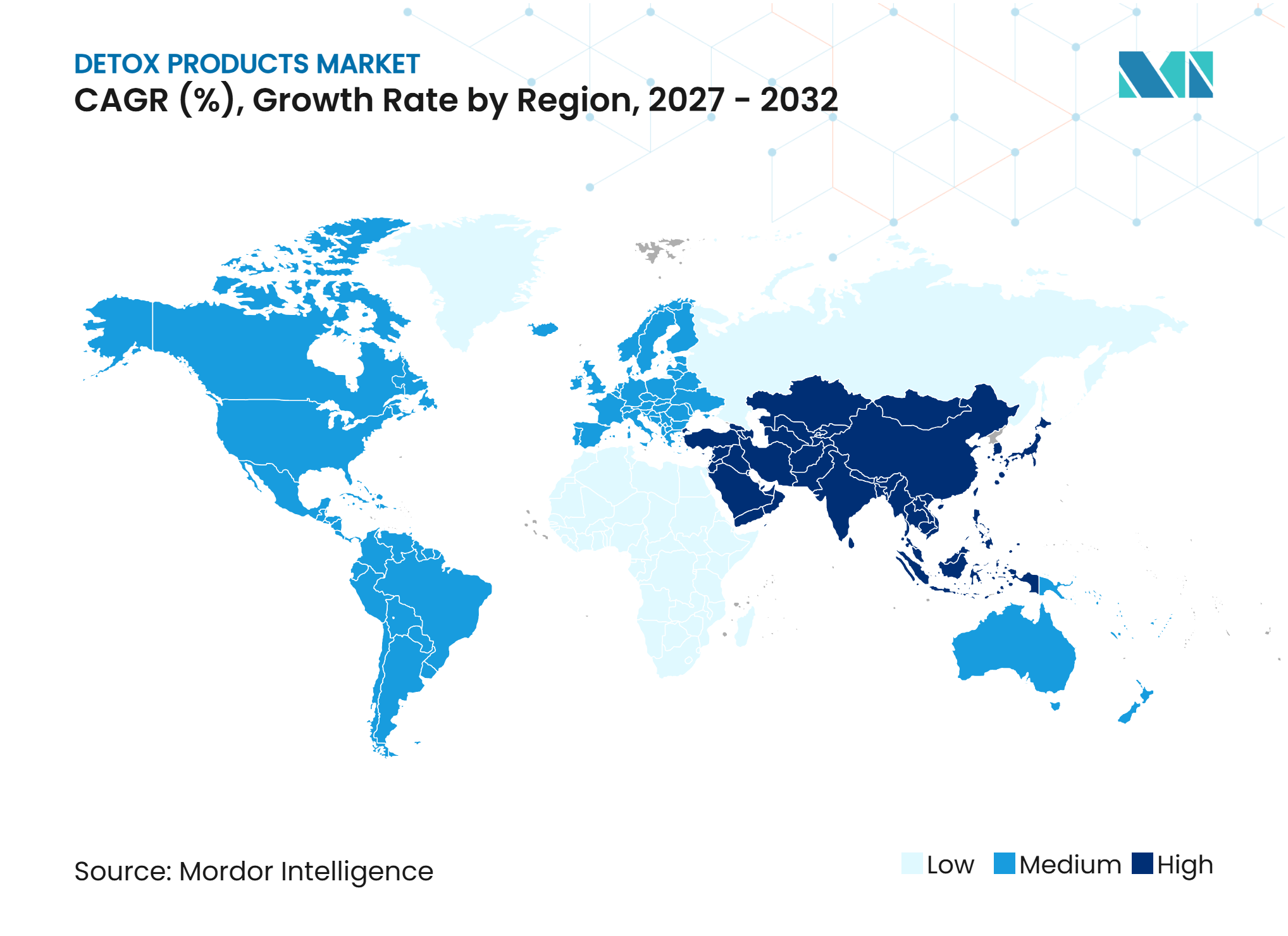
- By geography, North America held a 32.92% share in 2026, while Asia-Pacific is forecast to expand at a 9.31% CAGR through 2032.
Note: Market size and forecast figures in this report are generated using Mordor Intelligence’s proprietary estimation framework, updated with the latest available data and insights as of 2026.
Market Trends and Insights
Drivers Impact Analysis of Detox Products Market*
| Driver | (~) % Impact on CAGR Forecast | Geographic Relevance | Impact Timeline |
|---|---|---|---|
| Preventive Wellness and Self-Managed Health Spending | +1.8% | Global | Medium term (2-4 years) |
| Natural, Organic, and Clean-Label Formulations | +1.5% | Global | Long term (≥ 4 years) |
| Functional Beverage Substitution for Sugary Drinks | +1.2% | APAC, North America, EU | Medium term (2-4 years) |
| E-Commerce, Direct-to-Consumer, and Subscription Distribution | +1.3% | Global, with APAC and North America core | Short term (≤ 2 years) |
| Microbiome-Compatible Formulation Sequencing | +0.9% | North America and EU | Long term (≥ 4 years) |
| Exposure-Specific Detox Routines | +1.0% | North America, APAC core | Medium term (2-4 years) |
| Source: Mordor Intelligence | |||
Preventive Wellness and Self-Managed Health Spending
Consumers are placing preventive care alongside their regular food, fitness, and supplement spending, which makes daily health routines more relevant to product selection. This shift gives the detox products market a broader base than the traditional January cleanse period and reduces reliance on short seasonal buying peaks. Younger adults are particularly open to natural and alternative products, which supports repeat purchases of supplements and beverages that fit daily routines, travel, work schedules, and home-based wellness habits. Brands gain more value when they turn a one-time cleanse purchase into an ongoing program with clear use guidance, understandable ingredients, and a practical reason to reorder. A recurring relationship depends on evidence, ingredient transparency, appropriate claims, and products that consumers can use consistently without disruption. The resulting opportunity is not simply to sell more units, but to build retention through credible wellness support and reliable customer experience.
Natural, Organic, and Clean-Label Formulations
Clear labels and familiar ingredients are becoming basic purchase requirements for many wellness consumers, especially when product claims relate to internal health and daily exposure concerns. Organic, non-GMO, and plant-based positioning can help a brand communicate product standards without relying on broad detox promises or language that cannot be substantiated. Demand for traceable botanical inputs also makes dependable sourcing more important for the detox products market, because consumers and retailers increasingly expect information on origin and production. European requirements from the European Food Safety Authority and Germany’s Federal Institute for Risk Assessment create a high bar for ingredient review, documentation, and permitted claims. These standards can support consumer confidence, but they also increase the work required to source, test, document, and maintain consistent botanical materials. Companies with established organic supply networks can therefore protect availability and consistency more effectively than late entrants that need to develop supplier relationships from the beginning.
Functional Beverage Substitution for Sugary Drinks
Functional drinks are opening a new consumption occasion for products associated with digestion, hydration, and wellness, especially when they resemble familiar everyday beverages. Ocado Retail reported a 54% year-over-year increase in functional health drink sales during 2025, while 60% of Gen Z respondents viewed these drinks as an alcohol alternative at social occasions. The same release reported that 22% of adults had replaced morning tea or coffee with formats such as matcha, herbal infusions, or mushroom beverages.[1] Detox beverages can benefit when they compete on flavor, convenience, ingredient familiarity, and everyday refreshment rather than on a restrictive cleanse message. Grocery placement is important because the beverage aisle allows consumers to try a product without committing to a supplement routine, subscription, or specialist consultation. This gives brands a reason to develop ready-to-drink products that meet mainstream taste, price, packaging, and availability expectations.
E-Commerce, Direct-to-Consumer, and Subscription Distribution
Online selling has become important because it combines product discovery, education, product comparison, and repeat ordering in one purchase path. The detox products market benefits from digital programs that pair bundles with usage schedules, customer support, product information, and reminders that make a routine easier to maintain. Brand-owned subscriptions can improve purchase frequency and allow companies to understand which products consumers reorder, discontinue, or purchase together. Digital channels also help companies test new formats, packaging, and targeted bundles faster than conventional store distribution, although claims still need review before products are promoted. In Asia-Pacific, large marketplace platforms can introduce consumers to regional botanical traditions as well as international brands and can make product reviews highly influential. This advantage carries a responsibility to protect personal data, present claims carefully, verify sellers, and prevent counterfeit products from weakening trust in the detox products market.
Restraints Impact Analysis of Detox Products Market*
| Restraint | (~) % Impact on CAGR Forecast | Geographic Relevance | Impact Timeline |
|---|---|---|---|
| Limited Clinical Validation and Unsupported Detox Claims | -1.2% | Global | Medium term (2-4 years) |
| Hidden Ingredients, Contamination, and Adverse-Event Risk | -0.8% | Global | Short term (≤ 2 years) |
| Claim Renaming and Packaging Rework After Advertising Rulings | -0.6% | North America and EU | Medium term (2-4 years) |
| Cross-Border Divergence in Botanical Formulation and Claim Rules | -0.7% | APAC, spill-over to MEA and South America | Long term (≥ 4 years) |
| Source: Mordor Intelligence | |||
Limited Clinical Validation and Unsupported Detox Claims
The clinical evidence behind broad detox claims remains uneven, which limits consumer confidence and restricts how products can be promoted in the detox products market. The FDA states that it has not approved any over-the-counter products for chelation or heavy-metal detoxification.[2] Its August 2025 advisory action against a lung detox patch promoted with disease-treatment claims shows that oversight of this language is active and extends beyond conventional supplement labels. The Federal Trade Commission also expects competent and reliable scientific evidence for health and safety advertising claims, creating an additional requirement for companies that use digital advertising or influencer partnerships. Brands that rely on general promises instead of ingredient-level evidence may struggle to move beyond specialty retail, maintain retailer confidence, or retain consumers after a first purchase. Better clinical support can improve trust, while unsupported claims create a clear risk of enforcement, costly packaging changes, and lost consumer confidence.
Hidden Ingredients, Contamination, and Adverse-Event Risk
Ingredient quality is especially important in a category built around purity and wellness, since the detox products market can be affected by a single highly visible product-safety concern. Under the U.S. dietary supplement framework, the FDA can take action against adulterated or misbranded products after they enter the market. This places significant responsibility on manufacturers to qualify suppliers, test materials, maintain accurate labels, investigate complaints, and document their quality controls. Counterfeit and low-quality products sold through digital marketplaces can damage both consumers and reputable brands, particularly when a product imitates a known label or uses similar visual design. China’s National Medical Products Administration and India’s Food Safety and Standards Authority are raising attention to traceability and good manufacturing practices. A serious adverse event can reduce trials across the category, even when other manufacturers have strong safety records, tested ingredients, and responsible promotional practices.
*Our forecasts treat driver/restraint impacts as directional, not additive. The impact forecasts reflect baseline growth, mix effects, and variable interactions.
Detox Products Market Segment Analysis
By Product Type:
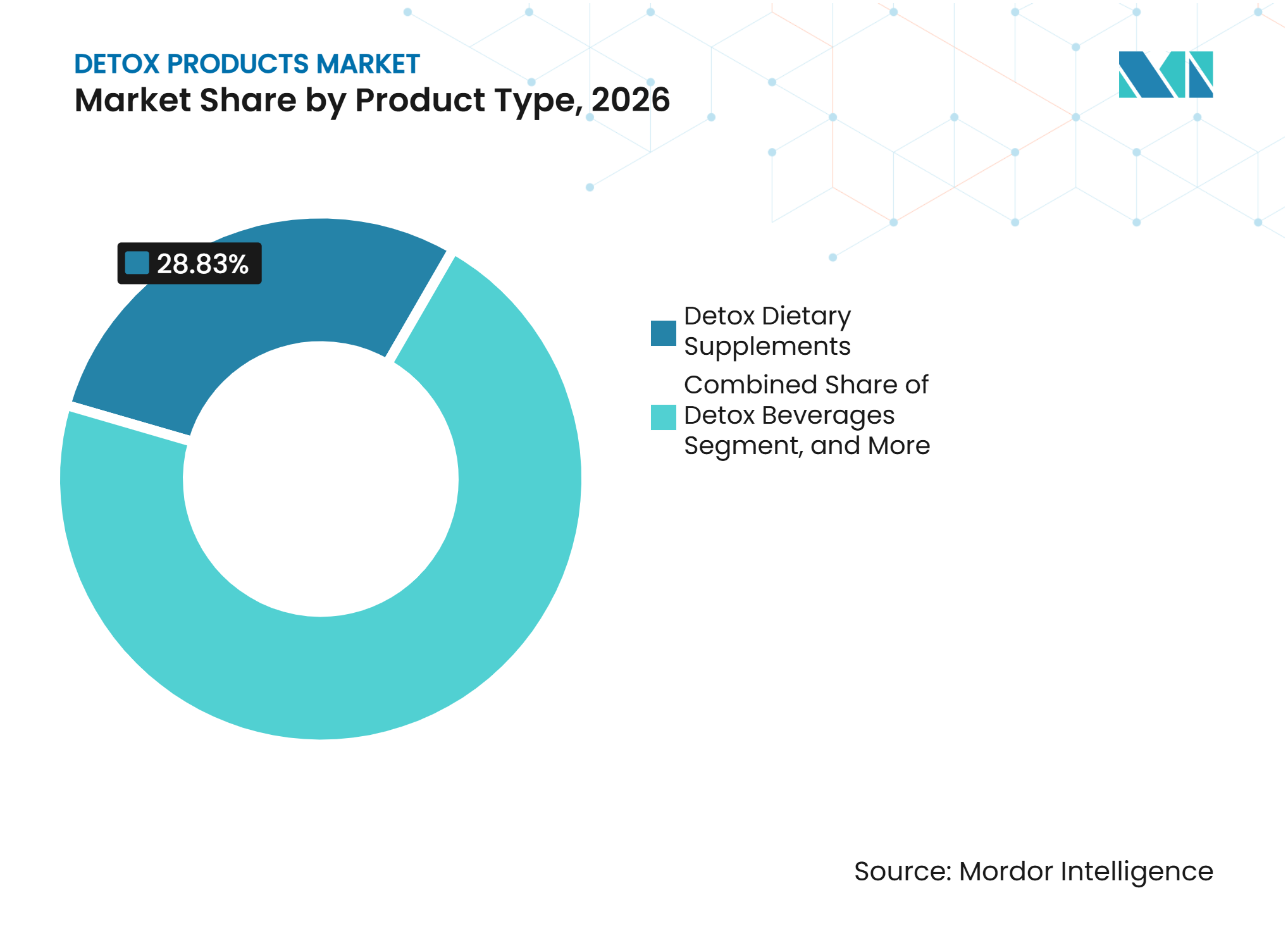
Beverages Outpacing Supplements in GrowthDetox dietary supplements held 28.83% of the detox products market share in 2026, making them the largest product type. Their scale reflects consumer familiarity with capsules and tablets, measured daily use, wide availability, and the perception that these formats fit easily into established vitamin routines. Liver-support formulations commonly use ingredients such as milk thistle, N-acetylcysteine, and artichoke extract, giving brands several familiar routes into digestive and general wellness positioning. Products positioned around metals may use chlorella, zeolite, or alpha lipoic acid, although companies need to avoid claims that exceed the evidence or regulatory allowance. Pharmacy and practitioner channels remain useful because professional guidance can support confidence in ingredient selection, product quality, intended use, and the difference between a wellness product and a treatment.
Detox beverages are forecast to record a 9.06% CAGR through 2032, supported by easy use, visible flavor choices, and the shift toward functional refreshment. Within the detox products market, wellness shots, herbal ready-to-drink beverages, and cold-pressed juice formats can reach consumers who may not want to add another capsule to their routine or commit to a multi-day program. These formats can also support trial because consumers can buy a single serving before deciding whether it suits their taste and routine. Detox kits and programs remain a premium niche, particularly when digital coaching helps consumers follow a structured plan, understand sequencing, and reorder products after an initial experience. Skin-focused formats such as charcoal masks, anti-pollution serums, botanical scrubs, and topical gels serve a separate purchase occasion, especially in high-pollution cities where daily topical routines are distinct from oral supplement use.



By Application:
Gut Health Reshaping Detox IntentFull-Body wellness and daily detox support represented 29.38% of the detox products market size in 2026, giving it the leading application position. Its broad positioning makes it easier for consumers to consider than a product tied to a specific organ concern or a narrowly defined health need. The segment supports a general maintenance routine rather than an acute treatment message, which allows brands to place it beside familiar daily wellness habits. This approach fits consumers who want simple product choices, accessible routines, and no requirement to identify a particular health condition. It also makes careful claim language essential, since broad wellness positioning should not imply disease prevention, treatment, medical cleansing, or a clinically proven response to environmental exposure.
Gut detoxification and digestive comfort is forecast to grow at a 9.65% CAGR through 2032. A 2025 randomized, placebo-controlled trial reported that a 24-strain synbiotic increased Urolithin A and butyrate in healthy adults, adding evidence to the broader microbiome discussion. This evidence does not validate broad detox claims, but it supports more focused discussion of digestive function, microbiome activity, and related wellness formulations. Liver support remains a large, mature application in Europe, where consumer familiarity with milk thistle, artichoke extract, and N-acetylcysteine supports demand through pharmacies and specialist retailers. Colon cleanse and elimination support benefit from wider awareness of fiber, prebiotic, and probiotic formats. In contrast, kidney and urinary support, weight management, metabolic reset, and anti-pollution skin products serve narrower needs and require precise, evidence-based communication.
By Form:
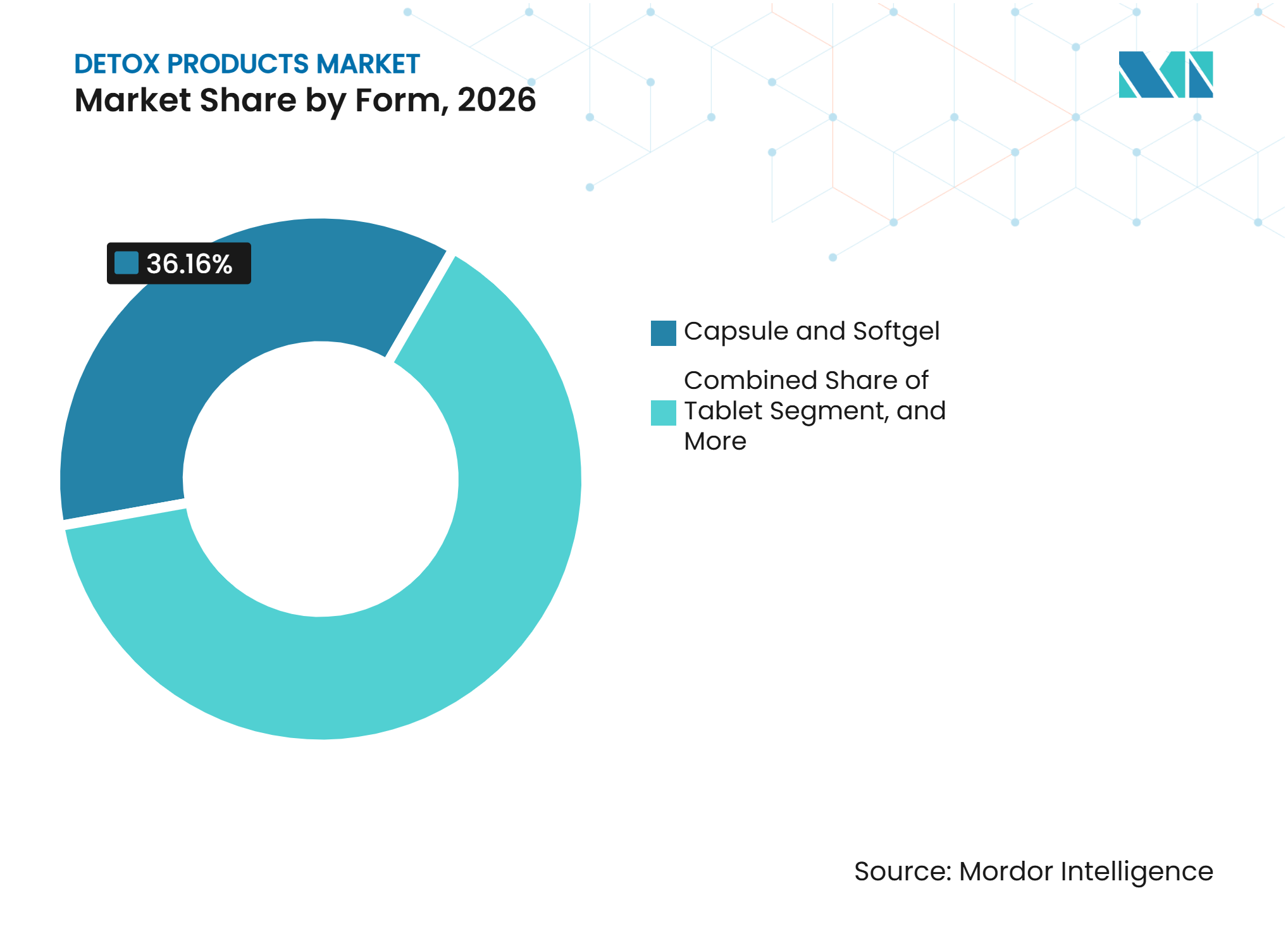
Ready-to-Drink Formats Change Conventional UsageCapsules and softgels held 36.16% of the detox products market in 2026. The format remains important because it offers stable storage, consistent dosing, portable use, and strong acceptance in pharmacy channels. This is particularly relevant in Germany and France, where consumers often associate pharmacies with product quality, documented ingredients, and informed guidance. Capsules also accommodate a wide range of botanical and nutrient formulations without requiring cold storage or preparation at the point of use. Their established position gives manufacturers a predictable way to extend a line into liver, digestive, and general wellness applications while preserving a familiar package, dosage form, and repeat-purchase pattern.
Liquid and Ready-to-Drink formats are forecast to advance at a 9.76% CAGR through 2032. Their appeal is linked to portability, taste, convenience, and a closer fit with the functional beverage occasion that consumers encounter in grocery, convenience, and online channels. Products in this form must still balance appealing flavors with ingredient disclosure, shelf life, packaging cost, and practical serving sizes. Powder products retain relevance in India and China, where home preparation traditions support turmeric, triphala, and adaptogen blends that are recognized within local wellness practices. Tea bags continue to provide a familiar entry point for first-time buyers, while gummies and chewables appeal to taste-focused consumers, and creams, masks, gels, and scrubs support the expanding skin-focused use case.

By Distribution Channel:
Digital Channels Support Repeat PurchasingSupermarkets and hypermarkets held 32.63% of the detox products market in 2026. Mainstream grocery availability has increased as retailers expand natural, organic, and wellness shelf space and consumers look for functional products during routine food shopping. This channel offers broad reach and makes beverages, teas, and simple digestive products easier to discover without a specialized consultation or an online search. It also gives smaller brands a chance to reach consumers outside specialty stores, provided that they can meet retailer requirements for supply, packaging, product information, and pricing. Competition for shelf space remains high, so product clarity, dependable supply, and a credible reason for consumers to try the item are important.
Online retail and E-commerce platforms are forecast to grow at a 9.38% CAGR through 2032. Subscriptions, product bundles, detailed descriptions, and personalized discovery can shorten the time between consumer interest and purchase. Brand-owned portals can offer higher margins by avoiding marketplace fees, collecting first-party customer information, and communicating directly about use instructions and reorder options. Pharmacies and drugstores retain a valuable role in Europe and Asia-Pacific, where professional advice carries weight for digestive and liver-support products and can help consumers understand responsible use. Specialty health and wellness clinics remain a smaller channel, but they can support high-value practitioner-led programs, clinical education, and closer attention to product selection than mass retail can provide.
Geography Analysis
North America
North America held 32.92% of the detox products market share in 2026. The detox products market benefits from high supplement familiarity, widespread direct-to-consumer selling, and established cleanse routines across supplements, cold-pressed juices, retail beverages, and digital coaching programs. The United States remains the largest revenue contributor in the region because brands can combine subscriptions with broad retail access, detailed online education, and frequent product discovery through social and marketplace channels. The FDA and Federal Trade Commission influence product positioning by scrutinizing disease-related claims, advertising evidence, and the way a product is described to consumers. Companies that use good manufacturing practices, substantiated ingredient profiles, transparent labels, and controlled supply chains are better placed to retain retail and consumer confidence. Canada’s natural health product framework provides a more structured premarket review route than the U.S. model, which can provide a useful quality signal for products sold across borders and a clearer route for companies planning regional launches.
Asia-Pacific
Asia-Pacific is forecast to grow at a 9.31% CAGR through 2032, the highest rate among the reported regions. The detox products market in the region is supported by urbanization, rising disposable income, established natural health traditions, and consumers who are already familiar with botanical ingredients in foods, beverages, and supplements. China’s market combines traditional Chinese medicine-inspired formulations with large online sales platforms, rapid product discovery, and strong interest in convenient formats. India’s Ayurvedic practices support consumer familiarity with triphala, neem, turmeric, and other botanical blends, while local production can improve cultural relevance and supply responsiveness. Japan and South Korea are advancing enzyme-based beverages, matcha-linked functional drinks, probiotic ready-to-drink products, and skin-focused concepts that can travel through cross-border retail. The National Medical Products Administration in China, the Food Safety and Standards Authority of India, and Japan’s Pharmaceuticals and Medical Devices Agency each set separate compliance paths, requiring companies to adapt ingredients, labels, documentation, and claims by country.
Europe, Middle East and Africa, and South America
Europe is the second-largest reported geography, with Germany supported by herbal medicine traditions and extensive pharmacy distribution. The detox products market in Europe is shaped by regulatory influence from the European Food Safety Authority and Germany’s Federal Institute for Risk Assessment, which can make strong documentation a useful quality credential for export markets. France and the United Kingdom show demand for liquid detox formats and organic supplements, while Nordic consumers show interest in fermented and probiotic beverages that fit wider functional-food habits. Southern European markets combine Mediterranean herbal traditions with newer supplement formats and consumer interest in plant-based products. In the Middle East and Africa, premium clean-label products have potential among urban consumers, especially where halal requirements and Gulf food authority approvals are addressed clearly. In South America, Brazil and Argentina are developing through functional food consumption, broader pharmacy access, and rising urban health interest, while Brazil’s ANVISA framework must be considered when planning labels, health claims, and launch documentation.
Competitive Landscape
Market Concentration
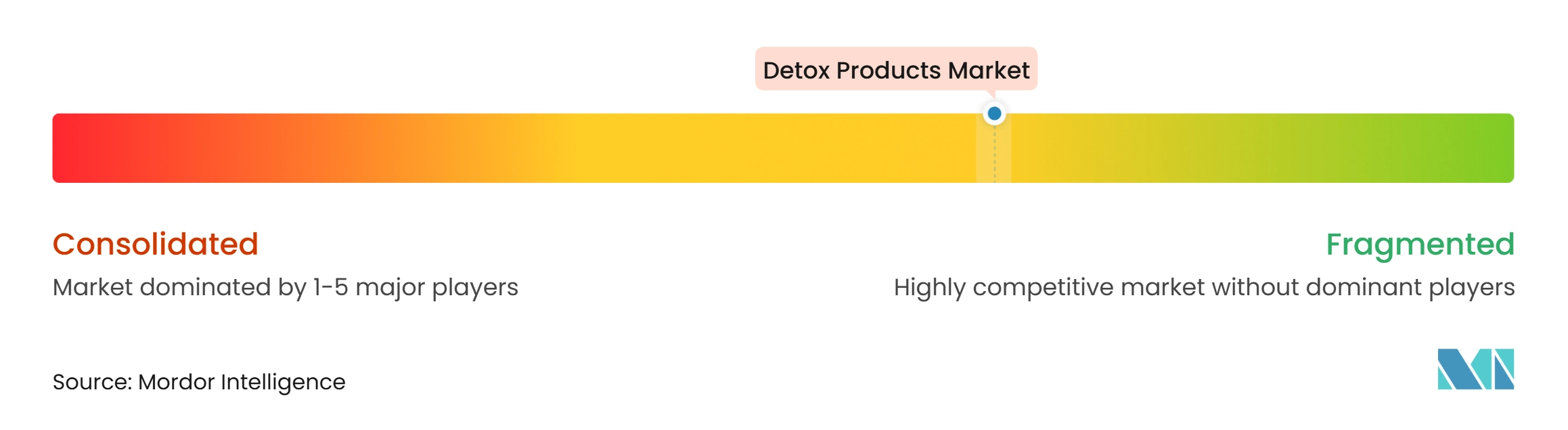
The detox products market is moderately fragmented, with no single company holding a dominant share in the supplied material. Large wellness companies benefit from broad distribution, regulatory resources, established manufacturing networks, and the ability to fund product development across several adjacent categories. Specialist brands can compete through traceable botanical sourcing, practitioner relationships, focused product lines, and clear explanation of what their formulations contain. Nestlé Health Science, Herbalife, and Amway compete alongside specialist businesses such as Gaia Herbs, Traditional Medicinals, and Detoxify LLC. The detox products industry is therefore divided between companies that can scale across countries and brands that build loyalty through narrower expertise, consistent sourcing, and closer consumer education.
Herbalife launched MultiBurn in the United States in July 2025, using Moro blood orange extract, hibiscus and lemon verbena, red chili pepper, and fenugreek in a formula without synthetic colors or dyes. The move shows how established companies are expanding into weight management and metabolic health categories that sit close to detox-related consumer demand. Nestlé Health Science’s Garden of Life introduced Sprouted Barley Protein + Probiotics in September 2025, combining 21g of upcycled plant-based protein with 1 billion CFU of Bacillus coagulans SNZ 1969 per serving. This launch illustrates the closer connection between functional protein, digestive support, and wellness nutrition. Amway’s rollout of Ayurveda-branded Nutrilite products in India also reflects a strategy of local ingredient relevance and regional production, although companies need to adapt claims to each market’s rules.
Competitive advantage increasingly depends on ingredient traceability, extraction methods, clinical evidence, manufacturing controls, and clear product communication rather than price alone. In the detox products market, ISO 22000-certified production and claims consistent with European requirements can support access to pharmacy and specialty channels where quality documentation has commercial value. Digital-native brands are exploring personalized kits, microbiome-led recommendations, and programs that connect product use with coaching. These approaches may create value, but they need careful evidence and privacy controls before they can gain broad acceptance. Companies that focus on heavy-metal or microplastic exposure themes face a higher burden to substantiate their claims and avoid presenting wellness products as treatments. The Detox products industry will likely reward firms that combine product quality with straightforward communication, credible substantiation, and practical formats that can retain consumers beyond an initial purchase.
Detox Products Industry Leaders
-
Detoxify LLC
-
Herbalife Ltd
-
Himalaya Global Holdings Ltd
-
PepsiCo, Inc.
-
Procter & Gamble Company
- *Disclaimer: Major Players sorted in no particular order
Detox Products Market Companies Covered in this Report
- Amway
- Detoxify LLC
- Gaia Herbs, Inc.
- Glanbia plc
- Herbalife Ltd
- Himalaya
- Metagenics, Inc.
- Nature’s Sunshine Products, Inc.
- Nestlé Health Science
- PepsiCo, Inc.
- Pressed Juicery, LLC
- Procter & Gamble
- Pukka Herbs Ltd
- Pure Encapsulations
- Raw Generation, LLC
- Standard Process, Inc.
- Suja Life, LLC
- The Bioforce Group
- The Clorox Company
- The Hain Celestial Group, Inc.
- The Nue Co.
- Traditional Medicinals, Inc.
Recent Industry Developments in Detox Products Market
- September 2025: Nestlé Health Science's Garden of Life brand launched Sprouted Barley Protein + Probiotics powder, combining 21g of upcycled plant-based protein with 1 billion CFU of Bacillus coagulans SNZ 1969 per serving in Vanilla Caramel and Chocolate variants. The product advances Garden of Life's gut-health-linked positioning and reflects the blurring boundary between functional protein nutrition and probiotic-supported digestive detox.
- July 2025: Herbalife launched MultiBurn in the United States, a weight management supplement combining three clinically studied botanicals, Morosil, Metabolaid, and Capsifen, formulated without synthetic colors or dyes. The product anchors Herbalife's clean-label positioning in the metabolic health category.
Global Detox Products Market Report Scope
The Detox Products Market refers to the global industry comprising products formulated and marketed to support the body's natural detoxification processes, eliminate toxins, improve digestive health, promote liver function, and enhance overall wellness. These products are available in various forms, including dietary supplements, herbal formulations, detox teas, cleansing beverages, juices, powders, capsules, gummies, and functional foods.
The study segments the market by product type, covering detox dietary supplements, detox beverages, detox kits and programs, and skin detox products. The report further analyzes the market by application, including full-body wellness and daily detox support, gut detoxification and digestive comfort, liver support, colon cleanse and elimination support, kidney and urinary support, weight management and metabolic reset, and skin and anti-pollution defense. Market insights are also provided by form, covering capsules and softgels, tablets, powders, liquid and ready-to-drink products, tea bags, gummies and chewables, and topical formats such as gels, creams, masks, and scrubs.
Additionally, the study evaluates the market by distribution channel, including online retail and e-commerce platforms, brand-owned portals and subscription models, supermarkets and hypermarkets, pharmacies and drugstores, and other channels such as specialty health and wellness clinics. Geographically, it is split into North America (United States, Canada, Mexico), Europe (Germany, United Kingdom, France, Italy, Spain, and Rest of Europe), Asia-Pacific (China, Japan, India, Australia, South Korea, and Rest of Asia-Pacific), Middle East & Africa (GCC, South Africa, and Rest of Middle East & Africa), and South America (Brazil, Argentina, and Rest of South America).
Segmentation Overview
| Detox Dietary Supplements | Capsules and Softgels |
| Tablets | |
| Powders and Stick Packs | |
| Gummies and Chewables | |
| Detox Beverages | Juice-Based Detox Drinks |
| Tea and Herbal Detox Drinks | |
| Water-Based Detox Drinks | |
| Smoothies and Functional Beverages | |
| Wellness Shots | |
| Detox Kits and Programs | One-Day and Short-Cycle Programs |
| Multi-Day Juice Cleanses | |
| Supplement-Based Cleanse Programs | |
| Digital Coaching-Enabled Programs | |
| Skin Detox Products | Masks and Scrubs |
| Cleansers and Serums |
| Full-Body Wellness and Daily Detox Support |
| Gut Detoxification and Digestive Comfort |
| Liver Support |
| Colon Cleanse and Elimination Support |
| Kidney and Urinary Support |
| Weight Management and Metabolic Reset |
| Skin and Anti-Pollution Defense |
| Capsule and Softgel |
| Tablet |
| Powder |
| Liquid and Ready-to-Drink |
| Tea Bag |
| Gummies and Chewables |
| Other Forms (Topical Gel and Cream, among others) |
| Online Retail and E-Commerce Platforms |
| Brand-Owned Portals and Subscriptions |
| Supermarkets and Hypermarkets |
| Pharmacies and Drugstores |
| Other Distribution Channels (Specialty Health and Wellness Clinics, among others) |
| North America | United States |
| Canada | |
| Mexico | |
| Europe | Germany |
| United Kingdom | |
| France | |
| Italy | |
| Spain | |
| Rest of Europe | |
| Asia-Pacific | China |
| Japan | |
| India | |
| Australia | |
| South Korea | |
| Rest of Asia-Pacific | |
| Middle East & Africa | GCC |
| South Africa | |
| Rest of Middle East & Africa | |
| South America | Brazil |
| Argentina | |
| Rest of South America |
| By Product Type | Detox Dietary Supplements | Capsules and Softgels |
| Tablets | ||
| Powders and Stick Packs | ||
| Gummies and Chewables | ||
| Detox Beverages | Juice-Based Detox Drinks | |
| Tea and Herbal Detox Drinks | ||
| Water-Based Detox Drinks | ||
| Smoothies and Functional Beverages | ||
| Wellness Shots | ||
| Detox Kits and Programs | One-Day and Short-Cycle Programs | |
| Multi-Day Juice Cleanses | ||
| Supplement-Based Cleanse Programs | ||
| Digital Coaching-Enabled Programs | ||
| Skin Detox Products | Masks and Scrubs | |
| Cleansers and Serums | ||
| By Application | Full-Body Wellness and Daily Detox Support | |
| Gut Detoxification and Digestive Comfort | ||
| Liver Support | ||
| Colon Cleanse and Elimination Support | ||
| Kidney and Urinary Support | ||
| Weight Management and Metabolic Reset | ||
| Skin and Anti-Pollution Defense | ||
| By Form | Capsule and Softgel | |
| Tablet | ||
| Powder | ||
| Liquid and Ready-to-Drink | ||
| Tea Bag | ||
| Gummies and Chewables | ||
| Other Forms (Topical Gel and Cream, among others) | ||
| By Distribution Channel | Online Retail and E-Commerce Platforms | |
| Brand-Owned Portals and Subscriptions | ||
| Supermarkets and Hypermarkets | ||
| Pharmacies and Drugstores | ||
| Other Distribution Channels (Specialty Health and Wellness Clinics, among others) | ||
| By Geography | North America | United States |
| Canada | ||
| Mexico | ||
| Europe | Germany | |
| United Kingdom | ||
| France | ||
| Italy | ||
| Spain | ||
| Rest of Europe | ||
| Asia-Pacific | China | |
| Japan | ||
| India | ||
| Australia | ||
| South Korea | ||
| Rest of Asia-Pacific | ||
| Middle East & Africa | GCC | |
| South Africa | ||
| Rest of Middle East & Africa | ||
| South America | Brazil | |
| Argentina | ||
| Rest of South America | ||
Key Questions Answered in the Report
What is driving demand for detox products?
Preventive wellness spending, clean-label preferences, functional beverages, and online subscriptions support demand. The shift toward daily routines favors products with transparent ingredients, clear use instructions, practical formats, and claims that remain within regulatory requirements.
How large is the detox products sector?
The detox products market is valued at USD 62.52 billion in 2026 and is forecast to reach USD 92.18 billion by 2032 at a 6.79% CAGR. The outlook reflects wider wellness adoption, although performance will depend on consumer trust, retail access, and the ability of companies to meet regional compliance expectations.
Which detox product type is growing fastest?
Detox beverages are forecast to grow at a 9.06% CAGR through 2032, supported by convenient functional drink formats. Ready-to-drink beverages, wellness shots, and herbal options can appeal to consumers who want a familiar beverage occasion rather than another capsule or a restrictive multi-day program.
Which application is expanding fastest?
Gut detoxification and digestive comfort is forecast to grow at a 9.65% CAGR through 2032. Interest is supported by broader attention to microbiome-related products, fiber, probiotics, and digestive comfort, though product communication should not extend beyond the available evidence.
Which region is expanding most quickly?
Asia-Pacific is forecast to record a 9.31% CAGR through 2032, supported by urbanization, rising disposable income, and established botanical traditions. China, India, Japan, and South Korea combine local formulation knowledge with large digital channels and active product innovation.