
Detergent Enzymes Market Size and Share
Market Overview
| Study Period | 2021 - 2031 |
|---|---|
| Market Size (2026) | USD 4.46 Billion |
| Market Size (2031) | USD 5.95 Billion |
| Growth Rate (2026 - 2031) | 5.93 % |
| Fastest Growing Market | Asia-Pacific |
| Largest Market | Asia-Pacific |
| Market Concentration | Medium |
Major Players *Disclaimer: Major Players sorted in no particular order Image © Mordor Intelligence. Reuse requires attribution under CC BY 4.0. | |
Detergent Enzymes Market Analysis by Mordor Intelligence
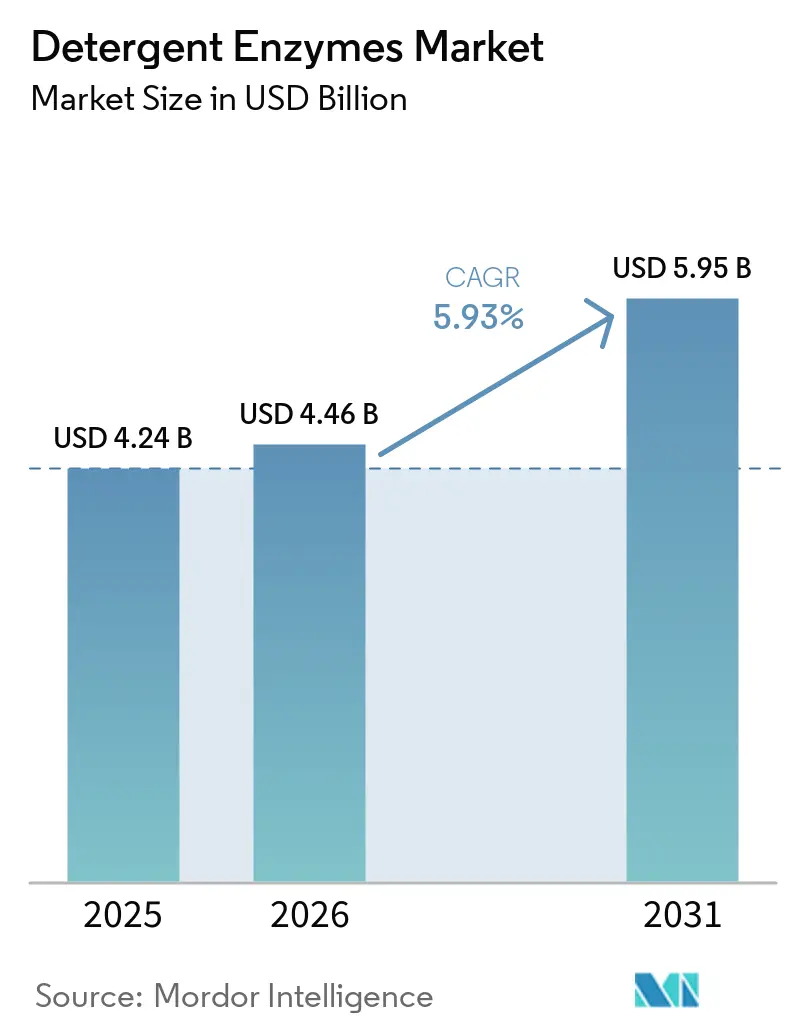
The Detergent Enzymes Market size is valued at USD 4.24 billion in 2025 and is estimated to grow from USD 4.46 billion in 2026 to USD 5.95 billion by 2031, at a CAGR of 5.93% during the forecast period (2026-2031). The detergent enzymes market is being shaped by lower wash temperatures, shorter cycles, and the need to maintain cleaning performance in concentrated products. These conditions make enzyme stability and stain-specific performance more critical in detergent design. Suppliers are responding with protein-engineered enzymes, liquid stabilization systems, and enzyme combinations that work together in the same formulation. Environmental requirements and procurement standards are also driving interest in products that clean effectively while using less energy. The primary opportunity lies in formulations that balance cold-water cleaning, shelf-life stability, worker safety, and compliance requirements without adding high cost.
Key Report Takeaways
- By enzyme type, proteases accounted for 41.45% of the detergent enzymes market share in 2025, while lipases recorded the highest projected CAGR at 6.75% through 2031.
- By form, liquid enzymes held 44.67% of the detergent enzymes market share in 2025, while encapsulated enzymes recorded the highest projected CAGR at 6.32% through 2031.
- By detergent type, laundry detergents held 70.56% of total detergent enzyme demand in 2025, while industrial and institutional detergents recorded the highest projected CAGR at 6.51% through 2031.
- By application, household cleaning held 58.22% of total detergent enzyme demand in 2025, while industrial cleaning recorded the highest projected CAGR at 6.66% through 2031.
- By geography, Asia-Pacific held 37.15% of total detergent enzyme demand in 2025 and recorded the highest projected CAGR at 6.78% through 2031.
Note: Market size and forecast figures in this report are generated using Mordor Intelligence’s proprietary estimation framework, updated with the latest available data and insights as of January 2026.
Market Trends and Insights
Drivers Impact Analysis of Detergent Enzymes Market*
| Drivers | (~) % Impact on CAGR Forecast | Geographic Relevance | Impact Timeline |
|---|---|---|---|
| Cold-Water and Short-Cycle Washing Adoption | +1.8% | Global, with the EU and North America leading adoption, and APAC following | Short term (≤ 2 years) |
| Concentrated and Unit-Dose Detergent Formats | +1.1% | Global, strongest in North America and Europe | Short term (≤ 2 years) |
| Regulatory Substitution of High-Chemical Cleaning Systems | +0.9% | Europe first, with spillover to North America and core APAC markets | Medium term (2-4 years) |
| Institutional and Industrial Laundry Sustainability Procurement | +0.8% | Global, concentrated in North America, Europe, and core APAC markets | Medium term (2-4 years) |
| Precision Fermentation and Protein Engineering | +0.6% | Global, with R&D hubs in North America, Western Europe, and Japan | Long term (≥ 4 years) |
| Regional Stain and Water-Condition Customization | +0.4% | APAC, MEA, and South America | Medium term (2-4 years) |
| Source: Mordor Intelligence | |||
Cold-Water and Short-Cycle Washing Adoption
Cold-water washing is a common operating condition for household laundry products. Lower temperatures and rapid cycles provide less time and thermal energy for conventional chemical cleaning systems to remove stains. A 2025 Novonesis consumer study covering 12 markets and 8,537 respondents found that 54% reported stubborn stains after rapid washes. This performance gap is directing product development toward enzymes that remain active at lower temperatures and during shorter wash periods. BASF introduced Lavergy L Pace in July 2025 for fat and oil stain removal at temperatures as low as 20°C. The detergent enzymes market benefits when brands need to restore cleaning performance without returning consumers to hotter, longer wash programs.
Concentrated and Unit-Dose Detergent Formats
Concentrated and unit-dose detergents reduce water use per wash and can lower packaging requirements, but they create demanding conditions for enzyme stability. High concentrations of surfactants, salts, and other ingredients can cause activity to be lost before the product reaches the wash. Research published by Aarhus University in 2025 found divergent effects of anionic surfactants on laundry enzymes, including conditions that promote protease self-cleavage during storage[1]. Encapsulation separates the enzyme from the formulation until activation is needed. The detergent enzymes market is also shifting toward stabilized liquid blends, as these formats reduce dust exposure during handling while supporting liquid detergent production.
Institutional and Industrial Laundry Sustainability Procurement
Professional laundry buyers assess energy use, cleaning quality, and chemical safety together. Hospitals, hotels, food-service facilities, and linen rental operations require reliable hygiene performance across a range of soils and fabric loads. Multi-enzyme blends support lower-temperature washing while retaining stain removal performance in these settings. UL 2700, Second Edition, issued in April 2026, includes sustainability criteria for cleaning products and provides a certification framework for institutional and industrial applications. A.I.S.E. and the American Cleaning Institute (ACI) issued updated 2025 guidance for risk assessment of enzyme-containing consumer products, strengthening the compliance basis for product development.
Precision Fermentation and Protein Engineering
Protein engineering is changing how quickly suppliers identify useful enzyme variants. A 2025 Nature Communications study described a data-driven approach that evaluated 64 million protease sequence variants against more than 600,000 substrate pairs in a single experimental run. Such methods help manufacturers select enzymes with better stability, stain specificity, and compatibility with other ingredients. Novonesis launched 33 biosolutions in 2025, according to its February 2026 earnings communication. Its Progress Beyond and Progress Go proteases were designed to avoid co-formulation with a protease inhibitor, simplifying use in multi-enzyme systems. These capabilities are increasing the importance of research platforms and application testing across the detergent enzymes market.
Restraints Impact Analysis of Detergent Enzymes Market*
| Restraints | (~) % Impact on CAGR Forecast | Geographic Relevance | Impact Timeline |
|---|---|---|---|
| Enzyme Inactivation in High-Ionic-Strength Liquid Formulations | -1.0% | Global, most pronounced in North America and Europe, where liquid and unit-dose formats dominate | Medium term (2-4 years) |
| Fermentation and Downstream Processing Cost Volatility | -0.8% | Global, with APAC producers, most exposed to feedstock competition | Short term (≤ 2 years) |
| Occupational Exposure and Dust-Control Requirements | -0.5% | Global, with the highest regulatory pressure in the EU and North America | Medium term (2-4 years) |
| Formulation Qualification and Switching Costs | -0.4% | Global, most significant in established North American and European markets | Long term (≥ 4 years) |
| Source: Mordor Intelligence | |||
Enzyme Inactivation in High-Ionic-Strength Liquid Formulations
Liquid products keep enzymes in contact with anionic surfactants, chelating agents, and salts during storage. Research from Aarhus University in 2025 found that surfactant interactions can alter enzyme structure and lead to protease self-cleavage under relevant conditions. Higher enzyme loading can improve cold-water cleaning but also increases the risk of performance loss over shelf life. This challenge becomes more severe in warmer climates, where storage conditions can place added pressure on sensitive formulations. Suppliers with stabilization and encapsulation capabilities are better positioned to serve liquid and unit-dose applications in the detergent enzymes market.
Fermentation and Downstream Processing Cost Volatility
Detergent enzyme production depends on fermentation and downstream processing systems that also serve other bio-based product categories. Competing demand from bioethanol, sustainable aviation fuel, and food processing can affect access to fermentation capacity and feedstocks. Kao Corporation was selected in February 2026 for a New Energy and Industrial Technology Development Organization (NEDO) biomanufacturing research project to build a saccharification enzyme supply platform to produce bioethanol and sustainable aviation fuel[2]. This illustrates how vertically integrated companies may allocate fermentation resources across multiple end uses. Research published in BMC Biotechnology in 2025 examined a shift from fed-batch to continuous cultivation using Bacillus licheniformis for recombinant protease production. Processing steps such as purification, precipitation, and granulation can increase costs when production yields change, placing smaller producers under greater pressure in the detergent enzymes market.
*Our forecasts treat driver/restraint impacts as directional, not additive. The impact forecasts reflect baseline growth, mix effects, and variable interactions.
Detergent Enzymes Market Segment Analysis
By Enzyme Type:
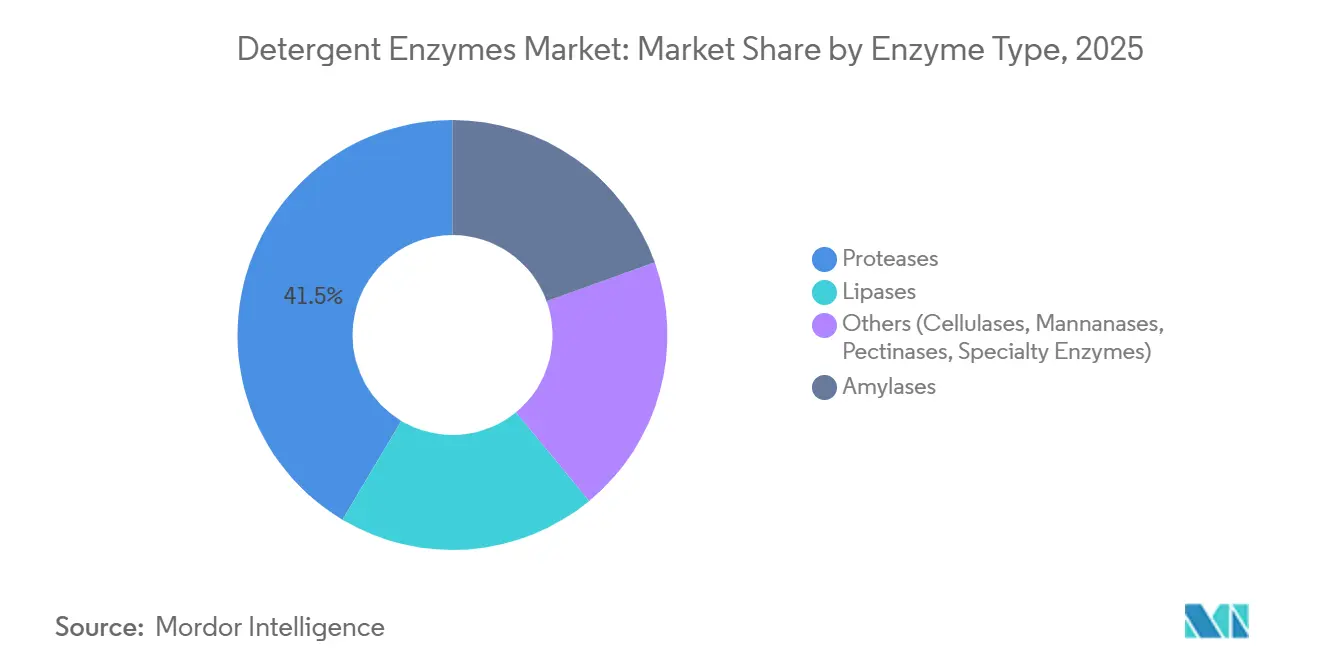
Proteases Hold Ground as Lipase Demand AcceleratesProteases accounted for 41.45% of total detergent enzyme demand in 2025, owing to their ability to address protein-based stains such as blood, sweat, egg, grass, and milk. Their broad use across a range of wash conditions provides formulators with a practical foundation for detergent systems. Amylases provide starch-stain removal and help maintain fabric brightness. Cellulases, mannanases, and pectinases support more specialized fabric-care claims, including whiteness retention and pilling reduction. A 2025 Scientific Reports study found that a thermostable alkaline protease from Bacillus paramycoides retained 75% of its activity after 10 minutes at 80°C and 89% after 1 hour at pH 12. This indicates that high-temperature institutional applications require strong enzyme performance, even as lower-temperature laundry becomes more common in the detergent enzymes market.
Lipases represent the fastest-growing enzyme class, with the detergent enzymes market size for this segment projected to grow at a CAGR of 6.75% from 2026 to 2031. Sebum, cooking oil, and cosmetic residues are difficult to remove during short, cold wash cycles when surfactant performance is reduced. A 2025 AMB Express study reported lipase activity of 3,867 U/mg at pH 8 and 40°C for an Aspergillus terreus enzyme evaluated for use in laundry, including performance against corn and olive oil stains under those conditions. Multi-enzyme systems combine protease, lipase, amylase, cellulase, pectinase, and mannanase into fewer dosing steps. AB Enzymes received ECOCERT certification for several detergent enzyme products in June 2026, reflecting continued interest in sustainability-certified enzyme portfolios.

By Form:
Liquid Formats Dominate, Encapsulation Unlocks Premium ValueLiquid enzymes accounted for 44.67% of total detergent enzyme demand in 2025, as they are straightforward to incorporate into liquid detergent systems and support low-dust manufacturing environments relevant to worker protection. Granular and powder forms remain important in regions with strong retail demand for powder detergents, including parts of South and Southeast Asia, Sub-Saharan Africa, and Latin America. Form selection depends on the detergent format, manufacturing process, climate exposure, and required shelf life.
Encapsulated enzymes are forecast to grow at a CAGR of 6.32% from 2026 to 2031. Unit-dose and highly concentrated detergents require enzymes to remain isolated from the formulation until use. IFF announced the first large-scale deployment of its Designed Enzymatic Biomaterials platform in a laundry detergent formulation in September 2025, replacing non-biodegradable polyquaternium ingredients with a biodegradable, bio-based polymer alternative. The American Industrial Hygiene Association (AIHA) identifies encapsulation as a relevant control method for reducing exposure to enzyme dust in industrial settings. The detergent enzymes industry is moving toward encapsulated formats, in which formulators require both shelf-life protection and exposure control.
By Detergent Type:
Laundry Detergents Dominate, Industrial and Institutional (I&I) Segment Leads GrowthLaundry detergents accounted for 70.56% of total detergent enzyme demand in 2025. This segment has the highest enzyme demand because household laundry products are widely used and must perform against a variety of everyday stains. Enzymes help suppliers support cleaning claims across cold, rapid, and standard wash programs. Industrial and institutional products use higher enzyme loadings per formulation batch to handle heavier soils and a wider range of wash temperatures. These buyers may also require documented compliance with product and environmental standards.
Industrial and institutional detergents are the fastest-growing detergent type, at a CAGR of 6.51% from 2026 to 2031. Commercial protocols require performance under higher soil loads, on difficult stains, and during regular cleaning cycles. Dishwashing remains a secondary channel in which protease-amylase combinations address protein and starch residues on tableware. The other category includes specialty settings such as medical textile processing and food processing linen services, where control of biocontamination risk in laundered textiles is required. Underwriters Laboratories (UL) 2700, Second Edition, provides a 2026 sustainability standard relevant to the qualification of cleaning products.
By Application:
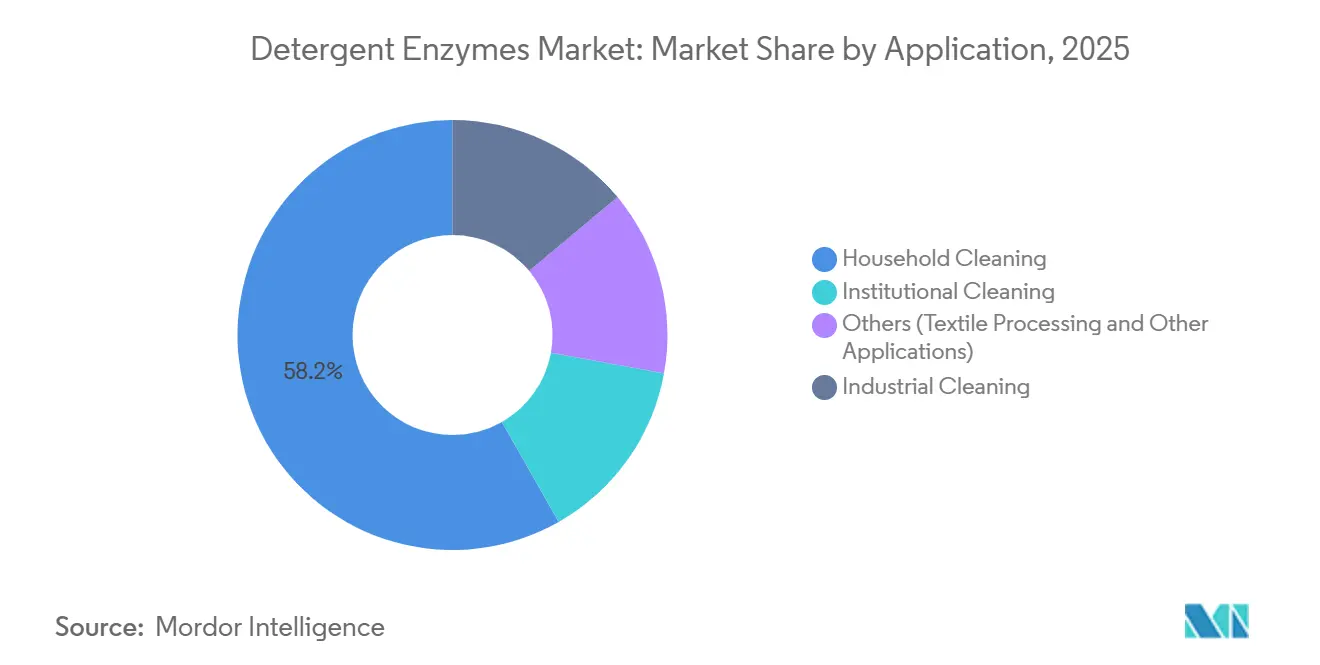
Household Cleaning Anchors Demand, Industrial Pace QuickensHousehold cleaning accounted for 58.22% of total detergent enzyme demand in 2025. Consumer laundry detergents used in automatic washing machines are the primary source of this demand. Lower default temperatures increase the need for enzymes that perform without high heat. Household users evaluate stain removal, fabric care, fragrance, and ease of use simultaneously, keeping household cleaning central to the detergent enzymes market.
Industrial cleaning is projected to expand at a CAGR of 6.66% from 2026 to 2031. Commercial laundry operators, food processing facilities, and healthcare linen services are replacing some solvent-based systems with enzyme-based formulations. REACH Regulation (EC) No 1907/2006 continues to shape chemical management and supplier documentation for European operations. Institutional cleaning serves healthcare, hospitality, and food service operations, where hygiene standards carry more weight than ingredient cost alone. The other category includes textile processing in manufacturing centers such as Vietnam, Bangladesh, and India, where enzymatic pretreatment can reduce water and chemical use during fiber finishing.
Geography Analysis
APAC Detergent Enzymes Market
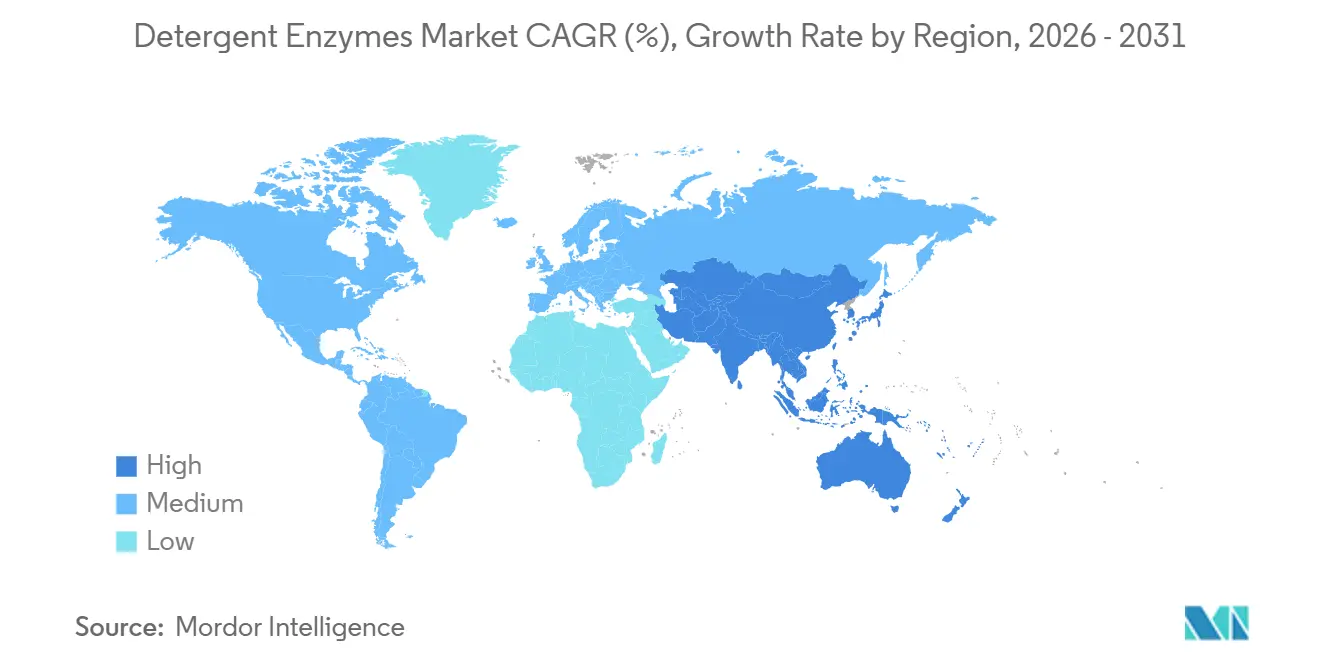
Asia-Pacific accounted for 37.15% of total detergent enzyme demand in 2025 and is forecast to grow at a CAGR of 6.78% from 2026 to 2031. The region benefits from rising washing machine ownership, urban growth, and increasing demand for higher-performing detergent formats. China remains the largest regional market, with high household detergent output providing a broad base for enzyme use. India is contributing by expanding washing machine adoption and regulatory action on phosphates. Japan and South Korea are important premium markets where brands compete on product performance and formulation technology. Kao relaunched its Attack ZERO series in March 2026 with biofilm-targeting technology designed to address bacteria in washing machine drums during regular cycles.
North America and Europe Detergent Enzymes Market
North America and Europe remain important markets for regulation, formulation research, and premium detergent demand. Washing machine efficiency standards and consumer use of colder wash cycles support demand for enzyme systems with low-temperature activity. European suppliers must maintain documentation and exposure controls under the REACH Regulation (EC) No 1907/2006. Germany, France, and Nordic countries present conditions for low-temperature product claims and Ecolabel-related formulation work. The International Association for Soaps, Detergents and Maintenance Products (A.I.S.E.) guidance on enzyme-containing consumer products provides suppliers with a current reference for risk assessment. These requirements can favor producers with expertise in applications, regulatory compliance, and stable supply relationships in the detergent enzymes market.
South America and MEA Detergent Enzymes Market
South America, the Middle East, and Africa present distinct opportunities in retail development, local manufacturing, and institutional demand. Brazil and Argentina are the primary South American markets where liquid detergent distribution is expanding, although price sensitivity can limit premium enzyme loading. Saudi Arabia's industrial diversification agenda may support local detergent manufacturing and related demand for ingredients. Growth in hospitality and healthcare sectors may also increase institutional laundry demand in the Middle East. South Africa represents an earlier stage of enzyme adoption, concentrated in commercial and institutional laundry settings. Across these regions, suppliers need products that meet local price expectations, climate conditions, water quality, and detergent format preferences.
Competitive Landscape
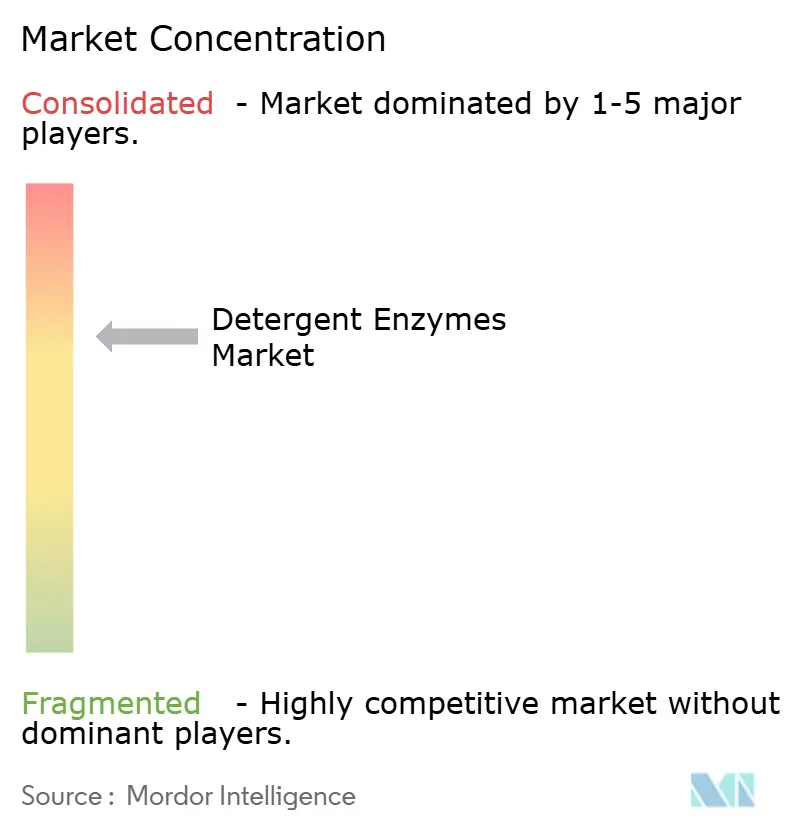
The detergent enzymes market is moderately consolidated. Novonesis, International Flavors & Fragrances (IFF), and BASF compete through protein engineering, application knowledge, and relationships with large consumer goods companies. These companies supply technologies that can be integrated into complex detergent formulations. Novonesis has built its detergent enzyme position through enzyme development and commercial application. IFF's enzyme capabilities include the Genencor heritage in protein engineering and enzyme performance. Competitive strength depends on the ability to pair enzyme performance with the customer's detergent base, manufacturing process, and regulatory requirements.
Suppliers are increasingly using joint development and platform partnerships rather than only selling standard ingredients. In October 2025, IFF and BASF announced a collaboration to develop enzyme and bio-based polymer technologies for fabric care, dish care, personal care, and industrial cleaning. Novonesis launched Progress Beyond and Progress Go in March 2025 to provide protease performance without requiring a protease inhibitor. BASF expanded its Lavergy liquid enzyme portfolio in July 2025 with new lipase, cellulase, and amylase variants. These developments indicate that product development is focusing on compatibility, stability, and lower-temperature performance, while also raising the technical standard for suppliers seeking to serve global detergent brands.
Mid-tier suppliers such as Advanced Enzyme Technologies, AB Enzymes, Amano Enzyme, Bestzyme, and Biocatalysts compete through regional service, cost control, and specialized enzyme classes. They target applications that do not require the full research infrastructure of the largest suppliers. Relevant opportunities include standardized multi-enzyme blends for private-label and regional detergent manufacturers, cold-adapted enzymes active below 15°C, and bio-based polymer systems that extend shelf life and meet sustainability requirements. The 2025 Nature Communications work on data-driven protease engineering demonstrates how computational tools could broaden access to enzyme design capabilities.
Detergent Enzymes Industry Leaders
-
Novozymes A/S
-
International Flavors & Fragrances Inc.
-
BASF
-
Advanced Enzyme Technologies
-
AB Enzymes
- *Disclaimer: Major Players sorted in no particular order
Detergent Enzymes Market Companies Covered in this Report
- AB Enzymes
- Advanced Enzyme Technologies
- Amano Enzyme Inc.
- Antozyme Biotech
- Aum Enzymes
- Aumgene Biosciences
- BASF
- Bestzyme
- Biocatalysts
- Creative Enzymes
- International Flavors & Fragrances Inc.
- Kao Corporation
- Maps Enzymes Ltd.
- Novozymes A/S
- Sunson Industry Group Co., Ltd
Recent Industry Developments in Detergent Enzymes Market
- June 2026: AB Enzymes received ECOCERT certification for several of its detergent enzyme products. The certification reflects the company's shift to plant-based propylene glycol in enzyme formulations, positioning its portfolio for sustainability-focused formulation requirements in European and global markets.
- October 2025: IFF and BASF announced a strategic collaboration to accelerate the development of IFF's Designed Enzymatic Biomaterials platform and develop next-generation enzyme technologies for fabric, dish, personal care, and industrial cleaning applications. Both companies retain independent operations while leveraging complementary biotechnology and chemical R&D capabilities.
Global Detergent Enzymes Market Report Scope
Detergent enzymes are specialized proteins added to cleaning formulations to act as biological catalysts. They break down complex stain molecules into smaller, water-soluble components that surfactants and water can wash away. They enable effective cleaning in cold water, reducing energy consumption and protecting fabrics.
The detergent enzymes market is segmented by enzyme type, form, detergent type, application, and geography. By enzyme type, the market is segmented into proteases, amylases, lipases, and others (cellulases, mannanases, pectinases, specialty enzymes). By form, the market is segmented into liquid enzymes, granular enzymes, powder enzymes, and encapsulated enzymes. By detergent type, the market is segmented into laundry detergents, dishwashing detergents, industrial and institutional detergents, and others (specialty cleaning products). By application, the market is segmented into household cleaning, industrial cleaning, institutional cleaning, and others (textile processing and other applications). The report also covers market size and forecasts for detergent enzymes across 15 countries in major regions. The market sizes and forecasts are provided in terms of value (USD).
Segmentation Overview
| Proteases |
| Amylases |
| Lipases |
| Others (Cellulases, Mannanases, Pectinases, Specialty Enzymes) |
| Liquid Enzymes |
| Granular Enzymes |
| Powder Enzymes |
| Encapsulated Enzymes |
| Laundry Detergents |
| Dishwashing Detergents |
| Industrial and Institutional Detergents |
| Others (Specialty Cleaning Products) |
| Household Cleaning |
| Industrial Cleaning |
| Institutional Cleaning |
| Others (Textile Processing and Other Applications) |
| Asia-Pacific | China |
| India | |
| Japan | |
| South Korea | |
| ASEAN Countries | |
| Rest of Asia-Pacific | |
| North America | United States |
| Canada | |
| Mexico | |
| Europe | Germany |
| United Kingdom | |
| France | |
| Italy | |
| NORDIC Countries | |
| Rest of Europe | |
| South America | Brazil |
| Argentina | |
| Rest of South America | |
| Middle East and Africa | Saudi Arabia |
| South Africa | |
| Rest of Middle East and Africa |
| By Enzyme Type | Proteases | |
| Amylases | ||
| Lipases | ||
| Others (Cellulases, Mannanases, Pectinases, Specialty Enzymes) | ||
| By Form | Liquid Enzymes | |
| Granular Enzymes | ||
| Powder Enzymes | ||
| Encapsulated Enzymes | ||
| By Detergent Type | Laundry Detergents | |
| Dishwashing Detergents | ||
| Industrial and Institutional Detergents | ||
| Others (Specialty Cleaning Products) | ||
| By Application | Household Cleaning | |
| Industrial Cleaning | ||
| Institutional Cleaning | ||
| Others (Textile Processing and Other Applications) | ||
| By Geography | Asia-Pacific | China |
| India | ||
| Japan | ||
| South Korea | ||
| ASEAN Countries | ||
| Rest of Asia-Pacific | ||
| North America | United States | |
| Canada | ||
| Mexico | ||
| Europe | Germany | |
| United Kingdom | ||
| France | ||
| Italy | ||
| NORDIC Countries | ||
| Rest of Europe | ||
| South America | Brazil | |
| Argentina | ||
| Rest of South America | ||
| Middle East and Africa | Saudi Arabia | |
| South Africa | ||
| Rest of Middle East and Africa | ||
Key Questions Answered in the Report
What is current market size of Detergent Enzymes Market?
The Detergent Enzymes Market size is estimated at USD 4.24 billion in 2025 and is estimated to grow from USD 4.46 billion in 2026 to USD 5.95 billion by 2031, at a CAGR of 5.93% during the forecast period (2026-2031).
Which enzyme type leads to demand in detergent formulations?
Proteases led demand with a 41.45% share in 2025 because they address a wide range of protein-based stains. Their broad stain-removal role keeps them relevant across household and professional cleaning formulations.
Which detergent enzyme category is growing the fastest?
Lipases are projected to be the fastest-growing enzyme type at a 6.75% CAGR through 2031. Growth is linked to the need to remove oil-based stains during cold, shorter wash cycles.
Why are encapsulated enzymes important in laundry products?
Encapsulation can protect enzymes from surfactants and salts in concentrated or unit-dose products. It can also help reduce dust exposure during handling and preserve performance through storage.