
Detergent Alcohols Market Size and Share
Market Overview
| Study Period | 2021 - 2031 |
|---|---|
| Market Size (2026) | USD 7.76 Billion |
| Market Size (2031) | USD 10.32 Billion |
| Growth Rate (2026 - 2031) | 5.87 % |
| Fastest Growing Market | Asia-Pacific |
| Largest Market | Asia-Pacific |
| Market Concentration | Medium |
Major Players *Disclaimer: Major Players sorted in no particular order Image © Mordor Intelligence. Reuse requires attribution under CC BY 4.0. | |
Detergent Alcohols Market Analysis by Mordor Intelligence
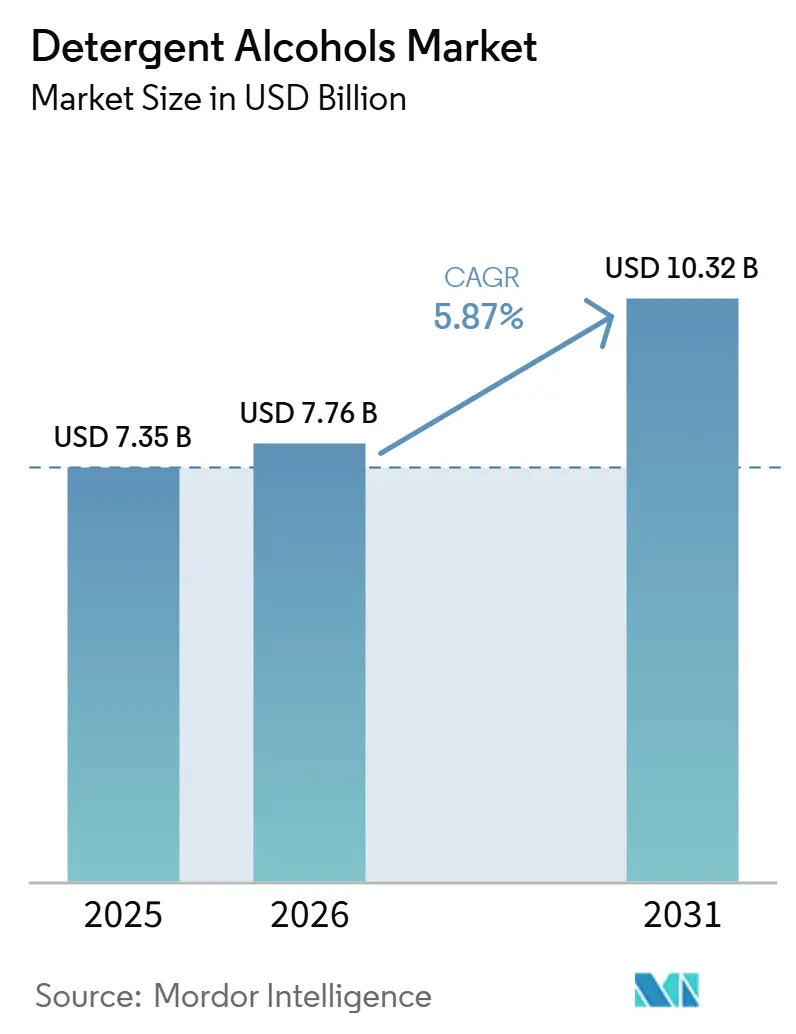
The Detergent Alcohols Market was valued at USD 7.35 billion in 2025 and is estimated to grow from USD 7.76 billion in 2026 to reach USD 10.32 billion by 2031, at a CAGR of 5.87% during the forecast period (2026–2031). Detergent alcohols, mainly C12 to C18 fatty and synthetic alcohols, remain important intermediates for anionic and non-ionic surfactants used in household cleaning, personal care, and industrial maintenance. Supply chains are moving toward bio-based feedstocks as consumer goods companies seek traceable materials and regulators place greater attention on biodegradability. The detergent alcohols market is therefore shaped by the balance between certified natural supply, synthetic alternatives, and changing requirements in downstream formulations. Regulation (EU) 2026/405 was published in March 2026 and will apply from September 2029, strengthening biodegradability and traceability requirements for detergents and surfactants. Producers with integrated oleochemical operations and documented sourcing are better positioned to serve premium customers, while feedstock volatility remains a near-term constraint for companies that lack long-term procurement agreements or flexibility to switch between natural and synthetic inputs.
Key Report Takeaways
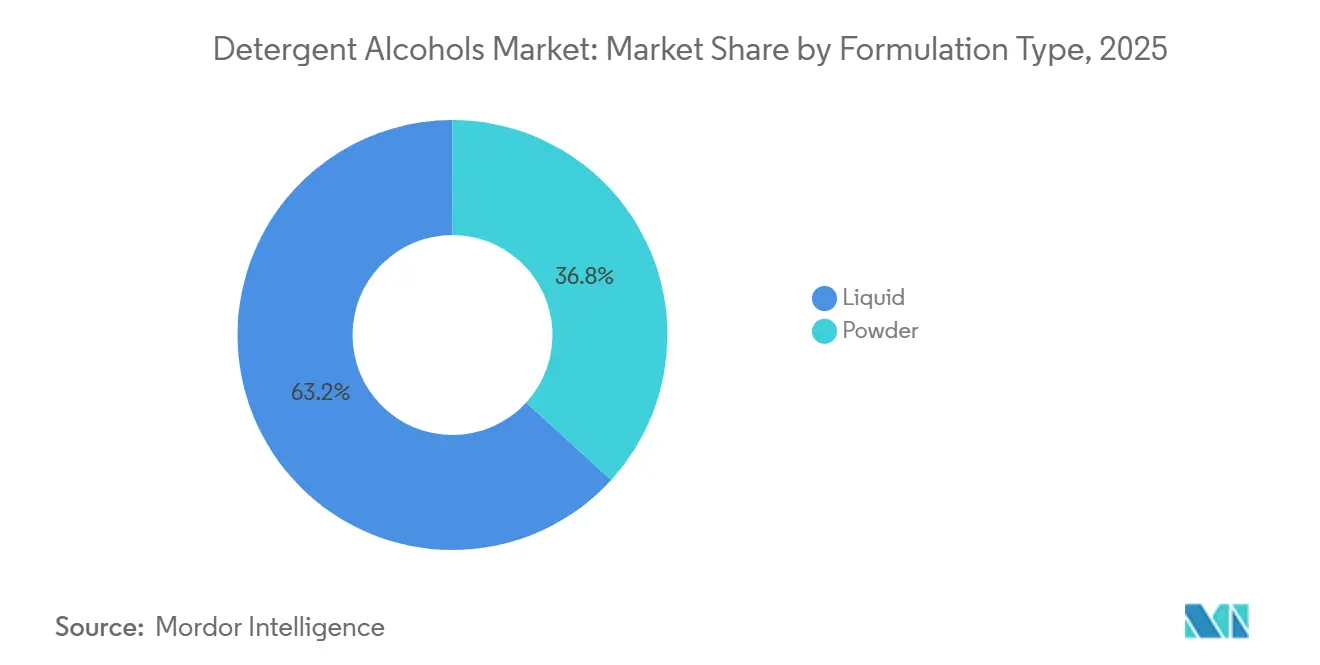
- By formulation type, liquid held 63.22% of the detergent alcohols market share in 2025 and is forecast to grow at a 6.22% CAGR through 2031.
- By source, natural detergent alcohols held 68.41% of the detergent alcohols market share in 2025 and are forecast to grow at a 6.38% CAGR through 2031.
- By application, household cleaning held 47.51% of the detergent alcohols market share in 2025, while personal care and cosmetics is forecast to grow at a 7.12% CAGR through 2031.
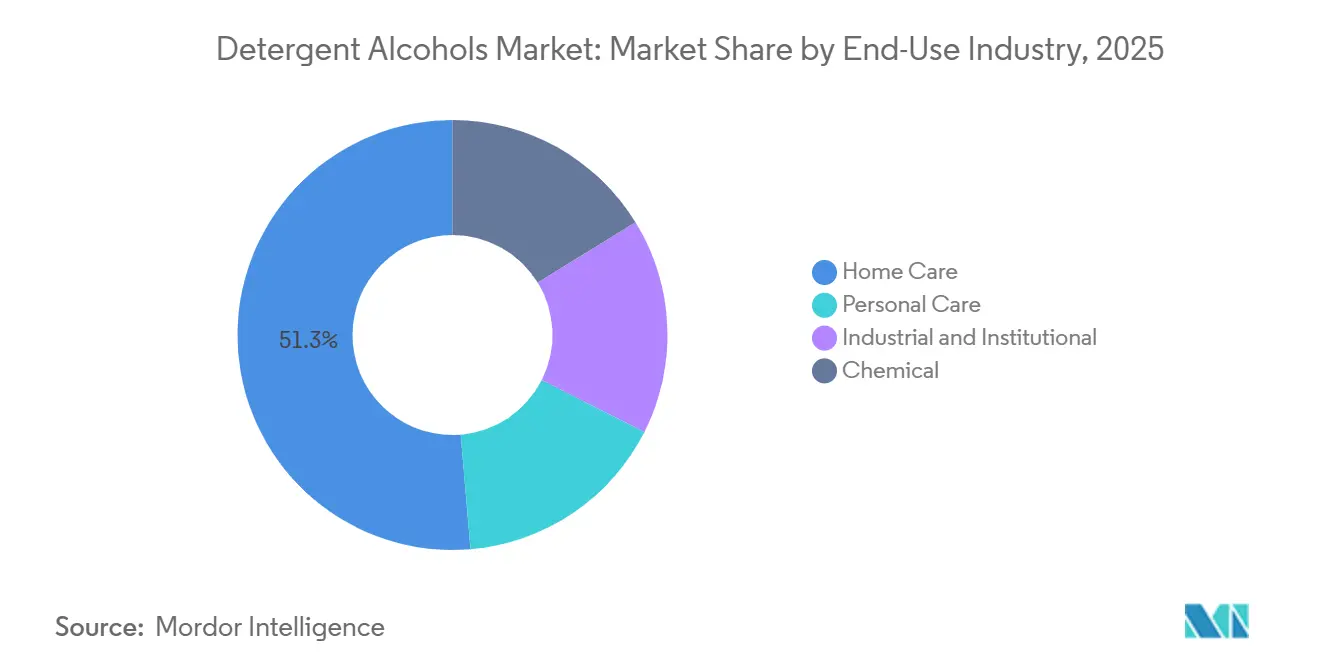
- By end-use industry, home care held 51.33% of the detergent alcohols market share in 2025, while personal care is forecast to grow at a 6.58% CAGR through 2031.
- By geography, Asia-Pacific held 45.38% of the detergent alcohols market share in 2025 and is forecast to grow at a 6.41% CAGR through 2031.
Note: Market size and forecast figures in this report are generated using Mordor Intelligence’s proprietary estimation framework, updated with the latest available data and insights as of January 2026.
Market Trends and Insights
Drivers Impact Analysis of Detergent Alcohols Market*
| Driver | (~) % Impact on CAGR Forecast | Geographic Relevance | Impact Timeline |
|---|---|---|---|
| Rising Demand for High-Performance Surfactants in Household and Industrial Cleaning | +1.5% | Global, concentrated in Asia-Pacific and North America | Medium term (2-4 years) |
| Expanding Use of Detergent Alcohols in Personal Care and Cosmetics Formulations | +1.2% | Global; highest adoption in Europe, North America, and APAC | Long term (≥ 4 years) |
| Growing Adoption of Bio-Based and Renewable Oleochemical Feedstocks | +0.9% | APAC core, spill-over to Europe and North America | Medium term (2-4 years) |
| Increasing Demand for Cost-Effective Detergent Raw Materials in Emerging Economies | +0.8% | Asia-Pacific, South America, MEA | Long term (≥ 4 years) |
| Favorable Regulatory Shift Toward Biodegradable and Environmentally Friendly Surfactant Ingredients | +0.7% | Global, with highest immediacy in EU and North America | Medium term (2-4 years) |
| Source: Mordor Intelligence | |||
Rising Demand for High-Performance Surfactants in Household and Industrial Cleaning
Alcohol ethoxylates and alcohol ether sulfates derived from C12 to C18 alcohols are widely used in liquid laundry, dishwashing, and institutional cleaning formulations. Their biodegradability and cold-temperature performance support their use in products that need dependable cleaning performance, especially where consumers expect results in lower-temperature wash cycles. Higher hygiene requirements in food service, health care, and hospitality have sustained demand for industrial cleaning surfactants, adding a durable layer of demand. Concentrated liquid detergents require greater fatty alcohol loading per unit volume than comparable powder products, raising alcohol value density for each unit of finished detergent even when the consumer product itself uses less packaging and water. Croda reported in July 2026 that its EBC Crosolv products delivered up to 27% better greasy stain removal in pre-treatment sprays, showing how bio-based ingredients can also address formulation performance. The detergent alcohols market is likely to favor natural grades with stronger functional properties as cleaning formulations continue to develop.
Expanding Use of Detergent Alcohols in Personal Care and Cosmetics Formulations
Cetyl, stearyl, and cetearyl alcohols are used as emulsifiers, emollients, and texture agents in rinse-off and leave-on personal care products. Their defined sensory and formulation properties make substitution difficult in some cosmetic applications. Fatty alcohol-based non-ionic surfactants are also used in hair care and other personal care formulations, where buyers seek plant-derived emollients and consistent sensory properties that petrochemical alternatives may not reproduce without formulation changes. Kao entered a multiyear purchase agreement with Future Origins in March 2025 for NALO, a palm-free C12/C14 fatty alcohol made through biofermentation. This agreement shows that buyers are preparing their sourcing strategies before fermentation-derived supply reaches broader commercial volumes, rather than waiting for large-scale production to become available. The detergent alcohols market benefits when personal care buyers accept higher costs for certified and differentiated materials.
Growing Adoption of Bio-Based and Renewable Oleochemical Feedstocks
Natural alcohol production is concentrated in integrated oleochemical supply chains, particularly in Indonesia and Malaysia. These supply chains connect palm-derived raw materials with finished fatty alcohol output and can provide greater traceability, which matters to multinational buyers with deforestation-related commitments. BASF reported in 2026 that 79.2% of its palm and palm kernel oil sourcing was Roundtable on Sustainable Palm Oil (RSPO)-certified, and 98% was traceable to the oil mill level. BASF also moved its target for fully certified palm-based intermediates to 2030 because certified palm kernel oil availability remains limited, showing the difference between sustainability commitments made by downstream brands and the physical availability of approved feedstocks. The American Chemical Society (ACS) recognized Future Origins’ NALO with its 2025 Green Chemistry Challenge Award, supporting biofermentation as a potential additional feedstock route. Capacity investment in certified supply can improve access to bio-based materials, but the shortage of certified inputs will remain relevant during much of the forecast period and will continue to affect sourcing decisions.
Favorable Regulatory Shift Toward Biodegradable and Environmentally Friendly Surfactant Ingredients
Regulation (EU) 2026/405 applies from September 2029 and removes derogations for non-biodegradable surfactants. The framework requires surfactants to meet ultimate aerobic biodegradability conditions and introduces Digital Product Passports for detergents and surfactants, creating a common compliance timetable for multinational companies selling into European and North American consumer channels. These measures raise the value of auditable supply chains and documented ingredient performance, making compliance a practical market-access consideration for suppliers. The U.S. Environmental Protection Agency added 18 chemicals to its Safer Chemical Ingredients List in July 2025, taking the list to 983 chemicals[1]. Fatty alcohol ethoxylates remain relevant to products seeking safer-ingredient recognition. The regulatory direction gives the detergent alcohols market a clearer incentive to use certified bio-based alcohols in regulated premium channels.
Restraints Impact Analysis of Detergent Alcohols Market*
| Restraint | (~) % Impact on CAGR Forecast | Geographic Relevance | Impact Timeline |
|---|---|---|---|
| Volatility in Prices of Palm Kernel Oil, Coconut Oil, and Other Oleochemical Feedstocks | -1.0% | APAC core, spill-over to Global | Short term (≤ 2 years) |
| Sustainability and Environmental Concerns Related to Palm Oil-Based Supply Chains | -0.6% | Global, particularly EU and North America | Long term (≥ 4 years) |
| High Capital Investment Requirements for Production and Refining Facilities | -0.4% | APAC, MEA | Long term (≥ 4 years) |
| Source: Mordor Intelligence | |||
Volatility in Prices of Palm Kernel Oil, Coconut Oil, and Other Oleochemical Feedstocks
Refined, Bleached, and Deodorized (RBD) palm kernel oil in Malaysia reached USD 2,035 per metric ton FOB in September 2025, following weather-related yield disruption, export restrictions, and logistics constraints. Coconut oil prices also rose sharply in 2025, increasing pressure on lauryl alcohol producers that rely on coconut-derived feedstock. These increases reduced margins for producers without long-term feedstock agreements and encouraged some lauryl alcohol producers to accelerate palm-kernel-oil-based substitution. Early 2026 conditions indicated easing pressure as supply and demand started to rebalance, although planting constraints and drought cycles continued to limit palm kernel oil output. Mid-tier producers may defer maintenance spending when margins narrow, which can prolong supply constraints even after feedstock prices begin to correct, because restoring production reliability and maintenance schedules takes longer than a short-term commodity price adjustment. Personal care producers have less flexibility than household product makers because formulation changes can require costly re-registration.
Sustainability and Environmental Concerns Related to Palm Oil-Based Supply Chains
Palm-based supply chains face scrutiny related to deforestation, land use, and traceability. RSPO reported that 21% of global palm oil was certified in 2025, leaving limited availability of fully traceable material for buyers with strict sourcing requirements. The shortage of certified supply can create a premium for segregated material and reduce its cost competitiveness, even when downstream customers prefer verified material. RSPO updated its certification systems in November 2025, with revised requirements effective May 14, 2026. The changes strengthen auditing and supply-chain assurance requirements for smaller producers. European buyers also face deforestation-related procurement obligations that can require more evidence than certification alone provides, raising the documentation burden for suppliers seeking access to premium applications and regulated customer programs.
*Our forecasts treat driver/restraint impacts as directional, not additive. The impact forecasts reflect baseline growth, mix effects, and variable interactions.
Detergent Alcohols Market Segment Analysis
By Formulation Type:
Liquid Formulation Maintains a Dual LeadershipLiquid formulation held 63.22% of the detergent alcohols market share in 2025 and is projected to grow at a 6.22% CAGR through 2031. This combined scale and growth position reflects continued use of liquid laundry, dishwashing, and personal care products. Alcohol ethoxylates and alcohol ether sulfates dissolve effectively in water-based matrices. They are therefore core active ingredients in many liquid formulations used in developed and emerging markets, including laundry and dishwashing products. Concentrated formats use more fatty alcohol per unit volume than standard powder products.
Powder formulation remains commercially important in price-sensitive areas, including rural India, Sub-Saharan Africa, and parts of Latin America. Cold-water washing habits and lower product costs support powder demand in these locations. BASF expanded its liquid enzyme portfolio in July 2025 with biodegradable Lavergy L Pace lipase and C Care cellulase for liquid detergent compatibility. Ingredient development is therefore concentrating on performance within the leading liquid format.
By Source:
Natural Detergent Alcohols Consolidate Their Structural LeadNatural detergent alcohols held 68.41% of the detergent alcohols market share in 2025 and are projected to grow at a 6.38% CAGR through 2031. Sustainability commitments, clean-label demand, and Indonesian capacity additions support this position. Lauryl and myristyl alcohols from palm kernel oil streams are widely used in household cleaning and industrial surfactants. Cetyl and stearyl alcohols are especially relevant to personal care products because their chain distribution supports emulsification and texture. Natural suppliers with traceable feedstock documentation can be preferred in premium customer agreements, particularly for personal care formulations with defined sourcing requirements.
Synthetic alcohols made through Ziegler and oxo processes remain relevant in North American and European industrial applications. Odd-carbon and branched-chain variants can provide properties that natural alcohols cannot readily match. Ecogreen Oleochemicals received BP Batam’s 2025 Investment Award as the domestic private national company with the largest investment realization in the Batam Free Trade Zone. This development points to continued investment in Indonesia’s natural alcohol infrastructure. Updated RSPO requirements also raise the importance of documented compliance across the supply chain.
By Application:
Household Cleaning Anchors Revenue, Personal Care and Cosmetics Drives GrowthHousehold cleaning accounted for 47.51% of the detergent alcohols market size in 2025, while personal care and cosmetics is projected to grow at a 7.12% CAGR through 2031. Household cleaning uses high-volume C12 to C14 alcohols as precursors for ethoxylates and sulfates. Personal care uses lower volumes of higher-purity C16 to C18 alcohols. Certified and traceable sourcing can support a premium in cosmetic applications, which is generally less accessible in bulk household cleaning procurement. This difference explains why personal care can grow more quickly despite household cleaning’s larger base.
Industrial and institutional cleaning remains a steady application because food service and health care require consistent hygiene products. Textile processing, lubricants, and chemical intermediates are specialized outlets for detergent alcohols. Synthetic branched alcohols retain a technical role in these applications because of thermal stability and tailored chain architecture. ISO 16128 is increasingly relevant to natural ingredients used in certified cosmetic formulations. The detergent alcohols market, therefore, combines household cleaning demand with value-focused personal care demand.
By End-Use Industry:
Home Care Anchors Scale, Personal Care Leads Forward GrowthHome care held 51.33% of the detergent alcohols market share in 2025, while personal care is projected to grow at a 6.58% CAGR through 2031. Laundry and dishwashing products use fatty alcohol-derived ethoxylates as important active ingredients. This base demand supports the economics of large Southeast Asian oleochemical facilities by providing recurring high-volume demand for ethoxylate precursors used in laundry and dishwashing products across a broad range of consumer price points. Personal care growth is supported by expanding beauty and grooming spending in China, India, and Southeast Asia. Western markets also support demand for certified natural ingredients through premium product positioning, where ingredient origin and documentation can influence brand loyalty.
Industrial and institutional demand is more price sensitive and therefore has lower uptake of premium-grade alcohols. This dynamic supports synthetic alcohol suppliers in procurement tenders. Kao opened a tertiary amine plant in Pasadena, Texas, in August 2025 with 20,000-ton annual capacity. The facility supports fatty alcohol derivative strategies in disinfectant, conditioner, and fabric care applications, illustrating how companies are extending their position from alcohol feedstocks into higher-value downstream intermediates that serve several end-use categories. Chemical end uses remain specialized, with branched synthetic alcohols retaining an advantage in high-temperature applications.

Geography Analysis
APAC Detergent Alcohols Market
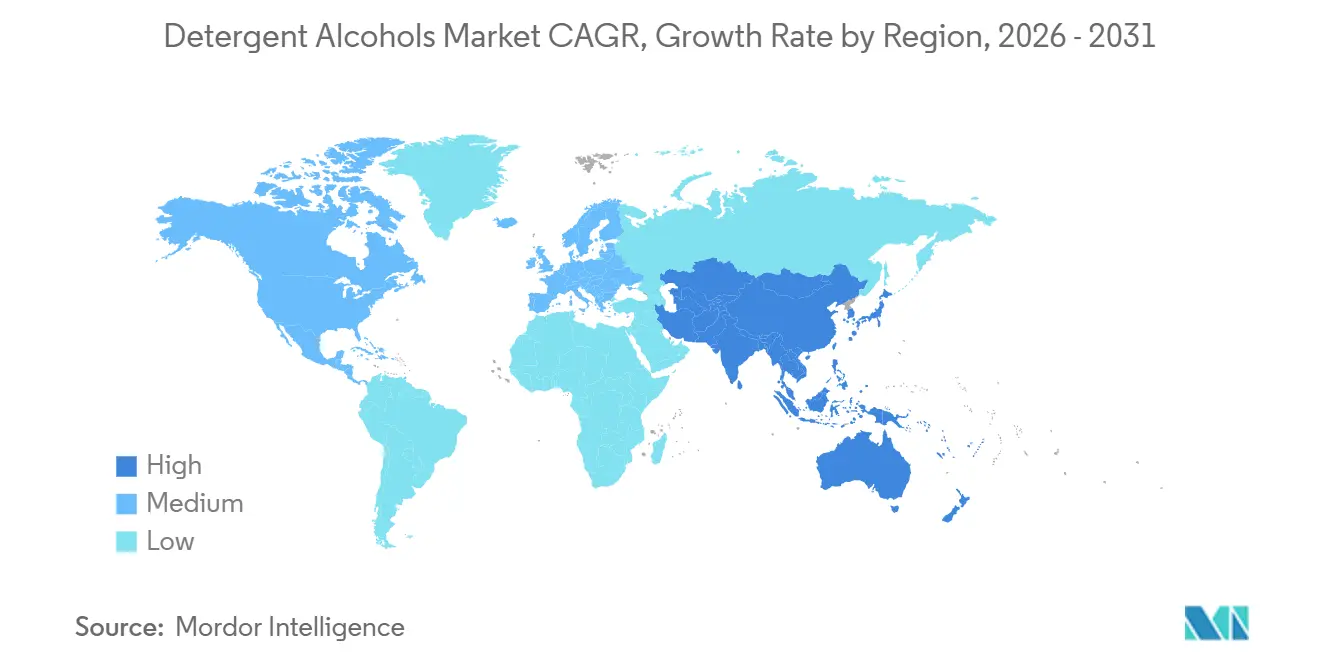
Asia-Pacific held 45.38% of the detergent alcohols market share in 2025 and is forecast to grow at a 6.41% CAGR through 2031. Indonesia and Malaysia host integrated oleochemical complexes that connect oil palm feedstock with C12 to C18 alcohol production. China and India add consumption growth through personal care and home care demand, while the regional production base provides a close supply source for many buyers. Japan supports demand for high-purity alcohols used in cosmetic formulations, where premium hair care and beauty products place greater weight on ingredient purity, defined performance, and supply-chain documentation than commodity household cleaning products. Ecogreen’s 2025 recognition in Batam also indicates continued capital deployment in Indonesia.
North America and Europe Detergent Alcohols Market
North America and Europe are mature regions where regulation and product value are more important. Regulation (EU) 2026/405 will apply from September 2029 and will require stronger biodegradability and traceability practices. BASF reported 79.2% RSPO-certified palm and palm kernel oil sourcing and 98% traceability to the oil mill level in 2026. North America relies substantially on synthetic alcohol capacity from Sasol and Shell. Bio-based imports can gain relevance as consumer goods companies pursue deforestation-free sourcing and seek materials supported by stronger traceability records.
MEA and South America Detergent Alcohols Market
South America, and the Middle-East and Africa are regions with growth potential. Brazil supports demand through consumer goods and institutional cleaning activity. In South America, renewable fatty alcohol processing by Indorama Ventures’ Oxiteno division shows downstream demand for bio-based materials. The Middle-East and Africa have supply support from Sasol’s South African synthetic alcohol production and Saudi petrochemical feedstock. Currency volatility and logistics costs can constrain imports of palm-derived oleochemicals, creating periodic gaps between demographic demand potential and realized purchasing. These factors can limit the extent to which the underlying population and urbanization growth convert into detergent alcohol demand.
Competitive Landscape
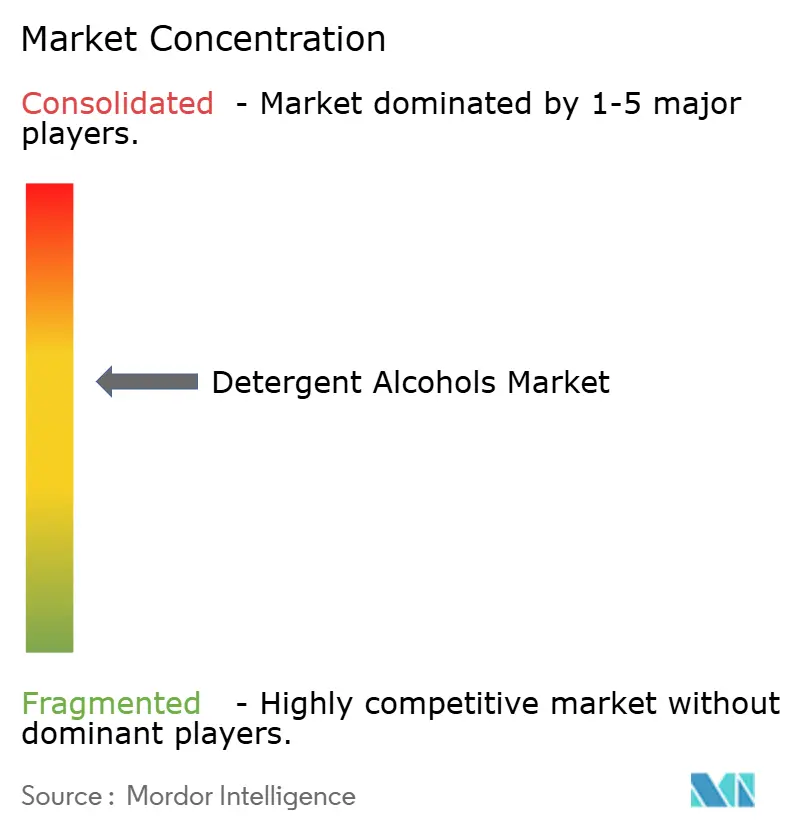
The detergent alcohols market is moderately concentrated, with the top five players including Sasol Limited, KLK OLEO, BASF, Wilmar International Ltd, and Godrej Chemicals. The leading natural suppliers have vertical integration from plantations to finished fatty alcohols, giving them control over feedstock access, processing, and traceability documentation. Their combined annual capacities exceed 2.5 million metric tons. BASF reported 98% traceability to oil mill level and 79.2% RSPO-certified palm sourcing in its 2026 Care Chemicals Responsible Sourcing Report[2]. This disclosure provides a benchmark for customers who use sourcing documentation in supplier qualification. Regulatory and certification requirements increasingly separate suppliers able to serve regulated markets from suppliers focused on less demanding trade flows.
The gap between certified palm kernel oil supply and buyer demand offers integrated suppliers an opportunity to secure long-term agreements with premium personal care customers. RSPO data showing 21% certification of global palm oil in 2025 supports the existence of a limited certified supply base. Future Origins’ NALO has support from Kao, Unilever, and L’Oréal and has a multiyear purchase agreement with Kao. This move gives palm-free fatty alcohols an early commercial route in cosmetics supply chains. Indian companies VVF Ltd. and Godrej Chemicals can compete through local formulation support and faster responsiveness. Such capabilities can matter where regional service offsets the scale advantage of larger Southeast Asian producers and where customers require faster formulation support.
Emery Oleochemicals achieved ISO 50001 Energy Management certification at its Cincinnati facility in May 2025. The reported outcome was a 25% reduction in NOx emissions, equivalent to 16 metric tons annually. Croda released July 2026 performance data for bio-based EBC Crosolv products used in home care formulations. These moves show that environmental performance and measurable formulation efficacy are being used in commercial positioning. Kao’s Pasadena plant is another example of investment in fatty alcohol derivative capacity.
Detergent Alcohols Industry Leaders
-
Sasol Limited
-
KLK OLEO
-
BASF
-
Wilmar International Ltd
-
Godrej Chemicals
- *Disclaimer: Major Players sorted in no particular order
Detergent Alcohols Market Companies Covered in this Report
- BASF
- Cargill, Incorporated
- Croda International Plc
- Ecogreen Oleochemicals
- Emery Oleochemicals
- Godrej Chemicals
- Kao Corporation
- KLK OLEO
- Musim Mas Group
- OLEOCHEMICAL INDUSTRIES BERHAD
- Procter & Gamble
- Sasol Limited
- Shell
- VVF Ltd.
- Wilmar International Ltd
Recent Industry Developments in Detergent Alcohols Market
- July 2026: BASF published its Care Chemicals Responsible Sourcing Report 2025, reporting 98% traceability of palm (kernel) oil to the oil mill level and 79.2% RSPO-certified sourcing, while extending its target for 100% certified palm-based intermediates to 2030. The initiative strengthens the sustainable sourcing of feedstocks used in detergent alcohol production and reflects the industry's transition toward certified, traceable raw materials for home and personal care applications.
- October 2025: Sasol Limited launched LIVINEX IO 7, a bio-circular, palm-free, and deforestation-free nonionic surfactant derived from insect oils. The launch expands Sasol's sustainable care chemicals portfolio and supports the growing demand for renewable, low-carbon ingredients in household and industrial cleaning products, driving innovation across the detergent alcohol value chain.
Global Detergent Alcohols Market Report Scope
Detergent alcohols are long-chain fatty alcohols derived from natural oils or synthetic feedstocks and are primarily used as raw materials for the production of surfactants. They offer excellent cleansing, foaming, emulsifying, and wetting properties, making them essential ingredients in household cleaners, personal care products, and industrial formulations.
The Detergent Alcohols Market is segmented by formulation type, source, application, end-use industry, and geography. By formulation type, the market is segmented into liquid and powder. By source, the market is segmented into natural detergent alcohols (lauryl alcohol (dodecanol), myristyl alcohol (tetradecanol), cetyl alcohol (hexadecanol), stearyl alcohol (octadecanol), oleyl alcohol (octadecenol), cetyl-stearyl alcohol blends, and other natural detergent alcohols) and synthetic detergent alcohols (linear synthetic alcohols, branched synthetic alcohols, and other synthetic detergent alcohols). By application, the market is segmented into household cleaning, industrial and institutional cleaning, personal care and cosmetics, textile processing, lubricants and chemical intermediates, and other applications. By end-use industry, the market is segmented into home care, personal care, industrial and institutional, and chemical. The report also covers the market size and forecasts for detergent alcohols in 16 countries across major regions. For each segment, the market sizing and forecasts have been done on the basis of value (USD).
Segmentation Overview
| Liquid |
| Powder |
| Natural Detergent Alcohols | Lauryl Alcohol (Dodecanol) |
| Myristyl Alcohol (Tetradecanol) | |
| Cetyl Alcohol (Hexadecanol) | |
| Stearyl Alcohol (Octadecanol) | |
| Oleyl Alcohol (Octadecenol) | |
| Cetyl-Stearyl Alcohol Blends | |
| Other Natural Detergent Alcohols | |
| Synthetic Detergent Alcohols | Linear Synthetic Alcohols |
| Branched Synthetic Alcohols | |
| Other Synthetic Detergent Alcohols |
| Household Cleaning |
| Industrial and Institutional Cleaning |
| Personal Care and Cosmetics |
| Textile Processing |
| Lubricants and Chemical Intermediates |
| Other Applications |
| Home Care |
| Personal Care |
| Industrial and Institutional |
| Chemical |
| Asia-Pacific | China |
| India | |
| Japan | |
| South Korea | |
| Rest of Asia-Pacific | |
| North America | United States |
| Canada | |
| Mexico | |
| Europe | Germany |
| United Kingdom | |
| France | |
| Italy | |
| Russia | |
| Rest of Europe | |
| South America | Brazil |
| Argentina | |
| Rest of South America | |
| Middle-East and Africa | Saudi Arabia |
| South Africa | |
| Rest of Middle-East and Africa |
| By Formulation Type | Liquid | |
| Powder | ||
| By Source | Natural Detergent Alcohols | Lauryl Alcohol (Dodecanol) |
| Myristyl Alcohol (Tetradecanol) | ||
| Cetyl Alcohol (Hexadecanol) | ||
| Stearyl Alcohol (Octadecanol) | ||
| Oleyl Alcohol (Octadecenol) | ||
| Cetyl-Stearyl Alcohol Blends | ||
| Other Natural Detergent Alcohols | ||
| Synthetic Detergent Alcohols | Linear Synthetic Alcohols | |
| Branched Synthetic Alcohols | ||
| Other Synthetic Detergent Alcohols | ||
| By Application | Household Cleaning | |
| Industrial and Institutional Cleaning | ||
| Personal Care and Cosmetics | ||
| Textile Processing | ||
| Lubricants and Chemical Intermediates | ||
| Other Applications | ||
| By End-Use Industry | Home Care | |
| Personal Care | ||
| Industrial and Institutional | ||
| Chemical | ||
| By Geography | Asia-Pacific | China |
| India | ||
| Japan | ||
| South Korea | ||
| Rest of Asia-Pacific | ||
| North America | United States | |
| Canada | ||
| Mexico | ||
| Europe | Germany | |
| United Kingdom | ||
| France | ||
| Italy | ||
| Russia | ||
| Rest of Europe | ||
| South America | Brazil | |
| Argentina | ||
| Rest of South America | ||
| Middle-East and Africa | Saudi Arabia | |
| South Africa | ||
| Rest of Middle-East and Africa | ||
Key Questions Answered in the Report
What is the size of the detergent alcohols market?
The detergent alcohols market stands at USD 7.76 billion in 2026 and is projected to reach USD 10.32 billion by 2031.
Which formulation type led market demand in 2025?
Liquid type held a 63.22% share in 2025. Its growth reflects concentrated laundry and dishwashing formats that use more alcohol per unit volume.
Why are natural detergent alcohols gaining demand?
Natural detergent alcohols held 68.41% share in 2025 and benefit from traceability needs, clean-label demand, and bio-based sourcing commitments.
Which application is expected to grow fastest through 2031?
Personal care and cosmetics is forecast to grow at a 7.12% CAGR through 2031, supported by demand for higher-purity and traceable ingredients.