
Desert Island Tourism Market Size and Share
Market Overview
| Study Period | 2021 - 2031 |
|---|---|
| Forecast Data Period | 2026 - 2031 |
| Base Year Market Size (2025) | USD 36.23 Billion |
| Market Size (2026) | USD 36.94 Billion |
| Market Size (2031) | USD 50.16 Billion |
| Growth Rate (2026 - 2031) | 6.31 % |
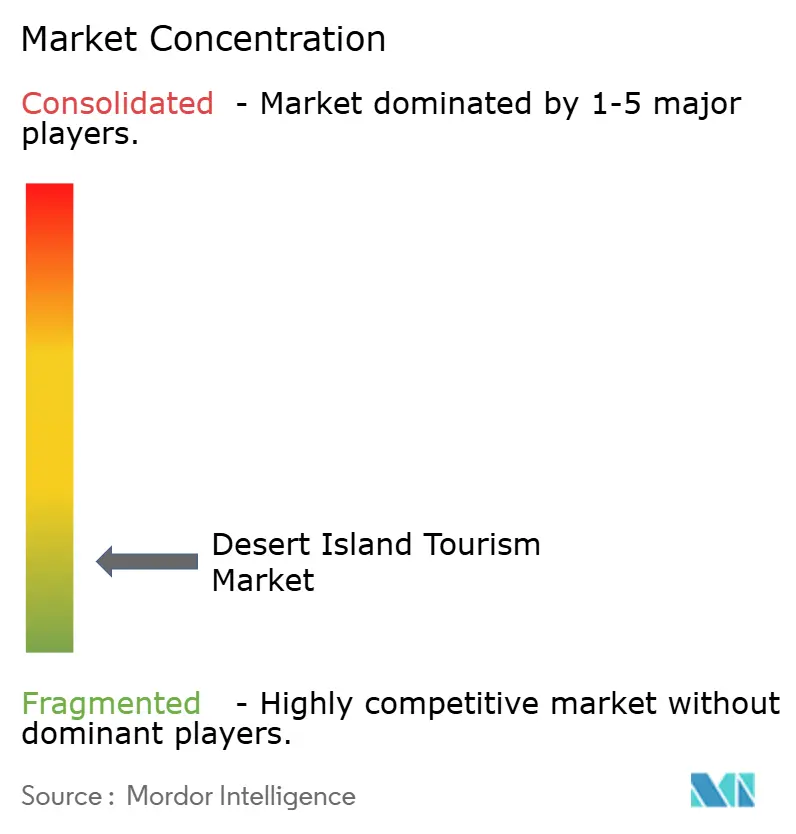
| Market Concentration | Low |
Major Players *Disclaimer: Major Players sorted in no particular order Image © Mordor Intelligence. Reuse requires attribution under CC BY 4.0. | |
Desert Island Tourism Market Analysis by Mordor Intelligence
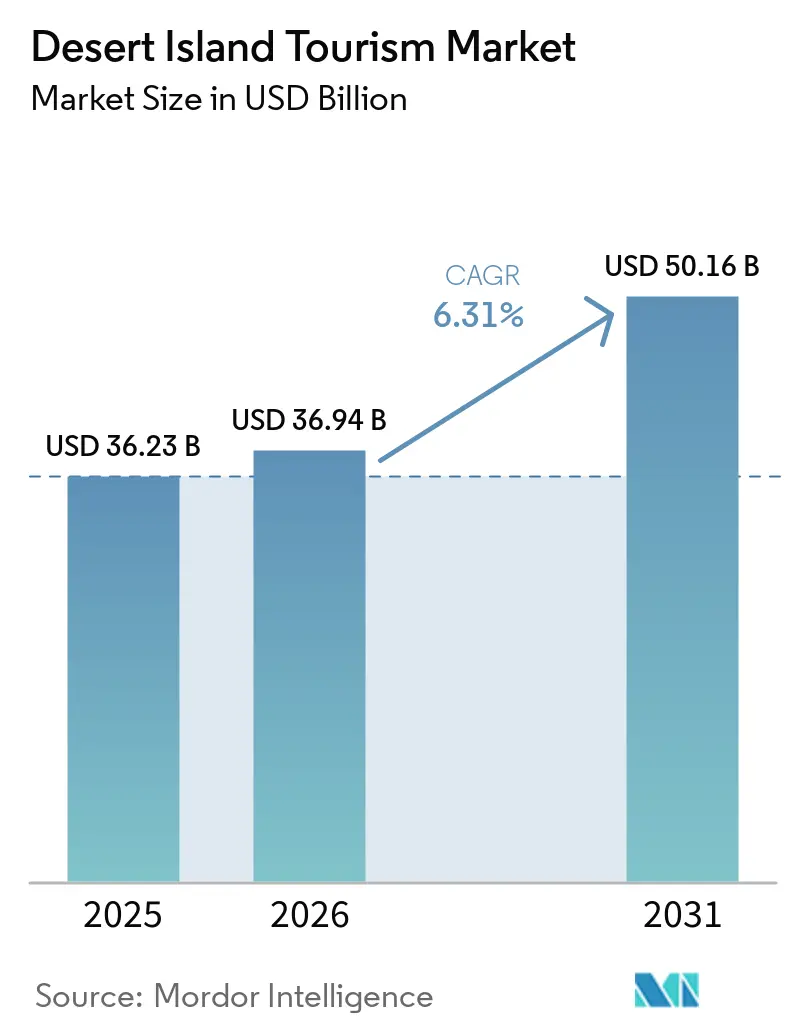
The Desert Island Tourism Market was valued at USD 36.23 billion in 2025 and estimated to grow from USD 36.94 billion in 2026 to reach USD 50.16 billion by 2031, at a CAGR of 6.31% during the forecast period (2026-2031). This growth reflects a shift toward travel emphasizing seclusion, ecological sustainability, and exclusivity over mass tourism. The travel and tourism sector contributed USD 11.6 trillion to global GDP in 2025, representing 9.8% of the world economy, and supported 366 million jobs, driving demand in 2026. Official Data recorded 1.5 billion international tourist arrivals in 2025, with projected growth of 3%-4% in 2026, indicating continued normalization of demand for long-haul leisure travel[1]. High-end island destinations maintain strong revenue per visitor by offering privacy, tailored services, and controlled supply. Climate adaptation measures, including renewable microgrids, desalination systems, and elevated construction, are increasingly integrated to protect asset value and support pricing stability in the Desert Island Tourism Market.
Key Report Takeaways
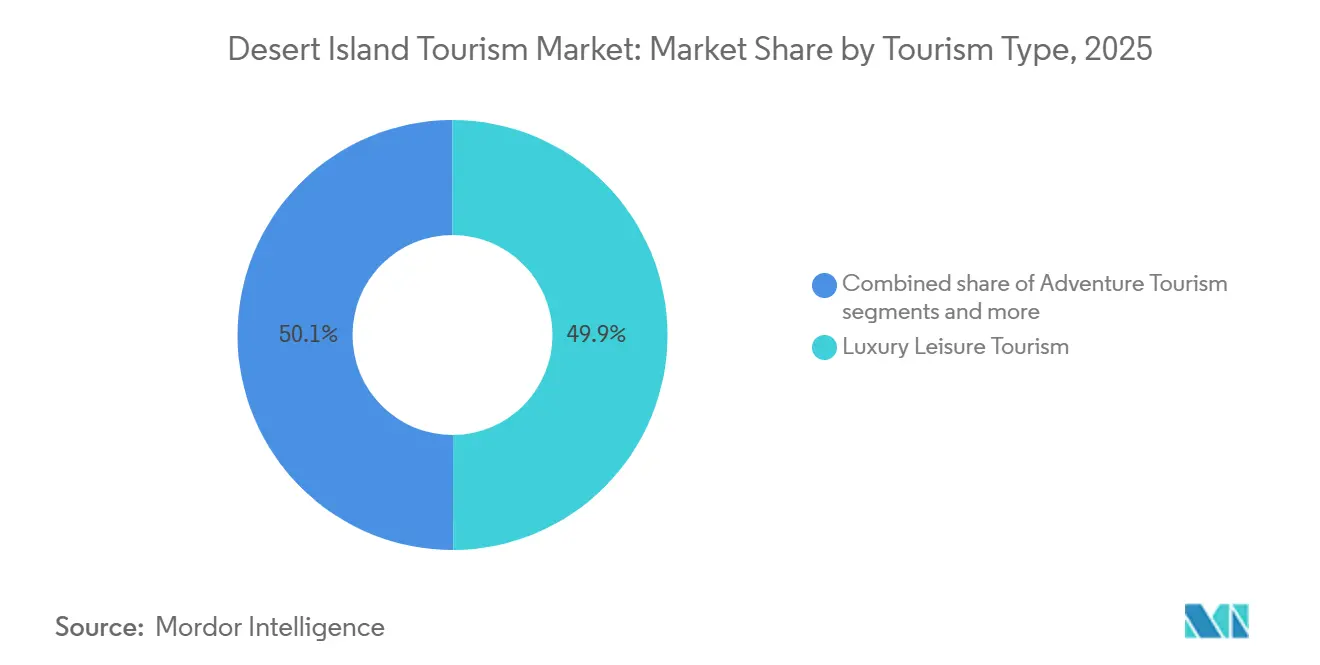
- By tourism type, Luxury Leisure Tourism commanded a 49.94% share of the Desert Island Tourism Market in 2025, while Wellness Tourism is projected to grow at the highest CAGR of 8.75% by 2031.
- By traveler type, Families and Group Travelers commanded a 61.36% share of the Desert Island Tourism Market in 2025, while Solo Travelers are projected to grow at the highest CAGR of 7.81% by 2031.
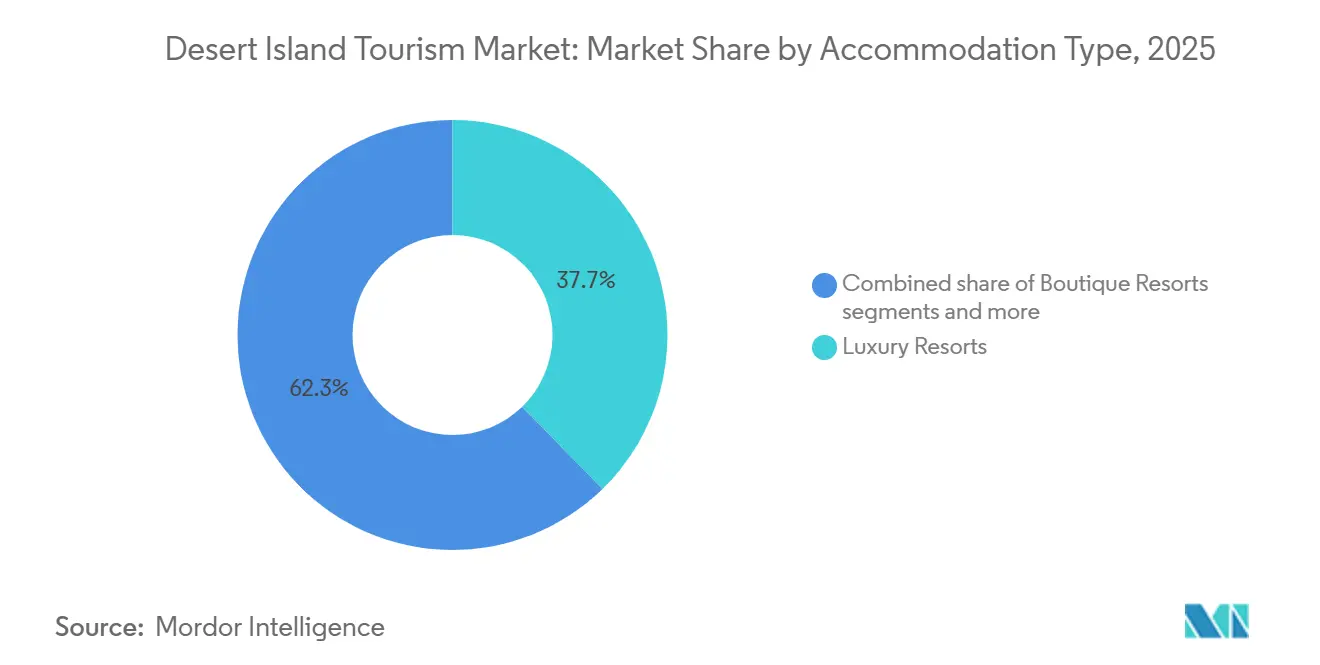
- By accommodation type, Luxury Resorts commanded a 37.71% share of the Desert Island Tourism Market in 2025, while Eco-Lodges and Villas are projected to grow at the highest CAGR of 8.07% by 2031.
- By booking channel, Online Travel Agencies commanded a 43.84% share of the Desert Island Tourism Market in 2025, while Direct Bookings are projected to grow at the highest CAGR of 7.21% by 2031.
- By geography, Indian Ocean Desert Islands commanded a 31.95% share of the Desert Island Tourism Market in 2025, while Red Sea and Arabian Gulf Desert Islands are projected to grow at the highest CAGR of 7.80% by 2031.
Note: Market size and forecast figures in this report are generated using Mordor Intelligence’s proprietary estimation framework, updated with the latest available data and insights as of January 2026.
Desert Island Tourism Market Trends and Insights
Drivers Impact Analysis*
| Driver | (~) % Impact on CAGR Forecast | Geographic Relevance | Impact Timeline |
|---|---|---|---|
| Rising Demand for Remote, High-Privacy Leisure Travel | +1.8% | Concentrated in the Indian Ocean, the Caribbean, and the Pacific | Short term (≤ 2 years) |
| Growth in Eco-Luxury and Low-Impact Resort Positioning | +1.2% | Indian Ocean, Pacific, Caribbean, Mediterranean | Medium term (2-4 years) |
| Improved Air and Sea Connectivity to Island Destinations | +0.9% | Indian Ocean, Red Sea, Arabian Gulf, and Pacific | Short term (≤ 2 years) |
| Premiumization of Wellness and Experiential Travel | +1.4% | Strongest in the Indian Ocean and the Caribbean | Medium term (2-4 years) |
| Digital Booking, Personalization, and Direct Revenue Capture | +0.7% | Across major desert island destinations | Short term (≤ 2 years) |
| Climate-Adaptation Spending Supporting Asset Resilience and Premium Rates | +0.5% | Caribbean, Pacific, Indian Ocean | Long term (≥ 4 years) |
| Source: Mordor Intelligence | |||
Rising Demand for Remote, High-Privacy Leisure Travel
The Desert Island Tourism Market continues to grow, driven by demand for remote and low-density leisure experiences. International tourist arrivals increased steadily, with destinations offering secluded experiences growing faster than the overall travel market. The Maldives exemplifies this trend, showing significant growth in visitor numbers and resort occupancy rates. This indicates that travelers are prioritizing privacy, personalized service, and isolation from crowded tourism areas. Travel from South America to the Caribbean also increased, diversifying the market's demand base, which previously relied more on North American and European visitors. This shift has broadened the geographic profile of demand, particularly for destinations that combine exclusivity with reliable access and high service standards. The Desert Island Tourism Market reflects a clear preference for unique, secluded travel experiences, underscoring its evolving dynamics and appeal to a wider audience.
Growth in Eco-Luxury and Low-Impact Resort Positioning
Eco-luxury has transitioned from a branding element to a core operational necessity in the Desert Island Tourism Market. The GSTC revised its hotel and accommodation standards, emphasizing local sourcing, emissions reduction, energy efficiency, and water management. This shift reflects growing scrutiny from travelers who demand measurable environmental practices instead of general sustainability claims. Rosewood Hotel Group obtained GSTC certification across its properties, establishing a benchmark for operators in environmentally sensitive regions. Banyan Group, after reaching a significant milestone in property expansion, outlined actionable sustainability goals in its report to address future environmental challenges[2]. The Seychelles iCOAST Program, supported by public funding, highlights the role of policy in aligning island tourism infrastructure with circular-economy and climate-resilience objectives.
Improved Air and Sea Connectivity to Island Destinations
Improved air and sea connectivity is expanding the customer base for the Desert Island Tourism Market while maintaining the appeal of remote destinations. Official data reported an increase in international air capacity and passenger traffic, which has supported the recovery of long-haul leisure travel to island destinations. The Maldives anticipates growth in scheduled inbound seats during the first half of 2026, with a notable increase in traffic from GCC hubs. This development enhances feeder traffic from high-spending outbound regions and strengthens routing resilience. In the Red Sea, NEOM’s Sindalah introduces a new island access point in the Gulf, focusing on superyacht and luxury hospitality, supported by significant investment. Caribbean cruise demand is also projected to grow, ensuring the continued relevance of private islands and beach clubs for operators seeking to capture higher spending from transit travelers.
Premiumization of Wellness and Experiential Travel
Desert Island operators are diversifying their revenue streams by moving beyond traditional leisure-seasonality. The economy has seen significant growth, with wellness tourism experiencing notable annual expansion. This trend is reshaping island tourism, as properties now offer medically supervised, structured, and extended wellness programs alongside traditional accommodations[3]. Consumer interest in wellness remains strong across major markets, with surveys indicating it as a top personal priority for a significant portion of respondents in the United States and China. Additionally, reports show increasing interest in island travel, reflecting the sustained demand for experiential travel even as travelers prioritize value. This shift enables the Desert Island Tourism Market to attract visitors during off-peak periods by offering programs focused on recovery, longevity, sleep, and immersive nature experiences, reducing reliance on the peak holiday calendar.
Restraints Impact Analysis*
| Restraint | (~) % Impact on CAGR Forecast | Geographic Relevance | Impact Timeline |
|---|---|---|---|
| High Logistics, Utilities, and Maintenance Costs | -0.8% | Most acute in the Pacific Desert Islands and the South Atlantic | Long term (≥ 4 years) |
| Weather Volatility and Seasonal Demand Disruption | -0.6% | Caribbean, Indian Ocean, Mediterranean | Short term (≤ 2 years) |
| Environmental Carrying-Capacity Limits and Permitting Constraints | -0.5% | Pacific, Indian Ocean, Mediterranean | Medium term (2-4 years) |
| Labor Scarcity and Emergency Response Gaps on Remote Islands | -0.4% | Pacific, Caribbean, Indian Ocean | Medium term (2-4 years) |
| Source: Mordor Intelligence | |||
High Logistics, Utilities, and Maintenance Costs
High operating costs remain a significant challenge in the Desert Island Tourism Market. Remote properties must independently provide services that mainland resorts can outsource or source more affordably. The Maldives' one-island, one-resort model highlights how isolation drives substantial investments in power, desalination, and transport links. These requirements exert constant pressure on margins, such as energy, food, materials, and spare parts, which rely on longer, less flexible supply chains[4]. Maintenance planning is similarly affected, with shipping delays for critical equipment disrupting guest services and increasing the risk of downtime. Dependence on small-scale diesel systems and early-stage renewable energy further elevates utility costs in many remote locations, delaying efficiency improvements. Operators with stronger logistics integration, local sourcing capabilities, or on-site generation assets are better positioned to maintain margins compared to smaller competitors in the Desert Island Tourism Market.
Weather Volatility and Seasonal Demand Disruption
Weather-related shocks continue to disrupt revenue stability in the Desert Island Tourism Market, particularly in regions dependent on seasonal leisure peaks. Official data reported that a hurricane significantly impacted arrivals in late 2025, highlighting how extreme events can quickly reduce travel volumes and room performance in vulnerable island destinations. The effects extend beyond cancellations, as severe weather increases insurance costs, disrupts marine access, and delays property maintenance. Even brief service interruptions can reduce RevPAR, as high-value stays booked by remote guests are difficult to replace on short notice. This challenge is especially evident in the Caribbean, Indian Ocean, and Mediterranean, where demand remains concentrated during specific periods. Consequently, weather resilience remains a critical focus in investment planning across the Desert Island Tourism Market, even as annual demand shows overall stability.
*Our forecasts treat driver/restraint impacts as directional, not additive. The impact forecasts reflect baseline growth, mix effects, and variable interactions.
Segment Analysis
By Tourism Type: Wellness Premiumization Expands the Value Pool
Luxury Leisure Tourism accounted for 49.94% of the market in 2025, maintaining its position as the primary demand driver for the Desert Island Tourism Market. This reflects the appeal of private villas, bespoke services, and high-privacy holiday formats across regions such as the Indian Ocean, Caribbean, and Pacific. The segment benefits from wealth concentration in North America, Europe, the GCC, and coastal Asia, where travelers prefer remote destinations over crowded resorts. This demand supports consistent pricing, as these stays are chosen for exclusivity. The segment’s stability also helps the Desert Island Tourism industry during broader downturns in leisure travel.
Wellness Tourism is projected to grow at an 8.75% CAGR through 2031, making it the fastest-growing segment in the Desert Island Tourism Market. Its growth is driven by programs combining medical supervision, nature-based recovery, and longer stays in secluded locations. Official data reported USD 893.9 billion in wellness tourism spending in 2024, with 13.8% annual growth, encouraging island resorts to expand beyond traditional spa offerings. Adventure Tourism and Eco and Nature-Based Tourism remain significant, appealing to younger travelers seeking meaningful experiences alongside comfort. Policies in destinations like the Cook Islands, where the 2026-2030 destination stewardship plan promotes community-based and managed eco-tourism, highlight government efforts to shape tourism toward higher-value, lower-impact demand.

By Traveler Type: Families Sustain Volume While Solo Demand Lifts Yield
Families and group travelers accounted for 61.36% of the Desert Island Tourism Market in 2025, driven by the popularity of multi-generational resort formats in the Indian Ocean and Caribbean. Features such as connected villas, private dining, and curated marine activities supported group travel. Official data reported an Average Daily Rate (ADR) of USD 350.37 in 2025, with a 63.7% occupancy rate, reflecting steady family demand in key island destinations. Family travelers also contributed to higher spending on excursions, food packages, childcare, and private transport, ensuring their importance to the operational stability of branded and independent resorts.
Solo travelers are projected to grow at a 7.81% CAGR through 2031, making them the fastest-growing segment in the Desert Island Tourism Market. Their spending often focuses on tailored wellness, dining, and experience packages. Official data report highlighted the immense value of direct channels, revealing that hotel websites generated an average gross value of USD 516 per booking in 2025, significantly higher than OTA bookings, which averaged USD 312 per reservation. The Maldives showed expanding demand across source regions, with Asia-Pacific accounting for over 31% of arrivals in 2025, supported by 12% annual growth. This trend indicates that solo travel demand is diversifying beyond Western markets, contributing to the overall growth of the Desert Island Tourism Market.
By Accommodation Type: Eco-Lodges and Villas Gain Ground Against Legacy Formats
Luxury Resorts accounted for 37.71% of the accommodation base in the Desert Island Tourism Market in 2025, maintaining the largest market share. This position stems from established infrastructure, brand recognition, and the ability to support extensive service teams and amenities. The Four Seasons Resort Mauritius at Anahita reopened in November 2025 after a seven-month renovation, introducing a new overwater spa, redesigned all-pool villas, and sustainability upgrades. Such investments highlight the continued use of full-property renovations to adjust pricing and refresh market positioning. Boutique Resorts and Overwater Villas remain significant, particularly in destinations where privacy and design differentiation influence booking decisions more than room availability.
Eco-Lodges and Villas are projected to grow at an 8.07% CAGR through 2031, making them the fastest-growing accommodation format in the Desert Island Tourism Market. This growth reflects their smaller physical footprint, alignment with sustainability goals, and increasing traveler interest in low-impact options. GSTC’s 2026 hotel guidelines emphasized measurable resource management, waste practices, and emissions performance, reinforcing this trend. Eco-focused formats also face fewer permitting challenges in some areas due to their alignment with conservation policies. Cruise and Liveaboard Stays are emerging as alternatives for travelers seeking multi-island itineraries, but land-based accommodations retain an advantage in privacy, wellness, and extended stays.
By Booking Channel: OTAs Lead Reach but Direct Channels Improve Economics
Online Travel Agencies (OTAs) held 43.84% of the booking channel share in the Desert Island Tourism Market in 2025, making them the largest customer acquisition route. Their visibility in search and destination comparison is vital for new island properties and younger affluent travelers who often start bookings on multi-brand platforms. Official data reported Agoda appeared in 40% of its Top 12 channel rankings in 2025, while Trip.com featured in 20%, highlighting the growing role of Asian-origin platforms in global travel. OTAs remain critical for awareness and initial demand, especially in long-haul island travel, where travelers compare routing, property class, and cancellation policies before committing to high-value bookings.
Direct bookings are projected to grow at a 7.21% CAGR through 2031, becoming a key profit channel in the Desert Island Tourism Market. In 2025, direct hotel bookings averaged USD 516 and had lower cancellation rates than OTA bookings, according to SiteMinder and Cloudbeds. This is significant for remote islands, where fixed costs like villas, boats, and staffing are less flexible. SiteMinder found in 2026 that 18% of travelers who started on an OTA later booked directly, showing OTAs and direct channels increasingly function as a combined funnel. While travel agents still serve high-end travelers, owned digital channels are gaining importance for better guest data, reduced cancellations, and stronger repeat bookings.
Geography Analysis
The Indian Ocean Desert Islands accounted for 31.95% of the global Desert Island Tourism Market in 2025. The Maldives recorded 2,246,000 visitor arrivals, a 9.8% year-over-year increase. Mauritius and Seychelles maintained high-value, low-volume tourism models. Seychelles launched the iCOAST Program in 2025 with USD 5 million in GEF-8 support to enhance circular tourism and climate resilience. Maldives air access is expected to improve in 2026, with 1.6 million inbound seats projected between February and June, supported by increased GCC hub connectivity.
The Red Sea and Arabian Gulf Desert Islands are projected to grow at a 7.80% CAGR through 2031, driven by Saudi Arabia’s Vision 2030 initiatives. NEOM’s Sindalah began operations with 440 hotel rooms, 88 villas, over 200 serviced apartments, and an 86-berth marina. The Caribbean saw 35 million stay-over arrivals in 2025, a 2.5% increase, with stay-over demand expected to grow 3%-4% and cruise arrivals 5%-7% in 2026. Despite weather disruptions, the Official data reported a 2025 ADR of USD 350.4 and RevPAR of USD 223.1.
The Mediterranean experiences seasonal demand, with summer months attracting affluent European travelers. The Pacific focuses on sustainability, as the Cook Islands’ 2026-2030 plan prioritizes community alignment, and the Marshall Islands’ 2025-2030 strategy aims to improve infrastructure and cultural preservation. OCIT South Atlantic islands face challenges from remoteness and high freight costs, limiting development. However, their exclusivity appeals to high-spending travelers, maintaining their niche role in the Desert Island Tourism Market.
Competitive Landscape
The Desert Island Tourism Market remains a patchwork of independent operators, privately owned island assets, and destination-specific groups, overshadowing any single branded chain. While hospitality giants like Marriott, Hilton, Accor, Hyatt, and Four Seasons boast a presence on these islands, none command a significant slice of the global revenue pie. This fragmentation arises from geographical nuances, licensing hurdles, environmental constraints, and diverse ownership structures, thwarting any singular entity from achieving global dominance. Moreover, brand prestige doesn't automatically translate to market leadership; discerning island travelers weigh destination allure and property nuances as heavily as the operator's name. Thus, the Desert Island Tourism Market thrives on a blend of exclusivity, operational resilience, and a commitment to sustainability, rather than merely the scale of its chains.
Global brands are actively pursuing strategic expansions. In March 2026, Marriott International inked a deal to introduce the St. Regis brand to Kapalua Bay in Maui, bolstering its Hawaiian portfolio to nearly 30 properties, with 6 more on the horizon. In May 2026, Hilton revealed plans for Ocean’s Edge Resort & Marina in Key West to rebrand as Hilton Key West Resort & Marina, enhancing its foothold in the Florida Keys with a marina-centric approach. After a significant upgrade, Four Seasons reintroduced its Mauritius property in late 2025, underscoring the importance of renovation in established island markets. Meanwhile, Rosewood's 2025 GSTC certification added a competitive edge, as elite operators leverage tangible sustainability metrics to bolster both pricing power and consumer trust.
The competitive landscape is evolving, with a focus on blending compliance, personalized experiences, and resilient operations. Data from SiteMinder and Cloudbeds highlight the growing significance of direct booking channels, which offer higher values and reduced cancellation risks - crucial for remote locales with fixed costs. Concurrently, sustainability initiatives such as GSTC's frameworks and Seychelles' iCOAST program are elevating operational standards, benefiting companies with robust capital and governance. This indicates a continued fragmentation in the Desert Island Tourism Market, but a widening chasm between premium, compliance-savvy operators and their smaller, less distinct counterparts is anticipated throughout the forecast period.
Desert Island Tourism Industry Leaders
-
Marriott International, Inc.
-
Hilton Worldwide Holdings Inc.
-
Accor S.A.
-
Hyatt Hotels Corporation
-
Four Seasons Hotels and Resorts
- *Disclaimer: Major Players sorted in no particular order
Recent Industry Developments
- May 2026: Sculptor Real Estate and Trinity Investments acquired the JW Marriott Marco Island Beach Resort in Florida, including two adjacent golf courses, for approximately USD 835 million. The new owners plan to renovate the property over the next two years to enhance its appeal as an island destination.
- May 2026: Hilton has rebranded Ocean's Edge Resort & Marina in Key West, Florida, as Hilton Key West Resort & Marina. Reservations will open in July 2026. The property includes a marina, six pools, and island-inspired activities.
- April 2026: GSTC held its 2026 Global Sustainable Tourism Conference in Phuket, Thailand, with 575 delegates from over 55 countries. The event addressed climate resilience, hotel waste management, and sustainable procurement frameworks, which are increasingly shaping compliance requirements for island resorts.
- March 2026: Marriott International partnered with Kemmons Wilson Hospitality Partners to introduce the St. Regis Hotels & Resorts brand at Kapalua Bay, Maui, Hawaii. The conversion and renovation are set for completion in 2027, expanding Marriott's Hawaii portfolio to approximately 30 operational properties and 6 in development.
Desert Island Tourism Market Report Scope
| Luxury Leisure Tourism |
| Eco and Nature-Based Tourism |
| Adventure Tourism |
| Wellness Tourism |
| Families /Groups Travelers |
| Solo Travelers |
| Luxury Resorts |
| Boutique Resorts |
| Overwater Villas |
| Eco-Lodges and Villas |
| Cruise and Liveaboard Stays |
| Direct Bookings |
| Online Travel Agencies |
| Travel Agents & Tour Operators |
| Caribbean Desert Islands |
| Indian Ocean Desert Islands |
| Red Sea and Arabian Gulf Desert Islands |
| Mediterranean Desert Islands |
| Pacific Desert Islands |
| South Atlantic Desert Islands |
| By Tourism Type | Luxury Leisure Tourism |
| Eco and Nature-Based Tourism | |
| Adventure Tourism | |
| Wellness Tourism | |
| By Traveler Type | Families /Groups Travelers |
| Solo Travelers | |
| By Accommodation Type | Luxury Resorts |
| Boutique Resorts | |
| Overwater Villas | |
| Eco-Lodges and Villas | |
| Cruise and Liveaboard Stays | |
| By Booking Channel | Direct Bookings |
| Online Travel Agencies | |
| Travel Agents & Tour Operators | |
| By Geography | Caribbean Desert Islands |
| Indian Ocean Desert Islands | |
| Red Sea and Arabian Gulf Desert Islands | |
| Mediterranean Desert Islands | |
| Pacific Desert Islands | |
| South Atlantic Desert Islands |
Key Questions Answered in the Report
What is driving growth in desert island tourism through 2031?
Growth is being supported by stronger demand for remote premium travel, wellness-led stays, better air access, and a wider shift toward eco-luxury formats. The market is projected to rise from USD 36.94 billion in 2026 to USD 50.16 billion by 2031 at a 6.31% CAGR.
Which region leads global demand for desert island tourism?
Indian Ocean Desert Islands led with 31.95% share in 2025, supported by Maldives arrivals of 2,246,000 and strong luxury positioning in Mauritius and Seychelles.
Which tourism type is expanding the fastest in desert island destinations?
Wellness Tourism is the fastest-growing tourism type with an 8.75% CAGR through 2031, supported by medically supervised programs and longer-duration premium stays.
Why are direct bookings becoming more important for island resorts?
Direct bookings improve economics by yielding higher booking values and lower cancellation rates. In 2025, direct hotel bookings averaged USD 516 compared with USD 312 for OTA bookings.
What is the main risk facing desert island resort operators?
Climate-related disruption remains the biggest structural risk, especially in the Caribbean and other weather-exposed regions where storms can affect arrivals, occupancy, and RevPAR in a short period.
Which accommodation format has the strongest growth outlook?
Eco-Lodges and Villas are projected to grow at 8.07% CAGR through 2031 because they align with sustainability standards, low-footprint development, and demand for low-impact luxury.