
Dental Needles Market Size and Share
Market Overview
| Study Period | 2020 - 2031 |
|---|---|
| Market Size (2026) | USD 1.86 Billion |
| Market Size (2031) | USD 2.38 Billion |
| Growth Rate (2026 - 2031) | 5.04 % |
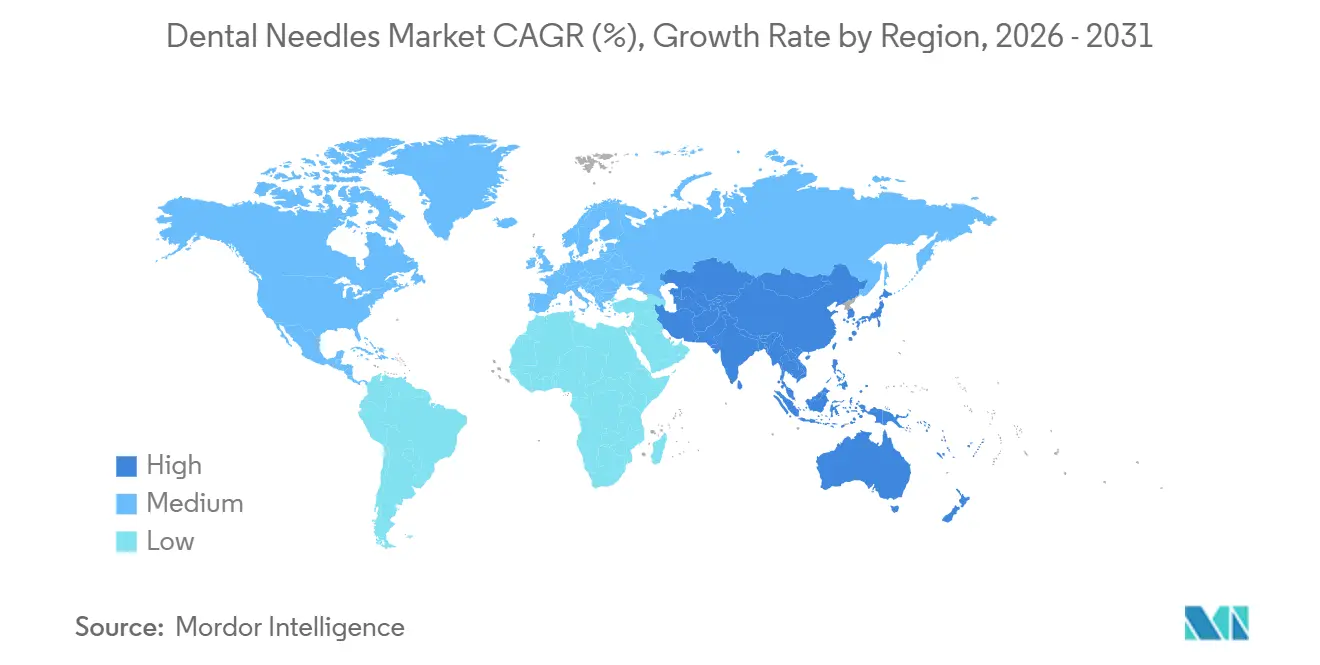
| Fastest Growing Market | Asia-Pacific |
| Largest Market | North America |
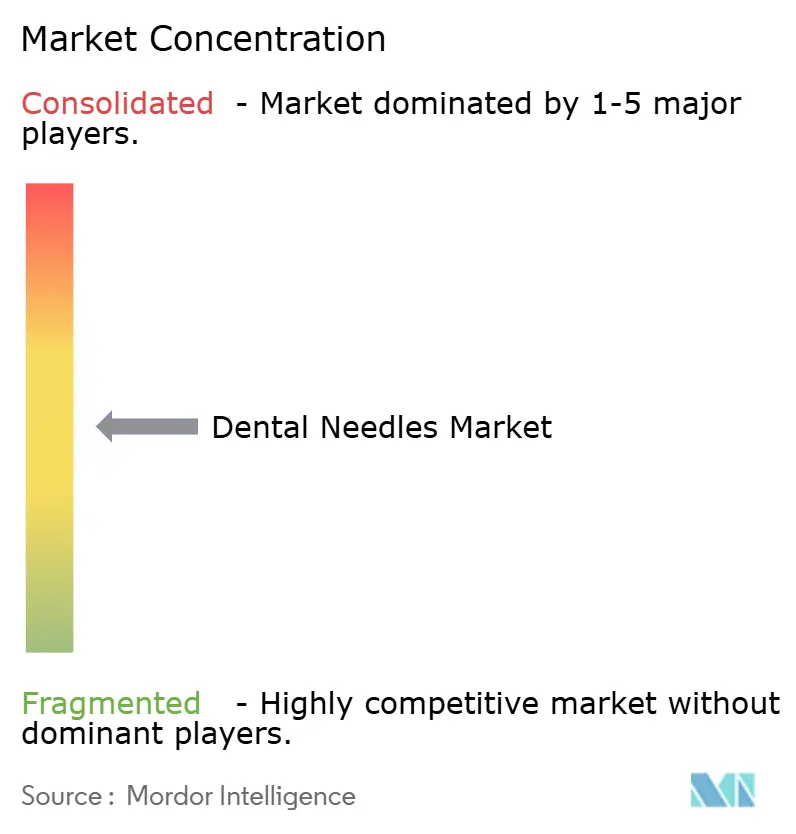
| Market Concentration | Medium |
Major Players *Disclaimer: Major Players sorted in no particular order Image © Mordor Intelligence. Reuse requires attribution under CC BY 4.0. | |
Dental Needles Market Analysis by Mordor Intelligence
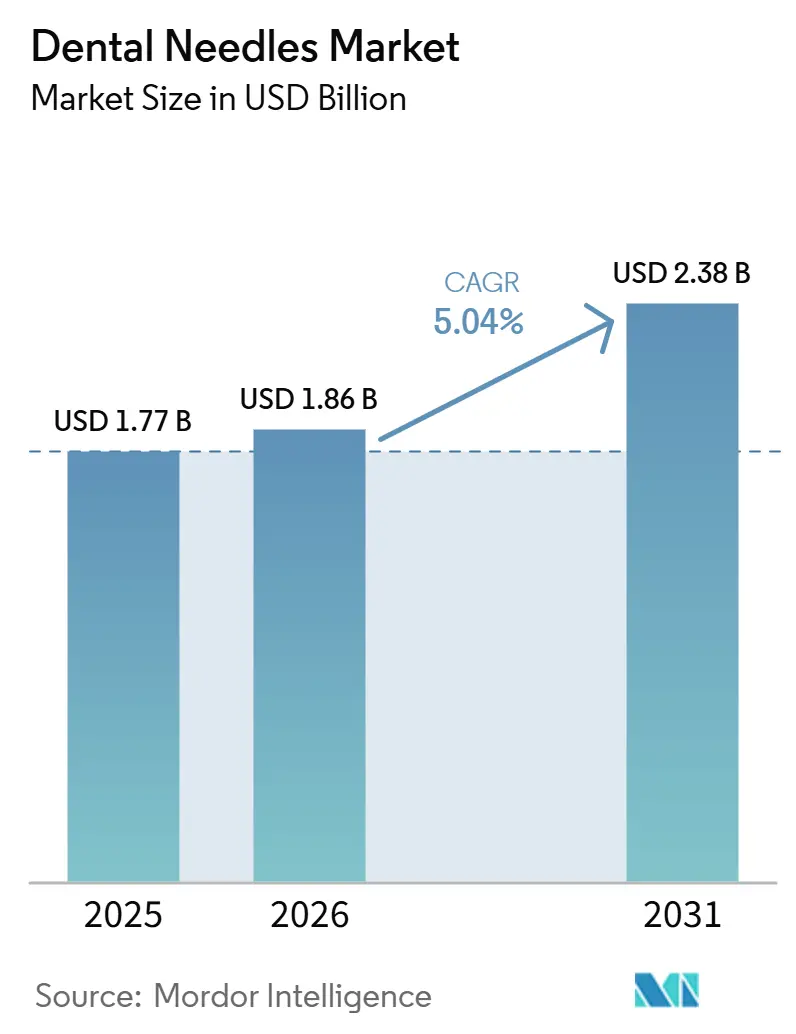
The Dental Needles Market size is projected to be USD 1.77 billion in 2025, USD 1.86 billion in 2026, and reach USD 2.38 billion by 2031, growing at a CAGR of 5.04% from 2026 to 2031.
Demand is linked to routine dental care, restorative treatment, oral surgery, and other procedures that require local anesthesia. The United States reported USD 189 billion in dental expenditures during 2024, while consumer dental spending increased 4% in January 2026 from the preceding 12 months, which supports continued procedure demand. Oral diseases affect 3.5 billion people worldwide, leaving a large base of patients who may require preventive and restorative services. The dental needles market is also moving toward standardized purchasing as larger clinic networks use formal product specifications and recurring supply arrangements. Manufacturers that combine reliable sterility, safety features, compatible designs, and dependable supply are better placed to serve these buyers.
Key Report Takeaways
- By product type, anesthetic dental needles held 44.31% of revenue share in 2025, while safety dental needles are projected to grow at a 7.38% CAGR through 2031.
- By gauge, 27 gauge needles held 38.44% of revenue share in 2025, while 30 gauge needles are projected to grow at a 6.52% CAGR through 2031.
- By length, short needles held 52.24% of revenue share in 2025, while long needles are projected to grow at a 7.52% CAGR through 2031.
- By application, infiltration anesthesia held 42.24% of revenue share in 2025, while intraosseous anesthesia is projected to grow at an 8.52% CAGR through 2031.
- By distribution channel, dental distributors held 46.26% of revenue share in 2025, while online marketplaces are projected to grow at an 8.95% CAGR through 2031.
- By geography, North America held 38.61% share in 2025, while Asia-Pacific is expected to record the fastest CAGR of 7.65% through 2031.
Note: Market size and forecast figures in this report are generated using Mordor Intelligence’s proprietary estimation framework, updated with the latest available data and insights as of January 2026.
Market Trends and Insights
Drivers Impact Analysis of Dental Needles Market*
| Driver | (~) % Impact on CAGR Forecast | Geographic Relevance | Impact Timeline |
|---|---|---|---|
| Rising Dental Procedure Volumes | +1.5% | Global, concentrated in North America, Western Europe, and East Asia | Medium term (2-4 years) |
| Infection-Control Adoption and Single-Use Preference | +1.3% | North America and EU primary, APAC and MEA spillover | Short term (≤ 2 years) |
| Expansion of Dental Clinics and Organized Dental Service Networks | +1.0% | APAC core, including India, China, and Southeast Asia, with North America secondary | Medium term (2-4 years) |
| Lower-Trauma and Patient-Centric Injection Technologies | +0.8% | North America, Western Europe, and Japan | Long term (≥ 4 years) |
| Procedure-Specific Needle Design | +0.6% | North America, Western Europe, and Australia | Long term (≥ 4 years) |
| Source: Mordor Intelligence | |||
Rising Dental Procedure Volumes
Rising procedure volumes support recurring demand across the dental needles market because anesthetic injections are used in many common treatments. England recorded 35 million dental treatment courses in 2024/25, 4% more than in the preceding year. Child patient volumes rose 7% during the same period, which broadens demand across preventive and restorative care pathways[1]NHS Business Services Authority, “Dental Statistics England 2024/25,” NHS Business Services Authority, nhsbsa.nhs.uk. Older patients often need restorative, prosthetic, and surgical work that can involve several injections during a treatment plan. These clinical needs support demand for sterile, single-use products across both general and specialist practices. The dental needles market also benefits when public systems expand access to essential oral health services for children and adults.
Increasing Infection-Control Adoption and Single-Use Preference
Infection-control rules support a shift toward sterile, single-use needle formats in the dental needles market. OSHA requires employers to use safer medical devices when they are available and appropriate for the task. This requirement applies to dental practices and supports the use of products designed to reduce exposure to sharps injuries. ISO 23908:2024 sets requirements for sharps protection mechanisms used with single-use needles[2]International Organization for Standardization, “ISO 23908:2024 Sharps Injury Protection, Sharps Protection Mechanisms for Single-Use Needles,” International Organization for Standardization, iso.org. These requirements increase the importance of design verification, reliable manufacturing, and clear product documentation. Established suppliers can use these capabilities to address buyer concerns over safety and compliance. Independent practices may still compare price closely, but the direction of travel favors products that meet safety expectations.
Expansion of Dental Clinics and Organized Dental Service Networks
Larger clinic networks are changing how the dental needles market is supplied and purchased. Central purchasing teams can set approved product lists, assess quality records, and negotiate recurring supply arrangements. These processes can reduce unplanned purchasing and improve consistency across multiple locations. They can also favor suppliers that provide standardized products in reliable volumes. The effect is important in North America and Asia-Pacific, where organized dental groups are expanding their service footprints. The dental needles market therefore has more opportunities for manufacturers that can support large contracts, traceability requirements, and predictable replenishment.
Demand for Lower-Trauma and Patient-Centric Injection Technologies
Patient comfort is becoming a more visible product consideration in the dental needles market. Septodont presents Septoject Evolution as a scalpel-bevel needle for infiltration procedures. Product designs that limit tissue displacement can be relevant for anxious adults, children, and patients receiving repeated procedures. These designs support a wider move from basic consumables toward products with specific clinical features. Finer gauges may also be used with computer-guided delivery systems that control injection flow. A 2025 randomized clinical trial found that computer-guided intraosseous anesthesia had efficacy comparable with conventional infiltration and reduced postoperative soft-tissue numbness. This clinical evidence can support demand for compatible needle configurations where practices invest in patient-centered delivery systems.
Restraints Impact Analysis of Dental Needles Market*
| Restraint | (~) % Impact on CAGR Forecast | Geographic Relevance | Impact Timeline |
|---|---|---|---|
| Needlestick Injury and Bloodborne Infection Risk | -0.7% | Global, most acute in health systems with manual disposal practices | Short term (≤ 2 years) |
| Regulatory Compliance and Product Validation Costs | -0.5% | EU, China, and emerging regulatory jurisdictions | Medium term (2-4 years) |
| Price Sensitivity in Emerging Dental Markets | -0.3% | South and Southeast Asia, Sub-Saharan Africa, and South America | Long term (≥ 4 years) |
| Limited Standardization of Needle Selection | -0.2% | Global, especially markets with fragmented dental education systems | Long term (≥ 4 years) |
| Source: Mordor Intelligence | |||
Needlestick Injury and Bloodborne Infection Risk
Needlestick injuries remain a restraint because safer products can carry a higher unit cost for dental practices. OSHA requires safer-device selection where appropriate, which can lead practices to replace conventional configurations. The change improves workplace protection, but it can increase the immediate consumables budget for smaller operators. Independent practices may find it difficult to absorb higher costs when reimbursement does not rise at the same rate. Buyers also need training and disposal processes that match the safety features of the chosen product. These requirements can slow conversion in clinics that have limited purchasing capacity. The dental needles market must therefore balance occupational protection with products that remain affordable for routine care.
Regulatory Compliance and Product Validation Costs
Product validation can raise the cost and time required to launch a dental needle in a new jurisdiction. Safety-related product claims need supporting evidence, controlled manufacturing processes, and quality documentation. ISO 23908:2024 establishes requirements for sharps protection mechanisms and strengthens the importance of validated product design. Suppliers must also maintain the records needed by distributors, clinic groups, and regulatory reviewers. Larger manufacturers generally have more resources to maintain these systems across several countries. Smaller manufacturers can face a more difficult path when seeking multiple registrations at once. The dental needles market may become more concentrated in tightly regulated settings if compliance costs remain difficult for smaller suppliers to manage.
*Our forecasts treat driver/restraint impacts as directional, not additive. The impact forecasts reflect baseline growth, mix effects, and variable interactions.
Dental Needles Market Segment Analysis
By Product Type:
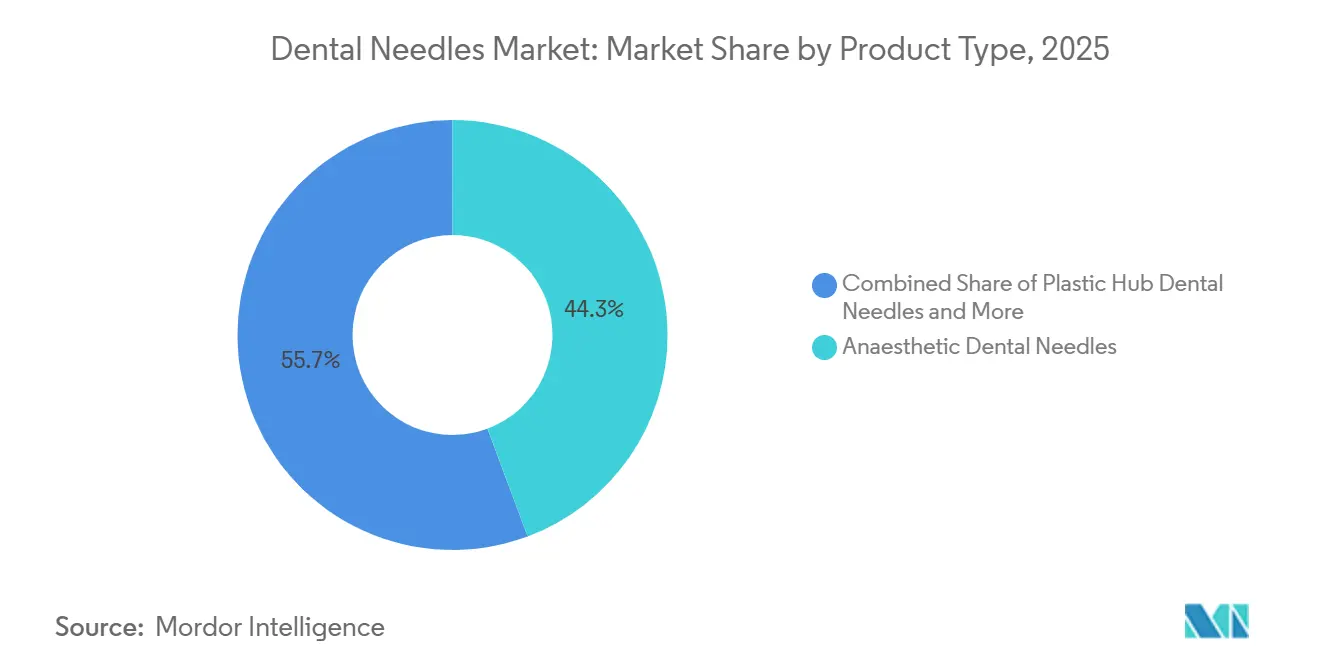
Safety Formats Challenge Anesthetic Needle LeadershipAnesthetic dental needles accounted for 44.31% of dental needles market share in 2025, reflecting their use in routine restorative, periodontal, and surgical care. Their broad role comes from the need for local anesthetic delivery across infiltration, nerve-block, and intraosseous procedures. These products are designed for sterile, single-use application with common dental syringe systems. Plastic hub products, triple-bevel products, and conventional products serve different clinical and purchasing needs. Triple-bevel formats can appeal to practices that place greater weight on patient comfort. Conventional formats remain relevant where price is the main purchasing factor. The product type mix therefore reflects both clinical practice and the buyer's ability to pay for added features. Anesthetic formats retain a large role because they fit the most frequently used injection approaches. They also benefit from established clinician familiarity and widespread syringe compatibility.
Safety dental needles are projected to grow at a 7.38% CAGR through 2031, the highest rate within the product type segmentation. Workplace safety rules and single-use preferences support this performance. Safety mechanisms can reduce the handling risks associated with used needles when staff follow the intended procedure. This advantage matters most for organized dental groups that use common protocols across many practices. The higher purchase cost can still delay adoption among independent providers with restricted budgets. Septodont offers scalpel-bevel formats that combine an anesthetic-use case with features focused on tissue penetration. This product direction shows how safety, comfort, and procedural fit can overlap within one portfolio. The dental needles market size for safety products can benefit as providers update approved product lists. Suppliers with clear safety documentation are likely to be better aligned with institutional purchasing requirements.



By Gauge:
27 Gauge Retains Broad Use While 30 Gauge ExpandsThe 27 gauge segment held 38.44% of revenue share in 2025, supported by its broad compatibility with common dental applications. It is used across procedures that require a balance between injectate flow and controlled tissue entry. Clinicians commonly use this gauge with carpule syringes for infiltration and nerve-block techniques. Its familiarity gives it an advantage in practices that standardize around a limited group of products. The 25 gauge segment remains useful when deeper placement and aspiration are important considerations. The 31 gauge segment serves narrower uses that require a finer entry point. Dental practices can select gauges based on technique, patient characteristics, and the delivery system in use. These decisions keep the 27 gauge category important within routine procurement. The segment also benefits from its availability across established supplier catalogs.
The 30 gauge segment is forecast to grow at a 6.52% CAGR through 2031. This growth is connected to interest in computer-guided and pressure-controlled anesthetic delivery systems. The 2025 clinical trial involving QuickSleeper 5 evaluated intraosseous anesthesia in pediatric dental care. Finer-gauge products can support delivery systems that are designed for controlled flow and selected intraosseous applications. The segment may also be relevant for pediatric and periodontal ligament procedures where perceived comfort matters. A finer gauge can carry a price premium over a more established configuration. Clinical evidence and delivery-system adoption can determine whether that premium is accepted by purchasing teams. Nipro lists dental needle products in both 27 gauge and 30 gauge configurations. This coverage allows suppliers to address both current practice patterns and rising interest in finer-gauge options.
By Length:
Short Needles Lead Routine Procedures While Long Needles Gain UseShort needles held 52.24% of revenue share in 2025, the largest reported share across the segmentation categories. Their position is closely linked to infiltration anesthesia, which is widely used in general dental practice. A short format can provide suitable access to the relevant tissue plane without the deeper placement associated with longer products. This makes it useful for common restorative and routine extraction procedures. Short needles can also be used in intraligamentary techniques when the clinical approach requires controlled placement. Their familiar use supports consistent ordering patterns for distributors and dental groups. The segment is therefore supported by high procedure volumes rather than by a narrow specialty use. It remains central to the dental needles market because many practices use it as a standard item. Reliable availability and compatibility are important for maintaining this role.
Long needles are projected to grow at a 7.52% CAGR through 2031. Their growth is connected to techniques that need deeper tissue access, including some nerve-block and intraosseous procedures. A 2025 pilot study reported shorter procedural latency and lower injectate volumes for computer-guided intraosseous anesthesia than for conventional inferior alveolar nerve block. The study supports the clinical relevance of intraosseous techniques in oral surgery and implantology. Long products can be selected when the procedure requires reach beyond that provided by a short format. Extra-long needles remain more specialized and are used in selected mandibular block approaches. Their demand is therefore concentrated in oral surgery and specialist periodontal settings. The dental needles market size for long products is supported by technique adoption rather than by routine infiltration volume alone. Suppliers that match length options with clinical guidance can better address specialist purchasing needs.
By Application:
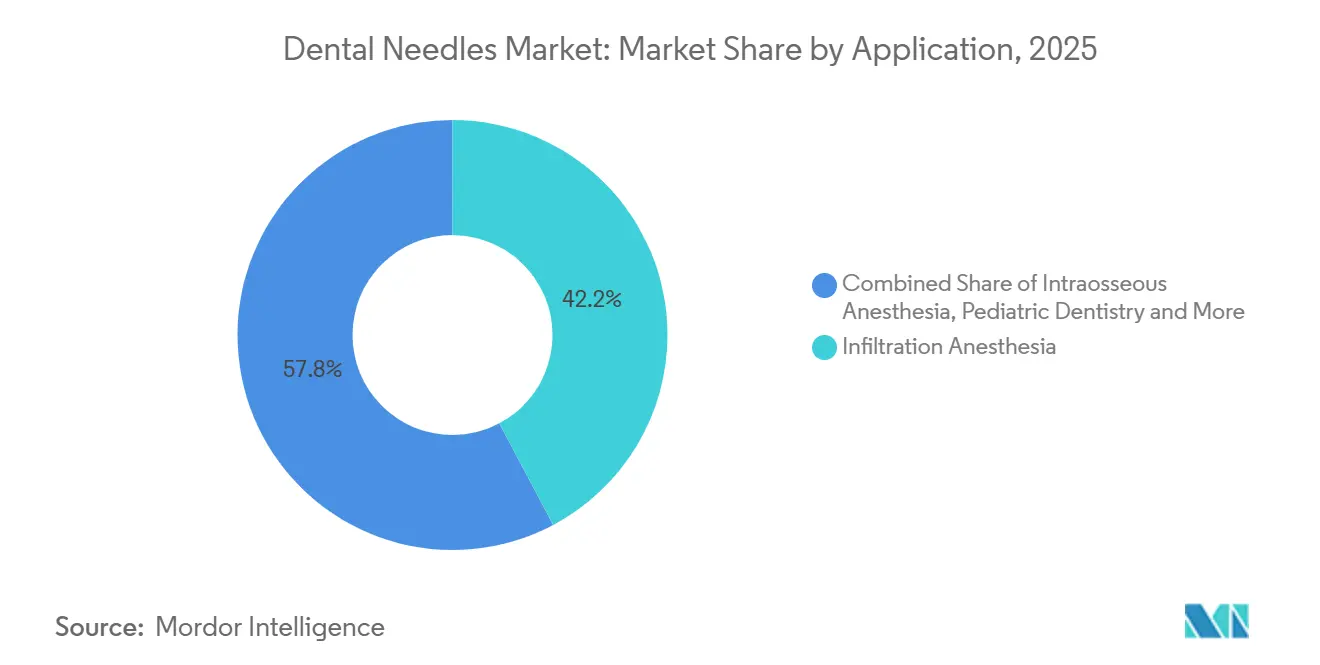
Infiltration Anesthesia Remains the Volume BaseInfiltration anesthesia accounted for 42.24% of revenue share in 2025. It is commonly used in general restorative care and in procedures such as simple extractions and crown preparation. Its wide use makes it an important source of recurring needle demand. The technique can be performed with common syringe systems and several established needle formats. This familiarity supports high purchasing volumes across general dental practices. Nerve-block anesthesia remains important for mandibular procedures that require greater pulpal anesthesia depth. Periodontal ligament and pulpal or endodontic injections serve more defined treatment needs. Each application requires selection by anatomy, procedure, and clinician preference. Infiltration remains the volume base because it addresses a large share of everyday dental treatment.
Intraosseous anesthesia is forecast to grow at an 8.52% CAGR through 2031, the strongest reported growth rate among applications. A 2025 cohort study found that clinician experience did not significantly affect intraosseous anesthesia outcomes in endodontic treatment. This finding supports use beyond a small group of specialist clinicians. A 2025 randomized trial also found lower postoperative soft-tissue numbness with computer-guided intraosseous anesthesia than conventional infiltration. This feature can be relevant for pediatric dental care and for practices focused on patient experience. Adoption still depends on training, equipment, and access to compatible products. The application may also require a more specific selection of needle gauge and length. The dental needles market has an opportunity where suppliers can support these technical requirements. Growth will depend on whether general practitioners incorporate the technique into routine treatment workflows.
By Distribution Channel:
Distributors Lead While Digital Purchasing GrowsDental distributors accounted for 46.26% of revenue share in 2025. Their position reflects the logistics and product-assurance services they provide to many smaller dental practices. Distributors can carry a broad range of sterile products and help practices consolidate orders across several categories. They may also provide credit arrangements, delivery schedules, and product documentation. These services remain useful for practices that do not have the scale for direct manufacturer agreements. Group purchasing organizations can strengthen the role of distributors by helping independent practices access negotiated pricing. This channel structure allows smaller providers to purchase products that meet their routine requirements. Distributor relationships can also help clinics respond quickly when stock levels change. The dental needles market continues to depend on this channel for regular replenishment across a fragmented customer base.
Online marketplaces are projected to grow at an 8.95% CAGR through 2031. Digital ordering can help multi-site practices compare stock availability and manage recurring purchases. It can also support sole practitioners who prefer to place smaller replenishment orders directly through online systems. Manufacturers with direct digital storefronts may keep more of the margin that would otherwise go to an intermediary. Digital channels require clear product information, current inventory data, and dependable order fulfillment. Buyers still need confidence that the products meet sterile-packaging and regulatory requirements. Direct sales may expand alongside consolidation because large dental groups can negotiate volume contracts with manufacturers. This creates different channel needs for large networks and individual practices. The dental needles market is likely to retain distributors while digital and direct channels take a larger role in selected accounts.
Geography Analysis
North America Dental Needles Market
North America accounted for 38.61% of dental needles market share in 2025, making it the largest geographic segment. The region benefits from high treatment volumes, established insurance structures, and a growing role for organized dental procurement. United States dental expenditures reached USD 189 billion in 2024, supporting the underlying level of dental service activity. Consumer dental spending increased 4% in January 2026 from the preceding 12 months. OSHA safety expectations make safer medical-device selection important for dental employers. BD announced in January 2025 that its 2024 manufacturing investment exceeded USD 10 million for additional needle and syringe production lines in Connecticut and Nebraska. The company stated that the capacity expansion would increase United States-made safety-engineered injection-device capacity by more than 40%[3]Becton, Dickinson and Company, “BD Boosts U.S. Manufacturing of Critical Medical Devices,” BD Newsroom, news.bd.com. Canada and Mexico add supplementary demand, with Mexico relevant for value-focused products serving mixed public and private care settings.
APAC Dental Needles Market
Asia-Pacific is projected to grow at a 7.65% CAGR through 2031, the fastest geographic growth rate in the dental needles market. Rising clinic capacity and the expansion of organized dental networks are important drivers in India, China, and Southeast Asia. The region includes markets with different reimbursement systems, care access levels, and purchasing practices. Large networks can increase demand for standardized products and recurring supply contracts. Smaller clinics may continue to purchase conventional formats when price remains the deciding factor. This creates room for both premium safety products and cost-focused basic products. Demand for patient-comfort features can increase as practices adopt computer-guided delivery systems. The region can therefore support a varied product mix rather than one uniform purchasing model. Manufacturers need local distribution, product documentation, and pricing that fits the requirements of each country.
EMEA and South America Dental Needles Market
Europe remains a mature and compliance-focused part of the dental needles market. Sharps-protection expectations and product documentation requirements make safety features important to many buyers. Germany, the United Kingdom, France, Italy, and Spain form the main regional revenue base, with developed distributor systems and established manufacturers. B. Braun and other suppliers serve dental customers through broad medical-device portfolios. The Middle East and Africa are smaller in absolute terms, but private clinic investment and oral health programs can support demand. South Africa acts as a distribution hub for parts of Sub-Saharan Africa. South America is led by Brazil, while currency volatility in Argentina can limit spending on imported consumables. Price sensitivity in these regions can preserve demand for conventional products even as procedure volumes rise.

Competitive Landscape
The dental needles market has moderate concentration, with Septodont, Terumo Corporation, and Dentsply Sirona competing alongside regional specialists. Large suppliers have advantages in regulated markets because they can maintain quality systems, broad portfolios, and established distribution. Regional suppliers can compete through local relationships, lower costs, and product availability. Competition is increasingly based on needle geometry, bevel design, safety mechanisms, and product documentation. Price remains important, especially where independent practices make purchasing decisions. Buyers with centralized procurement often place more weight on validated performance and reliable supply. This difference creates separate competitive conditions for large dental groups and smaller clinics.
The dental needles market is less favorable for suppliers that compete only on basic price. Manufacturers need to show that their products can meet clinical, safety, and logistics expectations. Large portfolios are useful because practices may require different gauges, lengths, and product types for routine and specialist procedures. They also allow a supplier to serve distributor orders that include several clinical configurations, rather than a single high-volume item. Quality documentation becomes more important when procurement teams compare products across multiple sites and need a consistent basis for approval. A supplier that cannot provide these records may remain limited to accounts where price and immediate availability outweigh broader purchasing requirements.
Dental Needles Industry Leaders
Septodont
Dentsply Sirona
Terumo Corporation
Shinhung Co., Ltd.
Nipro Corporation
- *Disclaimer: Major Players sorted in no particular order
Dental Needles Market Companies Covered in this Report
- 4tek S.r.l.
- A. Titan Instrument
- Acteon Group
- B. Braun
- Beckton Dickinson
- Biodent Co., Ltd.
- Dentsply Sirona
- EXELINT International, Co.
- Inibsa Dental S.L.U.
- J. Morita
- KDL Corporation
- Nipro
- Pierrel Pharma S.r.l.
- Power Dental USA, Inc.
- Septodont
- Shinhung Co., Ltd.
- Terumo
- Ultradent Products, Inc.
- Vista Dental Products

Recent Industry Developments in Dental Needles Market
- July 2026: Q&M Dental Group signed binding agreements to acquire Experteeth Dental Group (40 clinics in Australia) and a 51% stake in Deezy Q&M Dental Group (33 clinics in Thailand) for SGD 146 million (USD 107 million). The deals added over 150 dentists and expanded the group’s Asia-Pacific footprint and needle consumable procurement volumes.
- February 2026: Clove Dental launched 48 clinics in one day, expanding its network to 715 centers across 26 Indian cities and growing in tier-2 and tier-3 markets, where stand-alone practices previously handled over 90% of dental services. The rollout supported higher standardized consumable procurement across its supply chain.


Global Dental Needles Market Report Scope
As per the scope of the report, dental needles are specialized medical needles used in dentistry to administer local anesthetics, facilitate injections, or perform other procedures involving injection of fluids into oral tissues. They are typically fine, sterile, and designed for precision to minimize discomfort and ensure safety during dental treatments.
The dental needles market is segmented by product type into plastic hub dental needles, anesthetic dental needles, triple-bevel dental needles, safety dental needles, conventional dental needles, and other product types; by gauge into 25 gauge, 27 gauge, 30 gauge, 31 gauge, and other gauges; by length into extra-short needles, up to 10 mm, short needles, approximately 16 mm, long needles, approximately 22 mm, and extra-long needles, above 22 mm; by application into infiltration anesthesia, nerve block anesthesia, periodontal ligament injection, intraosseous anesthesia, pulpal and endodontic anesthesia, pediatric dentistry, and other applications; by distribution channel into direct sales, dental distributors, group purchasing organizations, online marketplaces, and other distribution channels; and by geography into North America, Europe, Asia-Pacific, Middle East and Africa, and South America. The market report also covers the estimated market sizes and trends for 17 countries across major regions globally. For each segment, the market size and forecast are provided in terms of value (USD).
| Plastic Hub Dental Needles |
| Anaesthetic Dental Needles |
| Triple-Bevel Dental Needles |
| Safety Dental Needles |
| Conventional Dental Needles |
| Other Product Types |
| 25 Gauge |
| 27 Gauge |
| 30 Gauge |
| 31 Gauge |
| Other Gauges |
| Extra-Short Needles, Up to 10 mm |
| Short Needles, Approximately 16 mm |
| Long Needles, Approximately 22 mm |
| Extra-Long Needles, Above 22 mm |
| Infiltration Anesthesia |
| Nerve-Block Anesthesia |
| Periodontal-Ligament Injection |
| Intraosseous Anesthesia |
| Pulpal and Endodontic Anesthesia |
| Pediatric Dentistry |
| Other Applications |
| Direct Sales |
| Dental Distributors |
| Group Purchasing Organizations |
| Online Marketplaces |
| Other Distribution Channels |
| North America | United States |
| Canada | |
| Mexico | |
| Europe | Germany |
| United Kingdom | |
| France | |
| Italy | |
| Spain | |
| Rest of Europe | |
| Asia-Pacific | China |
| Japan | |
| India | |
| Australia | |
| South Korea | |
| Rest of Asia-Pacific | |
| Middle East and Africa | GCC |
| South Africa | |
| Rest of Middle East and Africa | |
| South America | Brazil |
| Argentina | |
| Rest of South America |
| By Product Type | Plastic Hub Dental Needles | |
| Anaesthetic Dental Needles | ||
| Triple-Bevel Dental Needles | ||
| Safety Dental Needles | ||
| Conventional Dental Needles | ||
| Other Product Types | ||
| By Gauge | 25 Gauge | |
| 27 Gauge | ||
| 30 Gauge | ||
| 31 Gauge | ||
| Other Gauges | ||
| By Length | Extra-Short Needles, Up to 10 mm | |
| Short Needles, Approximately 16 mm | ||
| Long Needles, Approximately 22 mm | ||
| Extra-Long Needles, Above 22 mm | ||
| By Application | Infiltration Anesthesia | |
| Nerve-Block Anesthesia | ||
| Periodontal-Ligament Injection | ||
| Intraosseous Anesthesia | ||
| Pulpal and Endodontic Anesthesia | ||
| Pediatric Dentistry | ||
| Other Applications | ||
| By Distribution Channel | Direct Sales | |
| Dental Distributors | ||
| Group Purchasing Organizations | ||
| Online Marketplaces | ||
| Other Distribution Channels | ||
| By Geography | North America | United States |
| Canada | ||
| Mexico | ||
| Europe | Germany | |
| United Kingdom | ||
| France | ||
| Italy | ||
| Spain | ||
| Rest of Europe | ||
| Asia-Pacific | China | |
| Japan | ||
| India | ||
| Australia | ||
| South Korea | ||
| Rest of Asia-Pacific | ||
| Middle East and Africa | GCC | |
| South Africa | ||
| Rest of Middle East and Africa | ||
| South America | Brazil | |
| Argentina | ||
| Rest of South America | ||


Key Questions Answered in the Report
What is the projected size of the dental needles market by 2031?
The dental needles market is projected to reach USD 2.38 billion by 2031, up from USD 1.86 billion in 2026 at a CAGR of 5.04%, driven by demand for sterile injection consumables used in procedures requiring local anesthesia.
Which dental needle product type is growing fastest?
Safety dental needles are projected to grow the fastest by product type, at a CAGR of 7.38% through 2031, supported by workplace safety expectations, requirements, and demand for sterile, single-use products.
Why are dental distributors important for needle sales?
Dental distributors accounted for 46.26% of 2025 revenue by providing logistics, documentation, credit, broad product access, predictable replenishment, and product-assurance support for fragmented dental practices.
Which needle gauge is expected to grow fastest?
The 30 gauge segment is forecast to grow at a CAGR of 6.52% through 2031, driven by interest in computer-guided and controlled-flow delivery systems, while 27 gauge remains the largest reported gauge category.
What application has the highest projected growth rate?
Intraosseous anesthesia is projected to grow at a CAGR of 8.52% through 2031, supported by 2025 studies showing comparable efficacy to conventional infiltration, reduced postoperative soft-tissue numbness, and limited impact of clinician experience on outcomes.
Which region has the fastest expected growth?
Asia-Pacific is forecast to grow at a CAGR of 7.65% through 2031 as clinic capacity and organized dental networks expand, supporting demand for both cost-focused conventional products and higher-value safety or comfort-focused formats.
Page last updated on:





