
Denim Products Market Size and Share
Market Overview
| Study Period | 2021 - 2031 |
|---|---|
| Market Size (2026) | USD 103.5 Billion |
| Market Size (2031) | USD 136.88 Billion |
| Growth Rate (2026 - 2031) | 5.75 % |
| Fastest Growing Market | Asia-Pacific |
| Largest Market | Asia-Pacific |
| Market Concentration | Medium |
Major Players *Disclaimer: Major Players sorted in no particular order Image © Mordor Intelligence. Reuse requires attribution under CC BY 4.0. | |
Denim Products Market Analysis by Mordor Intelligence
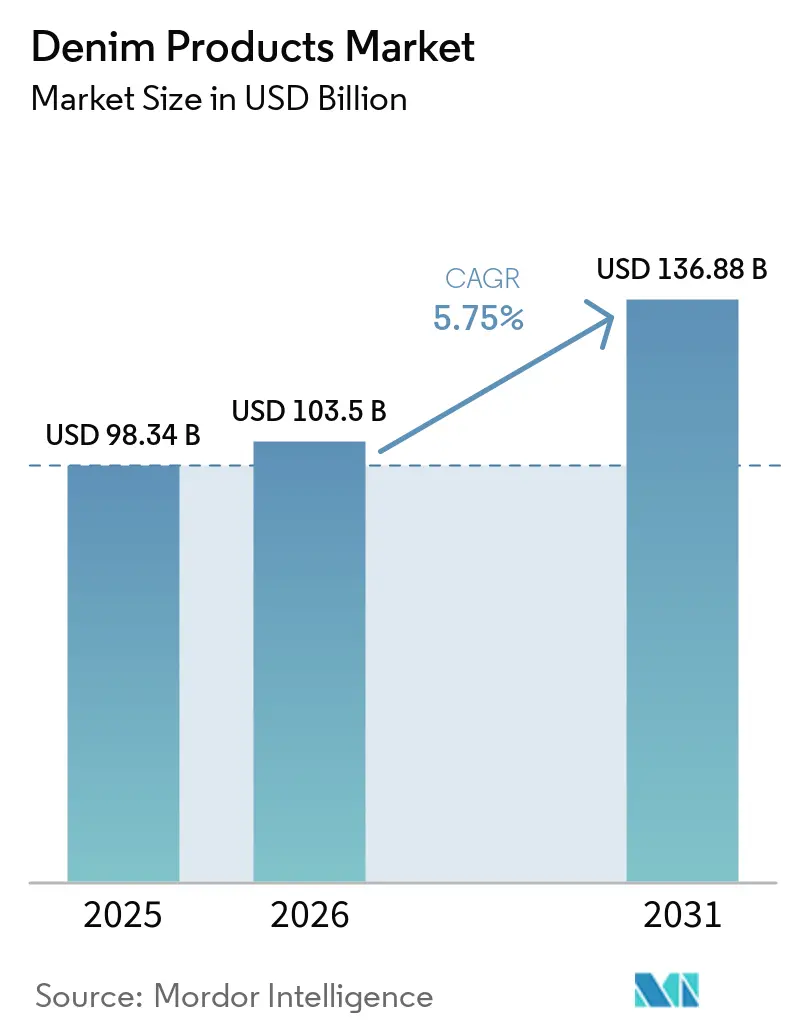
The denim products market size was valued at USD 98.34 billion in 2025 and is estimated to grow from USD 103.50 billion in 2026 to USD 136.88 billion by 2031, at a CAGR of 5.75% during the forecast period (2026-2031). The denim products market is supported by the broader acceptance of casual workplace attire, steady growth in digital retail, and rising purchasing power among consumers in the Asia-Pacific region. Hybrid and remote work arrangements have made denim suitable for a wider range of everyday settings, including office environments, travel, informal social events, and leisure use. This broader adoption helps brands reach consumers who may previously have reserved jeans and related products for weekends or occasional purchases. Companies are responding with more direct-to-consumer sales, greater use of first-party customer data, and product assortments that support full-price selling rather than repeated discounting. Material sourcing, recycled fiber availability, and processing practices increasingly influence product development, supply chain decisions, and access to markets with stricter environmental requirements. Cotton costs, climate exposure, and competition from alternative bottoms remain key constraints on the denim products market.
Key Report Takeaways
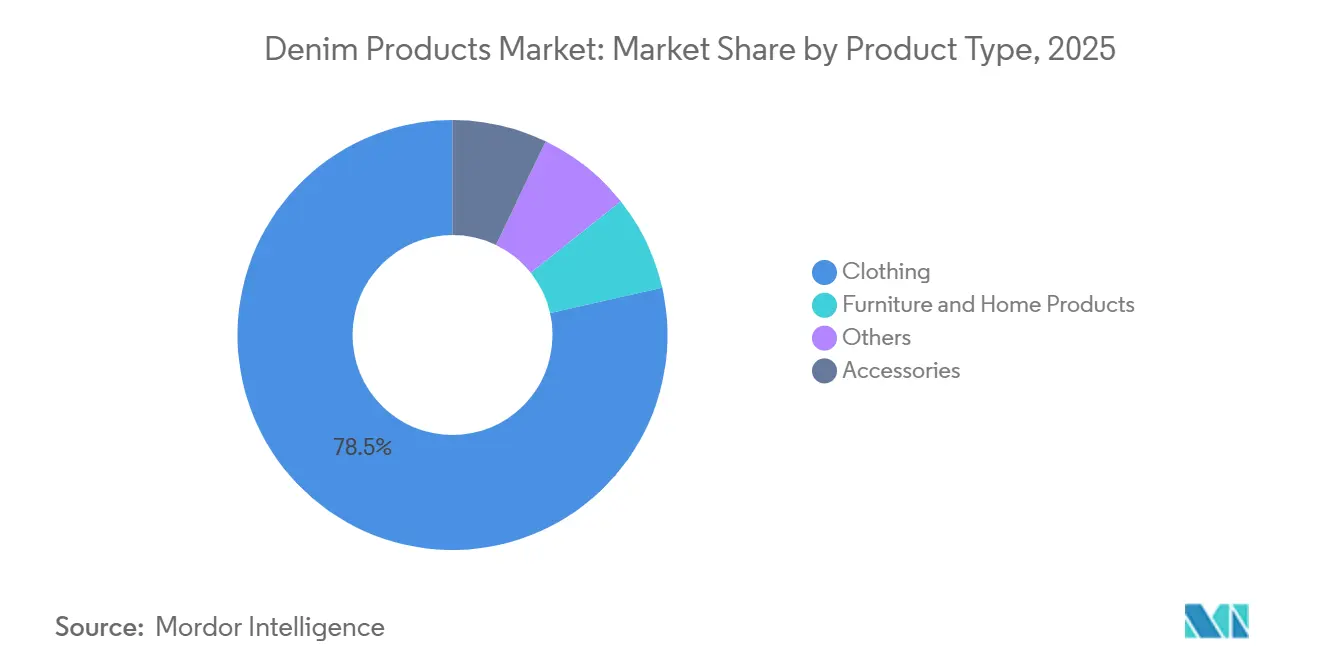
- By product type, clothing held 78.53% of the denim products market share in 2025, while accessories are forecast to grow at a CAGR of 6.23% through 2031.
- By material and fiber composition, combination denim held a 46.26% share in 2025, while recycled denim is forecast to grow at a CAGR of 6.47% through 2031.
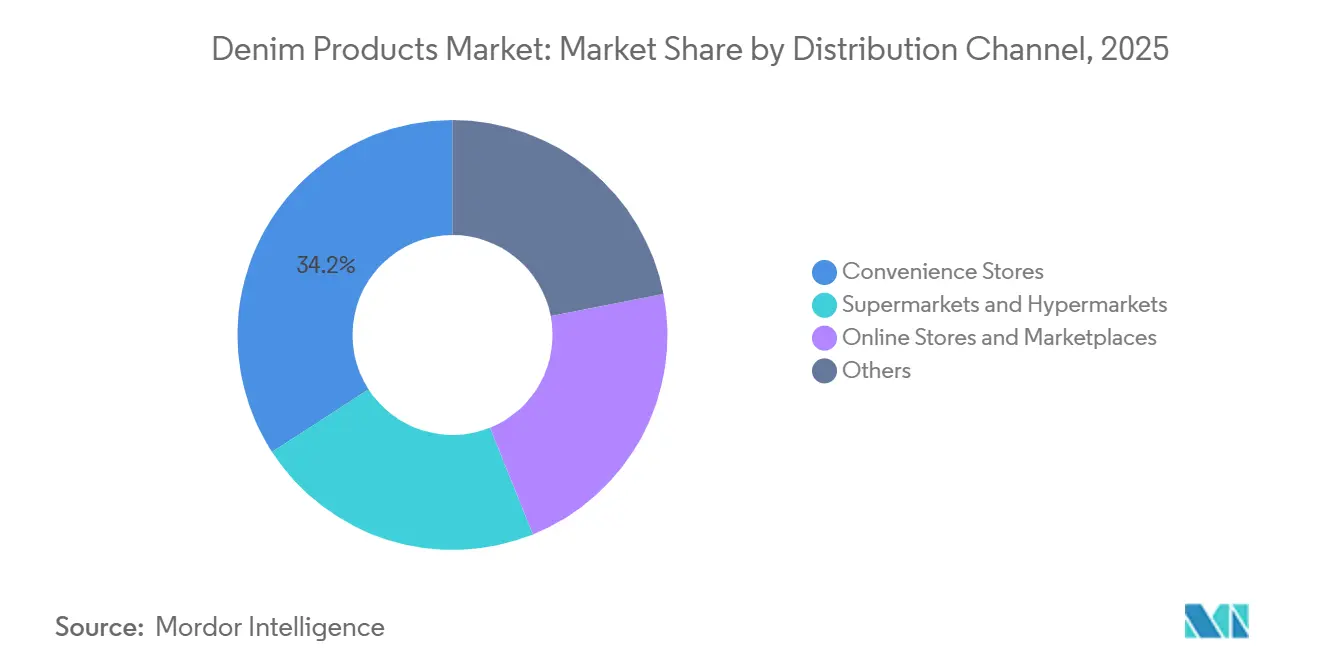
- By distribution channel, convenience stores held a 34.15% share in 2025, while online stores and marketplaces are forecast to grow at a CAGR of 6.59% through 2031.
- By geography, Asia-Pacific accounted for 41.81% of the market in 2025 and is forecast to grow at a CAGR of 6.44% through 2031.
Note: Market size and forecast figures in this report are generated using Mordor Intelligence’s proprietary estimation framework, updated with the latest available data and insights as of January 2026.
Global Denim Products Market Trends and Insights
Drivers Impact Analysis*
| Drivers | (~) % Impact on CAGR Forecast | Geographic Relevance | Impact Timeline |
|---|---|---|---|
| Casualization of Workwear and Everyday Apparel | +1.3% | Global, with the strongest intensity in North America and Europe | Medium term (2-4 years) |
| Premiumization and Brand-Led Denim Demand | +1.0% | North America, Europe, and APAC premium urban centers | Long term (≥ 4 years) |
| Growth of Digital Commerce and Direct-to-Consumer Retail | +0.8% | Global, led by North America and APAC | Medium term (2-4 years) |
| Stretch, Performance, and Comfort-Focused Product Innovation | +0.7% | Global | Medium term (2-4 years) |
| Asia-Pacific Middle-Class Adoption and Western-Wear Penetration | +0.6% | APAC core, with spillover to MEA | Long term (≥ 4 years) |
| Source: Mordor Intelligence | |||
Casualization of Workwear and Everyday Apparel
Relaxed business-casual dress codes have shifted denim from a mainly weekend item to a more regular choice for professional and everyday use. This shift gives the denim products market a steadier demand base across age groups and income levels. Consumers returning to office settings often seek clothing that sits between formal trousers and activewear, which favors comfortable denim designs. Stretch-oriented fits, softer fabrics, and versatile washes address those needs without changing the category's familiar appearance. Brands that do not adjust assortments to comfort preferences risk losing purchase occasions to activewear companies entering denim. Fabletics launched a denim collection in March 2026, indicating that apparel companies with established loyalty communities see value in these occasions.
Premiumization and Brand-Led Denim Demand
Premium positioning is raising expectations for fit, fabric quality, and brand experience across the denim products market. The effect extends beyond luxury labels, as mass-premium brands can use stronger product narratives to support higher prices and reduce reliance on promotions. PVH Corp. reported that Calvin Klein fashion denim represented more than 50% of the brand's total denim revenue and grew at a high-single-digit rate in 2025[1]PVH Corp., “Form 10-K for Fiscal Year 2025,” PVH Corp., pvh.gcs-web.com.. The company linked this performance to investment in hero products and coordinated marketing, underscoring the importance of a clear product focus. Levi Strauss & Co. reported FY2025 organic revenue of USD 6.3 billion, up 7%, while emphasizing a broader head-to-toe denim lifestyle and less promotional activity. These approaches support the denim products market, where brands can maintain product relevance and full-price sell-through.
Growth of Digital Commerce and Direct-to-Consumer Retail
Digital retail is changing how denim companies manage margins, customer relationships, and product selection in the denim products market. Direct consumer channels reduce dependence on wholesale intermediaries and allow brands to use purchase and loyalty data more effectively. Levi Strauss & Co. reported that direct-to-consumer sales represented 49% of total revenue in Q4 2025, while direct-to-consumer net revenue rose 9.5% to USD 3.07 billion for the full year. The company reported that direct-to-consumer sales reached 52% of revenue and grew 16% on a reported basis in 2026. Its e-commerce revenue share doubled from 5% in 2019 to 10% in 2024, followed by 12 consecutive quarters of global double-digit e-commerce growth through 2025. This model gives brands a practical route into secondary cities without the cost of building a wide store network.
Stretch, Performance, and Comfort-Focused Product Innovation
Comfort and performance features have become more important in denim product development. Stretch is now expected by many consumers, shifting competition toward materials that combine recovery, durability, and lower environmental impact. RE&UP, Madewell, and ISKO launched a program in April 2026 that converted 20,000 pairs of post-consumer jeans into Global Recycled Standard-certified fabric. The project demonstrated that recycled material can retain the strength and comfort required for commercial denim products. Hyosung TNC presented regen BIO Elastane at Kingpins Amsterdam in 2026 as a Recycled Claim Standard (RCS)-certified option made with pre-consumer recycled content. Early access to recycled-fiber and bio-based elastane networks can help brands prepare for stricter requirements on product and environmental claims.
Restraints Impact Analysis*
| Restraints | (~) % Impact on CAGR Forecast | Geographic Relevance | Impact Timeline |
|---|---|---|---|
| Competition from Athleisure and Alternative Bottom Wear | -0.8% | North America, Europe, and incremental risk in urban APAC | Short term (≤ 2 years) |
| Cotton Price Volatility and Climate-Related Supply Disruption | -0.6% | Global, with the strongest exposure in South Asia | Short term (≤ 2 years) |
| High Cost of Low-Impact Processing and Compliance | -0.5% | EU-led mandate with a global supply chain effect | Long term (≥ 4 years) |
| Source: Mordor Intelligence | |||
Competition from Athleisure and Alternative Bottom Wear
Athleisure continues to compete with denim for leisure-driven and comfort-driven bottom-wear purchases. The risk is higher when an activewear brand incorporates denim into a loyalty program that already maintains regular customer engagement. Fabletics introduced denim in March 2026 to serve existing members without requiring them to switch to a new apparel brand. This category overlap is more likely to affect lower-formality purchase occasions than workwear-related purchases. Denim brands retain an advantage when their heritage, fits, and styling options give customers a distinct reason to buy. The denim products market, therefore, needs product offerings that maintain comfort while preserving recognizable denim value.
Cotton Price Volatility and Climate-Related Supply Disruption
Cotton supply conditions can quickly affect costs and margin planning across the denim products market. The near-total closure of the Strait of Hormuz since late February 2026 has caused ship transits to fall by 97% and bunker fuel costs to double. This disruption also raised global textile production cost projections by 10%-15%, with cotton denim further affected by higher fertilizer and diesel costs. CottonWorks reported that 2026/27 global cotton production could fall by 3.9 million bales while global mill use could rise by 1.4 million bales. It also reported that NY/ICE cotton futures increased 10 cents per pound from early March to April 2026[2]Cotton Incorporated, “Monthly Economic Letter April 2026,” CottonWorks, cottonworks.com.. Supply chain diversification and nearshore capacity can help brands manage these pressures, particularly across South Asian production centers.
*Our forecasts treat driver/restraint impacts as directional, not additive. The impact forecasts reflect baseline growth, mix effects, and variable interactions.
Segment Analysis
By Product Type: Clothing Leads Demand While Accessories Extend Use Cases
Clothing accounted for 78.53% of denim product sales in 2025 and remained the primary source of category demand. Jeans across fit types continue to anchor clothing sales, serving casual, workwear-adjacent, and social occasions. Denim tops are also playing a larger role as relaxed professional dress becomes more widely accepted. Gap identified denim as a major growth driver in 2026, with relaxed silhouettes and updated washes supporting its assortment. Furniture, home products, and other applications remain smaller segments of the denim products market. These uses rely on denim's durability and visual texture in upholstery, cushions, and decorative products.
Accessories are expected to grow at a 6.23% CAGR in the denim products market from 2026 to 2031. Bags, caps, footwear accessories, and similar items create additional purchase occasions beyond apparel. They also provide an entry-level touchpoint for customers interested in premium labels, making accessories useful for direct-to-consumer brands seeking higher order values without the manufacturing requirements of a full clothing line. PVH's Calvin Klein business has expanded denim-related lifestyle categories alongside fashion denim. Travel, festival, and social styling occasions further support demand for these smaller products across the denim products market.



By Material and Fiber Composition: Combination Denim Holds the Largest Position and Recycled Denim Advances
Combination denim held 46.26% of the denim products market share in 2025. It combines stretch recovery, familiar texture, and durability in a single fabric construction, allowing it to serve both value-oriented and mid-premium products that prioritize fit retention. This format also allows manufacturers to balance performance needs with production considerations. Recycled denim is forecast to grow at a 6.47% CAGR through 2031 in the denim products market. RE&UP's April 2026 collaboration with Madewell and ISKO demonstrated that post-consumer waste can be converted into certified recycled fabric at a commercial scale.
Natural denim continues to play a strong role in premium and heritage products, particularly in selvage and raw constructions. These products appeal to customers who value traditional finishing, Japanese craftsmanship, and material character. Recycled and combination formats are increasingly relevant where brands need credible material documentation. H&M incorporated Circ and Lenzing Refibra technology into a standard men's denim assortment, indicating that recycled materials can move through large retail supply chains. The European Union's Ecodesign Regulation for textiles and the Green Claims Directive are expected to tighten requirements from 2027. Brands that integrate certified recyclers and material suppliers earlier will be better positioned to avoid rushed sourcing changes later in the denim products market.
By Distribution Channel: Convenience Stores Lead While Online Platforms Grow Faster
Convenience stores accounted for a 34.15% share in 2025. Their broad reach remains important in emerging economies where organized retail is less developed. Rural and semi-urban customers in Asia, Latin America, and Africa can access branded denim through these formats. Supermarkets and hypermarkets also serve value-focused shoppers who purchase apparel alongside household goods. Online stores and marketplaces are forecast to expand at a 6.59% CAGR through 2031 in the denim products market, reflecting direct-to-consumer investment by established brands and wider e-commerce infrastructure.
Levi Strauss adopted SCAYLE's e-commerce platform for key markets in 2026 to support a more personalized digital brand experience. Its 38-million-member Red Tab loyalty program provides demand signals that can guide localized product assortments. This data advantage can widen the gap between direct-to-consumer leaders and brands that rely primarily on wholesale distribution. Franchise boutiques, department stores, and specialty stores remain relevant for premium and niche products. However, direct flagship expansion places gradual pressure on the channels that traditionally carried those labels. The denim products market will continue to require both broad physical availability and effective digital engagement.
Geography Analysis
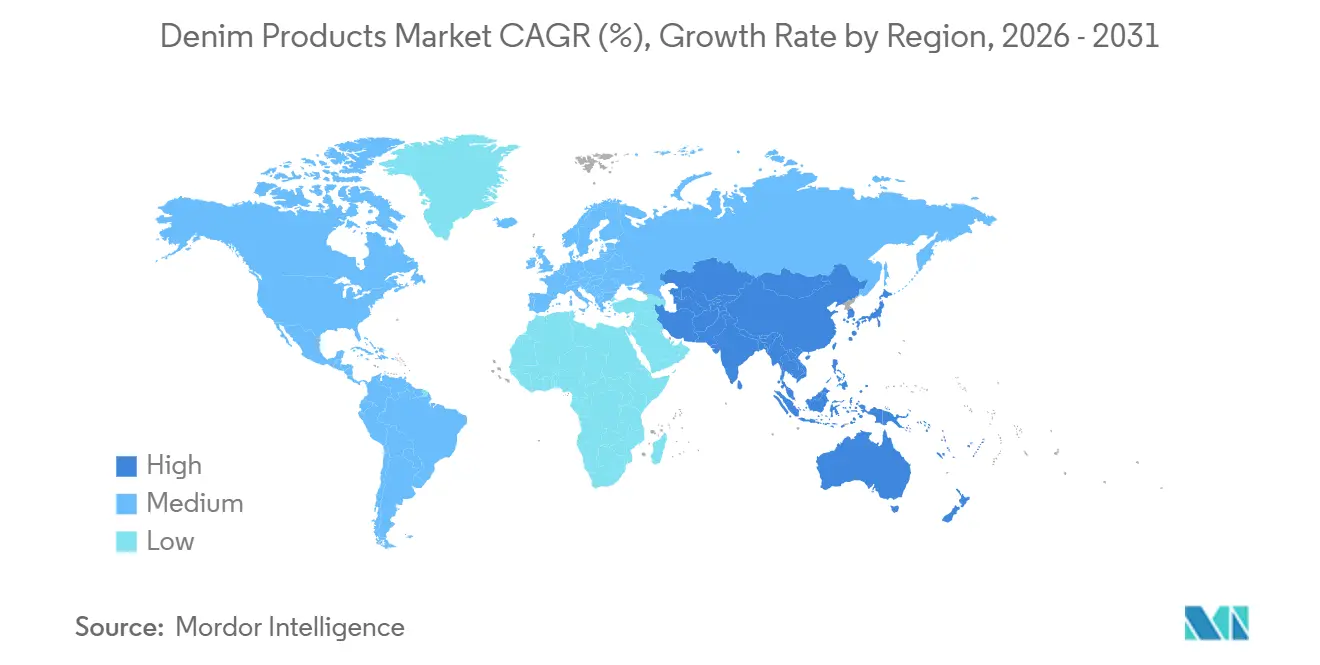
Asia-Pacific accounted for 41.81% of the market in 2025 and grew at a 6.44% CAGR through 2031. The region combines a large manufacturing base with expanding consumer demand. China produces more than 3 billion meters of denim fabric annually, supporting the global supply base. India's urbanization and rising adoption of Western casual clothing broadened denim demand beyond major metropolitan areas. Digital platforms enable delivery to secondary cities without equivalent investment in physical stores. Japan remains an important reference point for premium and selvedge craftsmanship in the denim products market.
ASEAN economies, including Vietnam, Indonesia, and the Philippines, serve both export production and growing domestic consumption. Vietnam's duty-free access to the European Union supports investment in branded apparel production. India's Production Linked Incentive program for textiles supports manufacturing modernization and quality improvements. North America and Europe are mature regions where premiumization remains more important than broad output expansion. Kontoor Brands reported that Wrangler's global revenue increased 6% to USD 1.91 billion in FY2025. Italy, France, and Germany remain central to European premium consumption, while Nordic markets show stronger interest in recycled denim.
European supply chain traceability requirements increase the importance of material origin and processing documentation. Brands that cannot provide this information face greater buyer and regulatory exposure. South America, the Middle East, and Africa are developing demand zones with varying local conditions. Riachuelo introduced its largest circular denim collection in 2025, using 25% recycled cotton. Brazil combines a large manufacturing base with rising interest in premium and circular offerings. Saudi Arabia's retail investment and South Africa's established retail sector provide distribution platforms for global brands in the denim products market.

Competitive Landscape
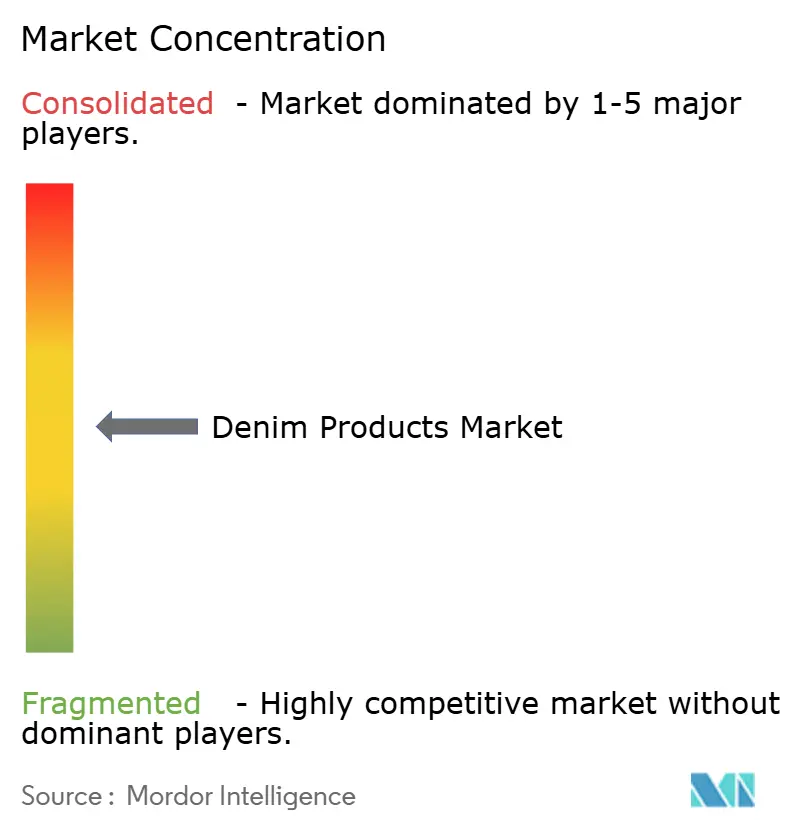
The denim products market is moderately fragmented. Regional companies can hold meaningful local positions without the global brand recognition or digital capabilities of major international labels. In Q4 2025 commentary, Levi Strauss stated that it held more market share than its next two global competitors combined. The company has strengthened its position through direct-to-consumer growth and a broader lifestyle assortment. Levi Strauss also reported that non-denim categories, such as tops, dresses, and skirts, contributed nearly one-third of its growth. Brands in the denim market need to manage price positioning, digital execution, and material credibility simultaneously.
PVH Corp. uses its PVH+ Plan to support Calvin Klein and Tommy Hilfiger as global lifestyle brands through shared data and marketing capabilities. This approach supports both premium denim and related product categories. Inditex reported positive H1 2026 results and operates across 215 markets. It is deploying soft-tag technology in stores to support Click and Collect and connected online-to-offline customer journeys. These investments are difficult for smaller competitors to replicate quickly. The denim products market also offers opportunities for suppliers and recyclers to address brands' material and compliance needs.
Accessible, sustainable performance denim remains a gap that large brands have not fully addressed. Denim accessories can also give loyalty programs more frequent product touchpoints. Digital-first brand building may be particularly relevant in Asia-Pacific cities that lack established wholesale networks. In 2026, ONLY & SONS launched jeans using renewable LYCRA fiber from Naveena Denim Mills. This move demonstrates how material partnerships can support product claims amid increasing scrutiny of environmental assertions. Specialized recycling companies are also becoming increasingly important partners, as brands and retailers have historically lacked deep textile-recycling capabilities.
Denim Products Industry Leaders
Levis
Kontoor Brands, Inc.
Gap Inc.
PVH Corp.
Inditex, S.A.
- *Disclaimer: Major Players sorted in no particular order

Recent Industry Developments
- July 2026: Gap Inc. partnered with Hailey Bieber to introduce "The Hailey Jean," a limited-edition denim capsule based on late-1990s relaxed silhouettes. The collection launched across Gap.com and North American stores, as well as in the UK, China, Japan, and select international markets. The capsule reflects Gap's strategy of using collaborations to strengthen its denim positioning and expand its global digital presence.
- April 2026: RE&UP Recycling Technologies, Madewell, and ISKO launched a textile-to-textile recycled denim capsule, converting 20,000 pairs of post-consumer jeans into Global Recycled Standard (GRS)-certified recycled fabric. The initiative demonstrated closed-loop denim production at commercial scale within a mainstream retail setting, with implications for how post-consumer collection programs can scale across the denim products market.


Global Denim Products Market Report Scope
Denim products span a wide range of applications, from classic everyday clothing and fashion apparel to eco-friendly upcycled accessories and heavy-duty industrial fabrics. The market includes casual wear such as jeans, jackets, and skirts, as well as workwear, upholstery, and specialty industrial textiles.
The denim products market is segmented by product type, material and fiber composition, distribution channel, and geography. By product type, the market is segmented into Clothing, Accessories, Furniture and Home Products, and Others. By material and fiber composition, the market is segmented into Natural Denim, Recycled Denim, and Combination Denim. By distribution channel, the market is segmented into Convenience Stores, Supermarkets and Hypermarkets, Online Stores and Marketplaces, and Others. The report also covers market size and forecasts for denim products across 15 countries in major regions. The market sizes and forecasts are provided in terms of value (USD).
| Clothing | Bottom Wear |
| Top Wear | |
| Accessories | |
| Furniture and Home Products | |
| Others |
| Natural Denim |
| Recycled Denim |
| Combination Denim |
| Convenience Stores |
| Supermarkets and Hypermarkets |
| Online Stores and Marketplaces |
| Others |
| Asia-Pacific | China |
| India | |
| Japan | |
| South Korea | |
| ASEAN Countries | |
| Rest of Asia-Pacific | |
| North America | United States |
| Canada | |
| Mexico | |
| Europe | Germany |
| United Kingdom | |
| France | |
| Italy | |
| NORDIC Countries | |
| Rest of Europe | |
| South America | Brazil |
| Argentina | |
| Rest of South America | |
| Middle East and Africa | Saudi Arabia |
| South Africa | |
| Rest of Middle East and Africa |
| By Product Type | Clothing | Bottom Wear |
| Top Wear | ||
| Accessories | ||
| Furniture and Home Products | ||
| Others | ||
| By Material and Fiber Composition | Natural Denim | |
| Recycled Denim | ||
| Combination Denim | ||
| By Distribution Channel | Convenience Stores | |
| Supermarkets and Hypermarkets | ||
| Online Stores and Marketplaces | ||
| Others | ||
| By Geography | Asia-Pacific | China |
| India | ||
| Japan | ||
| South Korea | ||
| ASEAN Countries | ||
| Rest of Asia-Pacific | ||
| North America | United States | |
| Canada | ||
| Mexico | ||
| Europe | Germany | |
| United Kingdom | ||
| France | ||
| Italy | ||
| NORDIC Countries | ||
| Rest of Europe | ||
| South America | Brazil | |
| Argentina | ||
| Rest of South America | ||
| Middle East and Africa | Saudi Arabia | |
| South Africa | ||
| Rest of Middle East and Africa | ||


Key Questions Answered in the Report
What is current market size of Denim Products Market?
The denim products market size was valued at USD 98.34 billion in 2025 and is estimated to grow from USD 103.50 billion in 2026 to USD 136.88 billion by 2031, at a CAGR of 5.75% during the forecast period (2026-2031).
Which material is growing fastest in denim?
Recycled denim is projected to grow at a 6.47% CAGR through 2031. Textile-to-textile recycling projects are supporting commercial use of certified recycled fiber. Brands also consider these materials, as environmental documentation requirements, to be increasingly important.
Which sales channel is growing fastest for denim products?
Online stores and marketplaces are forecast to grow at a 6.59% CAGR through 2031. Digital channels help brands sell directly, collect customer demand signals, and tailor assortments for different locations. Physical channels remain important where retail infrastructure is fragmented.
Which region leads denim demand?
Asia-Pacific held a 41.81% share in 2025 and is forecast to grow at a 6.44% CAGR through 2031. The region combines large-scale production with growing consumer demand. Digital commerce and expansion beyond major cities also strengthen access to branded denim.
Page last updated on:





