
Dehydration Monitoring Systems Market Size and Share
Market Overview
| Study Period | 2021 - 2032 |
|---|---|
| Market Size (2027) | USD 0.73 Billion |
| Market Size (2032) | USD 1.03 Billion |
| Growth Rate (2027 - 2032) | 7.13 % |
| Fastest Growing Market | Asia-Pacific |
| Largest Market | North America |
| Market Concentration | Medium |
Major Players *Disclaimer: Major Players sorted in no particular order Image © Mordor Intelligence. Reuse requires attribution under CC BY 4.0. | |
Dehydration Monitoring Systems Market Analysis by Mordor Intelligence
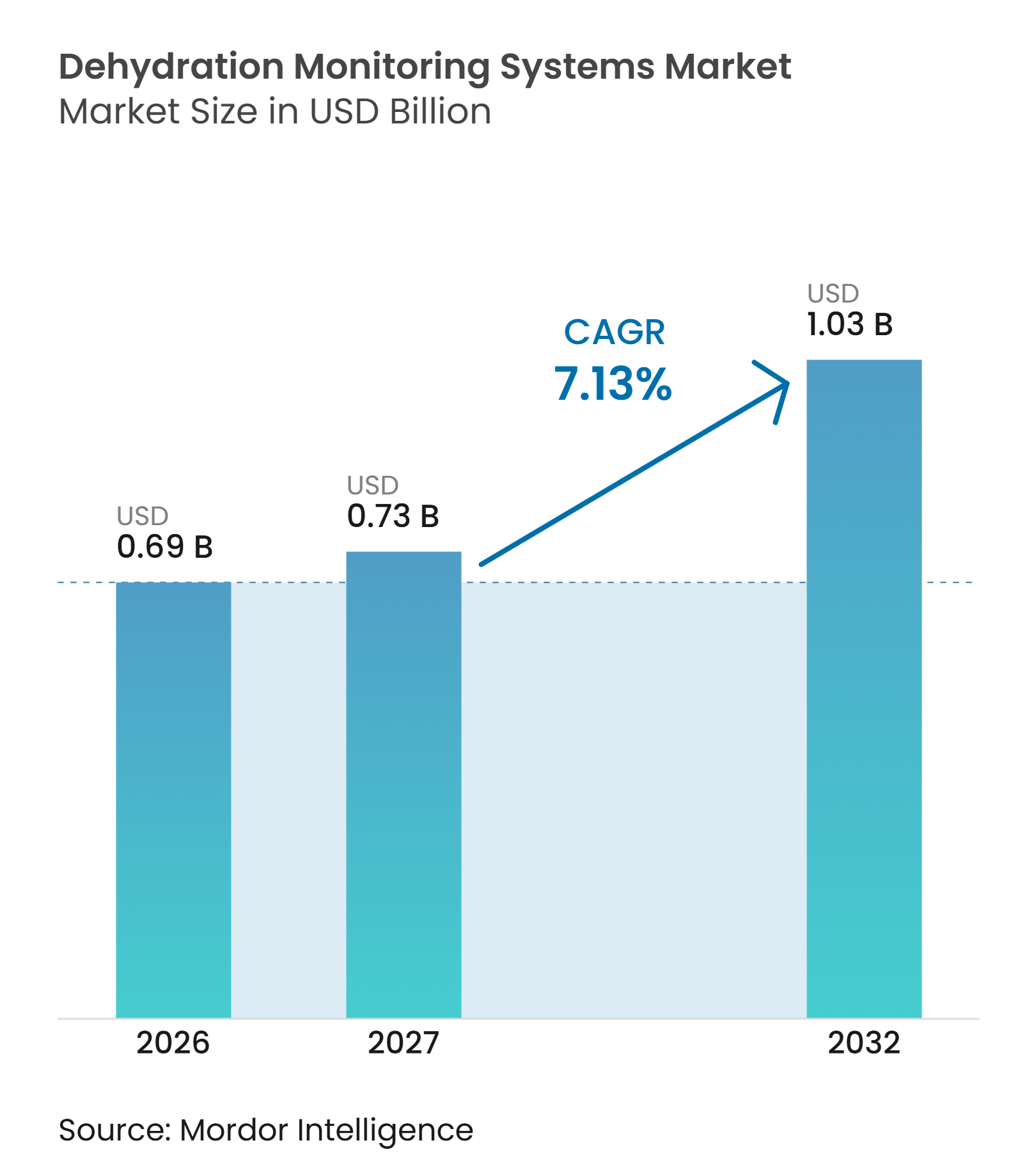
The Dehydration Monitoring Systems Market size was valued at USD 0.69 billion in 2026 and is estimated to grow from USD 0.73 billion in 2027 to reach USD 1.03 billion by 2032, at a CAGR of 7.13% during the forecast period (2027-2032).
Clinical fluid-balance monitoring, occupational heat-safety programs, and wearable sweat-analysis tools support the dehydration monitoring systems market. More than 2.4 billion workers face excessive heat exposure each year, and heat exposure is linked to more than 22.85 million occupational injuries globally, which strengthens the need for timely physiological monitoring. Kidney disease, peritoneal dialysis, and heart-failure care pathways also create demand for noninvasive fluid-status signals outside traditional diagnostics. The dehydration monitoring systems market, therefore, spans clinical care, employer safety, sports performance, and connected chronic-care programs.
Key Report Takeaways
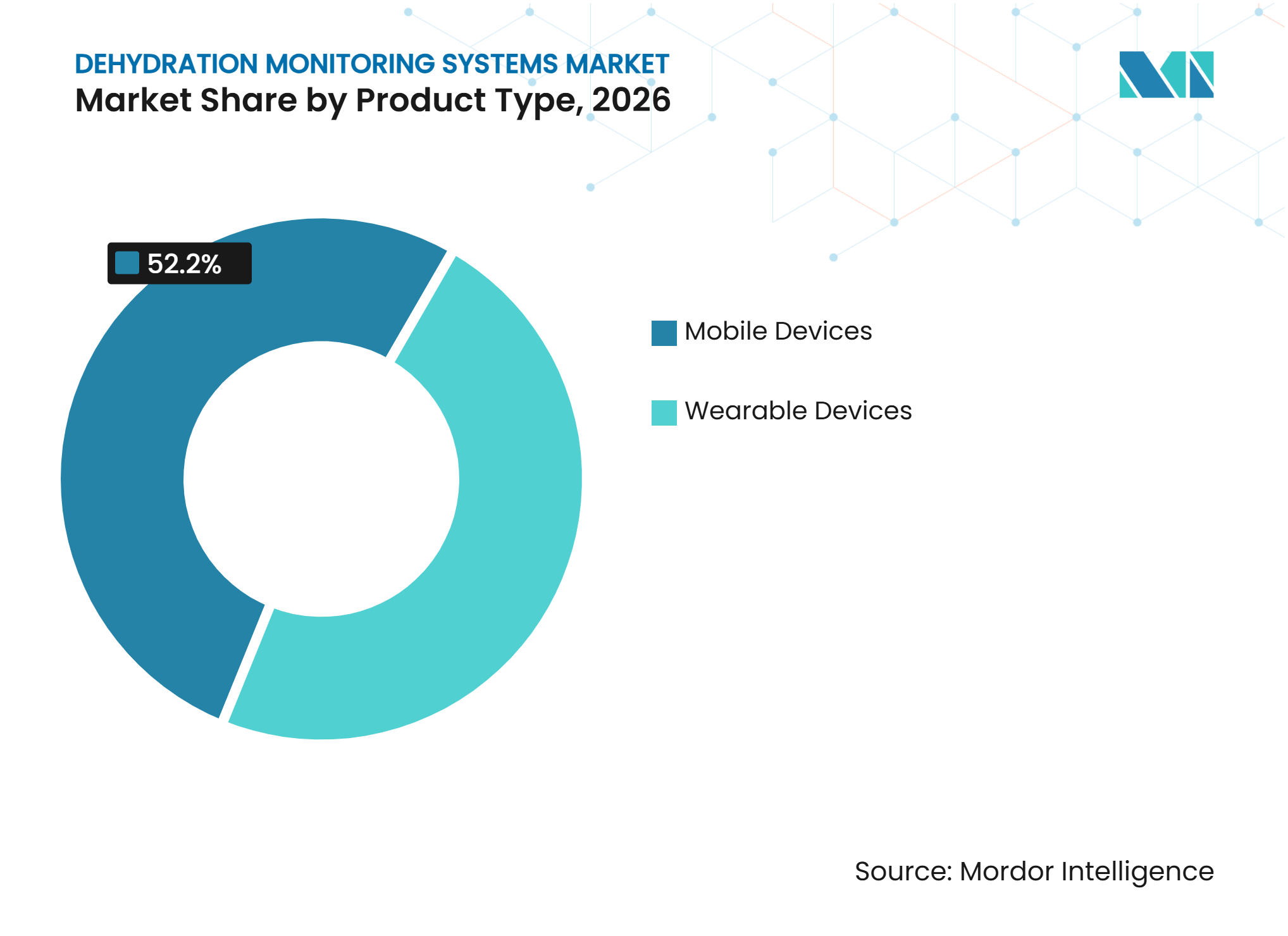
- By product type, mobile devices held 52.23% of the dehydration monitoring systems market share in 2026, while wearable devices are expected to grow at an 8.44% CAGR through 2032.
- By application, clinical dehydration detection accounted for 37.61% of the dehydration monitoring systems market in 2026, while chronic condition management is projected to advance at a 9.13% CAGR through 2032.
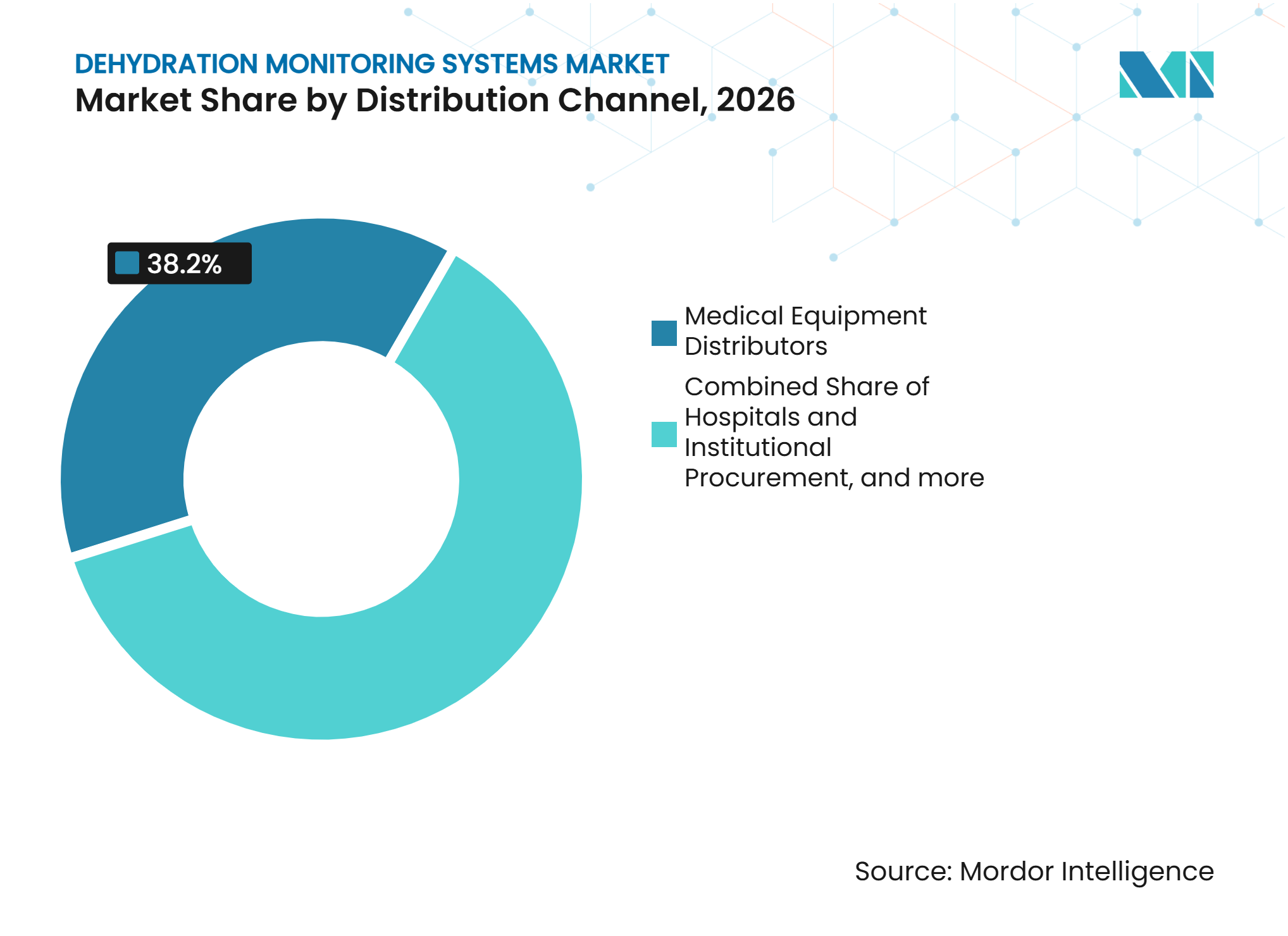
- By distribution channel, medical equipment distributors captured 38.16% of revenue in 2026, while specialty stores are forecast to expand at a 7.62% CAGR through 2032.
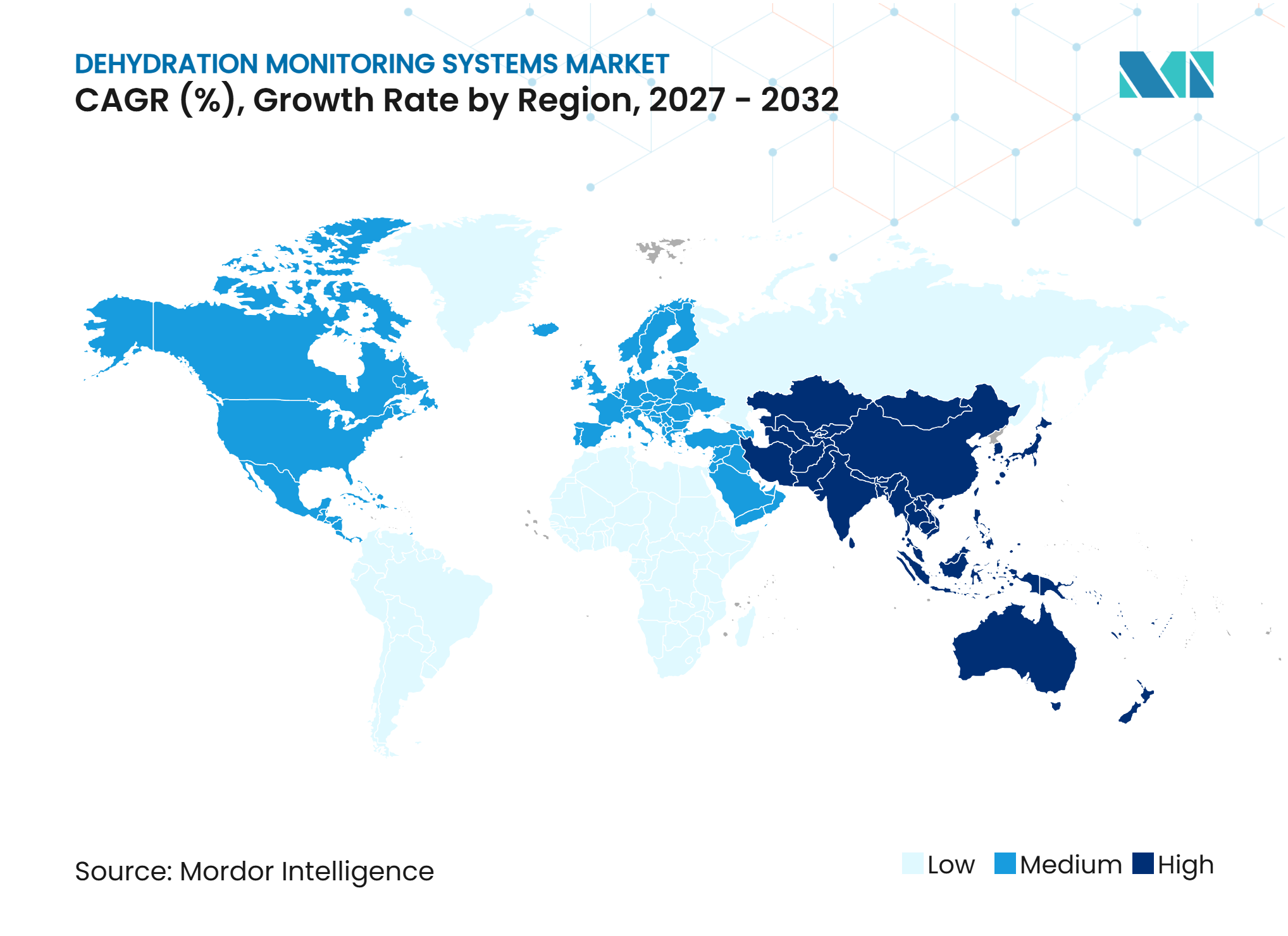
- By geography, North America captured 46.32% of revenue in 2026, while Asia-Pacific is projected to grow at a 10.11% CAGR through 2032.
Note: Market numbers in this report are based on Mordor Intelligence's proprietary estimation framework, which combines nine months of actuals with Q4 projections for base year 2026.
Market Trends and Insights
Drivers Impact Analysis of Dehydration Monitoring Systems Market*
| Driver | (~) % Impact on CAGR Forecast | Geographic Relevance | Impact Timeline |
|---|---|---|---|
| Adoption of Wearable and Noninvasive Hydration Monitoring | +2.1% | Global | Short term (≤ 2 years) |
| Expansion of Remote Patient Monitoring and Connected Care | +1.6% | North America and Europe | Short term (≤ 2 years) |
| Heat-Stress Prevention Requirements for Outdoor Workforces | +1.3% | Global, concentrated in GCC, South Asia, and North America | Short term (≤ 2 years) |
| Sports Science Demand for Individualized Fluid-Electrolyte Plans | +0.8% | North America and Europe | Medium term (2-4 years) |
| Heat-Exposure-Adjusted Safety Analytics for Employers | +0.6% | North America and core Asia-Pacific | Medium term (2-4 years) |
| Hydration Monitoring as a Cross-Signal for Clinical Deterioration | +0.7% | Global, with early gains in Asia-Pacific and Europe | Long term (≥ 4 years) |
| Source: Mordor Intelligence | |||
Rising Adoption of Wearable and Non-Invasive Hydration Monitoring
Sensor miniaturization, sweat electrochemistry, and bioimpedance processing have moved hydration monitoring beyond clinic-based assessments. The dehydration monitoring systems market now includes armbands and adhesive patches that can track fluid changes during normal activity. A 2026 PNAS study validated a wireless dry-electrode arm sensor against whole-body bioimpedance and reported a Pearson correlation of 0.956 plus or minus 0.033 across 8 participants.[1] A 2025 review found that multimodal wearable systems and data-led analysis support personalized hydration management, although common measurement methods and broader clinical studies remain necessary.[2] Sports and workplace deployments also give developers field data that can support later validation work in the dehydration monitoring systems market.
Expansion of Remote Patient Monitoring and Connected Care
Remote patient monitoring platforms built for cardiac, respiratory, and glucose care can add hydration signals without requiring a separate care model. The dehydration monitoring systems market can benefit where fluid status is already clinically relevant, and patients are using telemedicine services. Peritoneal dialysis patients need frequent fluid-balance assessment and are commonly connected to remote care programs. A 2025 cohort study of maintenance peritoneal dialysis patients reported improved clinical outcomes and fewer hospitalization-equivalent events with a remote management model than with standard care.[3] These settings can make fluid data a practical addition to broader chronic-care monitoring in the dehydration monitoring systems market.
Growing Heat-Stress Prevention Requirements for Outdoor Workforces
Heat-safety requirements are moving from voluntary workplace guidance toward more active inspection and compliance efforts. This shift broadens the dehydration monitoring systems market for employer-grade tools that issue timely fluid-loss or heat-strain alerts. In April 2026, OSHA updated its National Emphasis Program for indoor and outdoor heat hazards and identified 55 high-risk industries for enforcement and outreach. The program applies inspection activity when the National Weather Service issues a heat advisory. WHO and WMO reported that worker productivity falls by 2% to 3% for every degree above 20°C. Employers in construction, agriculture, manufacturing, logistics, energy, and other exposed fields can treat continuous physiological monitoring as an operational safety requirement in the dehydration monitoring systems market.
Increasing Sports Science Demand for Individualized Fluid-Electrolyte Plans
Sports programs increasingly use individual sweat-rate and electrolyte-loss profiles instead of population-average hydration advice. This practice supports demand in the dehydration monitoring systems market for wearable biosensors that provide fluid-deficit data during training and competition. In April 2026, Nix Biosensors and Baylor University Athletics began a 2-year partnership that deploys Nix Pro across 19 Division I programs and serves 450 student-athletes. The deployment allows comparisons across sports and climate conditions at an institutional scale. Epicore Biosystems stated in June 2026 that its reusable Connected Hydration armband was designed for continuous daily use across industrial and sports organizations. Sustained athletic deployments can build data sets that support later clinical decision-support work within the dehydration monitoring systems market.
Restraints Impact Analysis of Dehydration Monitoring Systems Market*
| Restraint | (~) % Impact on CAGR Forecast | Geographic Relevance | Impact Timeline |
|---|---|---|---|
| Limited Clinical Standardization for Mild Dehydration Detection | -0.9% | Global | Long term (≥ 4 years) |
| Reimbursement and Procurement Uncertainty for Nondiagnostic Systems | -0.7% | North America and Europe | Medium term (2-4 years) |
| Sensor Calibration Drift Across Skin Types and Environments | -0.5% | Global | Medium term (2-4 years) |
| Data Liability from Incorrect Hydration Alerts | -0.4% | North America and Europe | Long term (≥ 4 years) |
| Source: Mordor Intelligence | |||
Limited Clinical Standardization for Mild Dehydration Detection
A common clinical standard for mild and moderate dehydration detection is still absent. That gap limits the dehydration monitoring systems market because hospital buyers need a consistent benchmark for comparing device outputs. The 2025 JMIR review identified the lack of standardized protocols as a major obstacle to broader clinical adoption of wearable hydration monitoring. Without accepted clinical thresholds, developers may need to design their own reference methods for validation studies. This adds time and cost to clinical evidence programs. Until independent standards bodies or clinical societies define performance expectations for wearable dehydration monitoring, the clinical portion of the dehydration monitoring systems market will remain more limited than the technology’s technical potential.
Reimbursement and Procurement Uncertainty for Non-Diagnostic Systems
General-wellness devices can reach consumer and workplace users, but this positioning may limit reimbursement in healthcare settings. The dehydration monitoring systems market, therefore, faces a divide between devices used for wellness information and devices used in condition-specific care. CMS states that remote physiologic monitoring is subject to defined billing and coverage requirements. A hydration alert alone may not meet the same institutional requirements as monitoring linked to an acute or chronic condition. Companies seeking clinical reimbursement must build evidence, obtain the appropriate regulatory position, and support post-market obligations where applicable. This uncertainty can slow procurement decisions in the dehydration monitoring systems market, particularly for specialist wearable suppliers.
*Our forecasts treat driver/restraint impacts as directional, not additive. The impact forecasts reflect baseline growth, mix effects, and variable interactions.
Dehydration Monitoring Systems Market Segment Analysis
By Product Type:
Mobile Interfaces Lead While Wearables Expand Continuous MonitoringMobile devices held 52.23% of revenue in 2026, reflecting their established role as the interface for clinical fluid-balance systems, bedside bioimpedance monitors, hospital-connected applications, smartphones, tablets, portable diagnostic units, and research dashboards. The dehydration monitoring systems market still relies on these tools in institutional settings because they connect sensor readings with clinical workflows and electronic health records. Hospitals and dialysis centers commonly obtain mobile-connected systems through multiyear supply agreements, using distributors for compliance documents, logistics, and after-sales support.
Wearable devices are forecasted to grow at an 8.44% CAGR through 2032, driven by sweat sensors, bioimpedance components, and optical measurement tools that can operate in patches, armbands, and sleeve-worn modules. Epicore’s reusable armband supports movement away from single-use adhesive products for daily deployment, while medical-grade wearables must meet the evidence and compliance expectations of hospital buyers. Consumer and workplace versions can serve less intensive use cases, supporting the move from periodic checks to continuous monitoring in the dehydration monitoring systems market.


By Application:
Clinical Detection Leads While Chronic Care Grows FastestClinical dehydration detection held 37.61% of revenue in 2026, supported by emergency triage, perioperative fluid therapy, intensive-care fluid management, and workflows where fluid status affects immediate care decisions. The dehydration monitoring systems market uses these settings to support the assessment of patients with acute illness and patients undergoing complex treatment. Hospital-based monitoring is the second-largest application, while toxicology, substance-induced dehydration, and rehabilitation programs extend fluid-balance management to emergency, addiction, post-surgical, and post-cardiac-event care.
Chronic condition management is expected to expand at 9.13% CAGR through 2032 because dialysis, chronic kidney disease, and heart-failure care require repeated fluid assessment outside acute settings. The dehydration monitoring systems market can benefit when patients require regular assessments between clinic visits, and existing remote-care systems can incorporate fluid-status data. ZOLL’s remote pulmonary-fluid monitoring work offers a condition-specific precedent, although longitudinal data, clinical thresholds, and reimbursement pathways will influence scale.
By Distribution Channel:
Distributors Lead Institutional Sales While Specialty Stores AccelerateMedical equipment distributors captured 38.16% of revenue in 2026 because clinical buyers require supply reliability, compliance documentation, installation support, and service coverage. Hospitals, dialysis centers, and research institutions obtain hardware through established distributor relationships and multiyear contracts for capital equipment and connected monitoring systems. Direct hospital and institutional procurement remains important when hydration monitoring is included in a broader patient-monitoring upgrade that requires manufacturer coordination.
Specialty stores are forecasted to grow at a 7.62% CAGR through 2032, led by sports medicine retailers, occupational health suppliers, and performance-nutrition outlets that serve users seeking detailed sweat and hydration analytics. Online retail and direct-to-consumer channels are also important for biosensor companies without legacy distributor agreements, helping them build visibility and gather field-performance data before longer hospital procurement cycles. The dehydration monitoring systems market will retain a mixed channel structure because clinical, workplace, sports, and consumer buyers have different needs.


Geography Analysis
North America and Europe
North America held 46.32% of revenue in 2026, supported by established remote monitoring infrastructure and active workplace heat-safety enforcement. The region leads the dehydration monitoring systems market because hospitals have mature connected-care systems, while OSHA’s 2026 heat-hazards program increases enforcement attention across construction, agriculture, manufacturing, and logistics. The United States has a large base of chronic-condition management programs that can incorporate fluid-status monitoring, while Canada and Mexico are advancing healthcare digitization and connected chronic-disease programs. Europe is the second-largest regional area because aging populations, clinical monitoring infrastructure, and institutional purchasing practices support demand. Germany has the largest national position in Europe, while the United Kingdom and France lead community-based remote monitoring, and southern European employers face growing heat exposure.
Asia-Pacific
Asia-Pacific is projected to grow at a 10.11% CAGR through 2032. The region contributes clinical, consumer, industrial, and sports-related demand to the dehydration monitoring systems market, with China’s 14th Five-Year Plan prioritizing intelligent healthcare and wearable medical technology. Japan and South Korea offer premium clinical opportunities because aging populations increase the need to manage dehydration risk among older patients. India’s public telemedicine infrastructure can provide distribution routes for remote hydration programs, and extreme heat across the subcontinent supports employer-focused wearables. South Korea contributes through sports medicine, while Australia contributes through occupational health use cases, and growth depends on reimbursement, approval, and product fit.
Middle East and Africa, and South America
The Middle East and Africa combine extreme heat exposure with emerging clinical monitoring demand, and GCC countries are priorities because construction, energy, logistics, and industrial workers face sustained summer heat. Emirates Global Aluminum reported 3 consecutive summers without a heat-related illness after deploying Kenzen wearables with 300 employees in high-heat aluminum operations. South Africa leads sub-Saharan clinical monitoring use, while Brazil and Argentina support South American demand through healthcare modernization and sports medicine. Long-cycle infrastructure activity across the GCC and Brazil can make occupational health technology a recurring procurement category in the dehydration monitoring systems market.
Competitive Landscape
Market Concentration
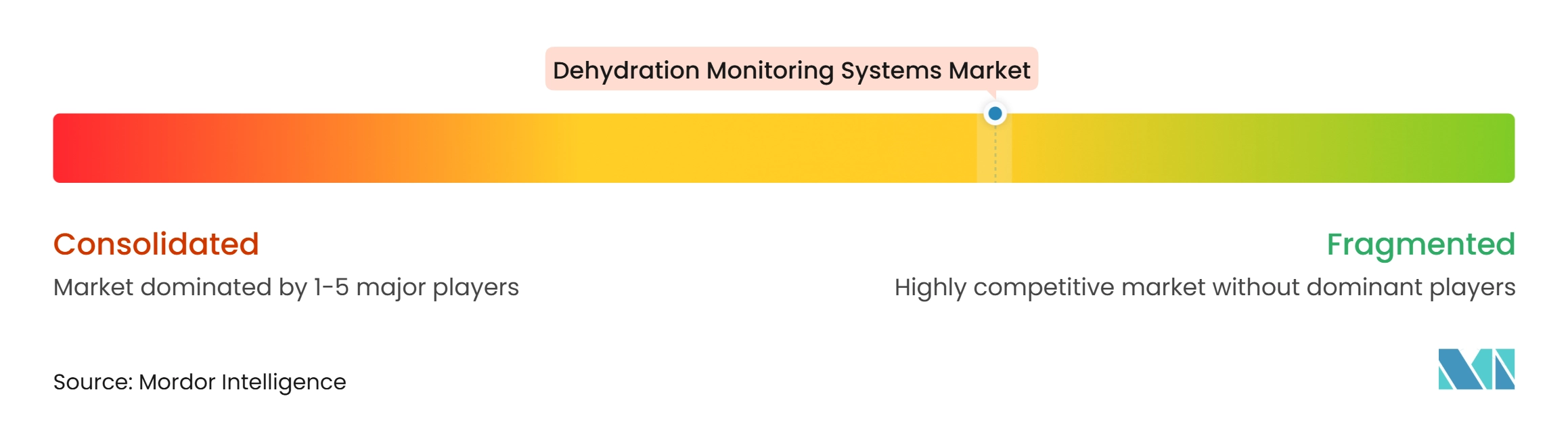
The dehydration monitoring systems market is moderately fragmented. Baxter International, Masimo Corporation, and Koninklijke Philips hold strong clinical positions through multi-parameter platforms, hospital procurement relationships, and regulatory experience. Baxter’s Starling system remains a reference point for noninvasive fluid-responsiveness monitoring in intensive and perioperative care. Its clinical evidence base raises the standard for new suppliers seeking hospital adoption. Large suppliers can embed hydration-relevant signals within wider monitoring systems and reduce procurement risk through established service networks.
Epicore Biosystems, Nix Biosensors, Kenzen, and Xsensio SA compete through sensor specificity, real-time analytics, and targeted workplace or sports deployments. Epicore reported the June 2026 launch of its Hydration Edge Score and reusable Connected Hydration armband for continuous use by industrial safety programs and sports organizations. Nix expanded its institutional position through the Baylor Athletics partnership across 19 Division I programs. Kenzen combines physiological and environmental data for industrial heat-risk management. Xsensio SA is associated with multianalyte electrochemical sensing that assesses sweat sodium and potassium rather than a single signal.
Field deployments can give specialists data that supports later clinical validation and strengthens their position against incumbent platforms. The dehydration monitoring systems market may see specialists use sports and employer data to develop broader reference populations. Pediatric dehydration, substance-induced dehydration in emergency care, and rehabilitation monitoring remain open applications without a clear commercial leader. Competition will depend on evidence quality, distribution access, data governance, workflow fit, and the ability to use partnerships or focused studies to address these areas.
Dehydration Monitoring Systems Industry Leaders
-
Koninklijke Philips N.V.
-
Baxter International Inc.
-
Masimo Corporation
-
Epicore Biosystems, Inc.
-
Nix Biosensors Inc.
- *Disclaimer: Major Players sorted in no particular order
Dehydration Monitoring Systems Market Companies Covered in this Report
- Baxter
- Bitome Inc.
- Eccrine Systems, Inc.
- Epicore Biosystems, Inc.
- GE HealthCare Technologies Inc.
- GraphWear Technologies Inc.
- hDrop Technologies Inc.
- HydrateME
- Hydrostasis Inc.
- Kenzen Inc.
- Koninklijke Philips
- LVL Technologies, Inc.
- Masimo
- Nix Biosensors Inc.
- Onalabs Inno-Hub
- SweatID
- WearOptimo Pty Ltd.
- Xsensio SA
- Zansors, LLC
- Zoll Medical
Recent Industry Developments in Dehydration Monitoring Systems Market
- June 2026: Epicore Biosystems launched the Hydration Edge Score, the first daily hydration readiness metric driven by real-time sweat data rather than heart rate estimates or self-reporting, alongside a reusable Connected Hydration armband designed for large-scale continuous daily deployment. The launch represents a deliberate transition from single-use adhesive patches to a scalable, washable platform intended for Fortune 500 industrial safety programs and sports organizations globally.
- April 2026: Nix Biosensors announced a 2-year department-wide partnership with Baylor University Athletics, deploying Nix Pro across all 19 Division I programs serving approximately 450 student-athletes, the largest collegiate athletic deployment of individualized hydration biosensor technology on record, enabling cross-sport, cross-climate sweat-profile analysis at an institutional scale.
- April 2026: OSHA updated its National Emphasis Program for Outdoor and Indoor Heat-Related Hazards, effective immediately for 5 years, targeting 55 high-risk industries using 2022–2025 inspection and BLS data. The update adds a new appendix on citation guidance and eliminates the prior numerical inspection goal in favor of risk-tiered enforcement, materially increasing compliance pressure on high-heat employers to adopt physiological monitoring solutions.
Global Dehydration Monitoring Systems Market Report Scope
According to the report’s scope, the dehydration monitoring systems market refers to advanced medical and consumer technologies, primarily wearable and non‑wearable sensors that continuously track hydration levels, providing real‑time insights to prevent dehydration in healthcare, sports, eldercare, and occupational settings. These systems leverage biosensors, AI analytics, and wireless connectivity to enable proactive health management.
The dehydration monitoring systems market is segmented into product type, application, distribution channel, and geography. By product type, the market is segmented into mobile devices and wearable devices. By application, the market is segmented into clinical dehydration detection, hospital-based monitoring, chronic condition management, toxicology monitoring, substance-induced dehydration, and rehabilitation monitoring. By distribution channel, the market is segmented into medical equipment distributors, hospitals and institutional procurement, specialty stores, retail outlets and medical stores, supermarkets and hypermarkets, and online retailers and direct-to-consumer sales. By geography, the market is segmented into North America, Europe, Asia-Pacific, the Middle East and Africa, and South America. The report also covers the estimated market sizes and trends for 17 countries across major regions globally. The report offers values (USD) for all the above segments.
Segmentation Overview
| Mobile Devices |
| Wearable Devices |
| Clinical Dehydration Detection |
| Hospital-Based Monitoring |
| Chronic Condition Management |
| Toxicology Monitoring |
| Substance-Induced Dehydration |
| Rehabilitation Monitoring |
| Medical Equipment Distributors |
| Hospitals and Institutional Procurement |
| Specialty Stores |
| Retail Outlets and Medical Stores |
| Supermarkets and Hypermarkets |
| Online Retailers and Direct-to-Consumer Sales |
| North America | United States |
| Canada | |
| Mexico | |
| Europe | Germany |
| United Kingdom | |
| France | |
| Italy | |
| Spain | |
| Rest of Europe | |
| Asia-Pacific | China |
| Japan | |
| India | |
| Australia | |
| South Korea | |
| Rest of Asia-Pacific | |
| Middle East and Africa | GCC |
| South Africa | |
| Rest of Middle East and Africa | |
| South America | Brazil |
| Argentina | |
| Rest of South America |
| By Product Type | Mobile Devices | |
| Wearable Devices | ||
| By Application | Clinical Dehydration Detection | |
| Hospital-Based Monitoring | ||
| Chronic Condition Management | ||
| Toxicology Monitoring | ||
| Substance-Induced Dehydration | ||
| Rehabilitation Monitoring | ||
| By Distribution Channel | Medical Equipment Distributors | |
| Hospitals and Institutional Procurement | ||
| Specialty Stores | ||
| Retail Outlets and Medical Stores | ||
| Supermarkets and Hypermarkets | ||
| Online Retailers and Direct-to-Consumer Sales | ||
| By Geography | North America | United States |
| Canada | ||
| Mexico | ||
| Europe | Germany | |
| United Kingdom | ||
| France | ||
| Italy | ||
| Spain | ||
| Rest of Europe | ||
| Asia-Pacific | China | |
| Japan | ||
| India | ||
| Australia | ||
| South Korea | ||
| Rest of Asia-Pacific | ||
| Middle East and Africa | GCC | |
| South Africa | ||
| Rest of Middle East and Africa | ||
| South America | Brazil | |
| Argentina | ||
| Rest of South America | ||
Key Questions Answered in the Report
What is the projected value of the dehydration monitoring systems market by 2032?
The market is forecasted to reach USD 1.03 billion by 2032, rising from USD 0.69 billion in 2026 to USD 0.73 billion in 2027 at a 7.13% CAGR.
Which product category leads the revenue of dehydration monitoring systems?
Mobile devices led with 52.23% of revenue in 2026 because they remain central to hospital dashboards, portable diagnostic tools, and connected clinical workflows.
Why are wearable hydration sensors growing faster than mobile devices?
Wearable devices are forecasted to grow at 8.44% CAGR because they can collect continuous sweat, bioimpedance, and related physiological data during normal activity.
Which region has the fastest projected growth?
Asia-Pacific is projected to grow at a 10.11% CAGR through 2032, supported by healthcare digitization, aging populations, heat exposure, and wearable adoption.