
Dark Chocolate Market Size and Share
Market Overview
| Study Period | 2022 - 2032 |
|---|---|
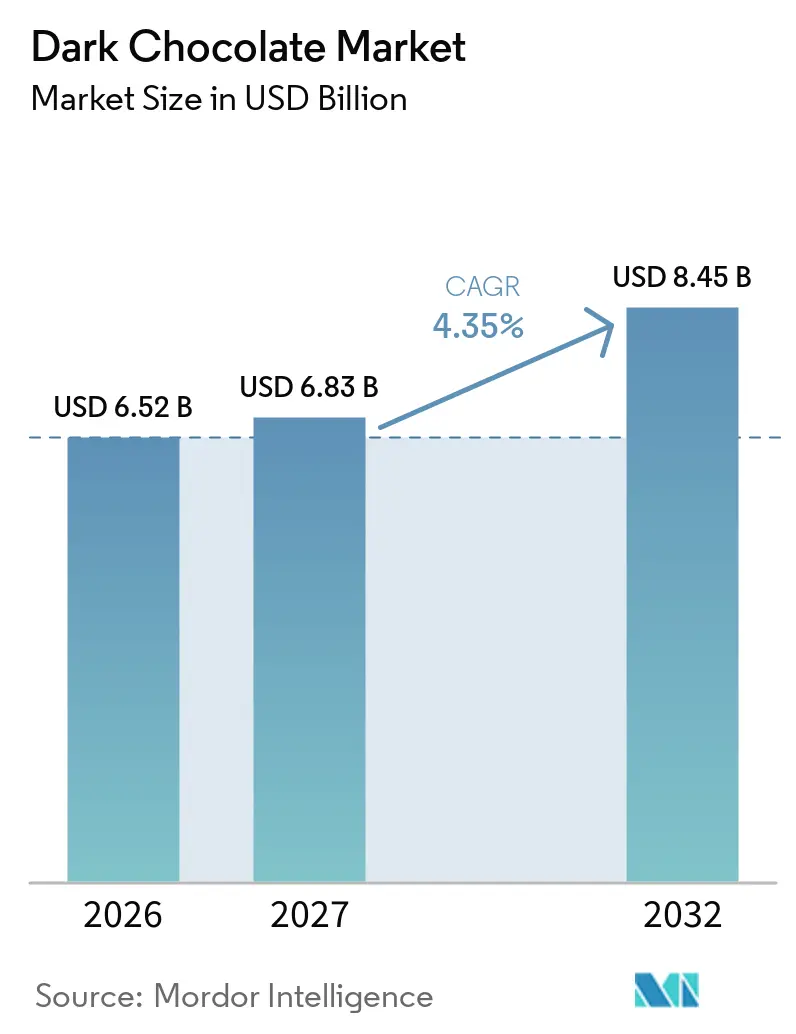
| Market Size (2027) | USD 6.83 Billion |
| Market Size (2032) | USD 8.45 Billion |
| Growth Rate (2027 - 2032) | 4.35 % |
| Fastest Growing Market | Asia-Pacific |
| Largest Market | Europe |
| Market Concentration | Low |
Major Players *Disclaimer: Major Players sorted in no particular order Image © Mordor Intelligence. Reuse requires attribution under CC BY 4.0. | |
Dark Chocolate Market Analysis by Mordor Intelligence
The dark chocolate market is projected to grow from USD 6.52 billion in 2026 to USD 6.83 billion in 2027, reaching USD 8.45 billion by 2032, at a CAGR of 4.35% from 2027 to 2032. Rising consumer interest in high-cocoa-content products, perceived health benefits, and premium-quality chocolate support market growth. Increasing demand for organic, single-origin, and distinctive-flavor varieties creates opportunities for product innovation and brand differentiation. In addition, expanding foodservice applications and growing consumer demand for baking products support market development. These trends encourage manufacturers to strengthen sourcing strategies and diversify product offerings amid cocoa supply constraints and cost pressures.
Key Report Takeaways
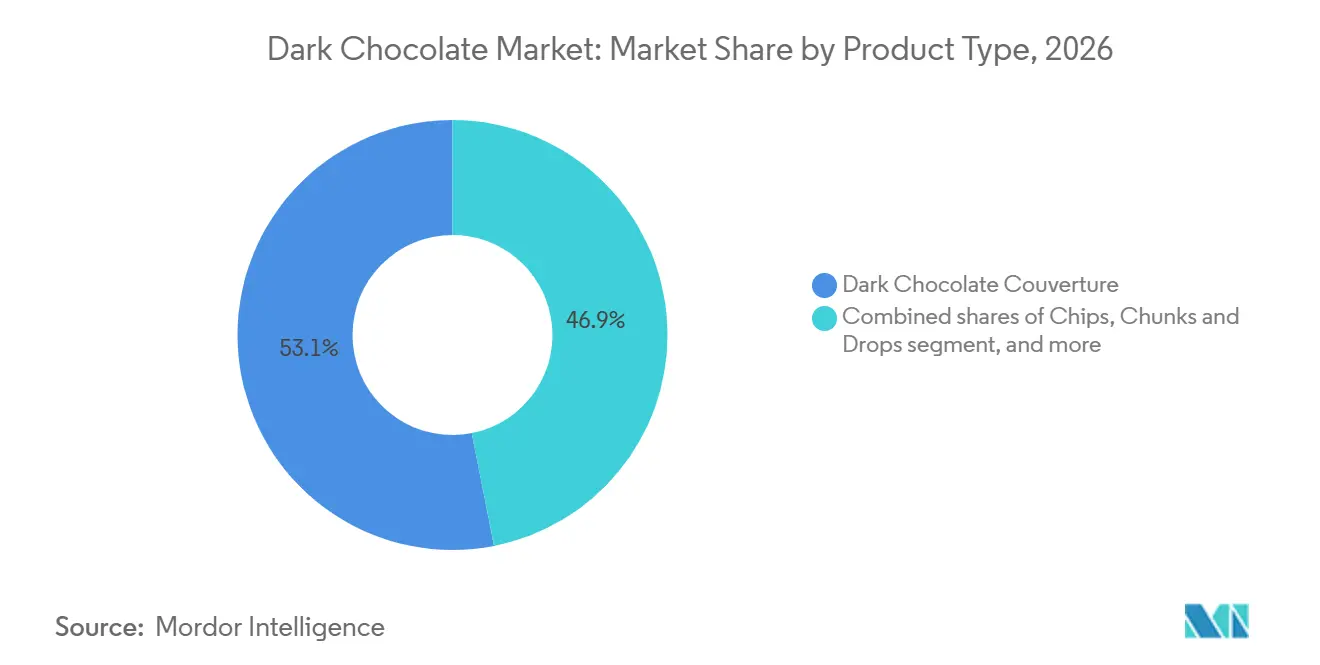
- By product type, Dark Chocolate Couverture held 53.12% of the dark chocolate market share in 2026, while Chips, Chunks, and Drops are projected to grow at a 7.41% CAGR through 2032.
- By cocoa content, the 50% to 70% Cocoa segment held 48.24% share in 2026, while 100% Cocoa is projected to grow at a 7.82% CAGR through 2032.
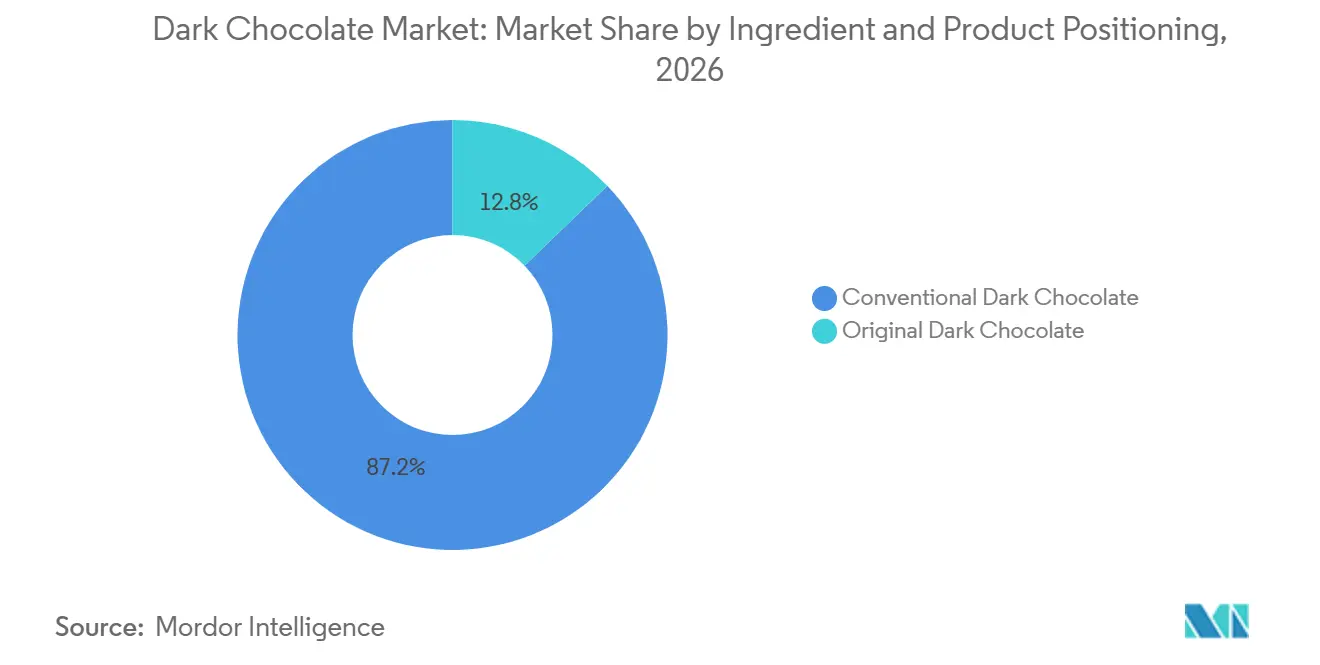
- By ingredient positioning, Conventional Dark Chocolate held 87.21% share in 2026, while Organic Dark Chocolate is projected to grow at a 7.22% CAGR through 2032.
- By application, Industrial Application held 72.11% share in 2026, while Foodservice and HoReCa are projected to grow at a 6.88% CAGR through 2032.
- By geography, Europe held 48.29% share in 2026, while Asia-Pacific is projected to grow at a 7.52% CAGR through 2032.
Note: Market numbers in this report are based on Mordor Intelligence's proprietary estimation framework, which combines nine months of actuals with Q4 projections for base year 2026.
Market Trends and Insights
Drivers Impact Analysis of Dark Chocolate Market*
| Driver | (~) % Impact on CAGR Forecast | Geographic Relevance | Impact Timeline |
|---|---|---|---|
| Perceived health benefits and demand for high-cocoa dark chocolate | +1.2% | Global, strongest in North America, Europe, and Japan | Long term (≥ 4 years) |
| Growing demand for artisanal and specialty dark chocolate | +0.7% | Europe, North America, and Australia | Medium term (2-4 years) |
| Growing consumer interest in distinctive cocoa origins and flavor profiles | +0.6% | North America and Europe, expanding to Asia-Pacific | Medium term (2-4 years) |
| Innovation in reduced-sugar dark chocolate formulations | +0.5% | Europe, North America, Japan, and Australia | Long term (≥ 4 years) |
| Increasing demand for convenient dark chocolate formats | +0.5% | Global, especially Asia-Pacific and North America | Short term (≤ 2 years) |
| Rising preference for organic and sustainably sourced dark chocolate | +0.6% | Europe, with spillover to North America and Asia-Pacific | Medium term (2-4 years) |
| Source: Mordor Intelligence | |||
Perceived Health Benefits and Demand for High-Cocoa Dark Chocolate
Growing awareness of cocoa’s potential health benefits is supporting demand for high-cocoa dark chocolate. For instance, in March 2025, according to the National Library of Medicine, a review reported clinical evidence showing that daily consumption of 30 g of 84% cocoa dark chocolate for eight weeks improved selected cardiometabolic and inflammatory markers [1]. These findings are strengthening consumer interest in high-cocoa formulations and supporting product positioning based on cocoa content and quality driving the market's growth.
Growing Demand for Artisanal and Specialty Dark Chocolate
Growing consumer interest in distinctive cocoa origins and premium flavor profiles is driving demand for artisanal and specialty dark chocolate. For instance, in February 2026, according to the Center for the Promotion of Imports from Developing Countries (CBI), 75% of consumers consider single-origin chocolate more premium and sustainable than standard chocolate, while 63% perceive chocolate sourced from specific regions as more premium than chocolate from other regions [2]. These preferences create opportunities for manufacturers to differentiate dark chocolate products through single-origin sourcing, bean-to-bar production, and distinctive flavor profiles.
Growing Consumer Interest in Distinctive Cocoa Origins and Flavor Profiles
Origin-specific cocoa and distinctive flavor profiles enable premium dark chocolate manufacturers to differentiate their products through provenance, craftsmanship, and product quality. For instance, in September 2025, according to the International Cocoa Organization’s market report, Ecuador’s cocoa production reached an estimated 570,000 tonnes, with average yields of approximately 800 kg per hectare, supporting its position as a key supplier of high-quality cocoa for premium chocolate production [3]. These attributes support the development of premium dark chocolate offerings that appeal to consumers seeking distinctive taste experiences and transparent sourcing
Innovation in Reduced-Sugar Dark Chocolate Formulations
Reduced-sugar formulations are creating opportunities for dark chocolate manufacturers to meet consumer demand for lower-sugar alternatives without compromising taste or texture. Manufacturers are exploring alternative sweeteners and functional ingredients to develop sugar-free and probiotic dark chocolate varieties. These innovations support product diversification and enable brands to address evolving dietary preferences while preserving the characteristic cocoa flavor and sensory appeal of dark chocolate.
Restraints Impact Analysis of Dark Chocolate Market*
| Restraint | (~) % Impact on CAGR Forecast | Geographic Relevance | Impact Timeline |
|---|---|---|---|
| Cocoa-price volatility and margin compression | -1.2% | Global, concentrated in European and North American manufacturing hubs | Short term (≤ 2 years) |
| Climate, disease, and aging-tree risks in cocoa origins | -0.8% | West Africa, with global supply implications | Long term (≥ 4 years) |
| Bitterness and taste-related adoption barriers | -0.5% | Asia-Pacific emerging markets | Medium term (2-4 years) |
| High premium-product prices | -0.4% | Eastern Europe, South America, and Middle East and Africa | Medium term (2-4 years) |
| Source: Mordor Intelligence | |||
Cocoa-Price Volatility and Margin Compression
Fluctuations in cocoa prices challenge dark chocolate manufacturers by increasing uncertainty in raw material procurement, production costs, and pricing strategies. Volatile cocoa prices make it difficult for manufacturers to maintain stable profit margins while keeping products affordable for consumers. Manufacturers may respond by reformulating products, adjusting portion sizes, or adopting alternative ingredient technologies. However, these strategies can affect product quality, consumer acceptance, and market competitiveness.
Climate, Disease, and Aging-Tree Risks in Cocoa Origins
Cocoa production faces persistent challenges from changing weather patterns, plant diseases, and aging trees across major growing regions. High temperatures, irregular rainfall, and disease outbreaks reduce crop yields and disrupt the consistency of cocoa supply. Addressing these issues requires long-term investments in farm rehabilitation, disease management, climate-resilient cultivation practices, and farmer support. These challenges create sourcing uncertainty for dark chocolate manufacturers, increase production costs, complicate procurement planning, and constrain supply continuity.
*Our forecasts treat driver/restraint impacts as directional, not additive. The impact forecasts reflect baseline growth, mix effects, and variable interactions.
Dark Chocolate Market Segment Analysis
By Product Type:
Couverture Holds Structural Lead While Chips and Drops AccelerateDark chocolate couverture is projected to account for 53.12% of the dark chocolate market in 2026. Its strong position in the dark chocolate market stems from its use in professional pastry, industrial confectionery, and hospitality applications, where finish, fluidity, and product consistency are critical. Couverture typically contains 32% to 39% cocoa butter, supporting the gloss and snap expected in premium finished products. These functional properties make it challenging for compound alternatives to replace couverture in higher-value applications. Germany, Belgium, France, and the Netherlands offer a stable demand environment for high-specification dark chocolate couverture.
Chips, chunks, and drops are projected to expand at a 7.41% CAGR through 2032, the highest among product types. This format benefits from the growing popularity of home baking and snacking, as well as improved online access to specialty baking ingredients. Blocks, slabs, and baking chocolate continue to serve industrial buyers who require precise dosing and cost control. Retail sales of chips and drops are also narrowing the historical divide between ingredient supply and consumer-facing products.

By Cocoa Content:
Mid-Range Cocoa Serves Broad Demand While 100% Cocoa Leads GrowthThe 50%-70% cocoa segment accounted for 48.24% of the dark chocolate market in 2026. This segment balances cocoa intensity with sweetness, making it widely appealing to retail consumers and industrial formulators. Its well-rounded flavor profile supports a broad range of applications, including chocolate bars, confectionery, bakery products, desserts, and beverages. The segment also benefits from its versatility, as manufacturers use it to develop products that require a consistent, accessible taste while meeting demand for premium yet moderately intense dark chocolate offerings.
The 100% Cocoa segment is forecast to grow at a CAGR of 7.82% through 2032, driven by consumers’ preference for intense cocoa flavor and minimal sweetness. Major brands are expanding into this niche category. The 86%-99% cocoa range provides an option for consumers transitioning to very high cocoa content. The 71%-85% Cocoa segment was the second-largest category, supported by demand for stronger cocoa flavor and health-related attributes. A 2025 clinical review cited an eight-week trial of 83% cocoa chocolate containing 450 mg of flavonoids.
By Ingredient and Product Positioning:
Conventional Scale Remains Strong While Organic Gains MomentumConventional dark chocolate accounted for 87.21% of the dark chocolate market in 2026. Established supply relationships, large-scale production capabilities, and the cost requirements of bakery and confectionery buyers support its leading position. Industrial buyers prioritize consistent quality, reliable availability, and competitive pricing when sourcing dark chocolate ingredients. Conventional products also reach a broad retail consumer base through mainstream retail channels. These scale advantages enable large manufacturers to serve multiple price points within the dark chocolate market while maintaining efficient production and stable supply.
The organic dark chocolate market is forecast to expand at a CAGR of 7.22% through 2032, driven by rising consumer demand for premium, sustainably sourced chocolate products and the increasing adoption of organic ingredients across retail and foodservice channels. Growing awareness of organic ingredients, ethical sourcing, and environmental responsibility is prompting manufacturers to expand their organic product offerings. In addition, the increasing emphasis on certification and traceability enables companies to differentiate their products based on quality and sustainable sourcing practices.
By Application:
Industrial Demand Leads While Foodservice and HoReCa Build Premium OccasionsThe industrial application segment is projected to account for 72.11% of the dark chocolate market in 2026. Demand spans confectionery manufacturing, bakery and baked goods, dairy and frozen desserts, and beverages, in which dark chocolate is a key ingredient in premium and mass-market formulations. Industrial customers value consistent formulations, standardized quality, and a reliable supply of dark couverture products to support efficient production processes and product consistency. Professional training further supports this preference by familiarizing future chefs and pastry professionals with couverture specifications, tempering techniques, and application requirements.
The foodservice and HoReCa application is projected to grow at a CAGR of 6.88% through 2032. Growth is driven by the increasing use of dark chocolate in desserts, beverages, confectionery, and baked goods across premium restaurants, specialty cafés, hotels, and professional pastry businesses. These establishments increasingly feature high-cocoa, single-origin, and artisanal dark chocolate varieties in their menus, exposing consumers to premium product offerings and distinctive flavor profiles. This exposure increases consumer interest in similar products through retail channels, particularly in premium and specialty segments, thereby supporting overall market growth.
Geography Analysis
Europe and APAC Dark Chocolate Market
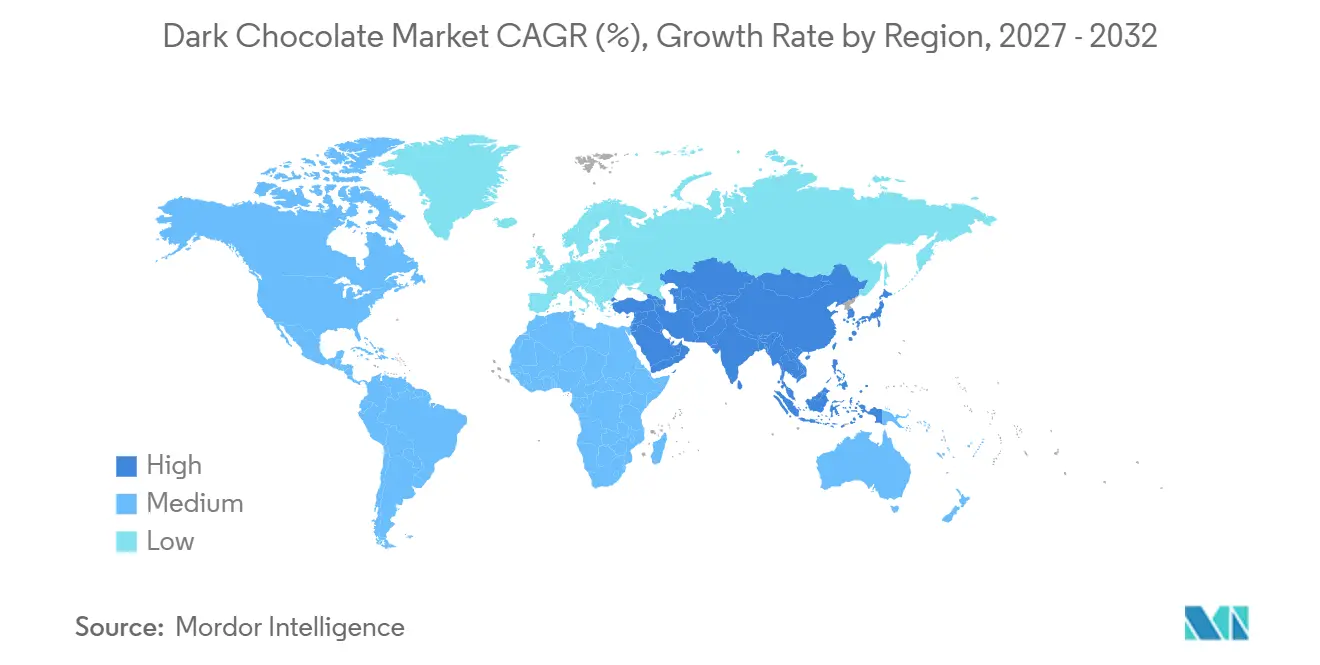
Europe held 48.29% of the dark chocolate market in 2026, supported by well-established chocolate manufacturing industries, strong consumer preference for premium products, and an increasing emphasis on sustainable cocoa sourcing and supply chain traceability. Asia-Pacific is projected to grow at the fastest rate, registering a CAGR of 7.52% through 2032. Rapid urbanization, rising consumer purchasing power, expanding premium gifting trends, and growing interest in high-cocoa and functional chocolate products are driving regional demand. The expansion of modern retail channels and e-commerce platforms is also improving product accessibility across key markets in the region.
The Americas Dark Chocolate Market
North America’s dark chocolate market is driven by health-conscious consumer preferences, premium product offerings, gifting occasions, and demand for home-baking ingredients. Growing interest in high-cocoa-content formulations, organic products, and specialty chocolate continues to support market growth. Seasonal celebrations also encourage premiumization through innovative flavors and single-origin varieties. South America plays a significant role in cocoa production and in the development of premium dark chocolate. The region’s fine-flavor cocoa varieties and expanding artisanal chocolate industry create opportunities for products differentiated by origin, quality, and unique flavor profiles.
MEA Dark Chocolate Market
The Middle East and Africa benefits from its role in cocoa production and the growing demand for premium imported chocolate, particularly in Gulf markets, where consumers increasingly favor high-quality products with distinctive flavors, premium ingredients, and strong brand positioning. The region’s cocoa-producing countries also provide opportunities to strengthen local processing capabilities, reduce reliance on raw cocoa exports, and capture greater value across the cocoa and chocolate supply chain. Rising interest in local cocoa processing, origin-based product differentiation, and traceable sourcing creates further opportunities for regional value addition and the development of premium dark chocolate products tailored to both domestic and export markets.
Competitive Landscape
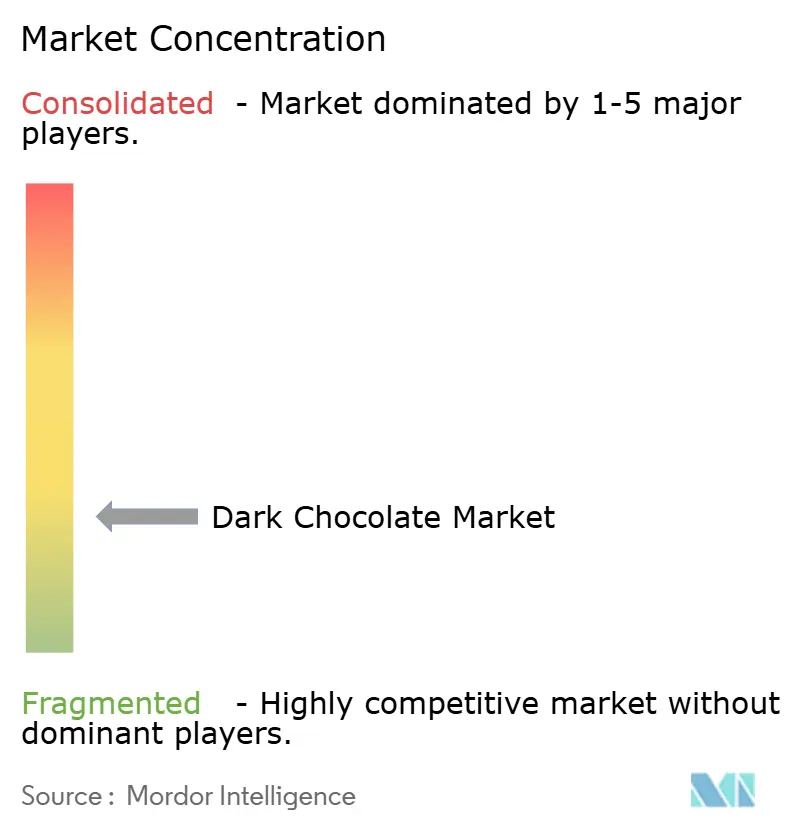
The dark chocolate market is fragmented, with large international manufacturers and specialist premium brands competing on distinct strengths. Lindt & Sprüngli, Mondelez International, Mars Incorporated, Ferrero, Nestlé, and The Hershey Company leverage extensive distribution networks, strong brand recognition, and substantial procurement capabilities. Valrhona, Guittard, Domori, Tony’s Chocolonely, and Alter Eco intensify competition through specialty-product quality, supply-chain transparency, ethical sourcing, and strong relationships with professional buyers.
Supply resilience is emerging as a key area of cooperation and competition in the dark chocolate market. Manufacturers are strengthening cocoa supply chains through farmer support initiatives, climate-resilient crop development, and alternative cocoa ingredients. These efforts include improving farmer access to training, financing, and sustainable farming practices, while developing cocoa varieties better suited to changing weather conditions. Companies are also exploring alternative cocoa ingredients to reduce dependence on conventional cocoa sources.
Premiumization remains a key competitive strategy in the dark chocolate market, as consumers increasingly seek products that offer superior taste, quality, and ethical value. Manufacturers differentiate their offerings through innovative product formats, distinctive flavors, single-origin cocoa, and high-quality ingredients. Professional training initiatives influence preferences among pastry professionals by promoting the use of premium dark chocolate products in bakery, confectionery, and dessert applications. Meanwhile, supply chain transparency and sustainability certifications strengthen brand positioning by addressing growing consumer interest in ethical sourcing and environmental responsibility.
Dark Chocolate Industry Leaders
-
Lindt & Sprüngli AG
-
Mondelez International, Inc.
-
Ferrero International S.A.
-
Mars, Incorporated
-
The Hershey Company
- *Disclaimer: Major Players sorted in no particular order
Dark Chocolate Market Companies Covered in this Report
- Lindt & Sprüngli AG
- Mondelez International, Inc.
- Ferrero International S.A.
- Mars, Incorporated
- The Hershey Company
- Nestlé S.A.
- Meiji Co., Ltd.
- August Storck KG
- Valrhona SAS
- Guittard Chocolate Company
- Gujarat Co-operative Milk Marketing Federation Ltd. (Amul)
- Tony’s Chocolonely B.V.
- Domori S.p.A.
- TCHO Chocolate
- Alter Eco Foods (WorldPantry.com LLC)
- Reliance Industries (Lotus Chocolate Company)
- Yıldız Holding (Guylian)
- MBK Partners (Pierre Marcolini Group)
- Endangered Species Chocolate, LLC
- Alfred Ritter GmbH & Co. KG (Ritter Sport)
Recent Industry Developments in Dark Chocolate Market
- September 2025: Ferrero North America launched Ferrero Rocher Chocolate Squares, including a Dark Hazelnut variant, at retail outlets across the United States. The launch extended the premium Ferrero Rocher franchise into dark chocolate snacking and sharing occasions through a multi-layer format priced at a premium.
- August 2025: Lindt & Sprüngli launched EXCELLENCE Fusion in Canada, combining premium 70% dark chocolate with a layer of milk or white chocolate in a single bar. This product is designed to reduce the sensory barrier to dark chocolate for milk-chocolate-dominant consumer segments while maintaining the brand’s premium positioning.
- March 2025: Japanese craft chocolate brand Minimal relaunched five signature single-origin dark chocolate bars with refreshed single-estate recipes, including a 90% high-cacao formulation produced using proprietary roasting techniques. The brand has received 96 international awards over nine consecutive years, reinforcing Asia-Pacific's emerging credentials in craft chocolate production.
Global Dark Chocolate Market Report Scope
The dark chocolate market includes products with varying cocoa content for direct consumption and industrial applications. The market is segmented by product type, cocoa content, ingredient, product positioning, application, and geography. Product types include couverture, chips, chunks and drops, blocks, slabs, baking chocolate, and others. Cocoa content segments include 50%-70%, 71%-85%, 86%-99%, and 100%. The market includes conventional and organic dark chocolate and covers industrial and foodservice/HoReCa applications. Geographically, it covers North America, Europe, Asia-Pacific, South America, the Middle East and Africa. The report provides market size estimates and forecasts in value (USD).
Segmentation Overview
| Dark Chocolate Couverture |
| Chips, Chunks and Drops |
| Blocks, Slabs and Baking Chocolate |
| Others Types |
| 50% to 70% Cocoa |
| 71% to 85% Cocoa |
| 86% to 99% Cocoa |
| 100% Cocoa |
| Conventional Dark Chocolate |
| Organic Dark Chocolate |
| Industrial application | Confectionery and Chocolate Manufacturing |
| Bakery and Baked Goods | |
| Dairy Products and Frozen Desserts | |
| Beverages | |
| Other Industrial Food Applications | |
| Foodservice and HoReCa Application |
| North America | United States |
| Canada | |
| Mexico | |
| Rest of North America | |
| Europe | Germany |
| United Kingdom | |
| Italy | |
| France | |
| Spain | |
| Netherlands | |
| Poland | |
| Belgium | |
| Sweden | |
| Rest of Europe | |
| Asia-Pacific | India |
| Japan | |
| Australia | |
| China | |
| Indonesia | |
| South Korea | |
| Thailand | |
| Singapore | |
| Rest of Asia-Pacific | |
| South America | Brazil |
| Argentina | |
| Colombia | |
| Chile | |
| Peru | |
| Rest of South America | |
| Middle East and Africa | South Africa |
| Saudi Arabia | |
| United Arab Emirates | |
| Nigeria | |
| Egypt | |
| Morocco | |
| Turkey | |
| Rest of Middle East and Africa |
| By Product Type | Dark Chocolate Couverture | |
| Chips, Chunks and Drops | ||
| Blocks, Slabs and Baking Chocolate | ||
| Others Types | ||
| By Cocoa Content | 50% to 70% Cocoa | |
| 71% to 85% Cocoa | ||
| 86% to 99% Cocoa | ||
| 100% Cocoa | ||
| By Ingredient and Product Positioning | Conventional Dark Chocolate | |
| Organic Dark Chocolate | ||
| By Application | Industrial application | Confectionery and Chocolate Manufacturing |
| Bakery and Baked Goods | ||
| Dairy Products and Frozen Desserts | ||
| Beverages | ||
| Other Industrial Food Applications | ||
| Foodservice and HoReCa Application | ||
| By Geography | North America | United States |
| Canada | ||
| Mexico | ||
| Rest of North America | ||
| Europe | Germany | |
| United Kingdom | ||
| Italy | ||
| France | ||
| Spain | ||
| Netherlands | ||
| Poland | ||
| Belgium | ||
| Sweden | ||
| Rest of Europe | ||
| Asia-Pacific | India | |
| Japan | ||
| Australia | ||
| China | ||
| Indonesia | ||
| South Korea | ||
| Thailand | ||
| Singapore | ||
| Rest of Asia-Pacific | ||
| South America | Brazil | |
| Argentina | ||
| Colombia | ||
| Chile | ||
| Peru | ||
| Rest of South America | ||
| Middle East and Africa | South Africa | |
| Saudi Arabia | ||
| United Arab Emirates | ||
| Nigeria | ||
| Egypt | ||
| Morocco | ||
| Turkey | ||
| Rest of Middle East and Africa | ||
Key Questions Answered in the Report
What is the projected value of the dark chocolate market by 2032?
The category is projected to reach USD 8.45 billion by 2032, growing at a 4.35% CAGR from 2027.
Which dark chocolate product type holds the largest share?
Dark Chocolate Couverture held 53.12% share in 2026 because of its importance in professional pastry, industrial confectionery, and hospitality use.
Which cocoa-content segment is growing fastest?
The 100% Cocoa segment is projected to grow at a 7.82% CAGR through 2032 as consumers seek higher-intensity, low-sugar products.
Which region is expected to grow fastest for dark chocolate?
Asia-Pacific is projected to grow at a 7.52% CAGR through 2032, supported by urban consumers, premium gifting, and health interest.