
Cultured Marble Market Size and Share
Market Overview
| Study Period | 2022 - 2032 |
|---|---|
| Market Size (2027) | USD 5.02 Billion |
| Market Size (2032) | USD 6.60 Billion |
| Growth Rate (2027 - 2032) | 5.63 % |
| Fastest Growing Market | Asia-Pacific |
| Largest Market | Asia-Pacific |
| Market Concentration | Low |
Major Players *Disclaimer: Major Players sorted in no particular order Image © Mordor Intelligence. Reuse requires attribution under CC BY 4.0. | |
Cultured Marble Market Analysis by Mordor Intelligence
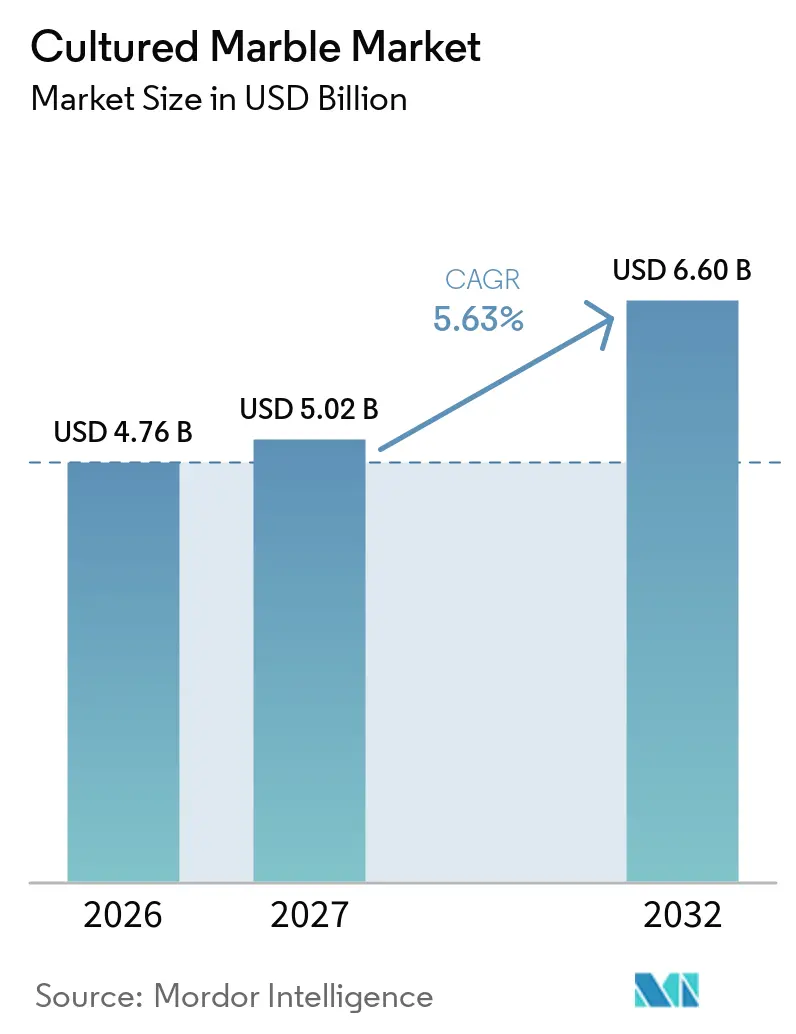
The cultured marble market size was valued at USD 4.76 billion in 2026 and is estimated to grow from USD 5.02 billion in 2027 to USD 6.60 billion by 2032, at a CAGR of 5.63% during the forecast period (2027-2032). The cultured marble market is supported by residential construction, bathroom replacement projects, and commercial renovation work that requires consistent finishes, planned installation, and durable surfaces. Renovation spending generates recurring demand, as vanity tops, shower systems, and related surfaces are typically selected as part of a complete bathroom replacement rather than as standalone purchases. Demand is also shifting toward surfaces that offer a stone-like appearance, low maintenance, predictable installation costs, and a coordinated finish across multiple bathroom components. Producers are responding with hybrid resin systems, recycled-content products, and formats suited to factory-built bathrooms. At the same time, competition from quartz, porcelain, and sintered slabs keeps product performance, documentation, design options, and price relevant across both renovation and new construction.
Key Report Takeaways
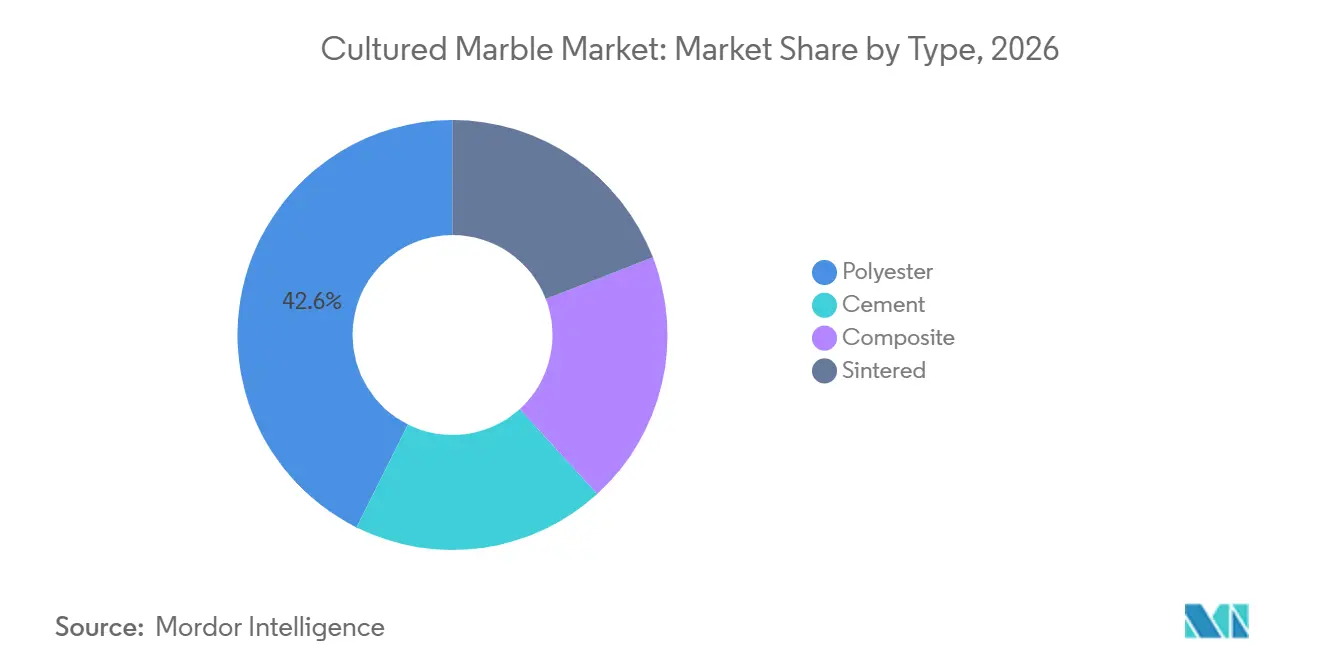
- By type, polyester held 42.64% of the cultured marble market share in 2026, while composite formulations are forecast to grow at a 5.96% CAGR through 2032.
- By application, countertops accounted for 35.75% of the cultured marble market share in 2026, while flooring is forecast to advance at a 6.17% CAGR through 2032.
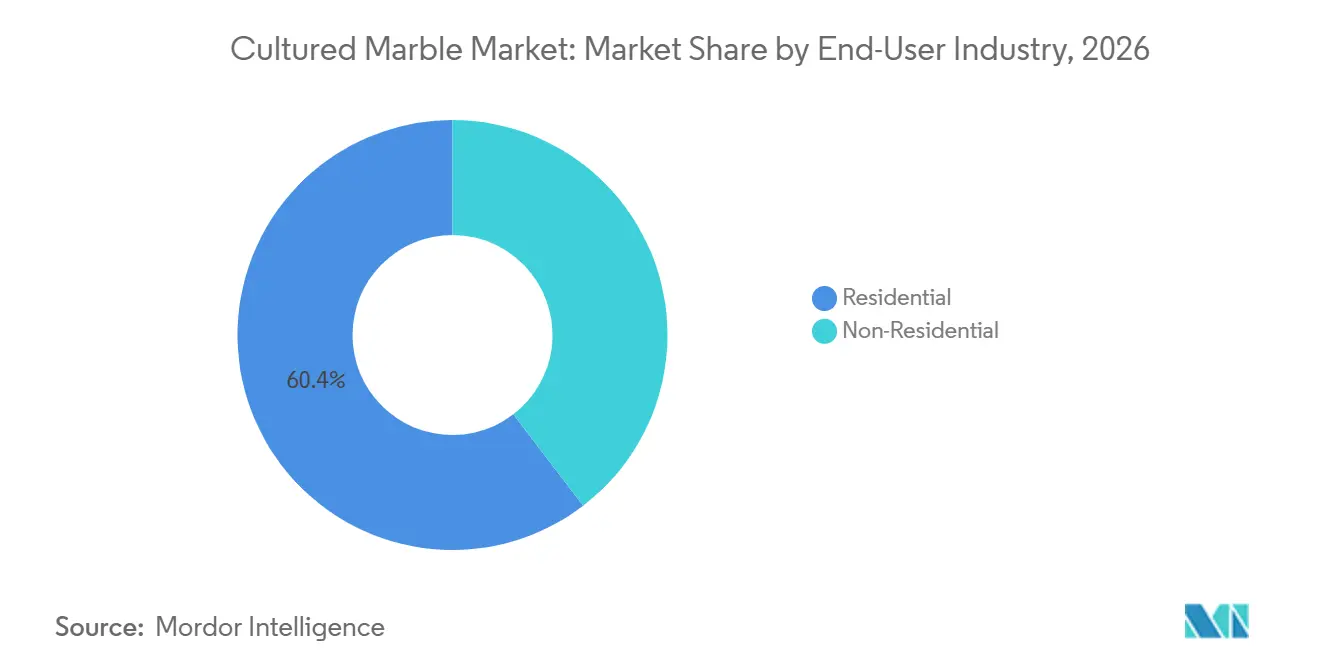
- By end-user industry, residential held 60.41% of the cultured marble market share in 2026, while non-residential is forecast to expand at a 6.42% CAGR through 2032.
- By geography, Asia-Pacific held 37.82% of the cultured marble market share in 2026 and is forecast to grow at a 6.33% CAGR through 2032.
Note: Market numbers in this report are based on Mordor Intelligence's proprietary estimation framework, which combines nine months of actuals with Q4 projections for base year 2026.
Market Trends and Insights
Drivers Impact Analysis of Cultured Marble Market*
| Drivers | (~) % Impact on CAGR Forecast | Geographic Relevance | Impact Timeline |
|---|---|---|---|
| Growth in Residential Construction and Bathroom Remodeling | +1.4% | Global, strongest in North America and Asia-Pacific | Medium term (2-4 years) |
| Demand for Cost-Effective Marble-Look Surfaces | +1.1% | Global, dominant in Asia-Pacific and South America | Long term (≥ 4 years) |
| Expansion of Hospitality, Healthcare, and Institutional Construction | +1.0% | North America, Asia-Pacific, Middle East | Medium term (2-4 years) |
| Adoption of Prefabricated and Modular Bathroom Components | +0.9% | Asia-Pacific, North America, Europe | Long term (≥ 4 years) |
| Rising Demand for Low-Maintenance and Hygienic Surfaces | +0.8% | Global, led by North America and Europe | Short term (≤ 2 years) |
| Source: Mordor Intelligence | |||
Growth in Residential Construction and Bathroom Remodeling
Bathroom renovation is an important source of demand for the cultured marble market, as surface replacement is central to a full bathroom update. The National Kitchen & Bath Association projected USD 235 billion in U.S. residential kitchen and bath spending for 2025. Harvard University's Joint Center for Housing Studies raised its 2025 remodeling benchmark to USD 509 billion following updated American Housing Survey data. This environment supports installed surfaces that can be supplied as integrated vanity systems rather than as separate slabs and bowls. For the cultured marble market, this product configuration keeps the renovation offering closely aligned with professional installation work. The integral-bowl format gives cultured marble a practical position in replacement projects, where installers and homeowners value a coordinated fit, fewer separate parts, and reduced uncertainty during final installation.
Demand for Cost-Effective Marble-Look Surfaces
The cultured marble market benefits when buyers seek the visual appeal of natural stone without the cost and installation requirements associated with quarried materials. Artificial marble producers are increasingly focusing on branded, design-led products and more detailed visual patterns. A 2025 industry interview with the China Stone Materials Association described a shift toward higher-value artificial stone products and the use of digital design tools. This shift can improve the visual range available to fabricators while keeping manufactured materials accessible for cost-sensitive projects, including multifamily work where repeatable patterns and controlled finishes are useful. The cultured marble market, therefore, competes not only on material cost but also on the accuracy and consistency of the finished visual design. Lower polyester input costs in the first half of 2025 also supported the value position of resin-based surfaces. The result is a broader set of color and veining choices for projects that require a consistent marble-like finish at controlled cost, while helping fabricators respond to design preferences without relying on the variability of natural stone slabs.
Expansion of Hospitality, Healthcare, and Institutional Construction
The cultured marble market can benefit from construction activity in healthcare, hospitality, education, and other institutional settings, as these projects prioritize durable, easy-to-clean surfaces. U.S. healthcare construction reached USD 69.78 billion in February 2025, with reported planning activity higher later in the year. The American Institute of Architects expected institutional building spending to rise 6.1% in 2025. Nonporous surfaces and reduced grout lines are useful where cleaning routines are frequent, staff require straightforward upkeep procedures, and consistent surface finishes are needed across multiple rooms. This driver also connects with demand for low-maintenance and hygienic finishes in healthcare and public-use bathrooms, where repeated cleaning and visual consistency can be part of the material selection process. EU construction product rules and ISO 22196 testing expectations further increase the value of documented material performance during specification.
Adoption of Prefabricated and Modular Bathroom Components
Factory-built bathroom systems provide a useful route to market for cultured marble producers offering standardized, installation-ready products. Resia Manufacturing opened third-party prefabricated bathroom services in October 2025 and completed a 420-unit Miami project in 14 months using assembled bathroom units from its Georgia facility[1]. A 2025 study in Buildings reported that modular bathroom construction can reduce on-site tasks by 70% and construction time by 67% compared with conventional wet-room construction. One-piece shower pans, vanity tops, and gelcoat wall systems fit these production workflows because they avoid on-site grout work, extended curing, and scheduling issues that can arise when multiple trades work in a confined space. Bathroom-pod capacity is also increasing in the United Arab Emirates, where Sobha Realty is scaling its facility to 18,000 pods annually. Products developed for standard pod dimensions, sealed assemblies, and plumbing integration can help suppliers participate in this shift. The cultured marble market can serve this channel when suppliers coordinate molded components with factory assembly requirements.
Restraints Impact Analysis of Cultured Marble Market*
| Restraints | (~) % Impact on CAGR Forecast | Geographic Relevance | Impact Timeline |
|---|---|---|---|
| Competition from Quartz, Ceramic, Natural Stone, Acrylic, and Solid Surface Materials | -1.7% | North America and Europe are mature renovation markets | Short term (≤ 2 years) |
| Volatile Polyester Resin, Pigment, and Mineral Filler Costs | -0.6% | Global, particularly China and Europe | Short term (≤ 2 years) |
| Styrene Emissions and Resin-Formulation Compliance Requirements | -0.5% | North America and Europe | Medium term (2-4 years) |
| Source: Mordor Intelligence | |||
Competition from Quartz, Ceramic, Natural Stone, Acrylic, and Solid Surface Materials
The cultured marble market faces direct competition from engineered quartz, porcelain, sintered stone, natural stone, acrylic, and solid surface materials. Quartz and sintered slabs are preferred in upscale kitchens due to their heat resistance, surface hardness, and large-format visual designs. Porcelain also competes in applications where zero-porosity surfaces and bold patterns are central to the design brief. As production capacity expands in Asia and competing products become more widely available through regional distributors and project suppliers, these materials can erode the traditional cost advantage of cultured marble. Health concerns related to crystalline silica exposure may redirect some projects away from engineered quartz, creating opportunities for silica-free alternatives such as acrylic products and cultured marble as designers and project owners reassess material choices. Cultured marble remains most competitive where integral sinks, bathroom installation speed, and manageable replacement costs are prioritized over kitchen heat performance.
Volatile Polyester Resin, Pigment, and Mineral Filler Costs
Raw material costs remain a constraint for the cultured marble market, as polyester resin, pigments, and mineral fillers directly affect its economics. General-purpose resin prices in China fell to CNY 7,600 to CNY 8,400 per metric ton in November 2025 as feedstock prices weakened. The reliance on styrene, maleic anhydride, and oil-linked inputs can result in rapid cost increases when energy markets shift. Specialty pigment costs can move independently of general resin prices, as titanium dioxide and iron oxide follow separate commodity cycles, complicating pricing for designs that depend on premium colorways or detailed veining. Manufacturers serving premium applications therefore face pressure to protect margins while maintaining finish quality. Compliance requirements add further cost, as U.S. regulations on volatile organic compound emissions encourage the adoption of lower-styrene and hybrid formulations[2].
*Our forecasts treat driver/restraint impacts as directional, not additive. The impact forecasts reflect baseline growth, mix effects, and variable interactions.
Cultured Marble Market Segment Analysis
By Type:
Composite Formulations Narrow the Gap on Polyester’s DominancePolyester accounted for 42.64% of the cultured marble market share in 2026, supported by low production costs and established fabrication practices. Its long use in vanity tops and bathroom countertops gives fabricators access to familiar processes, finishing methods, established supply chains, and installers who understand its handling requirements. This position is especially relevant in replacement work, where standardized dimensions, dependable installation, available fabrication skills, and a familiar material system remain important to contractors managing time-sensitive bathroom projects. Polyester-based products also meet the needs of projects that require an affordable, manufactured surface with a uniform appearance. However, their thermal sensitivity and styrene-related compliance considerations can limit their appeal in some higher-performance settings. These limitations support interest in materials that improve impact resistance and reduce emissions without sacrificing molded-product flexibility. Fabricators can retain familiar casting and finishing practices while offering a product range better suited to demanding project specifications, including bathrooms, public facilities, and commercial interiors where resilience and appearance are evaluated together.
Composite formulations are forecast to grow at a 5.96% CAGR through 2032, making them the fastest-growing type in the cultured marble market. The segment combines polyester with acrylic, alumina trihydrate, and other hybrid resin systems to improve surface performance. These formulations can offer lower thermal sensitivity, stronger impact resistance, and a more refined finish. They also provide manufacturers with a path to reduce styrene content as regulatory requirements evolve. Cement-based cultured marble remains relevant for lower-cost residential work in South and Southeast Asia. Sintered variants are used in commercial applications where buyers prioritize scratch resistance and heat performance. The U.S. Environmental Protection Agency finalized amendments to volatile organic compound standards in January 2025, strengthening the case for lower-emission alternatives. The cultured marble industry can use this transition to offer a broader technical range rather than relying solely on conventional polyester products.

By Application:
Flooring Gains Ground as Countertops Maintain Their LeadCountertops accounted for 35.75% of the cultured marble market share in 2026. Their lead reflects the integral-sink design, which makes the product a complete replacement solution rather than a surface-only purchase. This design reduces fitting complexity in many bathroom renovation projects, particularly when contractors need to coordinate a surface, basin, drain location, and backsplash within a limited construction schedule and deliver a finished room with minimal follow-up work. It also offers a clean, continuous appearance that is difficult to replicate at the same installed cost as some slab alternatives. Vanities and bathtubs remain established uses, particularly in multifamily projects that value standard sizes and shorter installation schedules. These applications keep the cultured marble market closely tied to bathroom replacement and new housing activity.
Flooring is projected to grow at a 6.17% CAGR through 2032 and represents the fastest-growing application. Commercial and hospitality refurbishment projects support this demand because seamless surfaces can simplify cleaning, reduce grout maintenance, and help operators maintain a consistent appearance across guest-facing or public-use areas. Hyundai L&C launched its Urban Shard artificial marble floor and wall product in April 2025, using upcycled production offcuts. The product targets recycled-content certification in the European market, aligning with broader demand for documented material attributes. This example illustrates how environmental credentials can be combined with a format designed for high-use interiors, and how production offcuts can be incorporated within a product system that still meets visual and functional requirements. The cultured marble market can therefore extend beyond traditional vanity applications by addressing durability, maintenance, and sustainability requirements together. Widespread adoption of flooring will still depend on reliable technical performance in commercial settings.
By End-User Industry:
Non-Residential Sector Accelerates Ahead of Residential BaseResidential held 60.41% of the cultured marble market share in 2026. Bathroom and countertop replacement cycles across single-family and multifamily homes provide the core revenue base. Homeowners and contractors often select manufactured surfaces for their consistent finish, integrated components, ease of cleaning, and ability to provide a complete bathroom surface solution within a single material system. Professional remodeling demand strengthens this channel because installed vanity systems require measurement, fabrication, and fitting. The National Kitchen & Bath Association projected growing professional remodeling activity in 2025. Accessibility needs also support surfaces that minimize grout lines and simplify daily cleaning. Residential demand remains broad, although buyers can switch among several surface materials based on style, budget, and installation needs.
Non-residential is projected to grow at a 6.42% CAGR through 2032, ahead of the residential base. Healthcare construction starts were up 27% year-to-date in the third quarter of 2025, supporting demand from hospitals and care facilities. Hotel refurbishment, student housing, education facilities, and other institutional projects provide additional opportunities. These buyers often evaluate lifecycle cost alongside purchase price, including cleaning needs, repair options, visual durability, and the operational impact of replacing damaged surface components. Cultured marble can support that evaluation through repair by buffing, resistance to common cleaning products, and fewer grout lines. The surface is especially relevant where appearance must be maintained across repeated cleaning cycles, regular use, and ongoing renovation schedules that prioritize predictable repair and replacement methods. Suppliers that provide test data, product documentation, and standardized project support may be better positioned to capture higher-value specification work in this segment. Suppliers need to present a clear case for cleaning performance, repairability, and the availability of replacement components.
Geography Analysis
APAC Cultured Marble Market
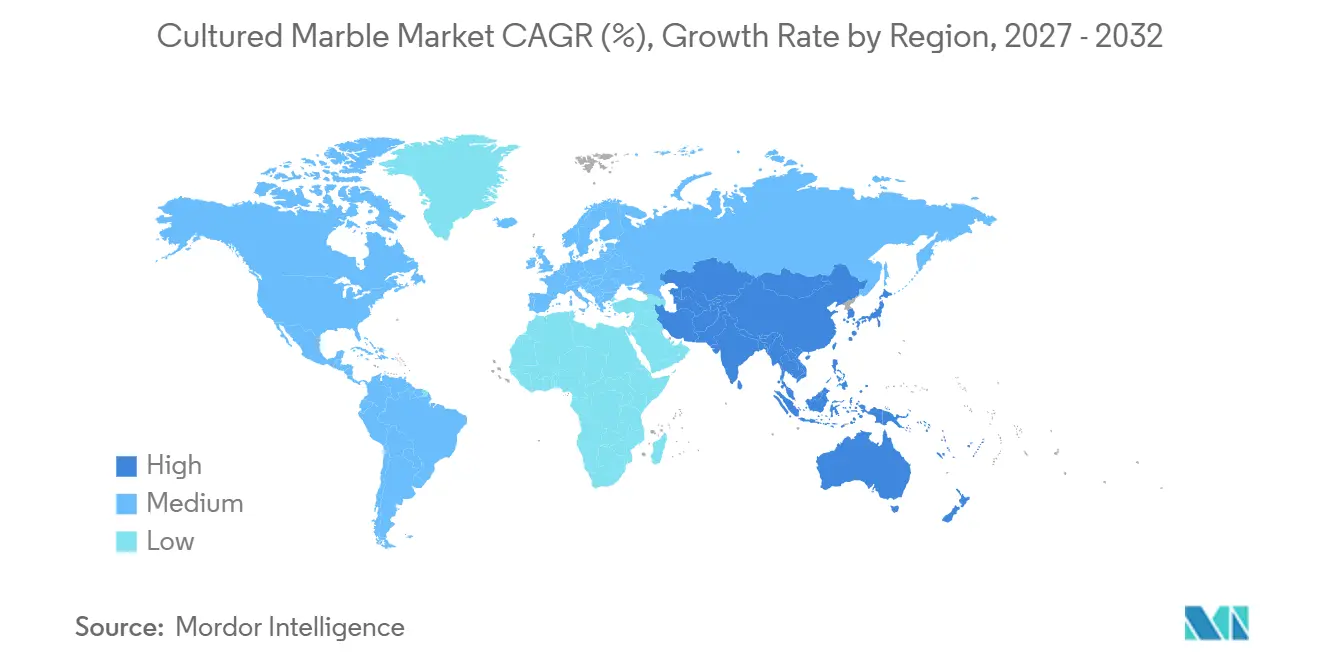
Asia-Pacific held 37.82% of the cultured marble market share in 2026 and is forecast to grow at a 6.33% CAGR through 2032. This growth reflects new construction activity in India and Southeast Asia, as well as renovation and fit-out demand in China. The region includes both fast-expanding housing markets and established manufacturing centers, giving suppliers access to varied demand conditions, fabrication capacity, and a wide range of residential and commercial project types. A 2025 forum in Xiamen identified self-cleaning surfaces and intelligent production systems as priority areas for Chinese artificial stone producers.
North America and APAC Cultured Marble Market
South Korea remains an important source of branded artificial marble products, and Hyundai L&C's 2025 recycled-content product launch addresses green-building specifications. India and Southeast Asia contribute incremental output through middle-income housing, hospitality development, and construction in secondary cities, where developers often prioritize installation efficiency alongside an attractive finished appearance. In these locations, the cultured marble market benefits when developers need materials that install quickly, stay within budget, and deliver a consistent look across housing, hospitality, and mixed-use developments. North America is the second-largest regional market, supported by a USD 235 billion kitchen and bath renovation sector. U.S. producers also face volatile organic compound requirements that increase the value of compliant, lower-emission resin systems. Resia Manufacturing's 2025 service expansion demonstrates how factory-built bathrooms can drive demand for standardized surface assemblies.
EMEA and South America Cultured Marble Market
Europe maintains demand through renovation activity and a mature market for premium bathroom products. Material documentation and compliance requirements remain important for producers serving these applications, particularly where projects require consistent technical information, clear product records, and reliable support through specification and installation. South America is supported by residential construction and demand for improved bathroom finishes in Brazil and Argentina. The Middle East and Africa remain smaller regional contributors, although hospitality and luxury residential projects present targeted opportunities.
Competitive Landscape
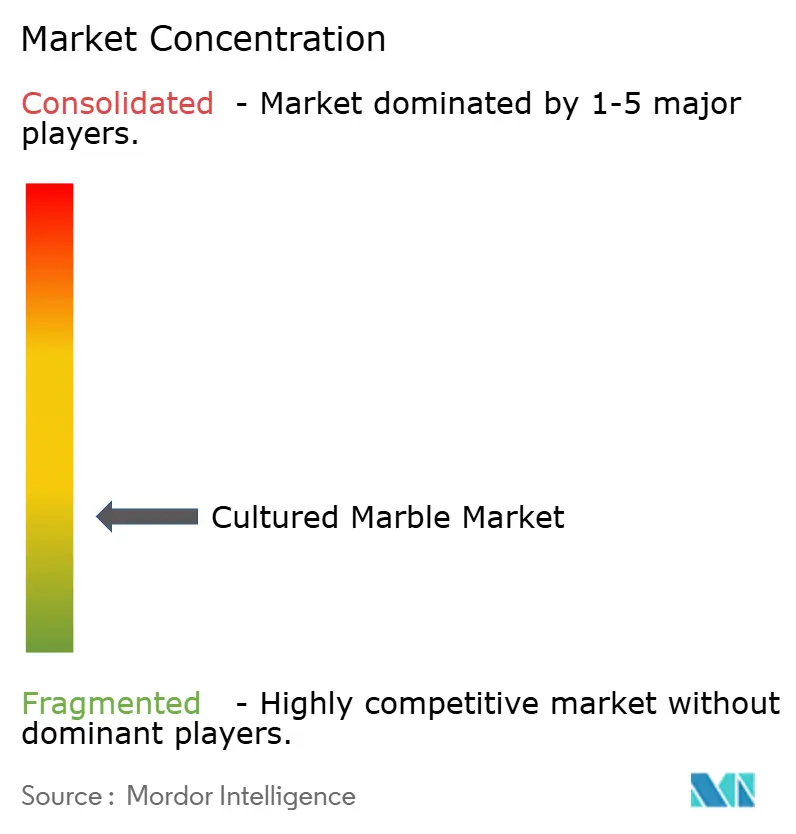
The cultured marble market is fragmented, with local fabricators and regional specialists serving bathroom and renovation projects. Price competition is most intense in conventional polyester products, where differentiation is limited, and buyers compare local availability, delivery times, surface appearance, fabrication quality, and installed project cost. Producers can strengthen their positions through design options, reliable distribution, and products that meet project specifications.
Leading companies are using product design and distribution to move beyond price-based competition. LOTTE Chemical launched its Aria Collection in August 2025, a 9-color premium artificial marble range under the Staron brand. The launch grouped products into Cream, Deep, and Concrete color families and targeted installation in model homes. LX Hausys expanded its US presence in 2025 by opening a Charlotte location and adding three-day delivery capability. DuPont's Corian Design positioned solid surfaces around flexible design and future applications in 2025. These moves indicate that suppliers competed on specification, availability, and design visibility.
The modular bathroom supply chain represents an emerging opportunity for cultured marble manufacturers. Manufacturers are increasing pod output, and material suppliers are adapting product formats to support factory installation, standardized quality control, and repeatable delivery requirements. Pod-ready surfaces require standard dimensions, pre-sealed assemblies, and compatibility with plumbing systems. Regional manufacturers can defend domestic positions through dealer networks and local procurement preferences. The cultured marble market will stay competitive as companies grow by offering product compatibility, visible design ranges, access to project channels, and better support for fabricators, builders, commercial specifications, distributor relationships, and coordinated product availability across regional project locations.
Cultured Marble Industry Leaders
-
LX Hausys
-
LOTTE Chemical Corporation
-
DuPont
-
CMC
-
Hangzhou Nabel China Co., Ltd.
- *Disclaimer: Major Players sorted in no particular order
Cultured Marble Market Companies Covered in this Report
- Antolini Luigi & C. S.p.A.
- CMC
- Cultured Marble Products
- DuPont
- Gruber Systems, Inc.
- Hangzhou Nabel China Co., Ltd.
- Kerrico Corporation
- LOTTE Chemical Corporation
- LX Hausys
- Marblecraft Company, Inc.
- MarCraft, Inc.
- Nicos International Spa
- Patrician Marble Company
- RYNONE
- Swan Corporation
Recent Industry Developments in Cultured Marble Market
- August 2026: Swan Corporation launched the Swan Odile Accessories collection, a line including towel bars and corner shelving designed to integrate with Swanstone cultured marble bathroom surfacing systems. The launch extends Swan's product range beyond surfaces to complete bathroom environments, targeting builders and designers who specify coordinated packages for multifamily and renovation projects.
- August 2025: LOTTE Chemical launched the Aria Collection, a nine-color premium cultured marble line under its Staron brand, organized into Cream, Deep, and Concrete color groups with wave-inspired marble patterns. The collection was installed in model homes of major South Korean construction companies, with initial overseas orders secured for September and a 2026 U.S. and European market lineup review completed.
Global Cultured Marble Market Report Scope
Cultured marble is an engineered composite material composed of approximately 75% crushed natural marble dust blended with liquid polyester resin and color pigments, cast in molds with a protective clear gel coat. The material combines natural marble particulate with synthetic binding agents to produce a finished product that replicates the appearance of natural marble while offering greater design flexibility and lower production costs.
The cultured marble market is segmented by type, application, end-user industry, and geography. By type, the market is segmented into polyester, cement, composite, and sintered. By application, the market is segmented into countertops, vanities, bathtubs, flooring, and other applications. By end-user industry, the market is segmented into residential and non-residential. The report also covers market sizes and forecasts for cultured marble across 15 countries in major regions. The market sizes and forecasts are provided in terms of value (USD).
Segmentation Overview
| Polyester |
| Cement |
| Composite |
| Sintered |
| Countertops |
| Vanities |
| Bathtubs |
| Flooring |
| Other Applications |
| Residential |
| Non-Residential |
| Asia-Pacific | China |
| India | |
| Japan | |
| South Korea | |
| ASEAN Countries | |
| Rest of Asia-Pacific | |
| North America | United States |
| Canada | |
| Mexico | |
| Europe | Germany |
| United Kingdom | |
| France | |
| Italy | |
| NORDIC Countries | |
| Rest of Europe | |
| South America | Brazil |
| Argentina | |
| Rest of South America | |
| Middle East and Africa | Saudi Arabia |
| South Africa | |
| Rest of Middle East and Africa |
| By Type | Polyester | |
| Cement | ||
| Composite | ||
| Sintered | ||
| By Application | Countertops | |
| Vanities | ||
| Bathtubs | ||
| Flooring | ||
| Other Applications | ||
| By End-User Industry | Residential | |
| Non-Residential | ||
| By Geography | Asia-Pacific | China |
| India | ||
| Japan | ||
| South Korea | ||
| ASEAN Countries | ||
| Rest of Asia-Pacific | ||
| North America | United States | |
| Canada | ||
| Mexico | ||
| Europe | Germany | |
| United Kingdom | ||
| France | ||
| Italy | ||
| NORDIC Countries | ||
| Rest of Europe | ||
| South America | Brazil | |
| Argentina | ||
| Rest of South America | ||
| Middle East and Africa | Saudi Arabia | |
| South Africa | ||
| Rest of Middle East and Africa | ||
Key Questions Answered in the Report
What is current market size of Cultured Marble Market?
The cultured marble market size was valued at USD 4.76 billion in 2026 and is estimated to grow from USD 5.02 billion in 2027 to USD 6.60 billion by 2032, at a CAGR of 5.63% during the forecast period (2027-2032).
Which type of cultured marble product is growing fastest?
Composite formulations are forecast to grow at a 5.96% CAGR through 2032 because they can improve impact resistance, surface finish, and resin performance. They also offer a path toward lower-styrene systems where emissions compliance matters, while giving suppliers more options for matching performance to specific project conditions.
Why are countertops the leading application for cultured marble?
Countertops held a 35.75% share in 2026 because integral sinks make them a convenient replacement solution for bathroom renovation projects. The molded format reduces fitting complexity compared with separate sink and surface selections, and it can help contractors achieve a coordinated appearance in bathrooms with limited space.
Which end-user group is growing the fastest?
Non-residential demand is forecast to expand at a 6.42% CAGR through 2032, supported by healthcare, hospitality, education, and institutional projects. Buyers in these settings can assess lifecycle maintenance and purchase cost, making cleaning requirements, surface repair, and standardized specifications part of the purchasing decision.