
Covalent Organic Frameworks Market Size and Share
Market Overview
| Study Period | 2022 - 2032 |
|---|---|
| Market Size (2027) | USD 278.72 Million |
| Market Size (2032) | USD 962.17 Million |
| Growth Rate (2027 - 2032) | 28.12 % |
| Fastest Growing Market | Asia-Pacific |
| Largest Market | Asia-Pacific |
| Market Concentration | Medium |
Major Players *Disclaimer: Major Players sorted in no particular order Image © Mordor Intelligence. Reuse requires attribution under CC BY 4.0. | |
Covalent Organic Frameworks Market Analysis by Mordor Intelligence
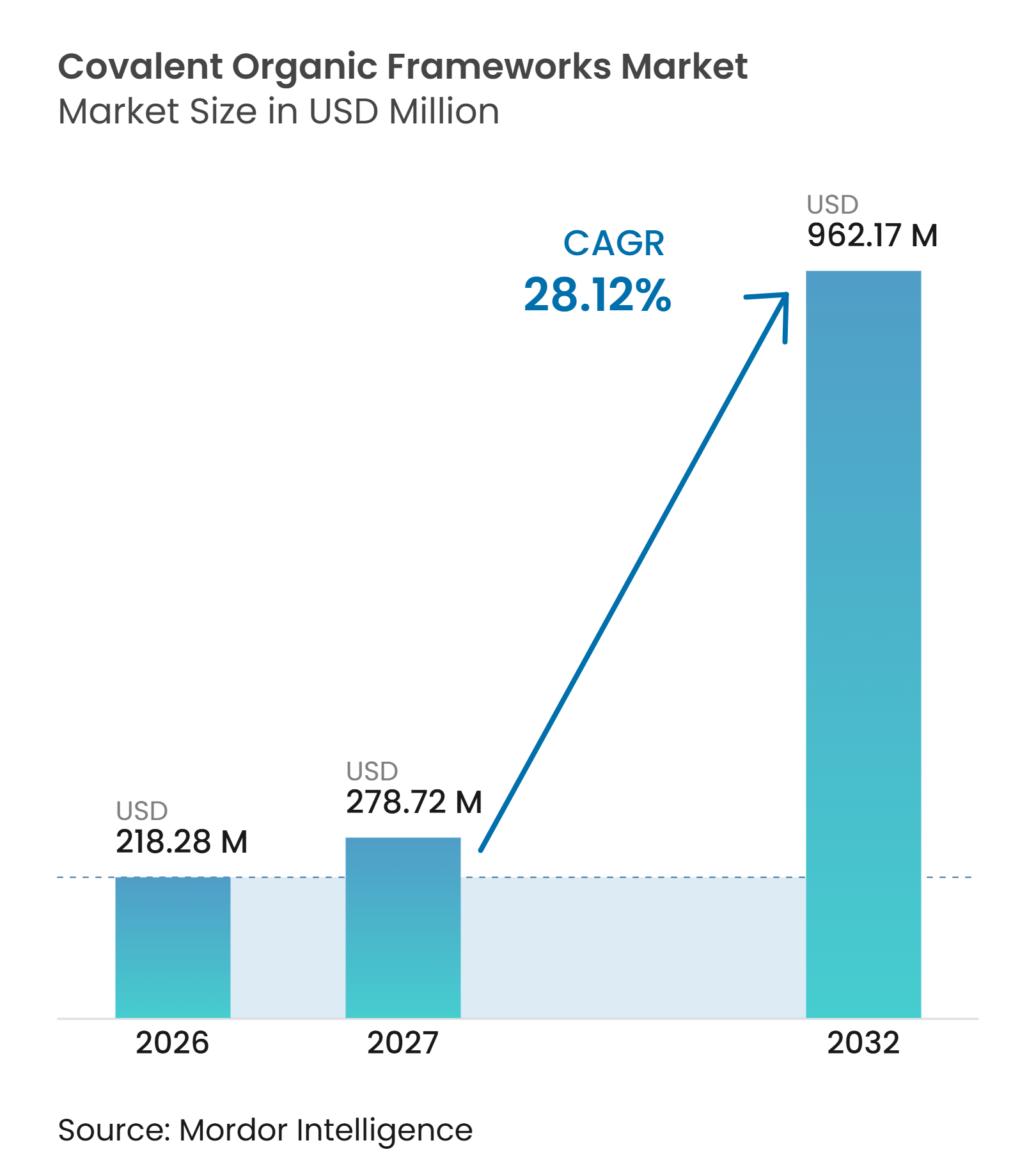
The Covalent Organic Frameworks market size was valued at USD 218.28 million in 2026 and is estimated to grow from USD 278.72 million in 2027 to USD 962.17 million by 2032, at a CAGR of 28.12% during the forecast period (2027-2032). The Covalent Organic Frameworks (COFs) market is transitioning from laboratory synthesis toward industrial-scale production, supported by advances in solvent-free manufacturing and growing producer activity in Asia-Pacific. The 2025 Nobel Prize in Chemistry drew increased attention to porous framework materials by recognizing research on metal-organic frameworks, which share reticular design principles with COFs. Unlike metal-organic frameworks, COFs rely on all-covalent bonding, which contributes to their thermal and chemical stability. Demand is strongest in applications where pore structure, chemical resistance, and controllable transport paths are critical, including gas separation, energy storage, catalysis, and biomedical delivery. Specialty chemical companies are developing adjacent capabilities, while dedicated producers focus on ton-scale supply, with application engineering and production consistency remaining central to competition. Key constraints for the market include costly aromatic precursors, multi-step synthesis processes, and limited electrical conductivity in many linkage families.
Key Report Takeaways
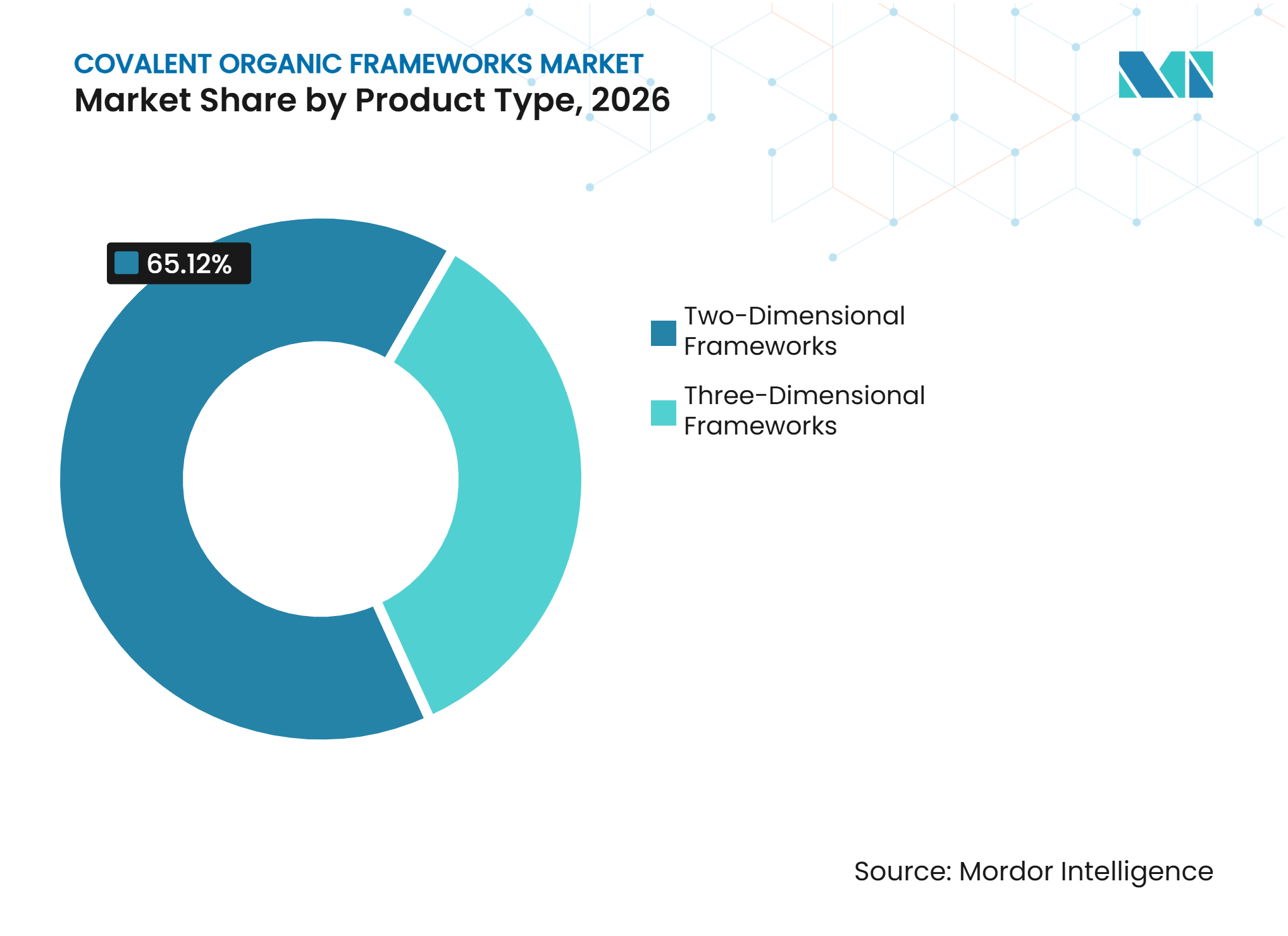
- By product type, two-dimensional frameworks held 65.12% of the Covalent Organic Frameworks market share in 2026, while three-dimensional frameworks are forecast to grow at a 29.56% CAGR through 2032.
- By linkage chemistry, imine-linked COFs held 35.67% of the Covalent Organic Frameworks market share in 2026, while β-ketoenamine-linked COFs are forecast to grow at a 31.34% CAGR through 2032.
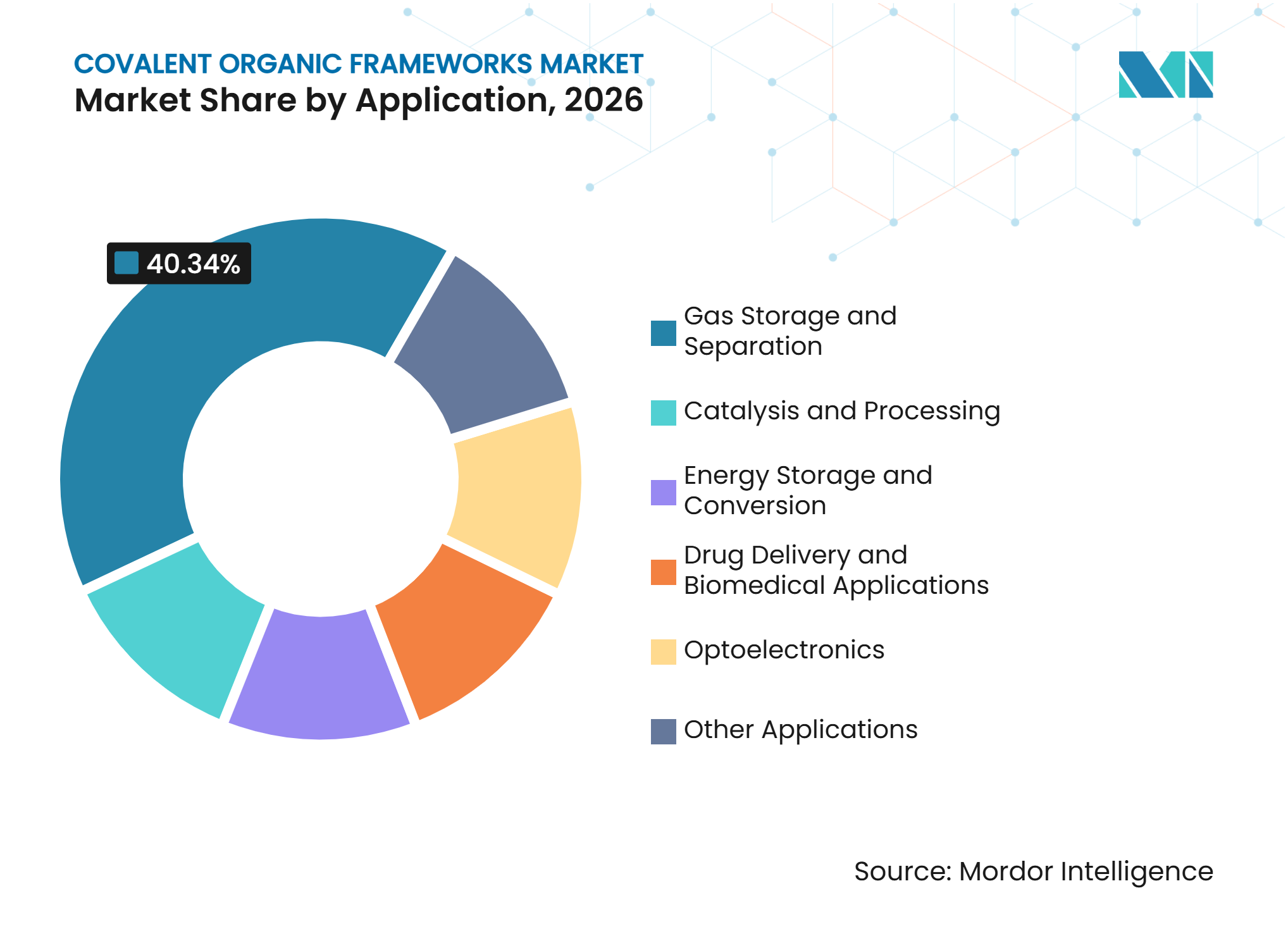
- By application, gas storage and separation accounted for 40.34% of market share in 2026, while energy storage and conversion are forecast to grow at a 32.87% CAGR through 2032.
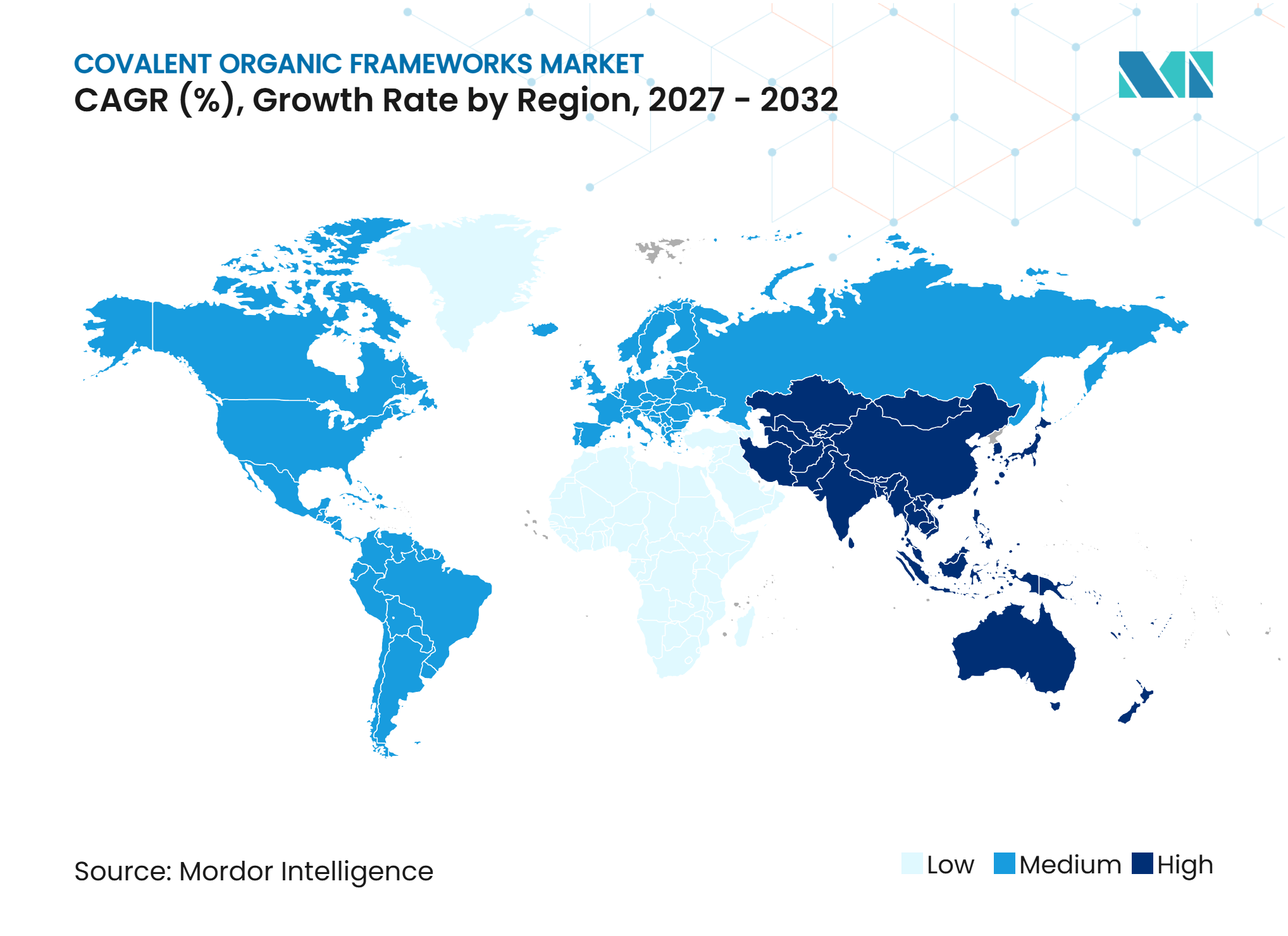
- By geography, Asia-Pacific held 42.45% of market share in 2026 and is forecast to grow at a 31.63% CAGR through 2032.
Note: Market numbers in this report are based on Mordor Intelligence's proprietary estimation framework, which combines nine months of actuals with Q4 projections for base year 2026.
Market Trends and Insights
Drivers Impact Analysis of Covalent Organic Frameworks Market*
| Drivers | (~) % Impact on CAGR Forecast | Geographic Relevance | Impact Timeline |
|---|---|---|---|
| Demand for Selective Gas Separation and Carbon Capture | +5.5% | Global, with North America and East Asia as principal demand centers | Short term (≤ 2 years) |
| Expansion of Energy Storage and Conversion Applications | +6.8% | Global, with the strongest relevance in Asia-Pacific, China, Japan, and South Korea | Medium term (2-4 years) |
| Growth in Catalysis and Green Chemistry | +3.5% | Europe and North America, with spillover to China | Medium term (2-4 years) |
| Rising Advanced-Materials R&D and Commercialization Funding | +3.2% | Global, including U.S. DOE, Horizon Europe, China MOST, and provincial budgets | Long term (≥ 4 years) |
| Ton-Scale Solvent-Free Synthesis | +2.5% | Asia-Pacific initially, with expansion toward Europe | Medium term (2-4 years) |
| Source: Mordor Intelligence | |||
Demand for Selective Gas Separation and Carbon Capture
Industrial efforts to decarbonize feedstock processing and manage carbon dioxide emissions are supporting growth in the Covalent Organic Frameworks (COF) market. COFs with pore diameters of 1-3 nm can deliver carbon dioxide and nitrogen selectivity that exceeds that of commercially deployed zeolite sorbents, according to cited research. Their all-organic composition also mitigates corrosion concerns associated with humid flue-gas applications that affect some metal-organic frameworks. In 2025, the U.S. Department of Energy confirmed USD 101 million in funding for carbon capture, removal, and conversion test centers, creating a pathway from materials development to pilot validation of engineered powders and membranes[1]. The European Committee for Standardization published CWA 18200:2025 in April 2025, providing guidance on characterization and testing of gas-separation membranes. Research at the Institute of Science, Tokyo reported a 2.5-dimensional COF architecture that reduced adsorption heat compared with conventional amine sorbents, thereby supporting lower regeneration energy requirements for point-source carbon capture.
Expansion of Energy Storage and Conversion Applications
Energy storage applications are driving growth in the COF market, as COF structures can combine ion transport with mechanical stability within a crystalline scaffold. In 2026, Japan's National Institute of Advanced Industrial Science and Technology reported an ion-conducting COF membrane with single lithium-ion conductivity of 40 μS/cm² at room temperature. The Technical University of Munich reported that β-ketoenamine-linked COF thin films demonstrated stable performance over 100,000 charge cycles in zinc-metal anode applications. These results address the need to control ion transport and maintain structural integrity in battery systems. CATL has filed patents covering the use of COFs in battery separators, indicating that qualification work is progressing beyond early research. This activity suggests that battery supply-chain investment may enter the COF market ahead of broader commercialization.
Growth in Catalysis and Green Chemistry
COF heterogeneous catalysts are supporting the COF market through carbon dioxide conversion and lower-input processing routes. Ionic liquid-functionalized COFs achieved more than 99% selectivity for carbon dioxide cycloaddition with epoxides under metal-free, solvent-free, and co-catalyst-free conditions. This reaction produces cyclic carbonates used in electrolyte solvents and polycarbonate production. A three-dimensional metalloporphyrin COF achieved carbon dioxide-to-carbon monoxide conversion of 21,251 μmol/g/h with 94.2% selectivity under visible light without noble-metal co-catalysts. Metal-free structures, solvent-free processing compatibility, and catalyst recyclability align these materials with green chemistry principles. These characteristics may support procurement in the COF market where low-carbon purchasing requirements apply.
Rising Advanced-Materials R&D and Commercialization Funding
Public funding and commercialization programs are establishing a longer-term basis for the COF market. The 2025 Nobel Prize in Chemistry recognized research on metal-organic frameworks and increased interest in related porous framework materials. The Beijing Municipal Science and Technology Commission's AI + New Materials Action Plan 2025-2027 identifies low-dimensional carbon and porous framework materials as priority directions within a program targeting 15 AI-enabled new-material products. In September 2025, Shanghai expanded its advanced-materials project library to support projects reaching first-batch commercialization milestones. The European Commission's revised Safe and Sustainable by Design framework provides guidance on lifecycle assessment for advanced materials. These programs reduce uncertainty around funding, design, and commercialization requirements in the COF market.
Restraints Impact Analysis of Covalent Organic Frameworks Market*
| Restraints | (~) % Impact on CAGR Forecast | Geographic Relevance | Impact Timeline |
|---|---|---|---|
| High Precursor and Process Costs | -2.5% | Global, most acute in North America and Europe where solvent costs are highest | Medium term (2-4 years) |
| Scale-Up and Reproducibility Challenges | -1.8% | Global, most acute for entrants without proprietary crystallization protocols | Medium term (2-4 years) |
| Limited Conductivity and Harsh-Environment Durability | -1.2% | Global, with particular constraints in electrocatalysis and high-humidity separation | Long term (≥ 4 years) |
| Source: Mordor Intelligence | |||
High Precursor and Process Costs
High precursor and process costs restrict broader adoption in the Covalent Organic Frameworks market. Aromatic diamine and polyaldehyde building blocks account for 60-70% of raw material costs in many COF formulations. Their prices remain tied to benzene and xylene derivative streams, exposing production economics to crude oil price cycles. Production costs for many COF grades range from USD 20-100/kg, compared with USD 1-5/kg for activated carbon and two to five times the cost of zeolites. These economics limit near-term demand in the Covalent Organic Frameworks market to pharmaceutical, specialty separation, and energy storage applications that can support a performance premium. REACH requirements in Europe and chemical registration requirements in China add qualification work when manufacturers consider alternative precursors.
Scale-Up and Reproducibility Challenges
Scale-up and reproducibility challenges constrain the Covalent Organic Frameworks market where customers require consistent material specifications. Crystallinity, surface area, and pore uniformity are sensitive to reactant ratios, water content, temperature ramp rates, and mixing conditions. A framework that achieves a Brunauer-Emmett-Teller surface area of 2,200 m²/g in a laboratory can deliver only 1,400-1,600 m²/g in a 10-kg run when temperature gradients and mixing are not tightly controlled. This variation increases the risk of qualification failures and raises effective production costs. Pharmaceutical and high-purity separation customers cannot readily accept lot-to-lot variation without additional qualification. Longer qualification processes extend sales cycles and reduce revenue visibility for emerging producers.
*Our forecasts treat driver/restraint impacts as directional, not additive. The impact forecasts reflect baseline growth, mix effects, and variable interactions.
Covalent Organic Frameworks Market Segment Analysis
By Product Type:
Three-Dimensional Frameworks Gain Ground Alongside Two-Dimensional LeadershipTwo-dimensional frameworks held 65.12% of COF revenue in 2026, supported by a more established processing approach. A scalable ketoenamine-linked COF membrane, produced via humidity-controlled heat treatment, achieved 99% dye rejection and a hydrogen permeance of 2,857 GPU (Gas Permeation Unit) at square-decimeter dimensions. Layered pi-stacking produces one-dimensional nanochannels that are useful for size-exclusion separation. An ambient method using metal triflimide catalysts produced highly crystalline imine-linked two-dimensional COFs in less than 15 minutes with gram-scale yields. This shorter process supports production flexibility for the dominant framework type.
Three-dimensional frameworks are forecast to expand at a 29.56% CAGR from 2027 to 2032. Their isotropic transport paths address the directional transport limits of stacked two-dimensional structures in solid-state battery electrolyte applications. Tohoku University reported that its TU-82-Fe three-dimensional COF achieved 88.1% Faradaic efficiency for nitrate-to-ammonia electrocatalysis in 2026. A large-area three-dimensional COF membrane with a 15 cm by 25 cm area also demonstrated continuous ionic pathways through in situ interfacial engineering. Work on symmetry reduction using eight-connected building blocks aims to limit interpenetration that can reduce pore volume and surface area.



By Linkage Chemistry:
β-Ketoenamine-Linked COFs Address Operating StabilityImine-linked COFs accounted for 35.67% of COF revenue in 2026, the largest share among linkage chemistries. Their position reflects accessible synthesis, structural flexibility, and use across gas storage, catalysis, and drug delivery. The metal-triflimide approach produced highly crystalline imine-linked COFs at room temperature across more than 15 framework topologies. This process reduces the historical burden of slow and energy-intensive preparation. Triazine COFs support carbon dioxide fixation and sensing through high nitrogen content, while boronate ester-linked COFs remain suited to dry and controlled environments. Hydrazone, azine, and imide linkages serve developing optoelectronic and high-temperature roles.
β-Ketoenamine-linked COFs are forecast to grow at a 31.34% CAGR from 2027 to 2032, the highest rate among linkage chemistries. Irreversible enol-to-keto tautomerization produces structures that resist acidic conditions and moisture. This stability addresses a limitation of imine-based frameworks in operating environments. In battery research, β-ketoenamine COF separators showed higher lithium-ion transference and stable cycling. A cobalt-integrated β-ketoenamine COF cathode delivered 1,556 mAh/g at 0.1C and retained 490.6 mAh/g after 2,000 cycles. A related nanotube composite delivered a sodium-ion capacity of 567 mAh/g with 77% retention after 3,000 cycles.
By Application:
Gas Separation Supports Revenue While Energy Storage ExpandsGas storage and separation accounted for 40.34% of COF revenue in 2026. This position reflects use in carbon dioxide capture, hydrogen purification, and hydrocarbon separation. The U.S. Department of Energy's USD 101 million test-center program supports the shift from laboratory materials to pilot-plant validation. COF catalysts also achieved 98.7% epichlorohydrin conversion at 1 bar carbon dioxide pressure under metal-free conditions in a solvent-free reaction[2]. Drug delivery remains early in commercialization but benefits from drug-loading capacities up to 90% by weight and stimuli-responsive release. A folic-acid-functionalized COF carrying doxorubicin showed stronger cytotoxicity than free drug at lower dose concentrations in colorectal cancer cell lines.
Energy storage and conversion is forecast to grow at a 32.87% CAGR from 2027 to 2032. COF membranes can address dendrite suppression in lithium-metal anodes and selective ion transport in multivalent battery chemistries. CATL's patent activity related to COF battery separators indicates that qualification work is underway ahead of broader commercialization in the Covalent Organic Frameworks market. The optoelectronics application has also been demonstrated through flexible crystalline COF films for OLEDs. These films achieved a luminance of 1,424 cd/m² at turn-on voltages below 3 V. Researchers at the Institute of Science, Tokyo, also reported COF-based nonvolatile memory platforms with thermal durability approaching 400°C.

Geography Analysis
Asia-Pacific
Asia-Pacific accounted for 42.45% of the Covalent Organic Frameworks market in 2026 and is forecast to grow at a CAGR of 31.63% from 2027 to 2032. China supports this position through state-backed capacity expansion and a developing ecosystem of specialist producers. A Journal of the American Chemical Society perspective on the industrialization of COFs cited evidence of ton-scale solvent-free production pathways. Beijing's AI + New Materials Action Plan and Shanghai's advanced-materials project library support the commercialization of porous frameworks. Japan contributes through ion-conducting membrane research, while battery-related COF patent activity reflects regional interest in energy storage applications.
North America
North America is the second-largest COF-consuming region and is home to research institutions, specialty chemical suppliers, distributors, and application developers. In 2025, the U.S. Department of Energy allocated USD 101 million to support carbon-capture test centers and, in June 2025, selected USD 15 million for energy storage and critical infrastructure projects. A separate 2025 notice addressed energy-storage manufacturability and cost reduction. These programs connect public procurement intent with development incentives for carbon capture and energy storage materials.
Europe and Other Regions
Europe is shaped by chemical companies' participation and regulatory conditions governing advanced materials. In December 2025, BASF confirmed industrial-scale production of metal-organic frameworks for carbon dioxide capture and noted projects in air dehumidification and industrial-emissions reduction. The European Commission's Safe and Sustainable by Design framework provides a compliance pathway for advanced materials, based on guidance on lifecycle assessment. Germany and Nordic countries have pilot-plant infrastructure that can support framework-material validation. South America, the Middle East, and Africa remain early-stage markets where academic interest is building ahead of broader commercial infrastructure. Brazil and Saudi Arabia are potential entry points, as their petrochemical bases align with separation and catalysis applications, with validation and precursor economics improving.
Competitive Landscape
Market Concentration
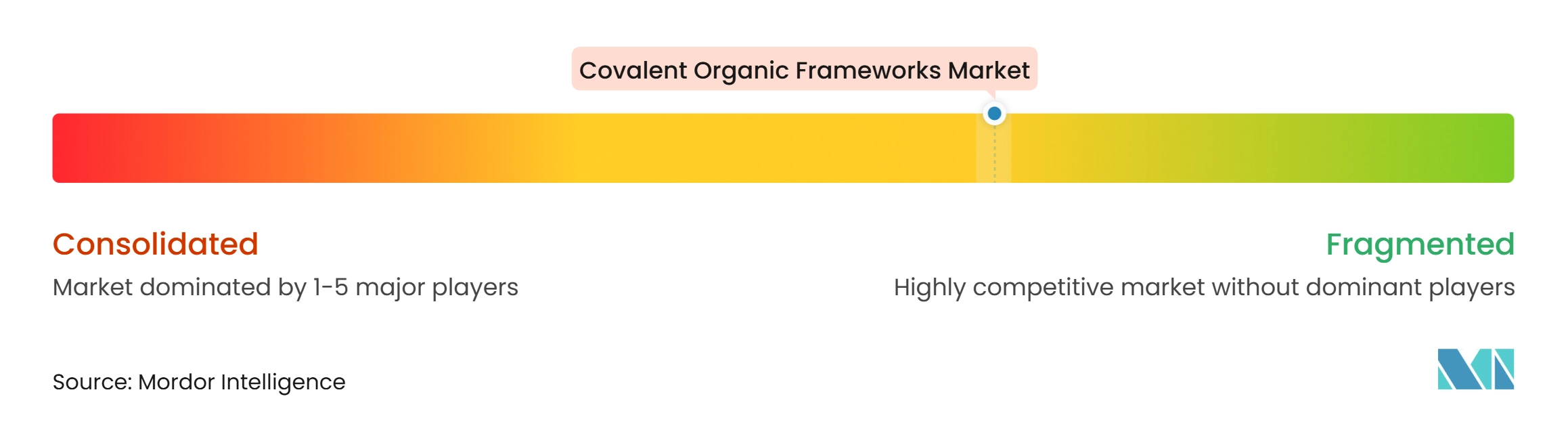
The Covalent Organic Frameworks market is moderately fragmented, with no single producer holding more than a mid-single-digit share of global revenue. Competitors include dedicated COF producers such as YOCOF Material, Lumtec, and xfnano, as well as diversified specialty chemical companies such as BASF, Evonik Industries, Merck KGaA, and Arkema. Distributors such as Strem Chemicals and ACS Material serve research and early-commercial customers. Dedicated producers in China and Taiwan benefit from solvent-free and mechanochemical production routes, while European chemical companies compete through application engineering capabilities and established customer relationships in energy, pharmaceutical, and industrial process markets.
In December 2025, BASF confirmed industrial-scale production of porous frameworks. In October 2025, Evonik presented work on COF-stabilized battery anodes at the Technical University of Munich's Evonik Day. YOCOF Material contributed to a 2025 perspective in the Journal of the American Chemical Society on COF industrialization, co-authored with Omar Yaghi's research group, providing a documented roadmap for manufacturing and scale-up. These developments indicate that competition is shifting from research materials toward application engineering and controlled production, and they highlight the growing importance of intellectual property and manufacturing process knowledge.
Underserved areas include COF-based organic light-emitting diode (OLED) intermediates, pharmaceutical-grade nanocarriers with particle-size control below 100 nm, and solid-state battery electrolyte membranes requiring ton-scale supply and consistent crystallinity. Academic-industry development agreements remain an important pathway between published research and process qualification. CATL's COF separator patents indicate that large battery producers may pursue materials development independently of a single supplier. Beijing's national AI + materials program supports the use of large-scale atomic models in new-material design. Activity in chemistry publications and battery-related intellectual property points to competition for proprietary COF formulations. Production scale-up, rather than chemical novelty alone, is becoming a key competitive differentiator.
Covalent Organic Frameworks Industry Leaders
-
ACS Material
-
Lumtec
-
YOCOF MATERIAL (SUZHOU) CO. LTD.
-
xfnano
-
Merck KGaA
- *Disclaimer: Major Players sorted in no particular order
Covalent Organic Frameworks Market Companies Covered in this Report
- ACS Material
- April Scientific Inc.
- Arkema
- BASF
- DuPont
- Evonik Industries AG
- Lumtec
- Merck KGaA
- Mitsubishi Chemical Group Corporation
- Nanografi
- Strem Chemicals, Inc.
- Sumitomo Chemical Co., Ltd.
- Toray Industries, Inc.
- xfnano
- YOCOF MATERIAL (SUZHOU) CO. LTD.
Recent Industry Developments in Covalent Organic Frameworks Market
- February 2026: Japan's National Institute of Advanced Industrial Science and Technology (AIST) published results on directly synthesized ion-conducting covalent organic framework (ICOF) membranes achieving single lithium-ion conductivity of 40 μS/cm² at room temperature. This established a benchmark for organic solid electrolytes targeting solid-state battery applications. The institute also initiated research on proton exchange membranes for high-temperature fuel cells using the same covalent organic framework platform.
- December 2025: BASF confirmed industrial-scale production of covalent organic framework-based metal-organic frameworks for CO₂ capture, coinciding with the Nobel Prize announcement. The company highlighted ongoing pilot projects for air dehumidification and industrial carbon emission reduction, confirming that porous framework materials moved from demonstration to commercial deployment at BASF's Verbund facilities.
Global Covalent Organic Frameworks Market Report Scope
Covalent organic frameworks (COFs) are crystalline, porous polymers composed of organic building blocks connected by strong, directional covalent bonds. These materials are constructed entirely from light elements such as carbon, hydrogen, nitrogen, oxygen, and boron, which are arranged in well-defined, repeating structural units.
The covalent organic frameworks market is segmented by product type, linkage chemistry, application, and geography. By product type, the market is segmented into two-dimensional frameworks and three-dimensional frameworks. By linkage chemistry, the market is segmented into imine-linked COFs, β-ketoenamine-linked COFs, boronate ester-linked COFs, hydrazone-linked COFs, triazine-based COFs, and other linkage chemistries. By application, the market is segmented into gas storage and separation, catalysis and processing, energy storage and conversion, drug delivery and biomedical applications, optoelectronics, and other applications. The report also covers market sizes and forecasts for the covalent organic frameworks across 15 countries in major regions. The market sizes and forecasts are provided in terms of value (USD).
Segmentation Overview
| Two-Dimensional Frameworks |
| Three-Dimensional Frameworks |
| Imine-Linked COFs |
| β-Ketoenamine-Linked COFs |
| Boronate Ester-Linked COFs |
| Hydrazone-Linked COFs |
| Triazine-Based COFs |
| Other Linkage Chemistries |
| Gas Storage and Separation |
| Catalysis and Processing |
| Energy Storage and Conversion |
| Drug Delivery and Biomedical Applications |
| Optoelectronics |
| Other Applications |
| Asia-Pacific | China |
| India | |
| Japan | |
| South Korea | |
| ASEAN Countries | |
| Rest of Asia-Pacific | |
| North America | United States |
| Canada | |
| Mexico | |
| Europe | Germany |
| United Kingdom | |
| France | |
| Italy | |
| NORDIC Countries | |
| Rest of Europe | |
| South America | Brazil |
| Argentina | |
| Rest of South America | |
| Middle East and Africa | Saudi Arabia |
| South Africa | |
| Rest of Middle East and Africa |
| By Product Type | Two-Dimensional Frameworks | |
| Three-Dimensional Frameworks | ||
| By Linkage Chemistry | Imine-Linked COFs | |
| β-Ketoenamine-Linked COFs | ||
| Boronate Ester-Linked COFs | ||
| Hydrazone-Linked COFs | ||
| Triazine-Based COFs | ||
| Other Linkage Chemistries | ||
| By Application | Gas Storage and Separation | |
| Catalysis and Processing | ||
| Energy Storage and Conversion | ||
| Drug Delivery and Biomedical Applications | ||
| Optoelectronics | ||
| Other Applications | ||
| By Geography | Asia-Pacific | China |
| India | ||
| Japan | ||
| South Korea | ||
| ASEAN Countries | ||
| Rest of Asia-Pacific | ||
| North America | United States | |
| Canada | ||
| Mexico | ||
| Europe | Germany | |
| United Kingdom | ||
| France | ||
| Italy | ||
| NORDIC Countries | ||
| Rest of Europe | ||
| South America | Brazil | |
| Argentina | ||
| Rest of South America | ||
| Middle East and Africa | Saudi Arabia | |
| South Africa | ||
| Rest of Middle East and Africa | ||
Key Questions Answered in the Report
What is current market size of Covalent Organic Frameworks Market?
The Covalent Organic Frameworks market size was valued at USD 218.28 million in 2026 and is estimated to grow from USD 278.72 million in 2027 to USD 962.17 million by 2032, at a CAGR of 28.12% during the forecast period (2027-2032).
Which linkage chemistry is growing the fastest?
Β-Ketoenamine-linked COFs are forecast to grow at a 31.34% CAGR through 2032 because they provide stronger moisture and acid resistance.
Why are COFs relevant to battery development?
COF membranes can support ion transport and dendrite suppression, while energy storage and conversion is forecast to grow at a 32.87% CAGR through 2032.
Which region leads demand for covalent organic frameworks?
Asia-Pacific held a 42.45% share in 2026 and is forecast to grow at a 31.63% CAGR through 2032.