
Corporate Communications Services Market Size and Share
Market Overview
| Study Period | 2020 - 2031 |
|---|---|
| Market Size (2026) | USD 82.29 Billion |
| Market Size (2031) | USD 117.57 Billion |
| Growth Rate (2026 - 2031) | 7.40 % |
| Fastest Growing Market | Asia-Pacific |
| Largest Market | North America |
| Market Concentration | Medium |
Major Players *Disclaimer: Major Players sorted in no particular order Image © Mordor Intelligence. Reuse requires attribution under CC BY 4.0. | |
Corporate Communications Services Market Analysis by Mordor Intelligence
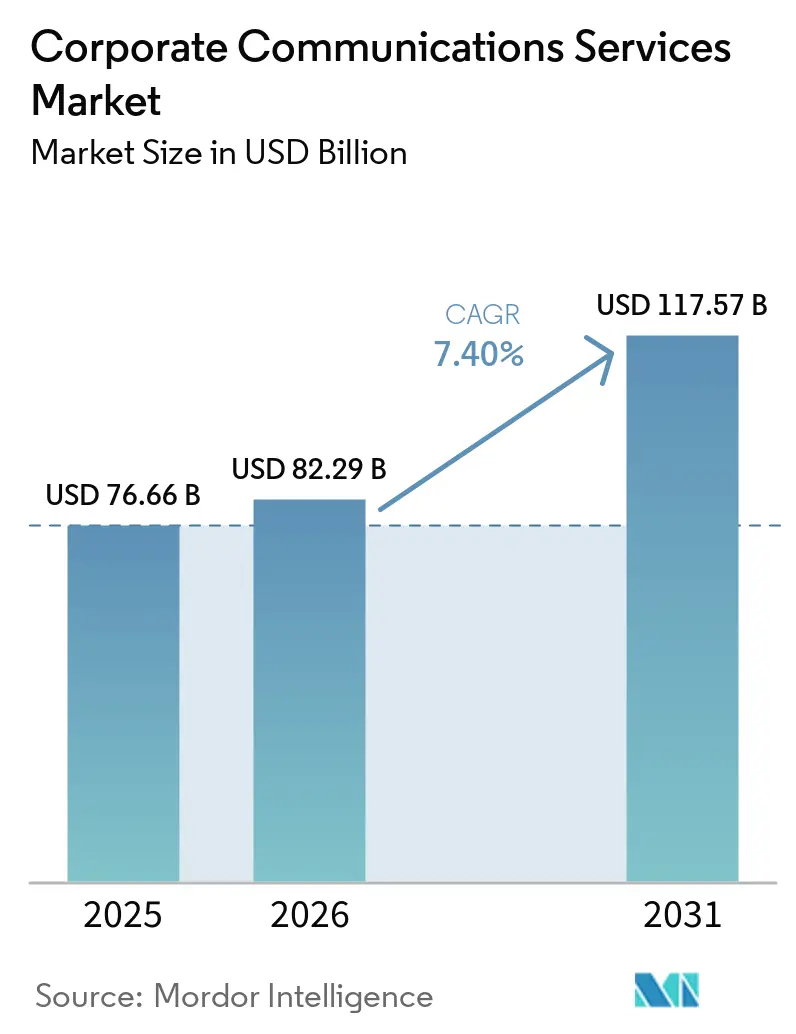
The corporate communications services market size is projected to be USD 76.66 billion in 2025, USD 82.29 billion in 2026, and reach USD 117.57 billion by 2031, growing at a CAGR of 7.40% from 2026 to 2031. The corporate communications services market is moving toward assignments that involve governance, reputation, investor expectations, stakeholder relationships, and the management of complex corporate narratives rather than routine media activity alone. Board oversight is increasing the importance of external counsel that can work with senior executives, legal teams, finance leaders, and operating teams before a material event creates reputational pressure. The corporate communications services market also faces a clear split between scaled global networks that offer broad capabilities and independent firms that offer senior-led advice for sensitive mandates. Technology is changing delivery models, while clients remain focused on evidence that communications spending supports business outcomes, protects long-term reputation, and reaches the stakeholder groups that influence major decisions. These conditions favor providers that can pair specialized judgment with measurable program delivery, credible governance practices, and an understanding of how corporate issues develop across markets and channels.
Key Report Takeaways
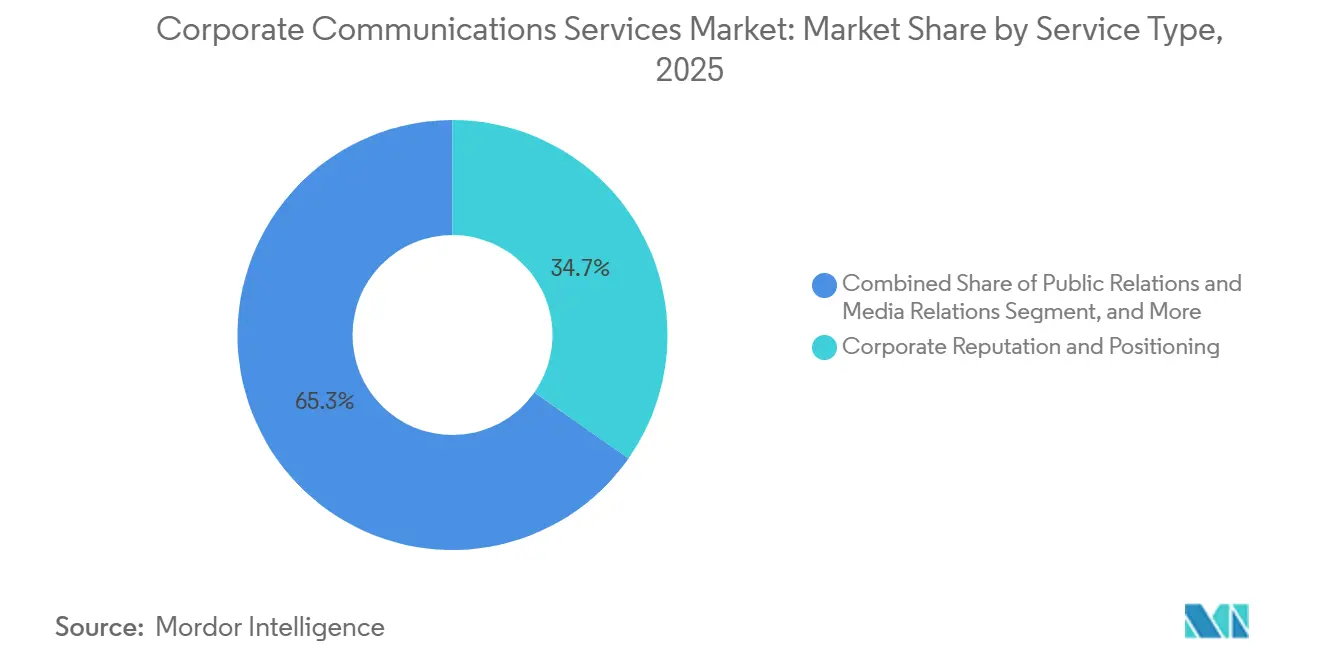
- By service type, Corporate Reputation and Positioning held 34.73% of the corporate communications services market share in 2025, while ESG and Sustainability Communications is projected to expand at a CAGR of 8.32% through 2031.
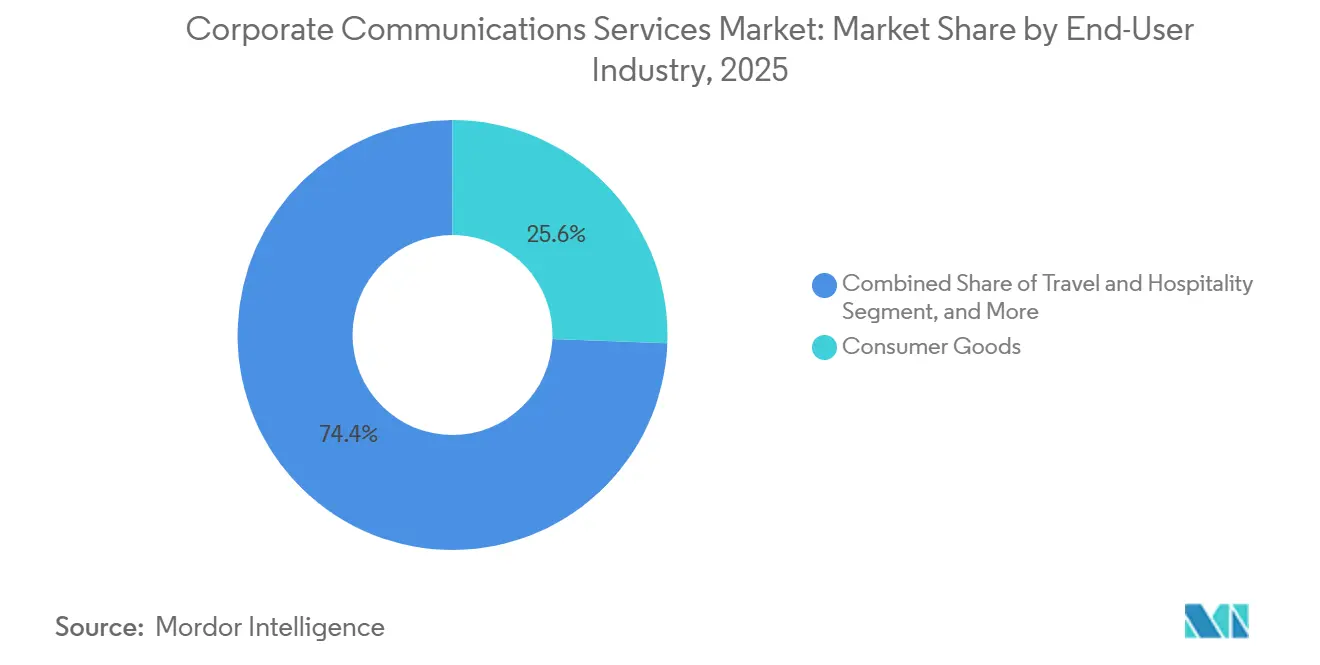
- By end-user industry, Consumer Goods accounted for 25.62% of the corporate communications services market size in 2025, while Healthcare and Life Sciences is projected to expand at a CAGR of 8.42% through 2031.
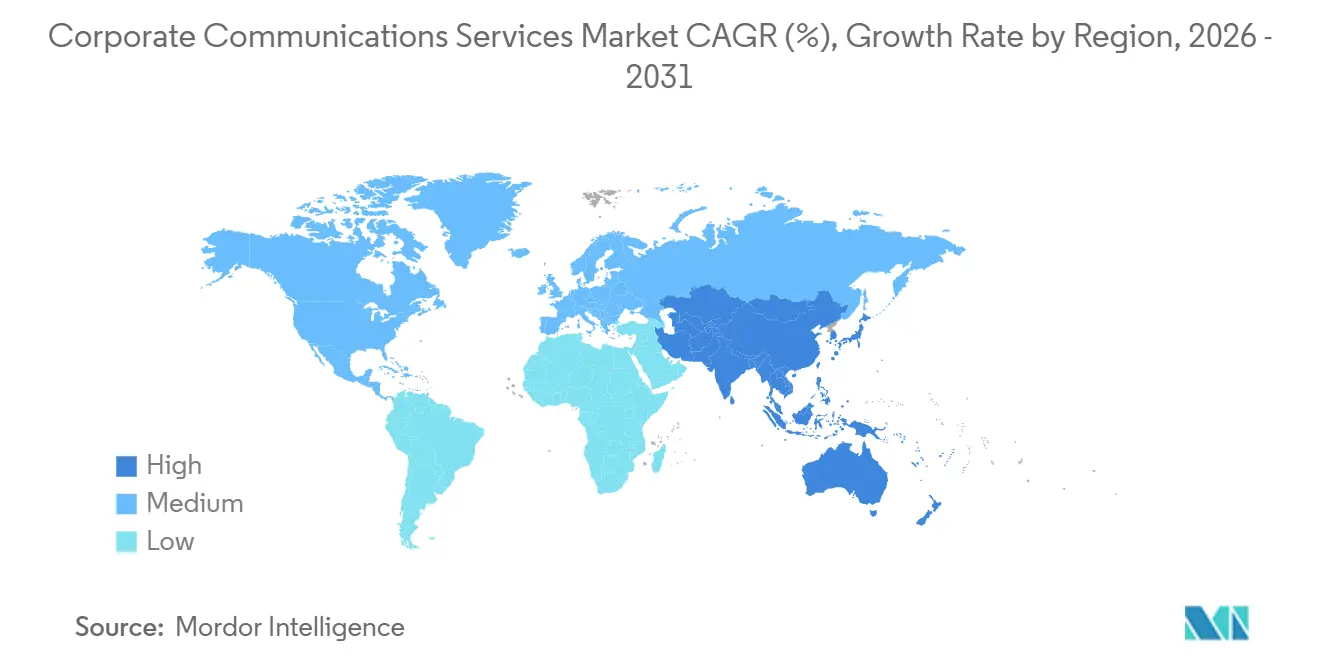
- By geography, North America held 36.93% of revenue in 2025, while Asia-Pacific is projected to expand at a CAGR of 9.03% through 2031.
Note: Market size and forecast figures in this report are generated using Mordor Intelligence’s proprietary estimation framework, updated with the latest available data and insights as of January 2026.
Market Trends and Insights
Drivers Impact Analysis of Corporate Communications Services Market*
| Driver | (~) % Impact on CAGR Forecast | Geographic Relevance | Impact Timeline |
|---|---|---|---|
| Board-Level Reputation and Stakeholder Advisory Demand | +1.4% | Global | Medium term (2-4 years) |
| Hybrid Workforce and Employee Communications Needs | +0.9% | Global, with concentrated gains in North America and Europe | Short term (≤ 2 years) |
| Executive Thought Leadership and Multi-Channel Earned Content | +1.1% | North America and Europe | Medium term (2-4 years) |
| AI-Enabled Analytics and Personalization in Communications Programs | +1.2% | Global, accelerating in North America and Asia-Pacific | Short term (≤ 2 years) |
| Corporate Narrative Optimization for Generative AI Discovery | +0.7% | North America and Western Europe | Short term (≤ 2 years) |
| Retail Investor and Alternative Financial Media Engagement | +0.5% | North America, with spillover to Europe | Medium term (2-4 years) |
| Source: Mordor Intelligence | |||
Rising Board-Level Demand for Reputation and Stakeholder Advisory
Boards are treating corporate reputation as a governance responsibility rather than a function delegated only to communications teams, especially where stakeholder expectations can affect a company’s license to operate. The 2026 IESE survey of 130 companies in 24 countries and 18 industries found that 56% of boards integrated sustainability into their agendas, while 61% embedded it in business models.[1] Goldman Sachs assigned its Public Responsibilities Committee oversight of strategies for reputation, culture, and stakeholder relationships in February 2026, showing how these responsibilities can be formalized through board committee structures.[2] This approach supports advisory work involving governance, stakeholder positioning, reputational risk, disclosure preparation, and communications planning before material corporate events occur. The corporate communications services market benefits when such mandates are approved by finance, legal, and board leaders rather than being treated as only a communications department expense. Firms with experience in governance, stakeholder theory, corporate positioning, and complex reputation matters are better placed to compete for assignments that require trusted senior involvement, careful preparation, credible disclosure support, and practical judgment when stakeholder concerns overlap with legal, financial, operational, or public policy issues.
Expansion of Hybrid Workforce and Employee Communications Needs
Hybrid work has widened the remit of internal communications beyond headquarters-based employee updates, making communication quality more important across dispersed workforces. Organizations need consistent executive messaging, workforce guidance, manager support, and change communications across office, remote, and frontline teams that may use different channels and work patterns. The corporate communications services market, therefore, has opportunities in channel planning, employee content, leadership communication, and communications support during M&A, restructuring, technology adoption, and organizational change. Unified employee experience platforms are also drawing investment because they can connect desk-based and frontline staff through one system. This demand is strongest where large employers must coordinate messages across many locations, functions, languages, and business units while avoiding inconsistent local interpretation. It also creates work for providers that can combine executive communication, employee listening, content personalization, manager guidance, and practical engagement during periods of workforce uncertainty, particularly when organizations need employees to understand new structures, new systems, new leadership priorities, or revised ways of working.
Growth in Executive Thought Leadership and Multi-Channel Earned Content
Executive visibility programs are becoming part of broader corporate reputation planning because senior leaders are increasingly expected to communicate directly with multiple external audiences. Golin’s 2025 CEO Impact Index assessed the top 250 Fortune 500 companies using 8 visibility criteria, including earned media, LinkedIn presence, and sentiment. The work reflects the need to coordinate leadership messages across earned media, professional networks, podcasts, newsletters, investor communications, and sector-specific forums without diluting the organization’s central narrative. Earned media remains important because it supports credibility with investors, employees, customers, partners, and other stakeholders who may not respond to paid or owned channels in the same way. The corporate communications services market can benefit when programs are tied to investor events, quarterly earnings communications, product launches, leadership transitions, and shifts in corporate strategy. Agencies that link executive content to these business moments can consolidate work that was once divided among public relations, digital agencies, investor relations teams, and executive coaching providers, while helping leaders maintain a consistent voice when audiences encounter the company through several media formats.
Increasing Use of AI-Enabled Analytics and Personalization in Communications Programs
AI-enabled tools are changing the way communications teams monitor audiences and tailor messages, particularly when stakeholders receive information through many digital channels. The applications described in the draft include sentiment analysis, predictive crisis modeling, media intelligence, and personalized messages for distinct stakeholder groups with different information needs. These capabilities can extend the reach of a program without a matching increase in execution effort, but they also make clients more demanding about speed, data quality, and demonstrable results. They place greater emphasis on strategic counsel, measurement systems, model explainability, bias mitigation, and responsible human review when communications may affect reputation or investor confidence. The corporate communications services market is likely to reward providers that can explain how technology supports sound judgment rather than replacing accountable senior advice. Clients will continue to compare agency capabilities with the tools and teams they can build internally, increasing pressure on providers to show unique analytical and advisory value, transparent methods, reliable governance standards, and a clear connection between communications activity, stakeholder response, and management decisions.
Restraints Impact Analysis of Corporate Communications Services Market*
| Restraint | (~) % Impact on CAGR Forecast | Geographic Relevance | Impact Timeline |
|---|---|---|---|
| In-House Content Studios and Communications Team Insourcing | -1.2% | North America and Europe | Medium term (2-4 years) |
| Budget Scrutiny and Return-on-Investment Measurement Pressure | -0.9% | Global | Short term (≤ 2 years) |
| CEO AI Literacy Gap in High-Stakes Communications | -0.4% | Global | Short term (≤ 2 years) |
| Greenhushing and Legal Caution Limiting External Narratives | -0.5% | Europe and North America | Medium term (2-4 years) |
| Source: Mordor Intelligence | |||
In-House Content Studios and Communications Teams Insourcing Agency Spend
The transfer of communications work to internal teams remains a material constraint on external agency revenue because companies can retain greater control over sensitive narratives and institutional knowledge. The USC Annenberg 2024 Global Communication Report found that 64% of corporate communications activities were conducted in-house.[3] Internal teams can use digital tools to handle routine content at scale and can coordinate more directly with leadership, legal, human resources, and operating teams. This places the greatest pressure on content production, earned media execution, social media management, graphics, translation, and other recurring activities that can be standardized. The corporate communications services market retains a stronger role in crisis response, shareholder activism, IPO communications, cross-border reputation matters, and situations where clients need an external perspective or specialized networks. Providers must show a clear advantage in senior judgment, specialist knowledge, speed, confidentiality, and the ability to work effectively in complex situations to sustain retainer relationships, especially when an organization lacks internal experience with an unusual transaction, contested issue, sudden crisis, or cross-border stakeholder challenge.
Budget Scrutiny and Return-on-Investment Measurement Pressure
Finance teams are examining discretionary communications spending more closely when its business value is difficult to demonstrate through measures that leaders consider credible. The constraint is especially relevant for providers serving midmarket and business-to-business clients with limited attribution infrastructure, fragmented data, or few established links between communications activity and commercial results. Communications teams need stronger links between stakeholder activity, reputation measures, investor sentiment, and business outcomes that decision-makers can understand and assess. This requirement is encouraging interest in measurement frameworks, closed-loop reporting systems, and approaches that connect communications work with revenue operations and investor relations information. The corporate communications services market will remain exposed where providers cannot distinguish strategic value from production activity or explain why specialist counsel cannot be delivered internally. Firms that connect communications data with investor relations and revenue systems can be better positioned in procurement reviews, particularly when budgets are being consolidated across suppliers and when decision-makers require clearer evidence before they renew a specialist advisory or program delivery engagement.
*Our forecasts treat driver/restraint impacts as directional, not additive. The impact forecasts reflect baseline growth, mix effects, and variable interactions.
Corporate Communications Services Market Segment Analysis
By Service Type:
Corporate Reputation Remains the Largest Service While ESG Communications ExpandsCorporate Reputation and Positioning held 34.73% of service type revenue in 2025, reflecting the priority boards' place on controlling narratives and managing reputational risk. The service covers high-value mandates such as M&A advisory, activist investor defense, and IPO narrative management, where senior executives need advice that aligns business, legal, and stakeholder considerations. These assignments require close coordination with legal and financial advisers because messages can influence investor confidence, regulatory attention, and public scrutiny. Public Relations and Media Relations remain an important adjacent service, although automation is reducing the value of routine media monitoring, automated pitching, and other execution-led activities. Investor Relations and Financial Communications is also gaining complexity as companies communicate with institutional, retail, and passive investors through different channels while maintaining consistent disclosures.
ESG and Sustainability Communications is projected to expand at a CAGR of 8.32% from 2026 to 2031, the fastest rate among the listed service types. Regulatory disclosure requirements are expanding globally, while some companies are becoming more cautious about voluntary public sustainability claims. This difference creates demand for structured communications work that explains required disclosures to employees, investors, customers, and other stakeholders. Executive Positioning and Thought Leadership is gaining importance as leadership teams seek a stronger presence around investor days, earnings communications, and corporate change. Crisis and Issues Management, Content Development and Distribution, and Internal and Change Communications support the broader stakeholder lifecycle during digital disruption, hybrid work, AI adoption, and post-merger integration.

By End-User Industry:
Consumer Goods Provides the Broadest Demand Base While Healthcare and Life Sciences Grows FastestConsumer Goods accounted for 25.62% of the corporate communications services market size by end-user industry in 2025, making it the largest current demand base. Large consumer goods companies require brand reputation management, product issue response, regulatory affairs communications, internal communications across supply chains, and investor engagement for publicly listed multinational groups. Their broad brand portfolios and geographic reach require coordination across countries, product categories, and stakeholder groups, sustaining demand at both strategic and execution levels. Retail and E-commerce businesses face a related set of needs because they must manage reputation narratives for consumers, employees, and investors at the same time. Travel and Hospitality companies are also investing in crisis readiness, as operational disruption can quickly create wider stakeholder management challenges.
Healthcare and Life Sciences are projected to expand at a CAGR of 8.42% from 2026 to 2031, supported by the communications demands associated with complex biologics, cell and gene therapies, and AI-enabled diagnostics. These products require scientific-to-commercial communications that can engage healthcare professionals, patients, regulators, and institutional investors at the same time. Other verticals include BFSI, education, automotive, and IT and telecom, with BFSI supporting high-value investor relations, regulatory communications, and crisis advisory work. Larger medical communications groups are consolidating, but specialized providers can still serve targeted clinical, regulatory, and commercial requirements.
Geography Analysis
North America Corporate Communications Services Market
North America held 36.93% of the corporate communications services market share in 2025, making it the largest regional market. The region’s position reflects established corporate governance practices, complex M&A activity, and a developed investor relations environment that supports premium advisory assignments. The United States concentrates many of these assignments, particularly in financial communications, transaction support, shareholder engagement, and high-stakes reputation matters involving public companies. Its dense network of corporate headquarters, advisers, capital markets participants, and specialist communications firms supports a deep market for sophisticated counsel. Canada contributes through resource-sector governance requirements and cross-border transactions, while Mexico is developing demand linked to nearshoring and manufacturing relocation. In-house teams in North America are also taking more content and media relations work, which narrows the most attractive external mandates to areas that require an independent perspective, senior relationships, and rapid response. This pattern puts pressure on mid-tier execution work while supporting demand for specialist firms that can advise boards, general counsels, and finance leaders.
APAC Corporate Communications Services Market
Asia-Pacific is projected to expand at a CAGR of 9.03% from 2026 to 2031, the fastest pace among the geographic areas identified. Multinational companies and regional champions are building stakeholder engagement capabilities across diverse regulatory systems, capital markets, media environments, and national business cultures. India is developing demand for investor relations and reputation programs as listed companies and private equity-backed technology businesses formalize communications activity and respond to evolving disclosure expectations. China requires government relations and reputation risk management in policy-sensitive sectors, where local understanding and careful engagement remain important. Japan needs crisis communications advice related to ongoing governance reforms, while South Korea supports executive communications programs for chaebol transformation narratives. Australia supports ESG communications linked to climate disclosure milestones, adding another regulatory dimension to advisory mandates. Real Chemistry acquired Spurwing Communications in Singapore in July 2026 to establish its first Asia-Pacific strategic hub, highlighting demand for regional market access, medical communications, and strategic corporate communications.
EMEA Corporate Communications Services Market
Europe was the second-largest geographic area in the corporate communications services market in 2025, with the United Kingdom serving as a major center for financial communications and Germany anchoring ESG-related stakeholder engagement. London, Frankfurt, and Paris remain important locations for high-value transaction, investor, public affairs, and reputation mandates that require cross-border coordination. France, Italy, Spain, and the rest of Europe contribute demand as companies respond to more complex regulatory frameworks and diverse stakeholder expectations. This environment gives corporate communications advisers a role in explaining regulated disclosures, managing reputation, and coordinating messages across national markets. The Middle East is developing advisory needs connected with sovereign wealth fund portfolios, Vision 2030 corporate transformations, and cross-border M&A that may require bilingual strategic communications. Africa remains an earlier-stage opportunity, led by South Africa, Egypt, and Nigeria as capital market depth expands and multinational companies formalize local stakeholder engagement. Across these markets, firms that understand local policy conditions and can connect regional communications with a global corporate narrative have a clearer opportunity to win mandates.
Competitive Landscape
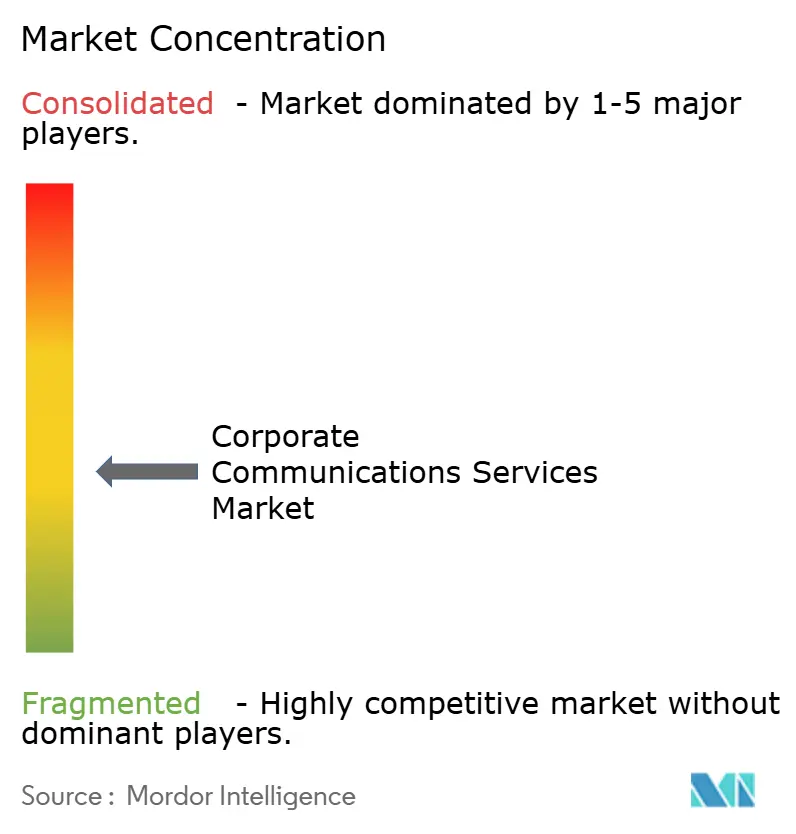
The corporate communications services market is moderately fragmented, with holding-company networks, senior-led advisers, and specialist boutiques serving different client needs. Omnicom’s acquisition of IPG brought Weber Shandwick, FleishmanHillard, Golin, and Ketchum under common ownership, reducing the number of full-service global PR networks. The transaction encouraged talent movement toward independent firms that compete for Fortune 500 corporate communications retainers and high-stakes board assignments. FGS Global became a standalone consultancy after KKR completed its acquisition of WPP’s full equity position in December 2024. The company then announced a governance structure with employee ownership in February 2025, supporting long-term expansion while maintaining a senior advisory model. The competitive field, therefore, includes organizations with an international scale, independent advisers built around senior expertise, and boutiques that compete on sector knowledge or regional access, leaving the corporate communications services market without a single model that suits every client mandate.
Capability acquisitions are a recurring competitive approach in the corporate communications services market because firms want to add specialist services quickly rather than building every capability internally. FGS Global acquired Edmonds Elder in August 2025, adding digital-first integrated communications and campaigning capabilities for complex stakeholder situations. Real Chemistry acquired Spurwing Communications in Singapore in July 2026, extending its market access, medical communications, and media capabilities across Southeast Asia. Real Chemistry also combined Spring and Bond, Greater Than One, and its legacy media practice in June 2026 to form Real Chemistry Media. These moves show an emphasis on healthcare communications, data, media, international reach, and integrated delivery for clients that need several related services, while also signaling how the corporate communications services market is using acquisitions to fill capability gaps and enter priority regions. They also create opportunities for smaller firms that can provide focused expertise without the cost structure or breadth of a major global network.
Technology is becoming a stronger source of differentiation in the corporate communications services market, particularly where clients expect analytics and measurement to guide program decisions. Leading firms are investing in tools that monitor stakeholder data, support closed-loop measurement, and adapt corporate narratives for generative AI discovery across digital information channels. These capabilities are more defensible when they are combined with senior counsel, responsible human review, and a credible approach to return-on-investment attribution. The central competitive question is whether a provider can combine technology-enabled delivery with advice that clients cannot readily reproduce through internal tools or teams. No firm has established a dominant position in reputation advisory for mid-cap industrial companies or emerging-market governance mandates. This leaves room for regional advisers and focused specialists, while larger independent firms continue to compete for board-level assignments in financial services, energy, technology, and other complex sectors, keeping the corporate communications services market open to differentiated providers with credible expertise.
Corporate Communications Services Industry Leaders
-
Daniel J. Edelman, Inc.
-
Inizio Evoke Limited
-
Real Chemistry, LLC
-
APCO Worldwide LLC
-
FINN Partners, Inc.
- *Disclaimer: Major Players sorted in no particular order
Corporate Communications Services Market Companies Covered in this Report
- Daniel J. Edelman, Inc.
- Real Chemistry, LLC
- APCO Worldwide LLC
- FINN Partners, Inc.
- Ruder Finn, Inc.
- Brunswick Group Partnership Limited
- FGS Global (UK) Limited
- Teneo Holdings LLC
- FTI Consulting, Inc.
- ICR, LLC
- Prosek Partners, LLC
- Weber Shandwick
- FleishmanHillard Inc.
- Ketchum Inc.
- Burson Cohn & Wolfe, Inc.
- Golin, Inc.
- MSL Group, Inc.
- Allison+Partners, Inc.
- Grayling Limited
- Clarity Global Group Limited
- Dix & Eaton, Inc.
- Inizio Evoke Limited
- LLYC (Llorente y Cuenca)
- H/Advisors
Recent Industry Developments in Corporate Communications Services Market
- July 2026: Real Chemistry acquired Spurwing Communications in Singapore, establishing its first Asia-Pacific strategic hub. The transaction positions the AI-driven healthcare communications firm to deliver integrated market access, medical communications, and media capabilities across Southeast Asia, with Spurwing's founder Emma Thompson joining as President, Asia-Pacific Growth, part of a broader international expansion plan targeting China, Japan, and Europe.
- June 2026: Real Chemistry launched Real Chemistry Media, integrating Spring and Bond, Greater Than One, and its legacy media practice into a single omnichannel unit comprising 450 media experts and 150 data and analytics professionals, with a proprietary orchestration platform for real-time personalization and closed-loop measurement.
- June 2026: CMI Media Group and Compas announced a strategic expansion adding medical affairs, consultancy, and data and technology business units to their existing healthcare DTC and healthcare professional media capabilities, broadening the integrated services spectrum available to life sciences clients.
- August 2026: FGS Global acquired Edmonds Elder, a London-based digital-first integrated communications and campaigning firm, as part of its accelerated 5-year growth plan. The acquisition deepened FGS's insight-led integrated campaigning capabilities for CEOs and executives navigating complex stakeholder situations.
Global Corporate Communications Services Market Report Scope
The Corporate Communications Services Market refers to the ecosystem of agencies, consultancies, and service providers that help organizations manage internal and external communication. It includes media relations, investor communications, crisis communication, employee engagement, executive messaging, and stakeholder outreach.
The Corporate Communications Services Market Report is Segmented by Service Type (Corporate Reputation, PR, Executive Positioning, Investor Relations, Internal Communications, Crisis Management, ESG Communications, and Content Development), End-User Industry (Retail, Media, Healthcare, Travel, and Consumer Goods), and Geography (North America, South America, Europe, Asia-Pacific, Middle East, and Africa). The Market Forecasts are Provided in Terms of Value (USD).
Segmentation Overview
| Corporate Reputation and Positioning |
| Public Relations and Media Relations |
| Executive Positioning and Thought Leadership |
| Investor Relations and Financial Communications |
| Internal and Change Communications |
| Crisis and Issues Management |
| ESG and Sustainability Communications |
| Content Development and Distribution |
| Retail and E-commerce |
| Media and Entertainment |
| Healthcare and Life Sciences |
| Travel and Hospitality |
| Consumer Goods |
| Other Industry Verticals (BFSI, Education, Automotive, IT and Telecom) |
| North America | United States |
| Canada | |
| Mexico | |
| South America | Brazil |
| Argentina | |
| Chile | |
| Rest of South America | |
| Europe | Germany |
| United Kingdom | |
| France | |
| Italy | |
| Spain | |
| Rest of Europe | |
| Asia-Pacific | China |
| Japan | |
| India | |
| South Korea | |
| Australia | |
| Rest of Asia-Pacific | |
| Middle East | Saudi Arabia |
| United Arab Emirates | |
| Qatar | |
| Rest of Middle East | |
| Africa | South Africa |
| Egypt | |
| Nigeria | |
| Rest of Africa |
| By Service Type | Corporate Reputation and Positioning | |
| Public Relations and Media Relations | ||
| Executive Positioning and Thought Leadership | ||
| Investor Relations and Financial Communications | ||
| Internal and Change Communications | ||
| Crisis and Issues Management | ||
| ESG and Sustainability Communications | ||
| Content Development and Distribution | ||
| By End-User Industry | Retail and E-commerce | |
| Media and Entertainment | ||
| Healthcare and Life Sciences | ||
| Travel and Hospitality | ||
| Consumer Goods | ||
| Other Industry Verticals (BFSI, Education, Automotive, IT and Telecom) | ||
| By Geography | North America | United States |
| Canada | ||
| Mexico | ||
| South America | Brazil | |
| Argentina | ||
| Chile | ||
| Rest of South America | ||
| Europe | Germany | |
| United Kingdom | ||
| France | ||
| Italy | ||
| Spain | ||
| Rest of Europe | ||
| Asia-Pacific | China | |
| Japan | ||
| India | ||
| South Korea | ||
| Australia | ||
| Rest of Asia-Pacific | ||
| Middle East | Saudi Arabia | |
| United Arab Emirates | ||
| Qatar | ||
| Rest of Middle East | ||
| Africa | South Africa | |
| Egypt | ||
| Nigeria | ||
| Rest of Africa | ||
Key Questions Answered in the Report
What is the size of the corporate communications services market?
The corporate communications services market was USD 82.29 billion in 2026 and is projected to reach USD 117.57 billion by 2031 at a 7.40% CAGR. Demand is shifting toward governance, reputation, stakeholder engagement, and other assignments where senior specialist counsel is important, reflecting a move from routine execution toward work that can influence board decisions, investor confidence, and long-term corporate credibility.
Which service type leads corporate communications services?
Corporate Reputation and Positioning led service types with 34.73% share in 2025. The position reflects demand for advice on M&A communications, activist investor defense, IPO narratives, board-level reputation matters, and corporate messaging that must remain aligned across legal, finance, and management teams, especially when companies face heightened public scrutiny, significant strategic change, or overlapping stakeholder demands.
Which end-user sector is growing fastest for communications services?
Healthcare and Life Sciences is projected to expand at a CAGR of 8.42% through 2031. Complex therapeutics, diagnostics, and commercialization needs require communications that can address patients, healthcare professionals, regulators, and investors while translating scientific information into accessible, accurate messages that remain consistent with clinical evidence, regulatory requirements, patient needs, and commercial objectives across different stages of the product lifecycle.
Which region is growing fastest for corporate communications services?
Asia-Pacific is projected to expand at a CAGR of 9.03% from 2026 to 2031. Companies are increasing stakeholder engagement capabilities across diverse regulatory systems, capital markets, media environments, national business conditions, and corporate governance expectations in individual countries, which can require companies to adjust engagement approaches without losing the central narrative used by global leadership teams.
Why are companies using external corporate communications advisers?
External advisers are most relevant for sensitive matters such as crisis response, shareholder activism, IPO communications, cross-border reputation programs, and other assignments where independent perspective, senior judgment, specialist networks, or temporary additional capacity are needed, particularly when internal teams are focused on day-to-day operations and cannot easily provide an outside view during a sensitive development.
What is limiting agency demand in corporate communications?
In-house teams are taking a larger share of routine work, while finance leaders seek clearer evidence of communications value before approving spend. This makes measurement, integrated reporting, differentiated advisory capabilities, and clear accountability for outcomes increasingly important for external providers, as clients seek a clear distinction between high-value counsel and activities that can be standardized, automated, or handled by internal teams.