
Conversion Coatings Market Size and Share
Market Overview
| Study Period | 2021 - 2031 |
|---|---|
| Market Size (2026) | USD 4.38 Billion |
| Market Size (2031) | USD 5.62 Billion |
| Growth Rate (2026 - 2031) | 5.08 % |
| Fastest Growing Market | Asia-Pacific |
| Largest Market | Asia-Pacific |
| Market Concentration | Medium |
Major Players *Disclaimer: Major Players sorted in no particular order Image © Mordor Intelligence. Reuse requires attribution under CC BY 4.0. | |
Conversion Coatings Market Analysis by Mordor Intelligence
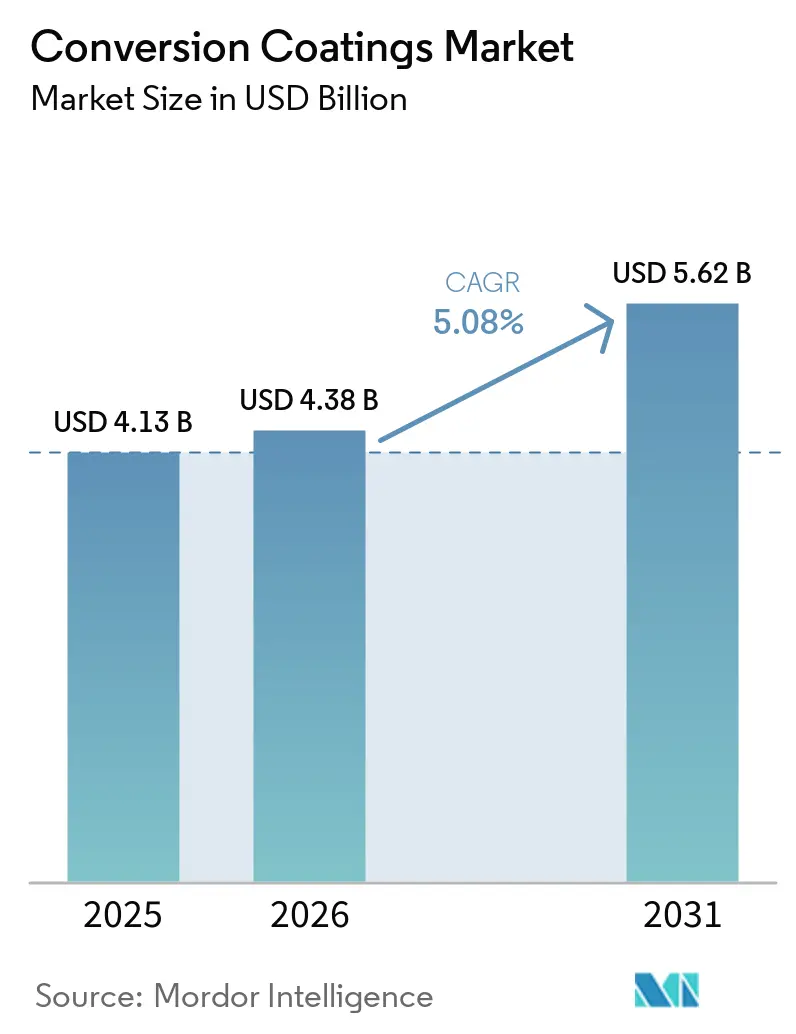
The conversion coatings market size was estimated at USD 4.13 billion in 2025 and was estimated to grow from USD 4.38 billion in 2026 to USD 5.62 billion by 2031, at a CAGR of 5.08% during the forecast period (2026-2031). The conversion coatings market is being shaped by the shift toward aluminum-intensive and mixed-metal electric vehicle platforms, which require pretreatment systems that work across different substrates. Regulatory action on hexavalent chromium is moving specifications toward chromate-free alternatives in automotive, aerospace, packaging, and general industrial applications. These two forces are connected, as aluminum components require effective chromate-free pretreatment before coating and painting. Large suppliers are expanding their portfolios and technical capabilities, while smaller specialists remain competitive where customers require flexible formulations and local support. Wastewater treatment costs and feedstock volatility remain key operational considerations, although improved bath monitoring can reduce chemical use and support line upgrades.
Key Report Takeaways
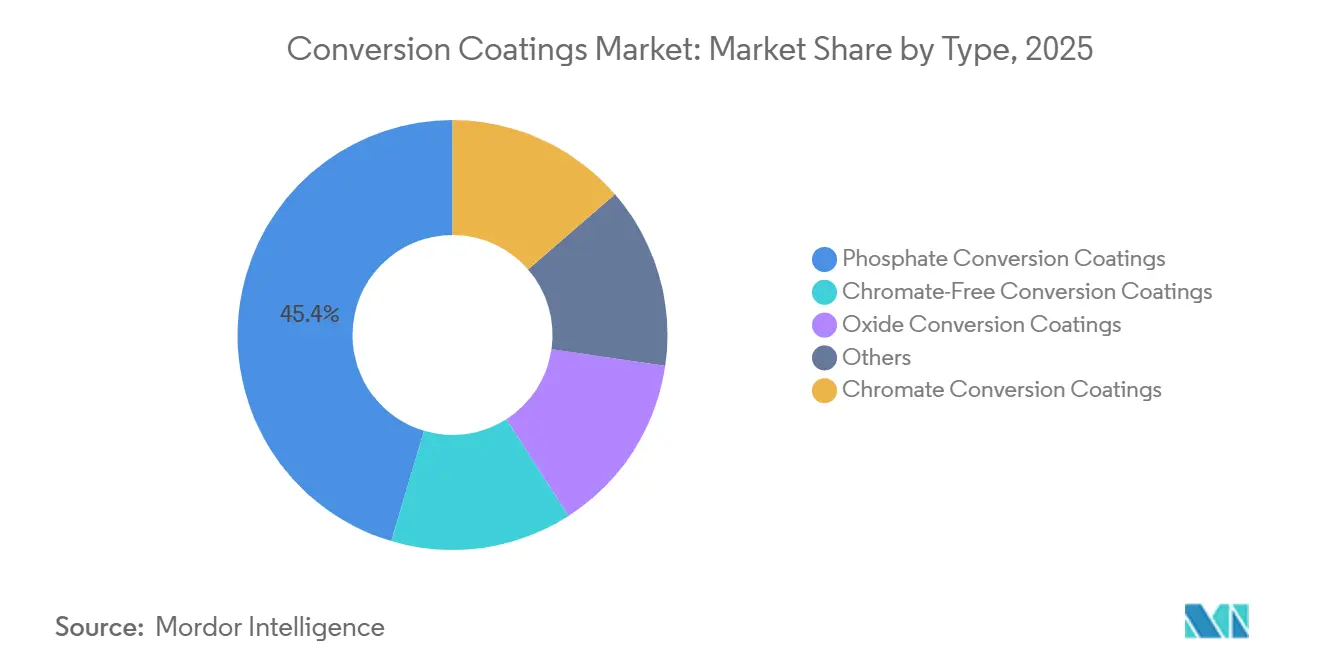
- By type, phosphate conversion coatings held 45.41% of the conversion coatings market share in 2025, while chromate-free conversion coatings are forecast to grow at a 6.12% CAGR through 2031.
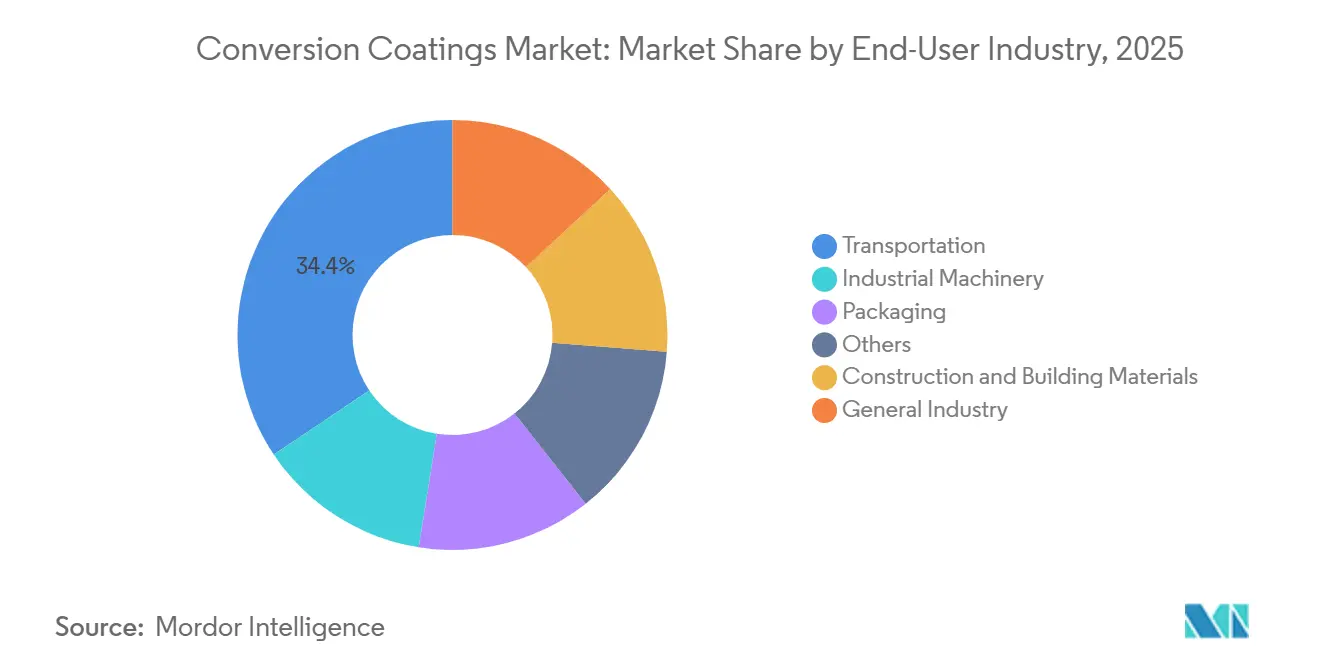
- By end-user industry, transportation accounted for 34.37% of the conversion coatings market share in 2025 and is projected to expand at a 6.35% CAGR through 2031.
- By geography, Asia-Pacific held 38.63% of revenue in 2025 and is forecast to grow at a 6.09% CAGR through 2031.
Note: Market size and forecast figures in this report are generated using Mordor Intelligence’s proprietary estimation framework, updated with the latest available data and insights as of January 2026.
Market Trends and Insights
Drivers Impact Analysis of Conversion Coatings Market*
| Drivers | (~) % Impact on CAGR Forecast | Geographic Relevance | Impact Timeline |
|---|---|---|---|
| Automotive and EV Mixed-Metal Corrosion Protection | +1.4% | Asia-Pacific core, with spillover to North America and Europe | Medium term (2-4 years) |
| Chromate-Free Compliance-Driven Substitution | +1.2% | Europe, North America, South Korea, and Japan, with global supply-chain effects | Short term (≤ 2 years) |
| Aerospace and Defense Durability Requirements | +0.8% | North America and Europe, with growing demand in Singapore and Japan | Long term (≥ 4 years) |
| Infrastructure and Industrial Asset-Life Extension | +0.7% | Asia-Pacific, the Middle East and Africa, and South America, with secondary gains in North America | Medium term (2-4 years) |
| Inline Bath Analytics and Automated Replenishment | +0.5% | Global, with early adoption in Europe and North America | Short term (≤ 2 years) |
| Source: Mordor Intelligence | |||
Automotive and EV Mixed-Metal Corrosion Protection
Electric vehicle platforms use more aluminum in battery housings, structural inserts, and front-end crash modules than conventional vehicles. This substrate shift requires OEMs and Tier 1 suppliers to qualify chemistries that can treat ferrous and aluminum materials in a single bath without compromising corrosion resistance. Thin-film systems have been adopted more widely in body lines than in component-level applications such as battery housings, motor mounts, and bracket assemblies. The remaining component-level work creates a near-term qualification opportunity for chemistry suppliers and makes technical validation a central part of winning new automotive business in the conversion coatings market.
South Korean stamping plants face a more compressed conversion schedule because regulations require a shift toward zirconium- and titanium-oxide pretreatment chemistries, making the timing of system changes less dependent on gradual commercial substitution. Mixed-metal vehicle architecture also increases the cost of inadequate pretreatment, as corrosion performance must be maintained across multiple alloy types. Suppliers with established automotive specifications can use this requirement to extend relationships across vehicle parts and regional production sites. Platform changes by vehicle manufacturers support the conversion coatings market, but also require careful process validation for every new substrate mix.
Chromate-Free Compliance-Driven Substitution
The European Union REACH framework identifies hexavalent chromium compounds as Substances of Very High Concern. The Aerospace and Defense Chromates Re-Authorization Consortium received authorizations in October 2024 and January 2025 that allow specified continued use until December 20, 2034, while downstream-user compliance deadlines began as early as October 2025[1]. This framework is shortening qualification timelines for alternatives that reduce regulatory exposure. Chromate-free chemistry can win a new specification when it meets the required performance threshold and removes the liability associated with hexavalent chromium, making compliance a direct purchasing factor in the conversion coatings market.
Zirconium-based coatings are widely used as substitutes in automotive and general industrial applications. Research published in 2026 found that zirconium coatings on galvanized steel can provide corrosion resistance comparable to trivalent chromium systems when process parameters are carefully controlled. The same study reported a higher zirconium film thickness when the bath was stirred during deposition, underscoring the importance of process control in commercial use. Demand for certified chromate-free systems is also increasing in packaging and consumer electronics, where food-contact and RoHS-related requirements influence pretreatment choices.
Aerospace and Defense Durability Requirements
Aerospace conversion coatings must meet military, aviation, and OEM-specific corrosion and adhesion requirements before use on flying hardware. Qualification cycles can take 12 to 24 months per program, making chemistry changes difficult to manage. The transition away from hexavalent chromium requires aerospace suppliers to requalify systems across commercial and defense programs in the European Economic Area. Liebherr-Aerospace completed industrialization of a REACH-compliant trivalent chromium system and post-application conversion sealer process at its Singapore service center in January 2026. The company stated that the process provides corrosion resistance and paint adhesion equivalent to legacy hexavalent formulations on aircraft heat-transfer components.
Scientific research has also examined fluorozirconate-, molybdate-, and cerate-based post-treatments as alternatives to chromate sealing in aerospace applications. These alternatives require comprehensive durability and corrosion testing before adoption in accordance with aviation and OEM standards. The continuing need for qualified replacement systems supports a service and maintenance opportunity in the conversion coatings market. Fleet operators must also update service manuals as newly authorized chemistries become available, making demand for aerospace MRO more dependent on qualification progress than on short-term changes in coating prices.
Infrastructure and Industrial Asset-Life Extension
Infrastructure operators in Asia, the Middle East, and South America are extending the useful life of steel assets through durable coating systems rather than full replacement. Conversion coatings are important in these systems because they promote topcoat adhesion on metal substrates. A 2025 study of steel bridge maintenance found that coating system selection affects life-cycle costs over a 75-year bridge life and that durable, low-VOC coating systems can reduce the social costs associated with maintenance closures. This supports demand for reliable pretreatment in corrosive environments and extends the conversion coatings market beyond automotive cycles.
India's infrastructure pipeline and Saudi Arabia's Vision 2030 construction activity support demand for pretreatment chemistry in regions with limited capacity for specialty formulation. Galvanized steel transmission tower components can use phosphate- and zirconium-based pretreatments to improve topcoat adhesion and extend the service life of the galvanized layer. Grid modernization programs, therefore, create an additional application for conversion coating systems. Relevant demand spans structural steel, industrial equipment, renewable energy installations, and transportation infrastructure, broadening the role of the conversion coatings market while retaining automotive as its primary demand anchor.
Restraints Impact Analysis of Conversion Coatings Market*
| Restraints | (~) % Impact on CAGR Forecast | Geographic Relevance | Impact Timeline |
|---|---|---|---|
| Hazardous-Waste, Sludge, and Wastewater Compliance Costs | -0.6% | Global, with the highest burden in North America and Europe | Short term (≤ 2 years) |
| Formulation and Line Requalification Cost | -0.4% | Global, with the sharpest effect in Europe and North America | Medium term (2-4 years) |
| Mixed-Metal Process-Window Sensitivity | -0.3% | Asia-Pacific and Europe, where multi-substrate EV platforms are prevalent | Medium term (2-4 years) |
| Source: Mordor Intelligence | |||
Hazardous-Waste, Sludge, and Wastewater Compliance Costs
Phosphate conversion lines generate sludge as a process byproduct, and aluminum chemical conversion coating can generate F019 hazardous waste under the U.S. Resource Conservation and Recovery Act. This regulatory classification creates permitting, reporting, and disposal requirements for affected facilities. Wastewater obligations also require investment in pH adjustment, coagulation, clarification, and sludge-dewatering systems. These obligations place greater cost pressure on mid-scale fabricators that cannot spread treatment costs over large output levels. As a result, the conversion coatings market has different cost structures for large OEM-aligned operators and smaller job-shop facilities.
U.S. metal-finishing requirements under 40 Code of Federal Regulations (CFR) Part 433 add another compliance consideration for operations that discharge wastewater. European facilities also operate under surface-treatment requirements that affect wastewater and sludge management. Large operators can amortize treatment infrastructure over higher output levels, while smaller facilities may need service partnerships to manage the burden. This gap can increase interest in low-sludge zirconium thin-film systems. In this way, compliance costs can also reinforce demand for chromate-free technologies in the conversion coatings market.
Formulation and Line Requalification Cost
A revised substrate mix can require a conversion coating supplier to reformulate and requalify its chemistry against the customer's full corrosion and adhesion test suite. New aluminum alloys, zinc-magnesium-coated steels, and high-strength steels can each affect process performance. A January 2026 study found that the iron phosphate-to-iron oxide ratio in cured films varies with the substrate surface composition[2]. These findings show why process parameters cannot be transferred without adjustment across substrate grades, and such requirements lengthen the acceptance cycle for new chemistries in automotive programs.
Automotive qualification can involve salt-spray, cross-hatch adhesion, and filiform corrosion testing before a production release. Research on trivalent chromium process coatings also found that structure and corrosion resistance can differ across common aluminum alloy systems, requiring application-specific tuning. Suppliers may need to operate legacy and next-generation systems in parallel during transition periods, which limits the capital available for additional research and development, particularly for mid-tier suppliers. The conversion coatings market, therefore, favors companies with technical support, testing capacity, and the financial resources to maintain qualified systems during customer transitions.
*Our forecasts treat driver/restraint impacts as directional, not additive. The impact forecasts reflect baseline growth, mix effects, and variable interactions.
Conversion Coatings Market Segment Analysis
By Type:
Phosphate Leads by Revenue Share, Chromate-Free Chemistries Record Fastest GrowthPhosphate conversion coatings accounted for 45.41% of global revenue in 2025, giving them the largest share of the conversion coatings market by type. Long-standing OEM qualifications support their use in automotive body-in-white, general fabrication, and industrial machinery pretreatment. Zinc phosphate holds the largest share of phosphate demand in automotive and general industrial applications. Manganese phosphate serves a narrower wear-resistance role in gearboxes, engines, and heavy-equipment components. A study of industrial zinc phosphating found that phosphoric-acid pickling and nitrate acceleration can produce lower, more stable crystal morphology, thereby supporting consistent output on high-throughput pretreatment lines.
Oxide conversion coatings serve electronics and precision engineering applications. Their demand is linked to semiconductor packaging and is less directly affected by automotive regulatory changes. Established phosphate systems remain competitive because operators understand their process windows and have qualified them over many years. They also remain relevant where corrosion protection, coating adhesion, and operating familiarity take priority over a full change in chemistry. These characteristics preserve phosphate demand even as thin-film alternatives expand. The conversion coatings industry continues to use phosphate systems across high-throughput industrial applications.
Chromate-free conversion coatings are forecast to expand at a 6.12% CAGR between 2026 and 2031, the highest rate among type segments. Zirconium fluoride and titanium-zirconium systems are replacing legacy chromate and trivalent chromium intermediates at new automotive pretreatment installations, particularly in Europe and South Korea. Chromate coatings retain a role in aerospace and defense under authorizations that apply through December 2034 for specified uses. Military programs can retain hexavalent formulations on legacy platforms where specifications permit. The Others category includes emerging nanoceramic and bismuth-based formulations.
The regulatory requirements for chromate and chromate-free systems differ, making qualification timing an important competitive factor. New specifications increasingly favor solutions that meet performance requirements while reducing regulatory burden. Suppliers need evidence from corrosion, adhesion, and production-line tests to win these programs, making technical service as important as basic chemistry supply. The conversion coatings market is moving toward a more application-specific product mix rather than a single universal coating route.

By End-User Industry:
Transportation Leads on Both Share and Growth VelocityTransportation held 34.37% of end-user revenue in 2025 and is forecast to grow at a 6.35% CAGR through 2031, making it the largest and fastest-growing end-user segment in the conversion coatings market. Electric vehicles increase the need to qualify pretreatment for battery-module housings, structural components, and mixed-metal assemblies. Passenger automobiles remain important, while commercial vehicles and rail equipment provide additional demand. Asian production of buses, metros, and freight rolling stock also supports regional transportation demand. The need for corrosion protection and coating adhesion remains central across these applications.
Transportation growth is not limited to vehicle body lines. Battery housings, motor mounts, brackets, and other components require separate process qualification, which increases the number of application points available to suppliers. This supports demand for systems that process aluminum and ferrous materials in a single bath. OEMs also value chemistry suppliers that can assist with testing and implementation at the component level. The shift gives established suppliers an opportunity to deepen existing specification relationships, while giving focused specialists a path to win business in applications where an OEM requires a tailored solution.
Construction and building materials are the second-largest end-user segment. Demand is supported by coil-coating pretreatment on galvanized steel cladding and structural profiles used in residential and commercial construction. Henkel introduced Color TOC for metal coil surfaces in December 2025, offering gold, green, red, blue, and brown variants on a corrosion-protection platform. The launch demonstrates that pretreatment chemistry can support both functional and aesthetic requirements in building materials, making the construction application more specification-driven than a basic commodity treatment step. It also gives suppliers an avenue to differentiate through surface appearance as well as performance.
General industry and industrial machinery follow broader manufacturing activity and are more exposed to cyclical changes in output. Manganese phosphate retains a clear use case in gears and bearings due to its wear-resistance properties. Packaging is the smallest named end-user segment by revenue, but it can support higher-value business for suppliers with relevant food-contact certifications. Food-contact requirements affect metal packaging applications that use tinplate and aluminum substrates. Certified chromate-free pretreatments are therefore important for these applications, creating a specialized opportunity in the conversion coatings industry for suppliers capable of meeting the required certification standards.
Geography Analysis
APAC Conversion Coatings Market
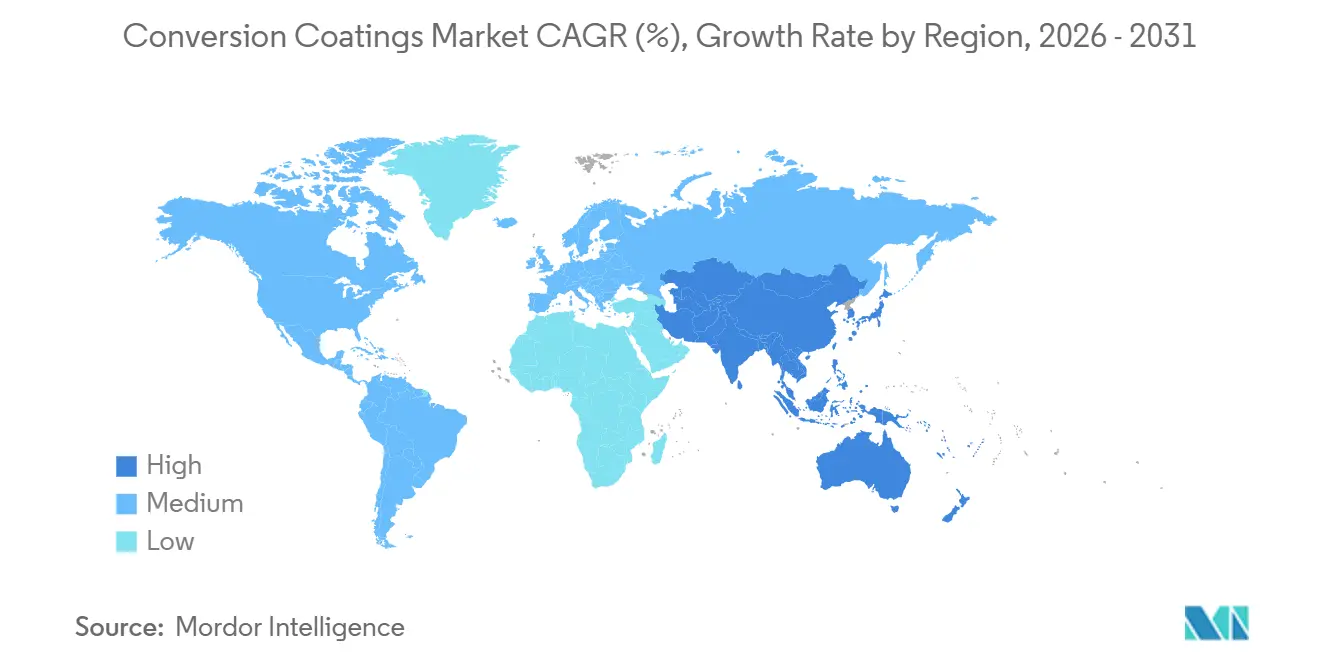
Asia-Pacific held 38.63% of global revenue in 2025 and is forecast to expand at a 6.09% CAGR through 2031, the fastest regional growth rate in the conversion coatings market. China's Yangtze River Delta and Pearl River Delta manufacturing clusters support regional demand by concentrating automotive production and pretreatment lines. Chinese heavy-metal standards for pretreatment baths are encouraging reformulation within the domestic phosphate coating supply chain, supporting greater use of zirconium fluoride and nanoceramic systems among auto-body suppliers. Japan adds high-value demand through established OEM specification relationships. Research on iron phosphate coatings published in January 2026 indicated continuing work on phosphate performance for aluminum-intensive substrates.
India and South Korea Conversion Coatings Market
India is the region's fastest-growing submarket, as automotive assembly additions and infrastructure programs are increasing demand. South Korea represents a near-term transition point for chromate-free chemistry, where stamping operations must convert systems in line with a regulatory schedule, making specification choices more time-sensitive than a standard commercial replacement cycle. Suppliers that can support qualification and local technical service hold an advantage in this environment. Asia-Pacific combines the broadest manufacturing base with the strongest forecast growth in the conversion coatings market, making regional regulatory developments relevant to global formulation strategies.
North America and Europe Conversion Coatings Market
North America and Europe are the second and third regional tiers by revenue. Germany supports European demand through its automotive OEM network and newer EV assembly operations, which are specifying chromate-free thin-film zirconium-silane systems that operate at room temperature and can reduce energy use and sludge compared with zinc phosphate. In North America, the United States is the main demand center, supported by aerospace and defense maintenance activity and chemical conversion coating requirements for aluminum components. Canada and Mexico contribute through their integration with U.S. automotive supply chains.
The Americas and MEA Conversion Coatings Market
North American regulatory compliance under the Resource Conservation and Recovery Act (RCRA) and discharge permits favors large integrated operators that can manage treatment infrastructure. Competition in the region also centers on lower-sludge chemistry and digital formulation capabilities. South America and the Middle East and Africa are import-dependent areas of the conversion coatings market. Brazil leads South American demand through automotive assembly activity in São Paulo and Minas Gerais, while Argentina retains baseline phosphate demand from infrastructure needs. Saudi Arabia's industrial city, renewable energy, and port projects support structural-steel pretreatment demand. South Africa serves as an automotive-component supply hub for Middle East and Africa markets, where limited local formulation capacity gives globally qualified suppliers an advantage.
Competitive Landscape
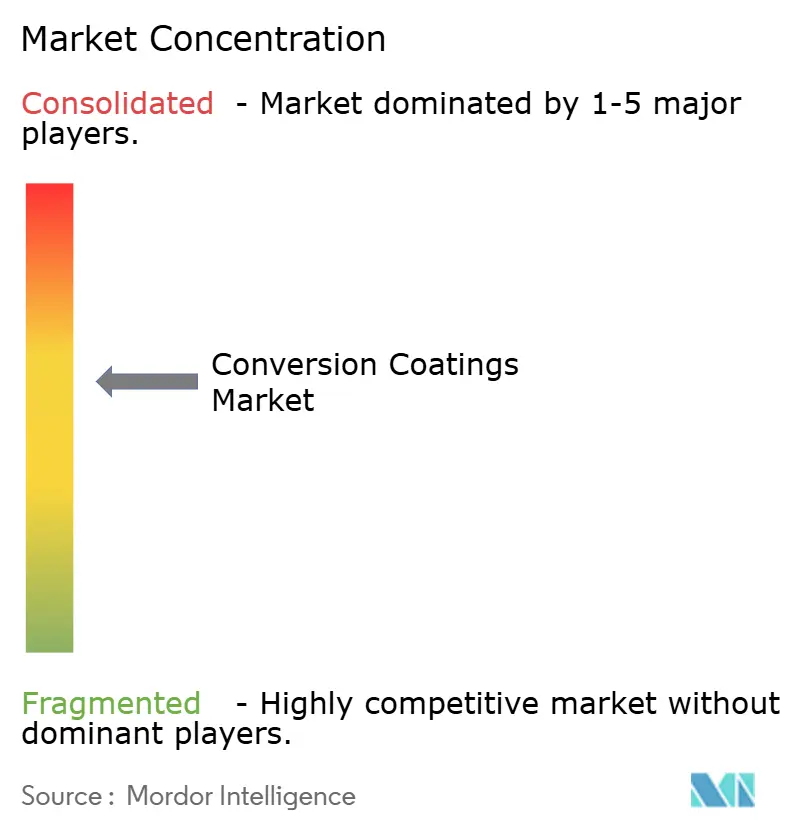
The conversion coatings market is moderately consolidated. Henkel AG, PPG Industries, Nihon Parkerizing, BASF through Chemetall, Quaker Houghton, and Element Solutions hold original equipment manufacturer (OEM) specification positions across multiple geographies and substrate types. SurTec International, DuBois Chemicals, Hubbard-Hall, and Troy Chemical Industries compete through formulation flexibility, technical service, and regional pricing. This structure supports both global providers and focused regional suppliers. Customers select suppliers based on technical qualification, compliance support, production reliability, and local service. No single supplier holds dominant control over the market.
In February 2026, Henkel agreed to acquire Stahl Group for EUR 2.1 billion (~USD 2.43 billion), expanding its Adhesive Technologies business into specialty coatings for flexible materials across automotive, fashion, and packaging applications. Henkel also introduced Cleaner and Coater technology, which combines cleaning and coating in a single step for general-industry metal finishers. Its Bonderite M-CR 1405 technology combines metal passivation and pretreatment in one step for coil processing. These developments reflect a broader trend among large suppliers toward process simplification and meeting sustainability requirements.
PPG launched its Knowledge Navigator formulation platform in 2025 to support the development of coating chemistries, including products for electric vehicle applications and low-volatile organic compound (VOC) coatings. Digital formulation, green chemistry, and chromate-free performance are becoming more important competitive factors. Large acquisitions can also prompt OEM customers to review their supply base and seek alternatives to single-source exposure, giving technically differentiated mid-tier suppliers an opportunity to pursue long-term specifications. The strongest opportunities remain in mixed-metal electric vehicle (EV) systems, certified food-contact solutions, and qualified aerospace chemistries. The market will continue to favor suppliers that combine chemistry performance with reliable qualification support.
Conversion Coatings Industry Leaders
-
Henkel AG & Co. KGaA
-
PPG Industries, Inc.
-
BASF
-
Quaker Houghton
-
Nihon Parkerizing Co., Ltd.
- *Disclaimer: Major Players sorted in no particular order
Conversion Coatings Market Companies Covered in this Report
- 3M
- Axalta Coating Systems, LLC
- BASF
- DuBois Chemicals
- Element Solutions Inc.
- Henkel AG & Co. KGaA
- Hubbard-Hall Inc.
- MKS Instruments, Inc.
- Nihon Parkerizing Co., Ltd.
- Nippon Paint Holdings Co., Ltd.
- PPG Industries, Inc.
- Quaker Houghton
- SurTec International GmbH
- The Sherwin-Williams Company
- Troy Chemical Industries
Recent Industry Developments in Conversion Coatings Market
- February 2026: Henkel AG & Co. KGaA signed a definitive agreement to acquire Dutch-based Stahl Group for EUR 2.1 billion (~USD 2.43 billion). The acquisition expands its Adhesive Technologies business into specialty coatings for flexible materials across the automotive, fashion, and packaging markets.
- December 2025: Henkel introduced Color TOC (Thin Organic Coating) for metal coil surfaces targeting the construction sector. The product is available in gold, green, red, blue, and brown variants, all built on the same corrosion-protection functional platform.
Global Conversion Coatings Market Report Scope
A conversion coating is a coating layer formed on a metallic surface by immersing it in a chemical solution, which may involve an electric current. The coating becomes an integral part of the substrate surface through a chemical reaction, with no distinct mechanical interface between the coating and the underlying material.
The conversion coatings market is segmented by type, end-user industry, and geography. By type, the market is segmented into phosphate conversion coatings, chromate conversion coatings, chromate-free conversion coatings, oxide conversion coatings, and others. By end-user industry, the market is segmented into transportation, construction and building materials, general industry, industrial machinery, packaging, and others. The report also covers market size and forecasts for conversion coatings across 15 countries in major regions. The market sizes and forecasts are provided in terms of value (USD).
Segmentation Overview
| Phosphate Conversion Coatings |
| Chromate Conversion Coatings |
| Chromate-Free Conversion Coatings |
| Oxide Conversion Coatings |
| Others |
| Transportation |
| Construction and Building Materials |
| General Industry |
| Industrial Machinery |
| Packaging |
| Others |
| Asia-Pacific | China |
| India | |
| Japan | |
| South Korea | |
| Rest of Asia-Pacific | |
| North America | United States |
| Canada | |
| Mexico | |
| Europe | Germany |
| United Kingdom | |
| France | |
| Italy | |
| Rest of Europe | |
| South America | Brazil |
| Argentina | |
| Rest of South America | |
| Middle East and Africa | Saudi Arabia |
| South Africa | |
| Rest of Middle East and Africa |
| By Type | Phosphate Conversion Coatings | |
| Chromate Conversion Coatings | ||
| Chromate-Free Conversion Coatings | ||
| Oxide Conversion Coatings | ||
| Others | ||
| By End-User Industry | Transportation | |
| Construction and Building Materials | ||
| General Industry | ||
| Industrial Machinery | ||
| Packaging | ||
| Others | ||
| By Geography | Asia-Pacific | China |
| India | ||
| Japan | ||
| South Korea | ||
| Rest of Asia-Pacific | ||
| North America | United States | |
| Canada | ||
| Mexico | ||
| Europe | Germany | |
| United Kingdom | ||
| France | ||
| Italy | ||
| Rest of Europe | ||
| South America | Brazil | |
| Argentina | ||
| Rest of South America | ||
| Middle East and Africa | Saudi Arabia | |
| South Africa | ||
| Rest of Middle East and Africa | ||
Key Questions Answered in the Report
What is current market size of Conversion Coatings Market?
The conversion coatings market size was estimated at USD 4.13 billion in 2025 and was estimated to grow from USD 4.38 billion in 2026 to USD 5.62 billion by 2031, at a CAGR of 5.08% during the forecast period (2026-2031).
Which conversion coating type has the largest revenue share?
Phosphate conversion coatings held 45.41% of global revenue in 2025, supported by established qualifications in automotive and industrial applications.
Which type is growing fastest?
Chromate-free conversion coatings are forecast to grow at a 6.12% CAGR through 2031 as regulations and qualification programs favor alternatives to hexavalent chromium.
Why are electric vehicles important for conversion coatings?
Electric vehicle platforms require pretreatment across aluminum and ferrous substrates, including battery housings, structural components, and mixed-metal assemblies.