
Construction Repair Composites Market Size and Share
Market Overview
| Study Period | 2021 - 2031 |
|---|---|
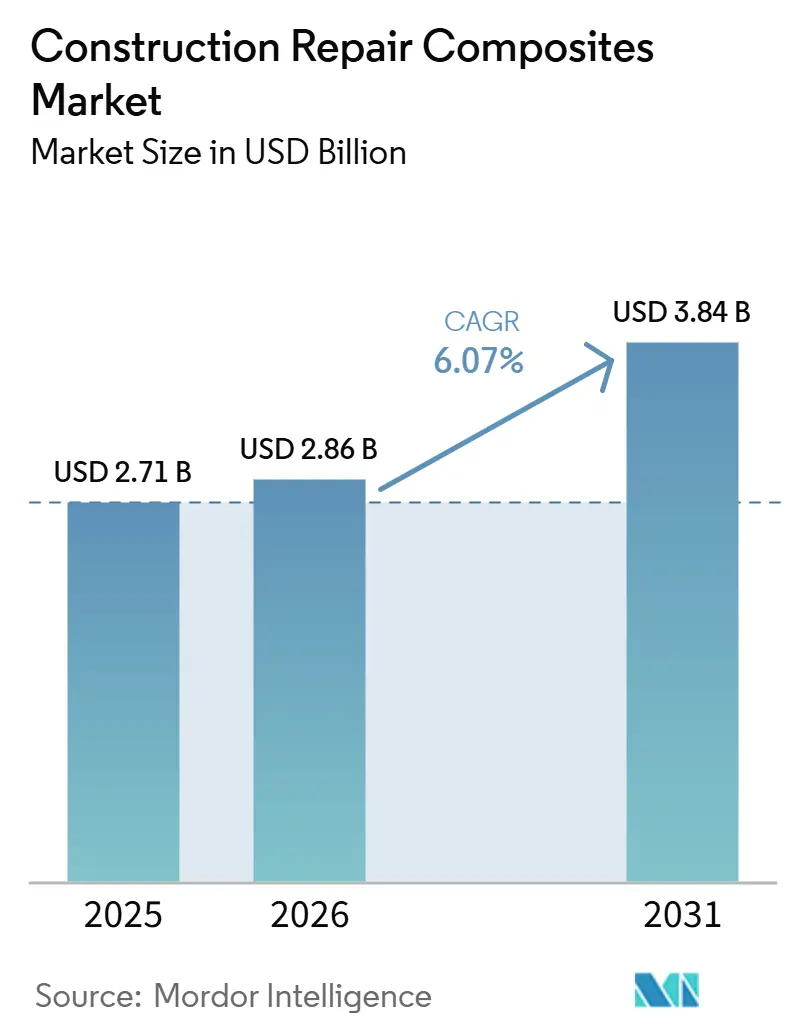
| Market Size (2026) | USD 2.86 Billion |
| Market Size (2031) | USD 3.84 Billion |
| Growth Rate (2026 - 2031) | 6.07 % |
| Fastest Growing Market | Asia-Pacific |
| Largest Market | Asia-Pacific |
| Market Concentration | Medium |
Major Players *Disclaimer: Major Players sorted in no particular order Image © Mordor Intelligence. Reuse requires attribution under CC BY 4.0. | |
Construction Repair Composites Market Analysis by Mordor Intelligence
The Construction Repair Composites Market size was valued at USD 2.71 billion in 2025 and is estimated to grow from USD 2.86 billion in 2026 to reach USD 3.84 billion by 2031, at a CAGR of 6.07% during the forecast period (2026-2031). Aging bridges, tunnels, coastal assets, and buildings are driving demand for repair methods that extend service life without full replacement. The United States bridge network received a C grade in 2025, with 49.1% of its more than 623,000 bridges rated in fair condition and more than 221,000 requiring repair or replacement. Fiber-reinforced polymer systems offer corrosion resistance, low weight, and shorter installation periods, making them practical in applications where closure time is costly. Public funding, design-code development, and climate-resilience spending are broadening the use of these systems in civil infrastructure. Suppliers are responding through certified installer networks, engineered repair packages, low-emission resin systems, and application-specific technical support.
Key Report Takeaways
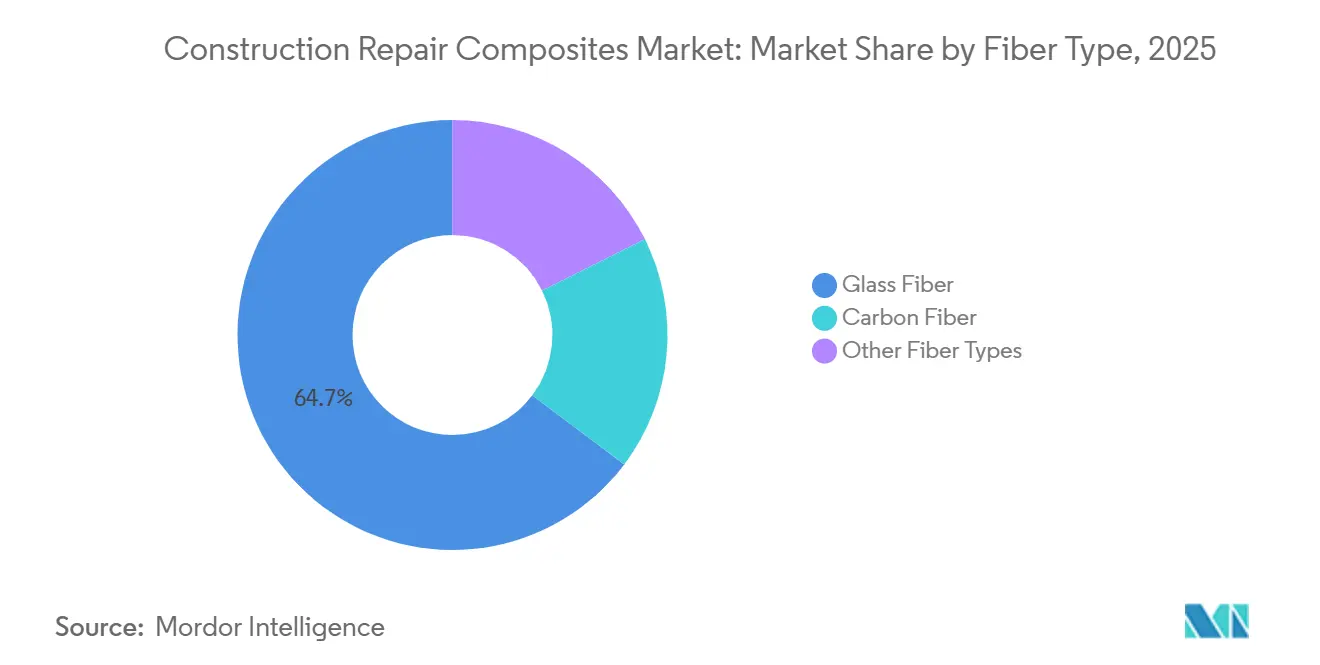
- By fiber type, glass fiber held 64.72% of the construction repair composites market share in 2025, while carbon fiber is forecast to grow at 6.82% CAGR through 2031.
- By resin type, epoxy held 53.14% of the construction repair composites market share in 2025 and is forecast to expand at a 6.57% CAGR through 2031.
- By product type, fabric and textile products accounted for 42.33% of the construction repair composites market size in 2025, while rods and tendons are forecast to grow at a 6.91% CAGR through 2031.
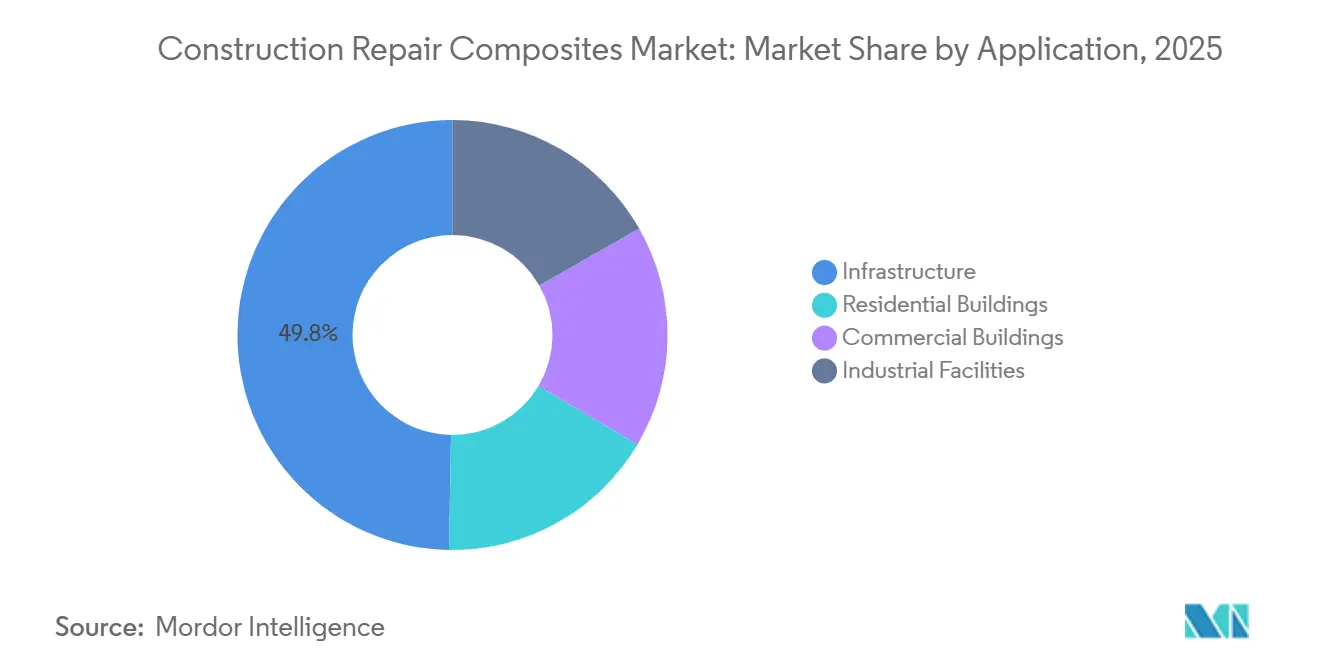
- By application, infrastructure accounted for 49.75% of the construction repair composites market share in 2025 and is forecast to grow at a 6.68% CAGR through 2031.
- By geography, Asia-Pacific held 39.61% of the construction repair composites market in 2025 and is forecast to grow at a 6.84% CAGR through 2031.
Note: Market size and forecast figures in this report are generated using Mordor Intelligence’s proprietary estimation framework, updated with the latest available data and insights as of January 2026.
Global Construction Repair Composites Market Trends and Insights
Drivers Impact Analysis*
| Drivers | (~) % Impact on CAGR Forecast | Geographic Relevance | Impact Timeline |
|---|---|---|---|
| Aging Civil Infrastructure Rehabilitation | +1.8% | Global, concentrated in North America, Europe, and East Asia | Medium term (2-4 years) |
| Corrosion-Resistant Materials in Harsh Environments | +1% | Coastal Asia-Pacific, Middle-East and Africa, and North American maritime corridors | Long term (≥ 4 years) |
| Faster Installation and Lower Downtime | +0.8% | Global, with high commercial relevance in North America and Europe | Short term (≤ 2 years) |
| Digital Structural Health Monitoring for Targeted Repairs | +0.5% | Asia-Pacific, North America, and Europe | Medium term (2-4 years) |
| Infrastructure Resilience Investment After Climate Events | +0.7% | Global, accelerating in South and Southeast Asia, North America, and Europe | Medium term (2-4 years) |
| Source: Mordor Intelligence | |||
Increasing Demand for Rehabilitation and Strengthening of Aging Civil Infrastructure
Aging civil assets are increasing the need for repair approaches that preserve structures rather than replace them. As of 2025, 45% of U.S. bridges had exceeded their planned design lives, and 6.8% were rated in poor condition. The construction repair composites market benefits when externally bonded systems are considered for fair-condition structures that still have usable capacity. The American Road and Transportation Builders Association placed the cost of identified U.S. bridge repairs at USD 467 billion in 2025. Bridge Formula Program allocations and related state reviews can create a pipeline that extends beyond a single budget cycle. India also has a substantial repair need, as more than 30% of its bridges are over 50 years old, providing a broader base for structural strengthening work.
Rising Preference for Corrosion-Resistant Composite Materials in Harsh Service Environments
Corrosion in steel reinforcement remains a central cause of deterioration in bridges, tunnels, marine structures, and industrial concrete assets. Fiber Reinforced Polymer (FRP) systems can avoid this failure mechanism rather than only slowing it, which supports their use in chloride, alkali, and sulfate exposure conditions. Research published in 2025 found that externally bonded FRP reinforcement has strong long-term chemical stability, although premature debonding remains a technical concern. This supports the construction repair composites market in coastal infrastructure, where moisture and salts can shorten the life of conventional reinforcement. Röchling introduced Durostone FRP Rebar for tunnels, harbor structures, and parking garages where corrosive exposure is a material-selection concern[1]Röchling Industrial SE and Co. KG, “Glass Fiber-Reinforced Durostone FRP Rebar Reinforcing Bars for Economic and Sustainable Construction,” Röchling, roechling.com. Longer repair cycles may reduce repeat material demand at an individual site, but they increase the importance of engineering, installation qualification, and long-term asset services.
Faster Installation and Reduced Downtime Compared to Conventional Repair Methods
Installation speed can materially influence repair selection when roads, rail lines, ports, or buildings must remain in service. Lightweight, prefabricated composite elements can reduce lifting requirements and simplify work at constrained sites. This shifts the procurement comparison from material cost alone to the total cost of closure, traffic disruption, and lost operating time. The American Association of State Highway and Transportation Officials (AASHTO) 2025 guide specifications for FRP pedestrian bridges provide a formal design reference for composite bridge applications. American Concrete Institute (ACI) CODE-440.13-24 also provides code requirements for strengthening structural concrete with FRP systems. The construction repair composites market therefore depends on engineers, certification bodies, and procurement teams, as specification decisions determine whether speed benefits are recognized within a project's scope.
Growing Use of Digital Structural Health Monitoring and Inspection Technologies to Support Targeted Repairs
Digital structural health monitoring is changing the timing and location of repair work. A 2026 study described the use of connected monitoring networks, building information modeling, and digital twins to enable real-time data synchronization and life-cycle tracking in civil infrastructure. Fiber-optic sensing can support the identification of localized damage in monitored structures, directing repair crews to a limited area rather than requiring broader planned intervention. This approach may increase the use of smaller, targeted composite patches while reducing wasted material and unnecessary work. It also favors suppliers that can support sensor-compatible materials, engineering data, and project-specific repair design.
Restraints Impact Analysis*
| Restraints | (~) % Impact on CAGR Forecast | Geographic Relevance | Impact Timeline |
|---|---|---|---|
| Limited Design-Code and Specification Standardization | -1% | Global, most acute in the Middle-East, Africa, and parts of the Asia-Pacific | Medium term (2-4 years) |
| Higher Initial Material Costs | -0.8% | South America, the Middle-East and Africa, and South and Southeast Asia | Short term (≤ 2 years) |
| Fire, UV, and Long-Term Durability Limitations | -0.7% | Global, with high relevance for occupied buildings and exposed infrastructure | Long term (≥ 4 years) |
| Source: Mordor Intelligence | |||
Limited Standardization of Design Codes and Engineering Specifications Across Applications
Differences in fiber-reinforced polymer (FRP) codes across jurisdictions can delay project approvals and increase validation costs. ACI CODE-440.13-24 is a key U.S. reference for structural concrete strengthening, while the American Association of State Highway and Transportation Officials (AASHTO) maintains guidance for glass fiber-reinforced polymer (GFRP)-reinforced concrete applications. Adoption is not uniform across U.S. states, and several regions still rely on project-specific approvals. The Federal Highway Administration and the National Institute of Standards and Technology continue to provide technical information on composite design and reliability. This gap is more pronounced outside established bridge applications, including industrial repair and residential seismic retrofits. Harmonization by ACI, AASHTO, ISO, and fib may reduce this constraint over time, but current approval processes continue to limit faster uptake.
Higher Initial Material Costs Compared to Conventional Repair Materials
Fiber-reinforced polymer (FRP) repair systems generally have higher initial material costs than concrete or steel alternatives. This is most challenging for asset owners with limited capacity to assess lifecycle costs or manage longer-term maintenance plans. Carbon fiber is expensive due to energy-intensive production and concentrated supply chains. Cost pressure is more pronounced in South America, sub-Saharan Africa, and parts of Southeast Asia. Glass fiber and vinyl ester systems offer a lower-cost entry point where their performance is sufficient for the exposure condition. The construction repair composites market may grow more slowly in projects that award contracts primarily on the basis of initial purchase price.
*Our forecasts treat driver/restraint impacts as directional, not additive. The impact forecasts reflect baseline growth, mix effects, and variable interactions.
Segment Analysis
By Fiber Type: Glass Fiber Leads While Carbon Fiber Supports High-Performance Repairs
Glass fiber held 64.72% of the construction repair composites market share in 2025, reflecting a cost-to-performance balance that suits concrete wrapping, column jacketing, and standard strengthening projects. Glass Fiber-Reinforced Polymer (GFRP) bars and fabrics are compatible with wet layup, pultrusion, and filament-winding systems familiar to contractor networks. Their low weight simplifies transport and handling at remote or restricted sites, and their nonmagnetic and nonconductive properties support repairs near electrical infrastructure and rail corridors. ACI CODE-440.11-22, referenced in the 2024 International Building Code, provides a code basis for structural concrete reinforced with GFRP bars, strengthening the use of glass fiber in established repair and reinforcement designs.
Carbon fiber is forecast to be the fastest-growing fiber type at a 6.82% CAGR through 2031. Its strength-to-weight performance supports seismic retrofits and high-load bridge repair, where thinner or lighter strengthening systems are required. A 2025 study found that bonded Carbon Fiber-Reinforced Polymer (CFRP) laminates improved the flexural capacity of reinforced concrete beams by 57%-72.5% in the assessed systems, which can justify the higher cost in major structural rehabilitation contracts. Basalt fiber, aramid, and natural-fiber hybrid products remain smaller categories, receiving attention where specifiers seek alternatives with different cost, durability, or embodied-carbon characteristics. Carbon fiber use may also be shaped by future revisions to durability factors for marine and alkaline service conditions.



By Resin Type: Epoxy Combines Current Scale With Continued Growth
Epoxy held 53.14% of the construction repair composites market in 2025 and is forecast to grow at a 6.57% CAGR through 2031. Its use in structural repair is supported by strong adhesion to concrete, low shrinkage during curing, and formulation options suited to different field conditions. Epoxy is used in wet layup systems and in bonded plate or laminate systems, and it is specified where cold-weather curing, elevated-temperature service, or lower volatile organic compound (VOC) levels are required. BASF and Sika introduced Baxxodur EC 151 in March 2025 as an amine curing agent for epoxy resins.
Vinyl ester is the second-ranked resin type and remains important for high-chemical-resistance environments. Industrial facilities exposed to concentrated acids or solvents can benefit from its barrier performance, which is superior to that of standard epoxy systems. Polyester and emerging bio-based matrix systems form a smaller segment but remain relevant where lower-carbon material specifications are developing. Resin selection must match the substrate, exposure condition, installation method, and required cure profile. Upstream epoxy supply is concentrated among large chemical producers, which can affect the price of finished composite repair systems. Suppliers are therefore pursuing hardener innovation and specialized formulations to differentiate their offerings without building large resin-manufacturing operations. Construction chemical standards and VOC requirements are also encouraging the adoption of lower-emission resin systems.
By Product Type: Fabrics and Textiles Lead Current Use, While Rods and Tendons Grow Fastest
Fabric and textile products accounted for 42.33% of the construction repair composites market in 2025. This format is suited to wet layup work on curved columns, irregular beams, and nonplanar wall surfaces. Woven and stitched fabrics can be saturated with epoxy or vinyl ester and applied directly at the repair site, and these systems are widely used for column confinement in seismic retrofit projects. Laminates and plates are the second-largest product type, suited to flexural and shear strengthening of bridge decks, floor slabs, and other flat structural components. Their pultruded form provides dimensional consistency for adhesive-bonded or bolted installation.
Rods and tendons are forecast to be the fastest-growing product type at a 6.91% CAGR through 2031. Their growth is linked to fiber-reinforced polymer (FRP) prestressing in aging concrete structures. Steel prestressing tendons can experience stress corrosion cracking, hydrogen embrittlement, and loss of prestress over time, and FRP tendons address these corrosion-related risks by design. Holcim opened Germany's first prestressed carbon-concrete modular bridge in Oldenburg in July 2025, demonstrating a steel-free carbon-fiber prestressed structure designed for a 100-year service life. Rebars, mesh, and geotechnical systems also support use in marine, tunnel, parking, and subsurface applications where corrosion resistance is required from the design stage.
By Application: Infrastructure Drives Demand While Buildings and Industry Broaden Use
Infrastructure held 49.75% of the construction repair composites market share in 2025 and is forecast to grow at a 6.68% CAGR through 2031. Bridge and highway programs are central to this demand, given their large repair volumes and formal engineering requirements. The American Road and Transportation Builders Association (ARTBA) identified more than 6,000 bridge projects in the active construction and repair pipeline under the Infrastructure Investment and Jobs Act (IIJA) formula funding in 2025. Fiber-Reinforced Polymer (FRP) properties are also relevant to water infrastructure, including dams, sluice gates, flood barriers, and pipelines, which operate in conditions where moisture, salt, and corrosion can affect conventional materials. The infrastructure segment, therefore, combines public funding, operational continuity requirements, and demanding exposure conditions.
Commercial and residential buildings represent smaller applications, but seismic retrofit programs support their use in earthquake-prone locations. Carbon Fiber-Reinforced Polymer (CFRP) column wrapping and shear-wall strengthening are considered in California, Japan, Taiwan, and Turkey, where local requirements address structural safety. Industrial facilities present different exposure conditions, including chemical attack, high-temperature cycling, and heavy loads.
Geography Analysis
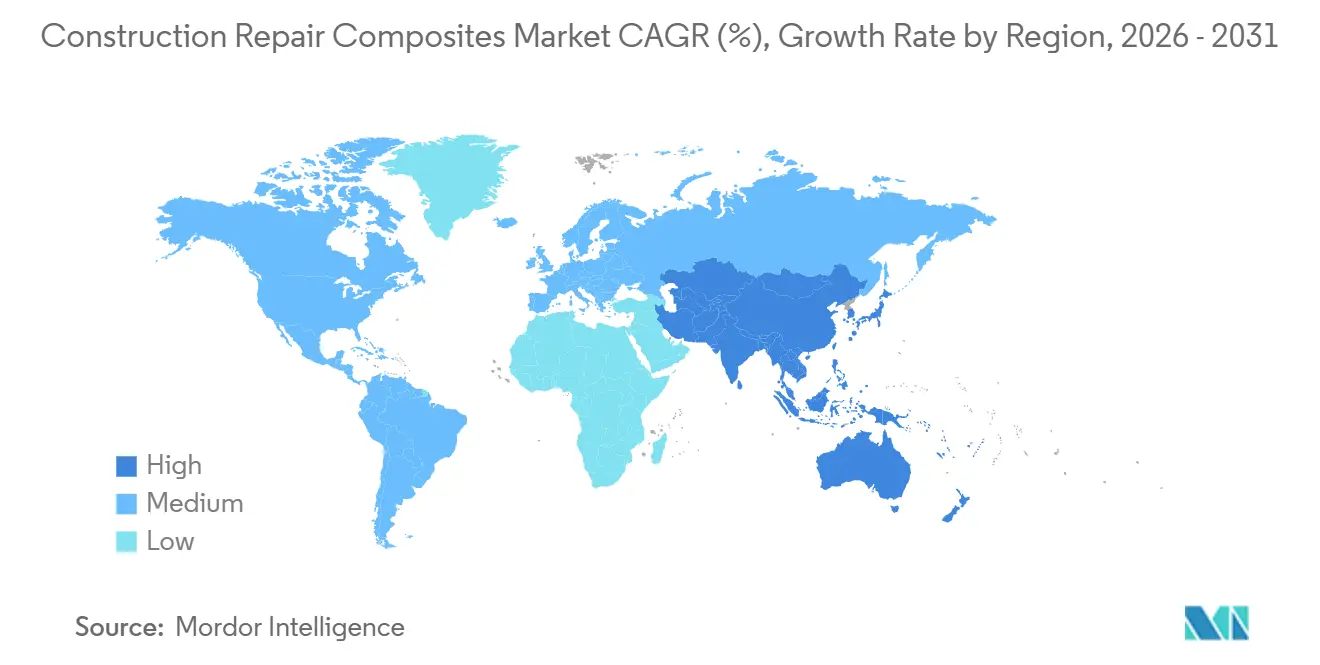
Asia-Pacific held 39.61% of the construction repair composites market in 2025 and is forecast to grow at a 6.84% CAGR through 2031. China is a major source of regional demand, as many highway bridges built between 1960 and 1990 are approaching or exceeding their intended service life. The region also has extensive new construction in coastal and seismic areas where FRP can be specified at the design stage. India's National Infrastructure Pipeline provides a broad framework for transport and infrastructure investment. Japan represents a more advanced model for coastal applications, where long-term exposure conditions have increased attention to corrosion-resistant reinforcement. These factors support continued demand for repair, strengthening, and preventive reinforcement across the region.
North America and Europe rely on bridge repair programs, seismic retrofits, and stricter building and infrastructure requirements. The United States has USD 40 billion in combined Bridge Formula and Bridge Investment Program funding, and states had committed USD 11.7 billion in Bridge Formula funds by mid-2025. The Congressional Research Service reported average annual Bridge Formula Program spending of USD 12 billion for the Infrastructure Investment and Jobs Act (IIJA) period, as of April 2026. These programs support an active pipeline for inspection, design, and repair work. In Europe, the absence of a unified national GFRP code in some applications can delay approvals. However, ongoing work by the European Committee for Standardization (CEN), fib, and ISO may reduce cross-border validation barriers as guidance becomes more aligned.
South America, the Middle-East, Africa, and other smaller geographies are at earlier stages of composite adoption. Brazil's road and water infrastructure needs support a case for targeted resilience investments. The International Finance Corporation identified infrastructure adaptation and resilience as an investment opportunity in 2026[2]International Finance Corporation, “The Adaptation and Resilience Investment Opportunity for Infrastructure,” International Finance Corporation, ifc.org. Gulf Cooperation Council port, hospitality, and coastal development projects face marine exposure conditions that support the use of corrosion-resistant materials. Saudi Arabia's Vision 2030 developments also create potential applications for structural and architectural composites. Africa has longer-term potential, but contractor certification gaps and resin import costs can delay wider adoption. Development bank programs that include resilient infrastructure requirements can help move composites from a premium option to a specified material choice.

Competitive Landscape
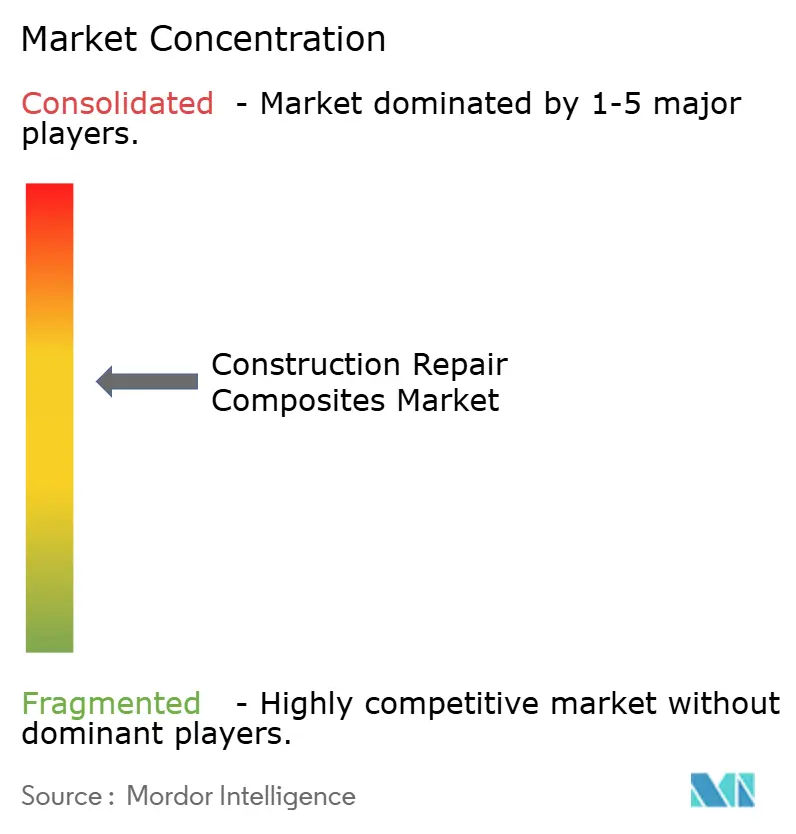
The construction repair composites market is moderately consolidated. Sika AG, BASF SE, and Saint-Gobain compete through resin chemistry, fiber materials, system design, and technical support. Their integrated product systems can provide warranty, design assistance, and qualification support for structural repair projects. Chomarat, Pultron Composites, Mateenbar Limited, Creative Composites Group, and Dextra Group compete through specialized engineering and local installer relationships. In bridge and industrial repair, project-specific engineering approval can carry more weight than general brand recognition. This places value on technical documentation, installer training, and a supplier's ability to support a project from design through commissioning.
Sika's CarboDur S system combines pultruded carbon fiber reinforced polymer (CFRP) laminates with Sikadur epoxy adhesive for externally bonded flexural strengthening. Such integrated systems allow suppliers to link materials, design methods, and application requirements in a single offering. BASF's Baxxodur EC 151 and Sika's development efforts reflect a focus on lower-emission epoxy curing and wider field-application temperatures. Suppliers are also pursuing bio-based resins, hybrid basalt-carbon systems, and pre-engineered repair packages. These approaches can address embodied-carbon requirements, cost-sensitive seismic retrofits, and limited installer capacity. Digital twins, sensor-linked systems, and automated fiber placement are also becoming part of how some suppliers differentiate their repair solutions.
Owens Corning completed the sale of its glass reinforcements business to Praana Group for USD 645 million in April 2026. The transaction repositioned Owens Corning toward branded building products in North America and Europe. Saint-Gobain entered into an agreement in July 2026 to acquire a 1.2 million-square-foot glass fiber plant in Lexington, North Carolina, from Electric Glass Fiber America. These moves reflect differing strategic views on the value of upstream glass-fiber capacity.
Construction Repair Composites Industry Leaders
Sika AG
MAPEI
BASF
Saint-Gobain
Chomarat
- *Disclaimer: Major Players sorted in no particular order

Recent Industry Developments
- July 2026: Saint-Gobain entered into a definitive agreement to acquire a glass fiber plant in Lexington, North Carolina, from Electric Glass Fiber America, a subsidiary of Nippon Electric Glass. The 1.2 million-square-foot facility will be integrated into Saint-Gobain's ADFORS business, strengthening the group's glass fiber supply chain for construction and industrial applications in North America.
- April 2026: Owens Corning completed the sale of its glass reinforcements business to Praana Group for an enterprise value of USD 645 million. The transaction repositioned Owens Corning as a focused branded building products company in North America and Europe, marking a strategic exit from raw composite fiber manufacturing.


Global Construction Repair Composites Market Report Scope
Construction repair composites are specialized materials, typically carbon or glass fibers embedded in a resin matrix, used to restore and reinforce aging structures. They allow engineers to repair cracks, prevent corrosion, and increase load capacity without the added weight or extensive demolition associated with traditional steel or concrete repairs.
The construction repair composites market is segmented by fiber type, resin type, product type, application, and geography. By fiber type, the market is segmented into glass fiber, carbon fiber, and other fiber types. By resin type, the market is segmented into vinyl ester, epoxy, and other resin types. By product type, the market is segmented into fabric/textile, laminates/plates, rebars, mesh, rods and tendons, and other product types. By application, the market is segmented into residential buildings, commercial buildings, industrial facilities, and infrastructure. The report also covers the market size and forecasts for construction repair composites in 16 countries across major regions. The market sizes and forecasts are provided in terms of value (USD).
| Glass Fiber |
| Carbon Fiber |
| Other Fiber Types |
| Vinyl Ester |
| Epoxy |
| Other Resin Types |
| Fabric/Textile |
| Laminates/Plates |
| Rebars |
| Mesh |
| Rods and Tendons |
| Other Product Types |
| Residential Buildings |
| Commercial Buildings |
| Industrial Facilities |
| Infrastructure |
| Asia-Pacific | China |
| India | |
| Japan | |
| South Korea | |
| Rest of Asia-Pacific | |
| North America | United States |
| Canada | |
| Mexico | |
| Europe | Germany |
| United Kingdom | |
| France | |
| Italy | |
| Russia | |
| Rest of Europe | |
| South America | Brazil |
| Argentina | |
| Rest of South America | |
| Middle-East and Africa | Saudi Arabia |
| South Africa | |
| Rest of Middle-East and Africa |
| By Fiber Type | Glass Fiber | |
| Carbon Fiber | ||
| Other Fiber Types | ||
| By Resin Type | Vinyl Ester | |
| Epoxy | ||
| Other Resin Types | ||
| By Product Type | Fabric/Textile | |
| Laminates/Plates | ||
| Rebars | ||
| Mesh | ||
| Rods and Tendons | ||
| Other Product Types | ||
| By Application | Residential Buildings | |
| Commercial Buildings | ||
| Industrial Facilities | ||
| Infrastructure | ||
| By Geography | Asia-Pacific | China |
| India | ||
| Japan | ||
| South Korea | ||
| Rest of Asia-Pacific | ||
| North America | United States | |
| Canada | ||
| Mexico | ||
| Europe | Germany | |
| United Kingdom | ||
| France | ||
| Italy | ||
| Russia | ||
| Rest of Europe | ||
| South America | Brazil | |
| Argentina | ||
| Rest of South America | ||
| Middle-East and Africa | Saudi Arabia | |
| South Africa | ||
| Rest of Middle-East and Africa | ||


Key Questions Answered in the Report
What is current market size of Construction Repair Composites Market?
The Construction Repair Composites Market size was valued at USD 2.71 billion in 2025 and is estimated to grow from USD 2.86 billion in 2026 to reach USD 3.84 billion by 2031, at a CAGR of 6.07% during the forecast period (2026-2031).
Which fiber type has the largest share in construction repair composites?
Glass fiber led with a 64.72% share in 2025 because it offers a practical cost-to-performance balance for common strengthening applications.
Why are composites used for bridge and infrastructure repair?
They can provide corrosion resistance, low weight, and shorter installation periods for bridges, water assets, tunnels, and other exposed structures.
Which application is growing fast for construction repair composites?
Infrastructure is forecast to grow at a 6.68% CAGR through 2031, supported by bridge and highway repair programs.
Page last updated on:





