
Composite Material Imaging Inspection Systems Market Size and Share
Market Overview
| Study Period | 2020 - 2031 |
|---|---|
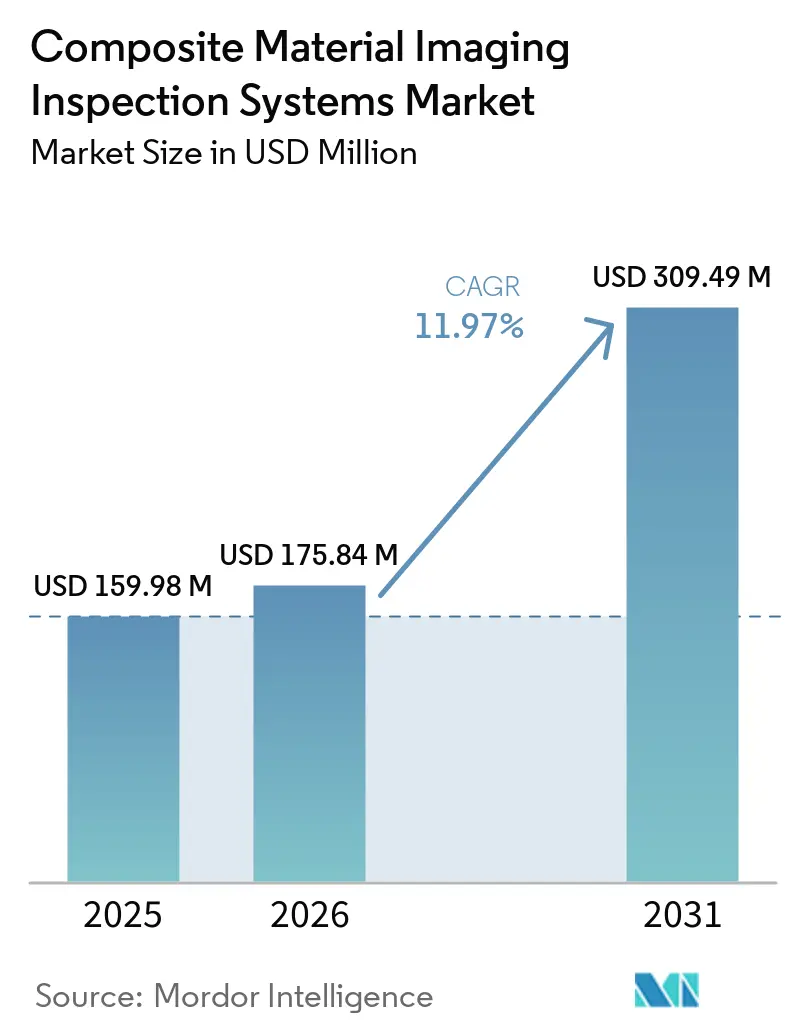
| Market Size (2026) | USD 175.84 Million |
| Market Size (2031) | USD 309.49 Million |
| Growth Rate (2026 - 2031) | 11.97 % |
| Fastest Growing Market | Asia-Pacific |
| Largest Market | North America |
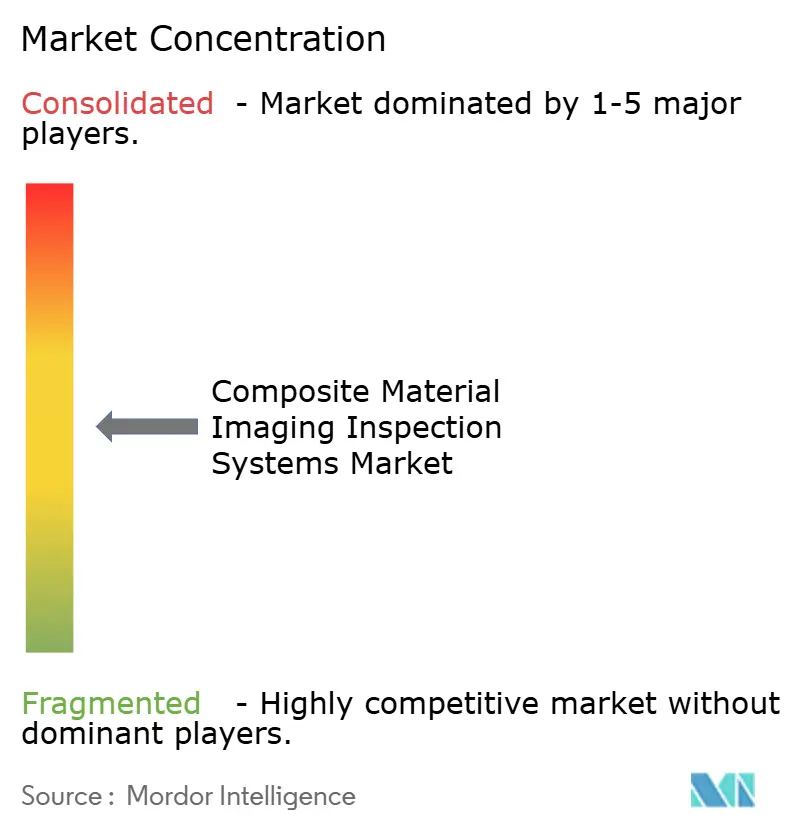
| Market Concentration | Medium |
Major Players *Disclaimer: Major Players sorted in no particular order Image © Mordor Intelligence. Reuse requires attribution under CC BY 4.0. | |
Composite Material Imaging Inspection Systems Market Analysis by Mordor Intelligence
The Composite Material Imaging Inspection Systems Market size is expected to grow from USD 159.98 million in 2025 to USD 175.84 million in 2026 and is forecast to reach USD 309.49 million by 2031 at 11.97% CAGR over 2026-2031.
The composite material imaging inspection systems market is supported by the wider use of carbon fiber reinforced polymer and glass fiber reinforced polymer laminates in aerospace, energy, and transportation equipment. Delamination, subsurface porosity, and low-velocity impact disbond are not reliably visible during surface examinations, which makes volumetric imaging important for defect detection and characterization. The composite material imaging inspection systems market requires recurring inspection activity for each composite airframe section, wind turbine blade, and pressure vessel in service. Procurement is moving toward platforms that combine phased-array ultrasonics, thermography, and traceable digital records as laminate designs become more complex. Recent ownership changes have also placed several advanced inspection portfolios within larger industrial groups globally, raising expectations for integration, service coverage, and global support.
Key Report Takeaways
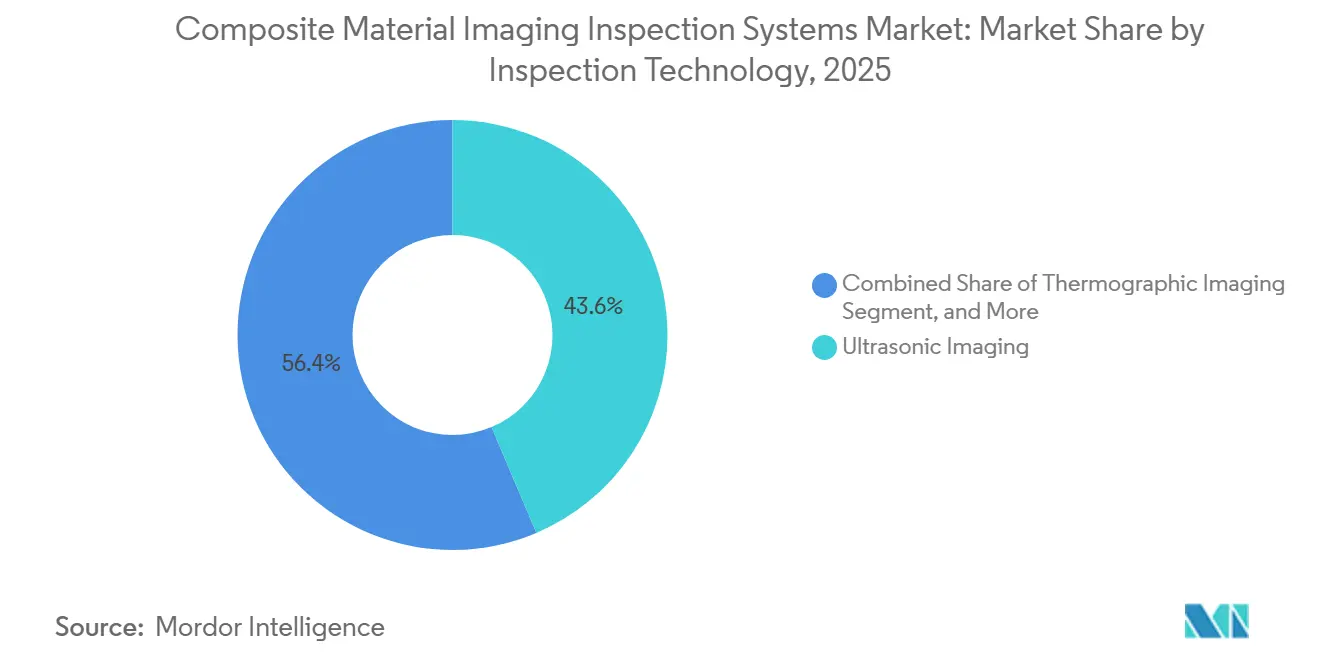
- By inspection technology, ultrasonic imaging held 43.62% of the composite material imaging inspection systems market share in 2025, while optical and laser imaging is projected to expand at a CAGR of 14.83% through 2031.
- By system configuration, portable and handheld systems held 36.84% of the composite material imaging inspection systems market in 2025, while in-line systems are projected to expand at a CAGR of 15.62% through 2031.
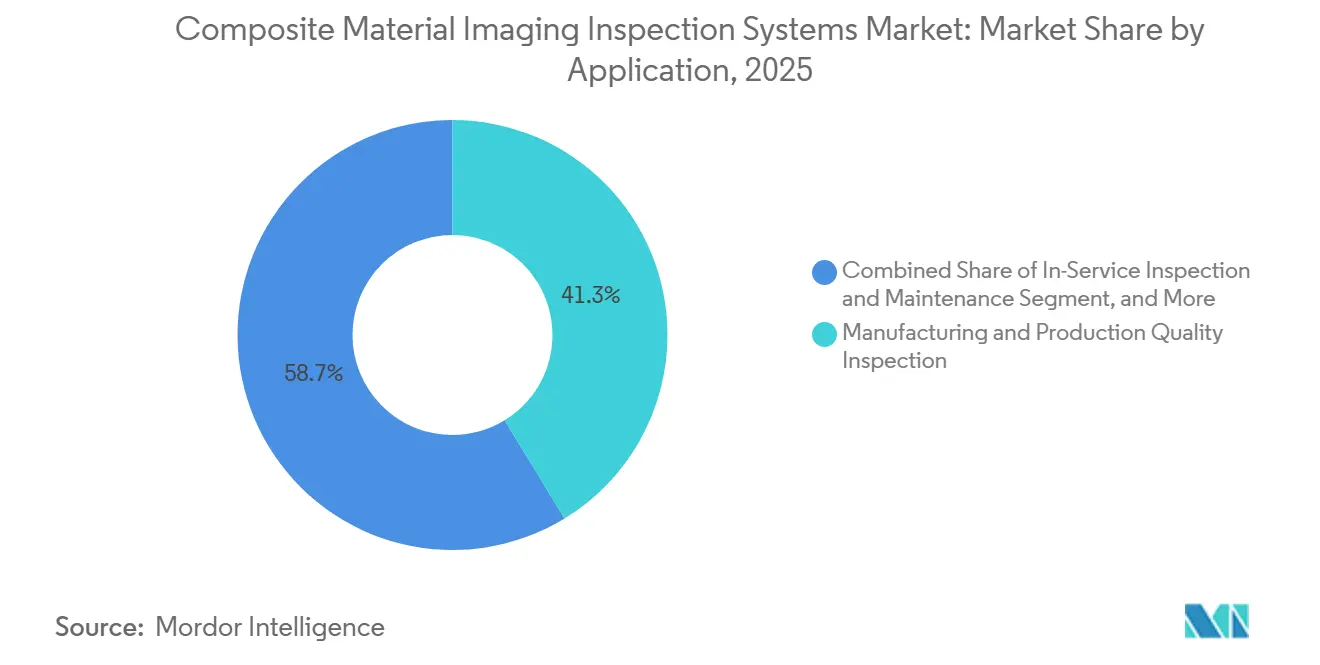
- By application, manufacturing and production quality inspection accounted for 41.27% of the composite material imaging inspection systems market size in 2025, while in-service inspection and maintenance is projected to expand at a CAGR of 13.94% through 2031.
- By end user, aerospace, defense, and space held 47.95% of the composite material imaging inspection systems market in 2025, while energy and power is projected to expand at a CAGR of 15.21% through 2031.
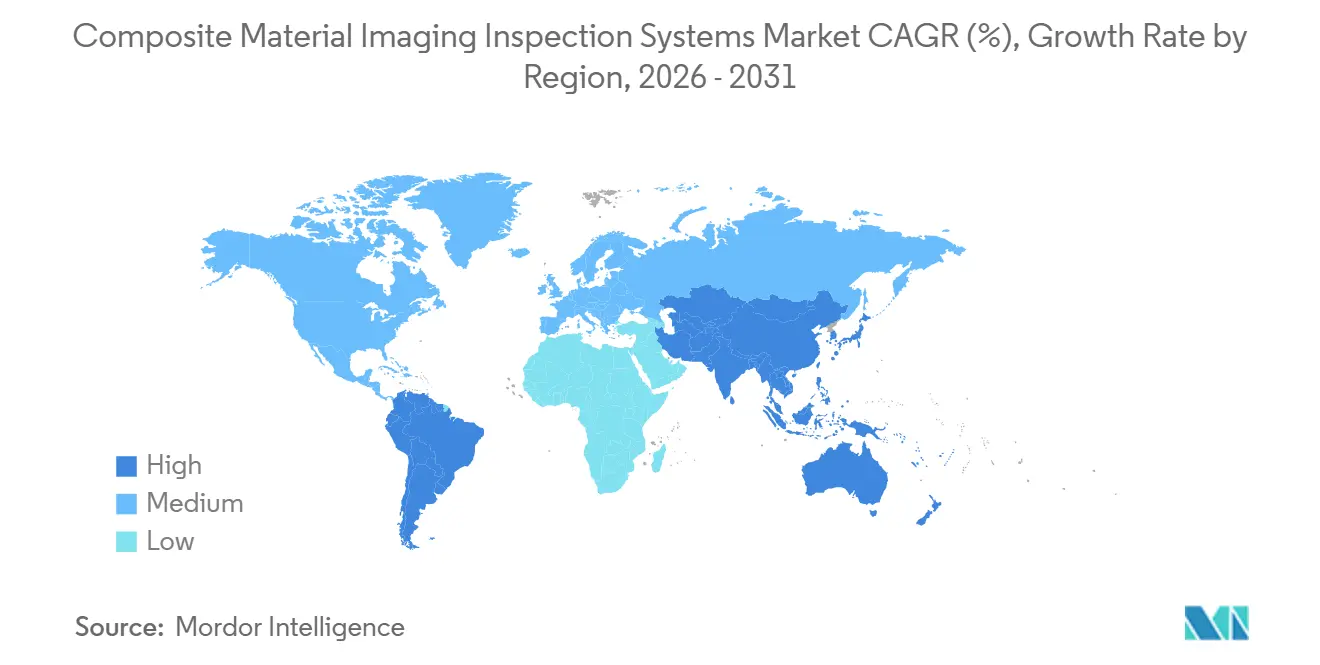
- By geography, North America held 35.18% of the composite material imaging inspection systems market in 2025, while Asia-Pacific is projected to expand at a CAGR of 14.67% through 2031.
Note: Market size and forecast figures in this report are generated using Mordor Intelligence’s proprietary estimation framework, updated with the latest available data and insights as of January 2026.
Global Composite Material Imaging Inspection Systems Market Trends and Insights
Drivers Impact Analysis*
| Driver | (~) % Impact on CAGR Forecast | Geographic Relevance | Impact Timeline |
|---|---|---|---|
| Increasing Composite Content in Safety-Critical Structures | +3.2% | Global | Long term (≥ 4 years) |
| Expansion of Aerospace Production and MRO Activity | +2.8% | North America and Europe | Medium term (2-4 years) |
| Adoption of Automated Phased-Array and Matrix-Array Ultrasonics | +2.1% | North America, Europe, Asia-Pacific | Medium term (2-4 years) |
| Regulatory Demand for Traceable Composite Inspection | +1.6% | Global, with EASA and FAA as primary jurisdictions | Short term (≤ 2 years) |
| Real-Time Stiffness Mapping and Defect Localization | +1.1% | Asia-Pacific and North America | Long term (≥ 4 years) |
| Digital Twin Integration for Composite Quality Records | +0.8% | Europe and North America | Long term (≥ 4 years) |
| Source: Mordor Intelligence | |||
Increasing Composite Content in Safety-Critical Structures
Composite materials are becoming a design baseline in certified aircraft structures rather than a limited performance feature. More composite content increases the area that requires volumetric inspection during each production cycle. A 2026 ECNDT paper noted that silicon carbide ceramic matrix composites in aerospace engine hot sections require traceable defect decisions because visual review does not provide consistent documentation. New ply orientations, sandwich cores, and hybrid metal-composite joints also increase inspection complexity. The composite material imaging inspection systems market, therefore, favors integrated ultrasonic and thermographic platforms that can assess finer subsurface features across variable laminate geometries. This demand remains relevant even when an individual aircraft program experiences a temporary production slowdown.
Expansion of Aerospace Production and MRO Activity
Aircraft delivery programs remained active in 2024 and 2025, supporting inspection cycles at original equipment manufacturer facilities and maintenance, repair, and overhaul sites. Heavy maintenance requires comprehensive nondestructive testing of composite primary and secondary structures at prescribed inspection intervals. Manufacturers are also using more complex ply arrangements and sandwich-core designs to meet performance requirements. These designs require deeper penetration and finer resolution than systems qualified for earlier laminate generations. The resulting focus on documented in-process results is increasing demand for systems that produce digital inspection records rather than operator-interpreted C-scan printouts. The composite material imaging inspection systems market benefits because the inspection scope per aircraft extends beyond a simple count of delivered aircraft.
Adoption of Automated Phased-Array and Matrix-Array Ultrasonics
Automated phased-array ultrasonic testing is improving the inspection of composite structures with delamination, porosity, and impact damage. Full-matrix capture and total focusing method processing improve imaging performance for curved and variable-thickness components. A 2026 ECNDT paper described automated single-pass robotic ultrasonic inspection of elongated aerospace composite members. Matrix-array probes can reduce the number of indexed scan passes required for complex geometries. This reduces inspection time and supports automated inspection at lower production volumes. The composite material imaging inspection systems market is consequently seeing a replacement opportunity for legacy single-element ultrasonic systems across aerospace production and maintenance operations.
Regulatory Demand for Traceable Composite Inspection
Traceable inspection records are becoming more important in composite qualification and lifecycle management. ISO 8203-4:2025 established requirements for out-of-plane laser shearography nondestructive testing of fiber-reinforced polymer composites, including monolithic and sandwich laminates. The standard gives inspection engineers a documented basis for qualifying shearography in production and in-service applications. FAA AC 20-107B and EASA AMC 20-29 continue to provide the framework for assessing composite aircraft structures and repairs.[1]European Union Aviation Safety Agency, “AMC 20-29 Composite Aircraft Structures,” European Union Aviation Safety Agency, easa.europa.eu These frameworks maintain a baseline level of imaging activity across aircraft fleets. The composite material imaging inspection systems market is, therefore, rewarding suppliers that provide calibration audit trails and regulation-ready digital outputs.
Restraints Impact Analysis*
| Restraint | (~) % Impact on CAGR Forecast | Geographic Relevance | Impact Timeline |
|---|---|---|---|
| High Capital Cost of Automated Imaging Cells | -1.7% | Global, most acute in Asia-Pacific and Middle East and Africa | Short term (≤ 2 years) |
| Shortage of Qualified Composite NDT Personnel | -1.3% | North America and Europe | Medium term (2-4 years) |
| Complex Calibration for Thick and Curved Composite Structures | -0.9% | Global | Medium term (2-4 years) |
| Limited Certification Pathways for AI-Assisted Inspection | -0.6% | Global | Long term (≥ 4 years) |
| Source: Mordor Intelligence | |||
High Capital Cost of Automated Imaging Cells
Fully automated composite inspection gantries and robotic scanning cells require multimillion-dollar capital commitments. This is particularly restrictive for tier 2 and tier 3 suppliers with lower production volumes. Total cost extends beyond hardware to adaptive scan-path software, calibration artifact libraries, environmental controls, and facility changes. Each distinct part geometry can also require custom fixtures, which raises the effective cost for suppliers with diverse part portfolios. These economics slow the shift from manual inspection to automated platforms in Asia-Pacific and the Middle East. The composite material imaging inspection systems market may offer more accessible opportunities for suppliers that provide modular or lease-based purchasing models.
Shortage of Qualified Composite NDT Personnel
The American Society for Nondestructive Testing revised SNT-TC-1A in April 2025 to recognize digital and AI-assisted methods within its personnel qualification framework.[2]American Society for Nondestructive Testing, “SNT-TC-1A Personnel Qualification and Certification in Nondestructive Testing 2025 Revision,” American Society for Nondestructive Testing, asnt.org The revision covers methods that include phased-array ultrasonics with full-matrix capture and total focusing method processing. Composite structure certification still requires 120 to 160 hours of documented training and written examinations. Maintenance operators cannot increase capacity by purchasing equipment alone because automated cells require qualified operators and Level II verification. The shortage can limit system utilization and reduce customer confidence in adding inspection platforms. Suppliers are responding with operator-assist software, defect flagging, decision support, and simpler calibration workflows.
*Our forecasts treat driver/restraint impacts as directional, not additive. The impact forecasts reflect baseline growth, mix effects, and variable interactions.
Segment Analysis
By Inspection Technology: Ultrasonics Lead Demand While Optical Methods Accelerate
Ultrasonic imaging held 43.62% of the composite material imaging inspection systems market share in 2025 and remained the main method for identifying delamination, porosity, and impact damage in CFRP and GFRP laminates. Phased-array ultrasonic testing with full-matrix capture and total focusing method processing is widely used for composite qualification. A 2026 ECNDT paper demonstrated fully automated single-pass robotic ultrasonic inspection for elongated composite structural members. The approach can reduce scan time for wing skins, stringers, and rotor-blade spars. Thermographic imaging addresses large-panel disbond and core-crush detection where noncontact coverage is useful. Radiographic imaging and computed tomography are used for volumetric void mapping in flight-critical fastener holes, splice regions, and ceramic matrix composite hot-section components.
Optical and laser imaging is projected to expand at a CAGR of 14.83% through 2031. ISO 8203-4:2025 sets out an international method for laser shearography of fiber-reinforced polymer composites. The method offers noncontact, large-area coverage with single-sided access for curved panels such as fuselage bays and nacelle fairings. Research published in 2026 found that filtered phase-map analysis improved detection of CFRP impact damage in laser shearography. Eddy current arrays and multisensor data fusion continue to serve specialized inspections of bonded metal-composite interfaces. This combination of standards, signal analysis, and blade inspection demand supports wider use of optical methods in the composite material imaging inspection systems industry.



By System Configuration: Portable Systems Lead While In-Line Automation Expands
Portable and handheld systems held 36.84% of the composite material imaging inspection systems market in 2025. They are important in maintenance settings where fixed gantries cannot access the part. Portable phased-array detectors and handheld shearography cameras also support field work in wind energy, marine, and civil infrastructure settings. Benchtop and laboratory systems serve material research and damage characterization work. Compact squirter-mode ultrasonic platforms support high-precision testing in facilities with limited floor space. Automated and fixed systems support dedicated production cells for parts such as wing skins, fuselage panels, and rotor blades.
In-line inspection systems are projected to expand at a CAGR of 15.62% through 2031. These systems place imaging sensors directly within automated fiber placement and resin transfer molding lines. Manufacturers can then identify layup errors, porosity, and foreign-object inclusions before laminate consolidation is complete. A collaboration involving Adaptix Ltd., Cranfield University, and the Aerospace Technology Institute demonstrated digital tomography with robotics for scalable 3D X-ray inspection at the composite preform stage.[3]Aerospace Technology Institute, “In-Process NDT for Aerospace Composites Adaptix and Cranfield University Collaboration,” Aerospace Technology Institute, ati.org.uk Earlier inspection can reduce post-cure rework and repeat inspection requirements. The composite material imaging inspection systems industry is thus evaluating in-line systems on lifecycle costs rather than on the initial capital cost alone.
By Application: Manufacturing Inspection Dominates as In-Service Demand Builds
Manufacturing and production quality inspection accounted for 41.27% of the composite material imaging inspection systems market size in 2025. Certified aircraft programs require volumetric inspection of primary structural composite parts before downstream assembly. Acceptance decisions cover void content, delamination extent, and ply alignment. Research, development, and material characterization remain important as thermoplastic laminates, ceramic matrix composites, and hybrid metal-composite joints move toward production qualification. Repair and refurbishment verification requires qualified inspection methods for particular repair types and structural configurations. FAA and EASA guidance continues to support this recurring inspection demand across maintenance networks.
In-service inspection and maintenance within the composite material imaging inspection systems market is projected to expand at a CAGR of 13.94% through 2031. The installed base of composite structures is reaching a more mature operational stage. Maintenance practices are also moving from fixed inspection intervals toward condition-based approaches. The AIRPASS project demonstrated the use of Structure from Motion camera positioning to connect nondestructive testing results with aircraft structural digital twins. Persistent links between inspection results and component geometry can support lifecycle fatigue tracking. Systems with interoperable digital outputs may therefore provide more value than platforms that rely on paper records or closed software formats.
By End User: Aerospace Leads as Energy Gains Momentum
Aerospace, defense, and space held 47.95% of 2025 demand, supported by certified composite inspection requirements and a dense installed base of automated cells at prime contractor facilities. Military airframe skins, rotorcraft blades, and missile sections can require higher-specification equipment to meet program qualification requirements. Composite overwrapped pressure vessels and carbon-composite primary structures are also extending inspection needs into satellite and launch-vehicle programs. Automotive and transportation, industrial manufacturing, marine and infrastructure, and research and testing remain smaller but relevant end-user groups. Automotive use of CFRP structural parts is increasing, although inspection standardization remains less mature than aerospace practice. These applications widen the addressable base for the composite material imaging inspection systems market.
Energy and power within the composite material imaging inspection systems market is projected to expand at a CAGR of 15.21% through 2031. Wind turbine blades require inspection for delamination, adhesive-joint disbond, and leading-edge erosion. A 2026 scientific review found that robotic ultrasonic scanning combined with drone-mounted thermographic and optical imaging can address a wider range of blade defects than a single method.[4]Advances, Challenges, and Recommendations for Non-Destructive Testing Technologies for Wind Turbine Blade Damage, “A Review,” Sensors, mdpi.com Turbine blades and aerospace parts both involve thick sandwich laminates and curved surfaces. Wind operators have historically used simpler equipment at lower price points than aerospace programs. Suppliers that adapt phased-array systems with rugged enclosures and drone-compatible formats can serve this shift in field inspection requirements.
Geography Analysis
North America held 35.18% of 2025 regional demand. The region benefits from the concentration of U.S. aerospace prime contractors, Department of Defense sustainment programs, and a substantial commercial maintenance, repair, and overhaul network. Canada contributes through its tier 1 aerospace supply chain, including structural composite programs and engine testing centers. Mexico is developing a composite manufacturing corridor in its northern states, which supports demand for portable and semi-automated systems near production facilities.
Europe was the second-largest regional area within the composite material imaging inspection systems market, anchored by the Airbus industrial system in Germany, France, the United Kingdom, and Spain. Airbus structures work in Hamburg, and Premium Aerotec operations support ultrasonic imaging procurement in Germany. The United Kingdom composite supply chain, including Rolls-Royce fan systems and GKN Aerospace wing structures, supports demand for portable and semi-automated platforms. The Middle East is investing in domestic aerospace maintenance infrastructure in Saudi Arabia and the UAE, creating openings for portable systems serving wide-body fleets.
Asia-Pacific is projected to expand at a CAGR of 14.67% through 2031. China, India, Japan, and South Korea are expanding domestic composite manufacturing and aerospace programs. China’s COMAC programs and related component production are increasing demand for traceability-capable infrastructure that meets AS9100 Rev D requirements. India combines military composite programs, a growing commercial maintenance sector, and rising wind-energy activity. Japan’s work on Boeing 787 composite fuselage sections and South Korea’s defense programs add further demand. Africa remains an early-stage area centered on South African aerospace maintenance, while wind-energy installations could strengthen demand later in the forecast period.

Competitive Landscape
The composite material imaging inspection systems market is moderately fragmented among a small group of global suppliers, while regional specialists compete through customization, throughput, and alignment with original equipment manufacturer requirements. Wabtec completed the acquisition of Evident’s Inspection Technologies division in July 2025 for USD 1.78 billion. ESAB completed its acquisition of Eddyfi Technologies in June 2026. Baker Hughes announced the sale of Waygate Technologies to Hexagon in April 2026 for USD 1.45 billion, with closing expected in the second half of 2026.
Larger parent organizations can raise customer expectations for software integration, service reach, and technical support. TecScan Systems, Dolphitech, and ScanMaster Systems retain differentiated positions through application-specific system architecture and qualification documentation. The composite material imaging inspection systems market has an active development focus on automated ultrasonic inspection for elongated composite components. A 2026 patent filing described a single-pass robotic system using pulse-echo phased arrays and a bubbler method for this application. The field is separating between incumbents that scale through acquisitions and challengers that use adaptive scanning software and modular architectures.
TecScan presented work at CANCOM 2026 on CAD correction and adaptive 3D inspection approaches for curved and variable-thickness composite parts. The work aimed to extend automated imaging accuracy to curved and variable-thickness geometries that historically required manual or semi-automated inspection. It also addressed CAD correction and enhanced C-scan interpretation for application-specific qualification workflows in aerospace production programs. Underpenetrated opportunities remain in in-process inspection for thermoplastic composites, which differ from thermoset laminates in toughness, failure modes, and weld-joint inspection needs. Portable in-situ imaging for wind turbine blades and offshore marine structures is another opportunity because inspection area is increasing faster than field-ready equipment adoption. EWSHM 2026 proceedings also documented work on digital twin-compatible inspection data for aircraft structures. The composite material imaging inspection systems market is increasingly competing on the ability to link inspection results with lifecycle models after the initial equipment sale.
Composite Material Imaging Inspection Systems Industry Leaders
Baker Hughes Company
Evident Corporation
Eddyfi Technologies Inc.
Zetec, Inc.
TecScan Systems Inc.
- *Disclaimer: Major Players sorted in no particular order

Recent Industry Developments
- June 2026: ESAB Corporation completed its acquisition of Eddyfi Technologies, integrating one of the leading advanced NDT instrumentation and robotic inspection providers into ESAB’s industrial portfolio. Eddyfi’s capabilities span phased-array ultrasonics, automated remote monitoring, and robotics across aerospace, defense, nuclear, and infrastructure applications, serving more than 110 countries. The acquisition positions ESAB to offer integrated fabrication-to-inspection workflow solutions to composite structure manufacturers.
- April 2026: Baker Hughes announced the sale of Waygate Technologies to Hexagon for USD 1.45 billion in cash, pending regulatory approval expected in the second half of 2026. Waygate’s portfolio spans ultrasound, radiography, and remote visual inspection for aerospace, energy, and industrial manufacturing. It will integrate with Hexagon’s precision measurement and CT analysis platforms, creating a combined metrology and NDT offer with material implications for composite CT and automated ultrasonic inspection procurement.
- April 2026: Waygate Technologies and GE Aerospace deployed automated Menu Directed Inspection templates for GEnx-1B and GEnx-2B engine borescope inspections, built on their joint technology development agreement, standardizing and automating composite and metallic engine component inspection workflows across GE Aerospace’s commercial engine maintenance programs.
- July 2025: Wabtec Corporation completed the acquisition of Evident’s Inspection Technologies division for USD 1.78 billion, absorbing a global leader in phased-array ultrasonic and remote visual inspection for aerospace structures into Wabtec’s Digital Intelligence business.


Global Composite Material Imaging Inspection Systems Market Report Scope
Composite Material Imaging Inspection Systems refers to the specialized, hardware-and-software packages used to look inside and evaluate fiber-reinforced structures (such as carbon fiber, fiberglass, and honeycomb panels) without damaging them. Since modern composites are built from layers of woven fibers held together by resin, they do not block or transmit energy uniformly like traditional metals.
The Composite Material Imaging Inspection Systems Market Report is Segmented by Inspection Technology (Ultrasonic Imaging, Thermographic Imaging, Optical and Laser Imaging, Radiographic Imaging, and Other Imaging Technologies), System Configuration (Portable and Handheld Systems, Benchtop and Laboratory Systems, Automated and Fixed Inspection Systems, and In-Line Inspection Systems), Application (Manufacturing and Production Quality Inspection, In-Service Inspection and Maintenance, Repair and Refurbishment Verification, Research, Development, and Material Characterization, and Other Applications), End-User (Aerospace, Defense, and Space, Automotive and Transportation, Energy and Power, Industrial Manufacturing, Marine and Infrastructure, Research and Testing, and Other End-Users), and Geography (North America, Europe, Asia-Pacific, Middle East, and Africa). The Market Forecasts are Provided in Terms of Value (USD).
| Ultrasonic Imaging |
| Thermographic Imaging |
| Optical and Laser Imaging |
| Radiographic Imaging |
| Other Imaging Technologies |
| Portable and Handheld Systems |
| Benchtop and Laboratory Systems |
| Automated and Fixed Inspection Systems |
| In-Line Inspection Systems |
| Manufacturing and Production Quality Inspection |
| In-Service Inspection and Maintenance |
| Repair and Refurbishment Verification |
| Research, Development, and Material Characterization |
| Other Applications |
| Aerospace, Defense, and Space |
| Automotive and Transportation |
| Energy and Power |
| Industrial Manufacturing |
| Marine and Infrastructure |
| Research and Testing |
| Other End-Users |
| North America | United States |
| Canada | |
| Mexico | |
| South America | Brazil |
| Argentina | |
| Rest of South America | |
| Europe | Germany |
| United Kingdom | |
| France | |
| Italy | |
| Spain | |
| Rest of Europe | |
| Asia-Pacific | China |
| Japan | |
| India | |
| South Korea | |
| ASEAN | |
| Rest of Asia-Pacific | |
| Middle East | Saudi Arabia |
| United Arab Emirates | |
| Turkey | |
| Rest of the Middle East | |
| Africa | South Africa |
| Nigeria | |
| Rest of Africa |
| By Inspection Technology | Ultrasonic Imaging | |
| Thermographic Imaging | ||
| Optical and Laser Imaging | ||
| Radiographic Imaging | ||
| Other Imaging Technologies | ||
| By System Configuration | Portable and Handheld Systems | |
| Benchtop and Laboratory Systems | ||
| Automated and Fixed Inspection Systems | ||
| In-Line Inspection Systems | ||
| By Application | Manufacturing and Production Quality Inspection | |
| In-Service Inspection and Maintenance | ||
| Repair and Refurbishment Verification | ||
| Research, Development, and Material Characterization | ||
| Other Applications | ||
| By End-User | Aerospace, Defense, and Space | |
| Automotive and Transportation | ||
| Energy and Power | ||
| Industrial Manufacturing | ||
| Marine and Infrastructure | ||
| Research and Testing | ||
| Other End-Users | ||
| By Geography | North America | United States |
| Canada | ||
| Mexico | ||
| South America | Brazil | |
| Argentina | ||
| Rest of South America | ||
| Europe | Germany | |
| United Kingdom | ||
| France | ||
| Italy | ||
| Spain | ||
| Rest of Europe | ||
| Asia-Pacific | China | |
| Japan | ||
| India | ||
| South Korea | ||
| ASEAN | ||
| Rest of Asia-Pacific | ||
| Middle East | Saudi Arabia | |
| United Arab Emirates | ||
| Turkey | ||
| Rest of the Middle East | ||
| Africa | South Africa | |
| Nigeria | ||
| Rest of Africa | ||


Key Questions Answered in the Report
What is the composite material imaging inspection systems market size?
The sector is projected at USD 175.84 million in 2026 and is forecast to reach USD 309.49 million by 2031 at a CAGR of 11.97%. Its demand base includes certified aerospace structures, wind turbine blades, and pressure vessels that need subsurface defect detection and documented inspection results.
Which inspection technology led demand in 2025?
Ultrasonic imaging led with 43.62% of 2025 demand because it is widely used to inspect delamination, porosity, and impact damage in composite laminates. Phased-array testing with full-matrix capture and total focusing method processing also supports assessment of curved and variable-thickness components.
Which system configuration is expanding fastest?
In-line systems are projected to expand at a CAGR of 15.62% through 2031 as manufacturers place imaging sensors within automated fiber placement and resin transfer molding lines. This allows layup errors, porosity, and foreign-object inclusions to be found before laminate consolidation and post-cure rework.
What application accounted for the largest share in 2025?
Manufacturing and production quality inspection accounted for 41.27% of 2025 demand, supported by certified inspection requirements for primary composite structures. Void content, delamination extent, and ply alignment must be assessed before parts move into downstream assembly.
Why is energy and power a fast-expanding end-user segment?
Energy and power is projected to expand at a CAGR of 15.21% through 2031 because wind turbine blades require inspection for delamination, adhesive-joint disbond, and erosion. Robotic ultrasonic scanning and drone-mounted thermographic and optical systems can address different defect types during the blade lifecycle.
Which region is expected to expand fastest through 2031?
Asia-Pacific is projected to expand at a CAGR of 14.67% through 2031, supported by composite manufacturing programs in China, India, Japan, and South Korea. India combines military composite work, commercial maintenance activity, and wind-energy demand, while China’s programs require traceability-capable inspection infrastructure.
Page last updated on:





