
Commercial Milkshake Machines Market Size and Share
Market Overview
| Study Period | 2020 - 2031 |
|---|---|
| Market Size (2026) | USD 2.25 Billion |
| Market Size (2031) | USD 2.75 Billion |
| Growth Rate (2026 - 2031) | 4.12 % |
| Fastest Growing Market | Asia-Pacific |
| Largest Market | North America |
| Market Concentration | Medium |
Major Players *Disclaimer: Major Players sorted in no particular order Image © Mordor Intelligence. Reuse requires attribution under CC BY 4.0. | |
Commercial Milkshake Machines Market Analysis by Mordor Intelligence
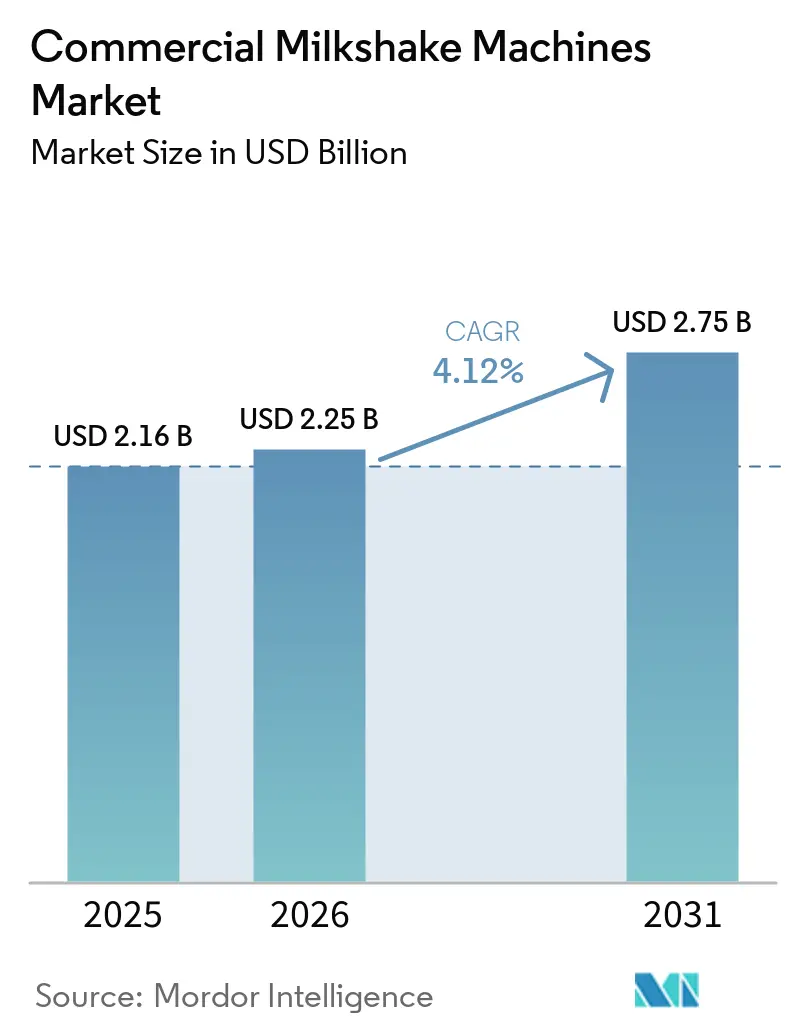
The commercial milkshake machines market size is expected to grow from USD 2.16 billion in 2025 to USD 2.25 billion in 2026 and is forecast to reach USD 2.75 billion by 2031 at 4.12% CAGR over 2026-2031. Demand is advancing because operators now value labor-saving technology, built-in heat-treatment modules, and predictive-maintenance connectivity more than sheer blending capacity. Quick-service restaurants, convenience stores, and petrol stations are all broadening beverage menus, forcing equipment makers to supply automated self-serve systems that shorten queues while widening flavor choice. Purchasers scrutinize regulatory compliance and total cost of ownership, recognizing that machines capable of logging pasteurization temperatures and transmitting service alerts reduce both food-safety risk and downtime[1]. Intensifying labor shortages—especially across North America and Europe—further boost interest in semi- and fully-automated models that cut training hours and ease turnover pressure. Regionally, Asia-Pacific is expanding fastest as urban consumers gravitate toward premium shakes sold through U.S.-style chains, while mature North America remains the largest replacement market because of stringent sanitation codes and established service networks.
Key Report Takeaways
- By machine type, multi-spindle units led with 38.2% of the commercial milkshake machines market share in 2025; automated self-serve units are forecast to post a 6.29% CAGR through 2031.
- By installation, countertop models accounted for 53.2% share of the commercial milkshake machines market size in 2025 and are rising at a 6.40% CAGR to 2031.
- By automation level, semi-automated machines held 34.6% revenue share in 2025, while fully-automated systems recorded the highest 6.02% CAGR between 2026 and 2031.
- By end user, quick-service restaurants captured 46.3% of the commercial milkshake machines market in 2025; convenience stores and petrol stations are the fastest-growing end-user group at 6.57% CAGR to 2031.
- By geography, North America commanded 36.6% revenue share in 2025, whereas Asia-Pacific is projected to clock the strongest 6.42% CAGR through 2031.
Note: Market size and forecast figures in this report are generated using Mordor Intelligence’s proprietary estimation framework, updated with the latest available data and insights as of January 2026.
Global Commercial Milkshake Machines Market Trends and Insights
Drivers Impact Analysis*
| Driver | (~) % Impact on CAGR Forecast | Geographic Relevance | Impact Timeline |
|---|---|---|---|
| Rapid expansion of quick-service restaurants & specialty drink chains | +0.9% | Global, with concentration in North America & Asia-Pacific | Medium term (2-4 years) |
| Rising consumer demand for experiential "freak" milkshakes | +0.6% | North America & Europe, emerging in urban Asia-Pacific | Short term (≤ 2 years) |
| Growing adoption of automated & self-serve milkshake kiosks | +0.7% | Global, led by North America | Medium term (2-4 years) |
| Labor shortages accelerating use of labor-saving blending equipment | +0.8% | North America & Europe primarily | Short term (≤ 2 years) |
| Food-safety rules favoring heat-treatment-equipped machines | +0.4% | Global, with varying regulatory intensity by region | Long term (≥ 4 years) |
| IoT-enabled predictive maintenance lowering total cost of ownership | +0.3% | North America & Europe, expanding to Asia-Pacific | Medium term (2-4 years) |
| Source: Mordor Intelligence | |||
Rapid Expansion of Quick-Service Restaurants & Specialty Drink Chains
Convenience stores such as Sheetz deploy full milkshake stations alongside fuel pumps, replicating QSR convenience and triggering new equipment orders. Operators chase premium beverage margins, often reaching 80%, so blenders capable of multiple viscosities beat single-purpose units. Multi-spindle systems that deliver parallel orders without flavor crossover help franchises withstand lunch-rush peaks. With global frozen-drink revenue still climbing, flexible mixers that swap recipes through software updates become critical upgrade factors.
Rising Consumer Demand for Experiential “Freak” Milkshakes
Over-the-top shakes topped with cookies, cereal or plant-based inclusions demand motors that can handle particulate ingredients without clogging. Multi-spindle models preserve flavor integrity while enabling simultaneous customization, trimming wait times that otherwise erode impulse purchases. European cafés focus on low-sugar bases, underscoring the need for precise speed control and allergen-safe wash cycles. Equipment reliability during viral-media surges directly influences brand perception and repeat traffic.
Growing Adoption of Automated & Self-Serve Milkshake Kiosks
Self-serve kiosks let guests personalize beverages while freeing staff for hospitality roles. Sensors track mix viscosity and blender counts, pushing maintenance alerts to managers before stoppages occur. Touchscreen interfaces must be intuitive enough that first-time users complete an order in seconds—a key requirement in travel centers and stadiums where footfall spikes. Chains also broadcast seasonal recipes across fleets overnight, preserving flavor consistency without onsite programming.
Labor Shortages Accelerating Use of Labor-Saving Blending Equipment
DePaul University finds quick-service turnover surpasses 100% annually, so intuitive controls and colorful prompts are indispensable for inexperienced staff[2]. Cloud dashboards alert maintenance teams to bearing fatigue or seal wear, allowing planned part swaps instead of weekend emergency calls. This feature is especially valuable in rural outlets where certified technicians are scarce. Suppliers bundling remote diagnostics with service contracts gain competitive insulation.
Restraints Impact Analysis*
| Restraint | (~) % Impact on CAGR Forecast | Geographic Relevance | Impact Timeline |
|---|---|---|---|
| High upfront capital & maintenance costs of premium machines | -0.70% | Global, particularly impacting smaller operators | Long term (≥ 4 years) |
| Stringent hygiene compliance adds operational complexity | -0.50% | Global, with varying regulatory intensity by region | Medium term (2-4 years) |
| Ready-to-drink bottled shakes cannibalizing on-premise demand | -0.40% | North America & Europe primarily | Medium term (2-4 years) |
| Shift to plant-based beverages reducing dairy-shake spend | -0.30% | North America & Europe, emerging in urban Asia-Pacific | Long term (≥ 4 years) |
| Source: Mordor Intelligence | |||
High Upfront Capital & Maintenance Costs of Premium Machines
Top-tier automated systems can cost three times more than entry-level mixers. Hamilton Beach Brands’ 2023 Form 10-K highlights commercial revenue driven by rugged blenders built for 20-hour-per-day duty cycles, but such durability premiums lengthen payback periods for independent cafés[3]. Leasing plans and subscription models ease cash-flow strain yet lock buyers into proprietary ecosystems, a deterrent for operators balancing multi-vendor kitchens.
Stringent Hygiene Compliance Adds Operational Complexity
Grade ‘A’ Pasteurized Milk Ordinance guidelines require every milk-contact surface to withstand high-temperature sanitation, pushing equipment costs up and adding nightly cleaning tasks. Automatic rinse and validation cycles reduce labor yet still demand staff check chemical concentrations. New entrants with slim payrolls may postpone machine purchases until compliance features become more user-friendly.
*Our forecasts treat driver/restraint impacts as directional, not additive. The impact forecasts reflect baseline growth, mix effects, and variable interactions.
Segment Analysis
By Machine Type: Multi-Spindle Systems Lead Automation Shift
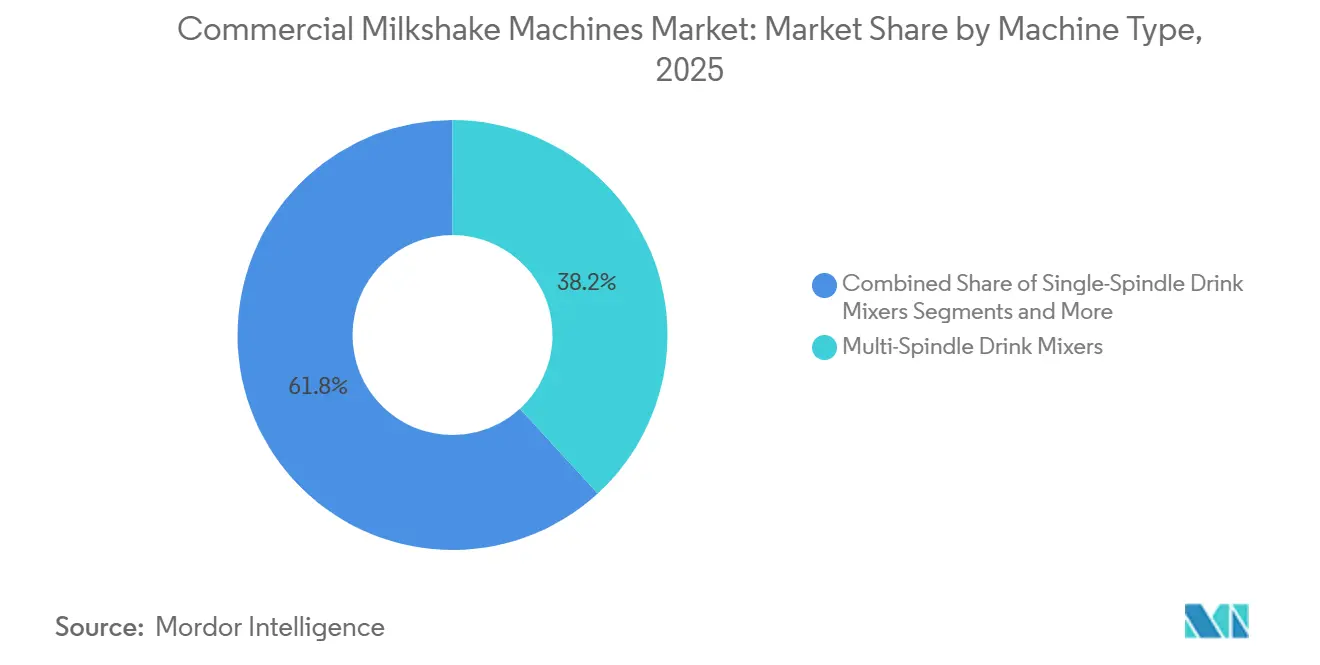
Multi-spindle drink mixers held 38.2% of the commercial milkshake machines market in 2025, underscoring their value in high-volume QSRs where speed and parallel processing matter. The commercial milkshake machines market size for automated self-serve units is projected to record the fastest 6.29% CAGR to 2030 as restaurant groups chase consistency with minimal labor input. Momentum toward robotics reflects growing comfort with touchscreen ordering and AI-driven portion control. Single-spindle models still serve boutique cafés that emphasize handcrafted texture, but their share will likely erode as chains dominate outlet expansion. Suppliers must balance feature sets, such as variable speed and auto-rinse, against capex budgets that differ sharply between independent and franchised sites.
Automated self-serve units excel in convenience stores and travel hubs, as they allow 24-hour access without staffing a barista. These machines integrate payment modules and allergen notifications, features that resonate in markets with strict labeling rules. Future growth hinges on lowering sensor costs and refining self-clean cycles that slash water use, aligning with rising sustainability targets.

By Installation: Countertop Models Dominate Through Flexibility
Countertop units commanded 53.2% of the commercial milkshake machines market share in 2025 and will widen their lead at a 6.40% CAGR over 2026-2031. Urban real-estate costs push operators to prefer portable machines that fit beneath standard shelving and roll into storage after the late-night rush. Floor-standing systems survive in theme parks and stadiums where sustained foot traffic justifies permanent floor space. Wall-mounted units remain niche, favored by food trucks and kiosks that lack counter depth.
The countertop trend also mirrors a break-even equation: a two-spindle countertop mixer reaches ROI quicker than a four-spindle floor model because staff can cross-utilize it for shakes, smoothies, and soft-serve mix-ins. As predictive maintenance spreads, the commercial milkshake machines industry expects future countertop variants to include removable diagnostic cartridges that couriers swap without onsite technicians, further lifting their convenience narrative.
By Automation Level: Semi-Automated Systems Balance Control and Efficiency
Semi-automated systems held 34.6% of revenue in 2025, serving as the entry point for operators wary of full robotics yet pressured by labor turnover. They deliver programmable cycles that cut operator error, while still letting staff top with cookies or candy for customized aesthetics. Fully-automated units post the fastest 6.02% CAGR, powered by cost savings in markets paying premium wages. In contrast, manual mixers persist at artisanal creameries that trade on showmanship and accept longer service times.
Successful automation adoption depends on intuitive user interfaces. Suppliers embed guided maintenance videos and multilingual alerts to reduce training hours. As cloud licensing models mature, software updates will add recipes for holiday flavors, extending machine life cycles, and boosting supplier service revenues.
By End-User: QSR Dominance Faces Convenience Store Challenge
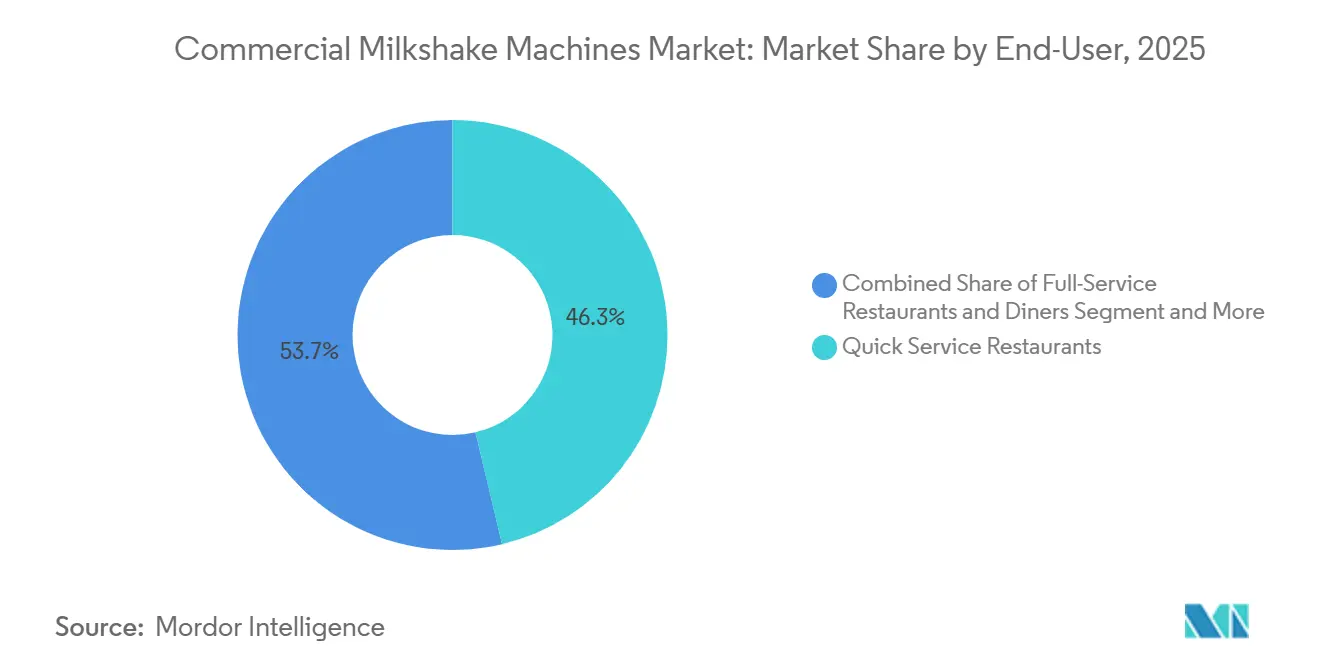
Quick-service restaurants captured 46.3% of the commercial milkshake machines market in 2025 and continue to anchor demand, yet convenience stores and petrol stations are logging the swiftest 6.57% CAGR through 2031. Their edge stems from long operating hours and impulse-purchase dynamics. Full-service restaurants retain steady demand as desserts enhance check size, while entertainment venues such as cinemas require high-capacity machines that sustain peak loads.
Convenience stores cherish equipment that auto-rinses between flavors, minimizing downtime. Some chains test drive-through-only formats that compress order-to-pickup intervals, ramping pressure on blender cycle times. QSRs answer with loyalty-app integrations, enabling customers to pre-program toppings and notify the bar when they arrive, reducing lobby congestion.
By Distribution Channel: Distributors & Dealers Lead Despite E-Commerce Growth
Traditional distributors and dealers held 44.8% share in 2025 because local technicians and spare-parts depots remain critical when downtime costs exceed savings from online discounts. However, e-commerce posts a 5.95% CAGR as independent cafés hunt bundle deals and faster price comparisons. Direct sales channels continue for franchise rollouts where custom electrical specs or brand-exclusive colors are needed.
Digital marketplaces increasingly offer service add-ons, narrowing the support gap with brick-and-mortar dealers. Yet large chains still negotiate multiyear service-level agreements linked to equipment uptime, anchoring physical distribution. Hybrid models now see suppliers listing base units online while steering buyers to certified service partners for installation, blending the best of both routes.
Geography Analysis
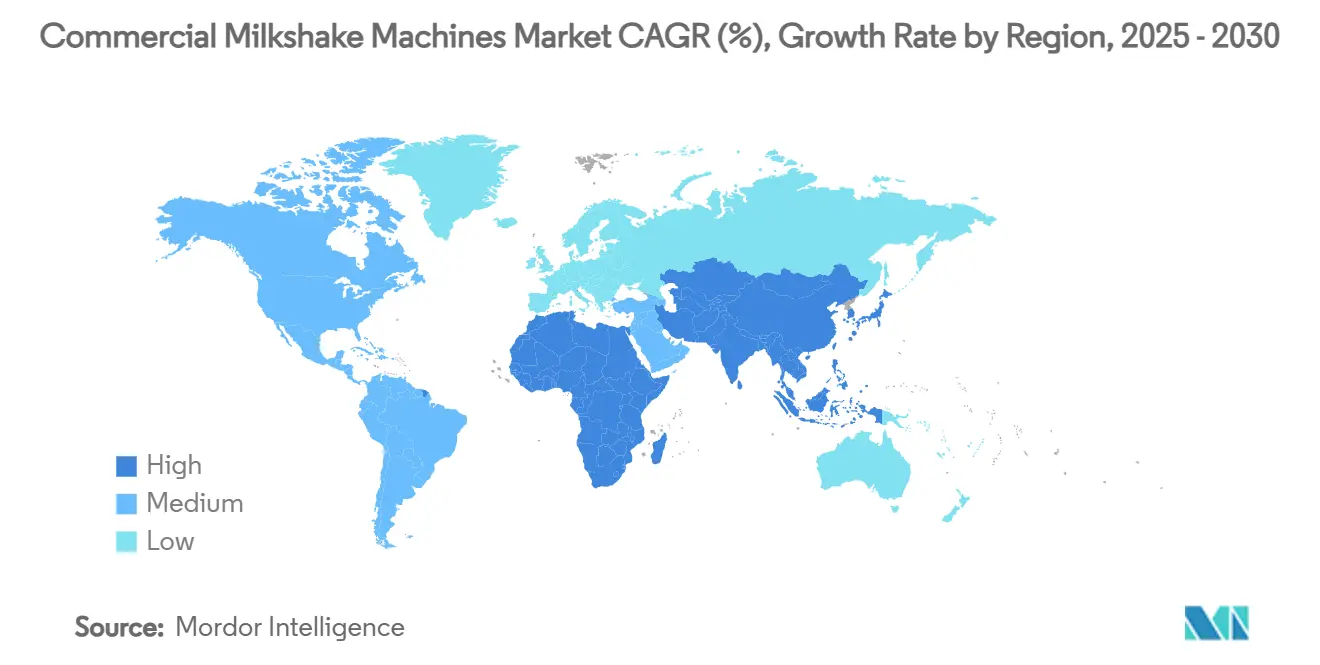
North America’s 36.6% commercial milkshake machines market share in 2024 stems from dense QSR networks and stringent FDA oversight that accelerates replacement cycles. Dairy processing investments topping USD 8 billion sustain supply chains, though debates around Federal Milk Marketing Orders could sway ingredient costs. Labor scarcity pushes chains toward countertop units with one-touch wash cycles.
Asia-Pacific posts the strongest 6.42% CAGR through 2030 as rising disposable income and mall culture fuel premium shake demand. Western brands launch compact stores requiring modular countertop mixers. Regulatory diversity forces suppliers to tailor voltage and sanitation features country by country, while bilingual training teams ease operator adoption.
Europe shows steadier expansion anchored in experiential dining and sustainability. Machines with energy-efficient motors and recycled plastics win bids. Strict allergen labeling favors segregated canisters, while tourist corridors in Southern Europe invest in high-capacity spindles for seasonal peaks. South America’s demand clusters in Brazil and Chile, whereas Middle East and Africa register starter orders from airports and resorts seeking durable, low-maintenance gear.
Competitive Landscape
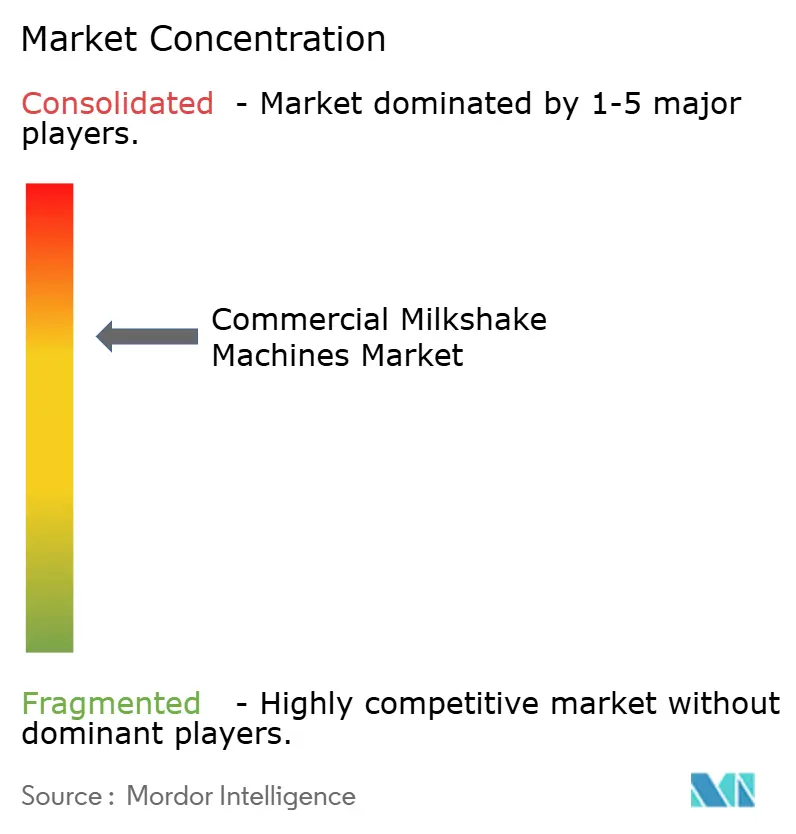
The commercial milkshake machine market features moderate concentration. Taylor Company, Hamilton Beach Brands, Ali Group (now trading as Welbilt in North America), H.C. Duke & Son, and Waring Commercial lead through integrated automation and broad service footprints. The top five players held a moderate share of the market in 2025, consistent with a moderately concentrated structure. Ali Group’s 2024 rebrand leverages a vast QSR customer base, while Middleby’s October 2024 purchase of Emery Thompson boosts its specialty dessert portfolio. Competition pivots on IoT dashboards and remote diagnostics-areas where incumbents pour R&D spend to deepen client lock-in.
White-space pockets emerge in convenience retail, where machine uptime must approach 24 hours and staff training windows are slim. Manufacturers that embed QR-code tutorials directly on machine panels ease adoption and gain shelf space. Plant-based flavor capability becomes another battleground as operators seek blenders that prevent allergen carryover without manual jug swaps. Middleby completed the spin-off of its food processing business as Midera Food Processing on July 6, 2026, after selling a 51% stake in its residential kitchen business to 26North, leaving Middleby a pure-play commercial foodservice company.
Start-ups attempt to undercut on price via imported components, yet regulatory hurdles and lack of nationwide service dampen traction. Mature players counter with “equipment-as-a-service” bundles, offering zero upfront payment in exchange for usage contracts. Given the top five brands’ sizable combined share, the market exhibits a moderately high concentration profile.
Commercial Milkshake Machines Industry Leaders
-
Taylor Company
-
Hamilton Beach Brands Holding Co.
-
Ali Group
-
H.C. Duke & Son LLC
-
Waring Commercial
- *Disclaimer: Major Players sorted in no particular order
Recent Industry Developments
- July 2026: Middleby completed the spin-off of its food processing business (Midera Food Processing), becoming a pure-play commercial foodservice company that includes Taylor." and "December 2025: Electro Freeze, a Welbilt company, announced its relocation from East Moline, Illinois, to a new Davenport, Iowa facility that will more than double its production capacity for soft-serve, shake and frozen-beverage machines.
- January 2024: Carpigiani, part of the Ali Group, has added Ice Cream Solutions of NE, Hess MM INC., and PHY Systems as distributors. These additions strengthen Carpigiani North America's ability to promote and service its frozen dessert equipment, including soft-serve and shake machines, batch freezers, hardening cabinets, and display cases.
Global Commercial Milkshake Machines Market Report Scope
| Single-Spindle Drink Mixers |
| Multi-Spindle Drink Mixers |
| Integrated Freezer-Blender Systems |
| Automated Self-Serve Machines |
| Countertop Models |
| Floor-Standing Models |
| Wall-Mounted / Attachment Mixers |
| Manual / Operator-Driven |
| Semi-Automated |
| Fully-Automated / Robotic |
| Quick Service Restaurants |
| Full-Service Restaurants & Diners |
| Convenience Stores & Petrol Stations |
| Entertainment Venues (Amusement Parks, Cinemas) |
| Cafés & Specialty Beverage Bars |
| Institutional Foodservice (Hospitals, Colleges, Military) |
| Direct Sales |
| Distributors / Dealers |
| Online E-commerce |
| North America | United States |
| Canada | |
| Mexico | |
| South America | Brazil |
| Peru | |
| Chile | |
| Argentina | |
| Rest of South America | |
| Asia-Pacific | India |
| China | |
| Japan | |
| Australia | |
| South Korea | |
| South East Asia (Singapore, Malaysia, Thailand, Indonesia, Vietnam, and Philippines) | |
| Rest of Asia Pacific | |
| Europe | United Kingdom |
| Germany | |
| France | |
| Spain | |
| Italy | |
| BENELUX (Belgium, Netherlands, and Luxembourg) | |
| NORDICS (Denmark, Finland, Iceland, Norway, and Sweden) | |
| Rest of Europe | |
| Middle East and Africa | United Arab Emirates |
| Saudi Arabia | |
| South Africa | |
| Nigeria | |
| Rest of Middle East and Africa |
| By Machine Type | Single-Spindle Drink Mixers | |
| Multi-Spindle Drink Mixers | ||
| Integrated Freezer-Blender Systems | ||
| Automated Self-Serve Machines | ||
| By Installation | Countertop Models | |
| Floor-Standing Models | ||
| Wall-Mounted / Attachment Mixers | ||
| By Automation Level | Manual / Operator-Driven | |
| Semi-Automated | ||
| Fully-Automated / Robotic | ||
| By End-User | Quick Service Restaurants | |
| Full-Service Restaurants & Diners | ||
| Convenience Stores & Petrol Stations | ||
| Entertainment Venues (Amusement Parks, Cinemas) | ||
| Cafés & Specialty Beverage Bars | ||
| Institutional Foodservice (Hospitals, Colleges, Military) | ||
| By Distribution Channel | Direct Sales | |
| Distributors / Dealers | ||
| Online E-commerce | ||
| By Geography | North America | United States |
| Canada | ||
| Mexico | ||
| South America | Brazil | |
| Peru | ||
| Chile | ||
| Argentina | ||
| Rest of South America | ||
| Asia-Pacific | India | |
| China | ||
| Japan | ||
| Australia | ||
| South Korea | ||
| South East Asia (Singapore, Malaysia, Thailand, Indonesia, Vietnam, and Philippines) | ||
| Rest of Asia Pacific | ||
| Europe | United Kingdom | |
| Germany | ||
| France | ||
| Spain | ||
| Italy | ||
| BENELUX (Belgium, Netherlands, and Luxembourg) | ||
| NORDICS (Denmark, Finland, Iceland, Norway, and Sweden) | ||
| Rest of Europe | ||
| Middle East and Africa | United Arab Emirates | |
| Saudi Arabia | ||
| South Africa | ||
| Nigeria | ||
| Rest of Middle East and Africa | ||
Key Questions Answered in the Report
How large is the commercial milkshake machines market?
The market was valued at USD 2.16 billion in 2025 and is forecast to reach USD 2.75 billion by 2031.
Which machine type is expanding fastest?
Automated self-serve units record the highest 6.29% CAGR through 2031 as operators automate beverage prep to offset labor shortages.
Why do operators prefer countertop milkshake machines?
Countertop models dominate because they conserve floor space, roll away for cleaning and reach payback faster in compact urban footprints.
What factors drive Asia-Pacific milkshake equipment demand?
Rising disposable income, expanding mall culture and the spread of Western QSR brands fuel Asia-Pacific’s leading 6.42% CAGR.
Which companies lead the market?
Taylor Company, Hamilton Beach Brands, Welbilt (Ali Group), H.C. Duke & Son and Waring Commercial hold the largest combined market share.
Which region is growing fastest?
Asia-Pacific is projected to grow at a 6.42% CAGR during 2026–2031, while North America accounted for the largest share in 2025.