
Commercial Beer Tap System Market Size and Share
Market Overview
| Study Period | 2021 - 2032 |
|---|---|
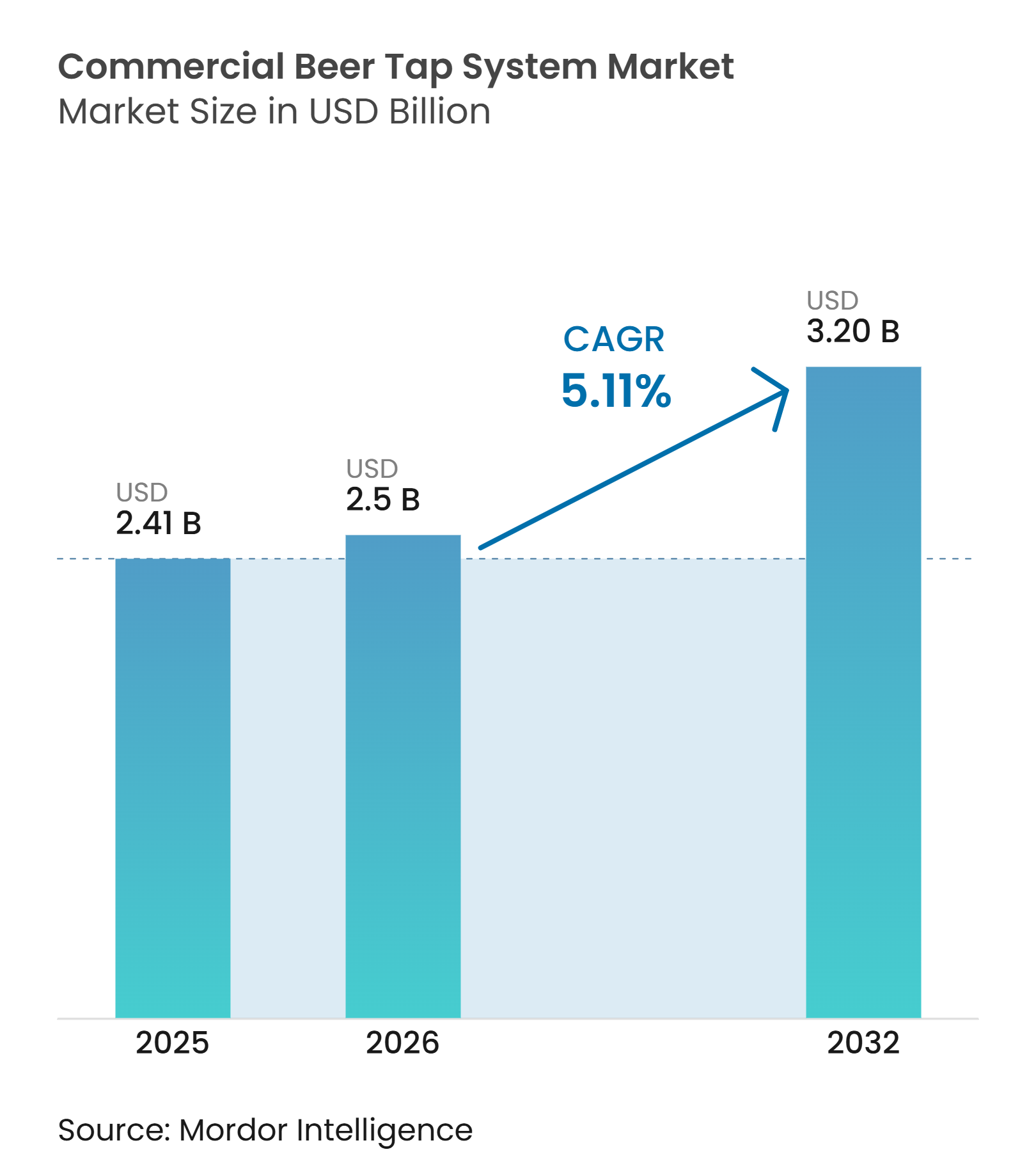
| Market Size (2026) | USD 2.5 Billion |
| Market Size (2032) | USD 3.20 Billion |
| Growth Rate (2026 - 2032) | 5.11 % |
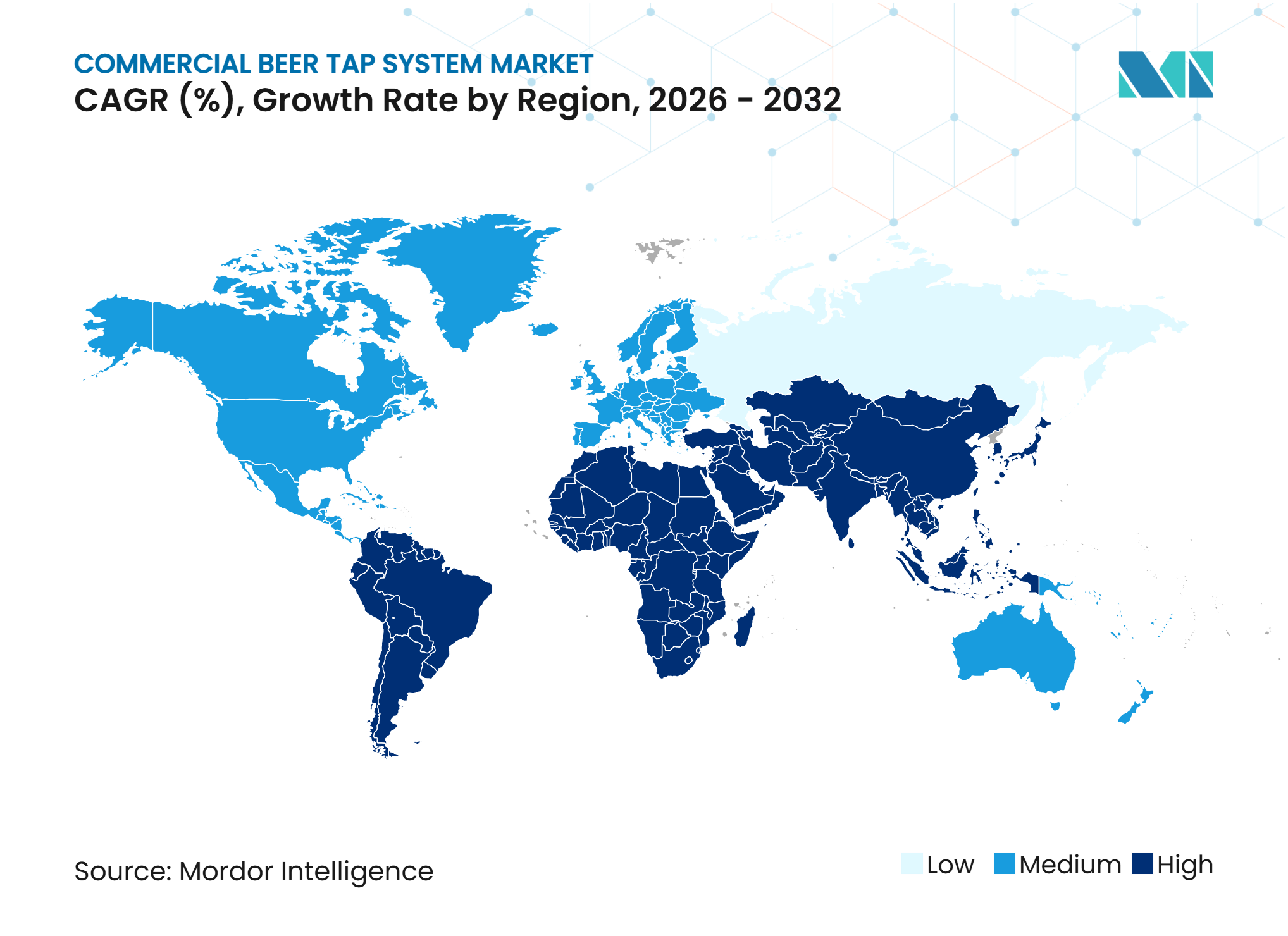
| Fastest Growing Market | Europe |
| Largest Market | Asia-Pacific |
| Market Concentration | Medium |
Major Players *Disclaimer: Major Players sorted in no particular order Image © Mordor Intelligence. Reuse requires attribution under CC BY 4.0. | |
Commercial Beer Tap System Market Analysis by Mordor Intelligence
The commercial beer tap system market size is valued at USD 2.41 billion in 2026 and is forecast to reach USD 3.20 billion by 2032, growing at a CAGR of 5.11% from 2027 to 2032. Demand is moving toward higher-value dispensing equipment that links mechanical performance with cleaning, inventory, and point-of-sale workflows. Recovery in on-premise hospitality supports replacement purchases, while premium draft programs raise the value of reliable temperature control and better pour quality. Equipment suppliers are also seeking recurring revenue from service and data tools rather than depending only on hardware sales. The commercial beer tap system market is shaped by a tension between demand for advanced systems and the cost burden faced by independent venues. Carbon dioxide supply uncertainty and the expense of long-draw installations can slow adoption, but they also encourage interest in nitrogen-compatible and modular formats.
Key Report Takeaways
-
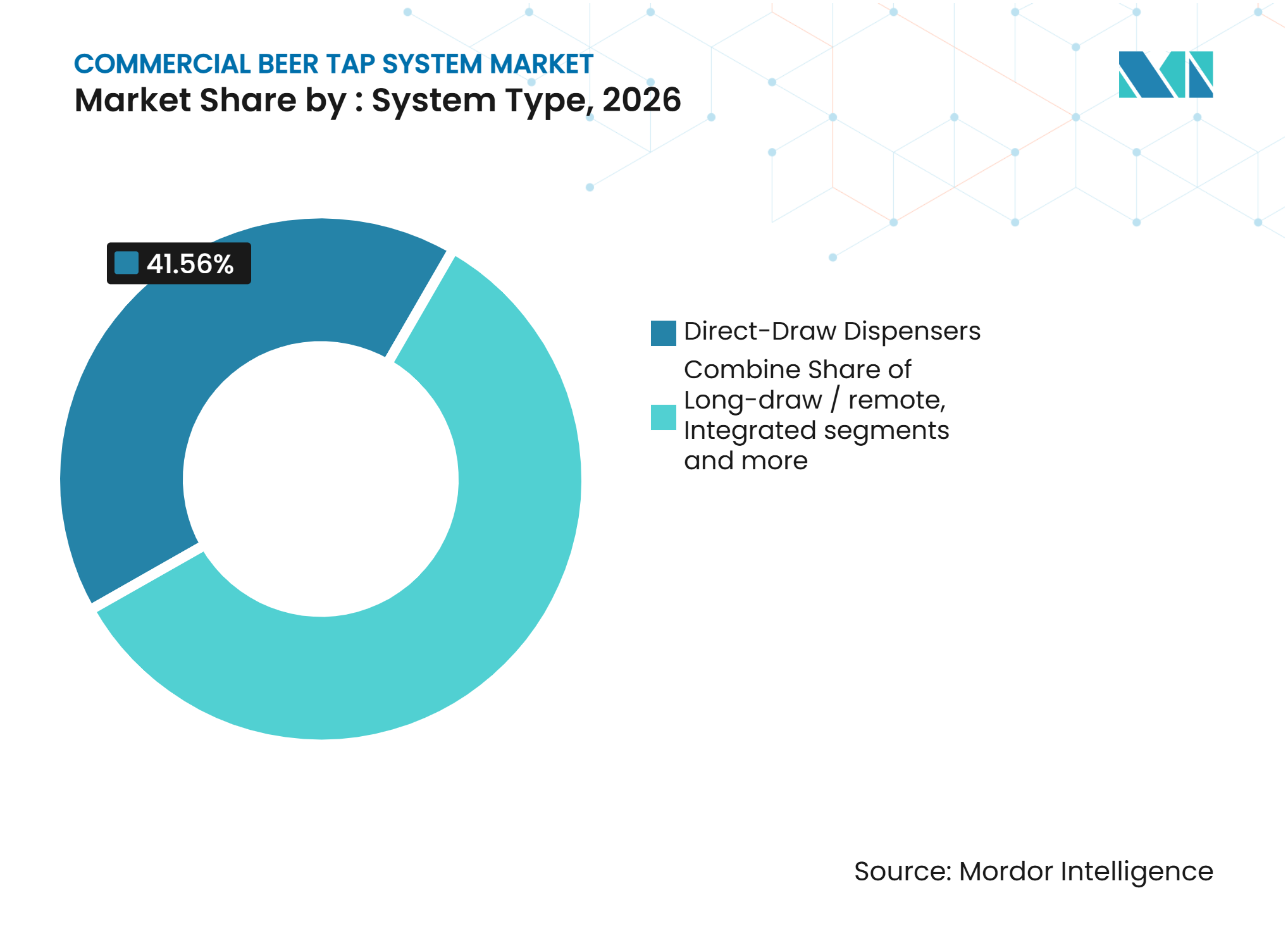
By system type, direct-draw dispensers held 41.56% of the commercial beer tap system market share in 2026, while long-draw and remote dispensing systems are forecast to grow at a 6.06% CAGR through 2032.
-
By dispensing capacity, multi-tap systems held 36.25% of the commercial beer tap system market share in 2026, while beer towers and high-capacity systems are forecast to grow at a 6.21% CAGR through 2032.
-
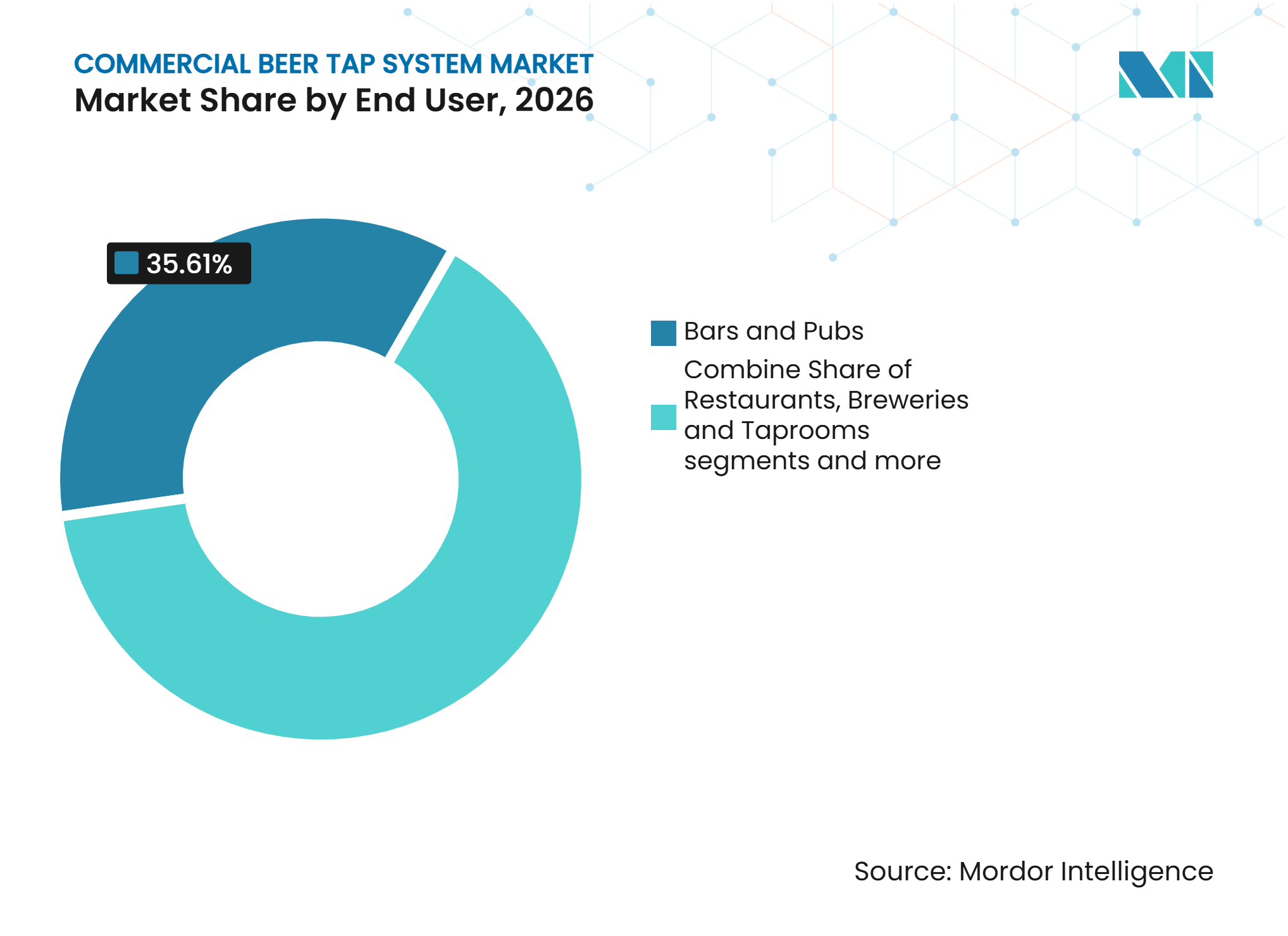
By end user, bars and pubs held 35.61% of the commercial beer tap system market share in 2026, while breweries and taprooms are forecast to grow at a 7.44% CAGR through 2032.
-
By distribution channel, beverage equipment wholesalers and distributors held 74.56% of the commercial beer tap system market share in 2026, while direct sales and manufacturer-managed projects are forecast to grow at a 7.32% CAGR through 2032.
-
By geography, Europe held 35.64% of the commercial beer tap system market share in 2026, while Asia-Pacific is forecast to grow at a 7.67% CAGR through 2032.
Note: Market numbers in this report are based on Mordor Intelligence's proprietary estimation framework, which combines nine months of actuals with Q4 projections for base year 2026.
Market Trends and Insights
Craft Brewery and Taproom Expansion Sustains Equipment Demand Despite Volume Headwinds
The commercial beer tap system market benefits from the continued role of taprooms and brewpubs in the United States craft beer base. The Brewers Association reported 9,269 operating craft breweries in the United States in mid-2025. Taprooms and brewpubs represented 73% of craft businesses, although they accounted for 15% of craft beer volume[1]. This structure favors compact systems that are easy to clean and fit within limited serving areas. Direct-draw units and two-to-four-tap systems meet those needs better than larger remote installations. The 300 United States craft brewery openings reported for 2025 maintained a base level of equipment demand even as the sector consolidated[2].
Premiumization Restructures Tap Lists and Raises System Complexity
Premium and super-premium draft beer programs increase the technical requirements of dispensing equipment in the commercial beer tap system market. These programs require controlled serving temperatures, suitable draw lengths, and regular line maintenance to protect product quality. A broader tap list can therefore raise the value of systems that support several products with consistent dispensing conditions. The effect is especially relevant in Europe, North America, Australia, and South Korea, where premium beer programs are well established. Higher system complexity can increase initial spending, but it also supports maintenance and service work for suppliers. Venues seeking more reliable pours have a reason to consider glycol-cooled long-draw systems even when their upfront cost is higher.
Hospitality Venue Renovation and Aging Infrastructure Replacement
Renovation activity gives the commercial beer tap system market a near-term replacement opportunity in Europe and North America. Older pub installations can become harder to maintain and less suited to current cleaning and dispensing practices. Wells & Co committed GBP 400,000 (USD 503,000) to renovate 2 Bordeaux pub sites in France in early 2025. Budweiser Brewing Group deployed its Budweiser Ultimate Dispense System, known as BUDS, across London venues in March 2025. The company reported more than 98% pour-quality compliance across 500,000 pints and introduced automated 4-week line-cleaning cycles[3]. These projects show how modernization can reset expectations for cleaning records and operating quality.
Tap-Level Yield Analytics Create a New Commercial Return Case for System Upgrades
Tap-level analytics create a separate reason to upgrade equipment in the commercial beer tap system market. BarTrack and Micro Matic introduced Smart Glycol Monitoring in February 2025. The system uses sensors to track ambient temperature, glycol temperature, and compressor health, then sends alerts through a centralized dashboard before service is affected[4]. This approach connects system maintenance with loss prevention and operating control. It also makes equipment suppliers more involved in a venue's daily workflow. Perlick's 2025 BevChek Telemetry System update similarly extended the use of predictive analytics and smart alerts in draft service.
High Installation and Lifecycle Costs for Long-Draw Systems
Long-draw glycol-cooled systems can remain beyond the financial reach of many independent operators. A full installation can require trunk lines, gas-blending equipment, compressors, and calibration work. These needs make the purchase decision more difficult for small pubs and restaurants. The constraint is stronger in markets where cold-chain infrastructure is fragmented, including India and Vietnam. Large chains, stadiums, casino resorts, and hotel complexes can spread the investment across greater sales volumes. The commercial beer tap system market therefore retains a wide difference between compact direct-draw demand and higher-value long-draw projects, particularly where venue scale and available capital diverge sharply.
Carbon Dioxide Availability, Pressure-Control Complexity, and Gas-Safety Exposure
Carbon dioxide, written as CO₂, supply conditions can interrupt draft service and add cost pressure for operators. This issue is particularly relevant in the United Kingdom, Western Europe, New Zealand, and parts of North America. A disruption can affect both the cost of gas and the ability of a venue to serve carbonated draft beer. Larger operators can respond through nitrogen-compatible equipment and dual-gas regulators. Smaller venues may face both gas expenses and the capital cost of replacement equipment. Proper regulator calibration and manifold maintenance also remain important because cellar gas systems have workplace safety implications.
Commercial Beer Tap System Market Segment Analysis
By System Type:
Long-Draw Systems Lead Growth as Analytics Drive AdoptionDirect-draw dispensers accounted for 41.56% of the commercial beer tap system market share in 2026. Their position reflects lower installation cost, simpler upkeep, and a practical fit with taprooms and smaller venues. These venues often favor a compact footprint over maximum throughput. Two-to-four-tap configurations can provide adequate choice without the infrastructure needed for remote systems. Direct-draw equipment also matches the operating needs of new craft venues where rapid setup and regular cleaning are important.
Long-draw and remote dispensing systems are forecast to expand at a 6.06% CAGR from 2027 to 2032. The commercial beer tap system market size for this system type benefits from larger entertainment spaces, including stadiums, arenas, casino resorts, and hotel complexes. Those venues need beer to travel longer distances while retaining serving temperature. Long-draw projects usually carry higher contract values and greater service needs than direct-draw units. Porifera introduced Draftfox at Drinktec in Munich, Germany, in September 2025, presenting a beer concentration and micro-keg approach intended to operate without traditional cellar infrastructure. Portable systems also remain relevant for festivals and temporary venues that need modular dispensing without permanent installation.



By Dispensing Capacity:
Beer Towers Pull Premium Spend at High-Volume VenuesMulti-tap systems held 36.25% of the commercial beer tap system market share in 2026. Their position reflects the need for variety in venues where the beer list influences dwell time and spending. A larger number of taps allows bars and pubs to accommodate craft, premium, and imported offerings. The configuration is especially useful where consumers expect regular rotation in the drinks list. Single-tap systems remain suitable for small independent bars and casual dining outlets. Double-tap systems serve smaller restaurants and hotel bars that are introducing draft beer service.
Beer towers and high-capacity systems are forecast to grow at a 6.21% CAGR through 2032. The commercial beer tap system market size for this category is supported by sports and entertainment venues that must serve many guests in short intervals. Micro Matic opened its second Perfect Pour location at Honda Center in Anaheim, California, in November 2025. The 24-tap, radio-frequency identification-enabled station was designed to pour a beer in less than 20 seconds and process several purchases in one transaction through ValidFill technology. Such systems make speed, pour control, and payment flow part of the dispensing proposition. This encourages venue operators to treat the tap station as a high-throughput service point rather than only a beverage fixture.
By End User:
Breweries and Taprooms Outperform Despite Sector ConsolidationBars and pubs captured 35.61% of the commercial beer tap system market share in 2026. Their extensive installed base and recurring upgrade needs sustain equipment purchases. Many sites replace components or systems as cleaning, service quality, and product range requirements change. Pub operators also need systems that can be serviced without long periods of disruption. Renovation activity in established beer-serving regions supports this replacement pattern. The commercial beer tap system market continues to rely on this large base of everyday on-trade accounts.
Breweries and taprooms are forecast to grow at a 7.44% CAGR from 2027 to 2032. The Brewers Association reported that brewpub volume declined 1.7% in 2025, while distribution-focused microbreweries declined 8.9%. On-site brewers still purchase dispensing equipment as part of a hospitality revenue model rather than solely as a production cost. Stadiums, arenas, and other large venues are also visible users of advanced systems. Pubinno's United Kingdom deployments at Lord's Cricket Ground and Tottenham Hotspur Stadium in September 2025 reported up to 99% keg efficiency and 80% shorter queue times. Hotels, resorts, and casinos typically have larger individual projects because they may specify long-draw glycol systems across several service areas.

By Distribution Channel:
Direct Sales Accelerate as Manufacturers Pursue Installed-Base OwnershipBeverage equipment wholesalers and distributors held 74.56% of the commercial beer tap system market share in 2026. This channel reflects the importance of regional product selection, installation support, and service logistics. Smaller and mid-sized operators often depend on a local distributor with certified technicians. Wholesale partners can provide access to equipment in markets where manufacturers do not maintain direct service coverage. They therefore remain important even as technology suppliers seek closer relationships with customers. The distributor channel is likely to remain the standard route for many independent hospitality accounts.
Direct sales and manufacturer-managed projects are forecast to grow at a 7.32% CAGR through 2032. Connected systems create a reason for manufacturers to manage the relationship after installation. When a system includes Internet of Things monitoring, point-of-sale integration, and analytics, the supplier can provide continuing support and data services. Middleby formed its Brewing & Distilling Solutions Group in March 2025, combining Wild Goose Filling, NexDraft, Cervizi, Meheen, Deutsche Beverage, and Ss Brewtech in a coordinated organization. The move illustrates the value of offering equipment across brewing, processing, and dispensing. It also shows why full-line suppliers may pursue direct project management for larger accounts.
Geography Analysis
Europe
Europe held 35.64% of the commercial beer tap system market share in 2026. The region includes the United Kingdom, Germany, France, Belgium, and the Netherlands, where draft beer culture, pub density, and replacement needs support demand. The United Kingdom shows the role of renovation, with Wells & Co committing GBP 400,000 (USD 503,000), to 2 Bordeaux pub renovations in France in early 2025. Budweiser Brewing Group also rolled out BUDS in London in March 2025, combining automated line cleaning with tap-level analytics. Germany's beer hall formats favor durable systems that handle high serving volumes. In Austria, Redl deployed SILEXA at the renovated Bierstadl Wien in 2025, using automated keg switching and a touchscreen-operated 8-line system. The Nordic countries are also becoming more active in automated dispensing because higher labor costs strengthen the case for self-service technology.
Asia-Pacific
Asia-Pacific is forecast to grow at a 7.67% CAGR from 2027 to 2032. Urbanization, modern hospitality development, and increasing craft and premium draft beer availability support the commercial beer tap system market size in the region. India, Vietnam, and the Philippines have a growing base of brewpubs and craft-focused venues. Japan has a high on-trade draft beer presence and is adopting automated dispensing technology. Itochuu Machine Technos made Pubinno's Artificial Intelligence Smart Tap commercially available in Japan in 2025 and stated that it can deliver per-keg cost savings of up to 20% through robotic pour control and remote monitoring. South Korea's on-trade beer culture and Australia's large pub estate support replacement demand for premium long-draw systems. Direct-draw equipment remains suitable for the many smaller venues in the region because it lowers installation complexity.
Middle East & Africa, South America and North America
The United Arab Emirates and South Africa are the main commercial markets in the Middle East and Africa. Dubai's hotel and entertainment districts support demand for premium dispensing systems, while Nigeria remains early-stage because infrastructure investment is still limited. Brazil is the primary South American market, with premium draft potential concentrated in São Paulo and Rio de Janeiro. Heineken's Evergreen 2030 strategy identifies emerging markets as central to its on-trade expansion and partnership approach. That approach can support brewer-led investment in on-trade infrastructure across Latin America and Africa. Peru, Chile, and Argentina have smaller craft beer scenes that create local demand for compact systems. These mixed regions offer growth opportunities, but distributor reach and venue investment will remain central to adoption.
Competitive Landscape
Market Concentration
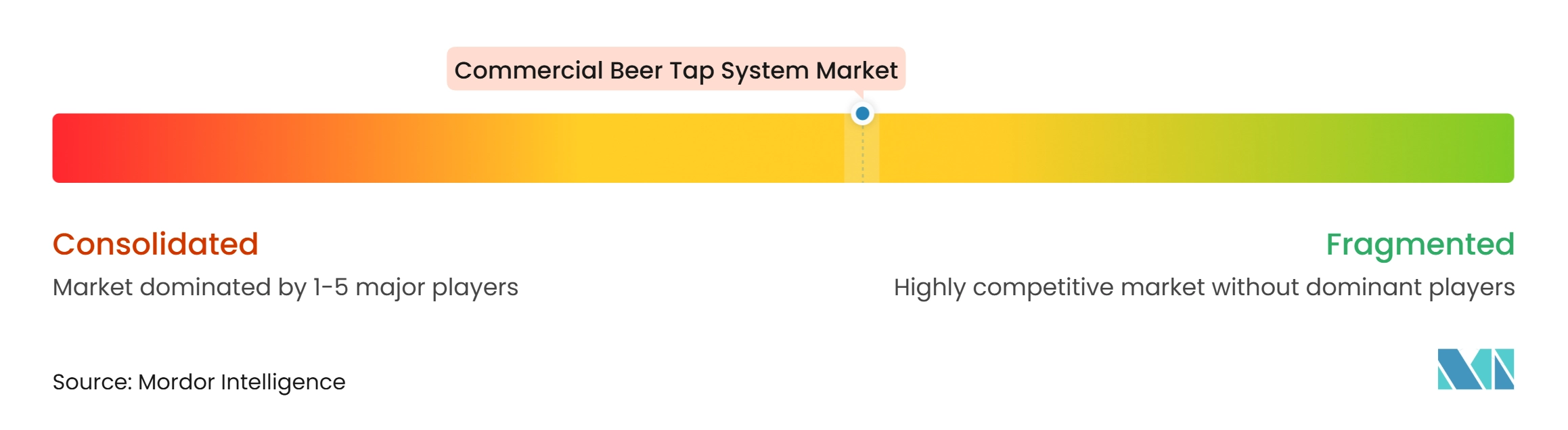
The commercial beer tap system market is moderately fragmented in hardware, while connected dispensing platforms are becoming more concentrated. Micro Matic, Perlick, and Middleby Draft Innovations are visible equipment suppliers, while iPourIt, Pubinno, and BarTrack focus on connected and self-pour platforms. The difference between these groups is increasingly defined by software, sensor data, and service capability. Hardware components face pricing pressure when they are viewed as interchangeable. Suppliers can differentiate their offer by linking dispensing equipment to inventory, point-of-sale, cleaning, and maintenance workflows. This makes system integration as relevant as mechanical accuracy for many larger customers, especially where operators need reliable service records and faster operational response.
Micro Matic expanded its connected offering through the February 2025 Smart Glycol Monitoring partnership with BarTrack. It followed this with the November 2025 Perfect Pour deployment at Honda Center in Anaheim, California. iPourIt installed a 50-tap self-pour wall at The Hub Stadium in Novi, Michigan, in October 2025, using radio-frequency identification wristbands and point-of-sale integration. iPourIt also launched its Digital Chalkboard in June 2025 to synchronize tap lists and promotional displays with its tap database. These actions reflect a focus on recurring software and data services around the physical dispenser.
A gap remains between enterprise stadium systems and smaller independent operators that use non-networked equipment. Modular analytics products that work with legacy hardware may be relevant for this middle group, especially in European renovation projects. Porifera's Draftfox, launched at Drinktec in Munich, Germany, in September 2025, offers an alternative to the conventional keg and long-draw model. The system uses Forward Osmosis technology and micro-kegs that are 90% smaller and lighter than conventional kegs. Its approach may reduce cellar requirements at venues with limited space. Competition is therefore moving toward low-waste dispensing, predictive maintenance, and easier integration with existing venue operations.
Commercial Beer Tap System Industry Leaders
-
Micro Matic A/S
-
Perlick Corporation
-
UBC Group USA
-
Lancer Worldwide
-
Krowne Metal Corporation
- *Disclaimer: Major Players sorted in no particular order
Commercial Beer Tap System Market Companies Covered in this Report
- Micro Matic
- Krome Dispense Pvt. Ltd.
- Berg
- UBC Group USA
- Duotank
- Lancer Worldwide
- Middleby Draft Innovations
- Talos Technology Corporation
- Chill Passion
- American Beverage Equipment Company
- Perlick Corporation
- Krowne Metal Corporation
- Glastender, Inc.
- Taprite
- McDantim, Inc.
- Automatic Bar Controls, Inc. / Wunder-Bar
- Beerjet GmbH
- Bottoms Up Draft Beer Systems
- iPourIt, Inc.
- Table Tap
Recent Industry Developments in Commercial Beer Tap System Market
- October 2025: iPourIt installed a 50-tap self-pour beverage wall at The Hub Stadium in Novi, Michigan, featuring beer, wine, craft cocktails, and nitro cold brew taps operated via radio-frequency identification wristbands. The system handles peak events of 400 to 800 guests with automated pour tracking and point-of-sale integration.
- September 2025: Pubinno entered the United Kingdom with deployments at Lord's Cricket Ground and Tottenham Hotspur Stadium. Its Artificial Intelligence-powered Smart Tap platform reported up to 99% keg efficiency and 80% queue-time reductions at Lord's Cricket Ground through a TapPay self-service collaboration.
- July 2025: EBar secured contracts with 5 Premier League football stadiums, including Brighton & Hove Albion, for its Beerwall automated self-serve system. The company reported 200 pints per hour and a 200% production-capacity increase through its partnership with PP Control & Automation
- March 2025: Middleby Corporation formed the Middleby Brewing & Distilling Solutions Group, consolidating Wild Goose Filling, NexDraft, Cervizi, Meheen, Deutsche Beverage, and Ss Brewtech under a coordinated go-to-market structure
Global Commercial Beer Tap System Market Report Scope
Segmentation Overview
| Direct-Draw Dispensers |
| Long-draw / remote dispensing systems |
| Integrated commercial dispensing units |
| Portable / temporary commercial systems |
| Single-Tap Systems |
| Double-Tap Systems |
| Multi-tap Systems |
| Beer towers / high-capacity systems |
| Bars and Pubs |
| Restaurants |
| Breweries and Taprooms |
| Hotels, Resorts, Casinos, and Leisure Groups |
| Stadium, Arena, and Venue Operators |
| Other Commercial End Users |
| Direct Sales and Manufacturer-Managed Projects |
| Beverage Equipment Wholesalers and Distributors |
| North America | Canada |
| United States | |
| Mexico | |
| South America | Brazil |
| Peru | |
| Chile | |
| Argentina | |
| Rest of South America | |
| Europe | United Kingdom |
| Germany | |
| France | |
| Spain | |
| Italy | |
| BENELUX (Belgium, Netherlands, Luxembourg) | |
| NORDICS (Denmark, Finland, Iceland, Norway, Sweden) | |
| Rest of Europe | |
| Asia-Pacific | India |
| China | |
| Japan | |
| Australia | |
| South Korea | |
| South-East Asia | |
| Rest of Asia-Pacific | |
| Middle East & Africa | United Arab Emirates |
| Saudi Arabia | |
| South Africa | |
| Nigeria | |
| Rest of Middle East & Africa |
| By System Type | Direct-Draw Dispensers | |
| Long-draw / remote dispensing systems | ||
| Integrated commercial dispensing units | ||
| Portable / temporary commercial systems | ||
| By Dispensing Capacity | Single-Tap Systems | |
| Double-Tap Systems | ||
| Multi-tap Systems | ||
| Beer towers / high-capacity systems | ||
| By End User | Bars and Pubs | |
| Restaurants | ||
| Breweries and Taprooms | ||
| Hotels, Resorts, Casinos, and Leisure Groups | ||
| Stadium, Arena, and Venue Operators | ||
| Other Commercial End Users | ||
| By Distribution Channel | Direct Sales and Manufacturer-Managed Projects | |
| Beverage Equipment Wholesalers and Distributors | ||
| By Geography | North America | Canada |
| United States | ||
| Mexico | ||
| South America | Brazil | |
| Peru | ||
| Chile | ||
| Argentina | ||
| Rest of South America | ||
| Europe | United Kingdom | |
| Germany | ||
| France | ||
| Spain | ||
| Italy | ||
| BENELUX (Belgium, Netherlands, Luxembourg) | ||
| NORDICS (Denmark, Finland, Iceland, Norway, Sweden) | ||
| Rest of Europe | ||
| Asia-Pacific | India | |
| China | ||
| Japan | ||
| Australia | ||
| South Korea | ||
| South-East Asia | ||
| Rest of Asia-Pacific | ||
| Middle East & Africa | United Arab Emirates | |
| Saudi Arabia | ||
| South Africa | ||
| Nigeria | ||
| Rest of Middle East & Africa | ||
Key Questions Answered in the Report
What is the forecast growth rate for commercial beer tap systems?
The commercial beer tap system market is forecast to grow at a 5.11% CAGR from 2027 to 2032 and reach USD 3.20 billion by 2032.
Which commercial beer tap system type has the largest share?
Direct-draw dispensers led system type demand with a 41.56% share in 2026 because of their lower installation cost and simpler maintenance needs.
Which end users are driving demand for draft beer equipment?
Bars and pubs held 35.61% of demand in 2026, while breweries and taprooms are forecast to grow at a 7.44% CAGR through 2032.
Why are long-draw beer dispensing systems gaining adoption?
Long-draw systems are forecast to grow at a 6.06% CAGR because large venues need temperature-controlled dispensing across longer distances.
Which region is growing fastest for commercial beer tap systems?
Asia-Pacific is forecast to grow at a 7.67% CAGR from 2027 to 2032, supported by modern hospitality development and rising craft and premium draft beer availability.