
Colombia Turf Protection Market Size and Share
Market Overview
| Study Period | 2021 - 2031 |
|---|---|
| Forecast Data Period | 2026 - 2031 |
| Base Year Market Size (2025) | USD 49.18 Million |
| Market Size (2026) | USD 51.59 Million |
| Market Size (2031) | USD 68.39 Million |
| Growth Rate (2026 - 2031) | 5.80 % |
| Market Concentration | Medium |
Major Players *Disclaimer: Major Players sorted in no particular order Image © Mordor Intelligence. Reuse requires attribution under CC BY 4.0. | |
Colombia Turf Protection Market Analysis by Mordor Intelligence
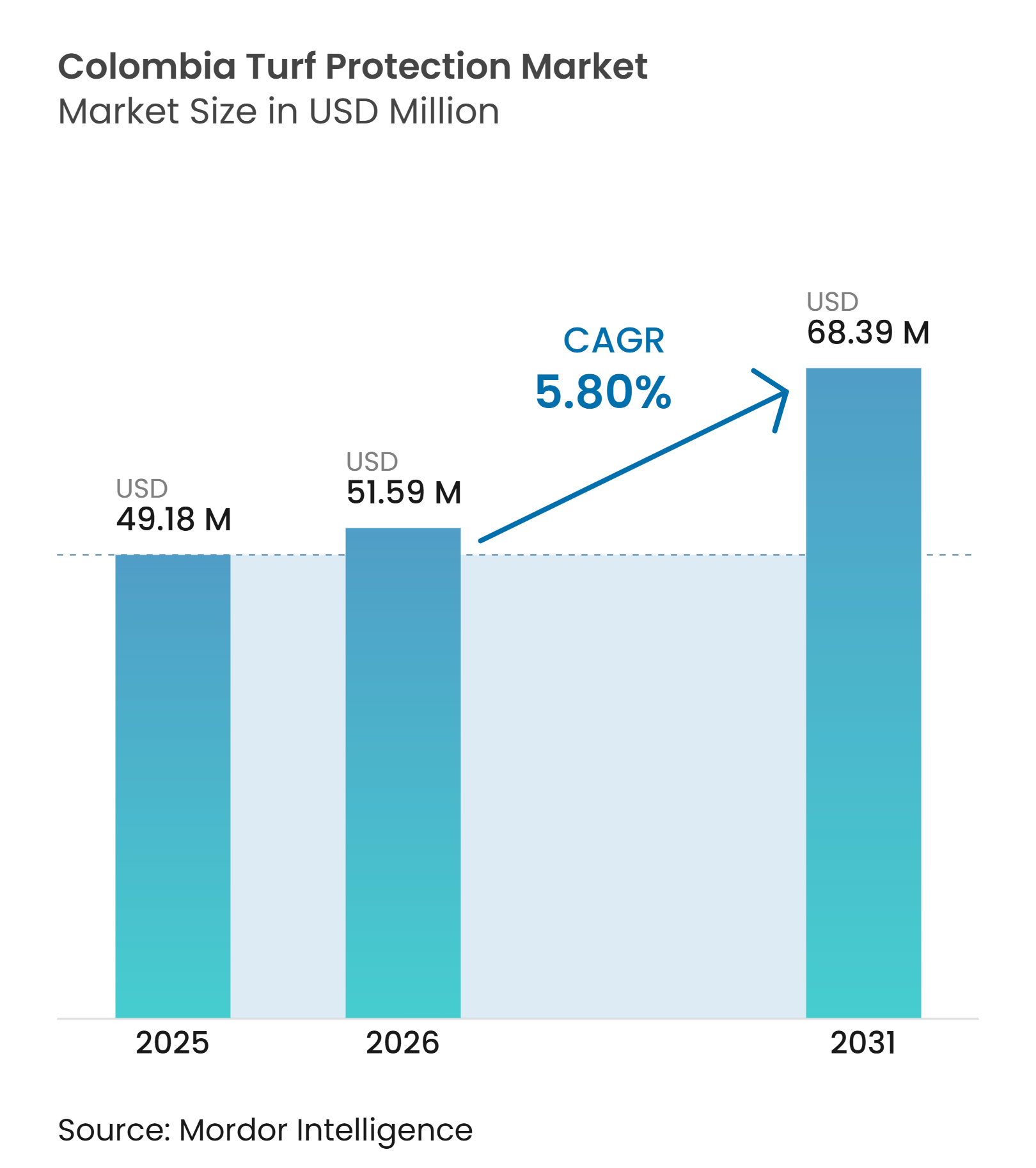
The Colombia turf protection market size was valued at USD 49.18 million in 2025 and is estimated to grow from USD 51.59 million in 2026 to reach USD 68.39 million by 2031, at a CAGR of 5.80% during the forecast period (2026-2031). Demand is supported by sports venues, golf facilities, public green areas, and managed residential landscapes that require regular treatment throughout the year. Venue operators purchase products to maintain appearance, safety, recovery, and playing quality. Colombia's regional climate allows turf managers to maintain grass continuously, without pausing programs during a cold-season dormancy period. As a result, routine treatment demand is distributed across the calendar, and suppliers must support management needs in both highland and lowland environments. New venue projects favor suppliers that can address disease control, nutrition, and wear recovery within a single operating plan, making technical service and product availability important factors in procurement decisions. Registration obligations and uneven municipal budgets may limit purchasing in smaller cities. Biological products present an opportunity for suppliers that meet public-venue sustainability requirements, provide technical guidance, and operate through distribution channels capable of serving a fragmented mix of public and private turf sites [1].
Key Report Takeaways
- By product type, fungicides accounted for 34% of the Colombia turf protection market share in 2025, while biostimulants and bio-fertilizers are forecast to grow at a CAGR of 9.4% from 2026 to 2031.
- By application, landscaping accounted for 36% of the Colombia turf protection market size in 2025, while sports fields are forecast to grow at a CAGR of 8.9% from 2026 to 2031.
- By end user, residential customers accounted for 31% of the market share in 2025, while sports facility owners are forecast to grow at a CAGR of 8.7% from 2026 to 2031.
- By mode of action, chemical modes accounted for 69% of the market share in 2025, while biological modes are forecast to grow at the highest CAGR of 10.8% from 2026 to 2031.
- By formulation, liquid concentrate accounted for 57% of the market share in 2025 and is forecast to grow at a CAGR of 7.1% from 2026 to 2031.
Note: Market size and forecast figures in this report are generated using Mordor Intelligence’s proprietary estimation framework, updated with the latest available data and insights as of January 2026.
Market Trends and Insights
Drivers Impact Analysis of Colombia Turf Protection Market*
| Driver | (~) % Impact on CAGR Forecast | Geographic Relevance | Impact Timeline |
|---|---|---|---|
| Expansion of Sports Venues and Golf Facilities | +1.2% | Andean cities, including Bogotá, Medellín, and Cali, and the Caribbean coast, including Cartagena and Barranquilla | Short term (≤ 2 years) |
| Increasing Turf Disease Pressure in Warm Humid Zones | +0.9% | Caribbean lowlands, Pacific region, and Orinoquía | Medium term (2-4 years) |
| Shift Toward Biological and Integrated Programs | +1.0% | National, with early adoption at premium Bogotá and Medellín venues | Medium term (2-4 years) |
| Precision Irrigation and Sensor-Led Application | +0.7% | Andean high-altitude venues and commercial golf courses nationwide | Medium term (2-4 years) |
| Year-Round High-Altitude Turf Maintenance in Andean Cities | +0.8% | Bogotá, Medellín, Manizales, and Cali | Long term (≥ 4 years) |
| Import Availability of Locally Registered Low-Residue Actives | +0.6% | National, with port-entry concentration in Bogotá and Medellín | Short term (≤ 2 years) |
| Source: Mordor Intelligence | |||
Expansion of Sports Venues and Golf Facilities
Major stadium redevelopment and golf facility investment create recurring procurement needs for professional turf programs, rather than one-time demand limited to the period when surfaces are first installed. The USD 604 million El Campín Sports and Cultural Complex concession, signed in June 2024, specifies a FIFA-compliant hybrid pitch that requires year-round disease management, nutrition, and wear-recovery work, linking the site’s surface condition to the operating requirements of a major public sports and cultural complex. The PGA of America announced its Punta Coral partnership in Cartagena during February 2026, adding the first PGA-affiliated golf facility in South America to the venue base and introducing a premium course setting where consistent turf presentation is part of the visitor experience [2]. A coastal course operating under high humidity requires regular management of disease and turf quality, including treatment decisions that respond to rainfall, surface wear, and the expectations of visiting players. These projects generate demand in the Colombia turf protection market that is tied to operational standards rather than only to construction activity, because a new hybrid surface must continue to meet playing and presentation requirements after opening. They also favor suppliers able to support scheduled treatment programs across several turf management needs, from prevention and nutrition to recovery after intensive match schedules.
Increasing Turf Disease Pressure in Warm Humid Zones
Colombia’s varied climate creates a persistent disease burden at low-elevation turf venues, where warmth, humidity, and regular rainfall can maintain conditions favorable to pathogens for extended periods. A 2024 UNIPAZ study identified filamentous fungi, including Curvularia sp. and Nigrospora sp., on Poaceae grass surfaces in Barrancabermeja, Santander [3]. The findings are relevant to warm and humid conditions in Caribbean and Orinoquía lowlands, where managed grass must remain usable despite environmental conditions that support fungal development. Laboratory analysis cited in the supplied research identified Fusarium sp., Pseudomonas sp., Xanthomonas sp., and Pratylenchus sp. in samples from El Campín stadium. This mix of pathogens supports the use of fungicide and bioinput rotations instead of a single treatment approach, because operators need programs that address several potential causes of surface decline. It also sustains demand in the Colombia turf protection market where lower-altitude venues manage disease pressure for much of the year, particularly when regular use leaves little time for untreated surfaces to recover.
Shift Toward Biological and Integrated Programs
Biological and integrated programs are becoming more prominent in turf procurement, especially where venues need to demonstrate a reduced reliance on synthetic-only treatment programs. Colombia’s Ministry of Agriculture adopted Resolution 295 in 2025, establishing a framework for bioinputs, organic fertilizers, and soil conditioners. The framework supports the replacement of synthetic-only programs where suitable alternatives are available, giving suppliers a policy basis for presenting biological products alongside conventional treatments. Syngenta expanded its agreement with Botanical Solution Inc. in 2026 to distribute Quillibrium, a botanical biofungicide for turf and ornamental uses across the Americas. Public concessions increasingly require reduced-synthetic-pesticide commitments, making biological rotations relevant to contract compliance and giving grounds teams a reason to document the products used near visitors and spectators, even when chemical products remain necessary within an integrated program for difficult disease conditions. This shift gives the Colombia turf protection market a route for growth in specialty products that can support performance and sustainability requirements without removing the need for disease control at intensively managed sites.
Precision Irrigation and Sensor-Led Application
Sensor-integrated irrigation is changing how managed turf programs are scheduled, as grounds teams can link product application windows more closely to measured soil moisture and expected precipitation. A 2024 study in Ingeniería y Competitividad found that IoT-based soil-moisture monitoring reduced water use across Colombian crop sites. The method is relevant to turf because irrigation timing affects fungicide and fertilizer application schedules, including whether a product will remain on the treated surface long enough to deliver the intended result. The supplied research identifies sensor platforms that use soil-moisture and precipitation data to support irrigation decisions at managed sites, including properties where water availability, site access, and the timing of field operations affect the practical use of protection and nutrition products. More targeted applications can reduce the volume used per hectare while raising the importance of products that deliver reliable results, since managers using recorded data have a clearer basis for assessing program performance. The Colombia turf protection market can therefore shift toward specialized products when agronomic advisers use sensor data to guide treatments, particularly at golf courses and major venues that can invest in monitoring equipment.
Restraints Impact Analysis of Colombia Turf Protection Market*
| Restraint | (~) % Impact on CAGR Forecast | Geographic Relevance | Impact Timeline |
|---|---|---|---|
| ICA Registration and Re-Evaluation Burden | -1.1% | National, with centrally managed registration and turf-specific label extensions affecting all regions | Medium term (2-4 years) |
| Fragmented Municipal Procurement and Maintenance Budgets | -0.9% | Secondary cities, smaller municipalities, and school districts nationwide | Short term (≤ 2 years) |
| Water and Environmental Stewardship Requirements | -0.8% | Andean cities, Caribbean coastal zones, and the Pacific corridor | Long term (≥ 4 years) |
| Limited Local Data on Turf Pest Thresholds | -0.7% | National, with concentration in non-Andean lowland and Orinoquía zones | Long term (≥ 4 years) |
| Source: Mordor Intelligence | |||
ICA Registration and Re-Evaluation Burden
ICA compliance requirements can delay product introductions and turf-specific label extensions, affecting suppliers seeking to adapt existing agricultural portfolios to the smaller, specialized turf customer base. Only 613 of Colombia’s 2,797 registered agricultural pesticides, or 21.9%, had completed mandatory harmonized-labeling adaptation by late 2024, indicating the scale of the administrative process that product registrants still needed to complete before updated labels could be used. Resolution 00020474 set December 30, 2026, as the deadline for Class II and Class III pesticide label updates. Registrants must allocate additional resources to remain compliant or risk suspension, creating administrative demands that can compete with spending on local commercial support and technical education. Multinational suppliers may face product timelines of 12 to 24 months, which can make a Colombia-specific turf extension less attractive than a larger agricultural application, particularly when sales volumes are distributed across many smaller venues and local distributors. As a result, the Colombia turf protection market may see slower access to some newly developed active ingredients.
Fragmented Municipal Procurement and Maintenance Budgets
Municipal procurement cycles can delay professional turf treatment at public parks and community sports fields, even when operators recognize the need for more consistent maintenance. Annual appropriations and midyear corrections make multi-season programs harder for municipal operators to commit to, reducing visibility for distributors planning inventory and service coverage. A 2026 SECOP II tender for La Ceja del Tambo, Antioquia, carried a value of COP 49 million (USD 11,000) for turf maintenance. This amount illustrates why direct participation by multinational suppliers can be limited in smaller municipalities, where the likely order size may not justify dedicated technical support, direct sales activity, or the administrative cost of a tailored supply arrangement. The research indicates that Colombia's four largest cities provide the procurement scale for more structured maintenance programs. Budget volatility can therefore shift the Colombia turf protection market toward generic or informal-channel inputs in smaller cities.
*Our forecasts treat driver/restraint impacts as directional, not additive. The impact forecasts reflect baseline growth, mix effects, and variable interactions.
Colombia Turf Protection Market Segment Analysis
By Product Type:
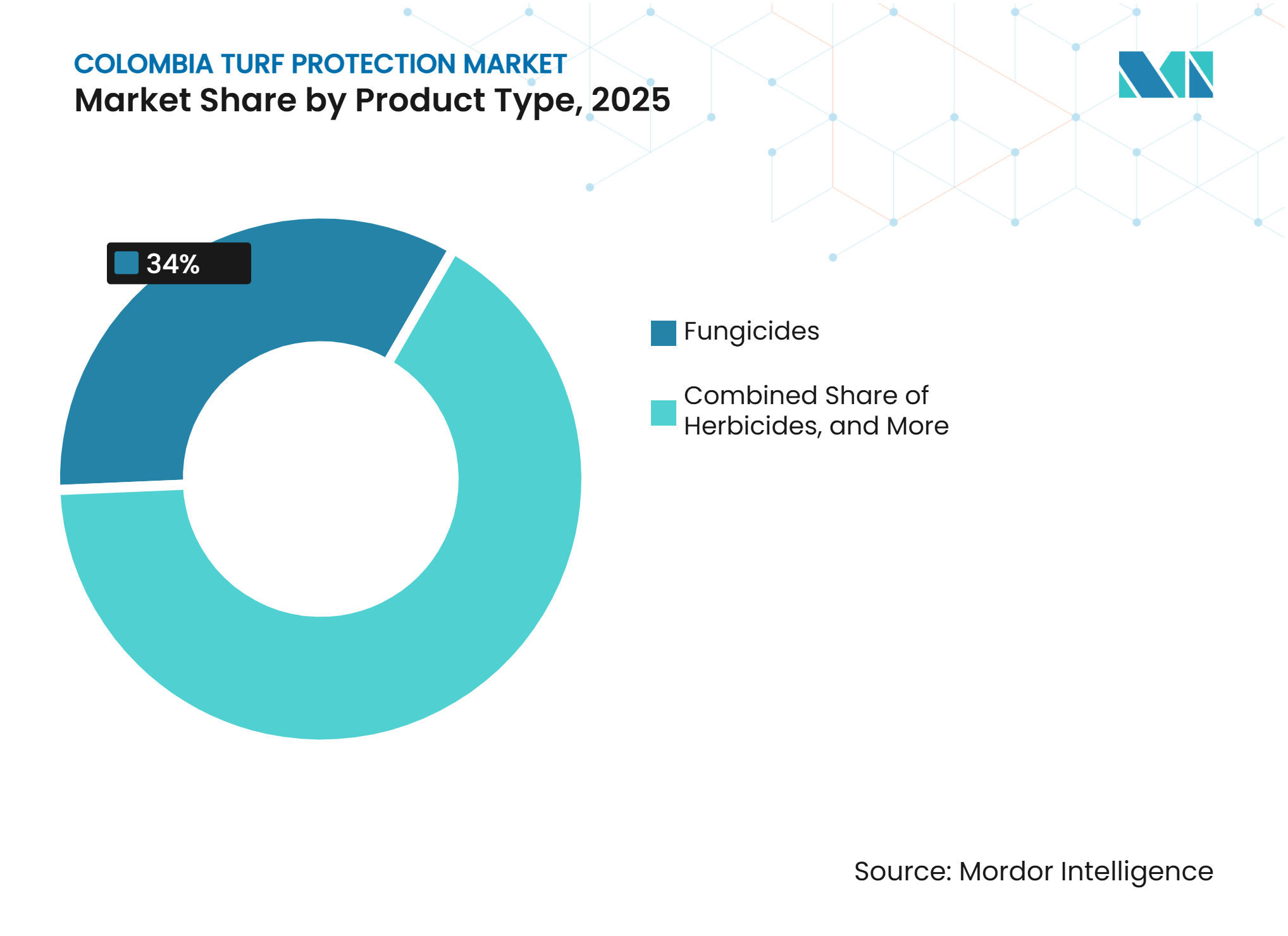
Fungicides Lead, While Biostimulants and Bio-fertilizers Grow FastestFungicides accounted for 34% of the market value in 2025 and formed the largest product category. Disease prevention and curative treatment remain regular requirements at sports fields, golf facilities, public grounds, and private landscaped areas. The category serves low-altitude Caribbean, Pacific, and Orinoquía conditions where Pythium blight, brown patch, and Fusarium patch require curative and preventive treatment rotations, rather than occasional responses after visual damage has appeared on the grass surface. The Colombia turf protection market for fungicides remains supported by the need to protect playing surfaces and managed landscapes throughout the year, as operators in climates with persistent disease pressure cannot rely on extended periods of natural dormancy to reduce treatment needs. Plant growth regulators serve a niche role on golf greens and heavily used stadium pitches, where operators seek improved turf density, more uniform growth, and surfaces that recover after repeated use by players or visitors. These uses make fungicides and growth regulators central to programs that protect surface quality under regular use, particularly where facilities need to maintain a dense and visually consistent grass cover while limiting disruption to scheduled sporting or landscaping activity.
Biostimulants and bio-fertilizers are forecast to grow at a 9.4% CAGR from 2026 to 2031, the fastest rate among product types. The bioinput framework cited in the supplied research and sustainability specifications at premium venues support greater use of biological products, particularly when purchasers seek an option that complements existing disease-management programs. Corteva introduced Floxcor for more than 20 turf and ornamental diseases, while Syngenta expanded Quillibrium for turf uses in the Americas. These product actions support the specialty and biological part of the Colombia turf protection market.



By Application:
Landscaping Leads, While Sports Fields Grow FastestLandscaping represented 36% of the market value in 2025 and was the largest application. Managed green spaces in Bogotá, Medellín, Cali, and their metropolitan areas generate recurring demand from residential complexes, commercial campuses, and public plazas, where maintenance contractors purchase treatments to maintain appearance and usability year-round. Service contractors connect much of this demand to professional treatment schedules and provide a broad base for purchases through retail and landscaping supply channels. The broad application base supports landscaping’s leading position in the Colombia turf protection market.
Sports fields are forecast to grow at an 8.9% CAGR from 2026 to 2031, the fastest rate among application segments. El Campín, Estadio Metropolitano Roberto Meléndez, Murillo Toro, and Estadio Pascual Guerrero drive demand for higher-specification turf maintenance, as their playing surfaces must accommodate high usage while remaining suitable for competition requirements. The May 2026 Murillo Toro procurement process covered more than COP 1,149 million (USD 258,000) for Bermuda 419 natural grass and synthetic turf across several playing surfaces. Golf courses remain a smaller but higher-value application, as operators require consistent turf quality. Sod farms generate input use during propagation for pitches installed during stadium renovation projects, connecting grass production activity with the requirements of newly renovated sporting surfaces. These applications broaden the Colombia turf protection market beyond routine landscaping work by connecting recurring urban maintenance with the separate needs of competition venues, premium golf facilities, grass production sites, and surfaces that must be restored or prepared for demanding schedules.
By End User:
Residential Customers Lead, While Sports Facility Owners Grow FastestResidential customers accounted for 31% of the market value in 2025, making them the largest end-user segment. Homeowners and strata-managed complexes in Bogotá’s Sabana, Medellín’s metropolitan ring, and Cali’s growth areas purchase through hardware retailers and landscaping suppliers, giving the segment a dispersed customer base rather than reliance on a small number of contracts. Commercial landscape contractors aggregate this dispersed demand through recurring service agreements. Contractors also serve corporate campuses and manage product rotation schedules for clients, allowing professional buyers to consolidate product demand across many landscaped properties and recurring service visits. This provides suppliers with a channel for reaching many end users through a smaller group of regular purchasers. This combination gives the Colombia turf protection market a broad base of smaller purchases, while landscape contractors provide a more predictable channel for suppliers as they buy for several properties and use products under established maintenance schedules.
Sports facility owners are forecast to grow at an 8.7% CAGR from 2026 to 2031. Stadium construction and higher technical expectations at private golf clubs and multi-sport complexes support this growth, as facility managers need to maintain dependable grass conditions for organized events and frequent recreational use. Municipalities and schools face budget constraints that limit their ability to purchase professional inputs consistently. Bogotá’s IDRD allocated COP 70,500 million (USD 17.2 million) to park and venue maintenance in 2024, indicating the scale available at the largest institutional buyer. Institutional demand is therefore concentrated among a limited number of large urban buyers within the Colombia turf protection market.
By Mode of Action:
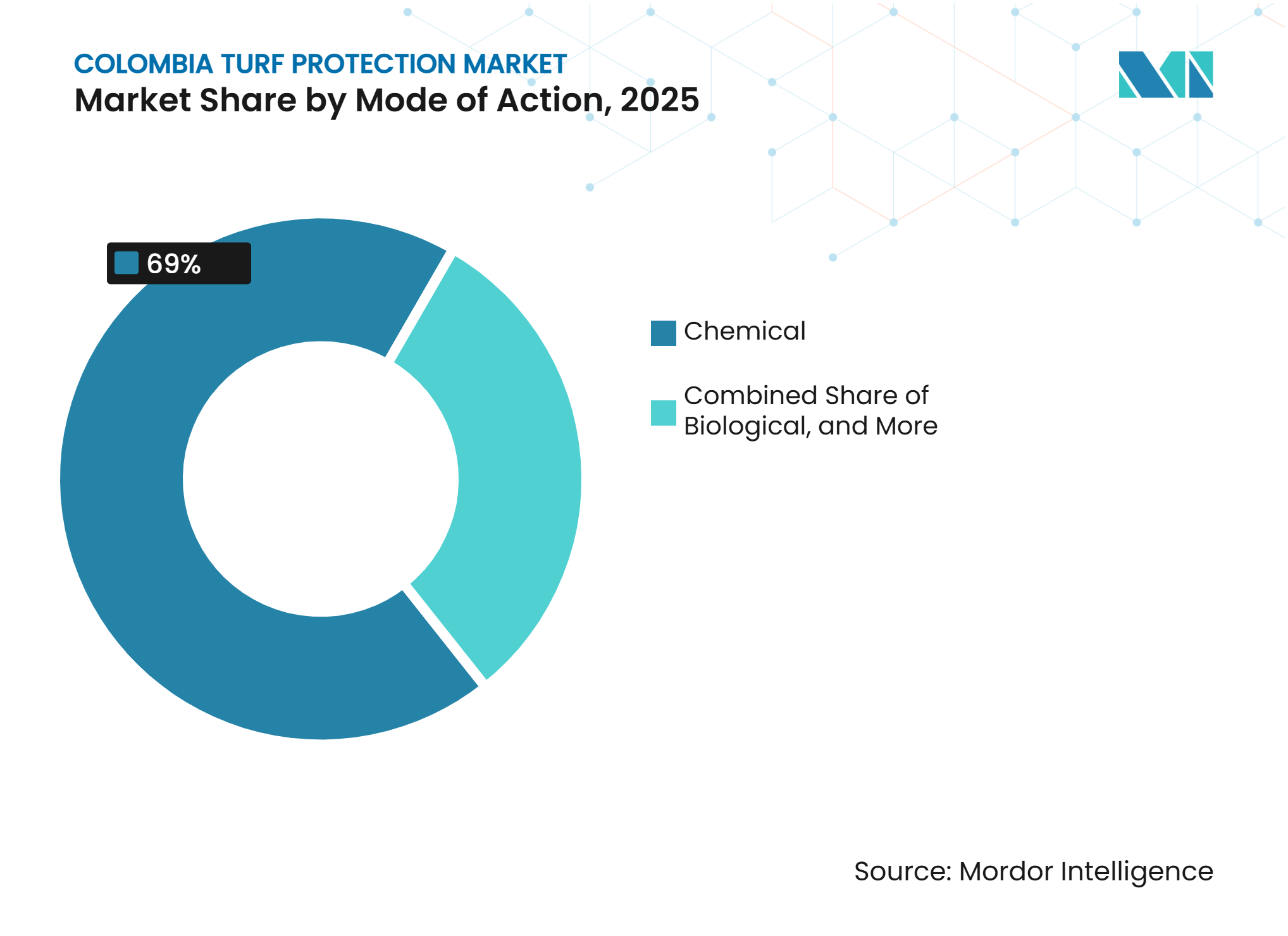
Chemical Products Lead, While Biological Products Grow FastestChemical accounted for 69% of the market value in 2025 and remained the leading mode of action. Their position reflects the range of active ingredients available through importers and the familiarity of landscape contractors with conventional formulations, which supports continued use where quick disease control and established application practices are important. Synthetic chemistry can also provide faster curative performance under intense tropical disease pressure. Integrated solutions combine chemical and biological components within structured resistance-management programs, giving suppliers a practical way to address treatment performance and evolving sustainability expectations within the same program. These factors keep chemical products important across the Colombia turf protection market, despite the faster growth of biological products, as many managed turf settings still require established curative options when disease pressure is high or surface quality declines quickly.
Biological are forecast to grow at a 10.8% CAGR from 2026 to 2031, the highest rate among the mode of action segments. Policy support under Resolution 295 and public-venue sustainability commitments support this direction. Visible pesticide use around spectators can create reputational concerns for public venues, especially where concession terms place greater attention on environmental stewardship and visitor experience. Envu's Fiata Boost microbial biostimulant and ICL's ProTurf and Sportsmaster biostimulant lines reflect the product positioning associated with biological adoption. Suppliers can use integrated programs to retain chemical performance while responding to changing procurement requirements.

By Formulation:
Liquid Concentrates Lead, While Growing Fastest in the MarketLiquid concentrate accounted for 57% of the market value in 2025 and is forecast to grow at a CAGR of 7.1% from 2026 to 2031, reflecting its fit with professional users that need to prepare treatment mixtures for different turf conditions and application areas. Precise dilution supports variable-rate application and compatibility with tank-mix biological programs. Flexible packaging also suits specialty distributors serving golf courses and stadium grounds teams with limited bulk storage, where products must be held safely and made available in quantities that fit scheduled maintenance work.
Granular formulations serve slow-release soil nutrition at sod farms and golf-course greens. The Andersons offers products such as Humic DG and Contec DG for these programs. Wettable powder retains a cost-focused role among smaller landscaping contractors in secondary cities. These buyers can prioritize cost per treated area over application convenience. The Colombia turf protection market therefore retains demand for several formulations even as liquid concentrate strengthens its lead, as purchasing choices depend on application equipment, storage capacity, cost priorities, soil-nutrition needs, and the technical experience of the contractor or grounds team.
Geography Analysis
The Andean region has the largest share of the Colombia turf protection market, supported by major cities, sports infrastructure, and continuous turf management. Bogotá's elevation of 2,600 meters and daily temperatures ranging from 7°C to 19°C support a continuous turf-management calendar. Cool-season grass cultivars in this region require different approaches to disease control and weed management compared to warm-season grasses used in lower-elevation areas. Demand in the Andean region is supported by the El Campín redevelopment and suburban expansion into the Sabana de Bogotá. Cool-season bluegrass and ryegrass require fungicide and herbicide programs that differ from those used for coastal warm-season grass management.
The Caribbean coast was the second-largest geographic cluster and grew above the national average. The USD 45 million renovation of Estadio Metropolitano Roberto Meléndez and the 2026 Punta Coral partnership support near-term demand, as both projects add or upgrade surfaces requiring continuous disease management, soil nutrition, and post-construction recovery work. Pythium blight and dollar spot remain active throughout the year under humid tropical conditions. Disease pressure in this region is higher than in the Andean highlands, requiring professional operators to account for tropical rainfall and persistent humidity when planning application timing, treatment rotation, and inventory requirements.
The Pacific corridor, Orinoquía, and Amazonía account for a smaller share of current market value but remain relevant to the country's longer-term demand base as sports facilities, managed landscapes, and sod operations develop. Extreme rainfall in the Pacific creates high disease pressure, although the number of professional-grade venues in the region is limited. Villavicencio and Yopal in Orinoquía have sports facilities serving expanding populations, while the broader eastern plains contain sod operations that require inputs during grass propagation and establishment cycles. Demand growth in these regions is expected to materialize after 2028 rather than in the near term, as development depends on the gradual formalization of facilities serving expanding urban populations.
Competitive Landscape
Market Concentration
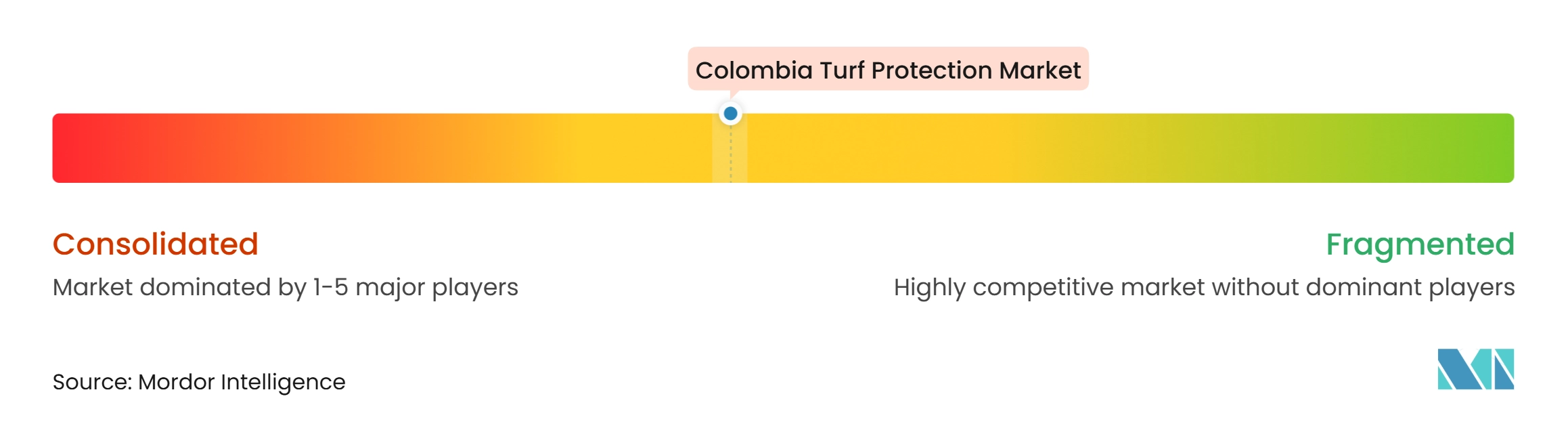
The Colombia turf protection market is moderately concentrated, with major players competing through broad product portfolios, product registrations, technical support, and established distribution networks. Key companies operating in the market include Syngenta Group, BASF SE, Nufarm Colombia S.A., FMC Corporation, and Sumitomo Chemical Co., Ltd. Syngenta Group offers turf products such as Primo Maxx and Atexzo, while BASF SE competes through Zampro Turf and sports-turf herbicide products supported by its Colombian operations. Nufarm Colombia S.A., FMC Corporation, and Sumitomo Chemical Co., Ltd. contribute to the competitive landscape through their crop protection portfolios and local market presence.
Syngenta Group expanded its biological platform in 2026 through its Groundwork BioAg partnership and its agreement with Botanical Solution Inc. These moves position the company to address biological product demand while retaining its synthetic portfolio, an approach that aligns with the continued importance of conventional products in high-disease-pressure turf settings. FMC Corporation and Corteva Agriscience Inc announced a June 2025 collaboration on fluindapyr fungicide technology, with Colombia listed among seven registration markets.
The clearest market opportunities include biological fungicides under ICA's bioinput pathway, water-efficient formulations for urban green infrastructure, and low-residue programs for public concessions. ICA requirements remain an important barrier for products requiring new registrations or label extensions, which creates an advantage for companies that already have compliant products, established local registration knowledge, and active relationships with in-country distribution partners. Digital agronomy and sensor-based application recommendations are emerging as competitive differentiators at premium venues, as they help grounds teams align irrigation, product selection, application timing, and maintenance documentation. Suppliers that combine technical guidance with local irrigation technology are better positioned with these buyers. Competition is strongest where suppliers can pair registered products with technical support and reliable distribution, as venue managers and contractors require products to be available when maintenance schedules, disease conditions, and event requirements call for treatment.
Colombia Turf Protection Industry Leaders
-
Syngenta Group
-
BASF SE
-
Nufarm Colombia S.A. (Nufarm Limited)
-
FMC Corporation
-
Sumitomo Chemical Co., Ltd. (Valent U.S.A. LLC)
- *Disclaimer: Major Players sorted in no particular order
Colombia Turf Protection Market Companies Covered in this Report
- Syngenta Group
- BASF SE
- Environmental Science U.S. LLC (Envu)
- Nufarm Colombia S.A. (Nufarm Limited)
- FMC Corporation
- Sumitomo Chemical Co., Ltd. (Valent U.S.A. LLC)
- Corteva Agriscience, Inc.
- The Andersons, Inc.
- PBI-Gordon Corporation
- SiteOne Landscape Supply, Inc. (LESCO)
- AMVAC Chemical Corporation (American Vanguard Corporation)
- ICL Group Ltd.
- SePRO Corporation
- LebanonTurf (Lebanon Seaboard Corporation)
- Atticus, LLC
Recent Industry Developments in Colombia Turf Protection Market
- February 2026: The PGA of America announced a strategic partnership with Punta Coral in Cartagena to develop the first PGA-affiliated golf facility in South America, featuring an 18-hole course by Ron Garl and Ricky Nix plus the first PGA of America Golf Academy in Colombia. Construction commenced spring 2026, creating structured agronomic management requirements at a premium coastal high-humidity venue.
- July 2026: Syngenta Group entered a global partnership with Groundwork BioAg to commercialize mycorrhizal technologies, launching Avakitt Neo in Brazil and targeting South America for expansion, placing its regional distribution infrastructure behind a biological soil-health platform accessible through existing Colombian distributor channels.
- June 2025: FMC Corporation and Corteva Agriscience, Inc. announced a strategic collaboration on FMC’s fluindapyr fungicide technology. Corteva’s fluindapyr-based product is planned for the 2026 growing season, introducing a novel active ingredient with broad-spectrum efficacy relevant to turf disease management.
Colombia Turf Protection Market Report Scope
The turf protection market is defined as products and solutions used to prevent, control, and reduce pest, disease, and stress damage in natural turfgrass across residential, commercial, and sports surfaces, with market value measured at the point of sale in USD.
The Colombia Turf Protection Market is Segmented by Product Type (Fungicides, Herbicides, Insecticides, Plant Growth Regulators, and Biostimulants and Bio-fertilizers), by Application (Landscaping, Golf Courses, Sports Fields, and Sod Farms), by End User (Residential Customers, Commercial Landscape Contractors, Sports Facility Owners, and Municipalities and Schools), by Mode of Action (Chemical, Biological, and Integrated Solutions), and by Formulation (Granular, Liquid Concentrate, and Wettable Powder). The Market Forecasts are Provided in Terms of Value (USD).
Segmentation Overview
| Fungicides |
| Herbicides |
| Insecticides |
| Plant Growth Regulators |
| Biostimulants and Bio-fertilizers |
| Landscaping |
| Golf Courses |
| Sports Fields |
| Sod Farms |
| Residential Customers |
| Commercial Landscape Contractors |
| Sports Facility Owners |
| Municipalities and Schools |
| Chemical |
| Biological |
| Integrated Solutions |
| Granular |
| Liquid Concentrate |
| Wettable Powder |
| By Product Type | Fungicides |
| Herbicides | |
| Insecticides | |
| Plant Growth Regulators | |
| Biostimulants and Bio-fertilizers | |
| By Application | Landscaping |
| Golf Courses | |
| Sports Fields | |
| Sod Farms | |
| By End User | Residential Customers |
| Commercial Landscape Contractors | |
| Sports Facility Owners | |
| Municipalities and Schools | |
| By Mode of Action | Chemical |
| Biological | |
| Integrated Solutions | |
| By Formulation | Granular |
| Liquid Concentrate | |
| Wettable Powder |
Key Questions Answered in the Report
What is the forecasted value of Colombia turf protection in 2031?
The Colombia turf protection market is forecast to reach USD 68.39 million by 2031, growing at a 5.80% CAGR from 2026 to 2031.
Which product category leads demand in Colombia?
Fungicides led the product type segment, accounting for 34% of the market value in 2025, supported by year-round disease pressure in low-altitude regions.
Which application is growing fastest in Colombia?
Sports fields are forecast to grow at an 8.9% CAGR from 2026 to 2031, supported by stadium redevelopment and higher turf specifications.
Why are biological turf products gaining traction in Colombia?
Resolution 295 of 2025 supports bioinputs, while public venues increasingly seek programs with lower synthetic pesticide use.