
Colombia Cartonboard Market Size and Share
Market Overview
| Study Period | 2020 - 2031 |
|---|---|
| Forecast Data Period | 2026 - 2031 |
| Base Year Market Size (2025) | USD 521.31 Million |
| Market Size (2026) | USD 553.35 Million |
| Market Size (2031) | USD 744.33 Million |
| Growth Rate (2026 - 2031) | 6.11 % |
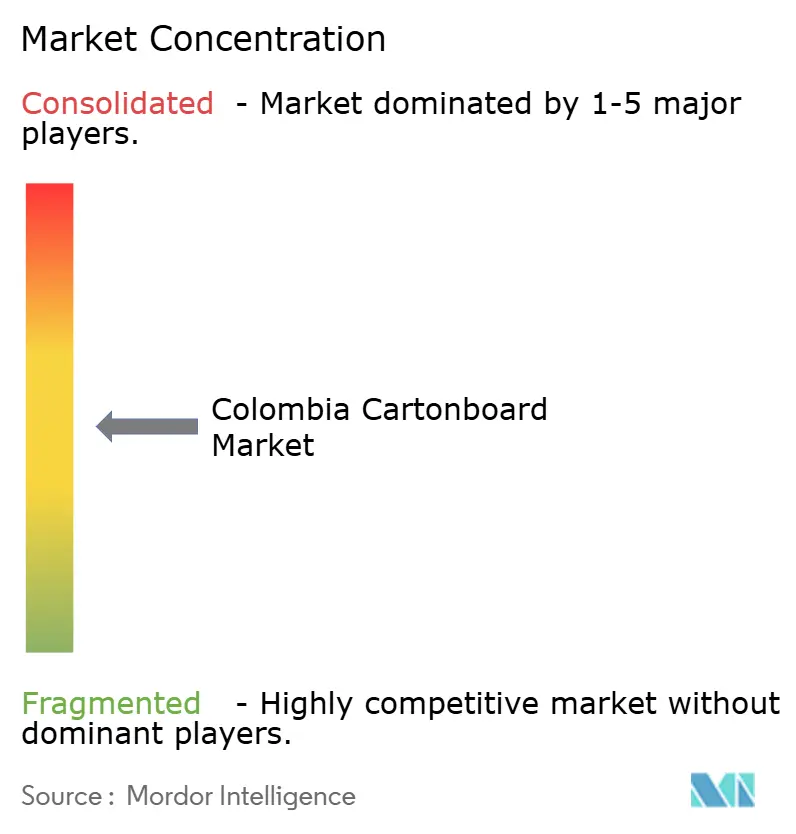
| Market Concentration | Medium |
Major Players *Disclaimer: Major Players sorted in no particular order Image © Mordor Intelligence. Reuse requires attribution under CC BY 4.0. | |
Colombia Cartonboard Market Analysis by Mordor Intelligence
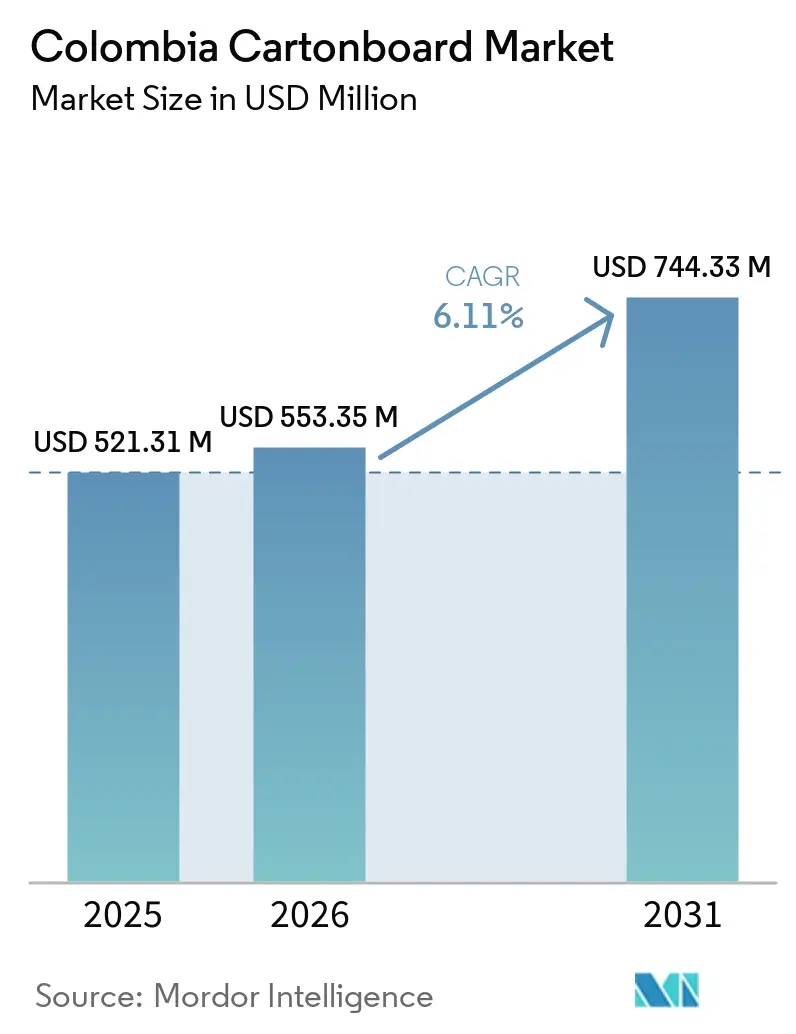
The Colombia cartonboard market size is projected to be USD 521.31 million in 2025, USD 553.35 million in 2026, and reach USD 744.33 million by 2031, growing at a CAGR of 6.11% from 2026 to 2031. Demand is tied to steady growth in packaged food output, a rising need for healthcare packaging, and the ongoing shift from single-use plastics to fiber-based formats. The country’s broad downstream base across consumer goods, healthcare, and foodservice helps the market avoid overdependence on any one end-use category. Competitive positioning is shaped by scale advantages among integrated players and by faster regional service among smaller converters. Cost pressure remains a central issue, especially where converters rely on imported pulp or specialized board grades. The clearest opportunity in the Colombia cartonboard market remains in premium printed grades, higher-barrier applications, and liquid packaging board where domestic production depth is still limited.
Key Report Takeaways
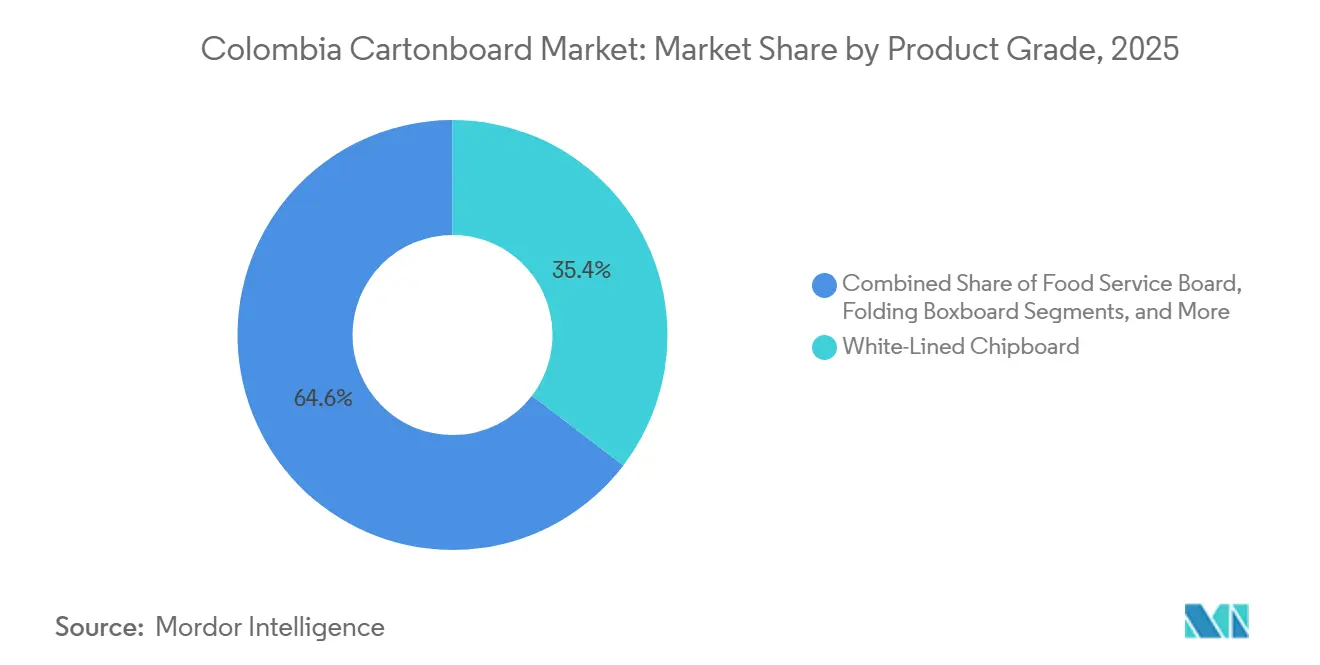
- By product grade, white-lined chipboard captured 35.38% of the Colombia cartonboard market share in 2025.
- By packaging format, the Colombia cartonboard market size for the liquid packaging segment is forecast to advance at a 6.56% CAGR through 2031.
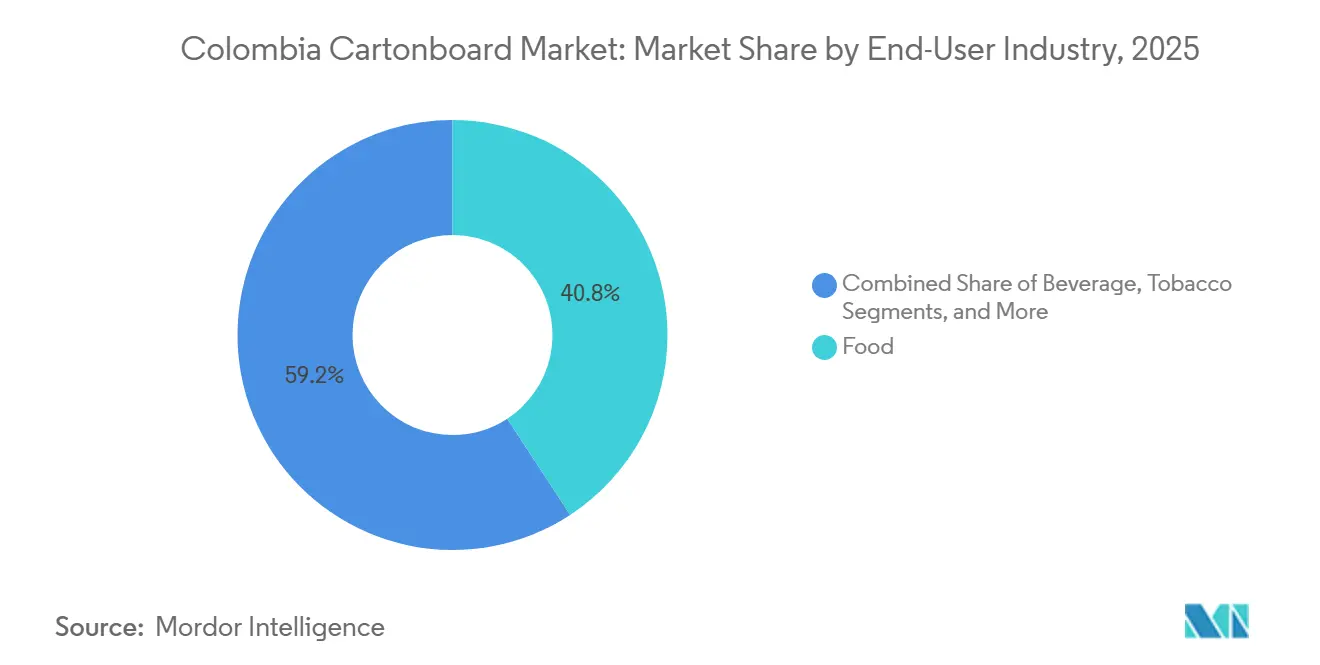
- By end-user industry, food captured 40.78% of the Colombia cartonboard market share in 2025.
Note: Market size and forecast figures in this report are generated using Mordor Intelligence’s proprietary estimation framework, updated with the latest available data and insights as of January 2026.
Colombia Cartonboard Market Trends and Insights
Drivers Impact Analysis*
| Driver | (~) % Impact on CAGR Forecast | Geographic Relevance | Impact Timeline |
|---|---|---|---|
| Rising Demand From Food and Beverage Carton Converters | +1.3% | National, with demand concentrated in Bogotá-Cundinamarca and Valle del Cauca corridors | Short term (≤ 2 years) |
| Expansion of Pharmaceutical and Healthcare Packaging Demand | +1.0% | National, with first-mover gains in Bogotá-Cali pharmaceutical corridor | Medium term (2-4 years) |
| Shift Toward Fiber-Based Substitutes for Plastic-Rich Pack Formats | +0.9% | National, concentrated in urban retail and modern trade zones | Short term (≤ 2 years) |
| Growth of Premium Print and Shelf-Impact Packaging in FMCG | +0.8% | National, led by Bogotá, Medellín, and Cali modern retail clusters | Medium term (2-4 years) |
| Nearshoring of Regional Pack Conversion and Contract Packaging | +0.6% | National, with early gains in Bogotá-Cali corridor and Atlantic Coast port zones | Medium term (2-4 years) |
| Improving Circularity Economics for Recycled Fiber Board | +0.5% | National, with spillover to Andean neighbors through intra-regional trade | Long term (≥ 4 years) |
| Source: Mordor Intelligence | |||
Rising Demand From Food and Beverage Carton Converters
Food and beverage demand remains the strongest volume anchor for the Colombia cartonboard market because packaged food output continues to feed secondary packaging requirements across major retail channels.[1] The USDA reported that Colombia received USD 4.4 billion in U.S. agricultural exports in 2024, up 19% from 2023, indicating a broader food import and processing base that supports converting demand. Branded producers serving hypermarkets, discount chains, and club stores continue to rely on cartonboard formats for cereals, snacks, confectionery, and pantry products, which sustains recurring order flow for converters. Private-label growth also increases the number of stock-keeping units and redesign cycles moving through packaging programs, which raises pack change frequency for converters. This pattern matters because more product variants usually require more print runs and more outer-pack updates within the same production network. The food service board adds another layer of support, with the grade forecast to grow at 6.59% through 2031 as quick-service restaurants, cafes, and delivery channels continue to move toward fiber-based formats.
Expansion of Pharmaceutical and Healthcare Packaging Demand
Pharmaceutical and healthcare packaging is one of the clearest growth lanes in the Colombia cartonboard market, with the segment projected to expand at a 6.38% CAGR from 2026 to 2031. Colombia is also strengthening its role as an Andean manufacturing and distribution base, which raises demand for folding boxboard and solid bleached board in secondary healthcare packs. This demand is not only about volume because healthcare cartons require stronger consistency in print accuracy, surface quality, and barrier performance than many mass-market consumer packs. As packaging programs become more compliance-focused, contract packagers that can run higher-specification board and stable converting processes gain an advantage in regulated applications. Biological and temperature-sensitive products also push board selection upward because they require stronger and more stable carton performance in handling and storage. That combination raises the value mix of the Colombia cartonboard market even before healthcare volume reaches its full forecast range.
Shift Toward Fiber-Based Substitutes for Plastic-Rich Pack Formats
Regulation continues to shift material choice in the Colombia cartonboard market toward paper-based formats.[2] Law 2232 of 2022 and Resolution 803 of 2024 formalized the phase-out path for several single-use plastic products and established the basis for extended producer responsibility requirements. This affects procurement decisions because brand owners and contract packagers now need fiber-certified alternatives that fit compliance expectations in retail and foodservice programs. The effect extends beyond cups and containers to secondary packaging, promotional packs, and other plastic-rich retail formats that are being reconsidered. Graphic Packaging stated that it replaced 880 million plastic packages with paperboard innovations in 2025 and generated USD 210 million from plastic-to-paperboard conversion projects, which shows that this substitution trend already has significant commercial scale. That commercial proof supports continued growth in folding boxboard, food service board, and liquid cartons, where regulation and brand preference are now moving in the same direction.[3]
Growth of Premium Print and Shelf-Impact Packaging in FMCG
Premium print and shelf presence keep raising quality requirements across the Colombian cartonboard market. Confectionery, personal care, and premium beverage brands increasingly require glossy surfaces, sharper multi-color printing, and stronger board stiffness for shelf display. Those needs favor solid bleached board and folding boxboard when appearance, surface finish, and food-contact compliance matter more than basic substrate cost. Smurfit Westrock stated in its 2026 packaging trends release that smart, traceable packaging will shape FMCG competitiveness, and that 85% of CPG companies planned to increase packaging connectivity investment in the near term.[4] Colombia still depends on imported premium board to meet part of this demand, which keeps conversion volumes active but can narrow local margins when grade availability tightens. This leaves a clear opening for local investment in higher-grade production capacity within the Colombia cartonboard market.
Restraints Impact Analysis*
| Restraint | (~) % Impact on CAGR Forecast | Geographic Relevance | Impact Timeline |
|---|---|---|---|
| High Sensitivity to Recovered Fiber and Pulp Cost Volatility | -1.2% | National, with amplified effect in Valle del Cauca and Bogotá production clusters | Short term (≤ 2 years) |
| Import Reliance for Specialized Board Grades | -0.9% | National, concentrated in Cali and Bogotá folding carton conversion hubs | Medium term (2-4 years) |
| Limited Local Capacity for High-Barrier Liquid Packaging Board | -0.6% | National, with import exposure concentrated at Buenaventura and Barranquilla port entries | Long term (≥ 4 years) |
| Downtime Risk From Energy and Logistics Disruptions | -0.5% | National, with peak risk at Buenaventura terminal and Valle del Cauca energy grid | Short term (≤ 2 years) |
| Source: Mordor Intelligence | |||
High Sensitivity to Recovered Fiber and Pulp Cost Volatility
Raw material volatility remains a direct brake on the Colombia cartonboard market because virgin-fiber grades depend on imported pulp while recycled grades depend on recovered fiber pricing. Suzano confirmed a USD 15-per-ton increase in pulp prices in April 2026, citing fiber scarcity and higher energy costs. That type of increase quickly narrows converter margins when supply contracts do not lock in pricing in advance. Recovered fiber costs are also becoming less predictable as collection systems mature and intra-regional trade in waste paper grows. The outcome is less pricing flexibility for converters that already face customer pressure on finished packaging costs. This matters most in short-cycle packaging programs where converters have little room to delay purchases or renegotiate contracts during sudden input swings.
Import Reliance for Specialized Board Grades
Import dependence for specialized grades continues to limit the Colombia cartonboard market, especially in solid bleached board, folding boxboard, and liquid packaging board. Domestic capacity remains weighted toward recycled grades and functional papers, so converters absorb freight changes, currency shifts, and global board tightness more directly. Buenaventura port congestion in February 2026 extended container dwell times to 12-18 days and forced pharmaceutical importers to use air freight at 4-5x ocean rates. This kind of disruption hurts mid-tier local converters more than integrated players because they have less scale, fewer hedging tools, and smaller safety stocks. It also affects delivery reliability for brand owners that need steady turnaround on regulated or promotional packaging runs. Without new domestic investment in higher-grade board, this structural exposure is likely to persist through 2031.
*Our forecasts treat driver/restraint impacts as directional, not additive. The impact forecasts reflect baseline growth, mix effects, and variable interactions.
Segment Analysis
By Product Grade: White-Lined Chipboard Leads, Food Service Board Accelerates
White-lined chipboard held 35.38% of the Colombia cartonboard market share in 2025, which made it the largest product grade in the mix. Its lead came from broad use in confectionery, dry foods, and household packaging, where cost efficiency still outweighs the need for premium surface brightness. The grade also aligns with Colombia’s mid-market converters' buying pattern, which has long favored recycled-fiber substrates due to easier supply access and lower entry costs. That behavior keeps white-lined chipboard central to the Colombia cartonboard industry in routine consumer packaging programs that move high volumes with low complexity. Solid bleached board and folding boxboard still hold an important place in premium FMCG applications where gloss, print precision, and food-contact suitability matter more than price alone.
The Colombia cartonboard market for food service board is projected to expand at a 6.59% CAGR between 2026 and 2031, making it the fastest-growing grade in this segment. Demand is being lifted by quick-service restaurants, branded beverage programs, and delivery platforms that need fiber-based cups, containers, and related food-contact formats. Propal’s Guachené operations continue to serve converters seeking sugarcane-bagasse- and rice-straw-based cartonboard with PFAS-free aqueous barrier coatings. This gives food and healthcare buyers a local sustainability option even while higher-barrier volumes remain limited in the broader supply base. The product mix shows that growth in the Colombia cartonboard market is no longer centered on conventional recycled grades, as specialty fiber-based formats are gaining ground in everyday converting demand.

By Packaging Format: Folding Cartons Anchor Volume, Liquid Packaging Outpaces on Growth
Folding cartons accounted for 56.59% of the Colombian cartonboard market in 2025, making them the leading packaging format by volume. They remain the default secondary packaging format across food, pharmaceutical, cosmetics, and household applications in both modern and traditional trade. Their scale is supported by the concentration of converting capacity in Valle del Cauca, Antioquia, and the Bogotá-Cundinamarca corridor. Sleeve and tray formats add a stable layer of demand from beverage bundling and personal care packaging programs. Other formats, such as cups, foodservice containers, and clamshells, are gaining ground as plastic substitution extends to more day-to-day consumer uses.
Liquid packaging is forecast to grow at 6.56% CAGR from 2026 to 2031, making it the fastest-growing format in the Colombia cartonboard market. Its growth pattern differs from folding cartons, as it is tied to aseptic use in UHT milk, plant-based beverages, and juice categories rather than general secondary packaging. Retailers and consumers value this format for its shelf life, transport efficiency, and a more competitive sustainability profile compared to several single-use plastic alternatives. SIG reported carton volume growth from customer ramp-up in Colombia during 2025, which indicates that new filling line activity is already translating into paperboard demand. Resolution 803 of 2024 also favors formats with established recycling pathways and verified fiber content, which supports the position of multi-layer liquid cartons in compliance-sensitive packaging choices
By End-User Industry: Food Dominates, Pharmaceutical and Healthcare Outperforms
Food captured 40.78% of the Colombian cartonboard market share in 2025, making it the largest end-user category. Breakfast cereals, snacks, confectionery, and processed foods keep this base stable because they require repeat secondary packaging volumes across large retail systems. Beverage producers add another layer of demand through multipacks and promotional overwraps, especially as dairy, juice, and soft drink lines move toward more differentiated packaging. Tobacco still contributes meaningful folding boxboard demand in Colombia, even though the category is mature in terms of growth. Cosmetics and toiletries raise the value profile of converter order books because those packs often need better coatings, stronger stiffness, and cleaner surface finishes.
Pharmaceutical and healthcare packaging is projected to grow at 6.38% CAGR through 2031, making it the fastest-growing end-user segment in the Colombian cartonboard industry. That growth comes from both rising output and tighter packaging requirements, which raise demand for better caliper control, smoothness, and ink receptivity. Healthcare cartons, therefore, improve the value mix even when their physical volumes remain below those of food-related packs. The other end-user group, including toys, apparel, automotive parts, household goods, electrical products, and foodservice, broadens the demand base across the Colombia cartonboard market. This wider application spread helps converters absorb slowdowns in any single downstream category
Geography Analysis
Colombia represented 13-14% of South America’s cartonboard demand in 2025, while the regional market stood at USD 3.9 billion in 2025 and is forecast to reach USD 5.79 billion by 2031 at a 6.78% CAGR. Within South America, Colombia followed Brazil and Argentina in total demand, but its growth profile remained stronger because food processing, healthcare packaging, and plastic substitution were all advancing together. Valle del Cauca and the Bogotá-Sabana de Bogotá corridor remained the main industrial centers for the Colombia cartonboard market. These corridors combine converting plants, consumer goods headquarters, and logistics access, which keeps volume concentrated even as end uses diversify. The Bogotá-Cali axis also carries growing importance for pharmaceutical packaging programs that need reliable converting and distribution support.
Valle del Cauca remains especially important because Yumbo anchors domestic board and converting activity within the Colombia cartonboard market. Smurfit Westrock’s biomass boiler investment at Yumbo is expected to supply 80% of the mill’s energy from renewable sources and cut annual CO₂ emissions by 200,000 tons. That strengthens cost resilience and reinforces the region’s role as the country’s main production base for fiber packaging. Antioquia also remains a meaningful secondary hub for food and consumer goods packaging. Smurfit Kappa opened its new corrugated packaging plant in Guarne in 2024, investing above USD 50 million, demonstrating continued capital deployment in the wider northwest industrial corridor.
The Atlantic Coast is emerging as a secondary demand pole for the Colombian cartonboard market as food processing and port-linked manufacturing expand along the Caribbean corridor. This region supports additional packaging demand tied to beverage, processed food, and trade-oriented manufacturing activity. The eastern and southern parts of the country are still served mainly by the major industrial corridors rather than by local converting clusters. As nearshoring activity widens and infrastructure improves, the geographic demand footprint is likely to spread beyond the current core zones.
Competitive Landscape
The Colombia cartonboard market shows moderate concentration at the top and clear fragmentation at the base. Smurfit Westrock holds a structural advantage because its plantation base, pulp and paper mill in Yumbo, and converting network give it scale across the value chain. Mayr-Melnhof’s MM Packaging Colombia remains the country’s largest folding carton converter, which keeps it influential in branded consumer and healthcare packaging programs. Tetra Pak also holds a near-exclusive position in long-life dairy and juice cartons through its installed liquid packaging equipment base and its active local presence in aseptic packaging solutions. Local converters still matter because they compete on turnaround speed and regional proximity for accounts that do not require integrated supply.
Recent strategic moves show how leading companies are widening their advantages inside the Colombia cartonboard market. Smurfit Westrock advanced its energy transition program in Colombia through the Yumbo biomass boiler, which supports lower operating risk and stronger sustainability positioning. Mayr-Melnhof’s 2025 annual report showed the Americas' share of group revenue rose to 11.0% from 10.1% in 2024, which indicates the region is growing faster than the company’s European core. International Paper completed its USD 9.9 billion acquisition of DS Smith in January 2025, creating a larger sustainable packaging platform, even though its stated focus remained North America and EMEA. That leaves room for established regional operators to deepen customer relationships in Colombia while the global portfolio adjusts its capital priorities.
White-space opportunities remain strongest in high-barrier and liquid packaging board, pharmaceutical-grade folding boxboard, and premium food service applications. Propal’s Guachené operations have gained attention by offering sugarcane-fiber board and PFAS-free aqueous barriers for sustainability-focused buyers. Smurfit Westrock’s 2026 packaging outlook also pointed to smart, traceable packaging as a new area of differentiation, suggesting that data-linked packaging may carry more weight in future supplier selection. Graphic Packaging’s Better by Design framework shows how global players are treating circularity and functionality as structured product development priorities, a discipline many local converters have not yet matched.
Colombia Cartonboard Industry Leaders
-
Smurfit Westrock plc
-
Tetra Laval International S.A.
-
Carvajal S.A.
-
Propal S.A.
-
Empresas CMPC S.A.
- *Disclaimer: Major Players sorted in no particular order
Recent Industry Developments
- June 2026: Smurfit Westrock Sets USD 7 Billion EBITDA Target by 2030, Cites South America as Above-Average Growth Engine. The company projected 2.0% growth in the South American market through 2030 and committed to cumulative free cash flow of USD 14 billion from 2026 to 2030, with Colombia highlighted as a key contributor to above-average margins in the region.
- April 2026: Suzano Confirms USD 15-Per-Ton Pulp Price Increase Citing Fiber Scarcity and Higher Energy Costs. The action directly affected Colombian cartonboard converters relying on imported bleached kraft pulp, compressing margins across the solid bleached board and folding boxboard segments in Colombia’s converting industry.
- February 2026: Smurfit Westrock Sets USD 7 Billion EBITDA Target by 2030, Cites South America as Above-Average Growth Engine. The company projected 2.0% growth for the South American market through 2030 and committed to USD 14 billion cumulative free cash flow from 2026 to 2030, with Colombia highlighted as a key contributor to above-average margins in the region.
- November 2025: Tetra Pak Participates in Andina Pack 2025 in Bogotá, Showcasing Automation and Sustainability Innovations. The company presented its latest liquid packaging carton developments and aseptic filling solutions at Corferias, Bogotá, reflecting the growing commercial momentum in Colombia’s aseptic liquid packaging segment.
- April 2025: Alder Packaging Forms Nearshoring Partnership With Medellín-Based Simex for Sustainable Packaging Production. The collaboration highlighted Colombia’s growing role in nearshore packaging supply chains serving North American brands seeking supply chain resilience amid shifting global tariff policies.
Colombia Cartonboard Market Report Scope
The Colombia Cartonboard Market encompasses the production, distribution, and application of cartonboard materials for packaging. Key product grades in the market include solid bleached board, solid unbleached board, folding boxboard, white-lined chipboard, liquid packaging board, and food service board. These grades are used across various packaging formats, including folding cartons, liquid packaging, sleeves, trays, cups, and foodservice containers. Due to their recyclability, printability, and sustainable packaging attributes, these cartonboard solutions are widely used across sectors such as food, beverage, pharmaceuticals, tobacco, cosmetics, and more.
The Colombia Cartonboard Market Report is Segmented by Product Grade (Solid Bleached Board, Solid Unbleached Board, Folding Boxboard, White-Lined Chipboard, Liquid Packaging Board, and Food Service Board), Packaging Format (Folding Cartons, Liquid Packaging, Sleeve and Tray, and Other Packaging Formats), and End-User Industry (Food, Beverage, Pharma and Healthcare, Tobacco, Cosmetics and Toiletries, and Other End-User Industries). The Market Forecasts are Provided in Terms of Value (USD).
| Solid Bleached Board |
| Solid Unbleached Board |
| Folding Boxboard |
| White-Lined Chipboard |
| Liquid Packaging Board |
| Food Service Board |
| Folding Cartons |
| Liquid Packaging |
| Sleeve and Tray |
| Other Packaging Formats (Cups, Foodservice Containers) |
| Food |
| Beverage |
| Pharmaceutical and Healthcare |
| Tobacco |
| Cosmetics and Toiletries |
| Other End-User Industries (Toy, Apparel, Automotive, Household, Electrical, Foodservice) |
| By Product Grade, Value | Solid Bleached Board |
| Solid Unbleached Board | |
| Folding Boxboard | |
| White-Lined Chipboard | |
| Liquid Packaging Board | |
| Food Service Board | |
| By Packaging Format, Value | Folding Cartons |
| Liquid Packaging | |
| Sleeve and Tray | |
| Other Packaging Formats (Cups, Foodservice Containers) | |
| By End-User Industry, Value | Food |
| Beverage | |
| Pharmaceutical and Healthcare | |
| Tobacco | |
| Cosmetics and Toiletries | |
| Other End-User Industries (Toy, Apparel, Automotive, Household, Electrical, Foodservice) |
Key Questions Answered in the Report
What is the Colombia cartonboard market size through 2031?
The Colombia cartonboard market size was USD 521.31 million in 2025, stands at USD 553.35 million in 2026, and is forecast to reach USD 744.33 million by 2031 at a 6.11% CAGR.
Which product grade leads cartonboard demand in Colombia?
White-lined chipboard led the product mix with a 35.38% share in 2025 because it serves high-volume consumer goods where cost efficiency remains important.
Which packaging format is growing fastest in Colombia?
Liquid packaging is the fastest-growing format, with a forecast CAGR of 6.56% through 2031, supported by demand in UHT milk, juice, and plant-based beverages.
Why does food remain the largest end-user in Colombia?
Food held 40.78% of demand in 2025 because cereals, snacks, confectionery, and processed foods require repeat cartonboard packaging volumes across broad retail networks.
What is the main margin risk for Colombian converters?
Input cost volatility and import dependence remain the biggest risks, especially when pulp prices rise or specialized board imports face freight or port disruption.
Which companies are shaping competition in this space?
Smurfit Westrock, Mayr-Melnhof, and Tetra Pak lead the upper tier through scale, integrated operations, and strong positions in folding cartons and liquid packaging.