
Cobalt Stearate Market Size and Share
Market Overview
| Study Period | 2021 - 2031 |
|---|---|
| Market Size (2026) | USD 2.40 Billion |
| Market Size (2031) | USD 3.23 Billion |
| Growth Rate (2026 - 2031) | 6.12 % |
| Fastest Growing Market | Asia-Pacific |
| Largest Market | Asia-Pacific |
| Market Concentration | Medium |
Major Players *Disclaimer: Major Players sorted in no particular order Image © Mordor Intelligence. Reuse requires attribution under CC BY 4.0. | |
Cobalt Stearate Market Analysis by Mordor Intelligence
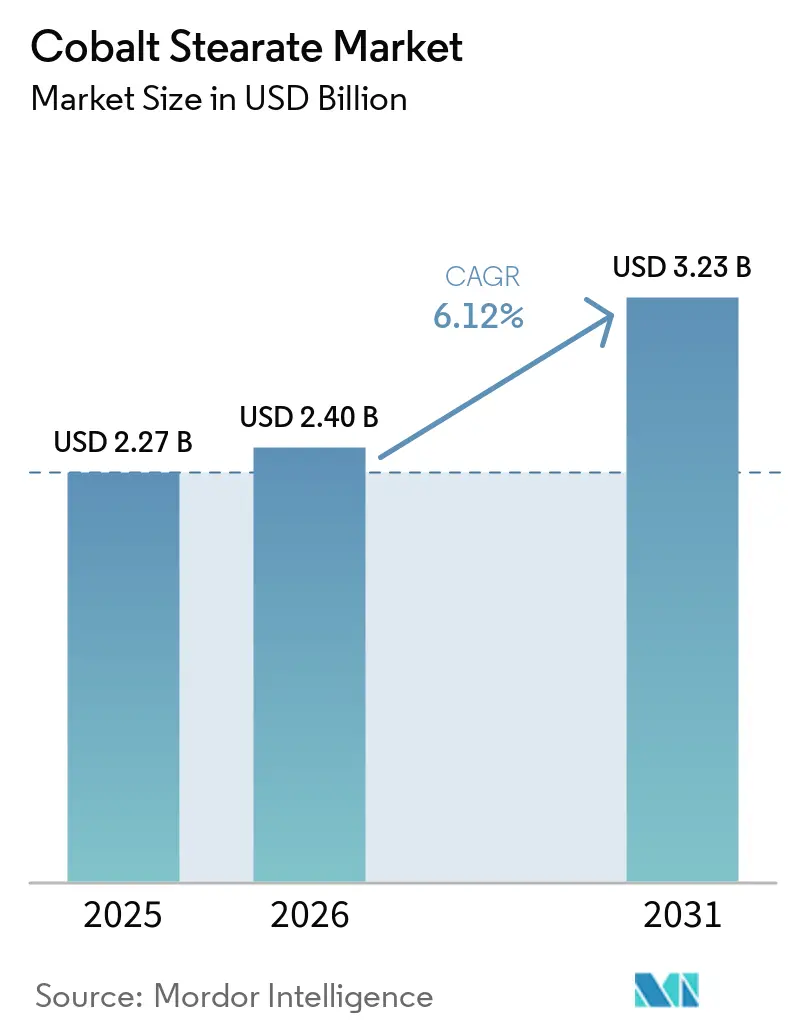
The Cobalt stearate market size was estimated at USD 2.27 billion in 2025 and is estimated to grow from USD 2.40 billion in 2026 to USD 3.23 billion by 2031, at a CAGR of 6.12% during the forecast period (2026-2031). The cobalt stearate market is supported by tire manufacturing, flexible food packaging, and specialty coatings. Steel-belted radial tire production remains an important driver of demand, as cobalt stearate helps bond rubber to brass-coated steel cord. Polyethylene terephthalate (PET) beverage and food packaging also supports demand, where cobalt stearate is used as an oxygen-scavenging catalyst. Supply conditions remain significant, as cobalt is also required for battery cathode materials, and restrictions on cobalt exports from the Democratic Republic of the Congo can affect input availability and prices. The cobalt stearate market therefore combines stable demand from established rubber applications with a growing need for specialized packaging and higher-purity material.
Key Report Takeaways
- By grade, industrial grade held 57.34% of revenue in 2025, while high-purity grade is forecast to grow at a CAGR of 6.86% through 2031.
- By form, powder accounted for 42.28% of revenue in 2025, while micropellets are forecast to grow at a 7.07% CAGR through 2031.
- By application, rubber and tire processing held 41.56% of revenue in 2025, while PET oxygen scavenging is forecast to expand at a CAGR of 7.29% through 2031.
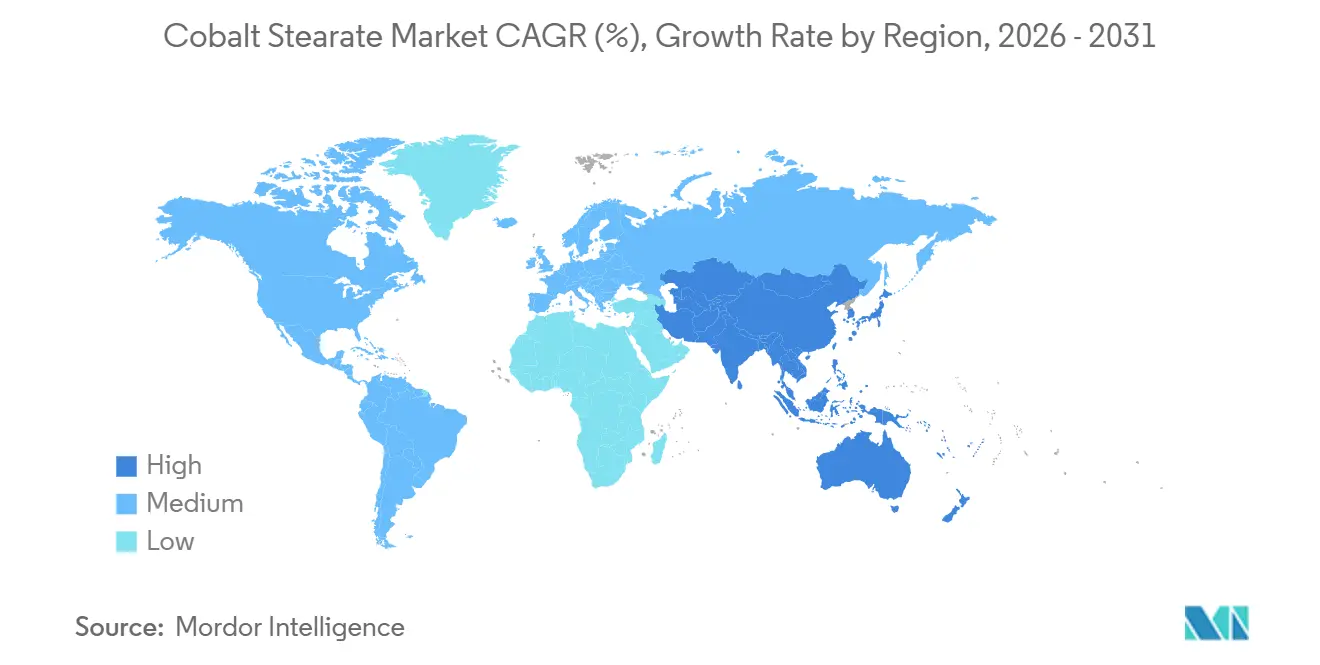
- By geography, Asia-Pacific held 36.13% of revenue in 2025 and is forecast to grow at a CAGR of 6.91% through 2031.
Note: Market size and forecast figures in this report are generated using Mordor Intelligence’s proprietary estimation framework, updated with the latest available data and insights as of January 2026.
Market Trends and Insights
Drivers Impact Analysis of Cobalt Stearate Market*
| Drivers | (~) % Impact on CAGR Forecast | Geographic Relevance | Impact Timeline |
|---|---|---|---|
| Expansion of Steel-Belted Radial Tire Production | +2.2% | Asia-Pacific core, including China, India, and ASEAN, with spillover to South America, the Middle-East, and Africa through export-oriented radial capacity | Medium term (2-4 years) |
| Rising Demand for High-Performance Rubber Adhesion | +1.5% | Global, with the strongest relevance in North America and Europe, where Electric Vehicle (EV)-grade tire specifications apply | Medium term (2-4 years) |
| Growth of Polyethylene Terephthalate (PET) Oxygen-Scavenging Packaging | +1.3% | Asia-Pacific and North America, with early gains in Brazil and Argentina | Short term (≤ 2 years) |
| Increasing Use of Precision-Engineered Metal Carboxylates | +0.9% | Asia-Pacific and Europe, supported by polymer processing and coatings activity | Long term (≥ 4 years) |
| Higher Adhesive Loading in Electric-Vehicle Tires | +0.8% | North America, Europe, and the Asia-Pacific EV manufacturing centers | Medium term (2-4 years) |
| Source: Mordor Intelligence | |||
Expansion of Steel-Belted Radial Tire Production Anchors Baseline Demand
Steel-belted radial tires remain the primary end use for cobalt stearate worldwide. The cobalt stearate market benefits as commercial vehicle fleets in developing economies transition from bias-ply to radial tire construction. This shift extends demand across passenger and commercial tire categories in India and ASEAN markets. China produced 1.207 billion rubber outer tires in 2025, providing a large manufacturing base for materials used in tire construction. China also reported output of 149 million all-steel tires in 2025, a 7.19% increase from the prior year, with infrastructure and mining equipment supporting demand for all-steel tires. ISO 23475-2:2025 established a standardized pull-out test for steel tire-cord adhesion, reinforcing the need for reliable and precisely dosed adhesion-promoting materials. The resulting quality requirements make tire producers less willing to replace established adhesion systems without validated alternatives. The cobalt stearate market also benefits from the steady expansion of export-oriented radial capacity outside China, as these plants create demand for materials that can maintain rubber-to-metal bonding under demanding operating conditions.
Rising Demand for High-Performance Rubber Adhesion Extends Cobalt Stearate’s Technical Utility
High-performance tire specifications require durable adhesion between rubber compounds and reinforcement materials. This requirement is especially relevant for premium consumer tires and original-equipment tire programs. Pirelli has reported more than 500 homologations for its Elect tire range since 2019, reflecting the scale of validation required for tires designed for electric and plug-in hybrid vehicles[1]. These programs test rubber-cord bonding under higher torque loads and demanding operating conditions. The cobalt stearate market serves this need because cobalt-based adhesion systems remain well established in radial tire formulations. The same chemistry applies to conveyor belts, steel-braided rubber hoses, and off-highway equipment that use comparable rubber-to-metal bonding systems, broadening the customer base beyond passenger tire manufacturing. Consistency in cobalt content and material quality is important because end users must validate adhesion performance before changing formulations. The cobalt stearate market, therefore, holds a technical role that is difficult to replace in applications requiring long-term bond durability.
Growth of Polyethylene Terephthalate (PET) Oxygen-Scavenging Packaging Diversifies the Demand Base
PET oxygen scavenging is expanding the use of cobalt stearate beyond tire compounds. Cobalt stearate acts as a catalyst in passive oxygen-scavenging systems embedded in PET preforms. Umicore offers its ECOS S 9.5 range in standard and micropellet formats, including ECOS S 9.5 V, which uses a bio-based fatty acid. The cobalt stearate market benefits when packaging converters seek longer product shelf life in beverage and food formats. This application requires controlled material performance at processing temperatures and careful management of clarity and food-contact requirements. Recyclability regulations in Europe are pressuring packaging developers to improve compatibility with recycled PET, which can affect loading levels and product formats rather than eliminate cobalt-based catalysis from oxygen-scavenging systems entirely. The cobalt stearate market is also supported by demand for dust-controlled forms that can be dosed accurately into high-speed preform production. Packaging customers therefore represent a distinct demand channel with different quality requirements than the rubber market.
Increasing Use of Precision-Engineered Metal Carboxylates Supports Higher-Value Demand
Precision-engineered metal carboxylates are increasingly relevant in polymer processing, coatings, and specialty rubber compounding. The cobalt stearate market includes products supplied as powders, pellets, micropellets, liquid dispersions, and customized forms, each addressing different production requirements for handling, dosing, and mixing. High-purity materials are particularly relevant where processors require low contamination levels and consistent catalyst activity. The cobalt stearate market also serves paint and coatings producers that require dependable drier performance in alkyd and oxidative-cure systems. Closed handling and pre-dispersed formats can reduce exposure during processing and improve dosing consistency. These requirements are most evident in Europe and Asia-Pacific, where polymer processing and coatings production are significant end uses. The cobalt stearate market can benefit from product differentiation even when industrial-grade output remains larger. Suppliers that combine formulation support with consistent material quality are better positioned to serve specialized customer requirements.
Restraints Impact Analysis of Cobalt Stearate Market*
| Restraints | (~) % Impact on CAGR Forecast | Geographic Relevance | Impact Timeline |
|---|---|---|---|
| Cobalt Hazard Classification and Occupational-Exposure Compliance | -1.0% | The European Union is the most immediate, followed by North America and the Asia-Pacific, in compliance cycles | Medium term (2-4 years) |
| Cobalt Price Volatility and Supply Concentration | -0.8% | Global, with the strongest effect on buyers in China and Europe that depend on Democratic Republic of the Congo-origin intermediates | Short term (≤ 2 years) |
| Substitution by Cobalt-Free and Low-Cobalt Adhesion Systems | -0.5% | Europe leads, followed by Asia-Pacific, as Environmental, Social, and Governance (ESG) requirements tighten original equipment manufacturer procurement | Long term (≥ 4 years) |
| Source: Mordor Intelligence | |||
Cobalt Hazard Classification and Occupational-Exposure Compliance Raise Formulation and Handling Costs
Regulatory requirements for cobalt compounds are becoming more demanding for downstream formulators. In July 2025, the European Commission proposed an inhalable occupational exposure limit of 0.01 mg/m³ for cobalt and inorganic cobalt compounds, with a transitional limit of 0.02 mg/m³. It also proposed a respirable limit of 0.0025 mg/m³, a transitional limit of 0.0042 mg/m³, and a six-year adaptation period after adoption[2]. Facilities that handle cobalt stearate for rubber compounding and as a packaging additive may need improved engineering controls and monitoring. Compliance requirements also affect chemical safety reporting and communication with downstream users. The cobalt stearate market incurs additional handling costs when materials are used in open powder systems. Closed handling, micropellets, and liquid dispersions can become more attractive because they reduce the risk of airborne cobalt particulate. These changes can alter the mix of forms sold into European production sites. The requirement can also influence purchasing decisions for non-European suppliers serving European customers. Formulation and process investments may raise costs, even as they create demand for safer handling formats.
Cobalt Price Volatility and Supply Concentration Compress Margins and Disrupt Planning Cycles
Cobalt price volatility is an immediate restraint for suppliers and buyers of cobalt stearate. Total cobalt supply reached 295 kt in 2025, while the Democratic Republic of the Congo export ban from February through October 2025 constrained available output to 183 kt. Price swings of more than 300% were recorded for cobalt hydroxide, 266% for cobalt sulfate, and 130% for cobalt metal during the year. The export quota system introduced in October 2025 allocated 77,400 tons for 2026. Producers without direct mining positions or strategic inventories have limited protection against spot price changes. This can compress margins during price increases and disrupt purchasing plans for tire and packaging customers. The International Energy Agency reported that the average market share of the top three mining countries for key energy minerals rose from 73% in 2020 to 77% in 2024. Indonesia increased its share of cobalt production from 11% in 2024 to 14% in 2025, providing some geographic diversification while leaving the supply base exposed to other input and geopolitical risks.
*Our forecasts treat driver/restraint impacts as directional, not additive. The impact forecasts reflect baseline growth, mix effects, and variable interactions.
Cobalt Stearate Market Segment Analysis
By Grade:
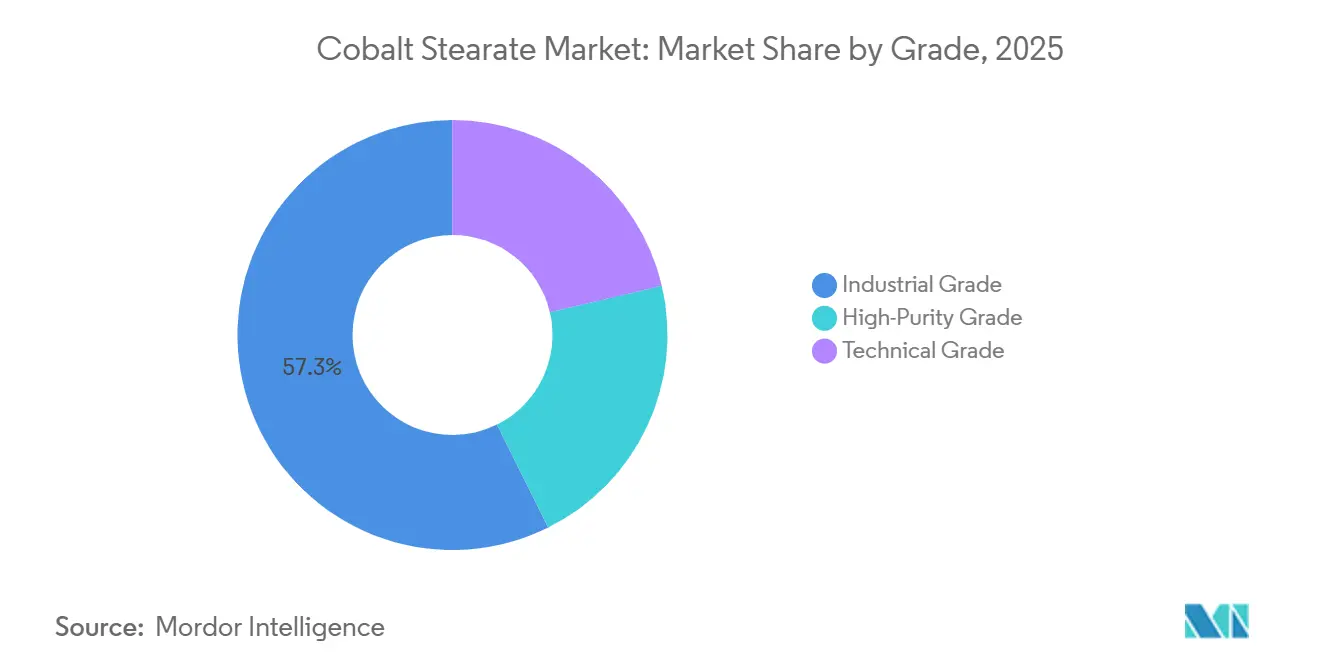
Industrial-Grade Demand Supports High-Purity Grade GrowthIndustrial-grade accounted for 57.34% of the cobalt stearate market share in 2025, making it the largest segment. This position reflects the large quantity of material required for tire and rubber processing. High-purity grade is projected to grow at a CAGR of 6.86% from 2026 to 2031. PET packaging converters and specialty polymer compounders require tighter metal-content tolerances and lower heavy-metal contamination. The cobalt stearate market size for high-purity material is driven by applications where catalyst performance must remain stable at processing temperatures. Food-contact packaging also requires controls to limit the risks of yellowing and off-flavor. These requirements support a premium position for high-purity products. Industrial-grade material remains important because rubber compounding continues to be the anchor of demand for the cobalt stearate market.
Umicore's ECOS S 9.5 and ECOS S 9.5 V lines illustrate the use of specialized grades in oxygen-scavenging packaging. The bio-based fatty acid version addresses customer interest in sourcing practices and sustainability commitments. Technical grade sits between industrial and high-purity material, serving coatings producers that need reliable drier activity without the strict impurity requirements of food-contact packaging. During cobalt price increases, industrial-grade products can face greater substitution pressure from cobalt-free formulations. High-purity grades are less exposed to substitution where qualified alternatives cannot meet processing-temperature and clarity requirements. The difference in end-use requirements creates a clear split between high-quantity rubber products and higher-value specialty products. The cobalt stearate market retains both segments because their performance needs and purchasing criteria differ. Suppliers must therefore balance scale in industrial material with technical support for higher-purity customers.

By Form:
Powder Leads While Micropellets Gain AdoptionPowder held 42.28% of revenue in 2025, reflecting the installed base of rubber compounding plants that use direct powder incorporation. Micropellets are projected to grow at a CAGR of 7.07% from 2026 to 2031. Their growth is linked to high-speed polyethylene terephthalate (PET) preform manufacturing and demand for low-dust masterbatch incorporation. Powder remains practical for internal mixers used by many tire producers in the Asia-Pacific. Transitioning from powder requires investment in feeding and dosing equipment, and many mid-tier producers have deferred these investments while their existing powder systems remain functional. The cobalt stearate powder market size remains substantial because it serves a broad and established customer base. However, handling requirements are strengthening the case for more controlled forms.
Micropellets support precision dosing and reduce airborne cobalt particulate in compounding facilities, making them relevant as occupational exposure controls become stricter. Granules and pellets provide a middle option for batch coatings producers that value improved handling. Liquid dispersions and customized forms serve customers who need pre-dispersed material in process oil or proprietary carrier systems. These formats can reduce mixing time and enable more controlled addition in continuous compounding lines. European and North American facilities are likely to place greater emphasis on closed handling as exposure documentation requirements become more demanding. The cobalt stearate market is consequently shifting toward pelletized and liquid forms in selected applications. Powder will remain important where installed equipment and cost considerations continue to favor direct incorporation. Form choice will depend on each customer's equipment, compliance requirements, and desired dosing accuracy.
By Application:
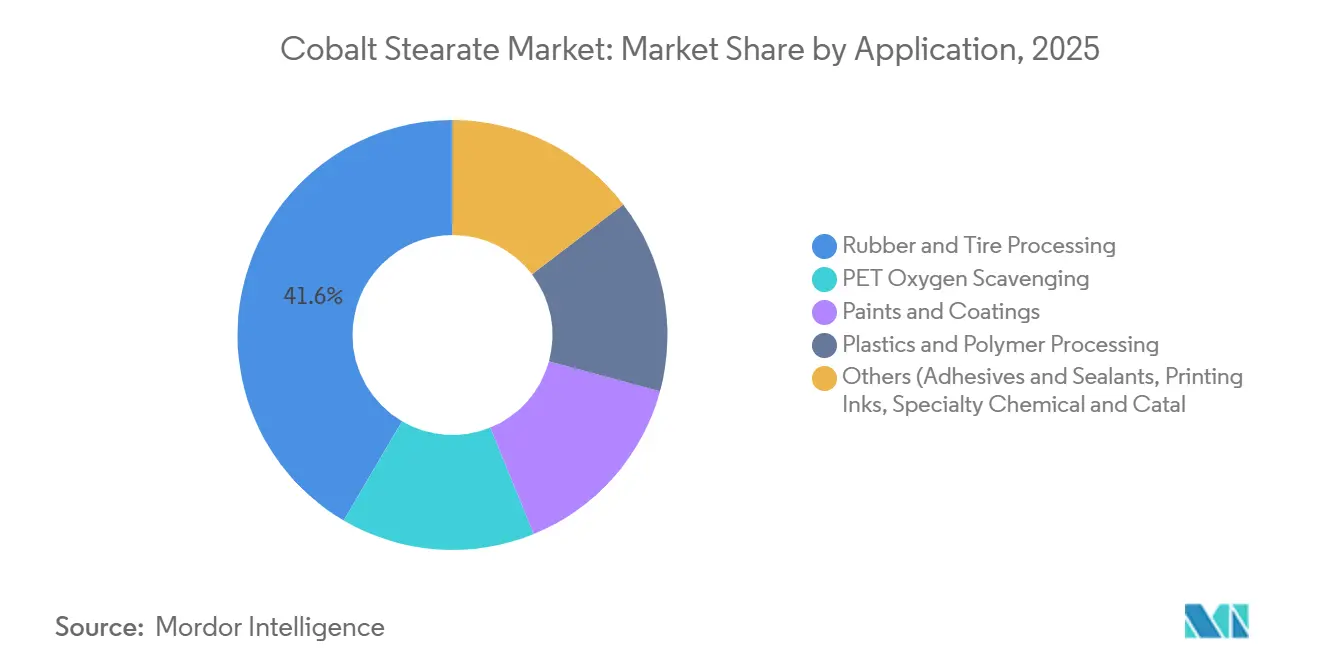
Tire Processing Anchors Demand While PET Scavenging Grows FasterRubber and tire processing held 41.56% of the cobalt stearate market share in 2025, making it the largest application segment. Polyethylene terephthalate (PET) oxygen scavenging is forecast to grow at a CAGR of 7.29% from 2026 to 2031. Tire processing sets a demanding quality baseline because steel-cord adhesion must be validated for safety and durability. The material qualified for this application is also used in conveyor belts, steel-braided hoses, and engineered rubber profiles. The cobalt stearate market continues to rely on tire applications because radial tire construction uses cobalt-based adhesion chemistry. PET scavenging represents the fastest-growing application as beverage and food packaging producers seek longer shelf life. The two applications have different demand patterns, but both depend on predictable formulation performance.
Paints and coatings represent another important application, as cobalt stearate functions as a surface drier in alkyd and oxidative-cure systems. Some European coatings producers are assessing manganese and zirconium alternatives in response to cobalt-related regulatory pressure. Plastics and polymer processing provide a stable but slower-growing demand base, including polyvinyl chloride (PVC) stabilization and polyolefin compounding. Adhesives and sealants, printing inks, and specialty catalyst uses form a smaller but technically diverse group of applications. These customers may require customized formulations and can pay a premium for materials designed for their specific processes. The cobalt stearate market is not dependent on a single end use, although tire processing remains its largest source of demand. PET packaging adds a higher-growth channel, reducing reliance on traditional rubber demand. The cobalt stearate market benefits when suppliers can address both large, standardized accounts and smaller technical applications. Application diversity also makes formulation support a significant competitive capability.
Geography Analysis
APAC Cobalt Stearate Market
Asia-Pacific held 36.13% of revenue in 2025 and is forecast to grow at a CAGR of 6.91% from 2026 to 2031. The region combines large tire manufacturing capacity, expanding PET packaging use, and developing cobalt supply chains. China's production of 1.207 billion units of rubber outer tires in 2025 provides a large base for cobalt stearate consumption. Japan produced 933,243 tons of tire rubber in 2025, an increase of 0.8% from the previous year and the first increase in four years. India is becoming a radial tire production hub through production incentives and original-equipment manufacturer localization, creating new demand for cobalt stearate in India and ASEAN markets. Asia-Pacific combines established Chinese scale with new manufacturing capacity across the region.
North America and Europe Cobalt Stearate Market
North America and Europe account for a smaller combined share of the cobalt stearate market but remain strategically important for high-value grades. North America benefits from domestic manufacturing capacity and automotive supply chains that require traceability documentation. Shepherd Chemical maintains a US-based presence in fatty acids and cobalt-based metal carboxylates, supporting regional tire and specialty chemical customers. Europe faces tighter occupational exposure and REACH requirements, increasing compliance needs for cobalt-containing materials. At the same time, electric-vehicle tire development supports demand for materials used in higher-performance tire compounds. Umicore reported strong profitability in its Specialty Materials activities in Q1 2026, supported by cobalt market conditions and demand for premium materials. These regions prioritize quality, traceability, and regulatory-ready product formats over scale.
MEA and South America Cobalt Stearate Market
South America, the Middle-East, and Africa are emerging demand areas for the cobalt stearate market. Brazil combines tire production capacity with growing demand for food and beverage packaging. Argentina supports polyethylene terephthalate (PET) oxygen scavenging through its agri-food packaging activity and the need for longer distribution distances. The Middle-East and Africa are linked to construction, mining, and commercial-vehicle activity. Saudi Arabia and South Africa are relevant markets where conveyor belts and other rubber goods support industrial activity. Infrastructure limitations and small local specialty-chemical distribution networks constrain more rapid adoption. These regions remain relevant as radialization and packaging growth can create incremental demand over time. Their opportunity is more localized than in Asia-Pacific but offers room for regional suppliers and distributors. Reaching these fragmented demand pockets will depend on customer access and technical service capabilities.
Competitive Landscape
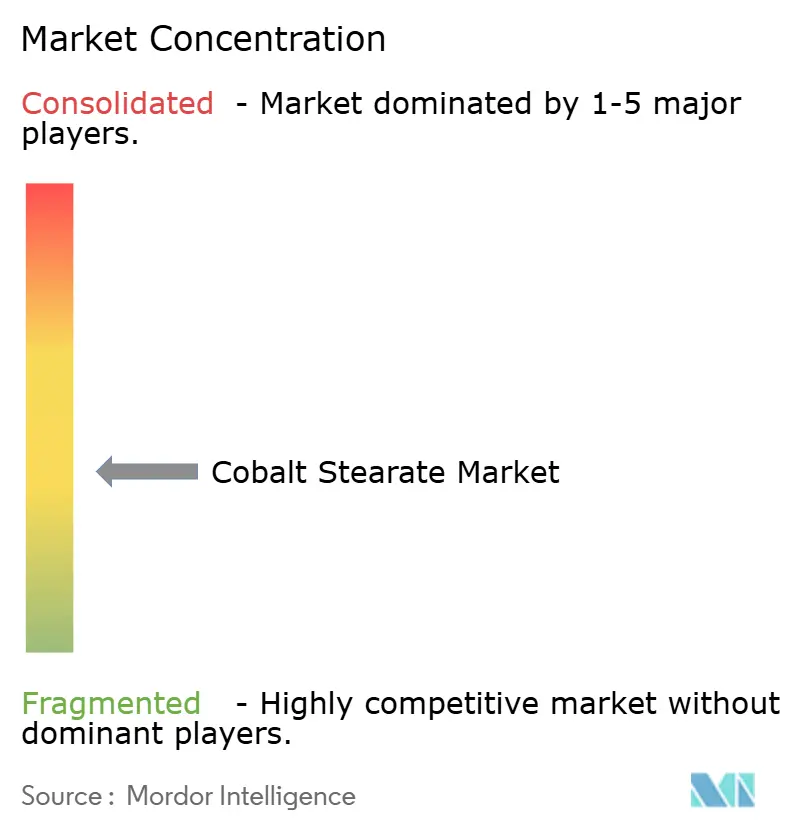
The cobalt stearate market is moderately fragmented. Umicore, Shepherd Chemical, DIC Corporation, Peter Greven GmbH & Co. KG, and Sun Ace Kakoh compete on formulation range, traceability, and technical service. A second tier of Chinese producers competes primarily on price and industrial-grade output, including Jiangyin Sanliang, Shandong Yanggu Huatai, Jiangsu Yixing Kaou, and Zibo Haiyue. The 10 largest suppliers control less than 50% of global revenue, indicating a fragmented supplier base. This structure creates price pressure during periods of oversupply while allowing room for specialized regional providers. It also favors companies that can supply consistent material and support customer qualification processes.
Integrated suppliers hold an advantage when cobalt availability becomes constrained. Direct sourcing relationships and strategic inventories can reduce exposure to spot-price fluctuations. Umicore's roadmap to 2028 targets growth in Specialty Materials revenue and an EBITDA margin above 20%, with Cobalt & Specialty Materials identified as the main growth driver. The company also reported a planned second-half 2026 investment decision for hydrometallurgical flowsheet expansion that would add cobalt recovery capacity, supporting greater vertical integration and material recovery. Milliken's acquisition of Borchers added expertise in cobalt-free adhesion promoters and tin-replacement catalyst technologies, positioning the company to address customer demand for lower-hazard alternatives while retaining its role in tire-related adhesion chemistry.
Competitive development also focuses on upstream cobalt access and joint development with tire producers. Jinchuan Group's Musonoi mine in the Democratic Republic of the Congo reached commercial ramp-up in September 2025, with an annual capacity of 7,400 tons and an estimated 14-year mine life. Export quota delays constrained sales during the first half of 2026 despite higher production. Cobalt production reached 4,345 tons in the first half of 2026, compared with 71 tons in the first half of 2025, demonstrating that physical output and export authorization remain separate constraints. Patent activity continues to specify cobalt stearate in sulfur-crosslinkable rubber coatings for steel-cord tires, indicating that companies are developing cobalt-retained systems alongside cobalt-free alternatives. The cobalt stearate market will remain competitive across both price-sensitive industrial products and high-performance grades, with product traceability, supply security, and application support continuing to distinguish suppliers.
Cobalt Stearate Industry Leaders
-
Umicore
-
Milliken & Company
-
DIC CORPORATION
-
Shepherd Chemical
-
Comar Chemicals
- *Disclaimer: Major Players sorted in no particular order
Cobalt Stearate Market Companies Covered in this Report
- Comar Chemicals
- Dalian Advance Performance Specialty Chemicals Co., Ltd.
- DIC CORPORATION
- Ege Kimya
- Guangsheng Xiangsu
- Jiangsu Yixing Kaou Chemical Co., Ltd.
- Jiangyin Sanliang Rubber & Plastic New Material Co., Ltd.
- Jinchuan Group International Resources Co. Ltd
- Milliken & Company
- Peter Greven GmbH & Co. KG.
- Shandong Yanggu Huatai Chemical Co., Ltd.
- Shepherd Chemical
- Sun Ace Kakoh (Pte.) Ltd.
- Umicore
- Wuhan Jiacheng Biotechnology Co., Ltd.
- Zibo Haiyue New Materials Co., Ltd.
Recent Industry Developments in Cobalt Stearate Market
- June 2026: Yokohama Rubber and Tohoku University published the first nanoscale characterization of cobalt stearate's adhesion mechanism at the rubber-brass steel cord interface. The study demonstrated that cobalt sulfide formed during vulcanization acts as a diffusion barrier, suppressing copper and zinc elution.
- January 2026: Triangle Tire announced plans to invest CNY 3.219 billion (~USD 442 million) to construct a high-performance radial tire production base in Cambodia, with a planned annual capacity of 7 million tires. This expansion is expected to increase demand for steel cord and cobalt stearate across Southeast Asia.
Global Cobalt Stearate Market Report Scope
Cobalt stearate is a metal-organic soap compound derived from cobalt and stearic acid. It is widely used as an adhesion promoter in steel-cord rubber tires, a drying catalyst in paints and inks, and an additive to facilitate plastic degradation.
The cobalt stearate market is segmented by grade, form, application, and geography. By grade, the market is segmented into Industrial grade, high-purity grade, and technical grade. By form, the market is segmented into powder, granules/pellets, micropellets, and liquid dispersions and customized forms. By application, the market is segmented into rubber and tire processing, PET oxygen scavenging, paints and coatings, plastics and polymer processing, and others (adhesives and sealants, printing inks, specialty chemicals, and catalyst uses). The report also covers market size and forecasts for cobalt stearate across 15 countries in major regions. The market sizes and forecasts are provided in terms of value (USD).
Segmentation Overview
| Industrial Grade |
| High-Purity Grade |
| Technical Grade |
| Powder |
| Granules/Pellets |
| Micropellets |
| Liquid Dispersions and Customized Forms |
| Rubber and Tire Processing |
| PET Oxygen Scavenging |
| Paints and Coatings |
| Plastics and Polymer Processing |
| Others (Adhesives and Sealants, Printing Inks, Specialty Chemical and Catalyst Uses) |
| Asia-Pacific | China |
| India | |
| Japan | |
| South Korea | |
| ASEAN Countries | |
| Rest of Asia-Pacific | |
| North America | United States |
| Canada | |
| Mexico | |
| Europe | Germany |
| United Kingdom | |
| France | |
| Italy | |
| NORDIC Countries | |
| Rest of Europe | |
| South America | Brazil |
| Argentina | |
| Rest of South America | |
| Middle-East and Africa | Saudi Arabia |
| South Africa | |
| Rest of Middle-East and Africa |
| By Grade | Industrial Grade | |
| High-Purity Grade | ||
| Technical Grade | ||
| By Form | Powder | |
| Granules/Pellets | ||
| Micropellets | ||
| Liquid Dispersions and Customized Forms | ||
| By Application | Rubber and Tire Processing | |
| PET Oxygen Scavenging | ||
| Paints and Coatings | ||
| Plastics and Polymer Processing | ||
| Others (Adhesives and Sealants, Printing Inks, Specialty Chemical and Catalyst Uses) | ||
| By Geography | Asia-Pacific | China |
| India | ||
| Japan | ||
| South Korea | ||
| ASEAN Countries | ||
| Rest of Asia-Pacific | ||
| North America | United States | |
| Canada | ||
| Mexico | ||
| Europe | Germany | |
| United Kingdom | ||
| France | ||
| Italy | ||
| NORDIC Countries | ||
| Rest of Europe | ||
| South America | Brazil | |
| Argentina | ||
| Rest of South America | ||
| Middle-East and Africa | Saudi Arabia | |
| South Africa | ||
| Rest of Middle-East and Africa | ||
Key Questions Answered in the Report
What is current market size of Cobalt Stearate Market?
The Cobalt stearate market size was estimated at USD 2.27 billion in 2025 and is estimated to grow from USD 2.40 billion in 2026 to USD 3.23 billion by 2031, at a CAGR of 6.12% during the forecast period (2026-2031).
Which application accounts for the largest share of cobalt stearate demand?
Rubber and tire processing held 41.56% of revenue in 2025, supported by its role in rubber-to-steel-cord adhesion.
Which cobalt stearate application is expected to grow fastest?
Polyethylene terephthalate (PET) oxygen scavenging is forecast to grow at a CAGR of 7.29% through 2031, supported by demand for food and beverage packaging.
Why are micropellets gaining use in cobalt stearate applications?
Micropellets are forecast to grow at a CAGR of 7.07% because they support low-dust handling and precise dosing in PET preform and compounding operations.