
Coated Abrasive Market Size and Share
Market Overview
| Study Period | 2021 - 2031 |
|---|---|
| Market Size (2026) | USD 15.68 Billion |
| Market Size (2031) | USD 20.26 Billion |
| Growth Rate (2026 - 2031) | 5.26 % |
| Fastest Growing Market | Asia-Pacific |
| Largest Market | Asia-Pacific |
| Market Concentration | Medium |
Major Players *Disclaimer: Major Players sorted in no particular order Image © Mordor Intelligence. Reuse requires attribution under CC BY 4.0. | |
Coated Abrasive Market Analysis by Mordor Intelligence
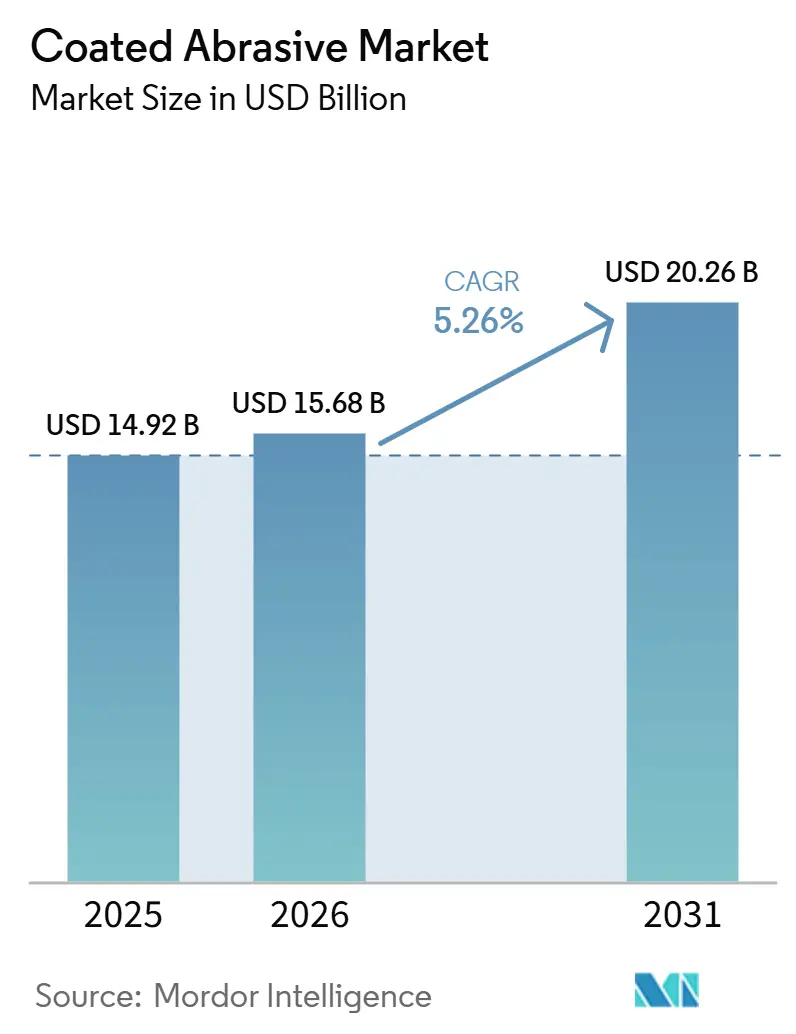
The Coated Abrasive Market was valued at USD 14.92 billion in 2025 and is estimated to grow from USD 15.68 billion in 2026 to reach USD 20.26 billion by 2031, at a CAGR of 5.26% during the forecast period (2026–2031). Demand comes from metalworking, automotive production, and electronics manufacturing, where abrasives are used repeatedly during finishing work. Their role as process consumables gives the coated abrasive market a steadier base than many discrete manufacturing purchases. Investment in semiconductor fabrication, electric vehicle production, and aerospace components is increasing demand for products that meet tighter surface requirements. Suppliers are focusing on engineered grain structures, precision-coated formats, and sustainability documentation to defend product value. Raw material price movements, alternative abrasive formats, and short-term changes in construction and automotive activity continue to affect purchasing decisions.
Key Report Takeaways
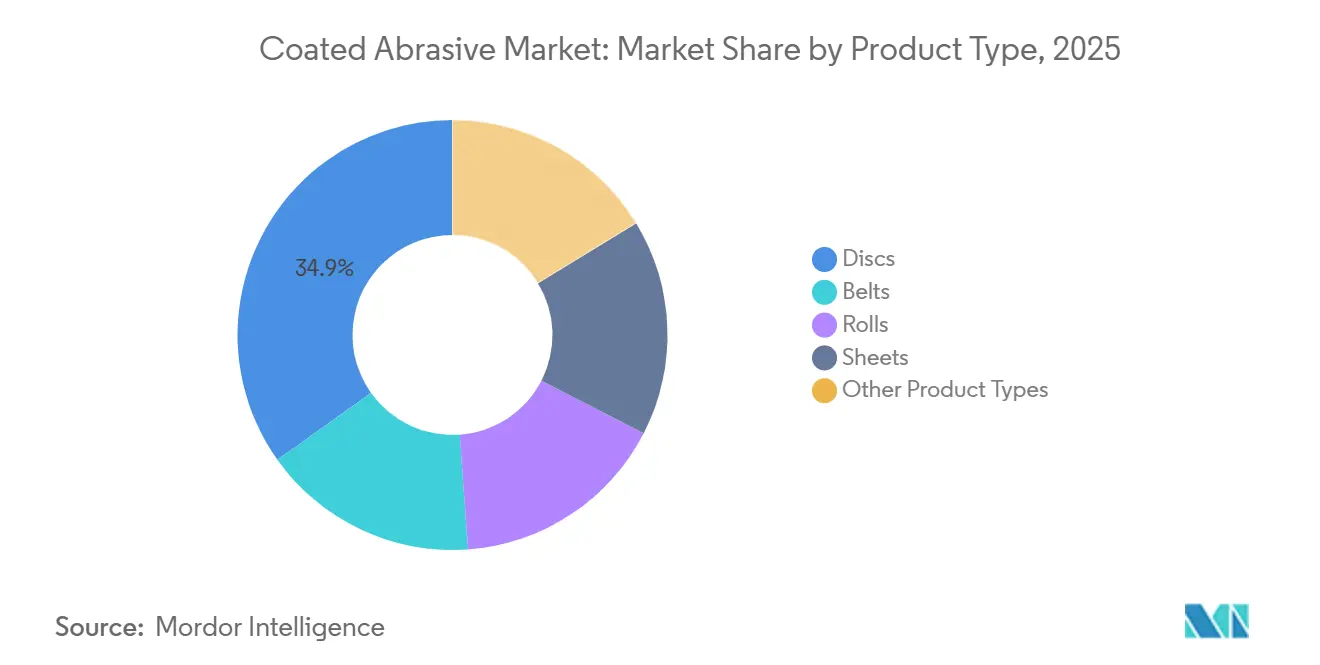
- By product type, discs held 34.86% of the coated abrasive market share in 2025, while belts recorded the highest projected CAGR at 5.94% through 2031.
- By material type, aluminum oxide held 41.66% of the coated abrasive market share in 2025, while ceramic alumina recorded the highest projected CAGR at 6.49% through 2031.
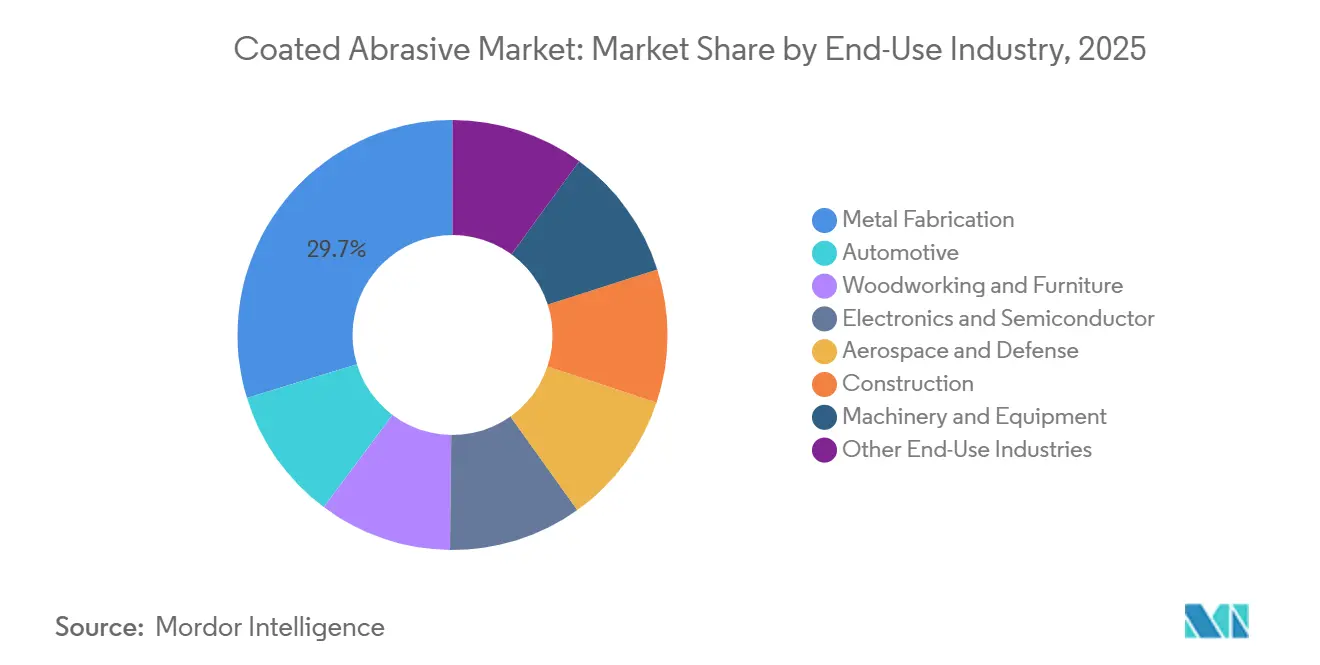
- By end-use industry, metal fabrication held 29.73% of the coated abrasive market share in 2025, while electronics and semiconductor is projected at a 6.42% CAGR through 2031.
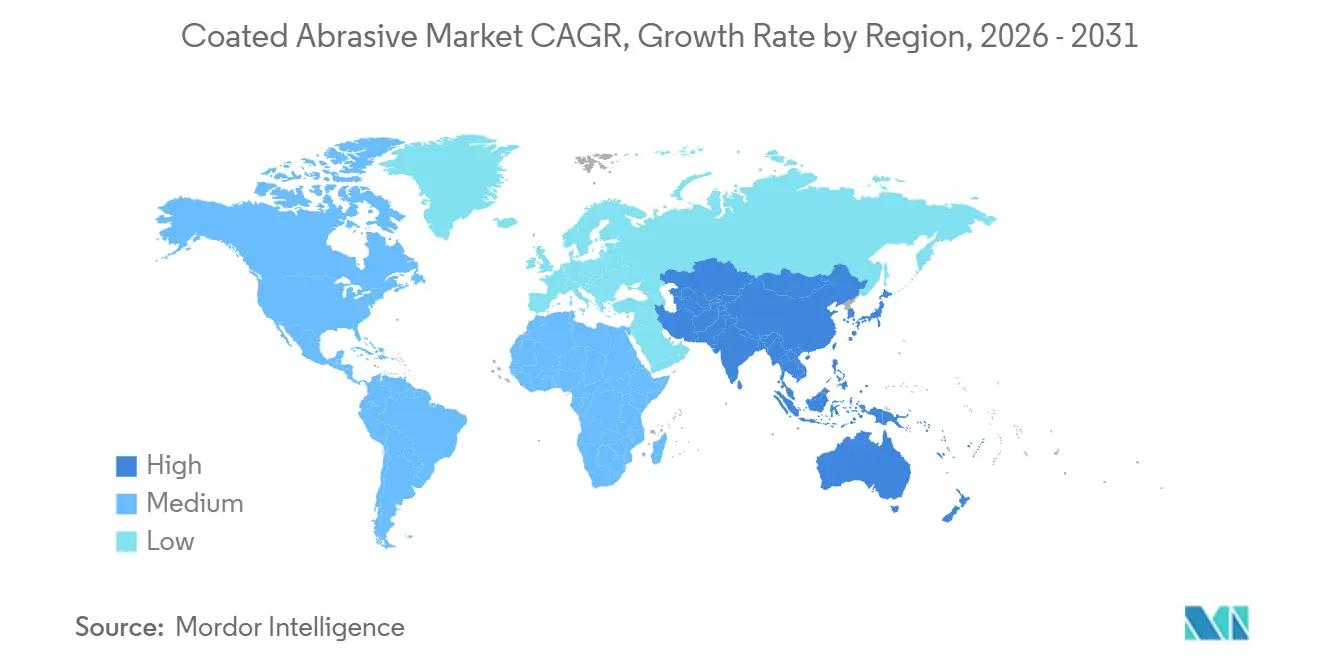
- By geography, Asia-Pacific held 45.41% of the coated abrasive market share in 2025 and is projected to grow at a 6.02% through 2031.
Note: Market size and forecast figures in this report are generated using Mordor Intelligence’s proprietary estimation framework, updated with the latest available data and insights as of January 2026.
Market Trends and Insights
Drivers Impact Analysis of Coated Abrasive Market*
| Driver | (~) % Impact on CAGR Forecast | Geographic Relevance | Impact Timeline |
|---|---|---|---|
| Growing Demand for Precision Surface Finishing in Metalworking and Manufacturing Industries | +1.5% | Global, concentrated in APAC core and North America | Medium term (2-4 years) |
| Increasing Automotive Production and Aftermarket Repair Activities Driving Abrasive Consumption | +1.2% | Global; highest impact in China, India, and North America | Medium term (2-4 years) |
| Expansion of Woodworking and Furniture Manufacturing Supporting Demand for Coated Abrasives | +0.7% | APAC core, spill-over to Europe and North America | Long term (≥ 4 years) |
| Rising Adoption of High-Performance Ceramic and Zirconia Abrasives for Industrial Applications | +1.0% | Global; strongest in North America and EU | Medium term (2-4 years) |
| Increasing Use of Recyclable and Bio-Based Backing Materials | +0.3% | Europe-led, expanding to North America | Long term (≥ 4 years) |
| Source: Mordor Intelligence | |||
Growing Demand for Precision Surface Finishing in Metalworking and Manufacturing Industries
Manufacturing modernization is raising performance requirements for surface finishing work across the coated abrasive market. Automated lines in aerospace, shipbuilding, and precision machining need abrasives that produce consistent finishes and dimensional accuracy. Fused aluminum oxide and silicon carbide are used downstream in bonded and coated abrasive products serving aerospace, automotive, furniture, and steel applications[1]U.S. Geological Survey, “Abrasives,” Mineral Commodity Summaries 2025, usgs.gov. Higher-alloy steels, titanium, and nickel superalloys need products that can work on hard materials without losing cutting performance. Structured abrasive formats are therefore more relevant in precision applications than basic paper products. Buyers can justify premium products when higher cut rates and longer tool life reduce downtime and rework.
Increasing Automotive Production and Aftermarket Repair Activities Driving Abrasive Consumption
Automotive production supports coated abrasive demand in paint preparation, body refinishing, drivetrain work, and component deburring. Electric and hybrid vehicles add finishing needs for battery housings, power electronics substrates, and aluminum structural parts. These applications use specifications that differ from conventional powertrain finishing work. Repair activity also supports demand because older vehicles remain in service longer in North America and Europe. Body shops require several sanding stages when repairing painted surfaces and body panels. This gives the coated abrasive market exposure to both vehicle production and replacement work.
Rising Adoption of High-Performance Ceramic and Zirconia Abrasives for Industrial Applications
Ceramic alumina and zirconia alumina are gaining use in heavy-duty and precision grinding applications across the coated abrasive market. Their engineered grains fracture in a controlled way and expose fresh cutting edges during use. This helps maintain removal rates on hard substrates and can reduce glazing and loading. Automation in metalworking and miniaturization in electronics are broadening the use of ceramic products beyond specialized work. Research on semiconductor chemical mechanical polishing identifies composite abrasive design, including alumina-based composite grains, as an important area for advanced processes. Suppliers with engineered grain capabilities are better placed to serve requirements for hard, heat-sensitive materials.
Increasing Use of Recyclable and Bio-Based Backing Materials
Sustainability requirements are increasingly influencing abrasive design and purchasing specifications. A published U.S. patent application describes a coated abrasive article with a biodegradable, water-soluble crosslinked polyester binder that can support recycling through hot-water dissolution[2]U.S. Patent and Trademark Office, “Coated Abrasive Article Including Biodegradable Thermoset Resin and Method of Making and Using the Same,” Patent Application US 20240253184, uspto.gov. Freudenberg introduced bio-based polylactic acid (PLA) and wood pulp wetlaid nonwovens in October 2025, providing a material platform with potential relevance for abrasive backings. A 2025 study found that grinding wheels made from nonwoven abrasive waste and 15% fresh phenolic resin had mechanical and tribological properties comparable with virgin-material products. These developments support a more circular approach to abrasive materials. Mirka received approval in May 2026 for a pre-verified life cycle assessment tool that generates environmental product declarations for coated abrasive products.
Restraints Impact Analysis of Coated Abrasive Market*
| Restraint | (~) % Impact on CAGR Forecast | Geographic Relevance | Impact Timeline |
|---|---|---|---|
| Volatility in Raw Material Prices Affecting Abrasive Grain and Backing Material Costs | -1.2% | Global; most acute in North America and Europe due to import dependence | Short term (≤ 2 years) |
| Competition from Bonded Abrasives and Non-Woven Abrasive Products | -0.9% | Global, concentrated in mature industrial markets | Medium term (2-4 years) |
| Frequent Replacement Requirements and Performance Variability Under Heavy-Duty Applications | -0.5% | Industrial manufacturing hubs across APAC and North America | Medium term (2-4 years) |
| Source: Mordor Intelligence | |||
Volatility in Raw Material Prices Affecting Abrasive Grain and Backing Material Costs
Raw material cost changes remain a margin risk across the coated abrasive value chain and the coated abrasive market. U.S. import prices for ground and refined fused aluminum oxide increased from USD 1,380 per metric ton in 2023 to USD 1,500 per metric ton in 2024. In the same period, crude silicon carbide prices declined from USD 905 per metric ton to USD 770 per metric ton. These movements show that manufacturers using both grains can face different cost pressures at the same time. China supplied 94% of U.S. crude fused aluminum oxide imports and 98% of U.S. crude silicon carbide imports, concentrating sourcing exposure. Tariff measures and export licensing pressures have made dual sourcing and procurement planning more important.
Competition from Bonded Abrasives and Non-Woven Abrasive Products
Coated products compete with bonded abrasives in precision metal grinding and with non-woven products in conditioning and polishing. Switching between formats can be straightforward for general fabricators. Bonded wheels retain advantages in centerless grinding, cylindrical finishing, and thread grinding because they provide rigidity and retain their profile. Non-woven products can reduce the number of finishing stages in automotive and electronics workflows. Suppliers are responding with hybrid formats that combine coated abrasive cutting with non-woven conditioning. These products can protect relevance in changing workflows, but their formulation costs can be harder for smaller producers to absorb.
*Our forecasts treat driver/restraint impacts as directional, not additive. The impact forecasts reflect baseline growth, mix effects, and variable interactions.
Coated Abrasive Market Segment Analysis
By Product Type:
Discs Lead on Share as Belts Drive Forecast GrowthDiscs held 34.86% of the coated abrasive market size in 2025. Their use with angle grinders, random orbital sanders, and robotic sanding heads supports demand in metal fabrication and automotive bodywork. Standard attachment systems and a broad grit range make discs useful for stock removal, sanding, and polishing. They are widely used in job shops and original equipment manufacturer finishing lines. The coated abrasive market continues to favor premium disc systems when they work with dust extraction equipment. In April 2026, 3M introduced Hookit Blue Net Abrasives with a ceramic and aluminum oxide blend and an open net structure that provides up to 95% dust extraction.
Belts are forecast to grow at a 5.94% CAGR from 2026 to 2031 in the coated abrasive market. Wide-belt lines support furniture production, engineered wood flooring, and continuous steel strip polishing. Their performance is closely linked to machine speed, workpiece throughput, and belt endurance. Mirka extended its Iridium range in February 2026 with flexible, dust-repellent handsanding sheets for wood, paint, and solid surfaces. Rolls retain a role in maintenance work and cut-to-length applications where format flexibility matters.



By Material Type:
Aluminum Oxide Anchors the Market as Ceramic Alumina Gains GroundAluminum oxide accounted for 41.66% of the coated abrasive market size in 2025. Its cost efficiency supports use in general metalworking, wood finishing, and paint preparation. The material is available across a broad range of grits, from coarse removal through fine polishing. Supply chain depth and compatibility with many substrates make it a standard choice in high-volume production. The U.S. Geological Survey states that up to 30% of fused aluminum oxide may be recycled into production. Recovery could become more relevant as lifecycle requirements and recycling economics develop.
Ceramic alumina is forecast to expand at a 6.49% CAGR from 2026 to 2031. Buyers in metal fabrication and electronics use self-sharpening grain structures for hard and heat-sensitive substrates. Silicon carbide remains necessary in non-ferrous metal finishing, stone processing, glass work, and semiconductor-substrate polishing. Zirconia alumina offers an intermediate option between standard aluminum oxide and ceramic grades. Garnet serves waterjet cutting and wood hand-sanding, while emery remains relevant in established polishing uses.
By End-Use Industry:
Metal Fabrication Dominates While Electronics and Semiconductor SurgeMetal fabrication accounted for 29.73% of the coated abrasive market size in 2025. Coated products are used for deburring, weld seam grinding, pipe finishing, and surface conditioning. These tasks are central to structural steel work and precision part production. Automated grinding cells also create predictable replacement cycles for belts and discs. Automotive applications remain important because paint preparation, battery enclosure finishing, and aluminum part processing require multiple finishing stages. Construction work adds demand through drywall sanding, concrete preparation, and stone edge finishing.
Electronics and semiconductor is forecast to grow at a 6.42% CAGR from 2026 to 2031. Semiconductor fabrication investment in the United States, the European Union, India, and Southeast Asia supports demand for high-specification finishing applications. Aerospace and defense require premium products for titanium, Inconel, and composite surfaces because traceability and surface integrity are important. Woodworking and furniture create stable belt and sheet demand. Machinery and equipment manufacturers also purchase abrasives for scheduled maintenance work.
Geography Analysis
APAC Coated Abrasive Market
Asia-Pacific held 45.41% of the coated abrasive market share in 2025 and is forecast to grow at a 6.02% CAGR through 2031. China’s Yangtze River Delta concentrates machine tools and automated grinding cells. India is a secondary growth center, supported by its industrial base and automotive supply chain. Japan and South Korea generate demand through precision machinery, semiconductor equipment, and automotive parts finishing. China’s Guobiao (GB) standards and Japan’s Japanese Industrial Standards (JIS) certification requirements are tightening product specifications and favoring certified suppliers.
North America and APAC Coated Abrasive Market
North America remains an important coated abrasive market because of automotive production, aerospace manufacturing, and construction activity. U.S. semiconductor fabrication investment is creating localized demand for high-specification products used in wafer and substrate work. China supplied 94% of U.S. crude fused aluminum oxide imports and 98% of U.S. crude silicon carbide imports, making supply chains vulnerable to changes in trade conditions. Mexico’s automotive supply chain supports precision finishing for electric drivetrain components.
EMEA and South America Coated Abrasive Market
Europe’s premium demand in the coated abrasive market is centered on Germany, France, and Italy, where precision machining, automotive production, and aerospace are well established. Eastern Europe broadens its regional footprint through automotive and electronics manufacturing investment. South America relies on Brazil’s automotive and agricultural equipment sectors, while Argentina contributes through the light industry and machinery. Saudi industrial diversification and infrastructure projects support steel fabrication and construction finishing in the Middle-East and Africa. European ecodesign and producer responsibility rules are increasing buyer attention to lifecycle documentation, which Mirka addressed through its approved 2026 LCA tool.

Competitive Landscape
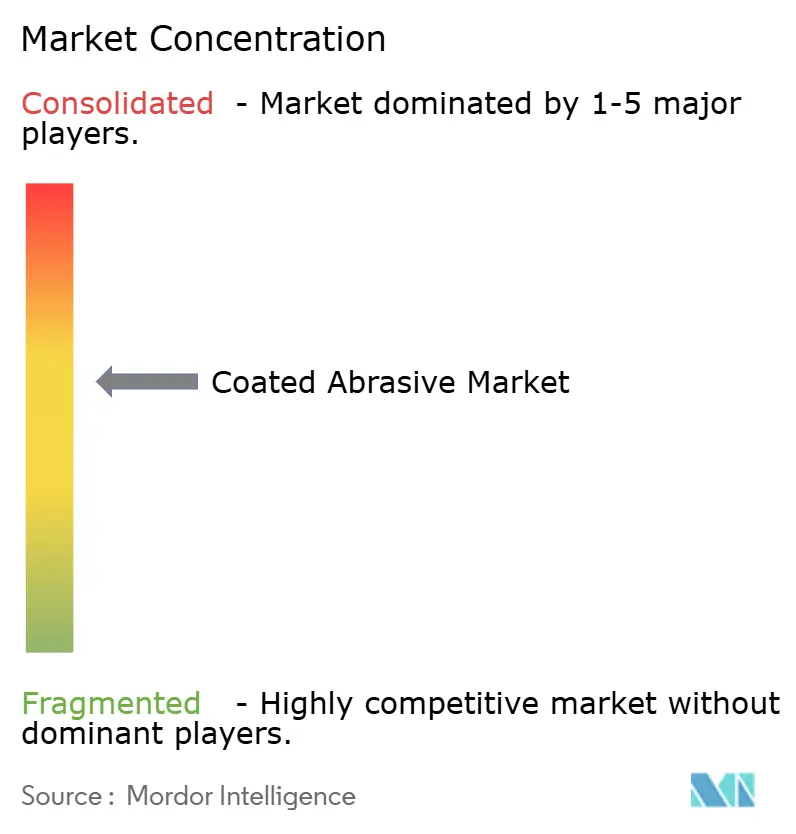
The coated abrasive market is moderately consolidated at the global level. 3M, Saint-Gobain, Mirka, Klingspor, and VSM are active in the technology-intensive premium segment. Hubei Yuli, Deerfos, and other Asian manufacturers compete strongly in standard-grade products and price. Global producers are investing in structured grains, digital tool systems, and sustainability credentials. Regional suppliers generally focus on manufacturing scale and distribution reach.
Precision-shaped ceramic grains and structured abrasive surfaces are important areas of competition. These products provide more consistent performance and can support specifications from original equipment manufacturers. VSM received the German Innovation Award in 2025 for its XELERION structured fine abrasive, recognizing resource conservation and precision finish grinding. Saint-Gobain’s 2026 to 2030 plan commits EUR 12 billion, equivalent to USD 14 billion, to investments and acquisitions focused on Asia-Pacific and North America.
High-specification opportunities include semiconductor back-grinding, aerospace composite finishing, and electric vehicle battery structural components. Mirka completed the acquisition of Hermes Bonded Abrasives in January 2026, expanding its coverage across coated and bonded formats. The deal can reduce the need for customers to use several specialist suppliers. Mirka also supported circular materials development through its 2026 Innovation Challenge. ISO 9001 certification and European ecodesign requirements are becoming market-access filters for suppliers.
Coated Abrasive Industry Leaders
Saint-Gobain
3M
Robert Bosch GmbH
Tyrolit AG
Carborundum Universal Limited
- *Disclaimer: Major Players sorted in no particular order
Coated Abrasive Market Companies Covered in this Report
- 3M
- Bibielle S.p.A.
- Carborundum Universal Limited
- Deerfos Co., Ltd.
- Hermes Schleifmittel GmbH
- Hubei Yuli Abrasive Belts Group Co., Ltd.
- Klingspor AG
- Kovax Corporation
- Mirka Ltd.
- Robert Bosch GmbH
- Saint-Gobain
- Sak Abrasives Limited
- Sia Abrasives Industries AG
- Smirdex S.A.
- Tyrolit AG
- VSM AG

Recent Industry Developments in Coated Abrasive Market
- July 2026: KSB SE & Co. KGaA introduced NoriResist, a carbon-based high-performance coating designed to improve the durability, efficiency, and sustainability of pumps and valves used in demanding applications. NoriResist has a hardness of 4,000 to 8,000 HV (40–80 GPa), providing high resistance to abrasive wear, particularly in fluids containing sand.
- March 2026: Carborundum Universal Limited announced the voluntary winding up of its German step-down subsidiary, CUMI AWUKO Abrasives GmbH (CAAG). The decision was driven by prolonged underperformance, mounting losses, and the absence of a viable turnaround path for the entity.


Global Coated Abrasive Market Report Scope
A coated abrasive is a flexible tool consisting of abrasive grains (such as aluminum oxide or silicon carbide) bonded to a substrate backing (such as paper, cloth, or polyester film) using specialized resins. The backing provides support and flexibility. Common backing materials include paper (for light hand sanding), cotton or polyester cloth (for heavy-duty belts), and vulcanized fiber.
The coated abrasives market is segmented by product type, material type, end-use industry, and geography. By product type, the market is segmented into discs, belts, rolls, sheets, and other product types. By material type, the market is segmented into aluminum oxide, silicon carbide, zirconia alumina, ceramic alumina, garnet, emery, and other material types. By end-use industry, the market is segmented into metal fabrication, automotive, woodworking & furniture, electronics & semiconductor, aerospace & defense, construction, machinery & equipment, and other end-use industries. The report also covers the market size and forecasts for coated abrasives in 16 countries across major regions. For each segment, the market sizing and forecasts have been done on the basis of value (USD).
| Discs |
| Belts |
| Rolls |
| Sheets |
| Other Product Types |
| Aluminum Oxide |
| Silicon Carbide |
| Zirconia Alumina |
| Ceramic Alumina |
| Garnet |
| Emery |
| Other Material Types |
| Metal Fabrication |
| Automotive |
| Woodworking & Furniture |
| Electronics & Semiconductor |
| Aerospace & Defense |
| Construction |
| Machinery & Equipment |
| Other End-Use Industries |
| Asia-Pacific | China |
| India | |
| Japan | |
| South Korea | |
| Rest of Asia-Pacific | |
| North America | United States |
| Canada | |
| Mexico | |
| Europe | Germany |
| United Kingdom | |
| France | |
| Italy | |
| Russia | |
| Rest of Europe | |
| South America | Brazil |
| Argentina | |
| Rest of South America | |
| Middle-East and Africa | Saudi Arabia |
| South Africa | |
| Rest of Middle-East and Africa |
| By Product Type | Discs | |
| Belts | ||
| Rolls | ||
| Sheets | ||
| Other Product Types | ||
| By Material Type | Aluminum Oxide | |
| Silicon Carbide | ||
| Zirconia Alumina | ||
| Ceramic Alumina | ||
| Garnet | ||
| Emery | ||
| Other Material Types | ||
| By End-Use Industry | Metal Fabrication | |
| Automotive | ||
| Woodworking & Furniture | ||
| Electronics & Semiconductor | ||
| Aerospace & Defense | ||
| Construction | ||
| Machinery & Equipment | ||
| Other End-Use Industries | ||
| By Geography | Asia-Pacific | China |
| India | ||
| Japan | ||
| South Korea | ||
| Rest of Asia-Pacific | ||
| North America | United States | |
| Canada | ||
| Mexico | ||
| Europe | Germany | |
| United Kingdom | ||
| France | ||
| Italy | ||
| Russia | ||
| Rest of Europe | ||
| South America | Brazil | |
| Argentina | ||
| Rest of South America | ||
| Middle-East and Africa | Saudi Arabia | |
| South Africa | ||
| Rest of Middle-East and Africa | ||


Key Questions Answered in the Report
What is the size of the coated abrasive market?
The coated abrasive market stands at USD 15.68 billion in 2026 and is forecast to reach USD 20.26 billion by 2031.
What is driving demand for coated abrasives?
Metal fabrication, automotive work, electronics manufacturing, and higher requirements for surface finish are the main demand factors.
Which product type led global demand in 2025?
Discs led product type demand with a 34.86% share in 2025, supported by use in grinding, sanding, and robotic finishing.
Which material type is expected to grow fastest through 2031?
Ceramic alumina is forecast to grow at a 6.49% CAGR through 2031 because it performs well on hard and heat-sensitive substrates.
Page last updated on:





