
Cinnamic Aldehyde Market Size and Share
Market Overview
| Study Period | 2021 - 2031 |
|---|---|
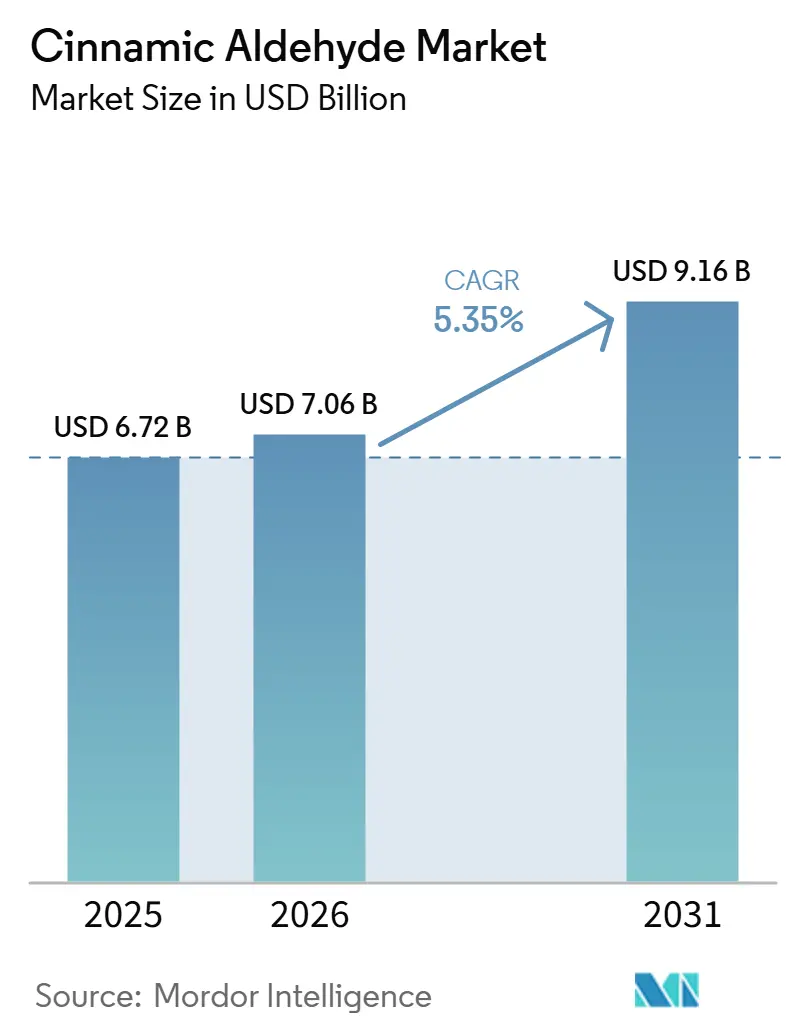
| Market Size (2026) | USD 7.06 Billion |
| Market Size (2031) | USD 9.16 Billion |
| Growth Rate (2026 - 2031) | 5.35 % |
| Fastest Growing Market | Asia-Pacific |
| Largest Market | Asia-Pacific |
| Market Concentration | Medium |
Major Players *Disclaimer: Major Players sorted in no particular order Image © Mordor Intelligence. Reuse requires attribution under CC BY 4.0. | |
Cinnamic Aldehyde Market Analysis by Mordor Intelligence
The cinnamic aldehyde market reached USD 6.72 billion in 2025, and is expected to grow from USD 7.06 billion in 2026 to USD 9.16 billion by 2031, and is expected to grow at a CAGR of 5.35% from 2026 to 2031. The cinnamic aldehyde market draws support from a broad demand base because the molecule works both as a sensory ingredient and as a functional active across food, fragrance, personal care, and pharmaceutical uses. Food and beverage remained the largest end-use base in 2025, which kept baseline demand steady even as higher-value uses expanded into health-related formulations. The cinnamic aldehyde market also benefits from the scale and consistency of synthetic production, while bio-based and fermentation-derived routes are gaining attention as cleaner and more resilient supply options. Pharmaceutical and healthcare demand is changing the growth mix because pharmaceutical-grade material is moving into API intermediate, nutraceutical, and research uses tied to antimicrobial, antidiabetic, and antitumor work[1]RSC Advances, “Novel Cinnamic Acid-Based N-Benzyl Pyridinium Analogs, Potent Dual Cholinesterase Inhibitors with Neuroprotective Properties for Alzheimer’s Disease,” RSC Advances, pubs.rsc.org . The cinnamic aldehyde market still faces pressure from tighter allergen disclosure rules in Europe and from cost swings in natural feedstocks, which raises the premium on suppliers that can offer consistent purity, documentation, and supply security.
Key Report Takeaways
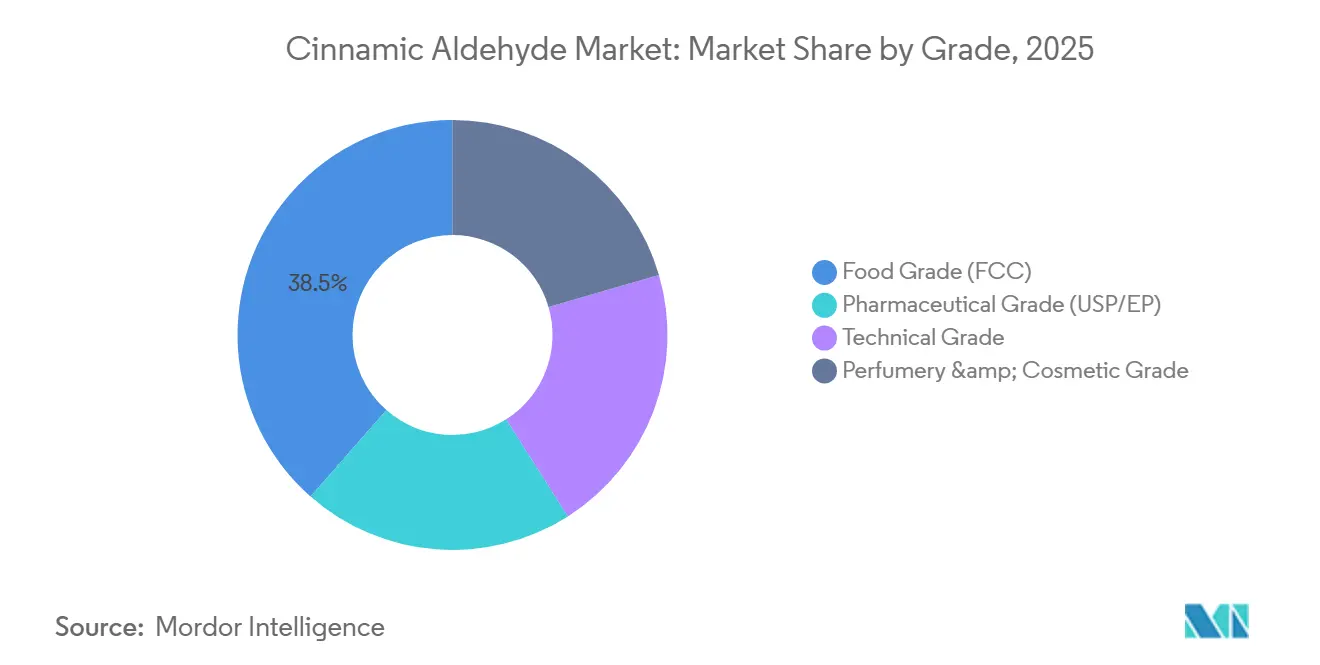
- By grade, Food Grade (FCC) led with 38.52% share in 2025, while Pharmaceutical Grade (USP/EP) is projected to expand at 6.18% CAGR through 2031.
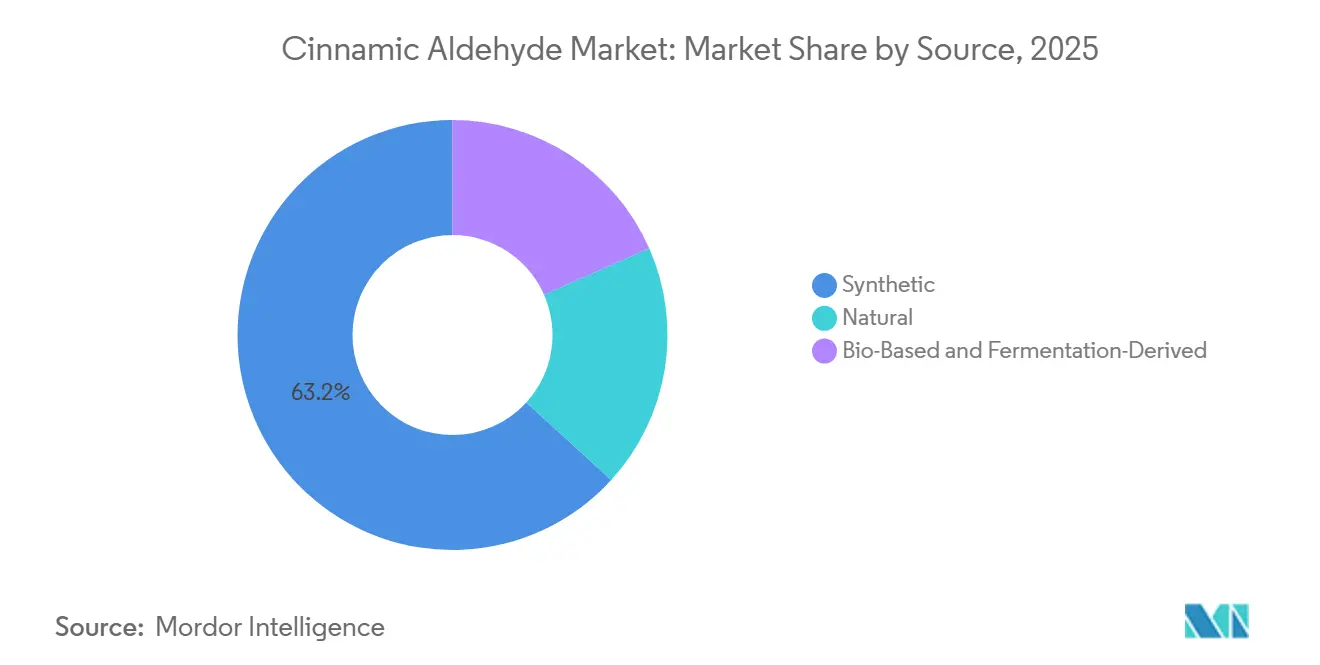
- By source, synthetic held 63.22% of the cinnamic aldehyde market share in 2025, while bio-based and fermentation-derived material is projected to grow at 7.02% CAGR through 2031.
- By application, flavoring agents accounted for 33.75% share of the cinnamic aldehyde market size in 2025, while antimicrobial and preservative use is projected to grow at 6.43% CAGR through 2031.
- By end-use industry, food and beverage led with 35.72% share in 2025, while pharmaceuticals and healthcare are projected to advance at 6.11% CAGR through 2031.
- By geography, Asia-Pacific held 41.86% of the cinnamic aldehyde market share in 2025 and is projected to expand at 6.08% CAGR through 2031.
Note: Market size and forecast figures in this report are generated using Mordor Intelligence’s proprietary estimation framework, updated with the latest available data and insights as of January 2026.
Market Trends and Insights
Drivers Impact Analysis of Cinnamic Aldehyde Market*
| Driver | (~) % Impact on CAGR Forecast | Geographic Relevance | Impact Timeline |
|---|---|---|---|
| Rising Demand in Flavor and Fragrance Applications | +2.0% | Global, concentrated in Asia-Pacific, North America, and Europe | Short term (≤ 2 years) |
| Growing Preference for Natural and Clean-Label Ingredients | +1.2% | North America and Europe, with spillover to APAC premium channels | Medium term (2-4 years) |
| Increasing Adoption in Oral Care, Personal Care, and Cosmetic Formulations | +0.8% | Global, led by APAC core markets and North America | Medium term (2-4 years) |
| Expanding Use of Multifunctional Antimicrobial and Preservative Ingredients | +0.7% | Global, with early gains in food processing hubs across APAC and North America | Medium term (2-4 years) |
| Rising Demand from Pharmaceutical and Specialty Chemical Industries | +0.5% | North America, Europe, and APAC including China, India, and Japan | Long term (≥ 4 years) |
| Source: Mordor Intelligence | |||
Rising Demand for Cinnamic Aldehyde in Flavor and Fragrance Applications
Flavor and fragrance applications remain the primary demand driver for the cinnamic aldehyde market, as trans-cinnamaldehyde already has meaningful commercial use in food systems. MDPI reported annual consumption of 180,000 kg in food applications, including 141,000 kg deliberately added as a flavoring agent rather than derived from cinnamon spice. This usage pattern supports steady orders from confectionery, bakery, chewing gum, and beverage manufacturers that rely on a recognizable cinnamon profile. The same sensory profile also drives fragrance demand, as warm and spicy notes remain widely used in personal care and household scent systems. This overlap between food and fragrance channels gives the cinnamic aldehyde market a broader demand base than ingredients that depend on a single end-use category. It also helps the cinnamic aldehyde market offset slower ordering in one channel when another remains active.
Growing Consumer Preference for Natural and Clean-Label Ingredients
The shift toward traceable and simpler ingredient systems is increasing interest in both natural and nature-identical materials in the cinnamic aldehyde market. LANXESS produces nature-identical cinnamic aldehyde with a minimum purity of 97% and supports it with ISO 9001:2015, ISO 14001:2015, and FSSC 22000 certifications, along with halal and kosher compliance. These certifications matter as buyers in food, fragrance, and institutional channels increasingly seek supply that meets quality, safety, and documentation requirements simultaneously. Nature-identical supply also addresses a practical issue by offering stable sensory performance without direct exposure to variability in bark extraction. This balance between natural positioning and production consistency helps suppliers defend premium pricing in selected accounts. As a result, demand in the cinnamic aldehyde market is shifting toward verified grades that support clean-label claims without compromising supply continuity.
Increasing Adoption in Oral Care, Personal Care, and Cosmetic Formulations
Cinnamaldehyde is gaining traction in oral care and personal care applications because it combines fragrance, flavor, and antimicrobial performance in a single ingredient. Manufacturers already use the compound in toothpastes, mouthwashes, soaps, shampoos, and deodorants, where it can help support shelf life and product differentiation. This benefits formulators, as one ingredient can reduce the need for additional fragrance components and separate antimicrobial inputs in certain systems. A 2025 in vitro study found that both cinnamaldehyde and nano-cinnamaldehyde particles demonstrated antifungal activity against candidiasis, supporting broader use in oral care formulations. This evidence is expanding cinnamaldehyde’s application from simple flavoring to functional oral hygiene solutions. As a result, the cinnamic aldehyde market is benefiting from personal care demand that prioritizes both sensory appeal and practical formulation performance.
Expanding Use of Multifunctional Antimicrobial and Preservative Ingredients
The antimicrobial role of cinnamaldehyde has emerged as a stronger growth driver for the cinnamic aldehyde market, supported by improving scientific evidence. A 2025 PMC study reported a minimum inhibitory concentration of 0.25 µg/mL against Streptococcus suis type 2, while treatment at 5 mg/kg delivered 50% mouse survival after one week, compared with 30% for ampicillin under comparable conditions. The same body of evidence also indicates activity against foodborne pathogens and highlights prolonged post-antibiotic effects in nano-encapsulated formats. These properties are relevant because food processors and preservative formulators are seeking multifunctional ingredients that work at lower addition levels and support cleaner-label strategies. The antimicrobial and preservative application segment is projected to expand at a CAGR of 6.4% through 2031, making it the fastest-growing application area in the cinnamic aldehyde market.
Restraints Impact Analysis of Cinnamic Aldehyde Market*
| Restraint | (~) % Impact on CAGR Forecast | Geographic Relevance | Impact Timeline |
|---|---|---|---|
| Price Volatility and Limited Availability of Natural Cinnamon-Derived Feedstocks | -1.5% | Global, concentrated in APAC and European natural-grade procurement | Short term (≤ 2 years) |
| Stringent Regulatory Requirements for Product Safety and Allergen Labeling | -0.8% | Europe primarily, with spillover to North America and export markets | Medium term (2-4 years) |
| Availability of Alternative Synthetic and Natural Aroma Compounds | -0.7% | Global, with pressure most acute in commodity-grade fragrance and flavoring segments | Long term (≥ 4 years) |
| Source: Mordor Intelligence | |||
Price Volatility and Limited Availability of Natural Cinnamon-Derived Feedstocks
Natural cinnamaldehyde supply depends on cinnamon bark availability, exposing part of the cinnamic aldehyde market to seasonal harvesting cycles and uneven regional supply. Bark extraction does not provide the same year-round production stability as synthetic routes. Producers that rely on certified natural raw materials face tighter margins when bark availability declines or competing buyers absorb more of the upstream crop. This pressure is stronger in premium fragrances and selected food applications, where botanical origin matters and substitution is less immediate. These supply swings also make it harder for buyers to secure stable input costs over longer contract periods. As a result, the cinnamic aldehyde market shows a wider cost gap between natural and synthetic grades when raw material conditions tighten.
Stringent Regulatory Requirements for Product Safety and Allergen Labeling
Regulatory compliance is becoming more demanding for the cinnamic aldehyde market, particularly in personal care and fragrance applications related to allergen disclosure. Commission Regulation (EU) 2023/1545 requires compliance from July 31, 2026, and expands the fragrance allergen disclosure list from 26 to 82 substances under Cosmetics Regulation (EC) 1223/2009. The regulation requires manufacturers to declare cinnamaldehyde, listed as Cinnamal, when concentrations exceed 0.001% in leave-on products and 0.01% in rinse-off products. This requirement increases formulation work, as manufacturers must review product portfolios, confirm concentration thresholds, and update label files before placing products on the market. The burden is greater for smaller fragrance and cosmetic suppliers that lack large regulatory teams. In practical terms, the cinnamic aldehyde market faces slower product cycles and higher documentation costs in Europe as these rules take full effect.
*Our forecasts treat driver/restraint impacts as directional, not additive. The impact forecasts reflect baseline growth, mix effects, and variable interactions.
Cinnamic Aldehyde Market Segment Analysis
By Grade:
Pharmaceutical Grades Outpace Traditional Food SpecificationsFood Grade (FCC) held a market share of 38.52% of the cinnamic aldehyde market size in 2025, making it the largest grade segment by value. Its leadership reflects its well-established use in confectionery, bakery, chewing gum, and beverage applications, where consistent flavor delivery remains critical. This grade also benefits from purchasing patterns that favor repeat volumes and standardized specifications across large food manufacturing programs. The scale of the food and beverage demand base keeps this segment ahead, even as other grades gain traction. Perfumery and cosmetic grade remains important in premium fragrance and personal care applications, where odor profile consistency and formulation behavior carry more weight than volume alone.
Pharmaceutical Grade (USP/EP) is projected to register a 6.18% CAGR through 2031, making it the fastest-growing grade segment in the cinnamic aldehyde market. This growth is tied to broader use in API synthesis, nutraceutical systems, and research programs that continue to explore cinnamaldehyde derivatives in metabolic, antimicrobial, and oncology contexts. LANXESS illustrates the quality standards required in this part of the cinnamic aldehyde industry, as its nature-identical offering carries food safety and quality certifications that support regulated procurement. Technical grade remains relevant in industrial and household applications, where cost competitiveness matters more than pharmaceutical purity. Even so, the cinnamic aldehyde market is moving toward tighter quality control and stronger documentation at the premium end.



By Source:
Synthetic Volume Anchors Market, Bio-Based Routes AccelerateSynthetic cinnamaldehyde accounted for 63.22% of the cinnamic aldehyde market size in 2025, making it the clear volume anchor across major applications. Its leadership stems from dependable purity, lower exposure to agricultural cycles, and a cost structure suited to large-scale food and fragrance programs. This production route also enables suppliers to offer year-round delivery, which is critical for buyers operating continuous manufacturing schedules. The value of this stability increases further when natural feedstock conditions become uncertain. Natural cinnamaldehyde continues to hold a position in premium fragrance applications and selected food uses, where botanical origin can support a higher selling price.
Bio-based and fermentation-derived cinnamaldehyde is projected to grow at a CAGR of 7.02% through 2031, making it the fastest-growing source segment in the cinnamic aldehyde market. Fermentation is important because it can strengthen supply resilience while supporting natural positioning in certain regulatory settings. This gives it a clearer long-term role beyond a niche experimental route. As a result, the cinnamic aldehyde industry is closely monitoring bio-based supply, as it could reshape the premium currently associated with bark-derived natural grades.
By Application:
Flavoring Agents Lead Volume, Antimicrobial Surge Signals DiversificationFlavoring agents accounted for a 33.75% share in 2025, retaining their position as the largest application segment in the cinnamic aldehyde market. The segment leads because cinnamaldehyde remains a standard cinnamon-character ingredient in bakery, confectionery, chewing gum, and functional beverage systems. Steady repeat use, rather than one-off specialty demand, supports this position. Fragrance ingredients represent the next major application segment, as the molecule supports base-note structure and blending depth in personal care and household scent formulations. Together, flavoring and fragrance applications continue to provide the cinnamic aldehyde market with a broad commercial base across daily-use consumer products.
Antimicrobial and preservative applications are projected to register a CAGR of 6.43% through 2031, making them the fastest-growing application area. Scientific evidence supports this shift, as cinnamaldehyde has demonstrated strong activity against pathogens and improved delivery performance in encapsulated systems[2]L. Zhu et al., “Antimicrobial and Antivirulence Function of Cinnamaldehyde Against Streptococcus suis Type 2,” PMC / National Institutes of Health, pmc.ncbi.nlm.nih.gov [2]. The 2025 nanocarrier work with soy protein isolate and ε-polylysine hydrochloride also addresses volatility and controlled release, which remain practical barriers to commercial use. Pharmaceutical intermediate and chemical intermediate applications continue to expand the end market beyond sensory roles. This shift indicates that the cinnamic aldehyde market is adding more functional use cases while maintaining its large flavoring base.
By End-use Industry:
Healthcare Vertical Outpaces Food-Led VolumeFood and beverage led the cinnamic aldehyde market with a 35.72% share in 2025, supported by its established role as a flavoring ingredient in high-volume products. The segment remains the primary demand base, driven by repeat purchase behavior and broad geographic adoption. Personal care and cosmetics follows as the second-largest end-use area, as cinnamaldehyde provides fragrance, sensory stimulation, and preservative support across multiple formats. Oral care stands out within this group, as manufacturers are evaluating the ingredient for applications beyond taste masking. This multifunctional role keeps consumer-facing applications central to the cinnamic aldehyde market, even as more technical applications continue to develop.
Pharmaceuticals and healthcare is projected to grow at a 6.11% CAGR through 2031, making it the fastest-growing end-use vertical. Research momentum across antifungal, antitumor, antidiabetic, and neuroprotective pathways is expanding the ingredient’s relevance in the cinnamic aldehyde industry. The 2026 ACS work on self-assembled nanodrugs shows how far the use case could move beyond simple ingredient applications. Household care and industrial applications continue to absorb technical and commercial grades in fragrance and disinfectant systems. However, the growth mix in the cinnamic aldehyde market is shifting toward health-linked and high-purity applications.
Geography Analysis
APAC Cinnamic Aldehyde Market
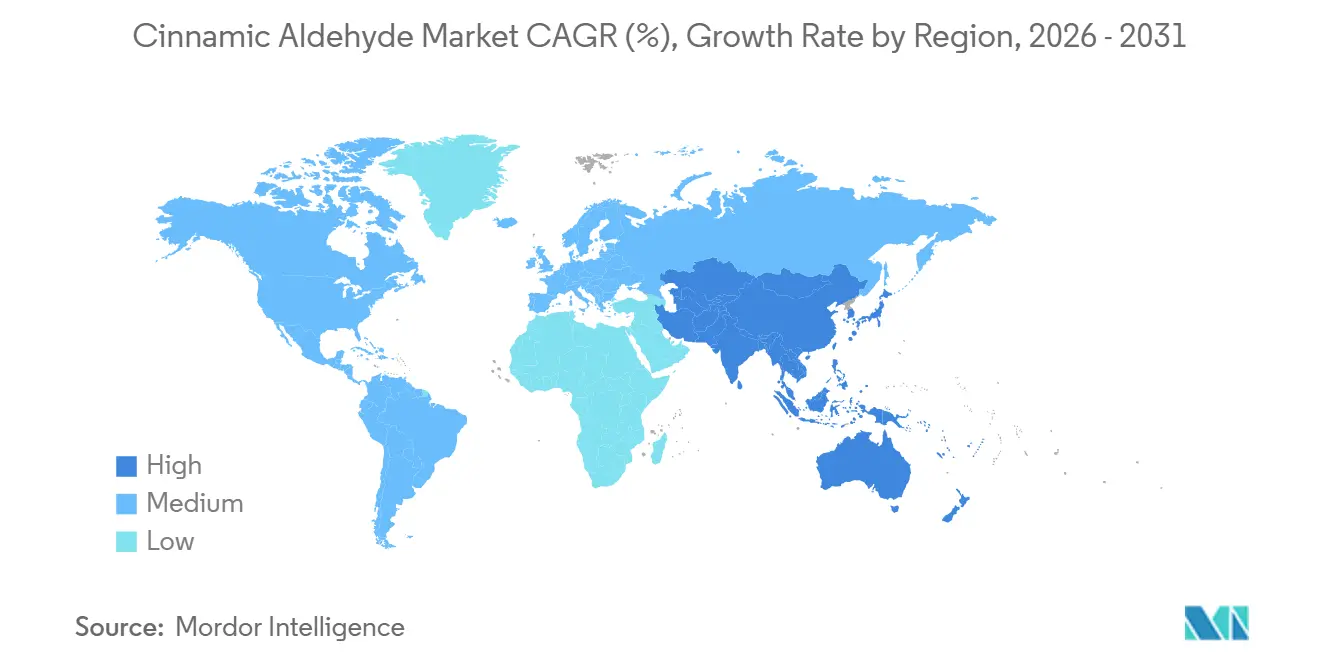
Asia Pacific accounted for 41.86% of the cinnamic aldehyde market size in 2025 and registered a CAGR of 6.08% through 2031. This positions the region as both the largest and fastest-growing geography in the cinnamic aldehyde market. The region combines large consumption centers with a strong production base, supporting domestic use and export activity. China remains central to regional supply and processing, while India, Japan, and South Korea drive demand from food manufacturing, personal care, and pharmaceutical production. This regional mix gives Asia Pacific scale across both the commodity and premium segments of the market.
North America and Europe Cinnamic Aldehyde Market
North America remains a major consumption center for food-grade and fragrance-grade material, supported by strong activity in confectionery, baked goods, household products, and personal care. The region benefits from broad and stable demand across several everyday consumer categories. Europe remains important for premium fragrance, perfumery, and regulated personal care applications. However, the European market now faces a tighter compliance burden, as Commission Regulation (EU) 2023/1545 requires the declaration of cinnamaldehyde above 0.001% in leave-on products and 0.01% in rinse-off products from July 31, 2026. This requirement is increasing reformulation and documentation work, especially for suppliers serving premium cosmetic and fragrance accounts.
MEA and South America Cinnamic Aldehyde Market
South America remains a smaller market, but food and beverage applications in Brazil and Argentina are supporting steady expansion in the cinnamic aldehyde market. The region benefits from demand for processed foods and the use of cinnamic aldehyde in personal care and household product manufacturing. The Middle East and Africa are also growing import markets for synthetic-grade material used in food flavoring, personal care, and scent applications. Halal compliance remains a notable buying factor in parts of the Middle East, and LANXESS directly addresses this requirement through its certified product profile. Across both regions, demand growth is driven less by frontier research and more by rising consumption of packaged foods and routine personal care products.

Competitive Landscape
The cinnamic aldehyde market shows moderate concentration in premium certified grades and broader fragmentation in commodity supply. A limited group of specialty chemical and fragrance suppliers competes in pharmaceutical, perfumery, and food-certified materials, where purity, regulatory files, and quality systems matter most. This part of the market rewards companies that provide complete documentation and consistent batch performance. LANXESS is a clear example, as it supports nature-identical cinnamic aldehyde with FSSC 22000, ISO 9001:2015, ISO 14001:2015, halal, and kosher credentials. These capabilities matter because premium buyers often assess suppliers based on compliance strength before negotiating on price.
Competition in the cinnamic aldehyde market is also shifting toward technology depth rather than output scale alone. Encapsulation work, controlled-release systems, and microbial production routes are becoming part of the competitive agenda, as they address volatility, water compatibility, and premium natural positioning. The 2024 KAIST publication on engineered fermentation shows that bio-derived production is moving closer to commercial relevance rather than remaining a laboratory concept. Symrise is set to add another strategic layer in May 2026 with the launch of SYM ALPHA™ Think Tank as a scaled co-creation platform for selected Scent & Care partners. This move matters because it links consumer intelligence and sensory work more closely with ingredient development and customer retention.
Robertet is also expected to signal a clear strategic direction in March 2026 through its investment in Aethera Biotech and its planned joint venture structure around active cosmetic ingredients. This development supports the view that larger fragrance and specialty ingredient groups are pursuing biotech-linked growth paths instead of relying only on conventional sourcing. At the same time, regional Asian producers continue to compete on cost and supply scale in synthetic grades. As a result, the cinnamic aldehyde market is separating into a premium tier driven by certification and innovation and a volume tier driven by cost and production efficiency.
Cinnamic Aldehyde Industry Leaders
LANXESS
Symrise
AUROCHEMICALS
SBBLG
Merck KGaA
- *Disclaimer: Major Players sorted in no particular order

Cinnamic Aldehyde Market Companies Covered in this Report
- LANXESS
- Privi Speciality Chemicals Limited
- Aadhunik Industries
- Advanced Biotech
- AUROCHEMICALS
- Axxence Aromatic GmbH
- Hindustan Mint & Agro Products Pvt. Ltd.
- Kao Corporation
- Merck KGaA
- Robertet Group
- SBBLG
- Shandong Yaroma Perfumery Co., Ltd.
- Symrise

Recent Industry Developments in Cinnamic Aldehyde Market
- May 2026: Symrise launched SYM ALPHA Think Tank as a scaled strategic co-creation platform for selected Scent & Care segment partners, building on a successful 2025 pilot. The platform integrates Generation Alpha consumer intelligence with sensory analytics to shorten ingredient innovation cycles for flavor and fragrance customers.
- March 2026: Robertet Group announced a strategic investment in Aethera Biotech, a European pioneer in active cosmetic ingredients, forming a joint venture with a 50-50 ownership structure to be completed over three years. The move marks Robertet's first entry into biotech and targets bio-derived cosmetic active ingredients, including plant-based aroma compounds.


Global Cinnamic Aldehyde Market Report Scope
Cinnamic aldehyde (cinnamaldehyde, C₉H₈O) is the primary organic compound responsible for cinnamon’s distinct warm, spicy, and sweet flavor and odor. It occurs naturally in the bark of cinnamon and cassia trees and is widely used as a flavoring agent and fragrance component.
The cinnamic aldehyde market is segmented by grade, source, application, end-use industry, and geography. By grade, the market is segmented into food Grade (FCC), technical grade, pharmaceutical grade (USP/EP), perfumery & cosmetic grade. By source, the market is segmented into synthetic, natural, and bio-based & fermentation-derived. By application, the market is segmented into flavoring agent, fragrance ingredient, antimicrobial & preservative, pharmaceutical intermediate, chemical intermediate, and other applications. By end-use industry the market is segmented into food & beverage, personal care & cosmetics, household care, oral care, pharmaceuticals & healthcare, and industrial. The report also covers the cinnamic aldehyde market size and forecasts for the cryogenic insulation market in 20 countries across major regions. For each segment, the market sizing and forecasts have been done on the basis of revenue (USD).
| Food Grade (FCC) |
| Technical Grade |
| Pharmaceutical Grade (USP/EP) |
| Perfumery & Cosmetic Grade |
| Synthetic |
| Natural |
| Bio-Based and Fermentation-Derived |
| Flavoring Agent |
| Fragrance Ingredient |
| Antimicrobial & Preservative |
| Pharmaceutical Intermediate |
| Chemical Intermediate |
| Other Applications |
| Food & Beverage |
| Personal Care & Cosmetics |
| Household Care |
| Oral Care |
| Pharmaceuticals & Healthcare |
| Industrial |
| Asia-Pacific | China |
| India | |
| Japan | |
| South Korea | |
| Rest of Asia-Pacific | |
| North America | United States |
| Canada | |
| Mexico | |
| Europe | Germany |
| United Kingdom | |
| France | |
| Italy | |
| Russia | |
| Rest of Europe | |
| South America | Brazil |
| Argentina | |
| Rest of South America | |
| Middle-East and Africa | Saudi Arabia |
| South Africa | |
| Rest of Middle-East and Africa |
| By Grade | Food Grade (FCC) | |
| Technical Grade | ||
| Pharmaceutical Grade (USP/EP) | ||
| Perfumery & Cosmetic Grade | ||
| By Source | Synthetic | |
| Natural | ||
| Bio-Based and Fermentation-Derived | ||
| By Application | Flavoring Agent | |
| Fragrance Ingredient | ||
| Antimicrobial & Preservative | ||
| Pharmaceutical Intermediate | ||
| Chemical Intermediate | ||
| Other Applications | ||
| End-use Industry | Food & Beverage | |
| Personal Care & Cosmetics | ||
| Household Care | ||
| Oral Care | ||
| Pharmaceuticals & Healthcare | ||
| Industrial | ||
| By Geography | Asia-Pacific | China |
| India | ||
| Japan | ||
| South Korea | ||
| Rest of Asia-Pacific | ||
| North America | United States | |
| Canada | ||
| Mexico | ||
| Europe | Germany | |
| United Kingdom | ||
| France | ||
| Italy | ||
| Russia | ||
| Rest of Europe | ||
| South America | Brazil | |
| Argentina | ||
| Rest of South America | ||
| Middle-East and Africa | Saudi Arabia | |
| South Africa | ||
| Rest of Middle-East and Africa | ||


Key Questions Answered in the Report
What is the 2031 value forecast for the cinnamic aldehyde market?
The cinnamic aldehyde market reached USD 6.72 billion in 2025, and is expected to grow from USD 7.06 billion in 2026 to USD 9.16 billion by 2031, and is expected to grow at a CAGR of 5.35% from 2026 to 2031.
Which source segment is expanding the fastest?
Bio-based and fermentation-derived material is the fastest-growing source segment, with a projected 7.02% CAGR through 2031.
Which grade leads the cinnamic aldehyde market?
Food grade (FCC) held the largest share of 38.52% in 2025 due to the growing demand for clean-label and organic food ingredients.
Which region leads global demand and growth?
Asia-Pacific led with 41.86% share in 2025 and is also projected to post the fastest regional growth at 6.08% through 2031.
Page last updated on:





