
China Grapes Harvesters Market Size and Share
Market Overview
| Study Period | 2021 - 2031 |
|---|---|
| Forecast Data Period | 2026 - 2031 |
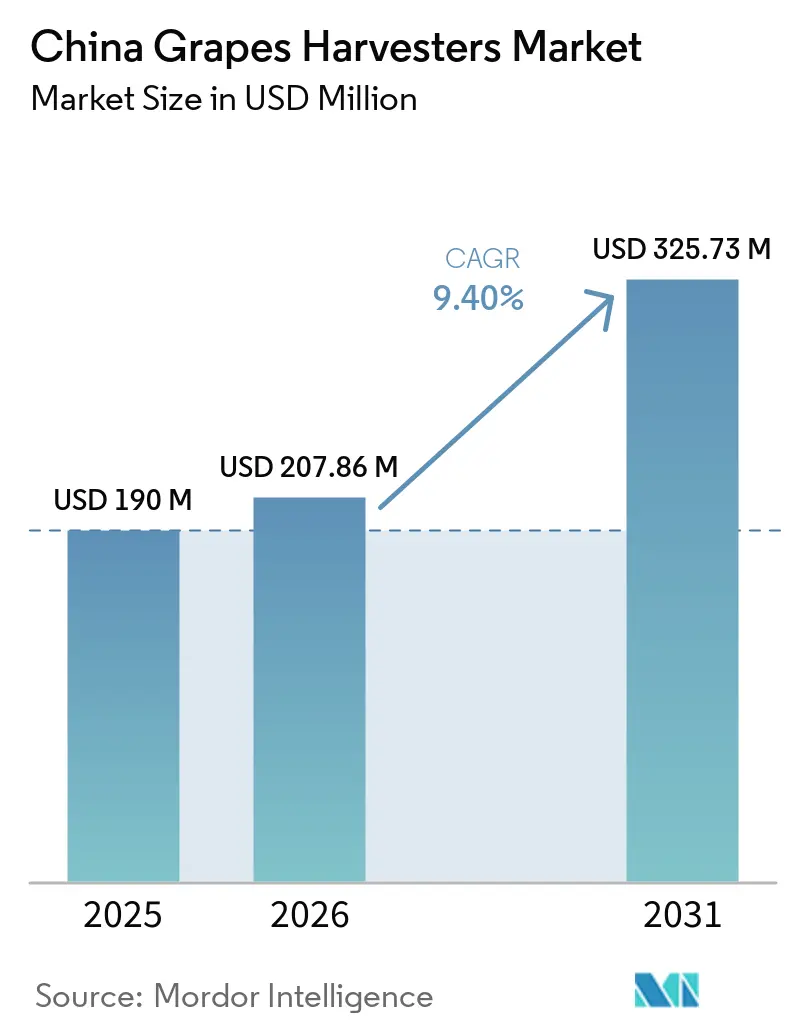
| Base Year Market Size (2025) | USD 190 Million |
| Market Size (2026) | USD 207.86 Million |
| Market Size (2031) | USD 325.73 Million |
| Growth Rate (2026 - 2031) | 9.40 % |
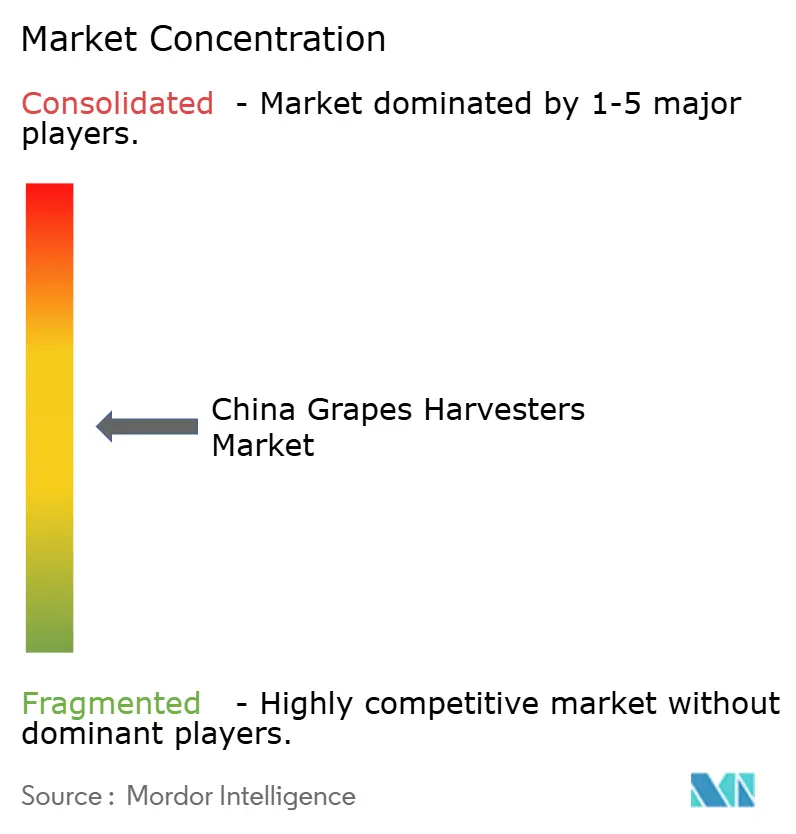
| Market Concentration | Medium |
Major Players *Disclaimer: Major Players sorted in no particular order Image © Mordor Intelligence. Reuse requires attribution under CC BY 4.0. | |
China Grapes Harvesters Market Analysis by Mordor Intelligence
The China grapes harvesters market size was valued at USD 190.00 million in 2025, USD 207.86 million in 2026, and is projected to reach USD 325.73 million by 2031, growing at a CAGR of 9.40% during the forecast period 2026-2031. Mechanical grape harvesting remains in its developmental stage, with adoption varying by vineyard scale, terrain, row configuration, and production model. Labor availability and rising vineyard-management costs are strengthening the case for mechanization, particularly during labor-intensive harvesting periods. Government support for agricultural mechanization is also improving the investment environment. China's 2024-2026 agricultural-machinery subsidy framework allows enhanced support for selected priority equipment, including qualifying new-energy machinery, subject to provincial eligibility. The growing adoption of precision viticulture technologies is creating opportunities for harvesters with automation, guidance, monitoring, and data integration capabilities. Competition spans international grape-harvester manufacturers and domestic agricultural-machinery suppliers, with differentiation centered on harvesting performance, automation, equipment cost, localization, and after-sales support. Compact and terrain-adapted harvesters also present opportunities in vineyards where narrow rows, fragmented plots, slopes, or trellis configurations limit the use of conventional high-capacity equipment.
Key Report Takeaways
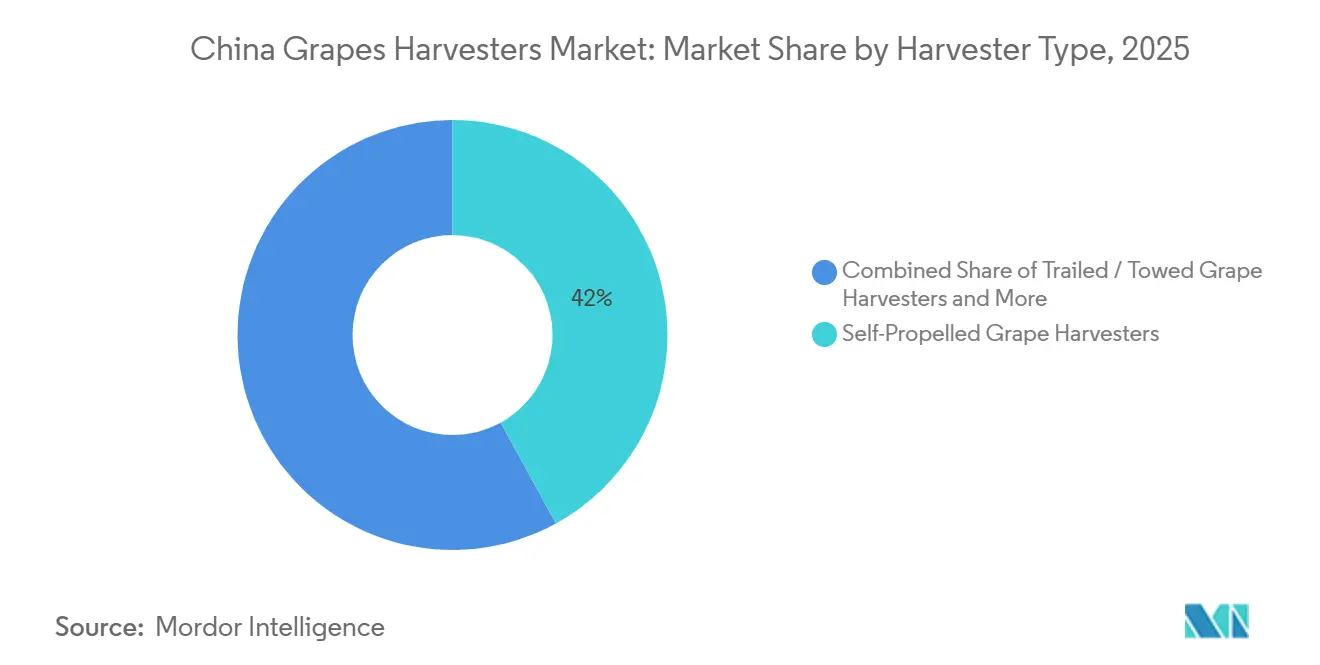
- By harvester type, self-propelled grape harvesters were the largest segment in the China grapes harvesters market and held 42.0% of the market share in 2025, while tractor-mounted grape harvesters are the fastest-growing segment with a 12.8% CAGR during the forecast period.
- By power source, diesel-powered harvesters were the largest segment with 58.0% market share in 2025, while electric harvesters are the fastest-growing segment and are anticipated to expand at a 15.0% CAGR between 2026 and 2031.
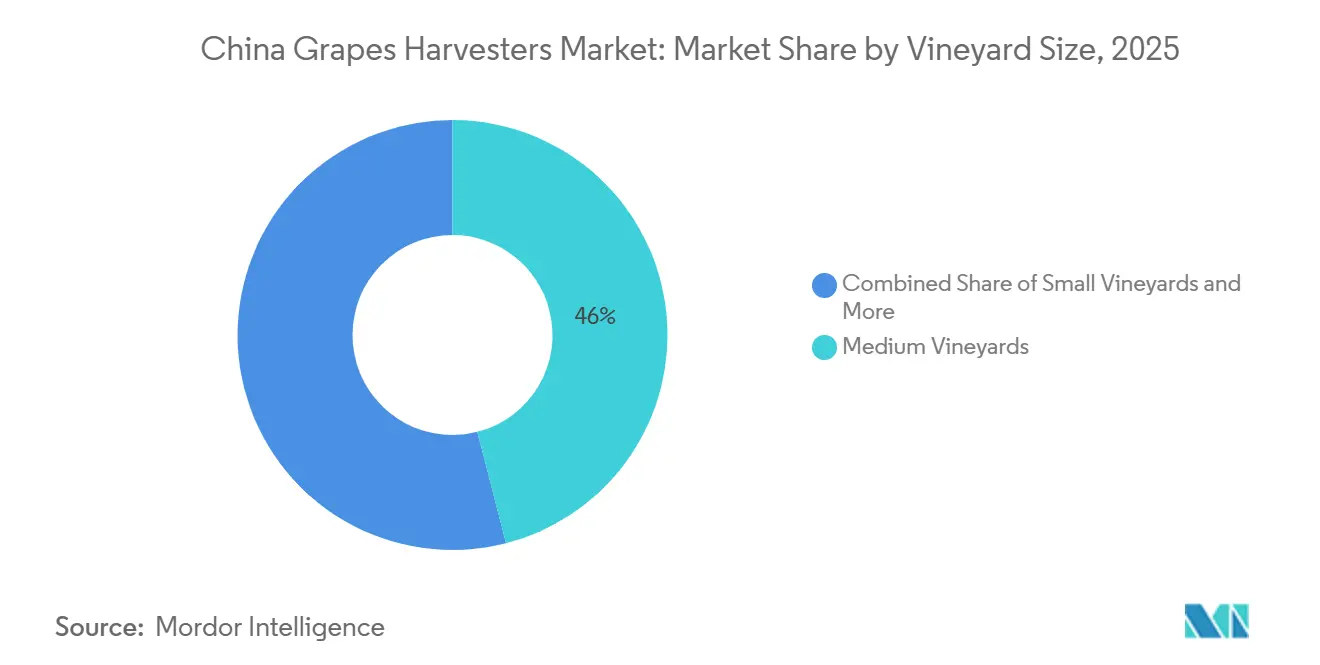
- By vineyard size, medium vineyards from 50 to 200 hectares were the largest segment with 46.0% market share in 2025, while large vineyards above 200 hectares are the fastest-growing segment and are anticipated to expand at a 13.4% CAGR between 2026 and 2031.
Note: Market size and forecast figures in this report are generated using Mordor Intelligence’s proprietary estimation framework, updated with the latest available data and insights as of January 2026.
Market Trends and Insights
Drivers Impact Analysis of China Grapes Harvesters Market*
| Driver | (~) % Impact on CAGR Forecast | Geographic Relevance | Impact Timeline |
|---|---|---|---|
| Labor-Shortage Driven Mechanization Surge in Chinese Vineyards | +2.5% | Global, strongest in China and broader Asia-Pacific | Short term (≤ 2 years) |
| Vineyard Consolidation and Larger-Scale Block Farming in Core Wine Regions | +1.5% | China and Europe | Medium term (2-4 years) |
| Provincial Mechanization Subsidies and Purchase Incentives | +1.8% | China, with policy spill-over to Asia-Pacific | Short term (≤ 2 years) |
| Shift Toward Precision Viticulture and Data-Ready Harvesting Equipment | +1.2% | Global, most pronounced in North America, Europe, and China | Medium term (2-4 years) |
| Rental, Leasing, and Service-Operator Models for Small and Mid-Sized Growers | +0.8% | Global | Long term (≥ 4 years) |
| Demand for Compact, Slope-Tolerant Harvesters in Ningxia, Xinjiang, and Similar Terrain | +0.9% | China and Europe in hilly sub-regions | Medium term (2-4 years) |
| Source: Mordor Intelligence | |||
Labor-Shortage Driven Mechanization Surge in Chinese Vineyards
Labor shortages and rising labor costs are accelerating vineyard mechanization in China's major grape-producing regions. In Xinjiang, standardized vineyards are increasingly being designed for machine operations to reduce dependence on manual labor and improve the efficiency of time-sensitive vineyard activities. In Ningxia, vineyards using IoT-connected drip irrigation managed more than 7,000 mu (466 hectares) with only 5 workers, whereas traditional flood irrigation systems required at least 5 workers per 300 mu (20 hectares)[1]. This labor productivity gap is influencing how estate managers approach mechanization, as harvesting represents the next major area where labor substitution can directly protect output timing. This wider shift toward labor-saving vineyard operations strengthens the economic case for mechanizing other labor-intensive activities, including harvesting. As growers seek to reduce dependence on seasonal labor and complete harvesting within narrow crop windows, mechanical grape harvesters can provide greater harvesting capacity and operational consistency.
Vineyard Consolidation and Larger-Scale Block Farming in Core Wine Regions
The market is also gaining support from estate consolidation in its main wine regions. Larger vineyard blocks improve machine economics because fixed equipment costs can be spread across wider hectares and longer operating schedules. They also make contract harvesting more viable because fleets can remain active in a single sub-region for longer periods during the season. Ningxia, Xinjiang, Shandong, and Hebei are the primary wine grape-producing regions in China, creating concentrated demand and reducing distribution risk for suppliers building service coverage in these clusters. Larger and more contiguous vineyard blocks improve the economics of mechanical harvesting because equipment costs can be spread across larger area, and machines can operate for longer periods with fewer relocations. Large-scale and standardized vineyard development in major wine-producing areas can therefore improve machine utilization and make ownership or contract harvesting more economically viable.
Provincial Mechanization Subsidies and Purchase Incentives
The China grapes harvesters market is benefiting from a supportive policy environment that lowers equipment acquisition costs and encourages agricultural machinery renewal. Government initiatives to expand machinery replacement programs and strengthen support for specialized agricultural equipment reflect continued efforts to modernize farm machinery fleets, creating favorable conditions for grape harvester adoption. At the same time, product certification requirements shape market competition by favoring brands that meet domestic technical and compliance standards. This makes the China grapes harvesters market more accessible for suppliers with localized certification and service capabilities, while creating higher entry barriers for those without an established local presence.
Shift Toward Precision Viticulture and Data-Ready Harvesting Equipment
The adoption of digital vineyard-management technologies in China is creating a more favorable environment for data-enabled grape-harvesting equipment. Ningxia's wine-industry technology collaborative innovation center supports the use of digital tools across vineyard management and wine production, encouraging greater integration of technology into commercial vineyard operations. As vineyards adopt digital monitoring and management systems, harvesters with telemetry, machine monitoring, and data-integration capabilities can provide greater operational visibility and coordination during harvesting. This trend supports demand for more connected harvesting equipment, particularly among larger and technology-oriented vineyards, although the impact on overall harvester demand remains gradual as digital adoption expands.
Restraints Impact Analysis of China Grapes Harvesters Market*
| Restraint | (~) % Impact on CAGR Forecast | Geographic Relevance | Impact Timeline |
|---|---|---|---|
| High Upfront Capital Cost Relative to Vineyard Cash Flows | -1.5% | China nation-wide | Short term (≤ 2 years) |
| Limited Suitability for Premium Hand-Picked Varietals and Quality-Sensitive Wine Programs | -0.8% | Ningxia premium appellations | Long term (≥ 4 years) |
| Maintenance, Operator Skill, and Parts-Service Availability Constraints | -0.7% | China in inland provinces, Middle East and Africa, and South America | Medium term (2-4 years) |
| Terrain, Row-Spacing, and Trellis Compatibility Constraints in Fragmented Vineyards | -0.6% | China in hilly zones | Medium term (2-4 years) |
| Source: Mordor Intelligence | |||
High Upfront Capital Cost Relative to Vineyard Cash Flows
The China grapes harvesters market continues to face a significant cost barrier for first-time buyers. Self-propelled machines require substantial upfront investment, while their seasonal use limits equipment utilization, making it difficult for many growers to justify ownership. This challenge is particularly pronounced for medium-sized vineyards, where machinery purchases can represent a considerable financial commitment. Although subsidies and leasing models help reduce the financial burden, adoption can still be delayed by administrative processes and procurement cycles. Cost constraints also slow mechanization among smaller vineyards, where labor shortages are often most acute. Until equipment utilization improves through expanded service models or greater year-round use, high ownership costs will continue to limit widespread adoption.
Limited Suitability for Premium Hand-Picked Varietals and Quality-Sensitive Wine Programs
The China grapes harvesters market is also constrained by quality concerns in premium wine programs. Premium wine producers often place greater emphasis on berry integrity, skin contact timing, and juice handling, which can make manual harvesting preferable to mechanized systems for certain high-value labels. Producers may also maintain harvesting protocols tailored to their specific quality standards and winemaking processes, limiting the suitability of standardized machine harvesting across premium vineyards. This positions premium vineyards as a selective opportunity rather than a broad-volume market for current equipment platforms. Unless machine harvesting can consistently meet stringent quality requirements, premium estates are likely to retain manual picking as a quality-control and brand-positioning decision.
*Our forecasts treat driver/restraint impacts as directional, not additive. The impact forecasts reflect baseline growth, mix effects, and variable interactions.
China Grapes Harvesters Market Segment Analysis
By Harvester Type:
Self-Propelled Machines Lead While Tractor-Mounted Units Gain GroundSelf-propelled grape harvesters held 42.0% of the China grapes harvesters market share in 2025, making them the dominant harvester type. These machines are suited to Xinjiang's large, flat commercial vineyard blocks, where operators require consistent daily harvesting capacity. Their ability to operate independently of a tractor makes them particularly efficient for large-scale operations where downtime must be minimized. Trailed/towed harvesters remain relevant for mid-sized estates that already operate high-horsepower tractors, allowing growers to adopt mechanical harvesting without purchasing a separate self-propelled unit. These harvesters offer a practical entry point into mechanization, as they leverage existing farm equipment while still delivering meaningful labor savings during harvest periods.
The China grapes harvesters market for tractor-mounted grape harvesters is anticipated to expand at a 12.8% CAGR between 2026 and 2031. Growers with multipurpose tractors can add mounting equipment at a lower cost than purchasing a complete harvesting platform, making this an attractive option for smaller and mid-sized vineyards looking to reduce labor dependency without significant capital investment. Grégoire's GT3 and GL7 models use ISOBUS (ISO bus communication standard) connectivity, which allows the tractor and harvester to exchange operating data. This integration supports more precise control over harvesting parameters such as shaking intensity and speed. As vineyards adopt more connected systems, equipment that supports data compatibility may gain an advantage in future procurement decisions.

By Power Source:
Diesel Leads the Installed Base While Electric Harvesters Grow FastestDiesel-powered harvesters accounted for 58.0% of the China grapes harvesters market size in 2025, primarily due to their reliability in remote wine regions where charging infrastructure remains limited. Many of these regions lack the grid connectivity needed to support battery-powered equipment at scale. This reliability is critical during the narrow harvest period, when equipment downtime can result in costly delays for vineyard operators. This market position reflects current operating conditions rather than a long-term preference for diesel technology. Hybrid harvesters offer an intermediate option for growers seeking new-energy compatibility without full dependence on charging infrastructure.
The China grapes harvesters market for electric harvesters is anticipated to expand at a 15.0% CAGR between 2026 and 2031. China's carbon reduction targets and subsidy policies favoring new-energy agricultural machinery are improving the outlook for electric and hybrid platforms. As rural charging networks expand and machine range improves, electric equipment will become more operationally viable. Manufacturers are also investing in longer-range battery systems and faster charging solutions tailored to agricultural use cases. Future environmental regulations may further increase the attractiveness of new-energy options in subsidy-supported equipment purchases.
By Vineyard Size:
Medium Estates Form the Current Base While Large Vineyards Lead GrowthMedium vineyards of 50 to 200 hectares accounted for 46.0% of the China grapes harvesters market share in 2025, making them the largest vineyard-size segment. These estates are large enough to support trailed or compact self-propelled harvesters, but often require only one machine for the full vineyard area. Their investment profile also aligns well with subsidy programs and installment-based equipment financing. Small vineyards below 50 hectares remain important, although they rely more on contract harvesting, leasing, and tractor-mounted equipment.
Large vineyards above 200 hectares are anticipated to expand at a 13.4% CAGR between 2026 and 2031, making them the fastest-growing size segment. In October 2025, Changji in Xinjiang identified wine grapes as a core part of its Green Quality Fruit and Vegetable Industrial Cluster and promoted unified management and staggered harvesting across blocks above 20,000 mu. Larger vineyard blocks can support multi-machine fleets and dedicated service partnerships, as equipment use is spread across more hectares. At 200 hectares and above, machine harvesting becomes more financially attractive because growers can reduce the harvesting cost per kilogram without depending entirely on subsidy support.
Geography Analysis
Ningxia and Xinjiang are China's primary wine grape demand centers, though their vineyard structures and harvesting requirements differ. Ningxia has a well-established wine grape cultivation and production base, with premium wine estates gradually adopting precision vineyard technologies, including soil sensors and canopy management tools, while manual harvesting remains important for quality-focused labels. Xinjiang, by contrast, benefits from its continental climate and large-scale vineyard operations, where mechanical harvesting is more widely used due to the scale of cultivation and relatively flat terrain.
Ningxia's wine-industry technology collaborative innovation center, established in January 2024, is supporting the adoption of digital tools across vineyard management and wine production, creating a favorable environment for harvesters with connectivity and data-integration capabilities. Xinjiang is well suited to self-propelled harvesting equipment due to its relatively flat terrain and larger contiguous vineyard blocks. In Changji, the development of wine grapes within the Green Quality Fruit and Vegetable Industrial Cluster has encouraged more coordinated vineyard management and harvesting schedules. These operating conditions can improve machine utilization and support fleet-based harvesting and specialized service-provider models.
Shandong, Hebei, and Yunnan remain relevant secondary demand areas within the China grapes harvesters market. Fragmented vineyard holdings and uneven terrain in these regions can limit the use of large straddle harvesters, creating demand for compact machines that can operate in narrow rows and on slopes. Service coverage, spare-parts availability, and operator training will remain important factors outside Ningxia and Xinjiang. Suppliers that adapt machine designs to local row spacing and terrain conditions can access demand that standard high-capacity platforms cannot serve.
Competitive Landscape
The China grapes harvesters market remained moderately consolidated in 2025, with the top five players accounting for a major share. Pellenc S.A.S and New Holland Braud demonstrate that European specialists continue to lead the premium end of the competitive landscape. The primary competitive divide is clear, European brands compete on harvest quality, machine refinement, and vineyard technology, while Chinese players compete on subsidy alignment, localization, and service response. The market still has an open space in compact, slope-capable equipment, as no player yet dominates vineyards with narrow rows and difficult terrain.
Gregoire S.A.S. holds a distinct position by combining mechanical harvesting with digital workflow capabilities, rather than focusing solely on throughput. Its EASYpilot system supports 3 cm line guidance without GPS dependence, which is relevant for estates operating in complex layouts. Domestic manufacturers follow a different path to market share gains by aligning local navigation standards, cost positioning, and field service support more closely with provincial buying requirements. This advantage is more significant in inland regions, where maintenance and parts access for imported machines can slow adoption. This results in a competitive landscape where premium leadership and local execution strength are both important, but for different buyer groups.
Strategic activity in the China grapes harvesters market is now focused on warranty support, automation, and harvest quality. In November 2025, New Holland announced a two-year factory warranty for all Braud grape harvesters produced at Coëx in France, directly addressing total-cost concerns in export markets. New Holland also unveiled the autonomous R4 robot series in 2025 for vineyard and specialty crop use, signaling that automation is becoming a product priority rather than a future concept[3]. Pellenc S.A.S updated its GRAPES'LINE tow-behind harvester in 2025 with a new flexible sorter conveyor, a new-generation harvesting arm, and the SELECTIV PROCESS system, which delivered a 99.82% clean harvest ratio. These developments indicate that established companies are working to defend pricing and market share by improving machine reliability, automation readiness, and fruit handling performance.
China Grapes Harvesters Industry Leaders
-
New Holland Braud (CNH Industrial N.V.)
-
Zoomlion Heavy Industry Science and Technology Co., Ltd.
-
Pellenc S.A.S.
-
Grégoire S.A.S.
-
ERO GmbH
- *Disclaimer: Major Players sorted in no particular order
China Grapes Harvesters Market Companies Covered in this Report
- Pellenc S.A.S.
- New Holland Braud (CNH Industrial N.V.)
- Gregoire S.A.S.
- Zoomlion Heavy Industry Science and Technology Co., Ltd.
- Weichai Lovol Intelligent Agricultural Technology Co., Ltd.
- Deere & Company
- Dongfeng Agricultural Machinery Group Co., Ltd.
- CLAAS KGaA mbH
- ERO GmbH
- SDF S.p.A.
Recent Industry Developments in China Grapes Harvesters Market
- January 2026: The China Agricultural Machinery Circulation Association issued T/CAMDA 38-2026, establishing the first industry-level technical standard for fully mechanized table grape production in Xinjiang. Co-developed by China Agricultural University and the Xinjiang Academy of Agricultural Sciences, it covers machinery specifications and operational workflows across all production stages and serves as a reference framework for other regions.
- June 2025: Jianong Vineyard and Lanjiang Tech established a 1,100-acre smart vineyard demonstration zone in Jiaxing, deploying autonomous multi-functional orchard robots for spraying and weeding, cutting labor costs by up to 40%. The project integrates AI, IoT, and big data across the full grape production cycle, serving as a commercial benchmark for intelligent vineyard mechanization in eastern China.
- February 2025: A standardized demonstration vineyard in Changji adopted machine-compatible vineyard layouts to support mechanical grape harvesting. The project demonstrated harvesting costs of CNY 0.20/kg (USD 0.03/kg), compared with CNY 0.40/kg (USD 0.06/kg) for manual harvesting, while one machine could cover 100–200 mu per day, supporting greater adoption of grape harvesters and service-based mechanized harvesting models.
China Grapes Harvesters Market Report Scope
A grape harvesting machine is a mechanized device used in vineyards to detach grapes from vines and collect them efficiently during harvest, reducing manual labor and increasing harvesting speed. The China grapes harvesters market report is segmented by harvester type (self-propelled, trailed or towed, and tractor-mounted), by power source (diesel, hybrid, and electric), and by vineyard size (small vineyards (below 50 hectares), medium vineyards (50 to 200 hectares), and large vineyards (above 200 hectares)). The market forecasts are provided in USD (value).
Segmentation Overview
| Self-Propelled Grape Harvesters |
| Trailed/ Towed Grape Harvesters |
| Tractor-Mounted Grape Harvesters |
| Manual Steering and Operation |
| Assisted/ Precision-Guided Operation |
| Autonomous and Semi-Autonomous Operation |
| Diesel-Powered Harvesters |
| Hybrid Harvesters |
| Electric Harvesters |
| Small Vineyards Below 50 Hectares |
| Medium Vineyards 50 to 200 Hectares |
| Large Vineyards Above 200 Hectares |
| By Harvester Type | Self-Propelled Grape Harvesters |
| Trailed/ Towed Grape Harvesters | |
| Tractor-Mounted Grape Harvesters | |
| By Mode of Operation | Manual Steering and Operation |
| Assisted/ Precision-Guided Operation | |
| Autonomous and Semi-Autonomous Operation | |
| By Power Source | Diesel-Powered Harvesters |
| Hybrid Harvesters | |
| Electric Harvesters | |
| By Vineyard Size | Small Vineyards Below 50 Hectares |
| Medium Vineyards 50 to 200 Hectares | |
| Large Vineyards Above 200 Hectares |
Key Questions Answered in the Report
What is the current size of the China grapes harvesters market?
The China grapes harvesters market was valued at USD 190.00 million in 2025 and stands at USD 207.86 million in 2026.
What is driving equipment adoption in Chinese vineyards?
The strongest forces are labor shortages, estate consolidation, provincial subsidy support, and wider use of digital vineyard systems that work better with connected harvesting equipment.
Which harvester type currently leads revenue?
Self-propelled grape harvesters led with 42.0% share in 2025 because they fit larger commercial vineyard blocks and support higher daily throughput.
Why are electric harvesters gaining attention?
Electric harvesters are gaining attention because subsidy rules and decarbonization goals are improving their long-term procurement case.