
China Footwear Market Size and Share
Market Overview
| Study Period | 2022 - 2032 |
|---|---|
| Forecast Data Period | 2027 - 2032 |
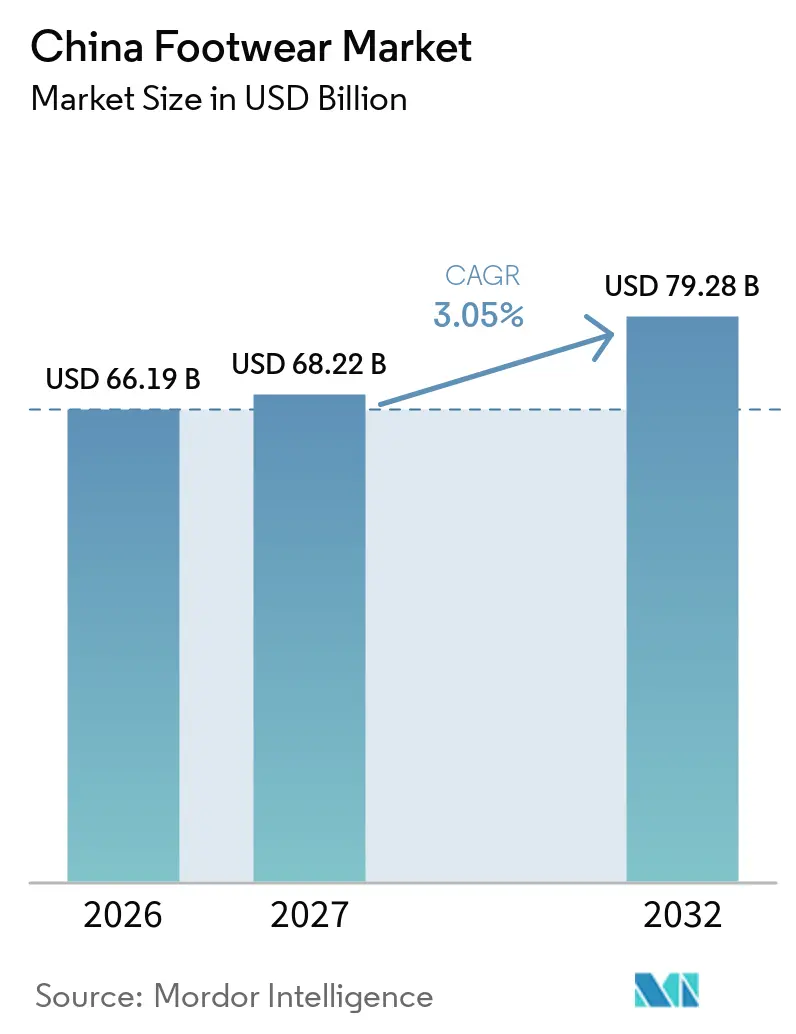
| Base Year Market Size (2026) | USD 66.19 Billion |
| Market Size (2027) | USD 68.22 Billion |
| Market Size (2032) | USD 79.28 Billion |
| Growth Rate (2027 - 2032) | 3.05 % |
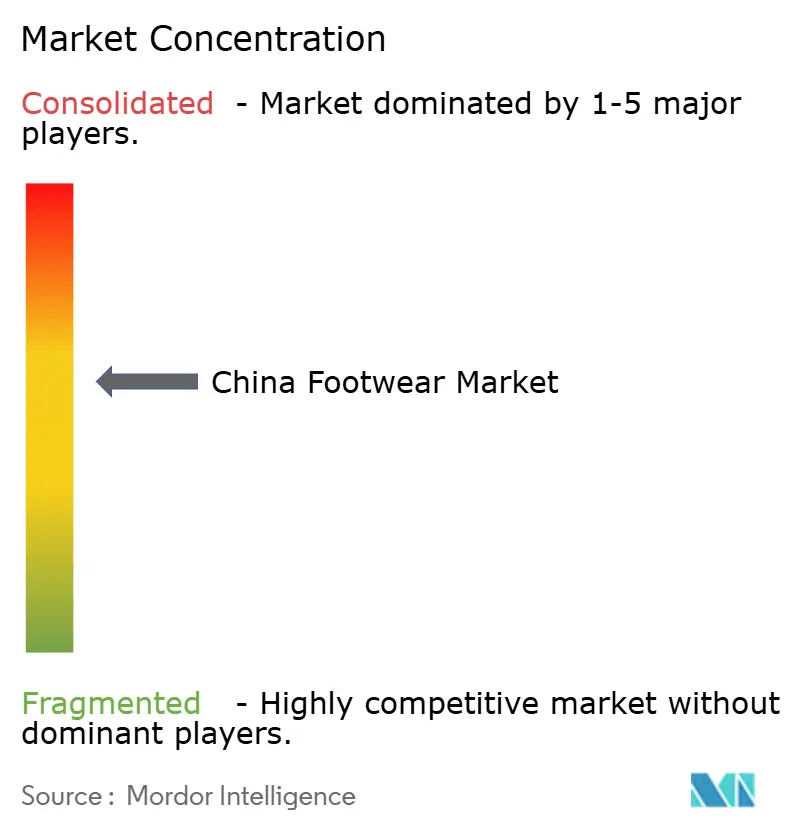
| Market Concentration | Medium |
Major Players *Disclaimer: Major Players sorted in no particular order Image © Mordor Intelligence. Reuse requires attribution under CC BY 4.0. | |
China Footwear Market Analysis by Mordor Intelligence
The China footwear market size is expected to grow from USD 66.19 billion in 2026 to USD 68.22 billion in 2027 and is forecast to reach USD 79.28 billion by 2032 at a 3.05% CAGR over 2027-2032. Domestic demand is increasingly divided between everyday purchases and sports-driven spending, while overall clothing and footwear sales continue to grow at a measured pace. The China footwear market benefits from a large domestic manufacturing base, and changing export conditions are prompting producers and brands to strengthen local sales channels. Domestic athletic footwear brands are enhancing product technology, expanding retail networks, and increasing their use of digital sales channels.
Key Report Takeaways
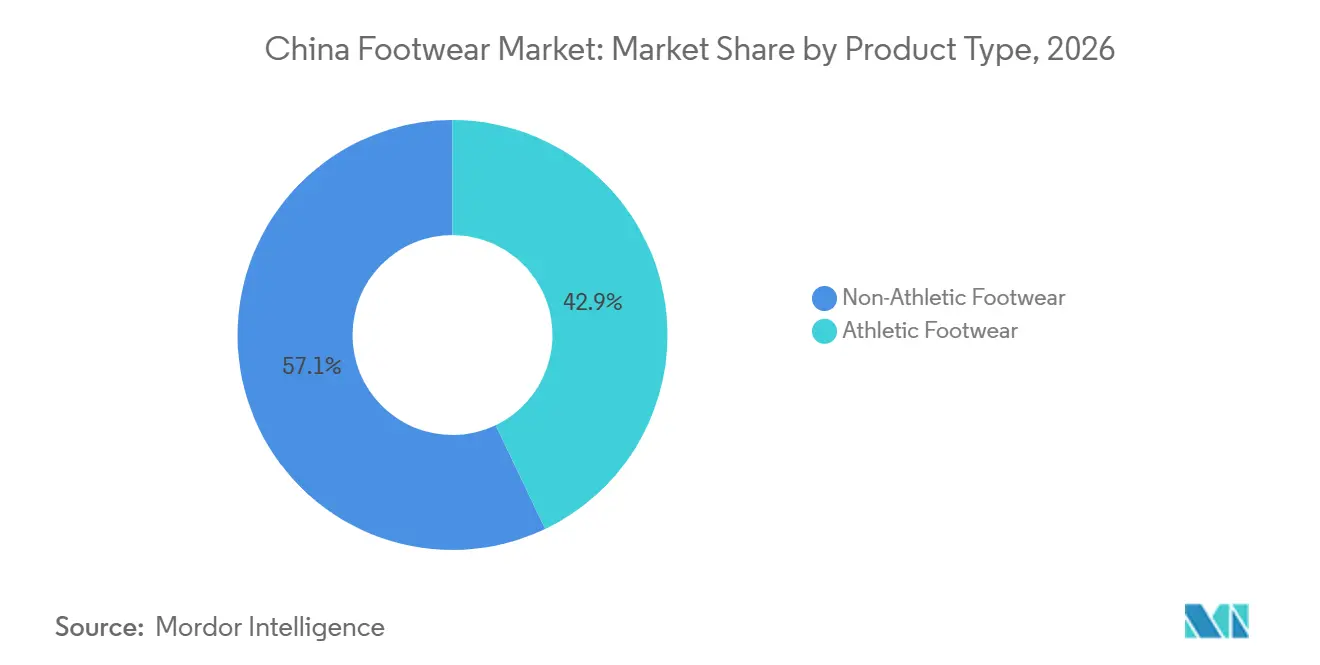
- By product type, non-athletic footwear held 57.12% of the China footwear market share in 2026, while athletic footwear is forecast to grow at a 3.65% CAGR through 2032.
- By category, the mass segment held 88.21% of the China footwear market share in 2026, while premium footwear is forecast to grow at a 3.91% CAGR through 2032.
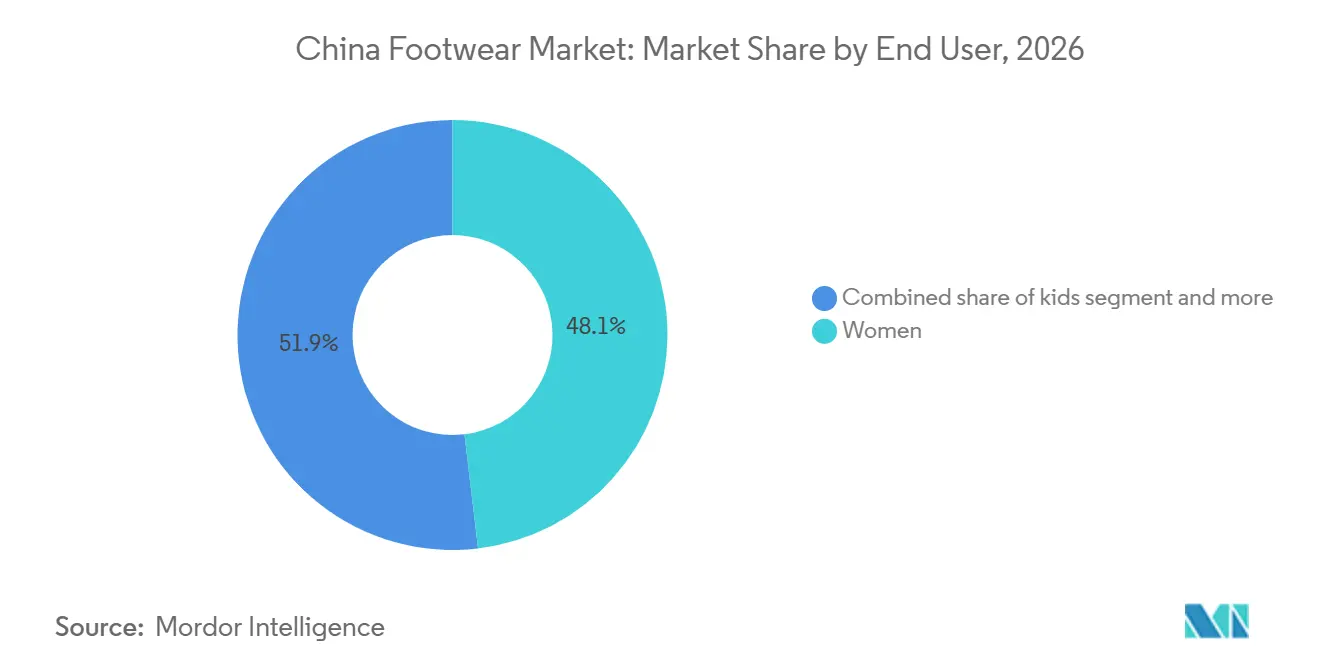
- By end user, women held 48.11% share in 2026, while kids' footwear is forecast to grow at a 3.75% CAGR through 2032.
- By distribution channel, online retail stores held 37.11% share in 2026 and are forecast to grow at a 3.95% CAGR through 2032.
Note: Market numbers in this report are based on Mordor Intelligence's proprietary estimation framework, which combines nine months of actuals with Q4 projections for base year 2026.
China Footwear Market Trends and Insights
Drivers Impact Analysis*
| Driver | (~) % Impact on CAGR Forecast | Geographic Relevance | Impact Timeline |
|---|---|---|---|
| Rising sports participation drives athletic footwear demand | +0.6% | National, with outsized gains in Tier 1 and Tier 2 cities | Medium term (2-4 years) |
| Outdoor and recreational activity expansion opens new footwear categories | +0.5% | National, with early strength in affluent coastal provinces and southwest China | Medium term (2-4 years) |
| Fashion, comfort, and premium demand reshape footwear mix | +0.4% | Tier 1 and upper Tier 2 cities, with spillover to lower-tier markets through e-commerce | Long term (≥ 4 years) |
| Domestic brand expansion and manufacturing technology reshape competition | +0.3% | National, with international expansion gains in Southeast Asia and the Middle East | Long term (≥ 4 years) |
| Increasing demand for comfortable and versatile footwear | +0.4% | National, particularly in women's and kids' segments | Short term (≤ 2 years) |
| Advancements in footwear materials and manufacturing technologies | +0.3% | Fujian, Guangdong, and Zhejiang manufacturing clusters | Long term (≥ 4 years) |
| Source: Mordor Intelligence | |||
Rising Sports Participation Drives Athletic Footwear Demand
Rising sports consumption and government support are creating growth opportunities for China's athletic footwear market. For instance, in May 2026, according to the General Administration of Sport of China, revenue from sports footwear and apparel among 28 listed companies increased by 7.38% in 2025, while sports product sales across four major e-commerce platforms grew by 15.89% [1]. Additionally, in September 2025, China's State Council aimed to expand the sports industry to more than RMB 7 trillion by 2030, supporting sports consumption and product development. These developments are driving demand for running, training, and lifestyle athletic footwear.
Outdoor and Recreational Activity Expansion Opens New Footwear Categories
Growing participation in outdoor and recreational activities is creating opportunities for specialized footwear in China. For instance, in November 2025, according to the Department of Sports Economy and General Administration of Sport of China, data from 2024-2025 show that China hosted 749 road-running events with at least 800 participants, attracting more than 7 million participant entries. Demand for outdoor sports products also increased, with sales of cross-country running shoes rising by 100% and ski boot sales growing by more than 80% [2]. These trends highlight opportunities for footwear brands to expand their ranges of running, hiking, trekking, and winter sports footwear to meet the needs of consumers engaged in a variety of outdoor activities.
Fashion, Comfort, and Premium Demand Reshape Footwear Mix
Fashion, comfort, and product quality are increasingly important considerations in China's footwear market, particularly for consumers seeking shoes suitable for work and everyday activities. For instance, in April 2026, according to the China Leather Industry Association's commuting footwear industry white paper, China has more than 300 million core commuters, while professionals spend over 45 hours per week wearing shoes. The report also highlighted common concerns, including heavy footwear, poor breathability, fatigue, and inadequate slip resistance [3]. These needs are encouraging the development of footwear that combines contemporary styling with comfortable construction, breathable materials, and functional features.
Domestic Brand Expansion and Manufacturing Technology Reshape Competition
Domestic footwear brands are strengthening their market presence by expanding product portfolios, increasing retail coverage, and investing in digital sales channels. Companies are developing specialized footwear for children, runners, and outdoor enthusiasts to address diverse consumer needs. The industry is also adopting intelligent manufacturing, AI-assisted design, and direct-to-consumer sales models to improve product development and broaden customer reach. Advances in materials, manufacturing processes, and product safety are enabling domestic manufacturers to meet evolving quality expectations and compete more effectively.
Restraints Impact Analysis*
| Restraint | (~) % Impact on CAGR Forecast | Geographic Relevance | Impact Timeline |
|---|---|---|---|
| Intense price competition and cost volatility compress industry margins | -0.4% | National, most acute in mass-market online channels | Short term (≤ 2 years) |
| Cautious consumer spending and counterfeit exposure limit growth | -0.5% | National, with deeper impact in Tier 3 cities and below | Medium term (2-4 years) |
| Volatility in raw material and manufacturing costs | -0.3% | Fujian, Guangdong, and Zhejiang production clusters | Short term (≤ 2 years) |
| Counterfeit products and brand imitation | -0.2% | National, most prevalent in lower-tier markets and unregulated online channels | Long term (≥ 4 years) |
| Source: Mordor Intelligence | |||
Intense Price Competition and Cost Volatility Compress Industry Margins
Intense price competition in China’s footwear market is pressuring manufacturers, particularly those operating in the mass-market athletic and casual footwear segments. Heavy discounting can reduce profitability and constrain investment in innovation, product development, and quality improvements. Manufacturers also face fluctuations in raw material and production costs, making it more difficult to maintain competitive prices while preserving product quality. Price competition across online and offline channels can further weaken brand differentiation and diminish the appeal of premium footwear collections.
Cautious Consumer Spending and Counterfeit Exposure Limit Growth
Consumer caution continues to constrain footwear spending in China, as shoppers increasingly prioritize essential purchases and value for money. Demand for footwear and related apparel remains under pressure relative to several other consumer goods categories. Counterfeit products and brand imitations can further erode consumer trust, particularly in lower-tier markets and less-regulated online channels. These challenges are prompting footwear companies to offer products that justify consumer spending through comfort, performance, safety, durability, and trusted branding. Enhanced product authentication and traceability can also help established brands safeguard consumer confidence and differentiate their offerings from imitations.
*Our forecasts treat driver/restraint impacts as directional, not additive. The impact forecasts reflect baseline growth, mix effects, and variable interactions.
Segment Analysis
By Product Type: Athletic Footwear Gains Momentum Alongside Everyday Non-Athletic Demand
Non-athletic footwear held 57.12% of the China footwear market in 2026. This segment includes boots, sneakers, flip-flops, slippers, and other casual footwear designed for everyday use. Sneakers drive demand by combining lifestyle appeal with suitability for light physical activities. Flip-flops and slippers remain popular in the mass-market segment because of their affordability and convenience. Boots meet seasonal demand, particularly during winter in northern provinces. Overall, the category benefits from broad consumer demand for comfortable, practical, and affordable footwear for daily activities rather than specialized performance products.
Athletic footwear is projected to register a CAGR of 3.65% during 2027-2032. It includes running shoes, sports shoes, trekking footwear, and hiking footwear, driven by growing consumer interest in exercise and outdoor recreation. Consumers increasingly seek footwear that provides comfort, durability, grip, and support for a range of physical activities. Product safety and quality requirements also prompt manufacturers to enhance material selection, testing, and production processes. These factors create opportunities for brands to address diverse consumer needs, ranging from everyday sports use to specialized outdoor activities, while differentiating products based on performance, comfort, and reliability.
By Category: Mass Footwear Retains Scale While Premium Footwear Expands Faster
The mass segment accounted for 88.21% of China footwear market in 2026. Affordable footwear remains popular in China, as consumers seek practical products at reasonable prices. The expanding reach of e-commerce and the availability of footwear across various price points, particularly in lower-tier cities, support demand. Domestic brands address this demand through cost-effective manufacturing and a broad range of styles. This trend creates opportunities for manufacturers to strengthen their market presence by offering comfortable, durable, and stylish footwear at competitive prices while meeting the needs of budget-conscious consumers.
Premium footwear is projected to register a CAGR of 3.91% during 2027-2032. Premium footwear appeals to consumers who prioritize quality, design, durability, and performance. Chinese manufacturers can strengthen this segment by improving materials, construction, and finishing to meet elevated consumer expectations. The growing recognition of Putian Shoes also enables domestic producers to showcase product quality and strengthen brand credibility. By maintaining consistent quality standards and offering distinctive designs, brands can attract consumers willing to pay more for footwear while continuing to serve the broader mass-market segment.
By End User: Women Lead Current Demand While Kids' Footwear Grows Faster
Women accounted for 48.11% of the China footwear market in 2026. The women’s footwear segment encompasses a wide range of styles, including flats, boots, sneakers, casual shoes, and heels. Consumer preferences vary according to comfort, fashion, price, and intended use. Changes in everyday lifestyles and workplace preferences are increasing the importance of casual and athletic footwear alongside formal styles. Brands are responding by introducing products that combine comfort, attractive designs, and practical features. This product diversity enables domestic and international companies to serve a broad customer base across different occasions and preferences.
Kids' footwear is projected to register a CAGR of 3.75% during 2027-2032. Parents’ focus on comfort, safety, durability, and suitability for daily activities supports demand for children’s footwear. Families increasingly seek higher-quality products for school, sports, and everyday wear, creating opportunities for brands to offer footwear tailored to diverse needs. Stricter safety and labeling requirements also encourage manufacturers to enhance material quality and product standards. Established brands, including ANTA Kids, Xtep Kids, and 361° Children’s, address these preferences through diverse product portfolios. In addition, the growing emphasis on physical activity in schools may further drive demand for children’s athletic footwear designed for exercise and sports.

By Distribution Channel: Online Retail Stores Lead Sales and Growth
Online retail stores accounted for 37.11% in 2026 and are projected to register a CAGR of 3.95% through 2027-2032. Online retail stores benefit from convenient shopping, easy price comparisons, and access to a wide range of footwear brands, styles, and price points. Consumers can browse different products, compare features, read customer reviews, and make purchases without visiting physical stores. Online platforms also help domestic footwear companies expand their reach across urban and lower-tier markets without incurring the high costs of establishing and maintaining extensive retail networks.
Supermarkets and hypermarkets continue to serve price-conscious consumers through convenient shopping locations, affordable footwear options, and private-label products. Specialty stores remain important for athletic and performance footwear, as consumers value professional advice, proper fitting, and product assessments when selecting shoes. Other distribution channels, including cross-border e-commerce and overseas warehouses, provide opportunities for Chinese footwear companies to reach international consumers through direct-to-consumer sales.
Geography Analysis
China’s eastern coastal provinces represent the main hubs for footwear production and consumption, supported by established manufacturing industries, strong retail networks, and consumer purchasing power. Guangdong, Zhejiang, Fujian, Jiangsu, and Shanghai play important roles in the market. Major cities such as Beijing, Shanghai, Guangzhou, and Shenzhen show stronger demand for premium and athletic footwear, driven by urban lifestyles, fashion preferences, and a preference for quality, performance-oriented products. Rural markets are also gaining importance as consumers increasingly access a wider range of footwear through retail outlets and online platforms, creating growth opportunities beyond major urban centers.
Central and western provinces are becoming increasingly important to China's footwear market as urban development and changing consumer preferences support demand. Sichuan, Henan, Hubei, and Chongqing offer growth opportunities, particularly in cities such as Chengdu, Wuhan, and Xi’an, where consumers are showing greater interest in athleisure, outdoor, and functional footwear. Government-supported consumption initiatives, including shopping incentives and trade-in programs, can encourage spending in these regions. The expansion of sports facilities and recreational infrastructure is also improving access to physical activities, supporting demand for footwear designed for sports, exercise, and outdoor use.
These developments create opportunities for footwear brands to expand beyond established coastal markets and reach consumers across emerging urban centers. Northern provinces, including Shandong, Hebei, and Liaoning, maintain demand for leather footwear and boots, supported by colder weather conditions and regional consumer preferences. However, athletic and sports-casual footwear is also gaining visibility in these markets as digital platforms such as Douyin help brands reach consumers with changing fashion and lifestyle preferences. Fujian plays a distinctive role in China's footwear industry by combining large-scale manufacturing capabilities with established domestic brands, including Anta, Xtep, 361°, Peak, and ERKE.
Competitive Landscape
China’s footwear market is highly competitive, with domestic athletic brands strengthening their presence through extensive retail networks, effective e-commerce strategies, and products tailored to local consumer preferences. Rising participation in sports and active lifestyles is expanding opportunities for these brands to broaden their customer base. International brands continue to benefit from established brand equity and distinctive product designs; however, they face intensifying competition from local companies that respond rapidly to evolving consumer demand. Domestic and international players are focusing on product innovation, brand positioning, and digital sales channels to sustain their market presence.
Competition in China’s footwear market is increasing in outdoor, performance-running, and premium footwear. Smaller brands can attract consumers by offering specialized products and building strong customer communities rather than relying on large retail networks. Manufacturers are also exploring advanced technologies, including innovative midsole materials, 3D printing, and AI-based product recommendations, to improve performance and the shopping experience. Greater attention to product safety and quality standards is encouraging companies to strengthen testing and compliance practices. These developments highlight the importance of product innovation, quality, and differentiation in helping footwear brands compete beyond price alone.
Government initiatives and industry programs are shaping China’s footwear market by promoting sports participation, enhancing product quality, and accelerating digital transformation. Support for sports and outdoor recreation is creating opportunities for athletic and outdoor footwear brands. Industry recognition programs emphasize the importance of product quality and traceability in strengthening consumer confidence. Meanwhile, manufacturers are adopting intelligent manufacturing, AI-assisted design, and direct-to-consumer sales strategies to improve operational efficiency and engage more effectively with customers. These developments are encouraging footwear companies to prioritize innovation, quality standards, and stronger customer relationships.
China Footwear Industry Leaders
-
NIKE, Inc.
-
ANTA Sports Products Limited (ANTA)
-
adidas AG (adidas)
-
Li Ning Company Limited (Li-Ning)
-
Xtep International Holdings Limited (Xtep)
- *Disclaimer: Major Players sorted in no particular order
Recent Industry Developments
- August 2026: Xtep launched new flagship running shoes featuring carbon-plate racing technology and advanced cushioning. The launch included the 160X8.0 racing shoe series, Airflow Zero cushioning shoes, and 2000KM 5.5PRO training shoes, expanding the company’s portfolio across competitive racing, professional training, and everyday running.
- July 2026: Birkenstock opened its first community experience store in China at HKRI Taikoo Hui in Shanghai. The store integrated footwear retail with shoe care services, personalized engraving, foot care treatments, and community workshops. This initiative supported the brand’s efforts to enhance customer engagement and expand its presence in China.
- April 2026: Anta expanded its market presence by leveraging China’s manufacturing capabilities and strengthening its position in the domestic and international sportswear markets.
China Footwear Market Report Scope
The China footwear market encompasses shoes designed for sports, outdoor activities, and everyday use, serving consumers across various age groups, price points, and purchasing preferences. The market is segmented by product type, end user, category, and distribution channel. By product type, the market is divided into athletic footwear and non-athletic footwear. Athletic footwear includes running shoes, sports shoes, trekking/hiking shoes, and other athletic footwear. Non-athletic footwear includes boots, flip-flops/slippers, sneakers, and other non-athletic footwear. By end user, the market is segmented into men, women, and kids. By category, it is divided into mass and premium segments. By distribution channel, the market is segmented into supermarkets/hypermarkets, specialty stores, online retail stores, and other distribution channels. Market forecasts for each segment are provided in terms of value (USD).
| Athletic Footwear | Running Shoes |
| Sport Shoes | |
| Trekking/Hiking Shoes | |
| Other Athletic Footwear | |
| Non- Athletic Footwear | Boots |
| Flip-Flops/ Slippers | |
| Sneakers | |
| Other Non-Athletic Footwear |
| Men |
| Women |
| Kids |
| Mass |
| Premium |
| Supermarkets/Hypermarkets |
| Specialty Stores |
| Online Retail Stores |
| Other Distribution Channels |
| By Product Type | Athletic Footwear | Running Shoes |
| Sport Shoes | ||
| Trekking/Hiking Shoes | ||
| Other Athletic Footwear | ||
| Non- Athletic Footwear | Boots | |
| Flip-Flops/ Slippers | ||
| Sneakers | ||
| Other Non-Athletic Footwear | ||
| By End User | Men | |
| Women | ||
| Kids | ||
| By Category | Mass | |
| Premium | ||
| By Distribution Channel | Supermarkets/Hypermarkets | |
| Specialty Stores | ||
| Online Retail Stores | ||
| Other Distribution Channels | ||
Key Questions Answered in the Report
What is the China footwear market forecast through 2032?
The China footwear market size is USD 66.19 billion in 2026 and is forecast to reach USD 79.82 billion by 2032, at a 3.05% CAGR.
Which product type is growing fastest in China?
Athletic footwear is the fastest-growing product type, with a forecast CAGR of 3.65% through 2032.
Why are domestic footwear brands gaining ground in China?
Domestic brands are expanding product portfolios, using local digital channels, and investing in technology, safety, and direct-to-consumer capabilities.
What are the main risks for footwear companies in China?
Price competition, cautious spending, cost volatility, and counterfeit products can weaken revenue growth and limit investment in product development.