
Chicken Powder Market Size and Share
Market Overview
| Study Period | 2027 - 2032 |
|---|---|
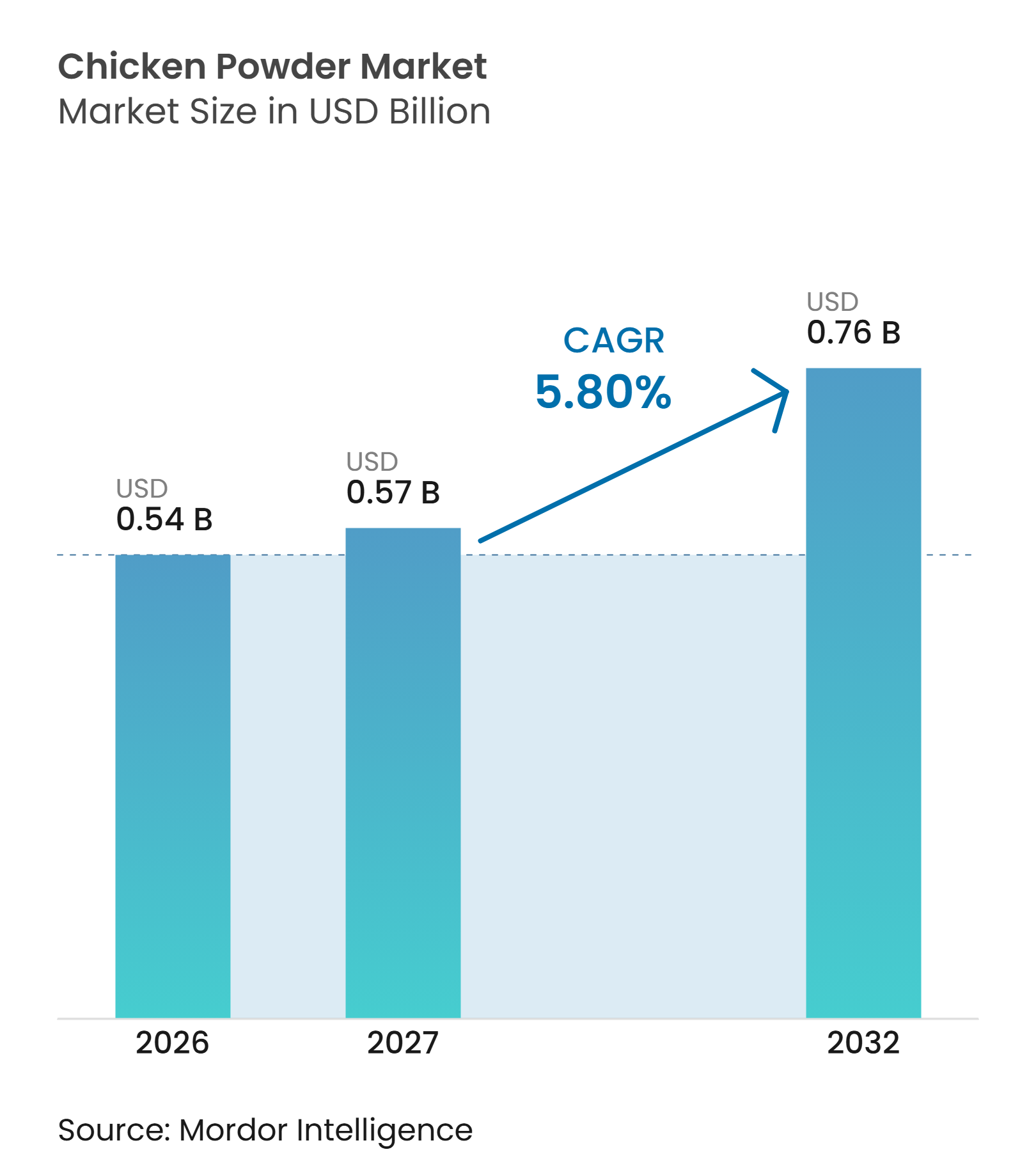
| Market Size (2027) | USD 0.57 Billion |
| Market Size (2032) | USD 0.76 Billion |
| Growth Rate (2027 - 2032) | 5.80 % |
| Fastest Growing Market | Asia-Pacific |
| Largest Market | Europe |
| Market Concentration | Medium |
Major Players *Disclaimer: Major Players sorted in no particular order Image © Mordor Intelligence. Reuse requires attribution under CC BY 4.0. | |
Chicken Powder Market Analysis by Mordor Intelligence
The Chicken Powder Market size is expected to increase from USD 0.544 billion in 2026 to USD 0.575 billion in 2027 and reach USD 0.763 billion by 2032, growing at a CAGR of 5.8% over 2027–2032. Growth is supported by rising demand for convenient and ready-to-use chicken-based seasoning ingredients, expanding processed food production, and increasing adoption across instant noodles, ready-to-eat meals, and foodservice applications. Chicken meat powder dominates the market by type, while chicken broth powder is expected to register the fastest growth. Conventional chicken powder accounts for the largest share by nature, whereas organic chicken powder is projected to grow at the fastest rate. Regular chicken powder remains the leading category, while low-fat formulations are expected to record steady growth. However, fluctuations in raw chicken prices, poultry supply disruptions, risks of avian influenza, and competition from alternative meat seasonings may restrain market growth. Geographically, Europe leads the market, accounting for 50.80% of the market share in 2026, while Asia-Pacific is expected to register the fastest growth, supported by expanding food processing industries, rising demand for packaged foods, and increasing consumption of savory convenience products.
Key Report Takeaways
- By type, chicken meat powder accounted for the largest share of the chicken powder market at 47.80% in 2026, while chicken broth powder is forecast to grow fastest at a 6.40% CAGR over 2027–2032.
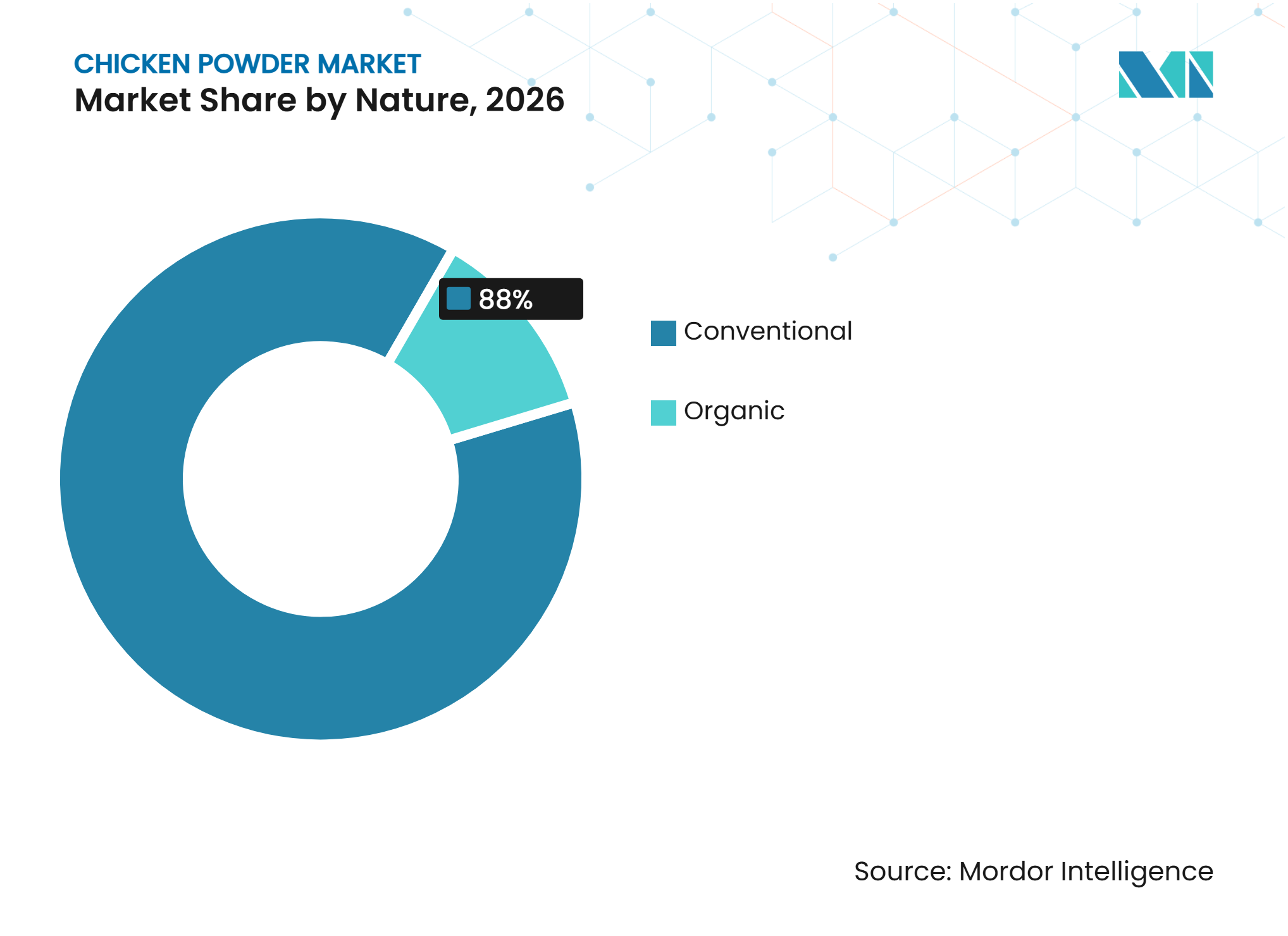
- By nature, conventional chicken powder dominated the market with an 88.00% share in 2026, while organic chicken powder is projected to record the fastest growth at a 6.40% CAGR over 2027–2032.
- By category, regular chicken powder accounted for the largest share of the chicken powder market at 79.80% in 2026, while low-fat chicken powder is expected to grow at a 5.80% CAGR over 2027–2032.
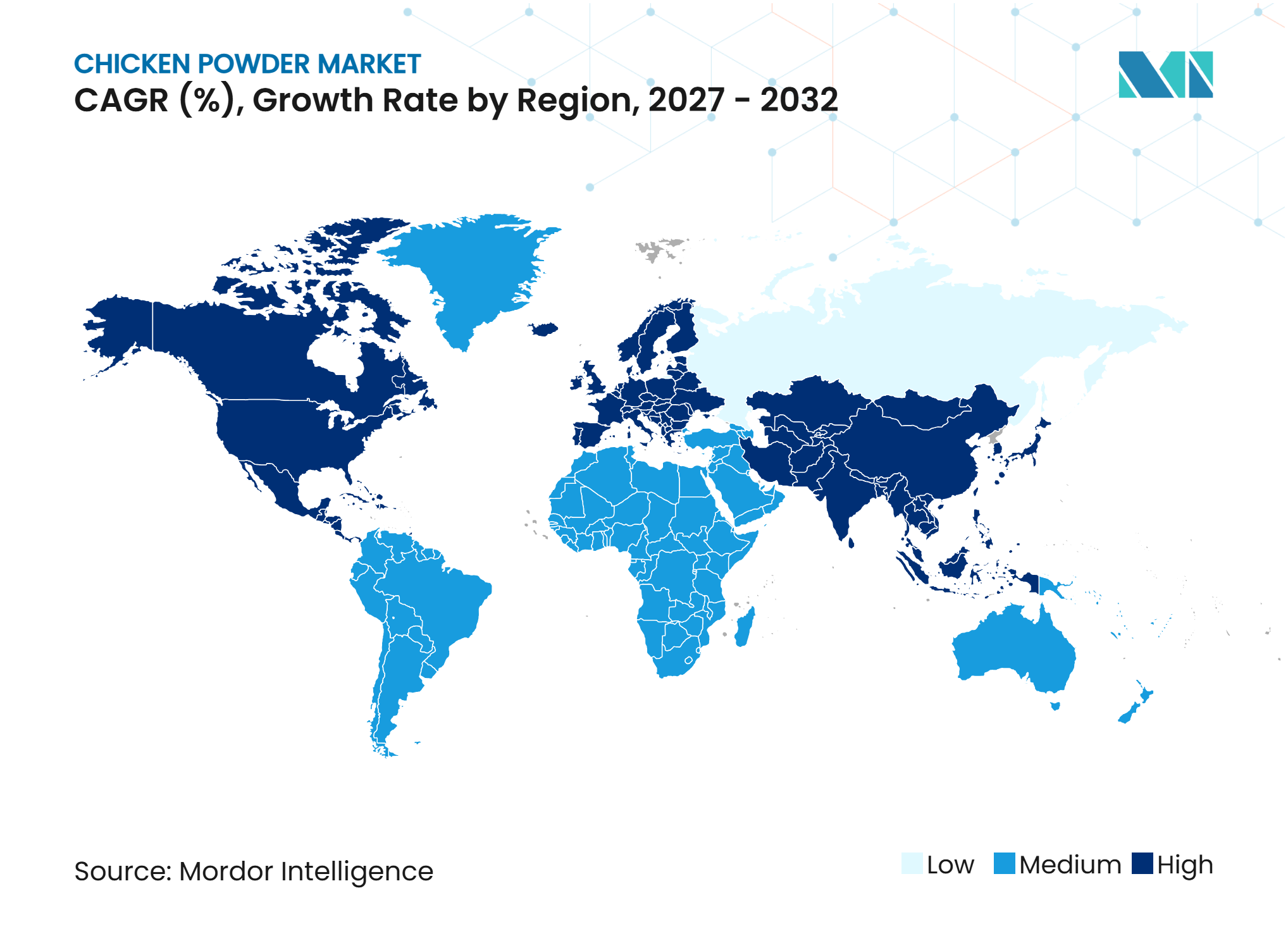
- Among geographies, Europe led the chicken powder market with a 50.80% share in 2026, while Asia-Pacific is projected to grow fastest at a 6.40% CAGR over 2027–2032.
Note: Market numbers in this report are based on Mordor Intelligence's proprietary estimation framework, which combines nine months of actuals with Q4 projections for base year 2026.
Market Trends and Insights
Drivers of Chicken Powder Market*
| Driver | (~) % Impact on CAGR Forecast | Geographic Relevance | Impact Timeline |
|---|---|---|---|
| Rising demand for convenient and ready-to-use chicken-based seasoning ingredients | +1.0% | Global, particularly North America and Asia-Pacific, where demand for convenient cooking ingredients and savory seasoning solutions supports adoption | Medium term (2–4 years) |
| Expansion of processed foods, instant noodles and ready-to-eat meals | +0.9% | Global, particularly Asia-Pacific and North America, supported by expanding packaged food production and consumption of convenience meals | Medium term (2–4 years) |
| Increasing adoption of chicken powder across foodservice and commercial food processing | +0.8% | Global, particularly Europe, North America and Asia-Pacific, where food manufacturers and foodservice operators use concentrated poultry-based flavor ingredients | Medium term (2–4 years) |
| Growing consumer preference for protein-rich and savory food ingredients | +0.6% | Global, particularly North America and Europe, where demand for protein-enriched foods and meat-based flavor formulations supports product usage | Long term (More than 4 years) |
| Product innovation in clean-label, low-sodium and specialized chicken powder formulations | +0.5% | Global, particularly North America and Europe, where food manufacturers are developing specialized seasoning formulations to meet changing consumer preferences | Long term (More than 4 years) |
| Source: Mordor Intelligence | |||
Rising Demand for Convenient and Ready-to-Use Chicken-Based Seasoning Ingredients
Changing consumer lifestyles and increasing demand for convenient cooking solutions are supporting the adoption of chicken powder across household and commercial food applications. Consumers are increasingly seeking ready-to-use seasoning ingredients that simplify food preparation while delivering consistent chicken flavor and taste.[1] Chicken powder offers a convenient alternative to preparing fresh chicken stock or broth, as it can be easily incorporated into soups, sauces, marinades, gravies, instant noodles, and other savory food preparations. Its concentrated flavor profile, ease of storage, and suitability for different food formulations further support its application across packaged food products. The growing demand for time-saving cooking ingredients also encourages manufacturers to introduce chicken powder in different formulations and packaging formats to serve household consumers, restaurants, and industrial food processors.
Expansion of Processed Foods, Instant Noodles and Ready-to-Eat Meals
The expansion of the processed food industry and increasing consumption of packaged meals are creating opportunities for chicken powder manufacturers.[2] Food processors increasingly use concentrated seasoning ingredients to deliver consistent flavor, improve product formulations, and simplify large-scale food preparation. Chicken powder is widely suited to applications such as instant noodles, packaged soups, ready-to-eat meals, frozen foods, snack seasonings, and convenience food products. Its ability to provide a consistent savory profile and blend easily with other ingredients makes it suitable for industrial food manufacturing. The continued development of convenient meal formats and packaged food offerings is therefore supporting demand for chicken-based flavoring ingredients among food manufacturers.
Increasing Adoption of Chicken Powder Across Foodservice and Commercial Food Processing
The expansion of foodservice establishments and commercial food preparation activities is supporting the use of chicken powder as a convenient flavoring ingredient. Restaurants, catering businesses, institutional kitchens, and commercial food manufacturers require seasoning solutions that deliver consistent taste across large food volumes while reducing preparation complexity. Chicken powder can be incorporated into broths, gravies, sauces, marinades, soups, and prepared meat dishes, making it suitable for different foodservice applications. Its concentrated formulation and ease of handling also allow commercial kitchens to standardize recipes and simplify ingredient storage and preparation. Increasing expenditure on food consumed outside the home is further creating opportunities for suppliers of chicken-based seasoning ingredients across foodservice and industrial distribution channels.[3]
Growing Consumer Preference for Protein-Rich and Savory Food Ingredients
Increasing awareness of dietary protein requirements and interest in protein-containing food products are supporting opportunities for poultry-derived ingredients. Chicken-based ingredients provide manufacturers with opportunities to incorporate animal-derived protein and familiar savory flavors into different food formulations. Chicken meat powder and chicken protein powder can be used in soups, seasoning blends, nutritional food preparations, sauces, and other processed food applications. The versatility of poultry-derived ingredients also allows manufacturers to develop products that combine protein content with desirable taste characteristics. As consumers and food manufacturers increasingly consider nutritional composition alongside flavor and convenience, demand for specialized chicken-based ingredients is expected to benefit.
Product Innovation in Clean-Label, Low-Sodium and Specialized Chicken Powder Formulations
Increasing attention to food composition, sodium intake, and ingredient transparency is encouraging manufacturers to develop differentiated chicken powder formulations. Food producers are exploring lower-sodium seasoning blends, specialized broth powders, and formulations that meet specific nutritional and application requirements. Chicken powder manufacturers can respond through adjustments in salt content, ingredient selection, flavor concentration, and processing techniques while maintaining the desired savory characteristics of their products. The World Health Organization recommends reducing sodium levels in processed foods through product reformulation, creating an additional incentive for food ingredient manufacturers to develop lower-sodium alternatives. These developments are encouraging innovation in chicken powder products for packaged foods, foodservice applications, and specialized food formulations.[4]
Restraints of Chicken Powder Market*
| Restraint | (~) % Impact on CAGR Forecast | Geographic Relevance | Impact Timeline |
|---|---|---|---|
| Fluctuations in raw chicken prices and poultry supply | −0.8% | Global, particularly North America, Europe and Asia-Pacific, where changes in feed costs, poultry production expenses, and raw chicken availability influence manufacturing costs | Short term (Less than 2 years) |
| Risk of avian influenza and other poultry-related diseases | −0.7% | Global, particularly Asia-Pacific, Europe and North America, where poultry disease outbreaks can disrupt production, restrict trade, and affect the availability of chicken-derived raw materials | Medium term (2–4 years) |
| Competition from alternative meat seasonings, bouillon and plant-based flavor ingredients | −0.5% | Global, particularly Europe and North America, where vegetable-based seasonings, beef and seafood flavorings, bouillon products, and plant-based alternatives compete for food formulation demand | Medium term (2–4 years) |
| Regulatory requirements for animal-derived ingredients and food safety compliance | −0.4% | Global, particularly Europe and North America, where stringent food safety, animal-origin ingredient, labeling, and traceability requirements increase compliance obligations for manufacturers | Long term (More than 4 years) |
| Source: Mordor Intelligence | |||
Fluctuations in Raw Chicken Prices and Poultry Supply
The chicken powder market is exposed to fluctuations in raw chicken prices and changes in poultry supply, which can influence manufacturing costs and product availability. Chicken meat is a primary raw material for chicken meat powder, broth powder, and other poultry-derived ingredients, making manufacturers dependent on stable poultry production and procurement networks. Variations in feed prices, including corn and soybean meal, along with energy, labor, transportation, and processing expenses, can increase the overall cost of poultry production. These fluctuations may create pricing pressure for chicken powder manufacturers, particularly when higher input costs cannot be fully transferred to food manufacturers and commercial buyers. Supply disruptions can also affect production schedules, inventory management, and contract fulfillment. Consequently, raw material price volatility and inconsistent poultry availability may constrain profit margins and create uncertainty for chicken powder manufacturers.
Risk of Avian Influenza and Other Poultry-Related Diseases
The chicken powder market faces supply-related risks from avian influenza and other poultry diseases that can affect chicken production, trade, and raw material availability. Outbreaks of highly pathogenic avian influenza can result in poultry mortality, mandatory culling, movement restrictions, and temporary disruptions to domestic and international poultry supply chains. These developments can affect the procurement of chicken meat for processing into powder, broth, and other poultry-based ingredients. Export restrictions and changes in disease-control requirements may further complicate sourcing for manufacturers operating across multiple countries. Companies dependent on specific poultry-producing regions may experience higher procurement costs and difficulties maintaining consistent production volumes during outbreaks. Consequently, recurring poultry disease risks can increase supply chain uncertainty and restrain the growth of the chicken powder market.
*Our forecasts treat driver/restraint impacts as directional, not additive. The impact forecasts reflect baseline growth, mix effects, and variable interactions.
Chicken Powder Market Segment Analysis
By Type:
Chicken Meat Powder Leads While Chicken Broth Powder Expands FasterIn 2026, chicken meat powder accounted for an estimated 47.80% of the Chicken Powder Market, making it the leading type segment. Its dominance reflects the widespread use of dehydrated chicken ingredients across processed foods, seasoning blends, soups, sauces, instant noodles, and ready-to-eat meals. Chicken meat powder provides concentrated poultry flavor and can be incorporated into different food formulations to improve taste and savory characteristics. Its versatility, compatibility with industrial food processing, and suitability for commercial foodservice applications support its established market position. Meanwhile, chicken broth powder is projected to record the fastest growth, at an estimated CAGR of 6.40% through 2032. Increasing demand for convenient soup bases, ready-to-use broth ingredients, and concentrated savory flavor solutions is supporting the expansion of this category. Food manufacturers are increasingly incorporating broth powders into instant soups, gravies, sauces, and prepared meals to deliver consistent flavor while simplifying preparation processes.
Chicken protein powder represents another product category, serving applications where poultry-derived protein and functional ingredients are required in specialized food formulations. Other chicken powder products, including customized and blended formulations, contribute to category diversity by addressing specific flavor, nutritional, and processing requirements. However, manufacturers across all product types need to maintain consistent flavor profiles, nutritional characteristics, microbiological safety, and product quality while managing raw material costs and processing requirements.
By Nature:
Conventional Chicken Powder Dominates While Organic Products Expand FasterIn 2026, conventional chicken powder accounted for an estimated 88.00% of the Chicken Powder Market, making it the dominant nature segment. Its leading position is supported by established poultry production networks, wider raw material availability, and relatively developed manufacturing and distribution infrastructure. Conventional chicken powder is widely used by food processors, seasoning manufacturers, restaurants, and commercial kitchens because of its suitability for large-scale production and diverse food applications. Established procurement channels and comparatively accessible pricing also support its adoption across industrial food processing and foodservice operations. Meanwhile, organic chicken powder is projected to record the fastest growth, at an estimated CAGR of 6.40% through 2032. Increasing interest in organically produced food ingredients and greater attention to poultry farming practices are creating opportunities for organic chicken powder manufacturers. Food producers seeking differentiated ingredient portfolios may incorporate certified organic poultry ingredients into specialized soups, seasonings, sauces, and packaged food formulations.
The organic segment remains comparatively smaller because organic poultry production involves specific certification, feed, farming, and traceability requirements. Manufacturers must also maintain compliance with applicable organic production standards throughout sourcing and processing. Nevertheless, growing interest in differentiated food ingredients is creating opportunities for organic chicken powder across premium and specialized food applications.



By Category:
Regular Chicken Powder Leads While Low-Fat Products Expand at a Steady PaceIn 2026, regular chicken powder accounted for an estimated 79.80% of the Chicken Powder Market, making it the leading category. Its dominance reflects widespread demand for conventional chicken-based flavoring ingredients across processed foods, instant noodles, soups, sauces, seasoning blends, and commercial food preparations. Regular chicken powder offers manufacturers a versatile ingredient for developing savory formulations without requiring substantial changes to existing production processes. Its established use across household cooking, foodservice, and industrial food manufacturing supports its leading position. Meanwhile, low-fat chicken powder is projected to grow at an estimated CAGR of 5.80% through 2032. Increasing attention to nutritional composition and demand for specialized food formulations are creating opportunities for lower-fat chicken powder products. Food manufacturers may incorporate these formulations into soups, seasoning blends, and prepared foods designed to meet specific nutritional and product positioning requirements.
Regular chicken powder continues to benefit from its broad application base and established manufacturing processes. Low-fat formulations, however, require manufacturers to maintain desirable flavor, texture, and functional characteristics while adjusting fat content. Product development and reformulation capabilities will therefore influence competition across both categories.
Geography Analysis
Europe Chicken Powder Market
Europe accounted for an estimated 50.80% of the Chicken Powder Market in 2026, making it the largest regional market. The region benefits from an established food processing industry, developed poultry production networks, and strong demand for processed food ingredients. Countries such as Germany, the United Kingdom, France, Italy, and Spain provide opportunities for chicken powder manufacturers through their established markets for soups, sauces, seasoning blends, instant meals, and ready-to-eat food products. The growing use of concentrated poultry-based ingredients in commercial food preparation and industrial food manufacturing further supports regional demand. Manufacturers also benefit from established food distribution infrastructure and the availability of specialized food ingredient suppliers. However, companies operating in the region must comply with stringent food safety, animal-origin ingredient, labeling, and traceability requirements.
Asia-Pacific Chicken Powder Market
Asia-Pacific is projected to be the fastest-growing regional market, with an estimated CAGR of 6.40% over 2027–2032. Expanding food processing industries, urbanization, changing dietary preferences, and increasing consumption of packaged convenience foods are creating opportunities for chicken powder manufacturers across China, India, Japan, Thailand, and South Korea. The region's established instant noodle, seasoning, soup, and ready-to-eat meal industries provide a strong application base for chicken meat powder and chicken broth powder. Increasing demand for convenient cooking ingredients and concentrated savory flavor solutions also supports product adoption across household, foodservice, and industrial applications. Furthermore, expanding organized food retail and food manufacturing capabilities are creating opportunities for suppliers to strengthen regional distribution. However, differences in food safety regulations, poultry supply conditions, consumer preferences, and price sensitivity require manufacturers to adapt their product formulations and distribution strategies to individual country markets.
North America, South America, and Middle East and Africa
North America represents an established market for chicken powder, supported by demand for packaged soups, sauces, seasoning blends, frozen meals, and convenience food products, particularly in the United States and Canada. Established food processing companies, commercial foodservice operators, and developed ingredient distribution networks support the adoption of poultry-based flavoring ingredients. South America offers opportunities through its established poultry production industry, particularly in Brazil, where domestic poultry availability supports the supply of chicken-derived ingredients. Argentina and other regional markets also provide opportunities through expanding processed food production and demand for convenient seasoning solutions. In the Middle East and Africa, market development varies across countries because of differences in food processing capabilities, poultry supply chains, consumer preferences, and regulatory requirements. South Africa and other developing food manufacturing markets provide opportunities for chicken powder suppliers serving packaged food and foodservice applications. Across these regions, manufacturers need to manage raw material procurement, food safety compliance, distribution costs, and changing consumer preferences to strengthen market penetration.
Competitive Landscape
Market Concentration
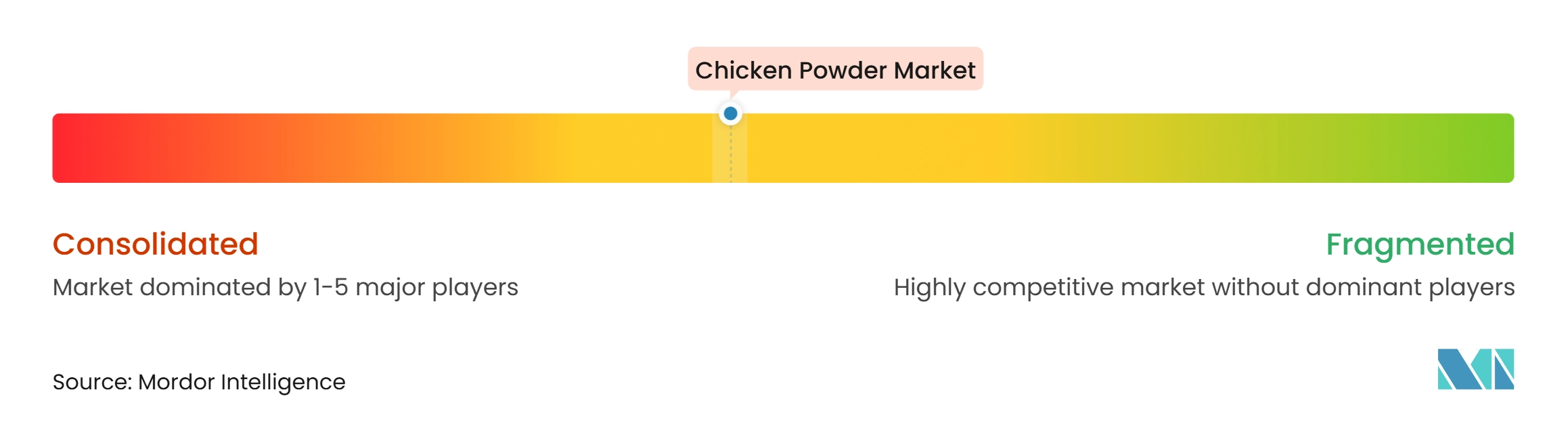
The Chicken Powder Market includes multinational food ingredient manufacturers, established seasoning and flavoring companies, poultry processors, and regional food ingredient producers competing through product quality, formulation capabilities, pricing, and distribution reach. Companies participate in the market through chicken meat powder, chicken broth powder, chicken protein powder, and other specialized chicken-based ingredients. Large food ingredient manufacturers benefit from established sourcing networks, processing capabilities, extensive product portfolios, and relationships with food manufacturers, while specialized producers focus on concentrated flavors, customized formulations, and application-specific solutions. The competitive landscape therefore reflects varying levels of participation across product types, ingredient specifications, and regional markets.
Competitive strategies in the Chicken Powder Market focus on expanding product portfolios, improving processing capabilities, and developing formulations for diverse food applications. Manufacturers supply chicken powder for use in soups, sauces, gravies, seasonings, instant noodles, ready-to-eat meals, and other processed food products. Companies also differentiate their offerings through variations in flavor intensity, protein content, solubility, moisture levels, and ingredient composition. Product development targeting conventional and organic requirements, as well as regular and low-fat formulations, allows manufacturers to address different customer specifications. These strategies enable suppliers to serve food processors, foodservice operators, and seasoning manufacturers seeking consistent chicken flavor, convenient ingredient handling, and reliable product performance.
Raw material sourcing, product consistency, food safety compliance, and distribution capabilities remain important competitive considerations. Companies with reliable poultry procurement networks and established processing infrastructure can improve supply continuity and maintain consistent product quality, while manufacturers with application-specific technical capabilities can strengthen relationships with food processing customers. However, fluctuations in poultry prices, disease-related supply disruptions, regulatory requirements for animal-derived ingredients, and competition from alternative meat seasonings can affect operating conditions across markets. Manufacturers must also maintain appropriate hygiene, traceability, labeling, and food safety standards throughout production and distribution. These factors make sourcing efficiency, product innovation, quality assurance, regulatory compliance, and customer relationships important areas of competition.
Chicken Powder Industry Leaders
-
Symrise AG
-
Proliver B.V.
-
BRF S.A.
-
Kerry Group plc
-
Ajinomoto Co., Inc.
- *Disclaimer: Major Players sorted in no particular order
Chicken Powder Market Companies Covered in this Report
- Nestlé S.A.
- Ajinomoto Co., Inc.
- Kerry Group plc
- Lee Kum Kee Company Limited
- BRF S.A.
- International Dehydrated Foods, Inc.
- Symrise AG
- Proliver B.V.
- Fuji Foods, Inc.
- Henningsen Nederland B.V.
- Unilever PLC
- McCormick & Company, Incorporated
- Weijia Food Ingredients Co., Ltd.
- Hangzhou Focus Corporation
- Nikken Foods Co., Ltd.
- H.E. Stringer Flavours Ltd.
- The Scoular Company
- A. S. Harrison & Co. Pty Ltd
- Soy Austria
- Grain Millers, Inc.
Recent Industry Developments in Chicken Powder Market
- October 2026: National Foods reported strong performance from its newly launched Chicken Powder product in its FY2026 investor briefing. The product generated more than PKR 130 million in revenue during its launch year and reached 70% of the general trade universe in Pakistan.
- December 2025: Premier Foods launched six new Bisto bouillon products for the foodservice industry in the United Kingdom. The range included Bisto Chicken Bouillon Powder, alongside beef and vegetable powder and paste variants. The new formulations feature no added MSG, no declarable allergens, no artificial colours or preservatives, and meet 2024 salt targets.
- October 2025: Premier Foods introduced OXO Chicken and Herb Stock Powder as part of its expanded stock product portfolio. The new product was launched alongside chicken bone broth and ready-to-use chicken stock, targeting consumers seeking convenient cooking ingredients.
- September 2025: Symrise AG announced plans to expand its chicken powder manufacturing capabilities at its Berric facility in France. The investment involved constructing a new spray-drying tower, scheduled to become operational in mid-2026, to introduce new chicken powder products and increase manufacturing capacity.
Global Chicken Powder Market Report Scope
For this study, the Chicken Powder Market is defined as the sales value of commercially produced chicken-derived powdered ingredients used to impart chicken flavor, enhance savory taste, and provide protein functionality across food and related applications. The market covers chicken meat powder, chicken broth powder, chicken protein powder, and other chicken-based powdered ingredients, segmented by nature into conventional and organic products, and by category into regular and low-fat formulations. The market includes dehydrated and spray-dried chicken-based ingredients used in instant noodles, soups, sauces, seasonings, snacks, ready-to-eat meals, and other food preparations, as well as applications across foodservice and commercial food processing. The market is analyzed across North America, Europe, Asia-Pacific, South America, and the Middle East and Africa, with country-level coverage as specified in the report. Market sizing and forecasts are presented in value terms (USD) across the defined segments and geographies.
Segmentation Overview
| Chicken Meat Powder | Chicken Broth Powder |
| Chicken Protein Powder | |
| Others |
| Conventional | Organic |
| Regular | Low-Fat |
| North America | United States |
| Canada | |
| Rest of North America | |
| Europe | United Kingdom |
| Germany | |
| France | |
| Italy | |
| Spain | |
| Europe | |
| Asia-Pacific | China |
| Japan | |
| India | |
| Thailand | |
| South Korea | |
| Rest of Asia-Pacific | |
| South America | Brazil |
| Rest of South America | |
| Middle East and Africa | South Africa |
| Rest of Middle East and Africa |
| By Type | Chicken Meat Powder | Chicken Broth Powder |
| Chicken Protein Powder | ||
| Others | ||
| By Nature | Conventional | Organic |
| By Category | Regular | Low-Fat |
| By Geography | North America | United States |
| Canada | ||
| Rest of North America | ||
| Europe | United Kingdom | |
| Germany | ||
| France | ||
| Italy | ||
| Spain | ||
| Europe | ||
| Asia-Pacific | China | |
| Japan | ||
| India | ||
| Thailand | ||
| South Korea | ||
| Rest of Asia-Pacific | ||
| South America | Brazil | |
| Rest of South America | ||
| Middle East and Africa | South Africa | |
| Rest of Middle East and Africa | ||
Key Questions Answered in the Report
What is the current size of the Chicken Powder Market?
The Chicken Powder Market is estimated at USD 0.544 billion in 2026.
What is the expected growth rate of the Chicken Powder Market?
The market is projected to grow at a CAGR of 5.8% during 2027–2032.
Which segment holds the largest share of the Chicken Powder Market?
Chicken meat powder is the largest segment by type, accounting for 47.80% of the market share in 2026.
Which region dominates the Chicken Powder Market?
Europe is the largest regional market, accounting for 50.80% of the market share in 2026. Asia-Pacific is projected to be the fastest-growing region, registering a CAGR of 6.4% during 2027–2032.