
Chelated Micronutrient Fertilizers Market Size and Share
Market Overview
| Study Period | 2021 - 2031 |
|---|---|
| Market Size (2026) | USD 1.05 Billion |
| Market Size (2031) | USD 1.56 Billion |
| Growth Rate (2026 - 2031) | 8.20% CAGR |
| Fastest Growing Market | Asia-Pacific |
| Largest Market | Asia-Pacific |
| Market Concentration | Medium |
Major Players *Disclaimer: Major Players sorted in no particular order Image © Mordor Intelligence. Reuse requires attribution under CC BY 4.0. | |
Chelated Micronutrient Fertilizers Market Analysis by Mordor Intelligence
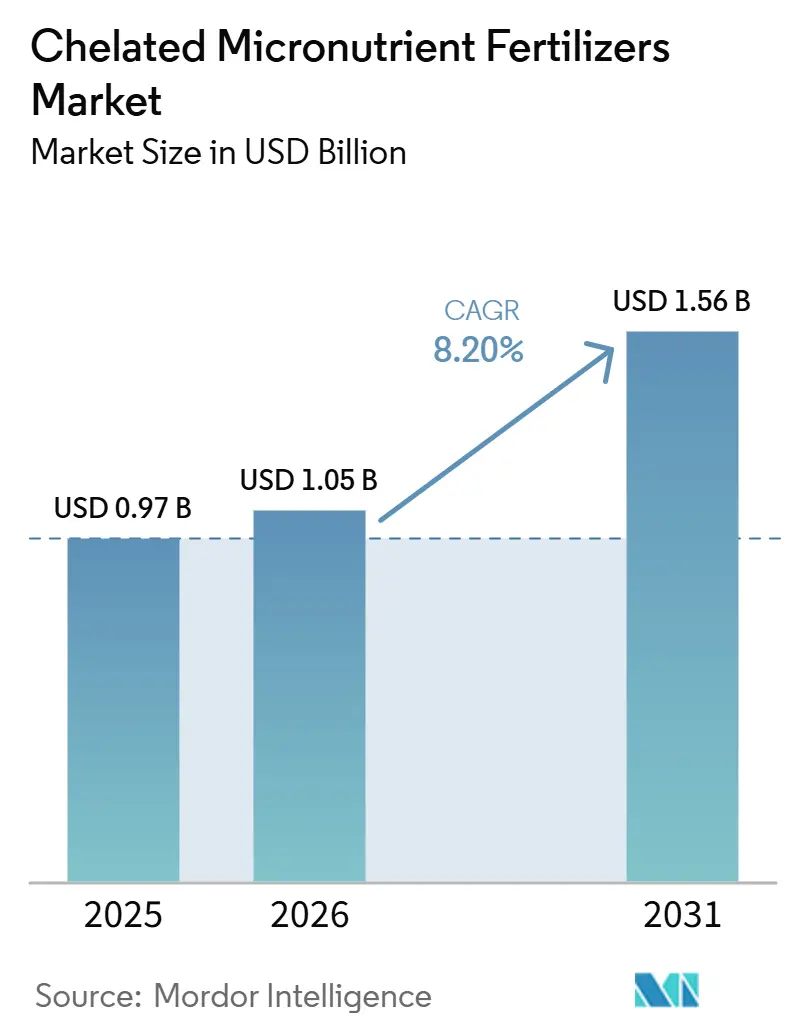
The Chelated micronutrient fertilizers market size is projected to expand from USD 0.97 billion in 2025 and USD 1.05 billion in 2026 to USD 1.56 billion by 2031, registering a CAGR of 8.20% between 2026 and 2031. The chelated micronutrient fertilizers market is expanding as growers face deeper soil nutrient depletion, especially in intensively cultivated systems where repeated cropping has reduced the effectiveness of basic nutrient programs. The shift is also tied to the need for more reliable micronutrient uptake in soils where pH, water quality, and fixation issues limit the performance of conventional salts, which keeps demand focused on products with stronger bioavailability. The chelated micronutrient fertilizers market is also benefiting from the rise of high-value crop programs, where fruit quality, export acceptance, and yield consistency warrant premium nutrient inputs. Competitive positioning is moving toward biodegradable chelates, liquid delivery systems, and formulations that fit fertigation and precision advisory models, while established producers still rely on broad registration portfolios and deep global distribution. The chelated micronutrient fertilizers market also has room to grow in commercial farming systems that are adding drip irrigation, foliar programs, and crop-specific nutrition services, which support a durable medium-term demand base.
Key Report Takeaways
- By micronutrient type, zinc led with 26.2% revenue share in 2025, while boron is forecast to expand at a 9.1% CAGR through 2031.
- By form, dry formulations held 58.4% of the chelated micronutrient fertilizers market share in 2025, while liquid formulations recorded the fastest projected CAGR at 8.8% through 2031.
- By chelating agent, EDTA accounted for 51.5% of the segment in 2025, while IDHA is advancing at a 9.5% CAGR through 2031.
- By mode of application, foliar spray represented 36.9% of the market in 2025, while fertigation is growing at a 9.7% CAGR through 2031.
- By crop type, fruits and vegetables accounted for 34.7% of the chelated micronutrient fertilizers market size in 2025 and are also projected to post the fastest CAGR of 9.2% through 2031.
- By geography, Asia-Pacific held 25.3% of the market in 2025 and is projected to record the fastest CAGR at 8.9% through 2031.
Note: Market size and forecast figures in this report are generated using Mordor Intelligence’s proprietary estimation framework, updated with the latest available data and insights as of January 2026.
Global Chelated Micronutrient Fertilizers Market Trends and Insights
Drivers Impact Analysis*
| Driver | (~) % Impact on CAGR Forecast | Geographic Relevance | Impact Timeline |
|---|---|---|---|
| Rising micronutrient depletion in intensively farmed soils | +2.1% | Global, with acute concentration in South Asia, Sub-Saharan Africa, and East Asia | Long term (≥ 4 years) |
| Precision agriculture is increasing prescription-based micronutrient use | +1.6% | North America, Europe, and Asia-Pacific core, with spillover to Middle East and Africa | Medium term (2-4 years) |
| Yield protection in high-value crops is supporting chelated formulations | +1.4% | Global, strongest in Asia-Pacific, Europe, and South America | Long term (≥ 4 years) |
| Water-soluble chelates are expanding fertigation compatibility | +1.2% | Asia-Pacific, Middle East, and Southern Europe | Medium term (2-4 years) |
| Sustainability pressure is accelerating low-dose nutrient efficiency adoption | +0.9% | Europe, North America, and Australia | Short term (≤ 2 years) |
| Bioavailability advantage over conventional micronutrient salts is driving conversion | +0.8% | Global, most visible in high-pH calcareous soil belts | Long term (≥ 4 years) |
| Source: Mordor Intelligence | |||
Rising Micronutrient Depletion in Intensively Farmed Soils
The chelated micronutrient fertilizers market is seeing strong support from continuous cropping systems that are depleting micronutrient reserves faster than they are replenished. A 2024 study in Frontiers in Soil Science reported that zinc deficiency in India was documented in 38% of soil samples collected across 28 states, confirming the scale of the agronomic problem in a large commercial farming base [1]Source: Frontiers in Soil Science, “Soil Zinc Surveillance Frameworks Can Inform Human Nutrition Studies, Opportunities in India,” frontiersin.org. The commercial effect is stronger in productive irrigation belts, where growers have both the economic incentive and the agronomic capability to shift toward premium nutrient correction programs. Research published in the Journal of Soil Science and Plant Nutrition in 2024 showed that zinc products can lose plant-available fractions in soil through aging, leaching, and migration, supporting the performance case for stable chelated delivery under repeated use. Once growers see more reliable crop response under these soil conditions, the chelated micronutrient fertilizers market tends to retain that demand because the move away from low-cost salts becomes harder to reverse.
Precision Agriculture is Increasing Prescription-Based Micronutrient Use
The market is benefiting from the spread of variable-rate systems, remote sensing, and soil mapping, which make micronutrient management more targeted and less reactive. Research in Applied Water Science in 2026 described how precision fertigation systems combine sensors, controllers, and injection units to deliver crop-specific nutrients with timing and placement that broadcast methods cannot match. This changes procurement behavior because growers and service providers increasingly want products with consistent stability, known uptake behavior, and compatibility with precision equipment. BASF SE expanded this logic in October 2025 when it launched xarvio HEALTHY FIELDS for RiTA in Japan, combining artificial intelligence-based soil improvement services and nutrient prescription support with a yield guarantee model for rice farmers[2]Source: BASF SE, “BASF Launches First Rice Yield Guarantee via xarvio HEALTHY FIELDS with AI-Powered Humus Soil Improvement Service,” basf.com . As these data-led programs become more common, the chelated micronutrient fertilizers market gains from the shift away from generic blends and toward defined formulations that fit prescription nutrition strategies.
Yield Protection in High-Value Crops is Supporting Chelated Formulations
Intensive horticulture is a key source of demand, as nutrient deficiencies can reduce crop quality, shelf life, fruit set, and final selling price. A 2025 analysis available through PubMed Central found that foliar and combined soil-plus-foliar zinc applications in wheat performed better than soil-only programs at increasing grain zinc levels, reinforcing the value of targeted micronutrient delivery rather than broad correction alone. The same cost logic applies even more strongly in horticulture, where the return from avoiding visible deficiency symptoms or poor fruit development can justify the premium for more advanced chelates. Boron is the fastest-growing micronutrient segment because its role in flowering, fruit set, and cell wall stability is directly linked to the crop categories expanding fastest in the chelated micronutrient fertilizers market.
Water-Soluble Chelates are Expanding Fertigation Compatibility
Wider use of drip and micro-irrigation systems is driving demand for clean, water-soluble chelated formulations designed for efficient fertigation. A 2026 study in Frontiers in Plant Science reported that subsurface drip fertigation can achieve water-use efficiency of 85% to 90% while supporting crop productivity under semi-arid conditions, further strengthening the case for chelates that remain soluble and stable in irrigation lines. This matters because precipitation, clogging, and incompatibility can quickly reduce system performance and crop response in fertigation-led farming. Liquid formulations are expanding faster than dry products, and suppliers with strong water-soluble manufacturing capability are better positioned to serve commercial farms using high-frequency nutrient programs. As irrigation infrastructure and digital advisory services develop together, the chelated micronutrient fertilizers market is likely to direct more of its future growth through fertigation-compatible product lines.
Restraints Impact Analysis*
| Restraint | (~) % Impact on CAGR Forecast | Geographic Relevance | Impact Timeline |
|---|---|---|---|
| Higher cost versus conventional micronutrient inputs | -1.8% | Global, most acute in South Asia, Sub-Saharan Africa, and South America | Long term (≥ 4 years) |
| Farmer misapplication risk from incompatible tank mixes | -0.9% | Asia-Pacific and South America smallholder segments | Medium term (2-4 years) |
| Variable performance across soil pH and water hardness conditions | -0.7% | Global, with concentration in calcareous and alkaline soil belts | Long term (≥ 4 years) |
| Regulatory scrutiny around chelating agent persistence and environmental fate | -0.6% | Europe, with growing influence in Asia-Pacific | Short term (≤ 2 years) |
| Source: Mordor Intelligence | |||
Higher Cost Versus Conventional Micronutrient Inputs
Pricing remains the most significant structural constraint in the chelated micronutrient fertilizers market, as chelated products typically cost more than comparable sulfate-based alternatives. This premium can range from 1.5 to 2.5 times the cost of conventional options, creating a barrier for smallholder farming systems and crops with limited input budgets. Lower application rates help offset that difference, but the saving is often not enough to change grower behavior in staple crop programs where immediate cost still drives decisions. The effect is strongest in cereals and other commodity crops, where a favorable agronomic response does not always translate into a convincing short-term economic return. That keeps the chelated micronutrient fertilizers market more concentrated in horticulture, export agriculture, controlled environments, and other farm systems where quality protection and yield stability carry higher commercial value.
Regulatory Scrutiny Around Chelating Agent Persistence and Environmental Fate
Growing regulatory scrutiny of synthetic chelating agents that persist in the environment is constraining the adoption of certain chelated micronutrient formulations. A 2024 study published in the Polish Journal of Chemical Technology found that EDTA persisted in natural soils, whereas the biodegradable chelating agent IDHA degraded within 28 days. The findings reinforce the environmental advantages of biodegradable chelates by reducing long-term soil accumulation and supporting their increasing adoption in sustainable fertilizer formulations. This is important because the European Union Fertilizing Products Regulation 2019/1009 has increased the commercial relevance of biodegradability in products intended for compliant fertilizer portfolios. Manufacturers that depend on legacy formulations may now face reformulation costs, restricted access, or slower acceptance in parts of Europe where sustainability alignment has become part of product selection. As a result, the chelated micronutrient fertilizers market is moving toward a more segmented product mix, with biodegradable chemistries gaining ground while older agents remain in use in cost-sensitive applications.
*Our forecasts treat driver/restraint impacts as directional, not additive. The impact forecasts reflect baseline growth, mix effects, and variable interactions.
Segment Analysis
By Micronutrient Type: Zinc Anchors Demand While Boron Leads Growth
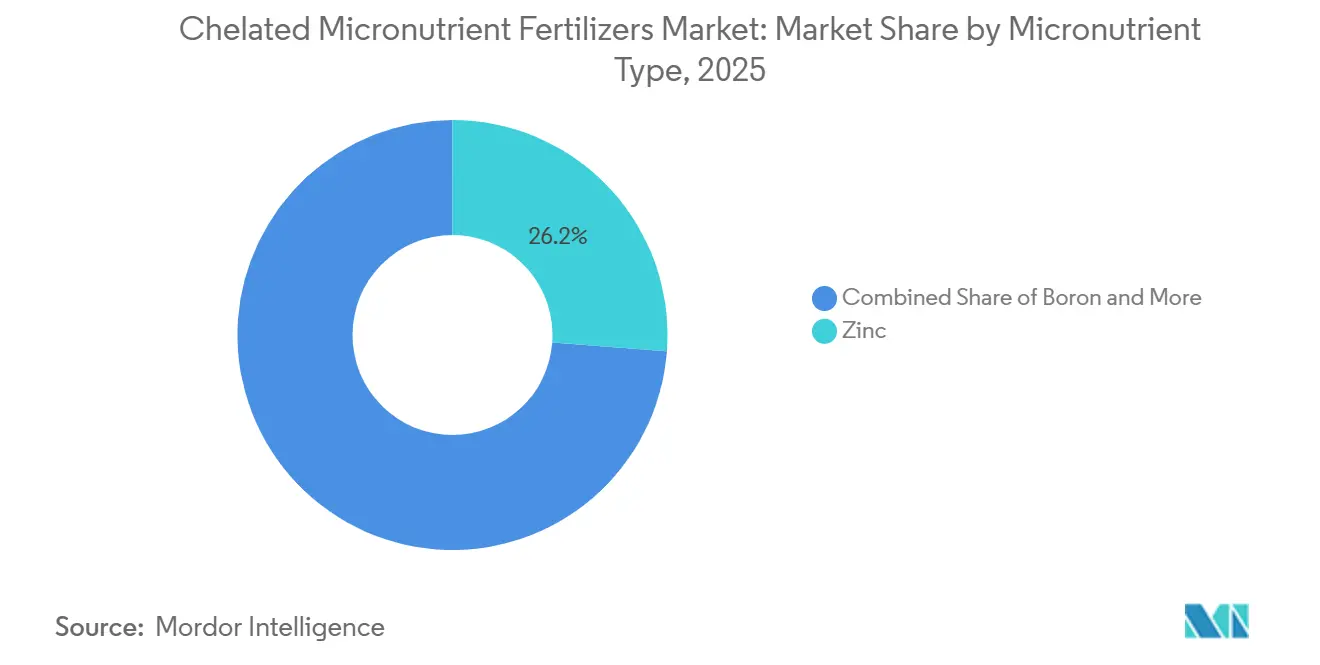
Zinc remained the largest nutrient category, accounting for 26.2% of the chelated micronutrient fertilizers market in 2025. This position reflects the broad geographic spread of zinc deficiency and the practical need for dependable correction across grain, vegetable, and horticultural systems. A 2024 review in Plants from MDPI noted that zinc is the most deficient micronutrient in tropical soils and reported weak zinc status across Brazil’s Cerrado region, underscoring its commercial relevance in tropical agriculture. Iron is one of the major segments because it remains essential for correcting chlorosis in calcareous soils, where iron availability breaks down quickly. Manganese, copper, and molybdenum also retained a role in the chelated micronutrient fertilizers market because their use is tied to specific enzyme functions, nitrogen fixation support, and crop-specific nutrition plans.
Boron is projected to register the fastest growth among micronutrient categories, expanding at a 9.1% CAGR through 2031. That growth is tied to rising acreage for fruit, vegetables, and oilseeds, where boron deficiency can directly affect flowering, fruit set, seed development, and quality. The commercial logic is straightforward: growers in these crop systems are usually more willing to pay for nutrient programs that prevent visible, irreversible production losses. Iron is likely to remain important in technically difficult soils because EDDHA-based delivery continues to offer strong performance, even as simpler formulations lose effectiveness. The broader nutrient mix, therefore, remains balanced between large-volume deficiency correction and smaller, but faster-growing, specialty uses that support higher-value crop production.



By Form: Dry Products Lead While Liquid Products Gain Ground
Dry formulations accounted for the largest share of the chelated micronutrient fertilizers market, representing 58.4% in 2025. Dry products kept this lead because they are easier to store, easier to move through conventional distribution channels, and better suited to broad-acre programs that still depend on standard handling systems. They also align well with bulk procurement practices for grain crops and with growers who prefer longer shelf life and familiar application formats. These practical advantages help explain why dry products remain the base volume category even as application methods continue to evolve.
Liquid formulations are projected to register the fastest growth, expanding at a CAGR of 8.8% through 2031. This shift is closely linked to the wider use of fertigation, protected cultivation, hydroponics, and other systems that require accurate dissolution and stable nutrient delivery. Liquid products are also better aligned with low-dose, high-frequency feeding schedules that commercial horticulture increasingly prefers. Newer biodegradable chelates also fit naturally into liquid product development because these formats make it easier to combine nutrient delivery with handling convenience and system compatibility. The result is a gradual form transition, not a sudden replacement, with liquids gaining share in technically advanced crop systems while dry products continue to dominate older application models.
By Chelating Agent: EDTA Leads Today While IDHA Shapes the Next Shift
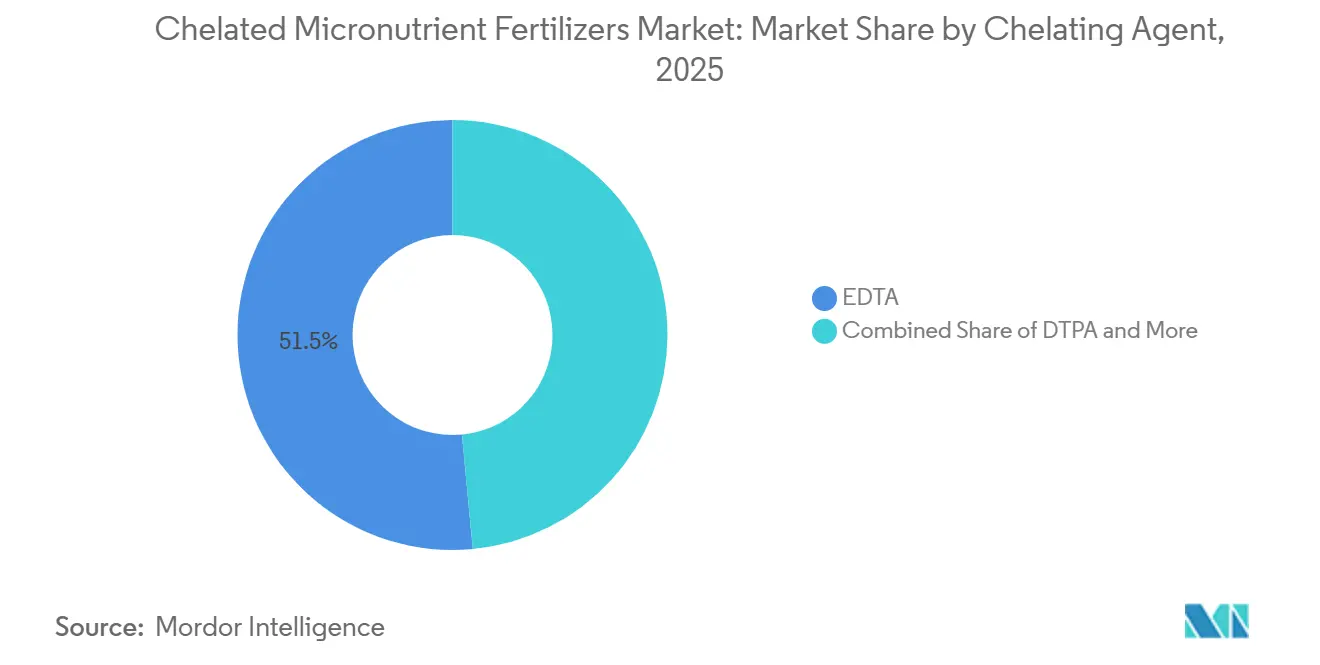
EDTA remained the largest chelating agent category, accounting for 51.5% of the chelated micronutrient fertilizers market in 2025. EDTA has maintained this position because it has long-established field performance, broad product registrations, and cost advantages that are difficult for newer options to match across all geographies. Its compatibility with several key micronutrients also makes it a practical mainstream choice for formulators serving diverse cropping systems. Diethylenetriaminepentaacetic acid (DTPA) offers a useful middle ground: it supports iron delivery in moderately alkaline soils where EDTA weakens, but premium alternatives are not always needed. Ethylenediaminedi(o-hydroxyphenylacetic) acid, or EDDHA, remained important for highly calcareous soils where iron stability is a more critical issue than cost.
IDHA is projected to register the fastest growth among chelating agents, expanding at a CAGR of 9.5% through 2031. That growth is driven by biodegradability requirements, sustainability screening, and the need for formulations that meet stricter product standards. The 2024 study in the Polish Journal of Chemical Technology supports this direction by showing the strong degradation advantage of IDHA compared with more persistent legacy agents. This does not mean EDTA disappears quickly, because price-sensitive applications and existing registrations still favor its continued use in many markets. Instead, the chelated micronutrient fertilizers industry is moving toward a split structure, with EDTA and DTPA serving mainstream demand while IDHA and EDDHA gain ground where technical performance or compliance pressure is higher.
By Mode of Application: Foliar Spray Holds the Lead While Fertigation Advances Fastest
Foliar spray remained the largest application segment, accounting for 36.9% of the chelated micronutrient fertilizers market share in 2025. Foliar use kept this lead because it avoids soil fixation and delivers nutrients directly to plant surfaces, where correction can be more immediate and more visible. That speed matters in crops where deficiency symptoms appear quickly and where growers want targeted treatment without changing the full soil program. The 2025 analysis available through PubMed Central also supported the value of targeted zinc application, showing stronger results for foliar and combined programs than for soil-only strategies in wheat. Seed and soil treatments still matter in the chelated micronutrient fertilizers market, but they serve different purposes and typically do not match foliar applications for fast in-season correction.
Fertigation is projected to register the fastest growth among application segments, expanding at a CAGR of 9.7% through 2031. This is a meaningful signal because it exceeds the overall market growth rate and points to a real change in how specialty nutrition is being delivered. Precision irrigation systems support crop-specific timing, lower waste, and smoother integration with digital advisory tools, which raises the value of nutrient products built for those systems. The 2026 Applied Water Science research on precision fertigation and the 2026 Frontiers in Plant Science study on drip efficiency both strengthen the case for this application model in water-sensitive production environments. Fertigation is therefore likely to keep taking share from more traditional methods in commercial farming systems that invest in precision and consistency.
By Crop Type: Fruits and Vegetables Dominate Both Current Demand and Future Expansion
Fruits and vegetables remained the largest crop type segment, accounting for 34.7% of the chelated micronutrient fertilizers market size in 2025. This dominance reflects the fact that high-value crops are far more exposed to visible quality loss, rejected shipments, poor fruit set, and short shelf life when micronutrient management is weak. In these crops, the cost premium for chelated inputs is easier to justify because the financial penalty from deficiency can be immediate and severe. Grains and cereals still represented a major volume base because of their vast planted area and regular need for zinc and iron correction, especially in intensive systems. Pulses, oilseeds, and commercial crops also continued to support the chelated micronutrient fertilizers market through crop-specific nutrient needs tied to pod development, plant vigor, and production quality.
Fruits and vegetables are projected to register the fastest growth among crop type segments, expanding at a CAGR of 9.2% through 2031. That dual position is important because it means the largest demand center is also the strongest growth center, which is not common across all agricultural input markets. Controlled environment agriculture, greenhouse programs, and premium export chains are reinforcing this pattern by favoring precise nutrient management and consistent output quality. Coromandel International Limited reported record specialty business volumes in the third quarter of fiscal year 2026, driven by micronutrients and organic categories, aligning with the stronger momentum in premium crop nutrition. The crop mix is therefore moving the chelated micronutrient fertilizers market further toward value-led demand rather than pure acreage-led demand.
Geography Analysis
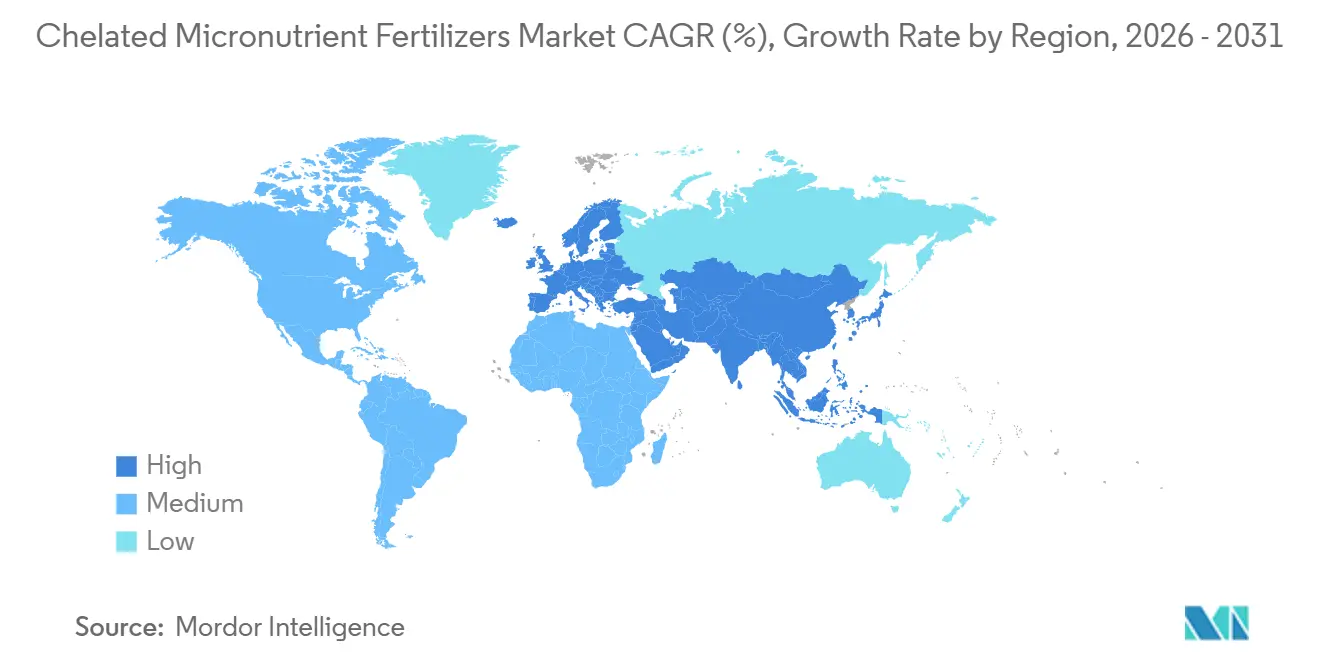
Asia-Pacific accounted for 25.3% of the chelated micronutrient fertilizers market share in 2025 and is also projected to post the fastest regional CAGR of 8.9% through 2031. This dual lead reflects the scale of crop production in China and India and the depth of unresolved micronutrient deficiency across intensively farmed soils in the region. The 2024 Frontiers in Soil Science study on India confirmed zinc deficiency in 38% of sampled soils from 28 states, underscoring the need for more targeted correction in one of the region’s largest agricultural systems. The region is also seeing stronger adoption of water-soluble products as drip irrigation, foliar feeding, and crop-specific advisory programs become more common in commercial farming. BASF SE’s October 2025 launch of xarvio HEALTHY FIELDS for RiTA in Japan showed how digital agronomy and micronutrient prescription can be bundled into service-led models, which is important for the future direction of the chelated micronutrient fertilizers market.
Europe held a significant position in the chelated micronutrient fertilizers market because growers there operate with tighter food quality requirements, stronger agronomic support systems, and broader access to precision application technology. Spain, Italy, Germany, and France remain central because Mediterranean horticulture and permanent crop systems need reliable micronutrient performance under intensive production conditions. The regulatory setting is also more demanding, especially for product portfolios that must align with European Union fertilizer rules and sustainability expectations. That is why biodegradable chelates are becoming more relevant in Europe than in many other regions. The region, therefore, influences not only local demand but also global formulation strategies for suppliers serving multiple markets.
North America and South America showed different demand structures within the chelated micronutrient fertilizers market, even though both regions are important to long-term growth. North America reflects greater maturity in precision farming, where fertigation, variable-rate systems, and detailed soil management support adoption in specialty crops and advanced row-crop operations. South America is more strongly tied to the agronomic realities of tropical and subtropical production, especially in Brazil, where zinc and boron deficiencies remain important in large-scale cropping systems. The Middle East and Africa remain smaller in volume, but they are strategically relevant because greenhouse production, export horticulture, and water-use discipline favor clean and efficient micronutrient delivery. Across these regions, the chelated micronutrient fertilizers market is strengthening as growers combine irrigation control, commercial crop intensity, and a clear need for more stable nutrient uptake.

Competitive Landscape
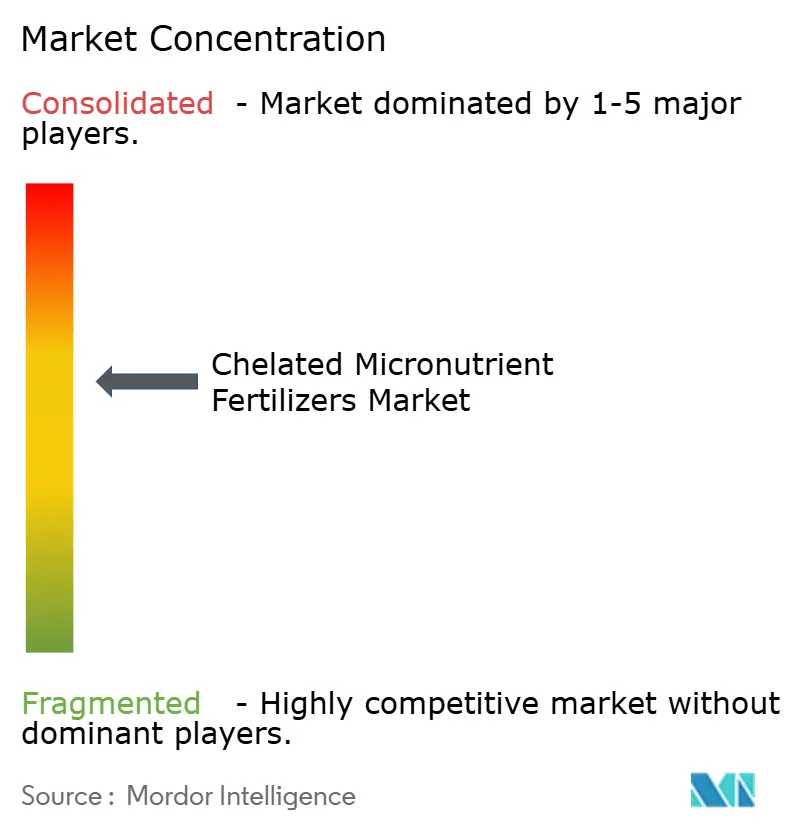
The chelated micronutrient fertilizers market is moderately consolidated, with BASF SE, Yara International ASA, The Mosaic Company, Coromandel International Limited, and Haifa Group forming the most visible global leadership tier. These companies shape product standards, technical positioning, and channel access, while a wider field of regional producers competes through localized distribution, price flexibility, and crop-specific formulations. The next layer includes companies such as BMS Micro-Nutrients B.V., ATP Nutrition, LLC, Nufarm Limited, The Andersons, Inc., and Valagro S.p.A. This structure keeps the chelated micronutrient fertilizers market competitive even though the leading players hold clear advantages in formulation breadth, compliance capacity, and technical marketing. It also explains why competition is not based on volume alone, but increasingly on performance reliability, sustainability fit, and the ability to support more precise application systems.
The competitive focus in the chelated micronutrient fertilizers market is shifting from simple efficacy claims toward product profile, regulatory fit, and integration with precision nutrition programs. Yara International ASA also expanded its Hanninghof Research Centre capabilities in 2025 to strengthen science-based specialty crop nutrition work, including micronutrient development[3]Source: Yara International ASA, “Yara Expands Research Capabilities in Biological Crop Solutions,” yara.com. These moves show that leading companies are trying to secure advantage through research depth and service integration, not only through standalone product sales. As a result, the chelated micronutrient fertilizers market is becoming more demanding for smaller suppliers that lack either research backing or differentiated product chemistry.
Capital allocation and portfolio discipline are also shaping competition in the chelated micronutrient fertilizers market. Yara International ASA said in January 2026 that its strategy toward 2030 includes stronger free cash flow generation and continued focus on premium crop nutrition lines such as YaraVita, which signals that specialty nutrients remain a strategic growth area. Coromandel International Limited also reported record specialty business volumes in the third quarter of fiscal year 2026, supported by micronutrients and organic categories, which highlights the value of scale in domestic distribution and specialty positioning. Suppliers that can combine water-soluble manufacturing, biodegradable chelate development, and advisory-led selling are likely to be better placed than those competing only on price. That keeps the competitive tone of the chelated micronutrient fertilizers market balanced between consolidation at the top and active fragmentation below it.
Chelated Micronutrient Fertilizers Industry Leaders
The Mosaic Company
Haifa Group
Coromandel International Limited
Yara International ASA
BASF SE
- *Disclaimer: Major Players sorted in no particular order

Recent Industry Developments
- March 2026: Yara International ASA expanded the Hanninghof Research Centre in Germany to strengthen research capabilities in biological crop solutions and specialty nutrition, including work relevant to micronutrient development.
- January 2026: Yara International ASA's 2026 Capital Markets Day outlined a roadmap to expand free cash flow by over USD 600 million from 2024 to 2030. The company positioned its YaraVita specialty crop nutrition portfolio, including chelated micronutrients, as a strategic growth driver and announced an NPK expansion project in Cartagena to accelerate portfolio growth through 2030.
- October 2025: BASF SE launched the xarvio HEALTHY FIELDS for RiTA service in Japan in partnership with NEWGREEN, combining artificial intelligence powered soil improvement and micronutrient prescription delivery with a yield-performance guarantee for dry direct-seeding rice farmers.


Global Chelated Micronutrient Fertilizers Market Report Scope
Chelated micronutrient fertilizers are specialized plant nutrients (like iron or zinc) chemically bound to larger organic molecules known as chelating agents. This organic "shield" prevents micronutrients from reacting with soil particles, keeping them highly soluble and readily available to plant roots and foliage.
The chelated micronutrient fertilizers market report is segmented by micronutrient type (zinc, iron, manganese, boron, copper, molybdenum, other micronutrient types), by form (dry and liquid), by chelating agent (EDTA, EDDHA, DTPA, IDHA, other chelating agents), by crop type (fruits and vegetables, cereals and grains, oilseeds and pulses, other crop types), by application mode (fertigation, foliar, seed treatment, and soil), and by geography (North America, South America, Europe, Asia-Pacific, Middle East and Africa). The market forecasts are provided in terms of value (USD) and volume (metric tons).
| Zinc |
| Iron |
| Manganese |
| Boron |
| Copper |
| Molybdenum |
| Other Micronutrient Types |
| Dry |
| Liquid |
| EDTA |
| EDDHA |
| DTPA |
| IDHA |
| Other Chelating Agents |
| Fruits and Vegetables |
| Cereals and Grains |
| Oilseeds and Pulses |
| Other Crop Types |
| Foliar |
| Soil |
| Fertigation |
| Seed Treatment |
| North America | United States |
| Canada | |
| Rest of North America | |
| South America | Brazil |
| Argentina | |
| Rest of South America | |
| Europe | Germany |
| France | |
| United Kingdom | |
| Italy | |
| Spain | |
| Russia | |
| Rest of Europe | |
| Asia-Pacific | China |
| India | |
| Japan | |
| South Korea | |
| Australia | |
| Rest of Asia-Pacific | |
| Middle East | Saudi Arabia |
| United Arab Emirates | |
| Turkey | |
| Rest of Middle East | |
| Africa | South Africa |
| Egypt | |
| Nigeria | |
| Rest of Africa |
| By Micronutrient Type | Zinc | |
| Iron | ||
| Manganese | ||
| Boron | ||
| Copper | ||
| Molybdenum | ||
| Other Micronutrient Types | ||
| By Form | Dry | |
| Liquid | ||
| By Chelating Agent | EDTA | |
| EDDHA | ||
| DTPA | ||
| IDHA | ||
| Other Chelating Agents | ||
| By Crop Type | Fruits and Vegetables | |
| Cereals and Grains | ||
| Oilseeds and Pulses | ||
| Other Crop Types | ||
| By Application | Foliar | |
| Soil | ||
| Fertigation | ||
| Seed Treatment | ||
| By Geography | North America | United States |
| Canada | ||
| Rest of North America | ||
| South America | Brazil | |
| Argentina | ||
| Rest of South America | ||
| Europe | Germany | |
| France | ||
| United Kingdom | ||
| Italy | ||
| Spain | ||
| Russia | ||
| Rest of Europe | ||
| Asia-Pacific | China | |
| India | ||
| Japan | ||
| South Korea | ||
| Australia | ||
| Rest of Asia-Pacific | ||
| Middle East | Saudi Arabia | |
| United Arab Emirates | ||
| Turkey | ||
| Rest of Middle East | ||
| Africa | South Africa | |
| Egypt | ||
| Nigeria | ||
| Rest of Africa | ||


Key Questions Answered in the Report
What is the 2031 outlook for chelated micronutrient fertilizers?
The chelated micronutrient fertilizers market is projected to reach USD 1.56 billion by 2031 from USD 1.05 billion in 2026, growing at an 8.2% CAGR over 2026 to 2031.
Which nutrient category leads current demand?
Zinc is the largest micronutrient type, holding 26.2% share in 2025, supported by widespread zinc deficiency across major agricultural regions.
Which application method is expanding the fastest?
Fertigation is the fastest-growing application mode with a 9.7% CAGR through 2031 because it fits precision irrigation systems and water-soluble nutrient programs.
Why are fruits and vegetables so important to demand growth?
Fruits and vegetables held 34.7% share in 2025 and are projected to grow at a 9.2% CAGR, because quality losses and fruit set issues make precise micronutrient management more valuable in these crops.
Page last updated on:






