
Ceramic Battery Insulation Sheets Market Size and Share
Market Overview
| Study Period | 2021 - 2031 |
|---|---|
| Market Size (2026) | USD 595.33 Million |
| Market Size (2031) | USD 964.03 Million |
| Growth Rate (2026 - 2031) | 10.12 % |
| Fastest Growing Market | Asia-Pacific |
| Largest Market | Asia-Pacific |
| Market Concentration | Low |
Major Players *Disclaimer: Major Players sorted in no particular order Image © Mordor Intelligence. Reuse requires attribution under CC BY 4.0. | |
Ceramic Battery Insulation Sheets Market Analysis by Mordor Intelligence
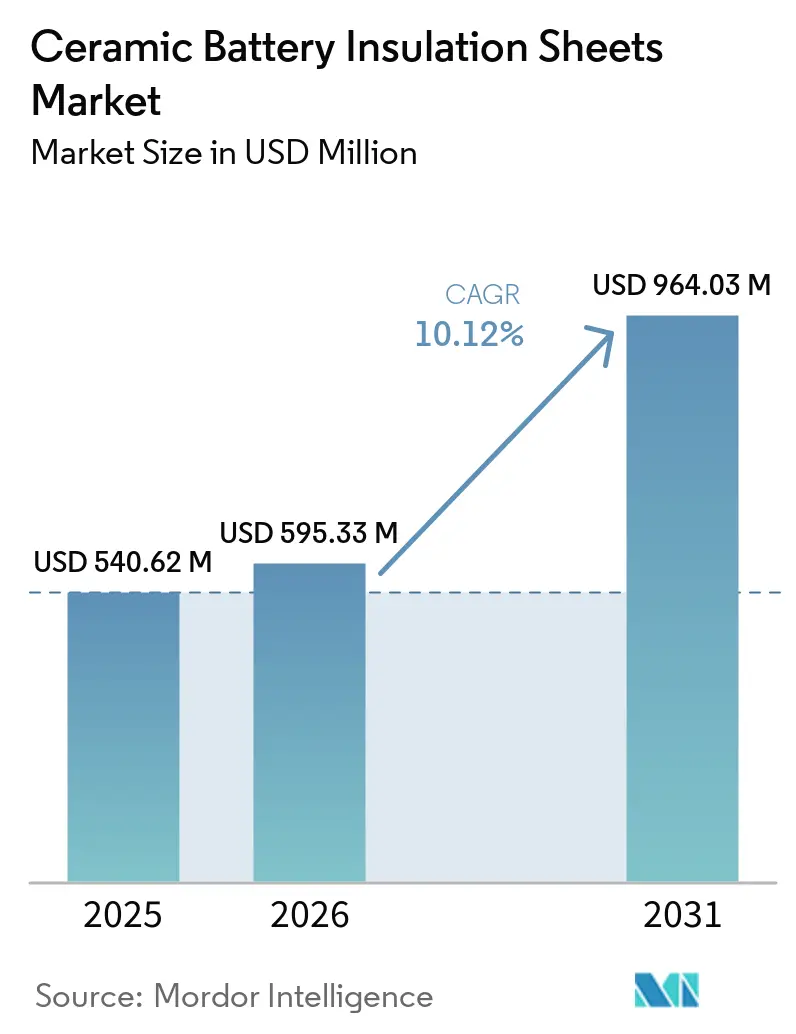
The Ceramic Battery Insulation Sheets Market size was valued at USD 540.62 million in 2025 and is estimated to grow from USD 595.33 million in 2026 to reach USD 964.03 million by 2031, at a CAGR of 10.12% during the forecast period (2026-2031). Higher cell energy density, faster charging, and the wider use of 800 V battery systems are raising thermal and electrical demands on barriers between cells, particularly when high power must be contained within compact battery pack layouts. Ceramic sheets provide resistance at temperatures that exceed the operating limits of many polymer materials, which makes them important in electric vehicle (EV) and stationary storage battery packs, where a local failure can spread heat across closely arranged cells. Cell-to-pack and cell-to-body designs are also shifting more thermal, mechanical, and electrical functions into the insulation layer itself, because those architectures reduce the supporting structures that previously offered secondary protection. Suppliers are responding through aerogel composites, alumina fiber formats, and sheets tailored for original equipment manufacturer qualification, with performance expectations covering insulation, mechanical stability, electrical separation, and manufacturability. Long qualification cycles, high aerogel production costs, and trade-offs between compression stability, venting, and crash performance continue to limit faster adoption across cost-sensitive battery applications and new technical platforms.
Key Report Takeaways
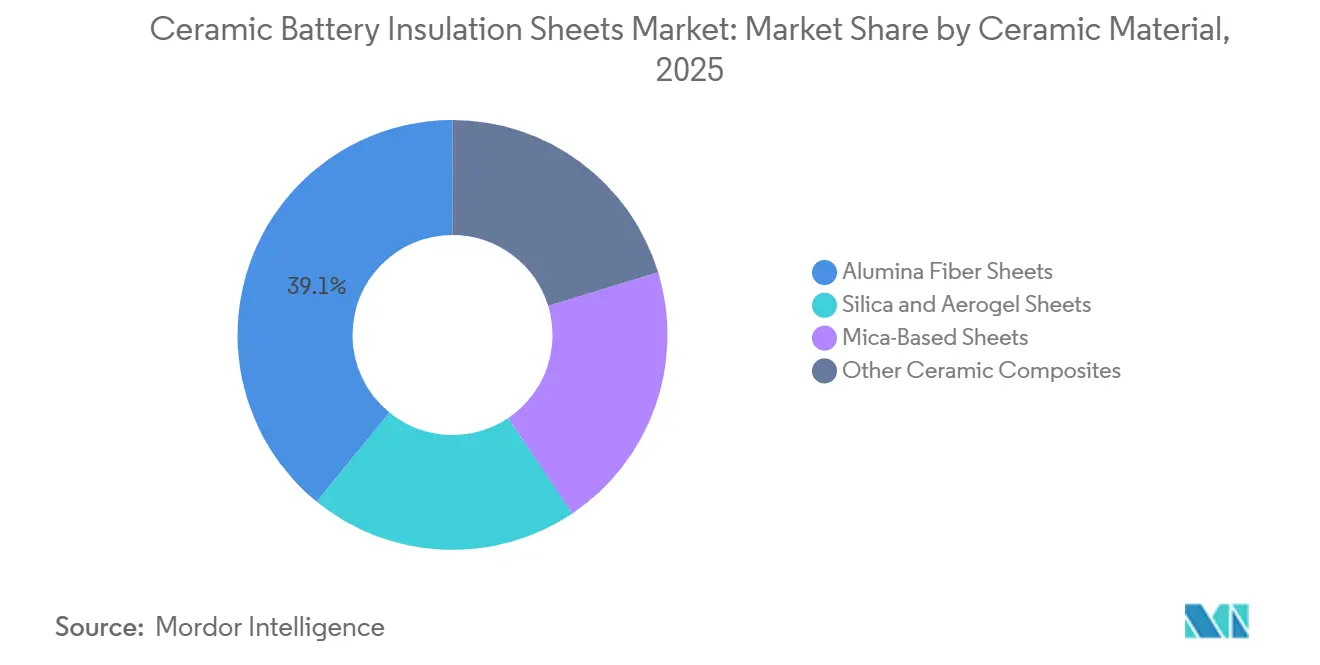
- By ceramic material, alumina fiber sheets held 39.13% of the ceramic battery insulation sheets market share in 2025, while silica and aerogel sheets are projected to advance at a 10.93% CAGR through 2031.
- By battery type, EV battery packs held 60.45% of the ceramic battery insulation sheets market share in 2025, while battery energy storage systems are projected to advance at an 11.34% CAGR through 2031.
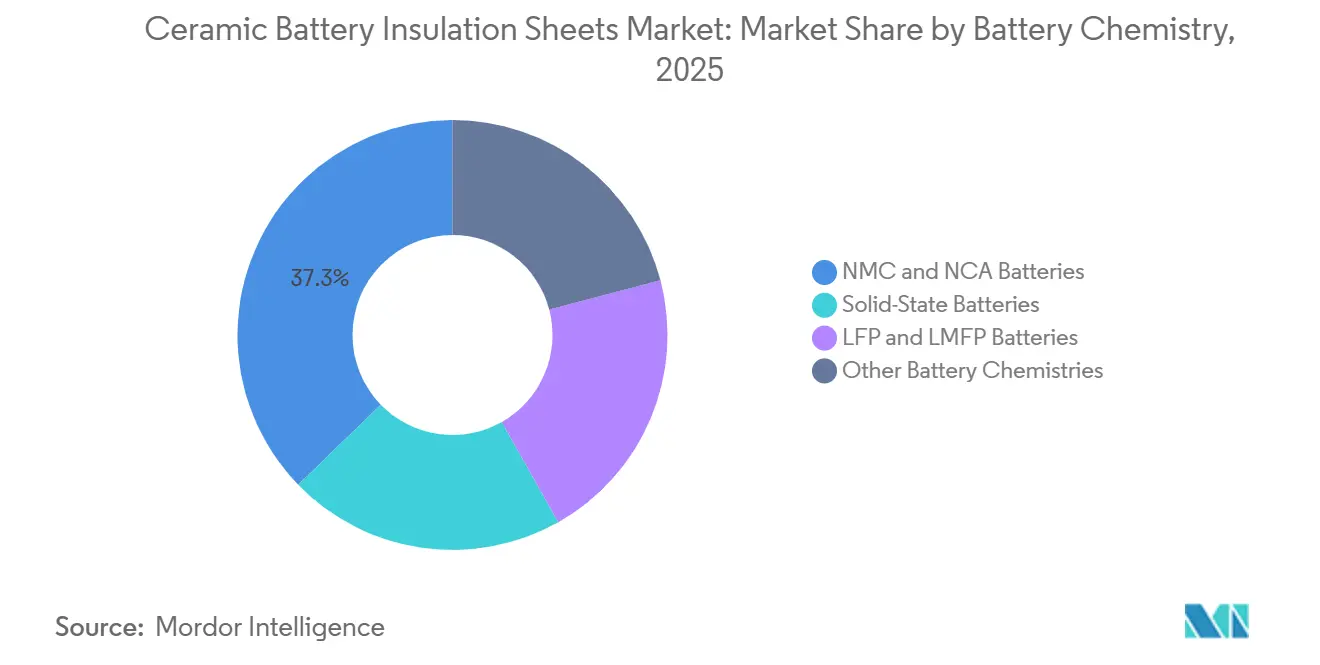
- By battery chemistry, Nickel Manganese Cobalt (NMC) and Nickel Cobalt Aluminum (NCA) batteries held 37.26% of the ceramic battery insulation sheets market share in 2025, while solid-state batteries are projected to advance at an 11.97% CAGR through 2031.
- By geography, Asia-Pacific held 44.58% of the ceramic battery insulation sheets market share in 2025 and is projected to advance at an 11.55% CAGR through 2031.
Note: Market size and forecast figures in this report are generated using Mordor Intelligence’s proprietary estimation framework, updated with the latest available data and insights as of January 2026.
Global Ceramic Battery Insulation Sheets Market Trends and Insights
Drivers Impact Analysis*
| Driver | (~) % Impact on CAGR Forecast | Geographic Relevance | Impact Timeline |
|---|---|---|---|
| Rising Thermal-Runaway Compliance Requirements | +2.8% | Global, highest intensity in China, EU, and South Korea | Short term (≤ 2 years) |
| Higher Battery Energy Density and Faster Charging | +2.4% | Global | Medium term (2–4 years) |
| Cell-to-Pack and Cell-to-Body Battery Architectures | +2.0% | China, EU, North America | Medium term (2–4 years) |
| Pack-Level Thermal, Mechanical and Electrical Protection Integration | +1.5% | Global | Medium term (2–4 years) |
| Growing Use of Battery Thermal Management Systems | +1.2% | Asia-Pacific core, spillover to EU and North America | Long term (≥ 4 years) |
| Source: Mordor Intelligence | |||
Rising Thermal-Runaway Compliance Requirements
Thermal-runaway compliance requirements are making ceramic barriers a standard procurement item in the ceramic battery insulation sheets market for many electric vehicle and Battery Energy Storage System (BESS) programs. North American BESS projects increasingly use large-scale fire testing as part of project approval, insurance, and grid interconnection work. Materials such as alumina fiber, silica aerogel, and mica sheets can maintain low thermal conductivity at elevated temperatures, supporting their use where a pack must delay heat propagation. A qualification win on a large vehicle platform can create several years of supply because replacing a validated material normally requires a new testing cycle. Research support for self-ceramicizing composite materials at Pusan National University also showed that thermal-runaway containment is receiving further development attention in Asia.
Higher Battery Energy Density and Faster Charging
The ceramic battery insulation sheets market is responding as the move from 400 V to 800 V electric vehicle designs is increasing the heat load around cells and inter-cell barriers. Fast charging and higher energy density reduce the available thermal safety margin during demanding operating conditions. A 2026 study reported a silica-alumina aerogel sheet in a dual-network composite with thermal conductivity of 0.0652 W/m·K at 1,000 °C. The result indicated that a 3 mm barrier can provide containment that previously required a substantially thicker layer in certain high-energy pack designs. This performance is strengthening interest in aerogel-containing sheets for high-density formats, where material thickness affects usable pack volume.
Cell-to-Pack and Cell-to-Body Battery Architectures
The ceramic battery insulation sheets market is affected as cell-to-pack designs remove the intermediate module layer and place more responsibility on the inter-cell insulation sheet. The sheet, therefore, needs stronger dielectric performance, puncture resistance, and stable behavior under repeated cell expansion. Ceramic battery insulation sheets used in these layouts commonly require a dielectric strength of at least 11 kV. A study of cell-to-pack vehicles found that prismatic cells offered the highest volumetric pack factor while producing thermal patterns that differed from conventional module-based packs. Cell-to-body layouts add structural loading requirements, which favor sheets that can retain tensile and flexural performance under load.
Pack-Level Thermal, Mechanical and Electrical Protection Integration
Across the ceramic battery insulation sheets market, pack designers are combining thermal insulation, dielectric isolation, compression management, and gas-venting guidance into fewer component specifications. This change favors suppliers that can tune several sheet properties rather than provide a single thermal layer. A multilayer battery pack thermal insulator patent published in 2026 described a combination of nonwoven layers, thermal barriers, and polymer encapsulation. The patent illustrates the move toward components that perform multiple protection functions within a compact space. A review of research also found that materials able to withstand thermal abuse while meeting flammability requirements represent the highest functional tier of battery insulation.
Restraints Impact Analysis*
| Restraint | (~) % Impact on CAGR Forecast | Geographic Relevance | Impact Timeline |
|---|---|---|---|
| High Material and Manufacturing Costs of Ceramic Insulation Sheets | -1.8% | Global | Short term (≤ 2 years) |
| Extended OEM Qualification and Validation Cycles | -1.3% | Global | Medium term (2–4 years) |
| Compression Stability, Venting and Crash-Performance Trade-Offs | -0.9% | North America & EU | Long term (≥ 4 years) |
| Source: Mordor Intelligence | |||
High Material and Manufacturing Costs of Ceramic Insulation Sheets
In the ceramic battery insulation sheets market, aerogel-based ceramic sheets require supercritical or ambient-pressure drying systems, which remain capital-intensive production methods. The cost structure slows price reductions even when output increases. A 2026 fire-safety study found that aerogel felt delivered stronger thermal isolation than ceramic fiber paper under comparable test conditions. That advantage supports use in higher-value battery packs, but it does not remove the affordability barrier in consumer and industrial applications. Additional qualification requirements for BESS-specific formats add another cost layer when suppliers move beyond electric vehicle programs.
Extended OEM Qualification and Validation Cycles
Within the ceramic battery insulation sheets market, ceramic insulation sheets commonly need 18-24 months of material, component, and pack testing before production approval. Aerogel sheets must also show compression resilience, particle stability, and compatibility with sensors over the intended pack life. This process separates technical readiness from meaningful production revenue. It also creates a barrier for smaller suppliers that do not have extensive application engineering resources. The cycle can protect incumbent suppliers after a design win, while extending the time required for material innovation to reach large-volume battery programs.
*Our forecasts treat driver/restraint impacts as directional, not additive. The impact forecasts reflect baseline growth, mix effects, and variable interactions.
Segment Analysis
By Ceramic Material: Alumina Fiber Sheets Lead Demand, While Silica and Aerogel Sheets Accelerate
Alumina fiber sheets held 39.13% of the ceramic battery insulation sheets market share in 2025. Their position reflected high-temperature stability, commonly rated to 1,300 °C, and established qualification networks in Asia and Europe. Many battery manufacturers had already standardized these formats before aerogel options became commercially available at scale. Silica and aerogel sheets are projected to expand at a 10.93% CAGR through 2031. Their lower thermal conductivity supports thinner barriers that can preserve pack volume and reduce insulation weight. Research on silica aerogel composite felts reported thermal conductivity as low as 0.034 W/m·K at room temperature, which supports their use where thickness is constrained.
Mica-based sheets continue to serve the ceramic battery insulation sheets market in upper-cover isolation and busbar protection applications that place greater importance on electrical insulation and rigidity. Alumina-silica aerogel hybrids and ceramicizable silicone composites are used where flexibility and high-temperature endurance must be balanced. Research published in 2026 showed that mullite fiber-reinforced alumina-silica aerogel composites could combine 0.41 MPa compressive strength with thermal conductivity of 0.034 W/m·K at 25 °C. Supply-chain scrutiny around mica extraction is also encouraging some battery manufacturers to consider mica-free alternatives. ElringKlinger AG has positioned ElroForm TP as a mica-free thermal insulation option for commercial vehicle battery packs.

By Battery Type: EV Battery Packs Anchor Revenue, While BESS Accelerates on Safety Imperatives
Electric vehicle (EV) battery packs accounted for 60.45% of the ceramic battery insulation sheets market size in 2025. Passenger and commercial vehicles use validated sheets between cells, around modules, and across pack-level barriers. The required format differs by cell design. Prismatic cells in cell-to-pack layouts can use rigid or semi-rigid sheets as structural separators. Cylindrical cells can use thin aerogel wraps beginning at 0.4 mm. Battery energy storage systems are projected to advance at an 11.34% CAGR through 2031 as stationary storage projects place greater emphasis on thermal containment.
Large BESS projects are widening the ceramic battery insulation sheets market, as fire testing and documentation can affect insurance and grid connection requirements. Ceramic-class thermal barriers are, therefore, becoming more relevant in the engineering of high-density stationary storage. Consumer battery modules used in power tools, e-bikes, and residential storage often use mica composite sheets when electrical isolation and end-of-life performance are important. Industrial battery packs for forklifts and marine use prioritize mechanical durability, sustaining demand for thicker alumina fiber configurations. BESS suppliers are adapting thermal barrier designs to pressure, thermal cycling, and installation conditions that differ from vehicle packs. This creates a separate qualification path even where the underlying ceramic insulation technology is similar.
By Battery Chemistry: NMC/NCA Batteries Anchor Revenue, While Solid-State Batteries Expand
NMC and NCA batteries held 37.26% of the ceramic battery insulation sheets market share in 2025. These chemistries were common in premium electric vehicles, where high energy density and fast charging supported additional spending on thermal protection. Lithium Iron Phosphate (LFP) and Lithium Manganese Iron Phosphate (LMFP) battery production is also increasing, particularly in China, and cell-to-pack LFP designs use ceramic insulation at the pack level. These applications support demand for cost-optimized alumina fiber and mica-based formats. A comparative 2026 study found that aerogel felt provided better thermal isolation than mica board and ceramic fiber paper under equivalent 3 mm test conditions. The performance gap can support aerogel adoption when its cost position improves.
Solid-state batteries are projected to grow at an 11.97% CAGR through 2031. Within the ceramic battery insulation sheets market, many solid-state cell designs need sustained stack pressure above 1,000 kPa to maintain electrolyte grain contact. The insulation sheet must then provide thermal resistance and controlled compression behavior rather than act as a simple separator. A 2026 roadmap described different thermal and pressure profiles across sulfide, oxide, and halide solid-electrolyte chemistries. Sumitomo Riko Company Limited received a US patent in February 2026 for a silica aerogel inter-cell sheet with controlled porosity, showing product development ahead of large-scale solid-state deployment[1].
Geography Analysis
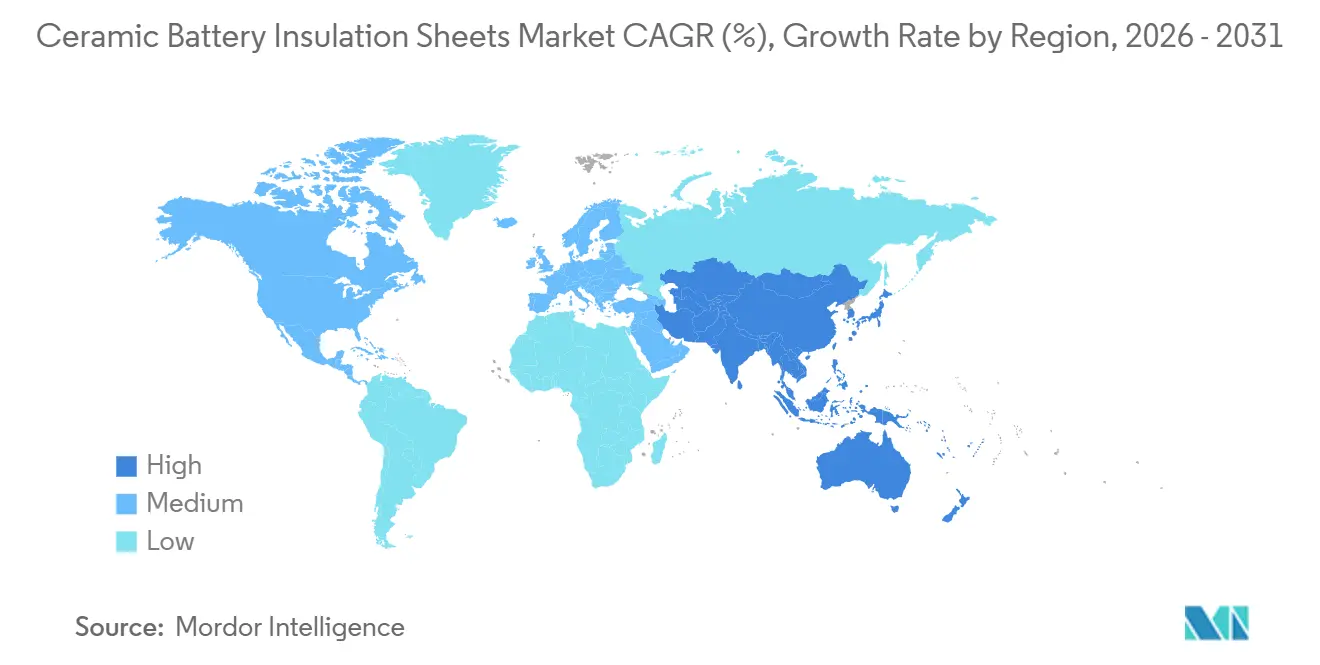
Asia-Pacific held 44.58% of the ceramic battery insulation sheets market share in 2025 and is projected to grow at an 11.55% CAGR through 2031. China’s electric vehicle production base and expanding BESS pipeline support the regional demand base. Japan contributes precision material development through Sumitomo Riko Company Limited’s aerogel-based inter-cell insulation work. Denka Elastlution Co., Ltd. developed a ceramic insulation and rubber cushioning solution for lithium-ion battery cell separation in 2026. South Korea added domestic ceramic paper supply for Energy Storage System (ESS) and electric vehicle batteries in July 2025. Pusan National University’s research award also pointed to the continuing development of next-generation containment materials.
In North America, demand is concentrated in the United States, where domestic battery and vehicle programs support local thermal barrier capacity. North American battery programs require qualified materials for vehicle and storage applications. Canada and Mexico support the regional supply network through manufacturing and vehicle assembly activity. Suppliers must balance safety performance, handling consistency, and dependable production capacity. These conditions reinforce the value of regional qualification and assembly support.
Europe’s demand is led by premium vehicle manufacturers and commercial vehicle programs. Germany remains important because it concentrates premium automotive manufacturers. ElringKlinger AG presented ElroForm TP in September 2026 for cell, module, and pack-level protection in commercial vehicle batteries[2]. European material selection increasingly considers traceability, recyclability, and thermal performance. South America and the Middle East and Africa remain early-stage regions. Infrastructure investment in Saudi Arabia is creating longer-term demand conditions for the ceramic battery insulation sheets market.
Competitive Landscape
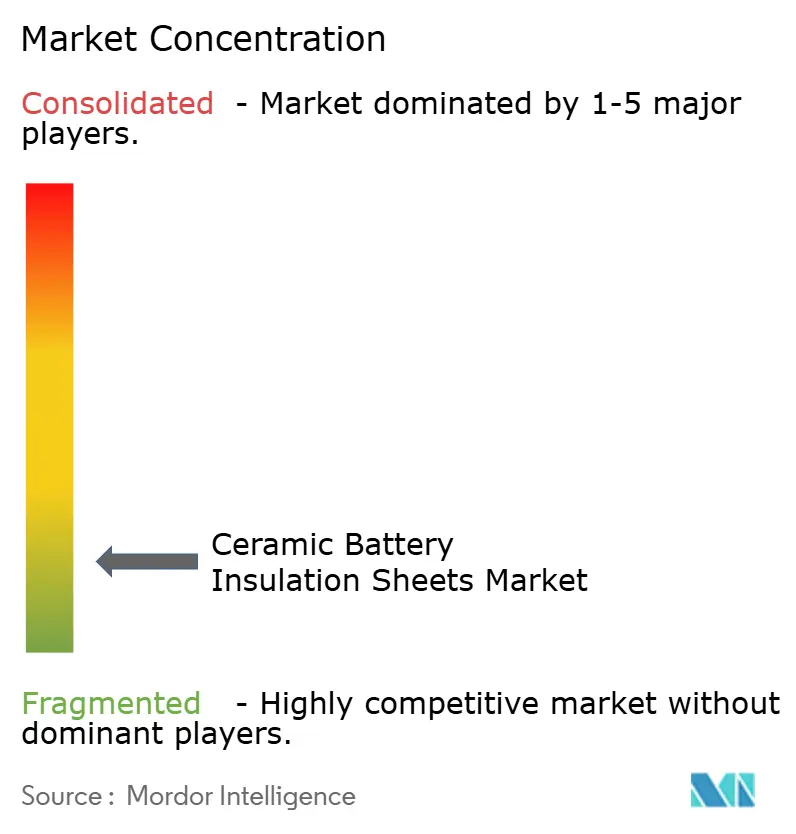
The ceramic battery insulation sheets market is highly fragmented, with the top five players including Saint-Gobain, Aspen Aerogels, Inc., Morgan Advanced Materials, Alkegen, and Rogers Corporation. Qualification requirements raise the cost of changing a supplier after a battery platform enters production. Suppliers compete through proprietary aerogel and alumina fiber composites. They also compete by converting those materials into pack-ready formats. Application engineering, thickness control, and handling properties remain important differentiators.
The ceramic battery insulation sheets market rewards suppliers that can provide evidence for specific battery designs. 3M received a US patent in May 2026 for an encapsulated nonwoven fibrous battery thermal-runaway barrier. Sumitomo Riko Company Limited’s February 2026 patent covered a porosity-controlled aerogel inter-cell sheet for electric automobiles. These moves focus on multi-layer structures, porosity control, and performance under compression. ElringKlinger AG has positioned a mica-free insulation format for commercial vehicle battery packs. The ceramic battery insulation sheets market is, therefore, moving beyond basic conductivity claims toward qualification-ready data.
BESS-specific ceramic sheets remain an opportunity because stationary storage has different pressure profiles and thermal cycles from electric vehicles. Compression-stable inter-cell barriers are also relevant as solid-state battery work progresses. South Korea’s support for self-ceramicizing composites reflects the continuing development of materials that transform under severe heat exposure. Chinese producers are expected to strengthen their role in alumina fiber and mica-based products as domestic demand grows. Their cost position will intensify competition in standard specifications. The ceramic battery insulation sheets market will continue to favor suppliers with validated data where a design change is difficult.
Ceramic Battery Insulation Sheets Industry Leaders
-
Saint-Gobain
-
Aspen Aerogels, Inc.
-
Morgan Advanced Materials
-
Rogers Corporation
-
Alkegen
- *Disclaimer: Major Players sorted in no particular order
Recent Industry Developments
- September 2026: ElringKlinger AG presented its ElroForm TP battery thermal insulation solutions at IAA Transportation 2026 in Hanover, Germany, showcasing a sustainable, mica-free alternative for commercial vehicle battery packs across cell-, module-, and pack-level barrier positions. The development supports the ceramic battery insulation sheets market by expanding advanced thermal barrier solutions for battery systems requiring protection against heat propagation and thermal runaway.
- February 2026: Sumitomo Riko Company Limited received a U.S. patent for a thermal insulation sheet designed for placement between battery cells in electric automobiles. The development supports the ceramic battery insulation sheets market by advancing cell-level thermal barrier solutions that help limit heat transfer and thermal runaway propagation within EV battery packs.
Global Ceramic Battery Insulation Sheets Market Report Scope
Ceramic battery insulation sheets are thermal and electrical insulation materials designed to protect battery cells and modules from heat transfer, electrical conduction, and thermal propagation. They provide heat resistance, dielectric insulation, and structural protection under demanding battery operating conditions.
The Ceramic Battery Insulation Sheets Market is segmented by ceramic material, battery type, battery chemistry, and geography. By ceramic material, the market is segmented into alumina fiber sheets, silica and aerogel sheets, mica-based sheets, and other ceramic composites. By battery type, the market is segmented into EV battery packs, battery energy storage systems, consumer battery modules, and industrial battery packs. By battery chemistry, the market is segmented into NMC and NCA batteries, LFP and LMFP batteries, solid-state batteries, and other battery chemistries. The report also covers the market size and forecasts for ceramic battery insulation sheets across 15 countries. For each segment, the market sizing and forecasts have been done on the basis of value (USD).
| Alumina Fiber Sheets |
| Silica and Aerogel Sheets |
| Mica-Based Sheets |
| Other Ceramic Composites |
| EV Battery Packs |
| Battery Energy Storage Systems |
| Consumer Battery Modules |
| Industrial Battery Packs |
| NMC and NCA Batteries |
| LFP and LMFP Batteries |
| Solid-State Batteries |
| Other Battery Chemistries |
| Asia-Pacific | China |
| India | |
| Japan | |
| South Korea | |
| Rest of Asia-Pacific | |
| North America | United States |
| Canada | |
| Mexico | |
| Europe | Germany |
| United Kingdom | |
| France | |
| Italy | |
| Rest of Europe | |
| South America | Brazil |
| Argentina | |
| Rest of South America | |
| Middle East and Africa | Saudi Arabia |
| South Africa | |
| Rest of Middle East and Africa |
| By Ceramic Material | Alumina Fiber Sheets | |
| Silica and Aerogel Sheets | ||
| Mica-Based Sheets | ||
| Other Ceramic Composites | ||
| By Battery Type | EV Battery Packs | |
| Battery Energy Storage Systems | ||
| Consumer Battery Modules | ||
| Industrial Battery Packs | ||
| By Battery Chemistry | NMC and NCA Batteries | |
| LFP and LMFP Batteries | ||
| Solid-State Batteries | ||
| Other Battery Chemistries | ||
| By Geography | Asia-Pacific | China |
| India | ||
| Japan | ||
| South Korea | ||
| Rest of Asia-Pacific | ||
| North America | United States | |
| Canada | ||
| Mexico | ||
| Europe | Germany | |
| United Kingdom | ||
| France | ||
| Italy | ||
| Rest of Europe | ||
| South America | Brazil | |
| Argentina | ||
| Rest of South America | ||
| Middle East and Africa | Saudi Arabia | |
| South Africa | ||
| Rest of Middle East and Africa | ||
Key Questions Answered in the Report
What is the size of the ceramic battery insulation sheets market?
The ceramic battery insulation sheets market stands at USD 595.33 million in 2026 and is projected to reach USD 964.03 million by 2031.
Which ceramic material held the largest share in 2025?
Alumina fiber sheets led with a 39.13% share in 2025, supported by high-temperature stability, established qualification networks, and their use in familiar pack-barrier configurations.
Which battery type is expected to grow fastest through 2031?
Battery energy storage systems are projected to advance at an 11.34% CAGR through 2031 as fire testing and thermal containment needs increase.
Which battery chemistry is expected to grow fastest through 2031?
Solid-state batteries are projected to advance at an 11.97% CAGR through 2031 and require sheets that manage both thermal resistance and sustained stack pressure.