
Caribbean Destination Wedding Market Size and Share
Market Overview
| Study Period | 2021 - 2031 |
|---|---|
| Forecast Data Period | 2026 - 2031 |
| Base Year Market Size (2025) | USD 2.64 Billion |
| Market Size (2026) | USD 2.98 Billion |
| Market Size (2031) | USD 4.17 Billion |
| Growth Rate (2026 - 2031) | 6.95 % |
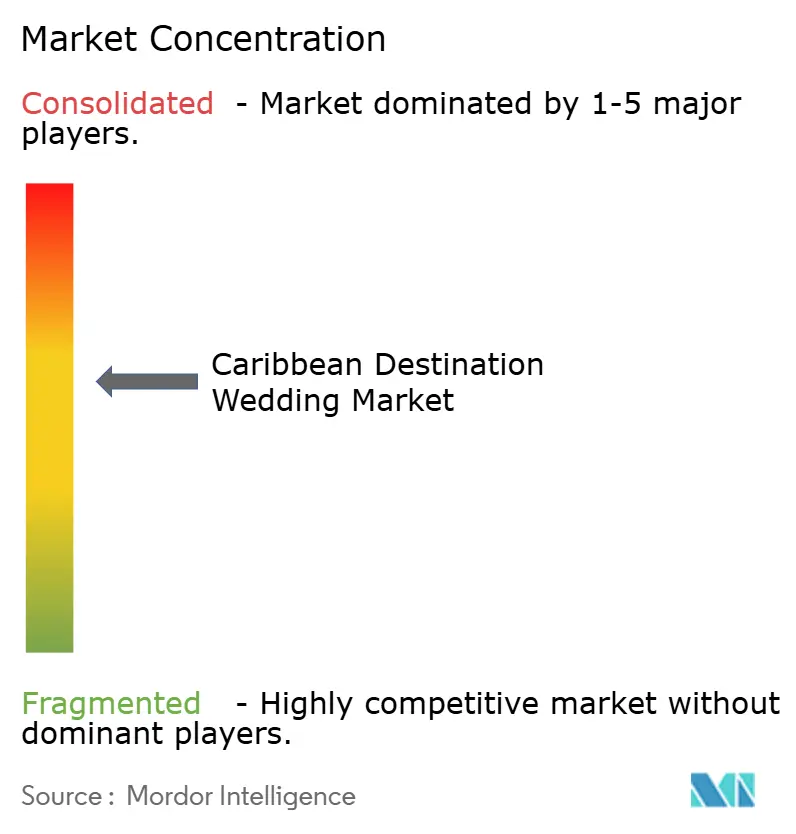
| Market Concentration | Medium |
Major Players *Disclaimer: Major Players sorted in no particular order Image © Mordor Intelligence. Reuse requires attribution under CC BY 4.0. | |
Caribbean Destination Wedding Market Analysis by Mordor Intelligence
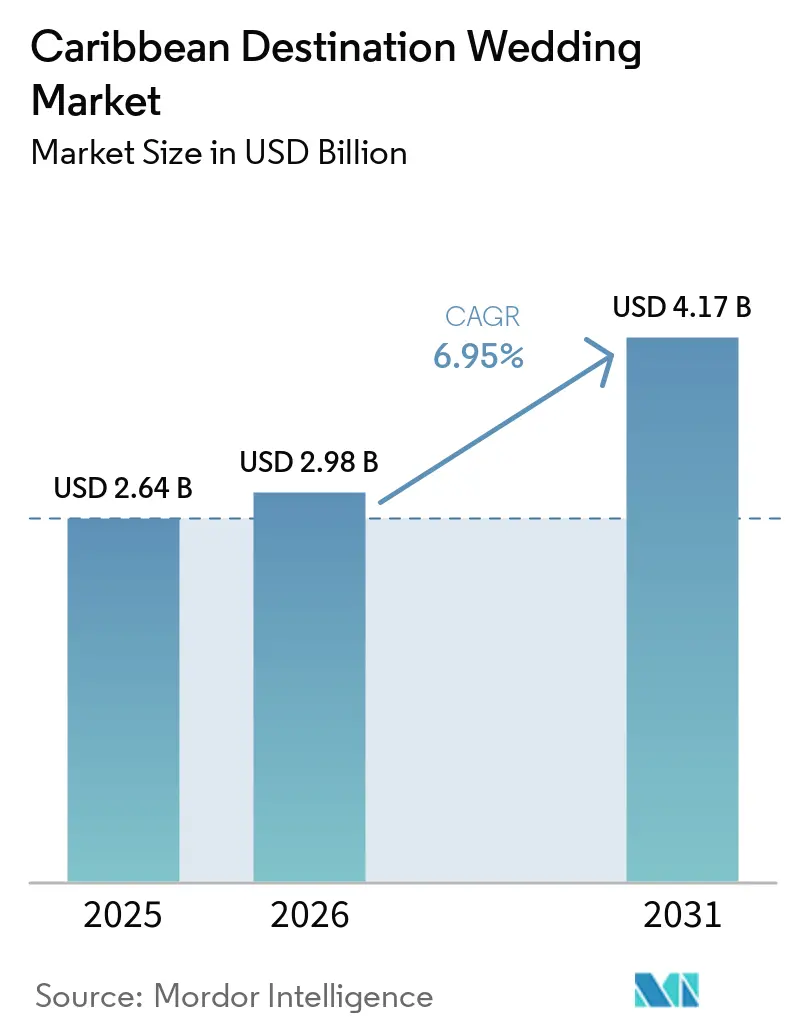
The Caribbean Destination Wedding Market was valued at USD 2.64 billion in 2025 and estimated to grow from USD 2.98 billion in 2026 to reach USD 4.17 billion by 2031, at a CAGR of 6.95% during the forecast period (2026-2031). The market has evolved from single-day beach ceremonies to supporting a broader hospitality ecosystem. In the Dominican Republic, average spending per guest is USD 1,400 over 3 to 4 nights, excluding airfares. Wedding tourism impacts 72 economic activities, including flowers, transport, excursions, and local produce. International stay-over arrivals reached 35 million in 2025, while hotels achieved an average daily rate of USD 350.37 and a RevPAR of USD 223.12, reflecting strong market growth[1]. The United States accounted for 17 million visitors to the Caribbean in 2025, while South American arrivals increased by 23.7%, indicating expanding demand for destination weddings. The Dominican Republic held a 28.93% revenue share in 2025, and Jamaica is expected to grow at 7.76% through 2031. In 2024, the top 5 resort groups held a 64% market share, leaving room for specialist planners and boutique venues. Weather disruptions remain a near-term risk, but demand from United States millennial couples and multi-day celebrations support medium-term growth.
Key Report Takeaways
- By type, international destination weddings held 67.63% share of the Caribbean Destination Wedding Market in 2025, while domestic destination weddings are forecast to grow at a 7.14% CAGR through 2031.
- By wedding size, medium (50–200 guests)-sized weddings accounted for 45.12% share of the Caribbean Destination Wedding Market in 2025, while intimate and micro-weddings are projected to advance at a 7.92% CAGR through 2031.
- By expenditure or budget, mid-range weddings led with 52.83% share of the Caribbean Destination Wedding Market in 2025, while luxury weddings are expected to expand at an 8.23% CAGR through 2031.
- By service type, venue and accommodation held 34.61% share of the Caribbean Destination Wedding Market in 2025, while event planning and coordination is forecast to record the fastest CAGR of 8.45% through 2031.
- By geography, the Dominican Republic captured 28.93% share of the Caribbean Destination Wedding Market in 2025, while Jamaica is projected to post the fastest growth at a 7.76% CAGR through 2031.
Note: Market size and forecast figures in this report are generated using Mordor Intelligence’s proprietary estimation framework, updated with the latest available data and insights as of January 2026.
Caribbean Destination Wedding Market Trends and Insights
Drivers Impact Analysis*
| Drivers | (~) % Impact on CAGR Forecast | Geographic Relevance | Impact Timeline |
|---|---|---|---|
| Surge in United States Millennial Destination Marriages | +2.1% | Global, concentrated in the North America to Caribbean corridor, strongest in Jamaica, the Dominican Republic, and the Bahamas | Short term (≤ 2 years) |
| Growing Popularity of Intimate “Micro-destination” Weddings | +1.3% | Global, with boutique property clusters in St. Thomas, St. John, Turks and Caicos, and St. Lucia | Short term (≤ 2 years) to Medium term (2-4 years) |
| Expansion of All-Inclusive Luxury Resort Packages | +1.2% | Primarily the Dominican Republic and Jamaica, with spillover to Barbados and Antigua | Medium term (2-4 years) |
| Caribbean Tourism Boards’ Incentive Grants for Weddings | +0.8% | National, with early gains in Bridgetown, Montego Bay, Santo Domingo, and Nassau | Short term (≤ 2 years) to Medium term (2-4 years) |
| Digital Nomad Laws Enabling Extended Wedding-Moon Stays | +0.5% | Dominica, Antigua and Barbuda, Barbados, and the Bahamas, with spillover to Curaçao and St. Lucia | Medium term (2-4 years) |
| Climate-Neutral Venue Certifications Driving Demand | +0.4% | Global demand signal, with adoption concentrated in Jamaica and Turks and Caicos | Long term (≥ 4 years) |
| Source: Mordor Intelligence | |||
Surge in United States Millennial Destination Marriages
The Caribbean destination wedding market benefits from a strong United States visitor base, which supports the region's resorts and airlift services. Reports from the Caribbean Tourism Organization indicate that 17 million United States visitors traveled to the Caribbean in 2025, reinforcing the North America-Caribbean corridor as a key driver of wedding travel demand. Millennial couples often prioritize group travel, convenience, and experience-driven celebrations, aligning well with the all-inclusive resort model common in the region. With guest lists becoming more selective, resorts can increase revenue per ceremony by encouraging higher spending per guest on accommodation, dining, beverages, and activities. This trend also supports related services, including planners, photographers, transport operators, and excursion providers, as weddings increasingly span multiple days instead of being limited to a single ceremony.
Growing Popularity of Intimate “Micro-destination” Weddings
Smaller-format ceremonies are reshaping how the Caribbean destination wedding market utilizes venue space and manages event inventory. Intimate weddings, which require fewer fixed inputs, provide resorts and boutique properties with the flexibility to host multiple events within the same day or weekend. This approach is particularly valuable in island destinations where beachfront space is limited. It allows properties to maintain high room occupancy while simplifying ceremony logistics. Smaller properties benefit by offering privacy, full-property buyouts, and closer guest interactions, rather than competing solely on size. As a result, demand in the Caribbean destination wedding market is shifting toward formats that enhance venue utilization without relying on large guest counts.
Expansion of All-Inclusive Luxury Resort Packages
Resort-led investments are a key driver of growth in the Caribbean destination wedding market, with the all-inclusive model centralizing spending under one contract. Meliá Hotels International and Grupo Puntacana signed an agreement in February 2026 to develop Paradisus Miches in the Dominican Republic, highlighting ongoing investment in all-inclusive wedding destinations[2]. Royalton Luxury Resorts expanded its offerings with the "Saint Lucia Experience Package," incorporating culturally immersive elements into its Caribbean portfolio. Iberostar launched JOIA Aruba in late 2024, increasing beachfront capacity in a southern Caribbean location outside the primary hurricane corridor. These developments enhance the availability of properties that combine lodging, ceremony spaces, dining, and additional experiences into a single wedding package.
Caribbean Tourism Boards’ Incentive Grants for Weddings
Public sector support is driving growth in the Caribbean destination wedding market by positioning weddings as a valuable tourism segment rather than a niche leisure activity. The Dominican Republic's Ministry of Tourism has identified wedding tourism as a diversification strategy, reinforcing the country's strong regional standing. The nation is also preparing to host the 2026 International Destination Wedding Congress in Santo Domingo[3]. These efforts enhance destination visibility, strengthen trade relationships, and build confidence among wedding specialists for sustained promotion. Tourism board initiatives further help wedding travel fill shoulder periods, as couples often book outside peak leisure seasons. Over time, these measures integrate weddings into national tourism planning, shifting the focus from standalone resort offerings to a broader tourism strategy.
Restraints Impact Analysis*
| Restraints | (~) % Impact on CAGR Forecast | Geographic Relevance | Impact Timeline |
|---|---|---|---|
| Intensifying Hurricane & Extreme-Weather Risk | -1.4% | Central and northern Caribbean, especially the Bahamas, Jamaica, the Dominican Republic, and Puerto Rico, with lower risk in the southern islands | Short term (≤ 2 years) to Medium term (2-4 years) |
| Rising Airfare & Limited Seat Capacity to Key Islands | -0.9% | North America to Caribbean routes, with stronger pressure on budget-tier weddings and on Jamaica and the Dominican Republic | Short term (≤ 2 years) |
| Visa Requirement Complexities for Non-US Couples | -0.5% | Global, especially couples from South Asia, Africa, and South America marrying in English-speaking Caribbean islands | Medium term (2-4 years) |
| Currency-Exchange Volatility vs. USD Peg | -0.4% | Islands with USD-pegged currencies compared with floating-rate islands such as Jamaica and the Dominican Republic | Medium term (2-4 years) |
| Source: Mordor Intelligence | |||
Intensifying Hurricane & Extreme-Weather Risk
Weather volatility significantly impacts the Caribbean destination wedding market due to the fixed-date nature of weddings and the high emotional and financial costs of rescheduling. NOAA forecasts an above-normal Atlantic season for 2025, with 13 to 19 named storms, including up to 5 major hurricanes, keeping risk awareness elevated across the region[4]. The Fifth National Climate Assessment for the United States Caribbean highlights increasing tropical cyclone rain rates, which heighten disruption risks for open-air venues, transportation, and local infrastructure. These risks are more critical for weddings than standard hotel stays, as rescheduling ceremony dates, guest flights, and vendor bookings become challenging once contracts are finalized. Southern islands outside the primary storm track benefit from this volatility, as they can attract displaced demand during active storm seasons.
Rising Airfare & Limited Seat Capacity to Key Islands
Air access remains a key limitation for the Caribbean destination wedding market, as guest travel often accounts for the largest expense outside the ceremony package. Connectivity, pricing, and travel planning conditions significantly influence demand across Caribbean destinations, as highlighted in the 2026 Caribbean Travel Trends Report. Higher airfare or reduced flight frequency often leads couples to reduce guest numbers, shorten event durations, or choose more accessible islands. This impact is particularly evident in budget-sensitive weddings, where even minor increases in airfare can alter the overall event budget for guests. As a result, the quality of airlift services directly affects the addressable demand for Caribbean wedding packages.
*Our forecasts treat driver/restraint impacts as directional, not additive. The impact forecasts reflect baseline growth, mix effects, and variable interactions.
Segment Analysis
By Type of Destination Wedding: International Formats Anchor the Market
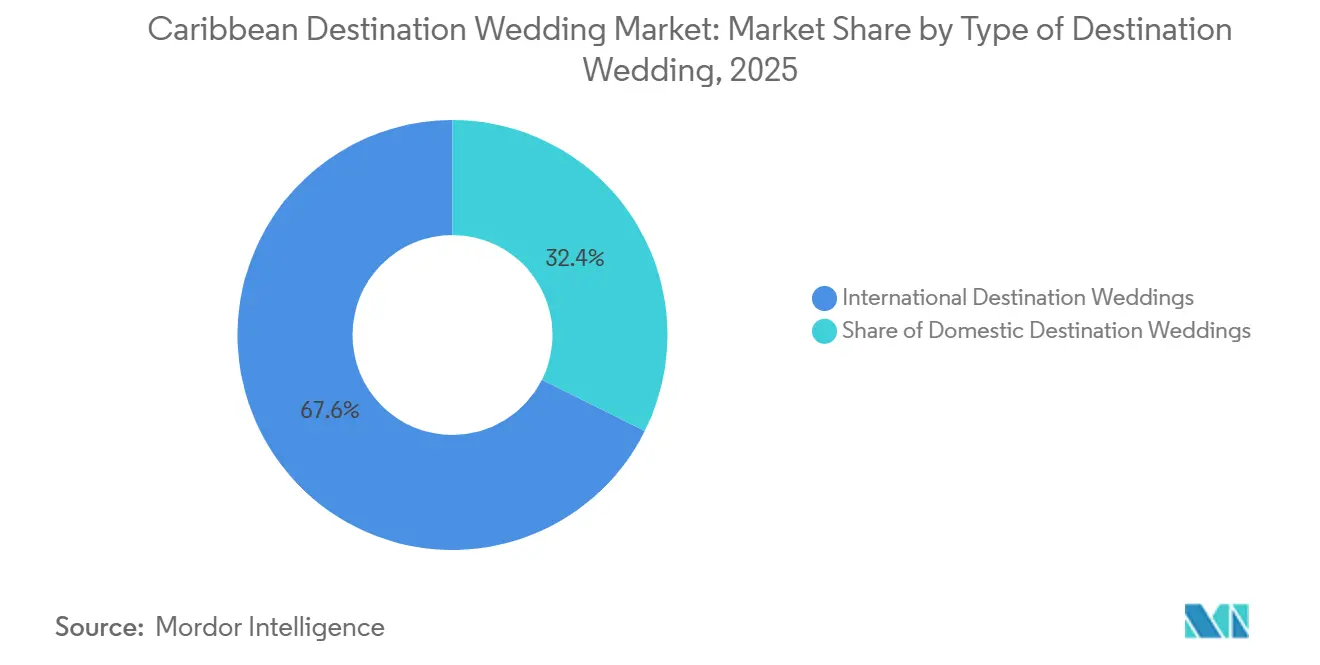
International destination weddings contributed 67.63% of revenue in 2025, highlighting the Caribbean destination wedding market's reliance on cross-border demand. Data from the Dominican Republic's Ministry of Tourism showed that 86.8% of wedding guests from January to November 2025 were international visitors, emphasizing the link between wedding traffic and foreign arrivals. Resort-led formats dominate as foreign couples prefer bundled contracts that simplify booking, accommodation, dining, and event logistics. Symbolic ceremonies have gained popularity by reducing legal complexities while preserving the destination experience, maintaining the appeal of the location and shifting administrative tasks to the couple's home country.
Domestic destination weddings are projected to grow at a 7.14% CAGR through 2031, making them the fastest-growing segment despite a smaller base. Stronger regional tourism flows in 2025 indicate that intra-Caribbean travel is becoming increasingly significant for both leisure and events. This growth is driven by rising middle-class aspirations, increased familiarity with resort wedding formats, and the convenience of celebrating on a nearby island without long-haul travel. Domestic and intra-regional couples benefit from better local knowledge, reducing uncertainties around vendors and legal requirements. As this segment expands, it is expected to provide a stable demand layer for the Caribbean destination wedding market, complementing its larger international segment.

By Wedding Size: Intimate Events Reshape Resort Yield Models
Medium-sized weddings contributed 45.12% of the revenue in the Caribbean destination wedding market in 2025, making it the largest segment. This category offers resorts the ability to secure significant room blocks and food and beverage spending while avoiding the operational challenges of larger guest lists. It aligns well with the region's all-inclusive model, simplifying the coordination of venues, accommodations, and group dining compared to larger banquet-style events. This size range balances the destination wedding experience with a guest list large enough to justify group travel costs, creating a stable demand that supports year-round market activity.
Intimate and micro-weddings are projected to grow at a 7.92% CAGR through 2031, the fastest among all segments. These smaller events optimize the use of limited beachfront and garden spaces while allowing venues to offer privacy-focused packages. They also integrate well with extended stays, personalized décor, and custom dining, increasing spending per guest despite lower headcounts. From an operational perspective, smaller weddings reduce setup demands and enable faster turnover of event spaces. While large weddings remain relevant, the trend is shifting toward smaller formats that emphasize personalization, efficiency, and higher spending per attendee.
By Expenditure / Budget: Premiumisation Lifts the Mid-Range Ceiling
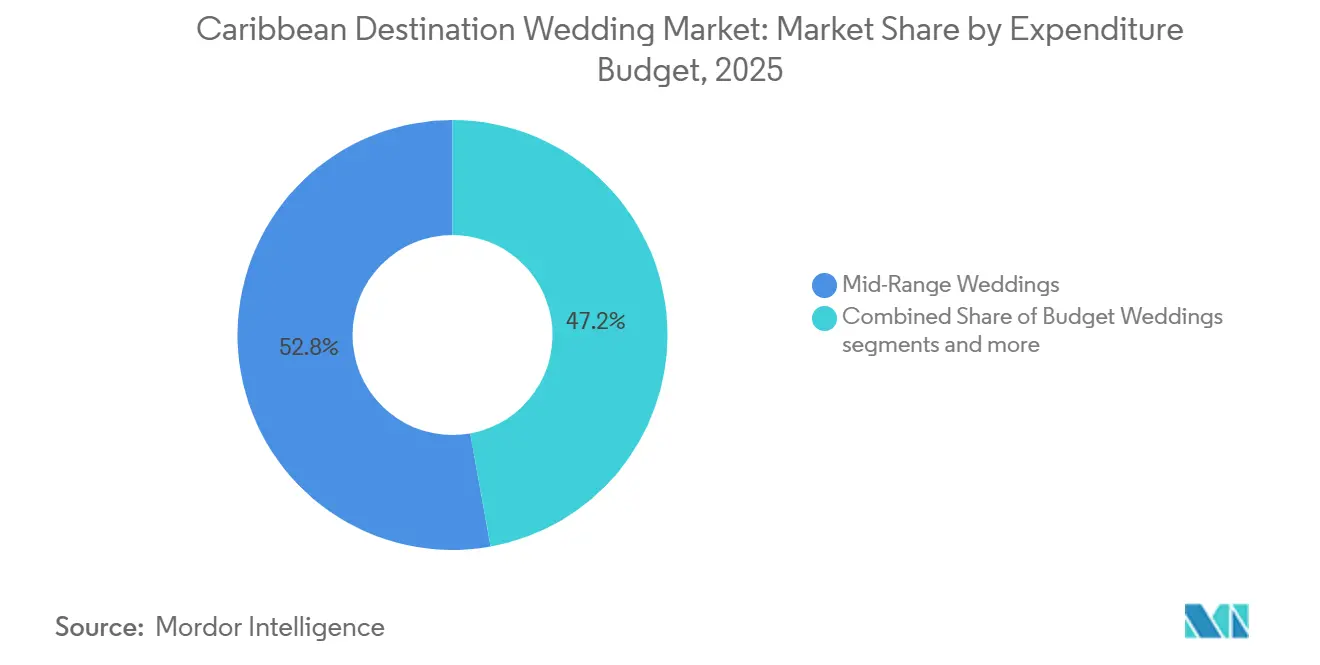
Mid-range weddings represented 52.83% of the Caribbean destination wedding market in 2025, highlighting their significant role. This segment benefits from the region's ability to offer all-inclusive resorts that combine accommodation, ceremony venues, dining, and entertainment at competitive costs compared to urban weddings in North America. Mid-tier also allows for customizations, enabling couples to add upgrades without incurring ultra-high costs. This balance attracts couples seeking destination celebrations while managing budgets for multi-day events. The mid-range tier has maintained its large share despite upward pricing trends.
Luxury weddings are expected to grow at an 8.23% CAGR through 2031, making them the fastest-growing segment. Meliá Hotels International’s Paradisus Miches project exemplifies the response to this demand, with a planned all-inclusive property in an emerging Dominican Republic area catering to higher-end wedding preferences. Couples increasingly prioritize privacy, wellness-focused amenities, upgraded accommodations, and curated local experiences that extend beyond standard resort packages. Meanwhile, the budget tier faces challenges from rising airfare and travel costs, making large guest-dependent celebrations less feasible. The market is shifting toward higher-value formats that can better absorb travel cost fluctuations while maintaining demand.
By Service Type / Vendor: Planning Infrastructure Commands Premium Margins
Venue and accommodation services accounted for 34.61% of service-type revenue in the Caribbean destination wedding market in 2025, representing the largest share. This reflects the financial structure of all-inclusive resorts, where host properties capture significant events spending through room nights, ceremony spaces, food, beverages, and in-house coordination. This model allows resorts to maintain control over pricing, guest experience, and supplier access, as most of the wedding budget remains within the property. For couples, it simplifies planning and provides clearer cost visibility for multi-day events. In the market, venue-focused operators serve as the primary channel for wedding-related expenditures.
Event planning and coordination is projected to grow at a CAGR of 8.45% through 2031, making it the fastest-growing service type in the Caribbean destination wedding market. In March 2025, Karisma Hotels & Resorts expanded its W.I.S.E. program with offerings such as Brewery Wedding and Beso for Two, showcasing a shift toward modular, planning-focused packages instead of fixed bundles. As destination weddings become more personalized, planners play a larger role in vendor coordination, guest itinerary design, and cultural or thematic customization. This trend supports related categories like entertainment, photography, décor, and transportation, as planners help couples incorporate additional services beyond standard resort offerings. The industry is shifting toward a model where coordination services are as integral as the venue itself.
Geography Analysis
The Dominican Republic held a 28.93% share of the Caribbean destination wedding market in 2025. Between January and November 2025, the country hosted 946 weddings of foreign nationals, attracting 39,172 guests and generating over USD 5.4 million in ceremony expenses, excluding accommodation, food, beverages, and excursions. Punta Cana and Bávaro remained key hubs due to their all-inclusive resorts, direct air links, and established wedding infrastructure. Hosting the 2026 International Destination Wedding Congress in Santo Domingo further highlighted strong institutional support for the segment. This combination of resources and destination backing strengthened the Dominican Republic's position in the market.
Jamaica is projected to grow at a 7.76% CAGR through 2031, making it the fastest-growing geography in the Caribbean destination wedding market. Its appeal lies in strong recognition in romance travel, a wide range of all-inclusive resorts, and alignment with United States and diaspora wedding demand. The island’s resorts accommodate both medium-sized and intimate weddings. However, weather-related disruptions have increased the need for resilience and product updates. While Jamaica is positioned for growth, managing climate-related booking risks remains a priority.
Barbados and the Bahamas occupy distinct roles in the market, while the "Rest of Caribbean" segment is gaining importance. Barbados attracts couples seeking exclusivity and smaller settings, while the Bahamas offers easy North American access and a mix of resorts and private-island experiences. Southern islands like Aruba, Curaçao, Grenada, and Trinidad benefit from being outside the main hurricane corridor, broadening growth opportunities across the Caribbean destination wedding market.
Competitive Landscape
The Caribbean Destination Wedding Market is moderately concentrated, with major resort groups influencing pricing, destination visibility, and package design. Sandals Resorts International, AMResorts or Hyatt Inclusive Collection, Royalton Luxury Resorts or Blue Diamond, Palace Resorts, and Iberostar Hotels & Resorts collectively account for a significant market share. Despite this, boutique hotels, independent planners, and destination management companies have opportunities to compete. The gap between leading groups and smaller players fosters competition in service quality, niche offerings, and guest experiences. Larger operators benefit from scale in marketing and contracting, while smaller entities succeed by focusing on privacy-driven or specialized formats. This balance maintains a competitive yet stable market environment.
Companies are focusing on capacity expansion, product enhancements, and segment-specific strategies. Meliá Hotels International’s Paradisus Miches agreement introduces luxury options in an emerging Dominican Republic area, reflecting a preference for asset-light growth through partnerships. Royalton Luxury Resorts launched the Saint Lucia Experience Package, incorporating local cultural elements to differentiate wedding offerings beyond room availability. Karisma Hotels & Resorts expanded its W.I.S.E. platform with themed packages, emphasizing modular and experience-focused designs. These approaches increase the appeal of wedding packages by making them more tailored and less comparable solely on price.
Second-tier and southern Caribbean operators are also shaping the market. Iberostar reported strong group revenue and opened JOIA Aruba, extending its presence to a southern island with lower hurricane exposure and a distinct competitive environment compared to Punta Cana and Montego Bay. Sustainability is gaining importance, with initiatives from the Caribbean Hotel and Tourism Association and Amadeus highlighting benchmarked practices. Certified operators stand out by demonstrating clear sustainability standards, especially in smaller or specialized wedding segments. The market is increasingly segmented by experience design, location risk, and operational standards rather than room inventory alone.
Caribbean Destination Wedding Industry Leaders
-
Sandals Resorts International
-
AMResorts / Hyatt Inclusive Collection
-
Royalton Luxury Resorts (Blue Diamond)
-
Palace Resorts
-
Iberostar Hotels & Resorts
- *Disclaimer: Major Players sorted in no particular order
Recent Industry Developments
- February 2026: Melia Hotels International and Grupo Puntacana signed an agreement to develop Paradisus Miches, the Dominican Republic's newest luxury all-inclusive resort, located on more than 500 metres of untouched beachfront on the DR's emerging north-eastern coast. The property will be Melia's eleventh in the Dominican Republic and the first in the Miches corridor.
- June 2025: Blue Diamond Resorts introduced the "Saint Lucia Experience" wedding package at Royalton Saint Lucia, offering a culturally immersive add-on with local cuisine, music, and traditions to enhance customized wedding options across Caribbean properties.
- March 2025: Karisma Hotels & Resorts expanded its W.I.S.E. (Weddings, Incentives, Social, Entertainment) program by introducing the Brewery Wedding package at Margaritaville Island Reserve and the Beso for Two elopement package at Azul Beach Resort Negril, Jamaica, along with updates to Crazy for You, Love You More, and I Do Celebration tiers.
- December 2024: Iberostar Group opened JOIA Aruba by Iberostar on Eagle Beach, its first property in Aruba, expanding its eco-certified presence in the southern Caribbean. The resort supports the "Wave of Change" sustainability initiative, featuring passive design and operating entirely on renewable electricity.
Caribbean Destination Wedding Market Report Scope
| Domestic Destination Weddings |
| International Destination Weddings |
| Intimate / Micro (Less than 50 guests) |
| Medium (50 - 200 guests) |
| Large/Grand (More than 200 guests) |
| Budget Weddings |
| Mid-Range Weddings |
| Luxury Weddings |
| Venue & Accommodation |
| Travel & Transport |
| Event Planning & Coordination |
| Catering & Beverages |
| Entertainment & Photography |
| Decor & Theming |
| Bahamas |
| Jamaica |
| Dominican Republic |
| Barbados |
| Rest of Caribbean |
| By Type of Destination Wedding | Domestic Destination Weddings |
| International Destination Weddings | |
| By Wedding Size | Intimate / Micro (Less than 50 guests) |
| Medium (50 - 200 guests) | |
| Large/Grand (More than 200 guests) | |
| By Expenditure / Budget | Budget Weddings |
| Mid-Range Weddings | |
| Luxury Weddings | |
| By Service Type / Vendor | Venue & Accommodation |
| Travel & Transport | |
| Event Planning & Coordination | |
| Catering & Beverages | |
| Entertainment & Photography | |
| Decor & Theming | |
| By Geography (Caribbean) | Bahamas |
| Jamaica | |
| Dominican Republic | |
| Barbados | |
| Rest of Caribbean |
Key Questions Answered in the Report
What is the current size of the Caribbean destination wedding market?
The Caribbean destination wedding market was valued at USD 2.64 billion in 2025 and is projected at USD 2.98 billion in 2026, before reaching USD 4.17 billion by 2031.
What is driving growth in Caribbean destination wedding demand?
Growth is being supported by strong United States source demand, broader regional tourism flows, the expansion of all-inclusive luxury resorts, and increasing demand for multi-day experience-led celebrations.
Which island leads wedding package revenue in the Caribbean?
The Dominican Republic led with a 28.93% revenue share in 2025, supported by scale, connectivity, and dedicated wedding infrastructure.
Which wedding format is growing the fastest in the Caribbean?
Domestic destination weddings are the fastest-growing type at a 7.14% CAGR, while intimate and micro-weddings are the fastest-growing wedding-size format at 7.92% CAGR through 2031.
Which service category captures the largest share of spending?
Venue and accommodation led with 34.61% of service-type revenue in 2025 because all-inclusive resorts capture a large part of event spending inside bundled contracts.
What are the main risks for Caribbean wedding package providers?
The main risks are hurricane and extreme-weather disruption, rising airfare and seat limits, visa formalities for legal ceremonies, and exchange-rate volatility affecting long-booking-cycle budgets.