
Cardiovascular OCT Imaging Market Size and Share
Market Overview
| Study Period | 2020 - 2031 |
|---|---|
| Market Size (2026) | USD 1.23 Billion |
| Market Size (2031) | USD 1.87 Billion |
| Growth Rate (2026 - 2031) | 8.78 % |
| Fastest Growing Market | Asia-Pacific |
| Largest Market | North America |
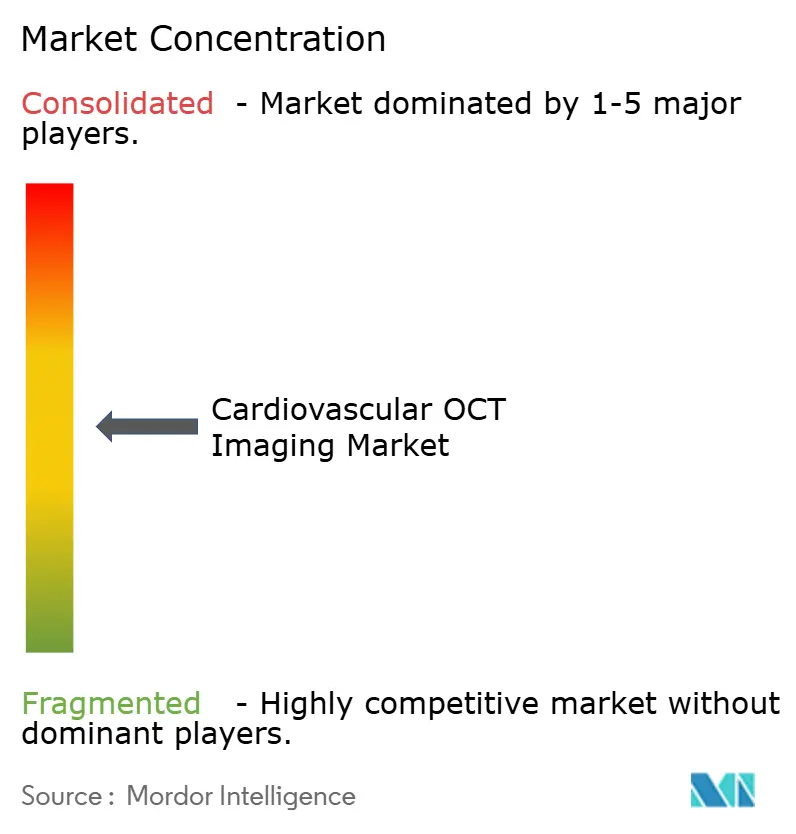
| Market Concentration | Medium |
Major Players *Disclaimer: Major Players sorted in no particular order Image © Mordor Intelligence. Reuse requires attribution under CC BY 4.0. | |
Cardiovascular OCT Imaging Market Analysis by Mordor Intelligence
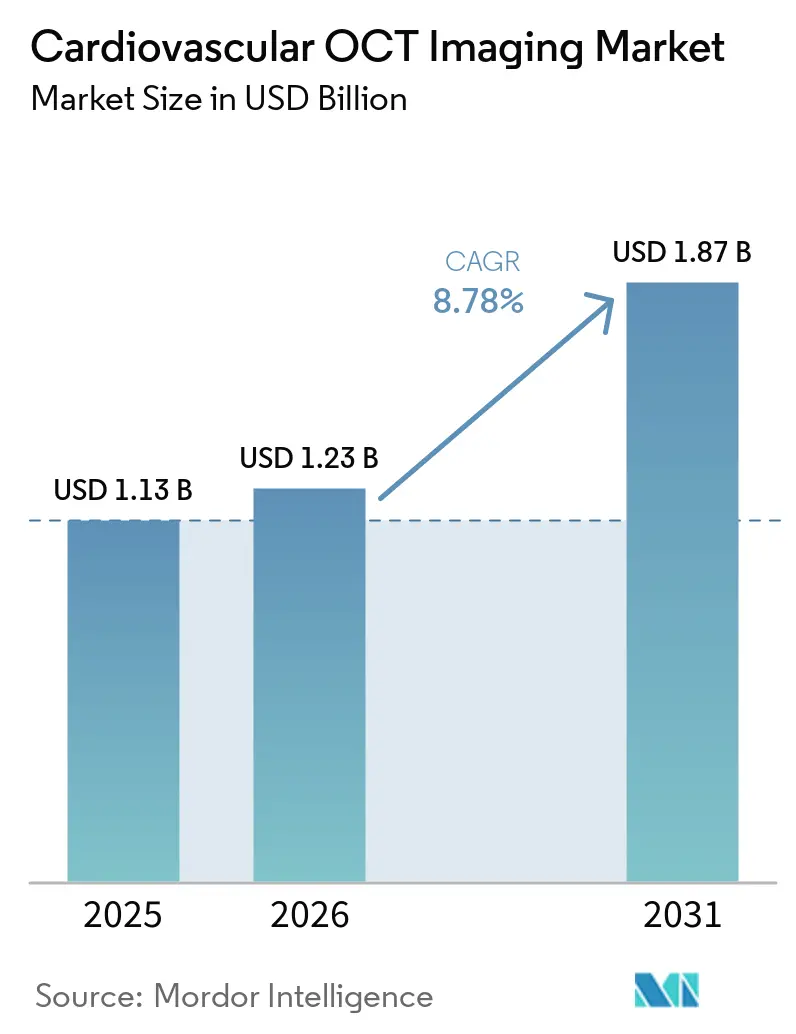
The Cardiovascular OCT Imaging Market size is expected to grow from USD 1.13 billion in 2025 to USD 1.23 billion in 2026 and is forecast to reach USD 1.87 billion by 2031 at 8.78% CAGR over 2026-2031.
The cardiovascular OCT imaging market is benefiting from stronger clinical support for intracoronary imaging in complex PCI, including Class I, Level A recommendations in recent European and U.S. guidelines for appropriate complex stent procedures. This support can accelerate hospital purchasing decisions by providing catheterization laboratories with a clear basis for integrating imaging into standard procedural pathways. Product competition is shifting toward systems that combine structural imaging, physiological assessment, artificial intelligence, and lower-contrast workflows. These capabilities can expand use among patients with renal impairment and improve interpretation consistency; however, uneven reimbursement and training outside high-income healthcare systems continue to limit adoption despite favorable clinical evidence.
Key Report Takeaways
- By product type, intravascular OCT imaging systems held 58.66% revenue share in 2025, while OCT imaging catheters are projected to grow at a 10.12% CAGR through 2031.
- By technology and imaging architecture, frequency-domain OCT and Fourier-domain OCT held 47.76% revenue share in 2025, while high-frequency OCT is projected to grow at a 9.80% CAGR through 2031.
- By application, acute coronary syndrome and MINOCA assessment accounted for 55.66% revenue share in 2025, while stent optimization is projected to grow at an 11.45% CAGR through 2031.
- By end user, hospitals and tertiary care centers held 53.56% share in 2025, while specialty cardiology clinics are projected to grow at a 10.56% CAGR through 2031.
- By geography, North America held 39.44% share in 2025, while Asia-Pacific is projected to grow at an 11.88% CAGR through 2031.
Note: Market size and forecast figures in this report are generated using Mordor Intelligence’s proprietary estimation framework, updated with the latest available data and insights as of January 2026.
Market Trends and Insights
Drivers Impact Analysis of Cardiovascular OCT Imaging Market*
| DRIVER | (~) % IMPACT ON CAGR FORECAST | GEOGRAPHIC RELEVANCE | IMPACT TIMELINE |
|---|---|---|---|
| Increasing use of intravascular imaging in complex PCI | +2.1% | Global, strongest in North America and Western Europe where guideline compliance monitoring is active | Short term (≤ 2 years) |
| AI-assisted stent sizing and optimization | +1.8% | North America and the EU as early adopters, followed by Japan and South Korea | Medium term (2-4 years) |
| Rising cardiovascular disease and complex lesion burden | +1.4% | Global, with high relevance in China, India, and the Middle East and Africa | Long term (≥ 4 years) |
| Saline-compatible and low-contrast OCT workflows | +0.9% | Global, with greater relevance for populations with high chronic kidney disease prevalence | Medium term (2-4 years) |
| Cath-lab integration, co-registration, and automated reporting | +0.7% | North America, Western Europe, and Japan | Medium term (2-4 years) |
| Source: Mordor Intelligence | |||
Increasing Use of Intravascular Imaging in Complex PCI
The cardiovascular OCT imaging market is gaining traction as OCT-guided PCI becomes more established for complex coronary lesions. A 2025 network meta-analysis of 17 randomized trials involving 13,751 patients found that OCT guidance reduced major adverse cardiovascular events by 37% compared with angiography alone, with consistent outcomes across chronic total occlusions, left main disease, bifurcations, and severe calcification.[1] The 2025 ECLIPSE trial enrolled 2,005 patients with severely calcified lesions and reported a 1-year target vessel failure rate of 7.7% with OCT guidance, compared with 13.2% with angiography guidance alone.[2] As complex PCI procedures involving multivessel disease, multiple stents, and heavily calcified lesions increase, hospitals have stronger incentives to invest in imaging systems and operator training.
AI-Assisted Stent Sizing and Optimization
Artificial intelligence is expanding the potential user base for the cardiovascular OCT imaging market by reducing the interpretation burden on less experienced physicians. A 2025 study found that Abbott’s Ultreon AI software improved physician accuracy in selecting stent diameter by a factor of 2.83 compared with conventional OCT software and reduced variation in landing-zone assessment.[3] Abbott received FDA 510(k) clearance and CE Mark for Ultreon 3.0 on April 28, 2026, offering automated plaque tissue characterization, stent-size recommendations, and a 1-second pullback using low or zero contrast. Standardized workflows, integrated reporting, co-registration, and software updates can help hospital networks improve consistency across catheterization laboratories.
Rising Cardiovascular Disease and Complex Lesion Burden
The cardiovascular OCT imaging market is supported by the rising cardiovascular disease burden and increasing clinical complexity associated with an aging population. The Global Burden of Disease 2023 study reported 626 million prevalent cardiovascular disease cases in 2023, compared with 311 million in 1990, while ischemic heart disease remained the leading contributor to cardiovascular disability-adjusted life years. A 2025 pooled analysis of four randomized trials involving 5,603 patients found that OCT-guided PCI reduced major adverse cardiovascular events, cardiac death, myocardial infarction, and stent thrombosis compared with angiography alone. The analysis reported a 57% reduction in cardiac death, strengthening the clinical case for OCT use in higher-risk procedures.
Saline-Compatible and Low-Contrast OCT Workflows
Low-contrast and saline-compatible workflows address a key barrier to OCT use in patients with renal impairment. Abbott stated in April 2026 that 25% of patients with coronary artery disease had comorbid chronic kidney disease, making contrast exposure a significant consideration during imaging-guided PCI. A prospective multicenter study presented at TCT 2025 found no meaningful difference between heparinized saline and iodinated contrast in quantitative OCT measurements, including minimum lumen areas of 5.33 ± 2.48 mm² and 5.36 ± 2.52 mm², respectively. Built-in low-contrast capabilities in Ultreon 3.0 and Gentuity’s HF-OCT system can expand OCT adoption, although broader uptake depends on operator training and catheterization laboratory protocol updates.
Restraints Impact Analysis of Cardiovascular OCT Imaging Market*
| RESTRAINT | (~) % IMPACT ON CAGR FORECAST | GEOGRAPHIC RELEVANCE | IMPACT TIMELINE |
|---|---|---|---|
| Contrast use and renal-risk concerns in conventional OCT workflows | -0.9% | Global, with greater relevance in South Asia, the Middle East and Africa, and aging populations with high chronic kidney disease prevalence | Medium term (2-4 years) |
| Procedure-time, radiation, and operator-training burden | -0.7% | Emerging markets and lower-volume community hospitals globally | Medium term (2-4 years) |
| Evidence, reimbursement, and governance variability | -0.6% | Asia-Pacific excluding Japan and South Korea, the Middle East and Africa, and South America | Long term (≥ 4 years) |
| Source: Mordor Intelligence | |||
Contrast Use and Renal-Risk Concerns in Conventional OCT Workflows
The cardiovascular OCT imaging market faces a gap between evidence supporting saline use and catheterization laboratory protocols. Complex procedures involving multiple OCT pullbacks can require more than 200 mL of iodinated contrast when combined with diagnostic angiography, increasing acute kidney injury risk in patients with renal impairment, diabetes, or heart failure. Most fellowship programs do not offer standardized saline-based OCT training, limiting operator familiarity with the workflow. Hospitals may continue to avoid OCT for patients who could benefit from detailed imaging until guideline updates, vendor-supported education, and local protocols establish contrast-minimizing practices.
Procedure-Time, Training, Reimbursement, and Governance Variability
The cardiovascular OCT imaging market also faces procedure-time, radiation exposure, and operator-training constraints, particularly in lower-volume hospitals and developing healthcare systems. Japan reimburses intravascular imaging as part of standard PCI practice and expanded OCT reimbursement following the OCCUPI trial, while many countries in South Asia, the Middle East, and South America lack dedicated OCT billing codes. Outside North America and Western Europe, payer-policy changes can take 3 to 5 years after guideline updates. FDA 510(k), CE Mark requirements under EU MDR, and approvals from India’s CDSCO and China’s NMPA can extend market-entry timelines, particularly for platforms with AI-enabled software.
*Our forecasts treat driver/restraint impacts as directional, not additive. The impact forecasts reflect baseline growth, mix effects, and variable interactions.
Cardiovascular OCT Imaging Market Segment Analysis
By Product Type:
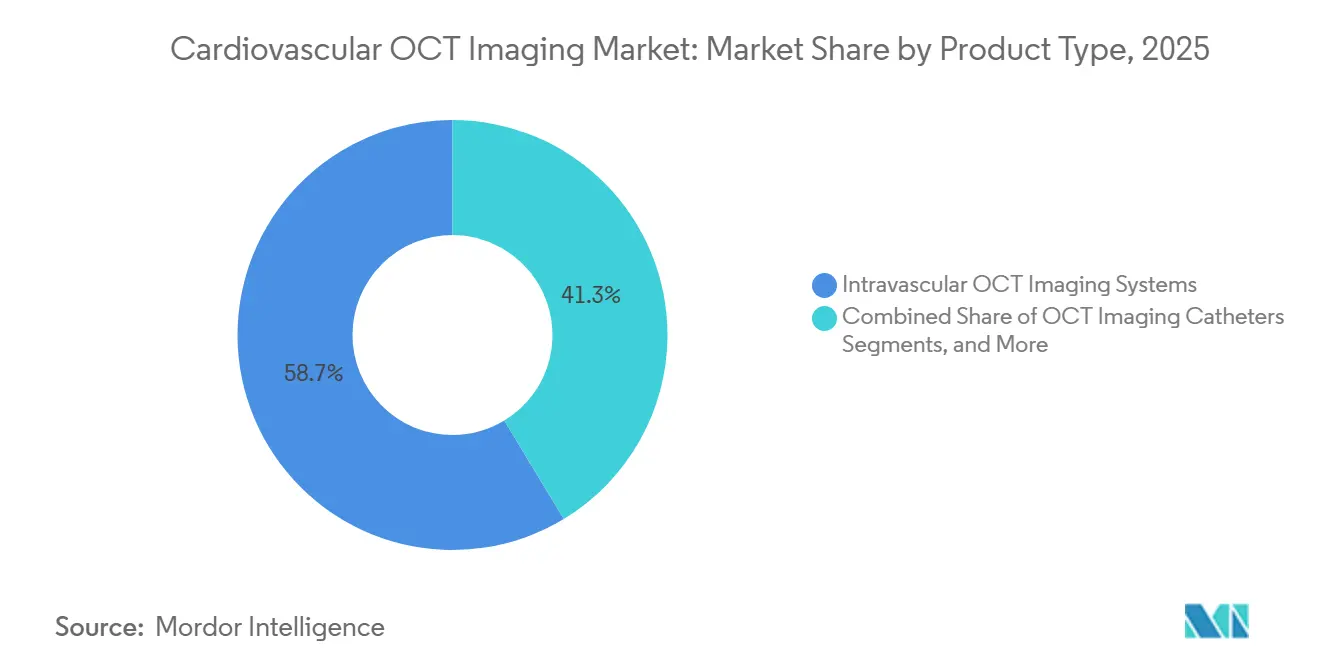
Catheter Replacement Cycles Reshape Revenue MixIntravascular OCT imaging systems held 58.66% of the cardiovascular OCT imaging market in 2025, reflecting the high upfront investment required for catheterization laboratory hardware. Hospitals typically procure consoles with multiyear service agreements, software road maps, and clinical training, making vendor relationships and system integration key purchasing considerations. The installed base results in long replacement cycles and high switching costs. OCT imaging catheters are the fastest-growing product category and are projected to expand at a 10.12% CAGR through 2031, supported by PCI procedure volumes and recurring demand.
Gentuity received FDA 510(k) clearance in January 2025 for the Vis-Rx PRIME micro-imaging catheter for use with its HF-OCT imaging system. Its 1.8F profile enables imaging of severely stenotic vessels without pre-dilation and provides 100 mm of coronary coverage in 1 second. Accessories and consumables support connection and flushing workflows, with demand generally following catheter adoption. FDA classification distinguishes diagnostic intravascular catheters under 21 CFR 870.1200 from imaging systems under 21 CFR 892.1560, affecting software modification requirements and Predetermined Change Control Plan eligibility.

By Technology / Imaging Architecture:
Hybrid Modalities Begin Disrupting the FD-OCT BaselineFrequency-domain OCT and Fourier-domain OCT held a 47.76% share in 2025, supported by an established clinical evidence base and broad commercial availability. However, limited penetration through lipid-rich or heavily calcified plaque and the need for contrast flushing remain key limitations. High-frequency OCT is projected to grow at a 9.80% CAGR through 2031, driven by smaller catheter profiles and reduced vessel-preparation requirements. Optical frequency-domain imaging also improves imaging speed for larger-vessel assessment.
Gentuity’s HF-OCT system features a 1.8F catheter profile that images narrow lesions before pre-dilation, where conventional OCT catheters may require vessel preparation. Philips acquired SpectraWAVE in December 2025, adding the HyperVue system, which combines DeepOCT, near-infrared spectroscopy, and X1-FFR single-angiogram wire-free FFR technology. Conavi Medical received FDA 510(k) clearance in April 2026 for the Novasight Hybrid System, which supports co-registered, simultaneous IVUS and OCT imaging in a single pullback. These developments position the cardiovascular OCT imaging market toward integrated multimodal platforms.
By Application:
ACS/MINOCA Anchors Volume While Stent Optimization Drives Outcomes EconomicsAcute coronary syndrome and MINOCA assessment accounted for a 55.66% revenue share in 2025. OCT identifies culprit lesions when angiography shows non-obstructive coronary arteries, supporting MINOCA diagnosis. A 2025 meta-analysis of 45 studies involving 17,539 patients found acute pathological findings with OCT in 62% of MINOCA presentations. A 2025 multimodality study of 754 MINOCA patients found that OCT identified an ischemic cause in 45% of cases, including 43% of women, and detected a culprit lesion in 27% of patients with a normal angiogram.
Stent optimization is the fastest-growing application, with a projected 11.45% CAGR through 2031. The OCTIVUS trial enrolled 1,980 patients undergoing imaging-guided PCI and reported stent optimization in 48.3% of OCT-guided cases. The optimized group recorded a 2-year target vessel failure rate of 3.0%, compared with 7.6% in the non-optimized OCT group. These outcomes support the clinical and economic case for OCT in stent sizing, landing-zone selection, post-stenting assessment, and repeat-intervention risk reduction.
By End User:
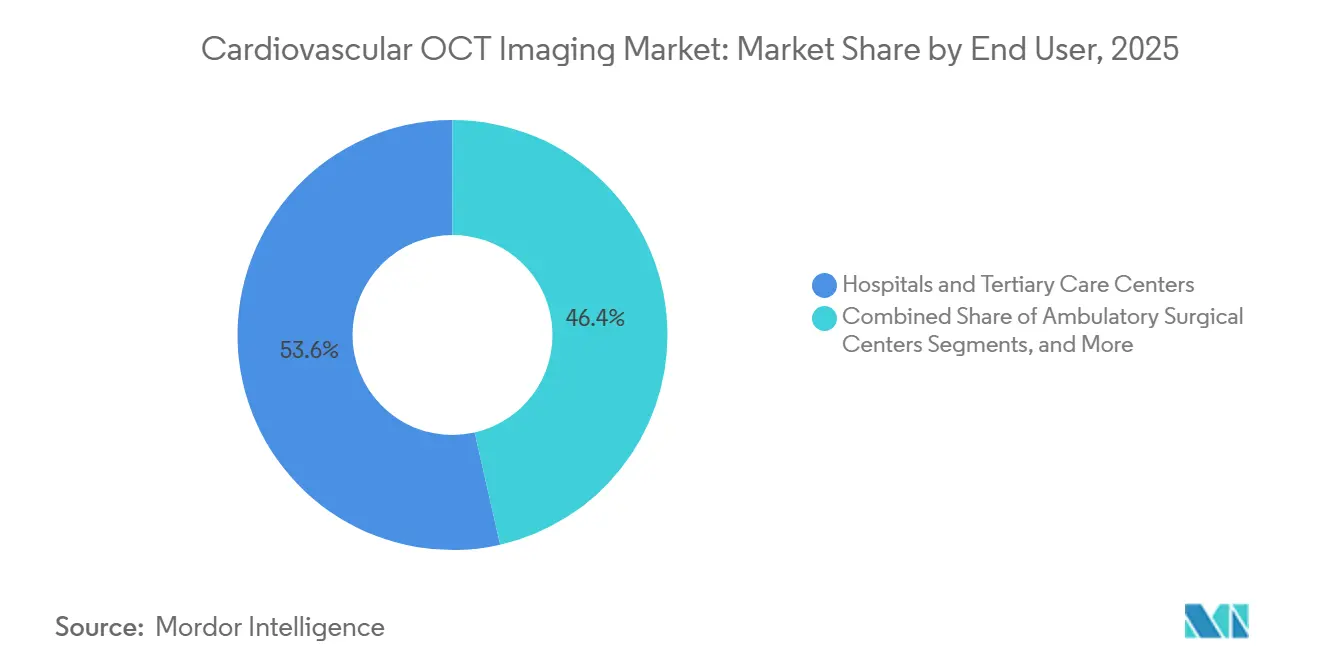
Hospitals Anchor the Market, Specialty Clinics Define the Growth FrontierHospitals and tertiary care centers held 53.56% of the cardiovascular OCT imaging market in 2025, reflecting the concentration of complex multivessel PCI procedures and the capital cost of OCT consoles. Cardiovascular service-line budgets, multiyear vendor relationships, and service contracts guide purchasing decisions. Switching vendors after installation can create significant cost and operational disruption. Abbott’s OPTIS Next and ILUMIEN platforms maintain a strong presence in U.S. and European hospitals, while ambulatory surgical centers are increasing demand for compact imaging systems.
Specialty cardiology clinics are projected to grow at a 10.56% CAGR through 2031. Smaller OCT console footprints reduce infrastructure requirements outside full-service hospitals, while expanding interventional cardiology credentials and case volumes support adoption. Academic and research institutes continue to influence clinical practice through investigator-led trials and fellowship training. ISO 13485 quality-management requirements also sustain vendor engagement through documented training and device-management processes.
Geography Analysis
North America and Europe Cardiovascular OCT Imaging Market
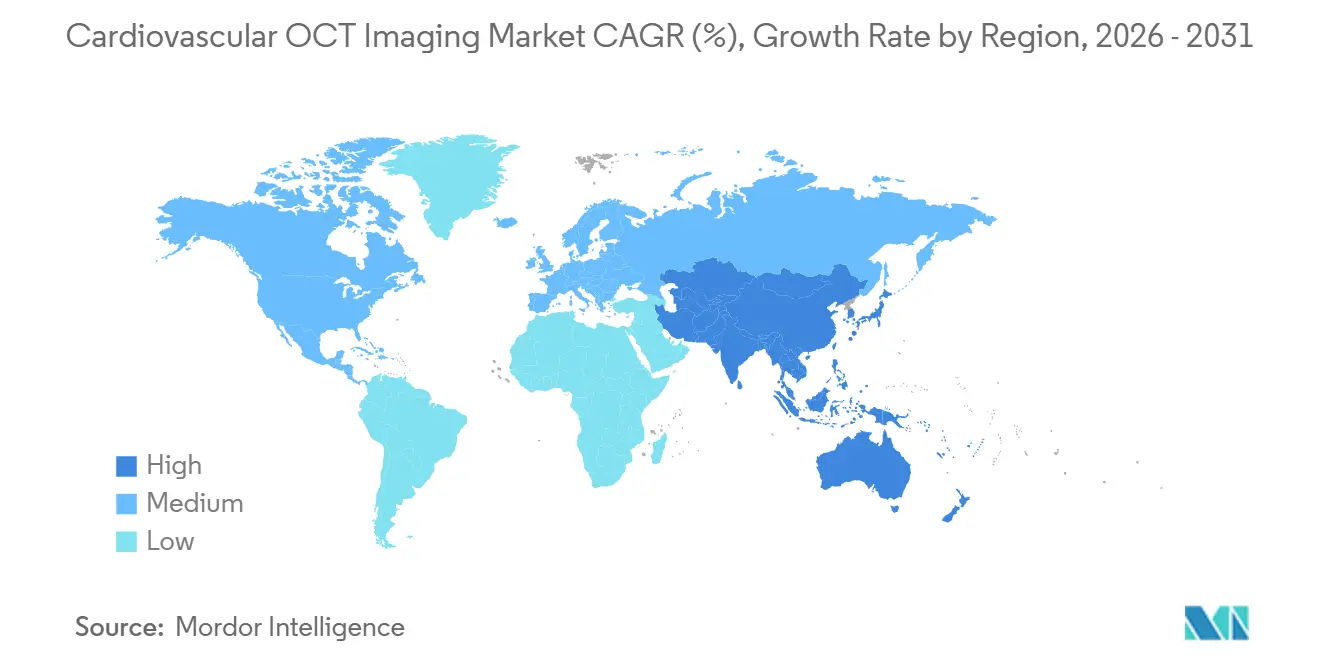
North America held 39.44% of the cardiovascular OCT imaging market share in 2025, supported by established reimbursement systems, high catheterization laboratory capacity, and clinical trial participation. The United States performed more than 600,000 PCI procedures annually, and the 2025 U.S. guideline recommendation for intravascular imaging in complex lesions supported broader institutional adoption. Canada and Mexico were smaller contributors, while cardiac centers in Toronto and Montreal adopted practices aligned with U.S. clinical evidence. Europe was the second-largest regional market, led by Germany, the United Kingdom, and France, although reimbursement remained inconsistent despite the 2024 ESC Class I, Level A recommendation.
APAC Cardiovascular OCT Imaging Market
Asia-Pacific was the fastest-growing region, with the cardiovascular OCT imaging market projected to expand at a CAGR of 11.88% through 2031. Japan reimbursed intravascular imaging under its national health insurance system, and its 2025 clinical guidance provided OCT recommendations for calcium assessment and rotational atherectomy planning. China drove procedure-volume growth and saw the emergence of domestic OCT suppliers, while South Korea and India expanded catheterization laboratory capacity. However, uneven reimbursement, regulatory approvals, and operator training continued to create significant variation in adoption across the region.
MEA and South America Cardiovascular OCT Imaging Market
The Middle East and Africa and South America represented smaller but improving opportunities for the cardiovascular OCT imaging market. Saudi Arabia’s Vision 2030 supported cardiac center installations in Riyadh and Jeddah, while Dubai expanded cardiac care infrastructure; South Africa led adoption in Sub-Saharan Africa, although reimbursement and training limitations persisted. Brazil led South American adoption through its public-private cardiology system and major cardiac centers in São Paulo and Rio de Janeiro, while Argentina had lower penetration. Market entry required compliance with ANVISA, INVIMA, and SAHPRA requirements, which could extend the introduction timeline for FDA- or CE-certified products.
Competitive Landscape
The cardiovascular OCT imaging market is moderately concentrated, with Abbott maintaining the largest global OCT installed base through its OPTIS and ILUMIEN system family. Boston Scientific competes through intravascular imaging capabilities within its broader coronary intervention portfolio. Abbott’s Ultreon 3.0 received FDA 510(k) clearance and CE Mark approval in April 2026, adding AI-enabled plaque characterization, stent-sizing recommendations, a one-second pullback, and low- or zero-contrast imaging capabilities. The product strengthened Abbott’s position in hospitals where its clinical evidence base and installed systems were already established.
Philips pursued a multimodal platform strategy through its December 2025 agreement to acquire SpectraWAVE. The transaction brought DeepOCT, near-infrared spectroscopy, and wire-free fractional flow reserve technology to Philips’ Azurion image-guided therapy platform. SpectraWAVE’s HyperVue system had FDA clearances K221257 and K230691 at the time of the proposed acquisition, confirming that Philips added commercial technology rather than a precommercial asset. Gentuity competed through compact, high-frequency OCT technology and a 1.8F catheter profile cleared by the FDA in January 2025.
Gentuity’s approach addressed lesions where conventional systems may require pre-dilation before imaging. Conavi’s FDA clearance for simultaneous IVUS and OCT imaging in April 2026 further demonstrated competition through multimodal imaging. These developments indicated that workflow integration and clinical decision support, alongside image resolution, shaped product competition.
Opportunities remained in smaller catheter profiles, connected OCT analytics, and hybrid systems for angiography-guided procedures. Remote analytics could support performance comparisons across centers, while AI-enabled tools may help standardize interpretation and training. Domestic Chinese suppliers created competitive pressure through lower-priced offerings in Asia and emerging markets, particularly where local distribution and price outweighed an established installed base. Global suppliers retained advantages in clinical evidence, regulatory experience, and relationships with major hospital networks, supporting a moderately concentrated market in which specialized suppliers pursued growth through technology niches and distribution partnerships.
Cardiovascular OCT Imaging Industry Leaders
-
Abbott Laboratories
-
Boston Scientific Corporation
-
Leica Microsystems GmbH
-
Koninklijke Philips N.V.
-
Carl Zeiss Meditec AG
- *Disclaimer: Major Players sorted in no particular order
Cardiovascular OCT Imaging Market Companies Covered in this Report
- Abbott Laboratories
- Boston Scientific
- Canon
- Carl Zeiss
- CONAVI Medical Inc.
- Forssmann Medical Technology Co., Ltd.
- Gentuity
- Heidelberg Engineering
- Koninklijke Philips
- Danaher
- LightLab Imaging, Inc.
- Medtronic
- MicroPort
- NIPRO CORPORATION
- Olympus
- Shenzhen Vivolight Medical Device & Technology Co., Ltd.
- SpectraWAVE, Inc.
- Terumo
- Thorlabs
- TOPCON CORPORATION
Recent Industry Developments in Cardiovascular OCT Imaging Market
- April 2026: Abbott received FDA 510(k) clearance and CE Mark approval for Ultreon 3.0, adding AI-guided plaque characterization and stent planning capabilities to the OPTIS Next Imaging System family.
- April 2026: Conavi Medical received FDA 510(k) clearance for Novasight Hybrid System v3.0, enabling co-registered IVUS and OCT imaging in a single pullback, with PCCP authorization for eligible AI updates.
- February 2026: Gentuity LLC partnered with GE HealthCare to expand U.S. distribution of its HF-OCT Imaging System and Vis-Rx PRIME Micro-Imaging Catheter across cardiac catheterization laboratories.
- December 2025: Koninklijke Philips N.V. agreed to acquire SpectraWAVE Inc., integrating its HyperVue Imaging System and X1-FFR technology into the Philips Azurion ecosystem.
Global Cardiovascular OCT Imaging Market Report Scope
As per the scope of the report, Cardiovascular Optical Coherence Tomography (OCT) imaging is an advanced, catheter-based medical test. It uses near-infrared light to take very clear, high-resolution pictures from inside your heart's blood vessels. Doctors use it to see blockages, check plaque, and guide stent placement.
The cardiovascular OCT imaging market is segmented by product type, technology/imaging architecture, application, end user, and geography. By product type, the market includes intravascular OCT imaging systems, OCT imaging catheters, and accessories and consumables. By technology/imaging architecture, the market is segmented into frequency-domain OCT/Fourier-domain OCT, optical frequency-domain imaging, high-frequency OCT, OCT-NIRS hybrid imaging, and OCT-IVUS hybrid imaging. By application, the market is categorized into pre-PCI lesion and vessel assessment, stent optimization, assessment of stent expansion failure, plaque characterization and vulnerable plaque assessment, and acute coronary syndrome and MINOCA assessment. By end user, the market is segmented into hospitals and tertiary care centers, ambulatory surgical centers, specialty cardiology clinics, academic and research institutes, and others. By geography, the market is analyzed across North America, Europe, Asia-Pacific, the Middle East and Africa, and South America. The report also covers the estimated market sizes and trends for 17 countries across major regions globally. The report offers market sizes and forecasts in terms of value (USD) for the above segments.
Segmentation Overview
| Intravascular OCT Imaging Systems |
| OCT Imaging Catheters |
| Accessories and Consumables |
| Frequency-Domain OCT / Fourier-Domain OCT |
| Optical Frequency Domain Imaging |
| High-Frequency OCT |
| OCT-NIRS Hybrid Imaging |
| OCT-IVUS Hybrid Imaging |
| Pre-PCI Lesion and Vessel Assessment |
| Stent Optimization |
| Expansion Failure Assessment |
| Plaque Characterization and Vulnerable Plaque Assessment |
| Acute Coronary Syndrome and MINOCA Assessment |
| Hospitals and Tertiary Care Centers |
| Ambulatory Surgical Centers |
| Specialty Cardiology Clinics |
| Academic and Research Institutes |
| Others |
| North America | United States |
| Canada | |
| Mexico | |
| Europe | Germany |
| United Kingdom | |
| France | |
| Italy | |
| Spain | |
| Rest of Europe | |
| Asia-Pacific | China |
| India | |
| Japan | |
| Australia | |
| South Korea | |
| Rest of Asia-Pacific | |
| Middle East and Africa | GCC |
| South Africa | |
| Rest of Middle East and Africa | |
| South America | Brazil |
| Argentina | |
| Rest of South America |
| By Product Type | Intravascular OCT Imaging Systems | |
| OCT Imaging Catheters | ||
| Accessories and Consumables | ||
| By Technology / Imaging Architecture | Frequency-Domain OCT / Fourier-Domain OCT | |
| Optical Frequency Domain Imaging | ||
| High-Frequency OCT | ||
| OCT-NIRS Hybrid Imaging | ||
| OCT-IVUS Hybrid Imaging | ||
| By Application | Pre-PCI Lesion and Vessel Assessment | |
| Stent Optimization | ||
| Expansion Failure Assessment | ||
| Plaque Characterization and Vulnerable Plaque Assessment | ||
| Acute Coronary Syndrome and MINOCA Assessment | ||
| By End User | Hospitals and Tertiary Care Centers | |
| Ambulatory Surgical Centers | ||
| Specialty Cardiology Clinics | ||
| Academic and Research Institutes | ||
| Others | ||
| By Geography | North America | United States |
| Canada | ||
| Mexico | ||
| Europe | Germany | |
| United Kingdom | ||
| France | ||
| Italy | ||
| Spain | ||
| Rest of Europe | ||
| Asia-Pacific | China | |
| India | ||
| Japan | ||
| Australia | ||
| South Korea | ||
| Rest of Asia-Pacific | ||
| Middle East and Africa | GCC | |
| South Africa | ||
| Rest of Middle East and Africa | ||
| South America | Brazil | |
| Argentina | ||
| Rest of South America | ||
Key Questions Answered in the Report
What is the 2026 value of the cardiovascular OCT imaging market?
The cardiovascular OCT imaging market was valued at USD 1.23 billion in 2026 and is projected to reach USD 1.87 billion by 2031, at an 8.78% CAGR.
What is driving adoption of cardiovascular OCT imaging?
Stronger support for imaging-guided PCI in complex lesions, AI-assisted stent planning, and low-contrast workflows are supporting adoption.
Which product category is growing fastest in cardiovascular OCT imaging?
OCT imaging catheters are projected to grow at a 10.12% CAGR through 2031, supported by recurring use in PCI procedures.
Which application has the highest growth forecast?
Stent optimization has the highest forecast growth among applications, at an 11.45% CAGR through 2031.
Which region is expected to grow fastest?
Asia-Pacific is expected to grow at an 11.88% CAGR through 2031, supported by reimbursement in Japan and expanding catheterization capacity in key countries.
Why do low-contrast OCT workflows matter for PCI?
They can reduce concerns over iodinated contrast exposure in patients with chronic kidney disease and may support broader use of imaging-guided PCI.