
Carbon Capture Solvents, Sorbents, and Membranes Market Size and Share
Market Overview
| Study Period | 2021 - 2031 |
|---|---|
| Market Size (2026) | USD 1.04 Billion |
| Market Size (2031) | USD 1.93 Billion |
| Growth Rate (2026 - 2031) | 13.16 % |
| Fastest Growing Market | Asia-Pacific |
| Largest Market | North America |
| Market Concentration | Medium |
Major Players *Disclaimer: Major Players sorted in no particular order Image © Mordor Intelligence. Reuse requires attribution under CC BY 4.0. | |
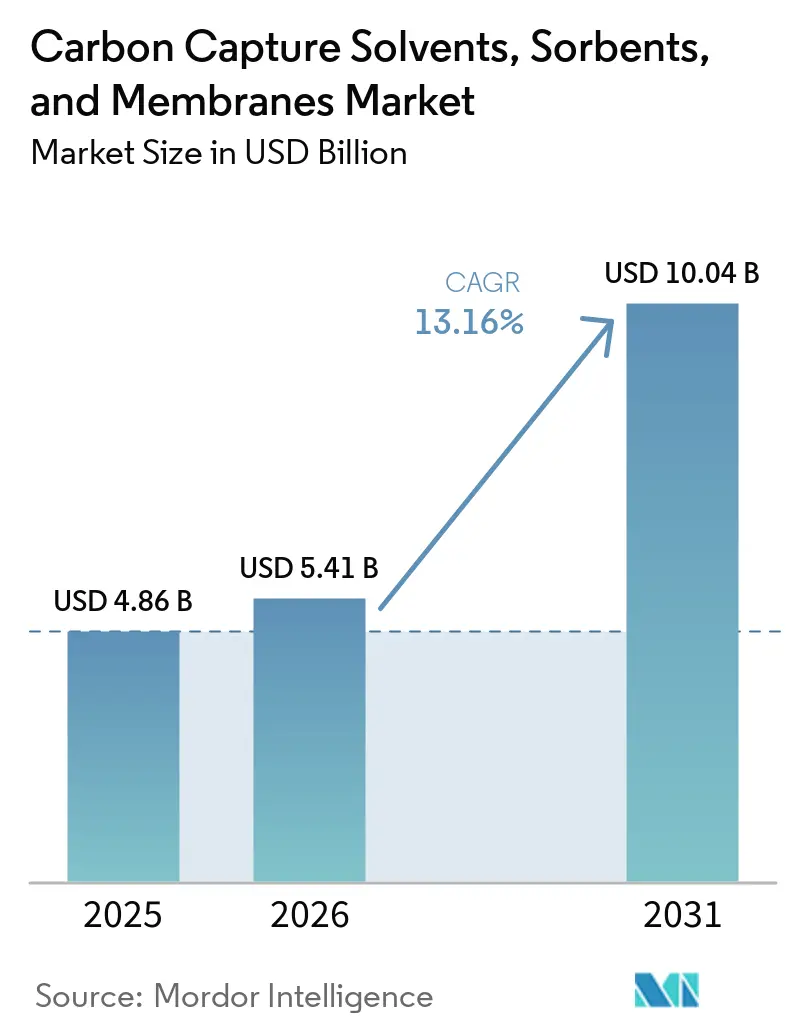
Carbon Capture Solvents, Sorbents, and Membranes Market Analysis by Mordor Intelligence
The Carbon Capture Solvents, Sorbents, And Membranes Market size is projected to expand from USD 0.92 billion in 2025 and USD 1.04 billion in 2026 to USD 1.93 billion by 2031, a CAGR of 13.16% between 2026 and 2031. Policy support, carbon pricing, and the project pipeline are shaping investment decisions for material capture across industrial facilities. Material selection depends on regeneration energy, site heat availability, and gas stream composition. Suppliers are offering lower-energy solvent formulations, structured sorbents, and membrane systems that integrate with existing assets. Therefore, the carbon capture solvents, sorbents, and membranes market places emphasis on providers that combine material supply with process performance and repeatable project delivery. Project pipelines through 2030 support this requirement, as purchasers need dependable materials, validated integration, and clear operating performance across long-lived industrial assets.
Key Report Takeaways
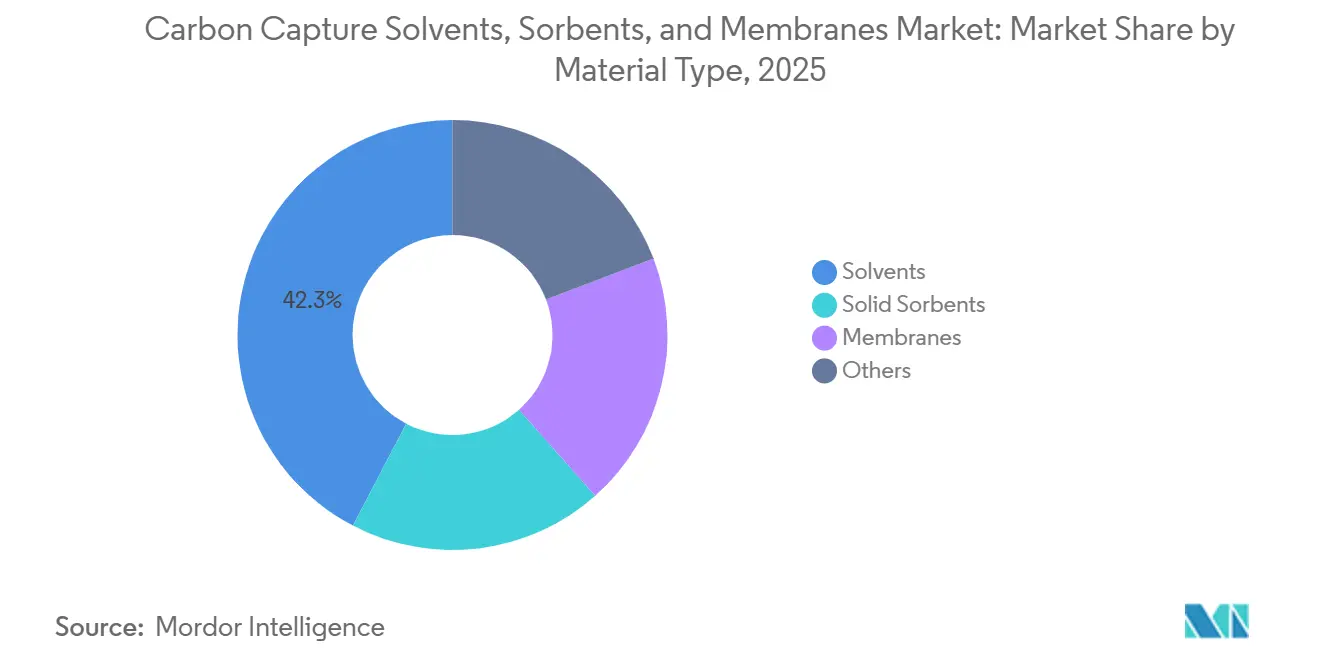
- By material type, solvents held 42.34% of the Carbon capture solvents, sorbents, and membranes market share in 2025, while solid sorbents are forecast to grow at a 15.34% CAGR through 2031.
- By solvent type, amine-based solvents held 70.21% share in 2025, while ionic liquids are forecast to grow at a 14.23% CAGR through 2031.
- By sorbent type, activated carbon held 33.45% share in 2025, while metal-organic frameworks are forecast to grow at a 17.06% CAGR through 2031.
- By membrane type, polymeric membranes held 62.17% share in 2025, while mixed-matrix membranes are forecast to grow at a 13.98% CAGR through 2031.
- By capture route, post-combustion capture held 54.09% share in 2025, while direct air capture is forecast to grow at a 17.67% CAGR through 2031.
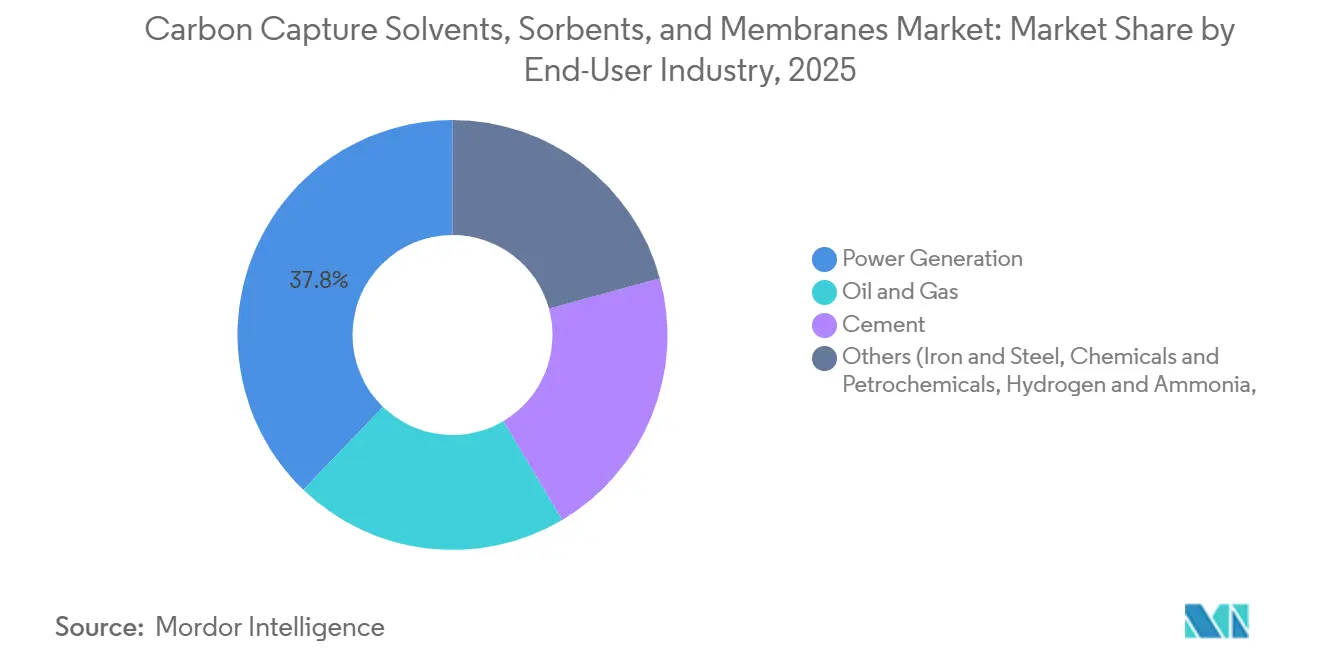
- By end-user industry, power generation held 37.78% share in 2025, while cement is forecast to grow at a 16.37% CAGR through 2031.
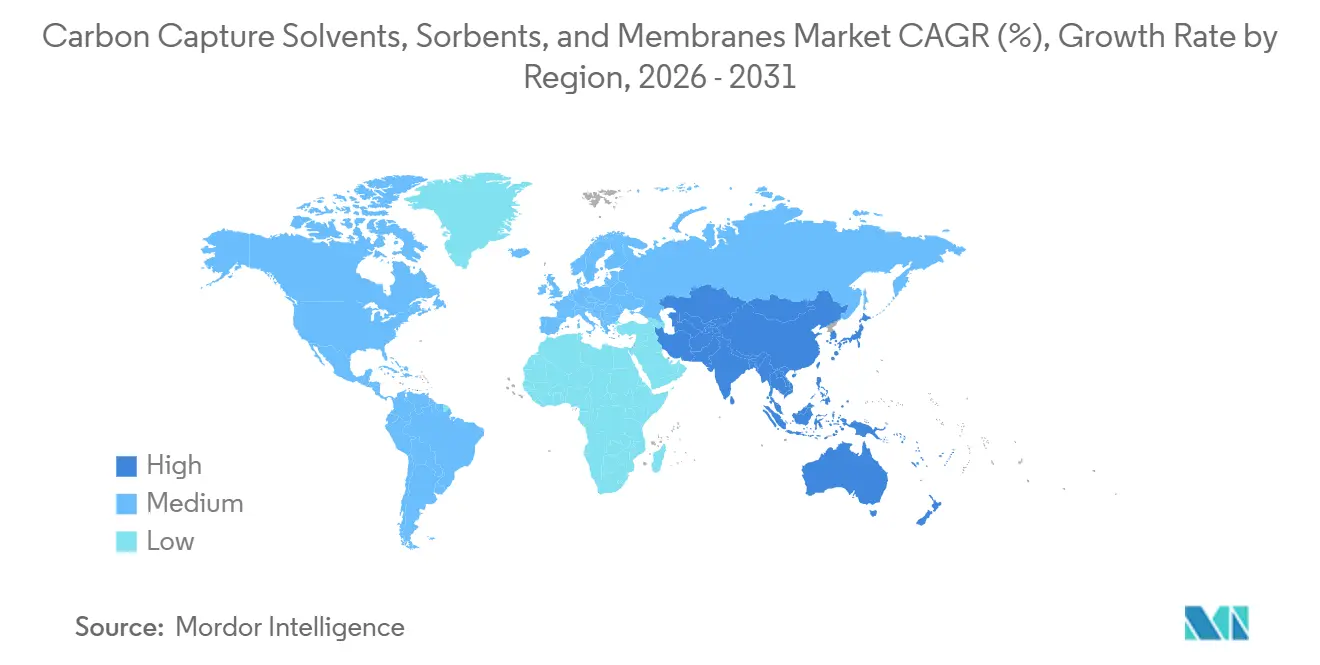
- By geography, North America held 36.34% share in 2025, while Asia-Pacific is forecast to grow at a 14.94% CAGR through 2031 in the Carbon capture solvents, sorbents, and membranes market.
Note: Market size and forecast figures in this report are generated using Mordor Intelligence’s proprietary estimation framework, updated with the latest available data and insights as of January 2026.
Market Trends and Insights
Drivers Impact Analysis of Carbon Capture Solvents, Sorbents, and Membranes Market*
| Drivers | (~) % Impact on CAGR Forecast | Geographic Relevance | Impact Timeline |
|---|---|---|---|
| Industrial Decarbonization Mandates and Carbon Pricing | +3.5% | Global, with concentrated near-term effect in North America and Europe | Short term (≤ 2 years) |
| Expansion of Carbon Capture Project Pipelines | +2.8% | Global, led by North America, Europe, and the Asia-Pacific industrial clusters | Medium term (2-4 years) |
| Demand for Lower-Regeneration-Energy Materials | +2.4% | Global, with the highest urgency in power-generation-heavy North America and Europe | Medium term (2-4 years) |
| Carbon Utilization and Permanent Removal Economics | +1.9% | North America and Europe, with emerging activity in the Middle East through enhanced oil recovery | Medium term (2-4 years) |
| Retrofit Demand from Cement, Steel, and Refining Assets | +2.2% | Europe, China, India, and the North American industrial belts | Medium term (2-4 years) |
| Waste-Heat and Low-Carbon-Hydrogen Integration | +1.6% | Europe and Japan, with spillover to Asia-Pacific industrial hubs | Long term (≥ 4 years) |
| Source: Mordor Intelligence | |||
Industrial Decarbonization Mandates and Carbon Pricing
Carbon pricing is making capture materials a direct procurement decision for heavy emitters. The planned withdrawal of free allowances for steel, cement, and aluminum through 2034 will increase cost exposure for facilities that do not reduce emissions. The US 45Q framework preserves a credit of USD 85 per metric ton for industrial point-source capture and USD 180 per metric ton for direct air capture. It also aligns the treatment of carbon dioxide sequestration and enhanced oil recovery, expanding the range of viable projects for solvent suppliers. These changes support demand in the carbon capture solvents, sorbents, and membranes market, where compliance costs and investment decisions are becoming increasingly connected.
Expansion of Carbon Capture Project Pipelines
More than 42 capture projects began operations in 2025, increasing global annual carbon capture and storage capacity by 25% and supporting the carbon capture solvents, sorbents, and membranes market. More than 650 announced projects target operations between 2026 and 2030, creating a multiyear procurement pipeline for capture equipment and materials. The global project count remains below the capacity required under the International Energy Agency's net-zero pathway, leaving unmet deployment needs. Northern Lights Phase 2 reached a final investment decision in March 2025 and aims to expand offshore Norwegian storage capacity to 5 Mt per year by 2028. This type of transport and storage project gives industrial facilities a clearer route for handling captured carbon dioxide. The carbon capture solvents, sorbents, and membranes market benefits because project developers must select materials early in process design and often contract supply before facilities enter service.
Demand for Lower-Regeneration-Energy Materials
Energy use remains a key factor in the adoption of capture materials across the carbon capture solvents, sorbents, and membranes market. Standard monoethanolamine systems require regeneration duties of 3.2 to 4.2 GJ per ton of CO₂, which can reduce host power plant output by 20% to 30%. Advanced solvent packages aim to lower this burden without compromising removal performance. CO₂ Enhanced Separation and Recovery (CESAR1) blends have reported specific reboiler duties of 3.0-3.5 MJ per kg of CO₂ at 90% capture rates, while a US Department of Energy-supported Sustanol test reported 2.16 GJ per ton. Developers are also exploring catalytic regeneration to lower desorption activation energy and accelerate carbon dioxide stripping. In the carbon capture solvents, sorbents, and membranes market, this trend increases the value of systems that reduce total energy demand rather than materials that only offer high absorption capacity.
Retrofit Demand from Cement, Steel, and Refining Assets
Cement production accounts for 8% of global carbon dioxide emissions, and calcination reactions generate 60% of those emissions. Changing energy inputs alone cannot eliminate these process emissions, making capture necessary at many cement plants. Air Liquide began a dedicated industrial-scale cement capture pilot at Holcim's CaptureLab in France in June 2026. The unit processes 3,000 Nm³ of flue gas per hour using Cryocap technology, which combines adsorption and cryogenic separation[1]. Steel assets have a more limited retrofit window in developed markets because hydrogen-based direct reduction could become less costly before 2035. Refining, cement, and selected steel facilities still provide an important near-term base for the carbon capture solvents, sorbents, and membranes market.
Restraints Impact Analysis of Carbon Capture Solvents, Sorbents, and Membranes Market*
| Restraints | (~) % Impact on CAGR Forecast | Geographic Relevance | Impact Timeline |
|---|---|---|---|
| Solvent Regeneration Energy Penalty | -1.8% | Global, with acute pressure in power-generation-heavy North America and Asia | Short term (≤ 2 years) |
| High First-of-a-Kind Installation Costs | -1.5% | Global, with the greatest pressure in South America, the Middle East, and Africa, and emerging Asian markets | Medium term (2-4 years) |
| Limited Carbon Transport and Storage Infrastructure | -0.7% | South America, the Middle East and Africa, and the rest of Asia-Pacific | Long term (≥ 4 years) |
| Material Degradation, Fouling, and Contaminant Sensitivity | -0.6% | Global, with the greatest exposure to coal-fired industrial facilities in the Asia-Pacific and South America | Medium term (2-4 years) |
| Source: Mordor Intelligence | |||
Solvent Regeneration Energy Penalty
The energy requirement for thermal solvent regeneration remains a project consideration in the carbon capture solvents, sorbents, and membranes market. Many industrial sites lack sufficient low-grade heat in the 100°C to 140°C range required for thermal stripping. At typical monoethanolamine concentrations, the energy requirement can reduce host power plant output by 20% to 30%. A 2025 study reported a membraneless, electrochemically mediated amine regeneration system that achieved carbon dioxide removal above 90% with energy consumption as low as 60 kJ per mol of CO₂. Heat-pump integration offers another partial solution. A demonstration at Amager Bakke reported that heat-pump integration covered 78.3% of the heat demand for capture. Until these options become broadly commercial, adoption in the carbon capture solvents, sorbents, and membranes market may remain slower at sites with limited heat-integration options.
High First-of-a-Kind Installation Costs
First-of-a-kind projects in the carbon capture solvents, sorbents, and membranes market favor large emitters that can manage engineering and financing uncertainty. This leaves many smaller industrial sites without an economic route to capture deployment. U.S. Department of Energy materials cite incumbent amine capture systems at USD 60-65 per metric ton, while a metal-organic framework sorbent system indicates a pathway toward USD 30 per ton[2]. Full-scale first-of-a-kind projects can add USD 20 to USD 40 per ton due to engineering contingencies, procurement premiums, and financing costs. Shell and Technip Energies entered an exclusive global CANSOLV alliance in 2025 to pursue repeatable delivery and lower project costs. Standardized and modular facilities will be important for the carbon capture solvents, sorbents, and membranes market to reach both smaller emitters and large industrial clusters.
*Our forecasts treat driver/restraint impacts as directional, not additive. The impact forecasts reflect baseline growth, mix effects, and variable interactions.
Carbon Capture Solvents, Sorbents, and Membranes Market Segment Analysis
By Material Type:
Solvents Lead Current Deployments While Sorbents Gain ScaleSolvents held 42.34% of the carbon capture solvents, sorbents, and membranes market size in 2025. Their position reflects extensive operating experience with liquid amine absorption across power generation and oil and gas processing. Established supply chains and well-understood maintenance practices reduce execution risk for developers. Solid sorbents are projected to expand at a CAGR of 15.34% through 2031, the highest growth rate among material types. Svante opened a USD 150 million solid-sorbent filter factory in British Columbia in May 2025, with capacity intended to support up to 10 Mt of carbon dioxide capture per year. The facility indicates that structured sorbent production has moved beyond pilot-scale supply. Larger output can also improve purchasing predictability for developers who require filter replacements over long operating periods. It gives project sponsors more certainty that advanced sorbents can be sourced in quantities suitable for large industrial facilities.
Solvents remain effective for low carbon dioxide concentrations, particularly below 5% in natural gas power plant exhaust. Sorbents and membranes compete more strongly where gas streams contain 12% to 15% carbon dioxide, including cement, steel, and ethanol applications. This difference shows that the material categories are not directly interchangeable. New hard-to-abate projects favor materials that match higher-concentration industrial streams and site-specific heat conditions. Membranes and other materials account for the remaining position within the carbon capture solvents, sorbents, and membranes industry. Their use is increasing as smaller, modular applications move toward the 10,000-ton-per-year range. Supplier strategies, therefore, center on the chemical profile of the gas stream and the operating conditions at each site. A site with constrained steam supply may prioritize sorbents or membranes even where liquid solvents are familiar. Conversely, existing amine-based infrastructure can make solvent upgrades more practical than a complete technology change.

By Solvent Type:
Amine Systems Retain the Installed Base as Ionic Liquids AdvanceAmine-based solvents held 70.21% of the solvent type segment in 2025. This share reflects their commercial maturity and the installed absorber and stripper base designed around their operating characteristics. Amine systems also benefit from well-developed maintenance practices and recognized regulatory pathways. CESAR1, a blend of 3 M 2-amino-2-methyl-1-propanol (AMP) and 1.5 M piperazine, reported reboiler duties of 3.0 to 3.5 MJ per kg of CO₂, compared with 3.5 to 4.2 MJ per kg for conventional monoethanolamine systems. Physical solvents serve high-pressure pre-combustion and natural gas streams, where thermal regeneration requirements are lower. Their role is focused because they fit a defined set of feed conditions. This distinction matters because suppliers cannot assume that lower regeneration duty will outweigh operating familiarity at every facility. Developers typically compare total integration costs, solvent handling requirements, and the expected life of the host asset.
Ionic liquids are forecast to grow at a CAGR of 14.23% through 2031. Their negligible vapor pressure, thermal stability, and adjustable affinity for carbon dioxide make them relevant for lower-energy capture designs. A 2025 peer-reviewed study found that water-lean ionic liquid absorbents reduced regeneration energy by 20% to 50% against the monoethanolamine baseline. High viscosity still affects mass transfer and pumping efficiency at larger scales. Encapsulation and supported ionic-liquid membrane designs aim to address this limitation. Carbonate-alkaline and deep eutectic solvents are also being considered for higher-temperature streams where conventional amines can degrade. Their importance lies in giving operators alternatives when flue gas contaminants or temperature profiles shorten conventional solvent life. The selection process remains site-specific because a favorable laboratory property does not eliminate the need for pumping, corrosion control, or maintenance.
By Sorbent Type:
Activated Carbon Maintains Its Base While Metal-Organic Frameworks GrowActivated carbon held 33.45% of the sorbent type segment in 2025. Its low cost, mature manufacturing base, and tolerance for contaminated flue gas support ongoing use at coal and biomass facilities. Zeolites offer carbon dioxide selectivity at low temperatures, but moisture can limit their stability in industrial settings. These operating constraints have increased interest in metal-organic frameworks for humid flue gas applications. Metal-organic frameworks are projected to grow at a CAGR of 17.06% through 2031. The 2025 Nobel Prize in Chemistry recognized the discovery and development of metal-organic frameworks, supporting broader confidence in this material class.
The main hurdle for metal-organic frameworks has been cost-effective manufacturing at a commercial scale. BASF’s production of CALF-20 and Decarbontek’s commercial launch of DCF-1 in July 2025 point to a broader effort to improve the supply base. The U.K. government also confirmed funding for the development of monolithic metal-organic frameworks at Immaterial’s Sawston facility in May 2026. Structured formats can make the materials more suitable for industrial pressure-swing adsorption cycles. Activated carbon will continue to serve applications that value low cost and tolerance to contaminants. Metal-organic frameworks have growth potential when high selectivity and controlled operating conditions warrant more advanced materials. This combination keeps the carbon capture solvents, sorbents, and membranes market open to both established and newer sorbent types. Buyers that require proven tolerance for contaminants may remain with activated carbon even as higher-performance frameworks develop. Projects with tighter removal requirements may accept more specialized materials if they reduce equipment size or operating energy.
By Membrane Type:
Polymeric Membranes Hold the Base as Mixed-Matrix Designs Improve PerformancePolymeric membranes accounted for 62.17% of the membrane type segment in 2025. Established hollow-fiber manufacturing supports their use in natural gas processing, biogas upgrading, and early post-combustion projects. Low fabrication costs and flexible module design make them useful in smaller applications. Ceramic membranes also serve high-temperature separations where solvent degradation poses a concern. However, their cost limits their use in many projects. Mixed-matrix membranes are forecast to grow at a CAGR of 13.98% through 2031, making them the highest-growth membrane type.
Mixed-matrix membranes combine polymer matrices with metal-organic framework, zeolite, or silica fillers. This structure can improve carbon dioxide and nitrogen selectivity as well as permeability. A 2026 study evaluated more than 104,000 combinations of metal-organic frameworks and polymers to identify improved carbon dioxide separation designs. Uniform filler distribution and stable adhesion at the polymer-filler interface remain manufacturing challenges. Developers are advancing surface-functionalization methods to improve compatibility between the filler and the polymer backbone. As larger post-combustion membrane projects began operation in 2026, field data gained greater weight in material selection. This trend supports a gradual shift within the carbon capture solvents, sorbents, and membranes market toward membranes that balance separation performance with practical manufacturing control. Module makers also need to demonstrate stable output under pressure cycling and changing feed conditions. These requirements can slow the adoption of new filler combinations until operators validate them in commercial operating environments.
By Capture Route:
Post-Combustion Capture Has the Largest Base While Direct Air Capture Grows FastestPost-combustion capture held 54.09% of the capture route segment in 2025. Existing fossil-fuel plants, oil and gas sites, and industrial combustion sources support this position. Operators can add the route to existing flue gas treatment trains, making it suitable for retrofit projects. More than 650 announced facilities are targeting operation by 2030, sustaining demand for post-combustion equipment and materials. A 2026 study reported 85% carbon dioxide capture efficiency for post-combustion monoethanolamine systems across cement, steel, and power configurations. Process-specific energy requirements make tailored material selection important.
Direct air capture is forecast to grow at a CAGR of 17.67% through 2031. The route operates on much lower carbon dioxide concentrations than industrial point sources, increasing the importance of material performance and energy use. It attracts investment where removal credits and corporate offtake can support capture costs. Pre-combustion capture is used in blue hydrogen and gasification settings, while oxy-fuel combustion is used in selected industrial processes. Industrial process capture is also becoming increasingly relevant for emissions from calcination and fermentation. The carbon capture solvents, sorbents, and membranes market serves these routes with different combinations of solvents, solid sorbents, and membranes. Growth in direct air capture expands the addressable role for highly selective sorbents and purpose-designed contactor systems. However, direct air capture materials must maintain performance despite dilute feed gas and repeated regeneration cycles. This makes durability and energy demand as important as initial capture capacity in supplier evaluations.
By End-User Industry:
Power Generation Supplies the Largest Base While Cement Expands QuicklyPower generation accounted for 37.78% of the market share for carbon capture solvents, sorbents, and membranes in 2025. The sector has an established installed base of coal- and gas-fired plants and a history of using amine scrubbing. This installed base supports steady demand for established solvent systems. However, renewable energy deployment can affect the economics of some planned power plant retrofits before developers build them. Oil and gas remains a key end-user industry for physical solvents and selective amine blends used in gas processing, acid gas removal, and blue hydrogen production. These applications often involve high carbon dioxide partial pressures and defined process requirements. They can support the use of physical solvents in applications where low-pressure post-combustion systems may not. This maintains demand across several material classes rather than concentrating it around a single capture approach.
Cement is forecast to grow at a CAGR of 16.37% through 2031. The industry’s process emissions make it difficult to replace capture materials with energy changes alone. Air Liquide's Cryocap application and Holcim's CaptureLab show that cement producers are testing several capture pathways, including adsorption and cryogenic separation. Iron and steel, chemicals, hydrogen, ammonia, and waste-to-energy form the remaining end-user group. A TRL7 calcium-copper pilot at ArcelorMittal's Asturias plant demonstrated 95% carbon dioxide capture from blast furnace gas. The carbon capture solvents, sorbents, and membranes industry will require different material packages for these end-user industries because gas composition, heat availability, and operating schedules vary significantly. Cement operators need solutions that manage process emissions, while power producers often focus on energy penalties and load flexibility. These differences create separate qualification processes and make cross-industry experience valuable for suppliers.
Geography Analysis
North America Carbon Capture Solvents, Sorbents, and Membranes Market
North America accounted for 36.34% of the carbon capture solvents, sorbents, and membranes market in 2025. The region combines a large base of industrial emitters with a developed policy framework for carbon capture. The US 45Q framework supports projects for industrial point sources and direct air capture. US capture capacity was projected to increase from 22 million tons per year in 2024 to 176 million tons per year by 2030. Svante's British Columbia factory also strengthens the regional supply of solid sorbents. Canada supports growth through carbon credit structures and Alberta sequestration hubs. Mexico presents an emerging opportunity in refining and petrochemicals. The scale of the regional opportunity depends on access to storage, permitting progress, and individual sites' ability to secure tax-credit eligibility. These factors make North America a major demand center, although project-level differences in material selection are expected to remain.
APAC Carbon Capture Solvents, Sorbents, and Membranes Market
Asia-Pacific is forecast to grow at a CAGR of 14.94% through 2031. Japan plans to expand carbon capture, utilization, and storage capacity from 0.3 million tons per year to nearly 12.5 million tons per year by 2035, with many projects relying on cross-border storage arrangements. China is a major contributor to carbon capture research and is moving toward procurement-scale projects through amine capture and oxy-combustion facilities. India, South Korea, and ASEAN countries are building policy foundations for future deployment. South Korea and Singapore have shown comparatively stronger policy readiness. The region's large industrial base supports a broad long-term opportunity for materials that align with local fuel and feedstock conditions. Cross-border storage plans may increase the need for consistent carbon dioxide specifications before transport and injection. This requirement increases the importance of capture systems that can deliver predictable purity and high removal rates.
EMEA and South America Carbon Capture Solvents, Sorbents, and Membranes Market
Europe's carbon price signals and storage infrastructure continue to support demand for capture materials. EU Emissions Trading System prices averaged EUR 73.43 per ton CO₂ in 2025, while verified emissions declined by 1.3% year over year. The European Commission identified solvents, compressors, and column vessels as supply chain gaps for achieving the 50 million tons per year storage target by 2030. The Netherlands, Norway, and the United Kingdom provide key cluster and storage projects. South America, the Middle East, and Africa remain smaller markets with distinct opportunities. Brazil and Argentina offer high-concentration ethanol and biofuel sources, while the Middle East has oil and gas-linked capture projects. These geographies require further expansion of transport and storage infrastructure before demand can scale. Their projects may prioritize high-concentration sources first, as these sources generally offer more manageable capture economics. Material providers that support early ethanol, biofuel, oil, and gas applications may establish a market position before larger infrastructure networks are completed.
Competitive Landscape
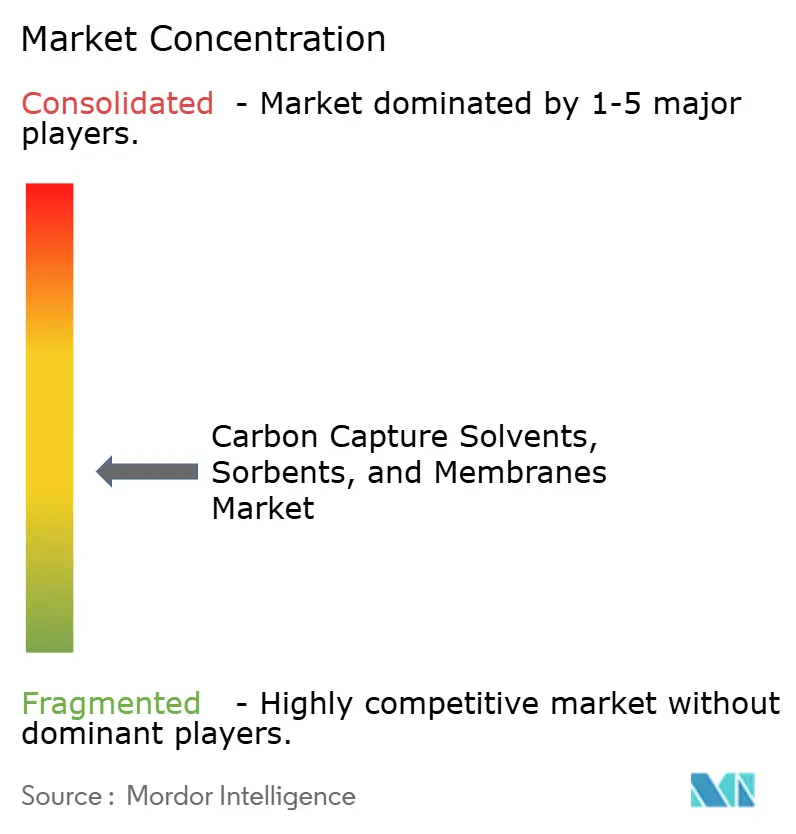
The carbon capture solvents, sorbents, and membranes market is moderately fragmented. Air Liquide, Linde, BASF, Air Products, and Dow hold established positions in solvents and conventional sorbents. Their scale supports engineering access, supply networks, and customer relationships. BASF is the exclusive commercial-scale manufacturer of CALF-20 for Svante's solid-sorbent operations. Shell formalized its exclusive global alliance with Technip Energies to deliver CANSOLV in 2025.
Competition in the carbon capture solvents, sorbents, and membranes market increasingly depends on system performance rather than material supply alone. Svante and Climeworks offer integrated contactor or filter systems, which give them control over operating specifications and material replacement cycles. Membrane Technology and Research holds a specialist position in polymeric membrane module design and Polaris membrane materials for natural gas processing. Linde worked with Valmet in 2026 on electrically driven carbon dioxide capture for pulp and paper applications using HISORP adsorption technology. This approach uses electricity rather than steam and addresses the heat constraint that affects many solvent systems. Procurement requirements under EPA Subpart RR and the EU Net-Zero Industry Act also favor suppliers that can demonstrate verified performance.
Smaller modular point-source projects remain a developing competitive area within the carbon capture solvents, sorbents, and membranes market. These projects can suit emitters that fall below the size threshold for large first-of-a-kind facilities. Such customers need compact systems, reliable operations, and manageable upfront costs. The carbon capture solvents, sorbents, and membranes market creates opportunities for specialized providers where major engineering-led offerings may be too complex. At the same time, larger players can use alliances, licensing, and manufacturing scale to maintain their positions. Suppliers that reduce regeneration energy, manage material degradation, and demonstrate repeatable installations can compete for projects. Therefore, the competitive landscape is not fully consolidated, but established companies retain advantages in project execution and customer access. New entrants must demonstrate that their material improvements translate into lower energy use, longer service life, or simpler installation. Incumbents must show that their established delivery models can keep pace with demand for modular systems and specialized performance guarantees.
Carbon Capture Solvents, Sorbents, and Membranes Industry Leaders
-
BASF
-
MITSUBISHI HEAVY INDUSTRIES, LTD.
-
Honeywell International Inc
-
Dow
-
Svante Technologies Inc.
- *Disclaimer: Major Players sorted in no particular order
Carbon Capture Solvents, Sorbents, and Membranes Market Companies Covered in this Report
- Air Liquide
- Air Products and Chemicals, Inc.
- BASF
- Carbon Clean
- Climeworks
- Dow
- Exxon Mobil Corporation
- Fluor Corporation
- Honeywell International Inc
- Linde PLC
- Membrane Technology and Research, Inc. (MTR)
- MITSUBISHI HEAVY INDUSTRIES, LTD.
- Shell plc
- Siemens Energy
- Svante Technologies Inc.
- TORAY INDUSTRIES, INC.
- TOSHIBA CORPORATION
Recent Industry Developments in Carbon Capture Solvents, Sorbents, and Membranes Market
- June 2026: Air Liquide started up its first industrial-scale cement-sector CO₂ capture pilot at Holcim's CaptureLab in Martres-Tolosane, France. The pilot uses Cryocap FG technology, which combines adsorption and cryogenic separation. The unit processes 3,000 Nm³/h of flue gas and marks Air Liquide's first industrial-scale deployment of solvent-free capture technology in the cement segment.
- February 2026: CarbonQuest and Cielo Carbon Solutions announced the first integration of Captivate Technology's metal-organic framework adsorbents into a distributed carbon capture unit on a Tourmaline Oil natural gas compressor in Alberta. The project marks the first commercial integration of MOFs in Canadian oil and gas point-source capture.
Global Carbon Capture Solvents, Sorbents, and Membranes Market Report Scope
Carbon capture solvents, sorbents, and membranes are chemical and physical media used to separate and capture carbon dioxide emissions from industrial exhaust and air. They support emissions management through liquid absorption, binding to solid surfaces, or selective physical-barrier filtration.
The carbon capture solvents, sorbents, and membranes market is segmented by material type, solvent type, sorbent type, membrane type, capture route, end-user industry, and geography. By material type, the market is segmented into solvents, solid sorbents, membranes, and others. By solvent type, the market is segmented into amine-based solvents, physical solvents, ionic liquids, and others (carbonate and alkaline solvents, deep eutectic solvents). By sorbent type, the market is segmented into activated carbon, zeolites, metal-organic frameworks (MOFs), and others (amine-functionalized silica, metal oxides, activated alumina). By membrane type, the market is segmented into polymeric membranes, mixed-matrix membranes, ceramic membranes, and others (facilitated-transport membranes, hollow-fiber membranes). By capture route, the market is segmented into post-combustion capture, pre-combustion capture, direct air capture, and others (oxy-fuel combustion, industrial process capture). By end-user industry, the market is segmented into power generation, oil and gas, cement, and others (iron and steel, chemicals and petrochemicals, hydrogen and ammonia, waste-to-energy). The report also covers market size and forecasts for carbon capture solvents, sorbents, and membranes across 15 countries in major regions. The market sizes and forecasts are provided in terms of value (USD).
Segmentation Overview
| Solvents |
| Solid Sorbents |
| Membranes |
| Others |
| Amine-Based Solvents |
| Physical Solvents |
| Ionic Liquids |
| Others (Carbonate and Alkaline Solvents, Deep Eutectic Solvents) |
| Activated Carbon |
| Zeolites |
| Metal-Organic Frameworks (MOFs) |
| Others (Amine-Functionalized Silica, Metal Oxides, Activated Alumina) |
| Polymeric Membranes |
| Mixed-Matrix Membranes |
| Ceramic Membranes |
| Others (Facilitated-Transport Membranes, Hollow-Fiber Membranes) |
| Post-Combustion Capture |
| Pre-Combustion Capture |
| Direct Air Capture |
| Others (Oxy-Fuel Combustion, Industrial Process Capture) |
| Power Generation |
| Oil and Gas |
| Cement |
| Others (Iron and Steel, Chemicals and Petrochemicals, Hydrogen and Ammonia, Waste-to-Energy) |
| Asia-Pacific | China |
| India | |
| Japan | |
| South Korea | |
| ASEAN Countries | |
| Rest of Asia-Pacific | |
| North America | United States |
| Canada | |
| Mexico | |
| Europe | Germany |
| United Kingdom | |
| France | |
| Italy | |
| NORDIC Countries | |
| Rest of Europe | |
| South America | Brazil |
| Argentina | |
| Rest of South America | |
| Middle East and Africa | Saudi Arabia |
| South Africa | |
| Rest of Middle East and Africa |
| By Material Type | Solvents | |
| Solid Sorbents | ||
| Membranes | ||
| Others | ||
| By Solvent Type | Amine-Based Solvents | |
| Physical Solvents | ||
| Ionic Liquids | ||
| Others (Carbonate and Alkaline Solvents, Deep Eutectic Solvents) | ||
| By Sorbent Type | Activated Carbon | |
| Zeolites | ||
| Metal-Organic Frameworks (MOFs) | ||
| Others (Amine-Functionalized Silica, Metal Oxides, Activated Alumina) | ||
| By Membrane Type | Polymeric Membranes | |
| Mixed-Matrix Membranes | ||
| Ceramic Membranes | ||
| Others (Facilitated-Transport Membranes, Hollow-Fiber Membranes) | ||
| By Capture Route | Post-Combustion Capture | |
| Pre-Combustion Capture | ||
| Direct Air Capture | ||
| Others (Oxy-Fuel Combustion, Industrial Process Capture) | ||
| By End-User Industry | Power Generation | |
| Oil and Gas | ||
| Cement | ||
| Others (Iron and Steel, Chemicals and Petrochemicals, Hydrogen and Ammonia, Waste-to-Energy) | ||
| By Geography | Asia-Pacific | China |
| India | ||
| Japan | ||
| South Korea | ||
| ASEAN Countries | ||
| Rest of Asia-Pacific | ||
| North America | United States | |
| Canada | ||
| Mexico | ||
| Europe | Germany | |
| United Kingdom | ||
| France | ||
| Italy | ||
| NORDIC Countries | ||
| Rest of Europe | ||
| South America | Brazil | |
| Argentina | ||
| Rest of South America | ||
| Middle East and Africa | Saudi Arabia | |
| South Africa | ||
| Rest of Middle East and Africa | ||
Key Questions Answered in the Report
What is current market size of Carbon Capture Solvents, Sorbents, and Membranes Market?
The Carbon Capture Solvents, Sorbents, And Membranes Market size is projected to expand from USD 0.92 billion in 2025 and USD 1.04 billion in 2026 to USD 1.93 billion by 2031, a CAGR of 13.16% between 2026 and 2031.
Which material type leads to carbon capture applications?
Solvents led material types with 42.34% share in 2025 because liquid amine systems have the largest installed operating base.
Which capture material is growing fastest?
Solid sorbents are projected to expand at a 15.34% CAGR through 2031, supported by investment in structured filter and metal-organic framework production.
Why are low-energy capture materials important?
Monoethanolamine regeneration can require 3.2-4.2 GJ per tonne of CO₂, so lower-energy alternatives can improve project economics.